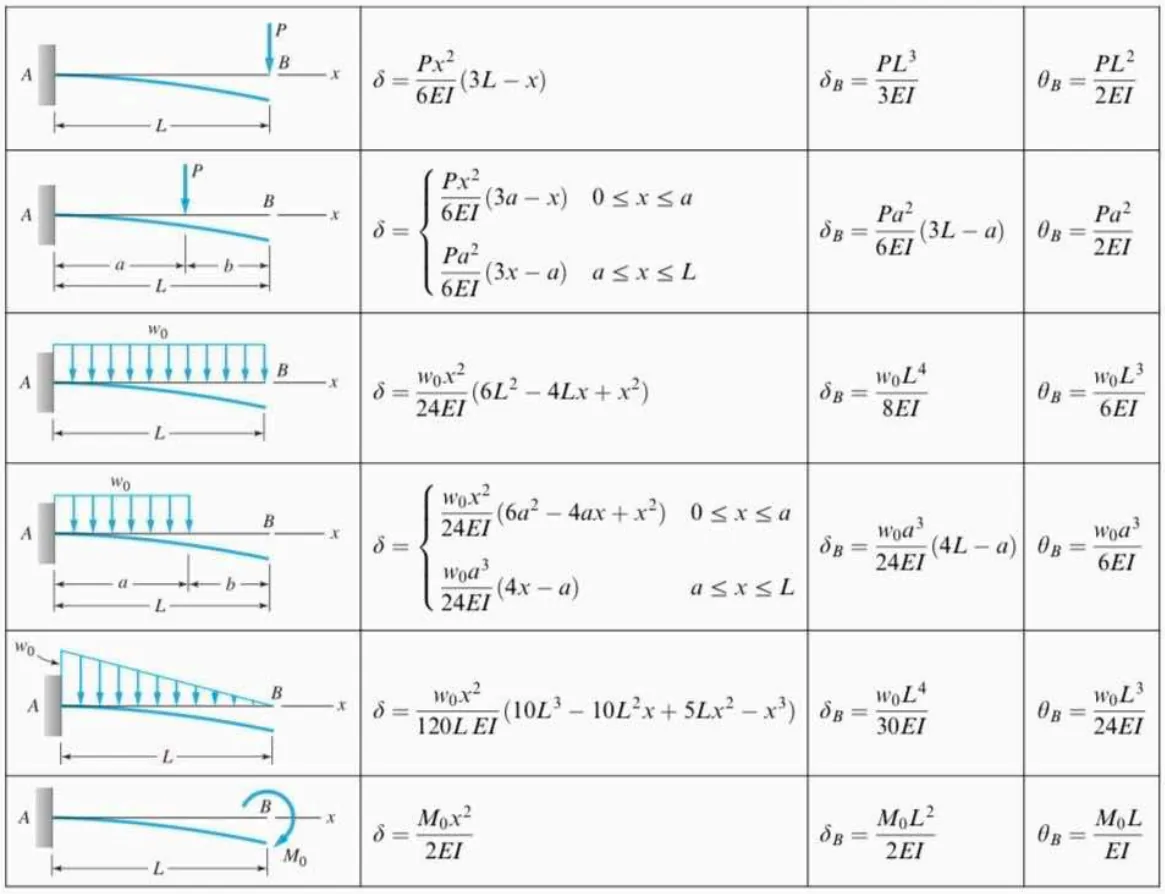
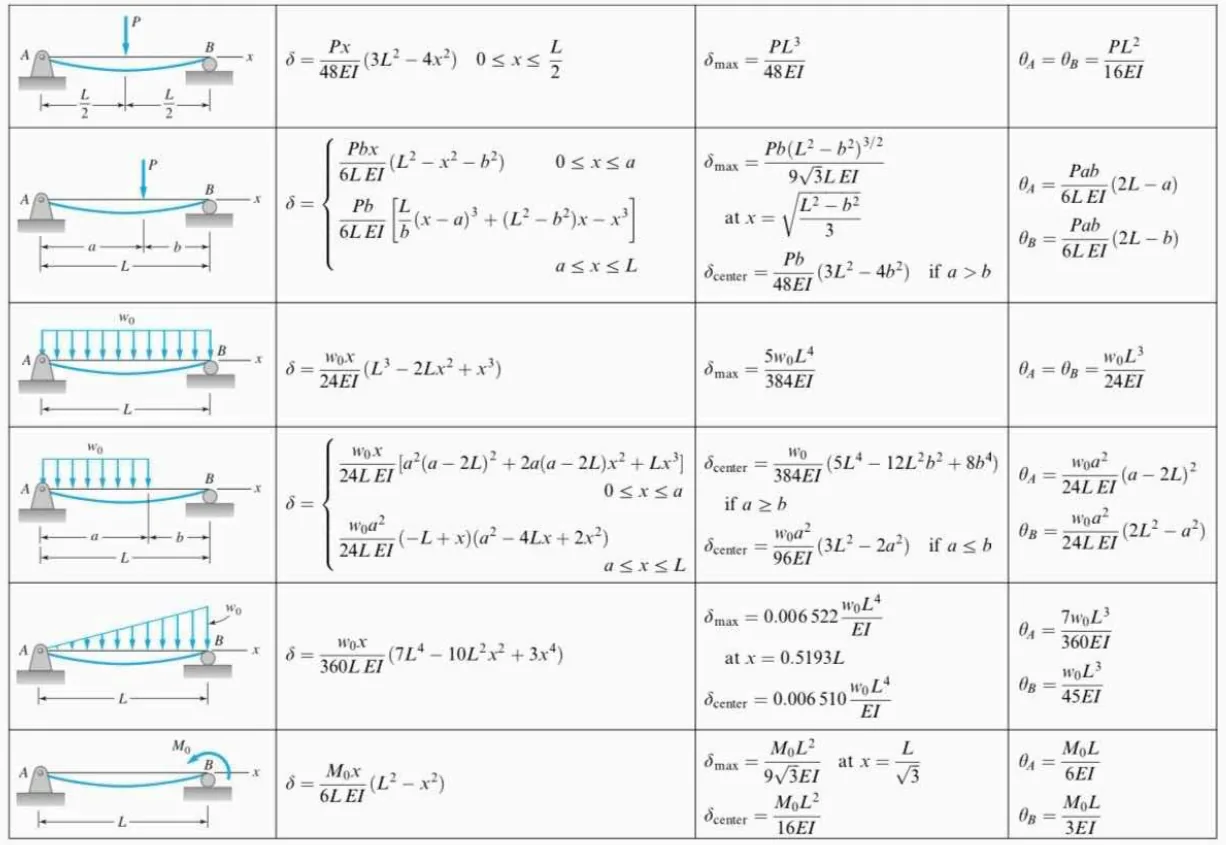
The Superposition Theorem states that the total moment or deflection in a linear structure under multiple loads can be found by summing the effects of individual loads applied separately. This is valid as long as the structure behaves elastically --> follows Hooke's Law. Below is a complete list of the formulas we can use for any beam, but we will later discuss how we only need to memorize at least five formulas in total if we combine the concept of integration in formulas with point loads.
Image excerpted from Pytel, F., & Kiusalaas, J. (2012). Engineering Mechanics: Statics and Dynamics 4th ed. Cengage Learning. Used under fair use for educational and illustrative purposes.
Problem: Cantilever Beam with Uniform Load and Concentrated Load at the Free End
A 4-m long cantilever beam carries a concentrated load of 50kN at the free end and a uniformly distributed load of 20kN/m throughout the entire span. The beam is made of steel where E=200GPa and I=200x106mm4
See images:
Problem: Cantilever Beam Resting on a Simply Supported Beam | Consistent Deformation with Superposition
Beam BD is fixed at D and is supported by girder AC at B with P=14kN applied at the free end.
L1=4m, L2=2m, L3=4m.
The Section Modulus of both members about the plane of bending is:
S=6.18x105mm3
See images:
Problem: Application of Formulas for Fixed-Ended Beam
Refer to the load diagrams shown:
a. If MA = -10 kN-m, L = 6 m, calculate P in kN based on Figure A. a. 7.5
b. 10
c. 5
d. 12.5
b. If MA = -40 kN-m, L = 10 m, calculate w in kN/m based on Figure B.
a. 6.78
b. 8.76
c. 8.67 d. 7.68
c. If MA = -60 kN-m, MB = -90 kN-m, L = 10 m, calculate w in kN/m based on Figure C.
a. 15 b. 18
c. 21
d. 24
See images:
Problem: Cantilever Beam with Uniform Load Resting on a Simply Supported Beam | Consistent Deformation
Refer to the figure shown. A cantilever beam rests on B of beam ABC. THe cantilever beam carries a uniform load W=24.6kN/m throughout its length. Prior to loading, the cantilever beam is only touching beam ABC at B. Both beams have identical cross-sectional properties. Given the following data:
L1=4m
L2=2m
E=30GPa
I=1333x106mm4