Unlike determinate beams, indeterminate beams have more unknown reactions than available static equilibrium equations.
This means that while we still use methods like the Double Integration Method, Moment-Area Theorems, or the Conjugate Beam Method to compute slopes and deflections,
additional compatibility conditions must be introduced to solve for the unknowns.
In statically indeterminate beams, deflections or rotations at certain points are known or constrained — and we use these as compatibility equations to solve the redundant forces.
For example, if a beam has an extra support, we assume a redundant force (e.g., a reaction) and compute the resulting deflection at that point using superposition or virtual work.
This deflection is then set equal to the required geometric constraint (usually zero), forming the compatibility equation.
The analysis then becomes a two-part process:
Assume a redundant and analyze the structure using standard deflection techniques.
Apply compatibility (e.g., total deflection at the redundant point must be zero) to solve for the redundant force.
Once the redundant force is known, you can fully determine internal forces, reactions, and deflected shapes using the usual methods.
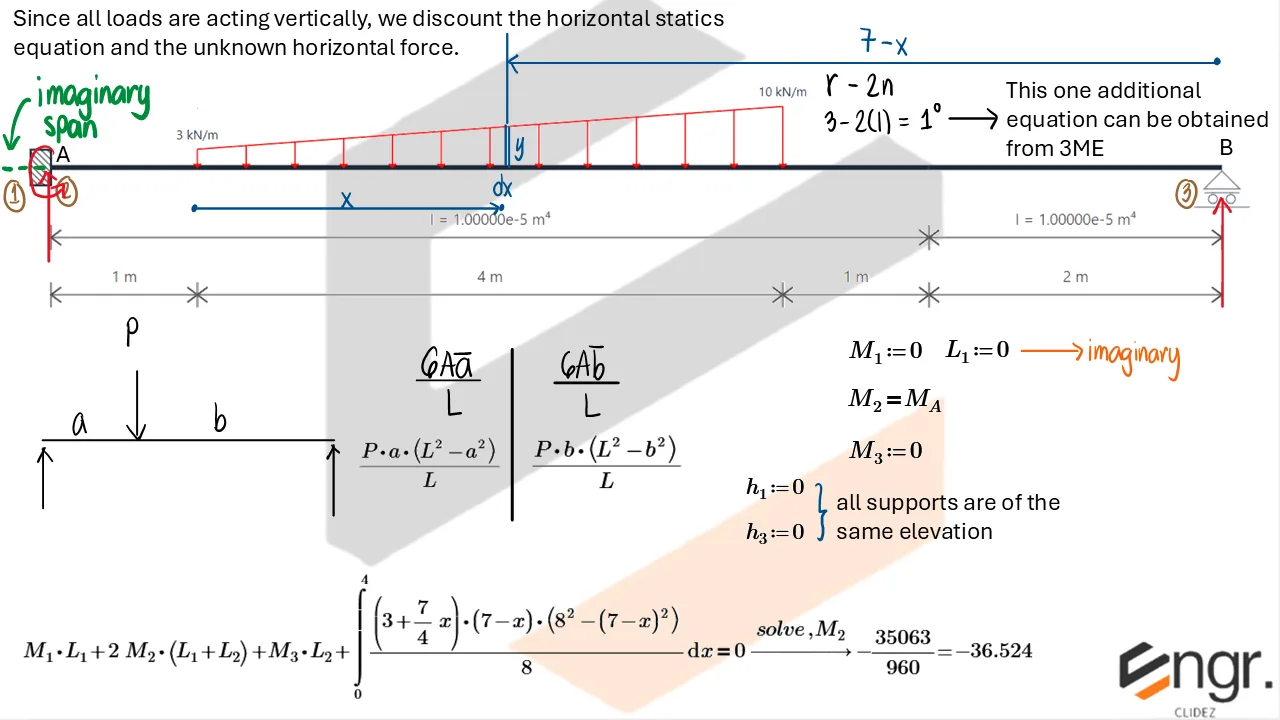
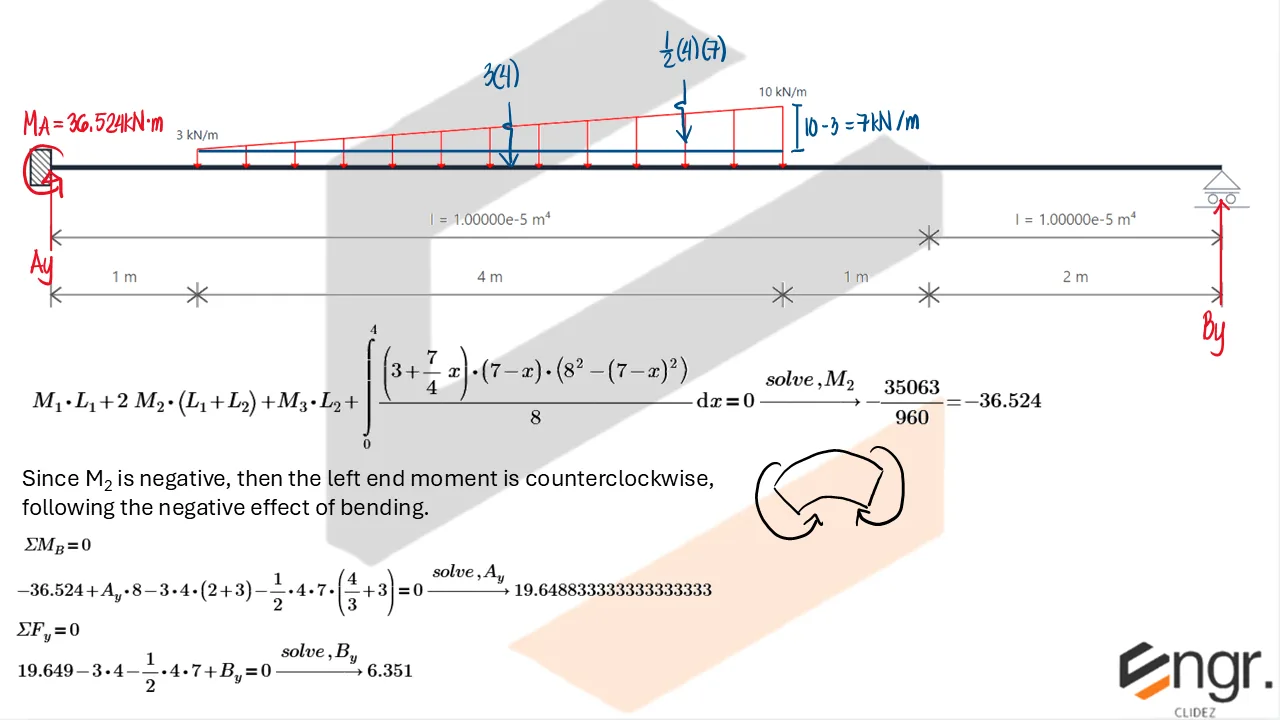
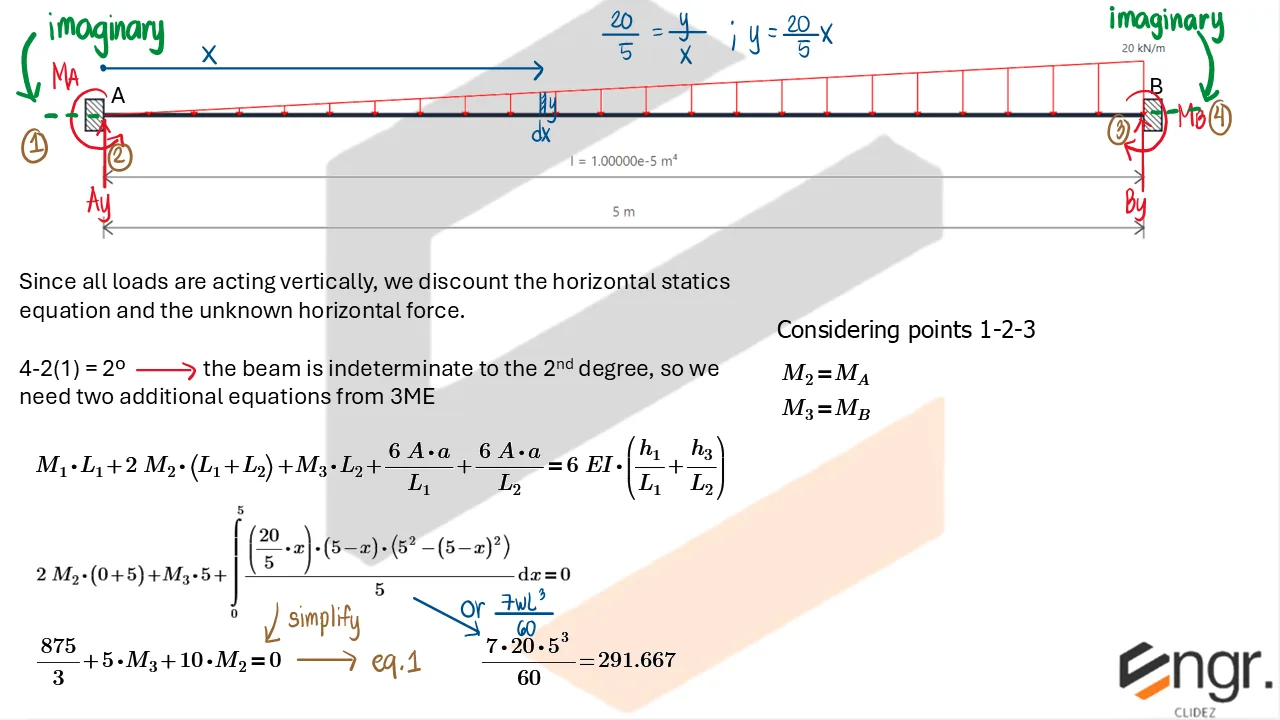
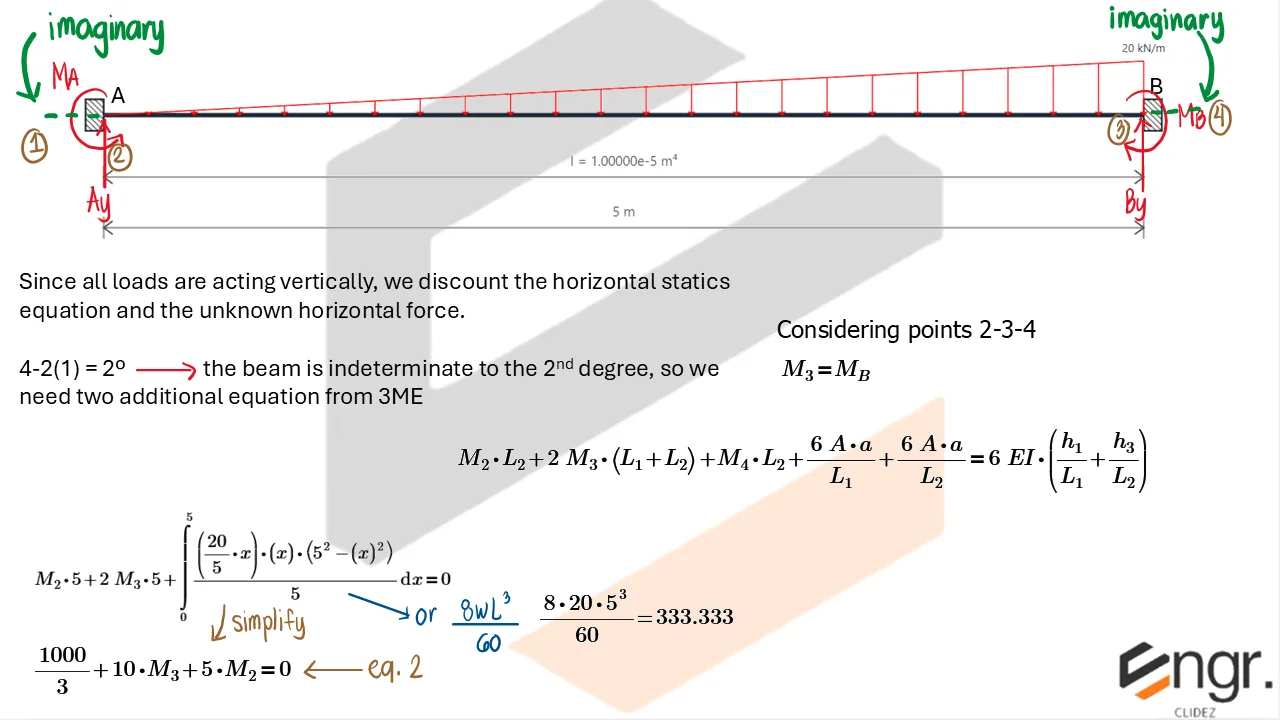
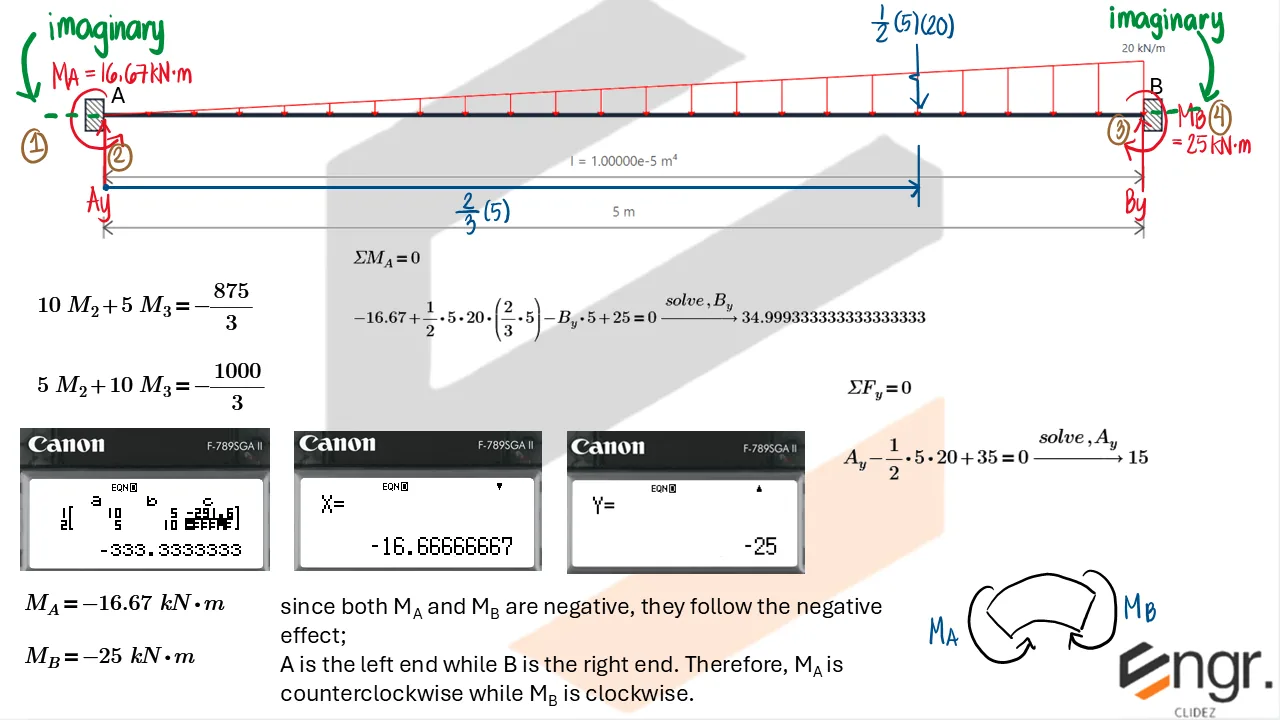
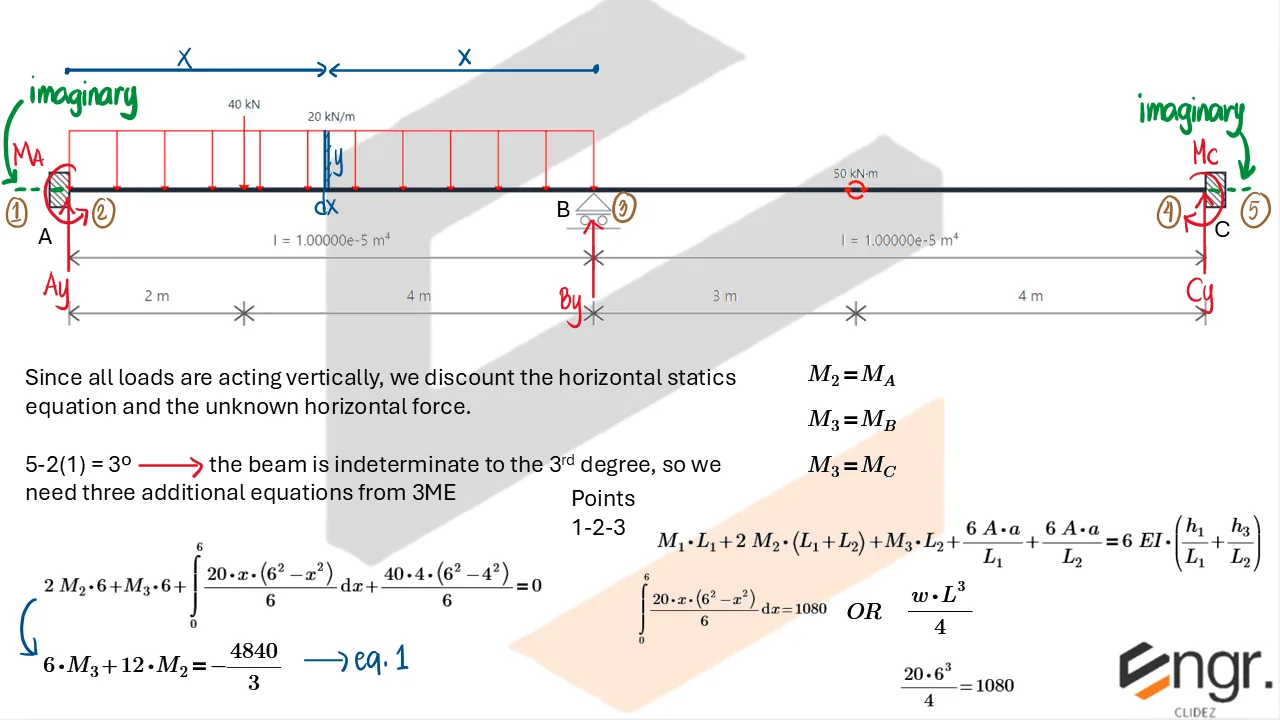
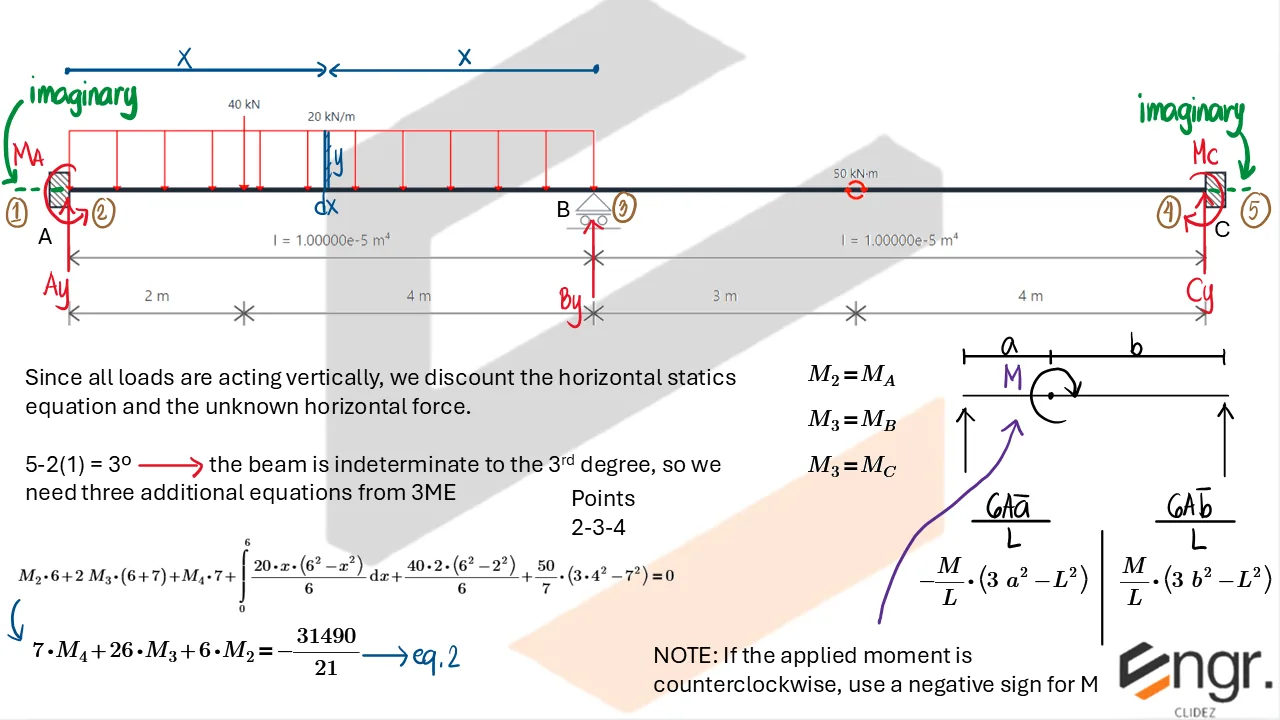
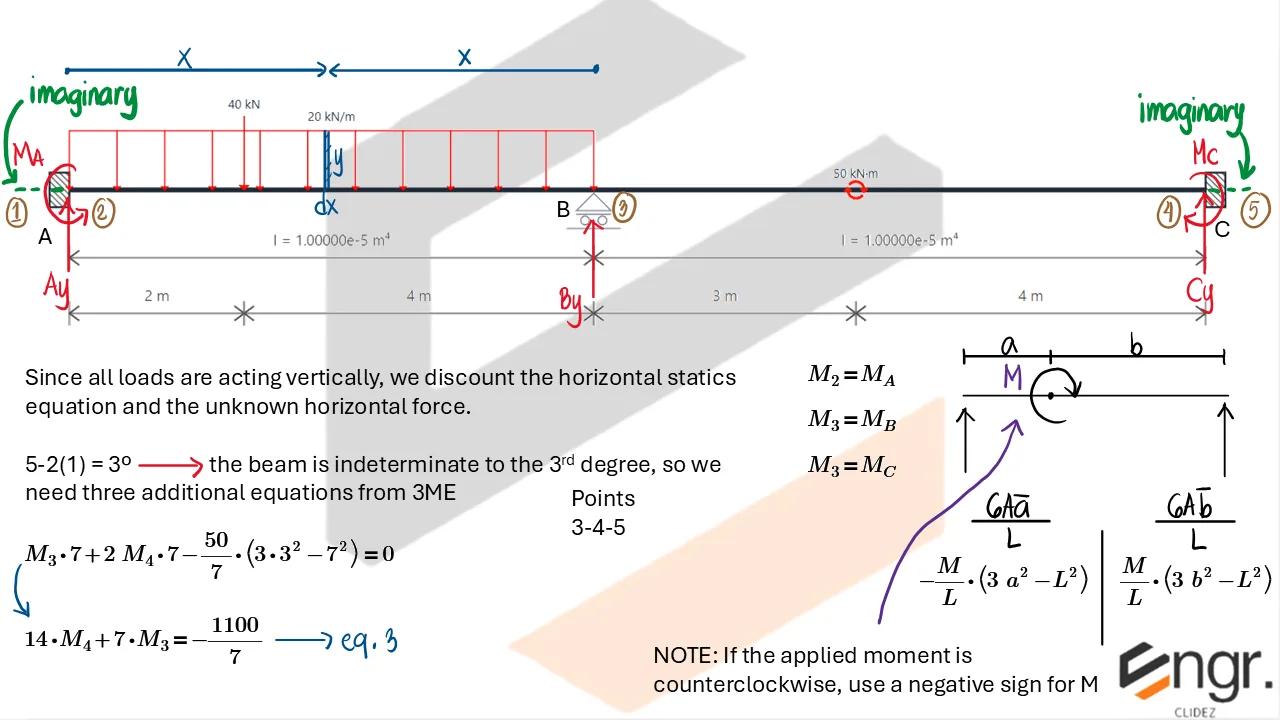
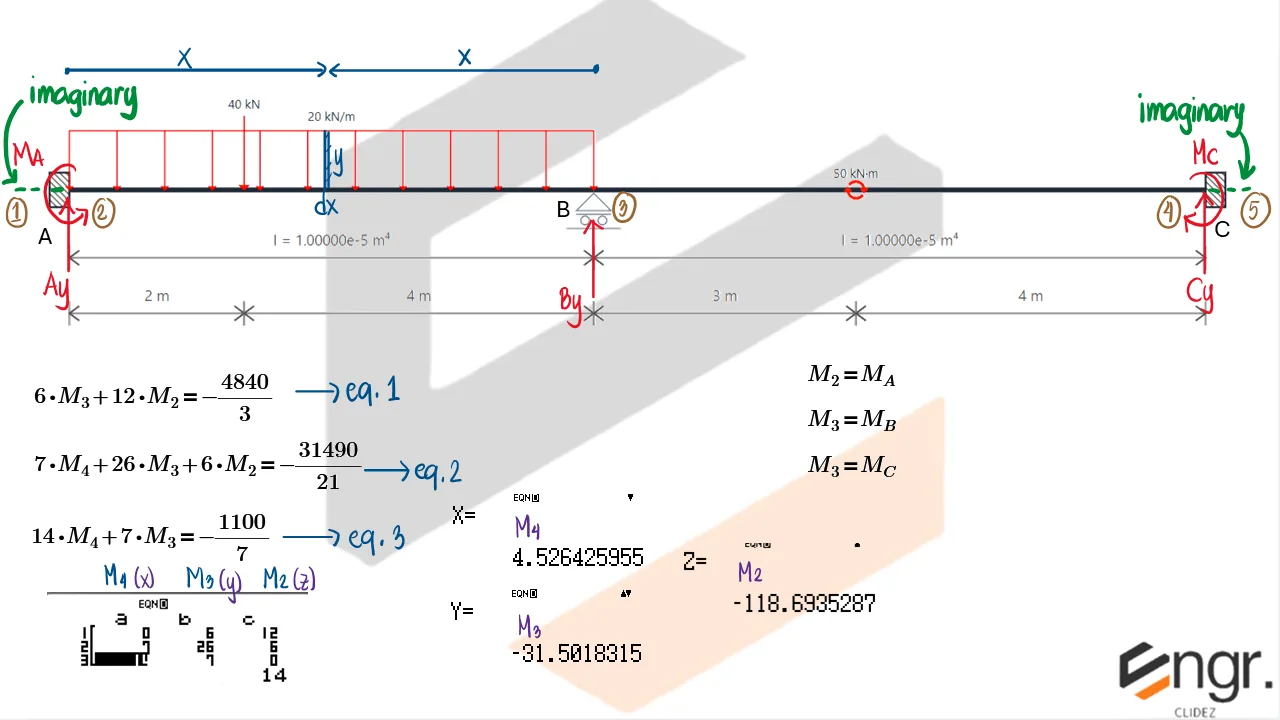
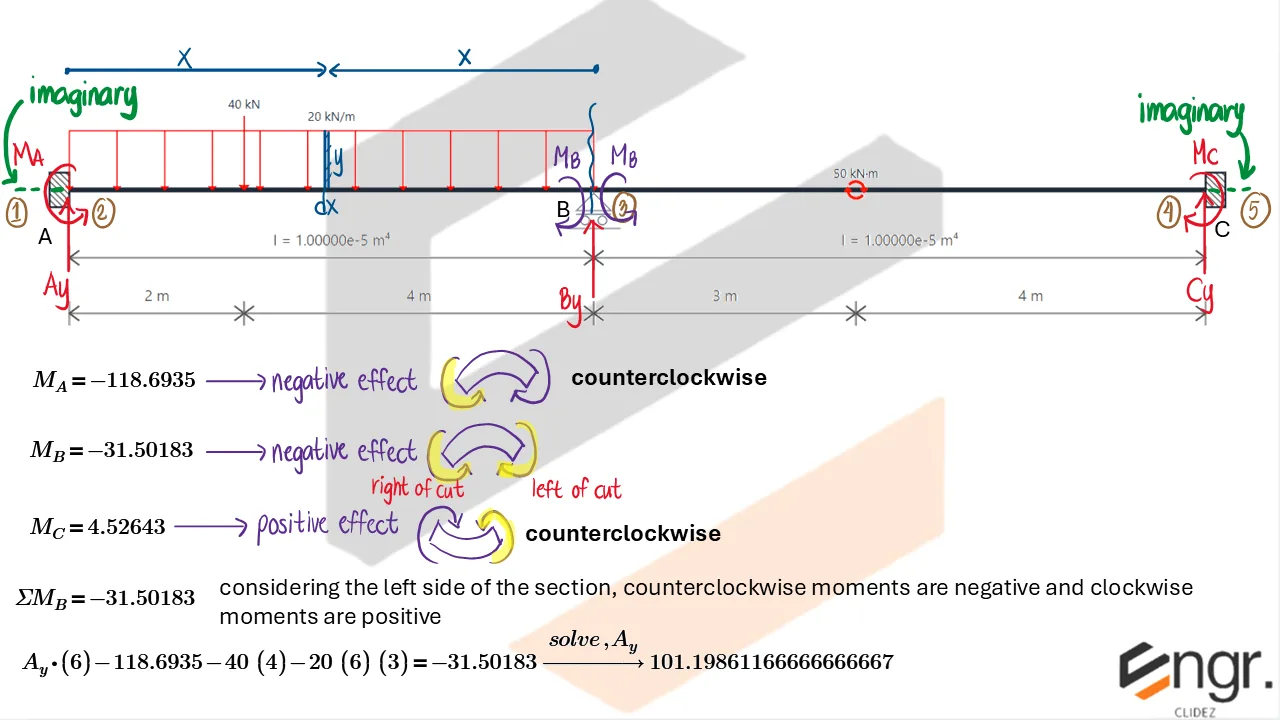
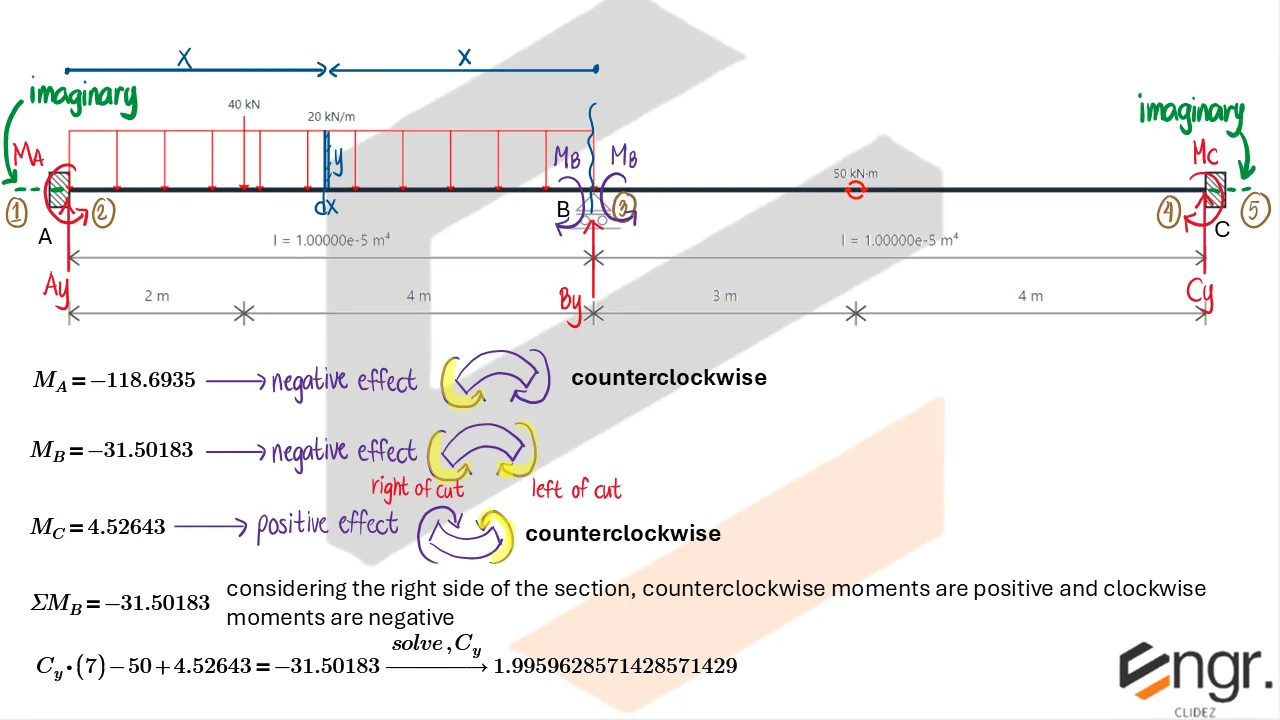
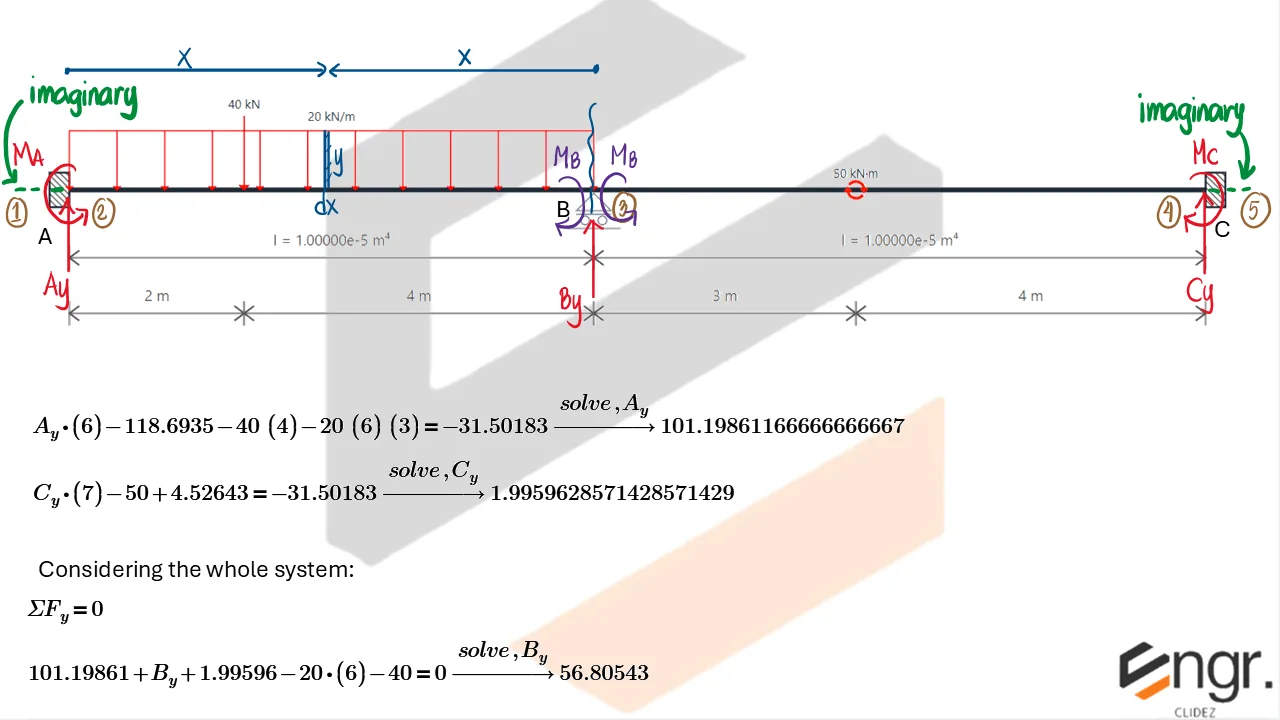
Indeterminate Beams by Three Moment Equation
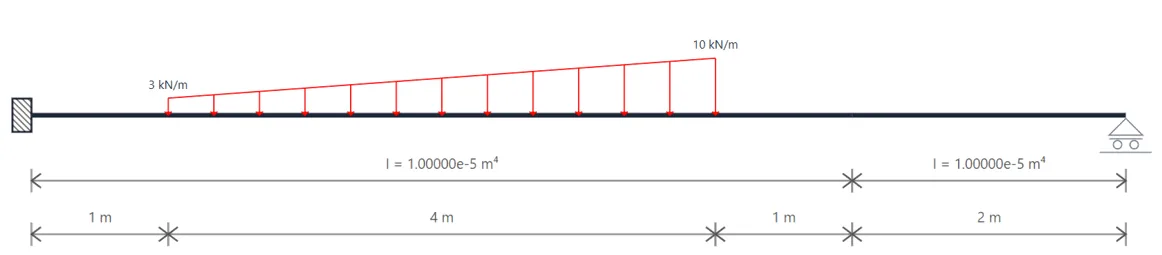
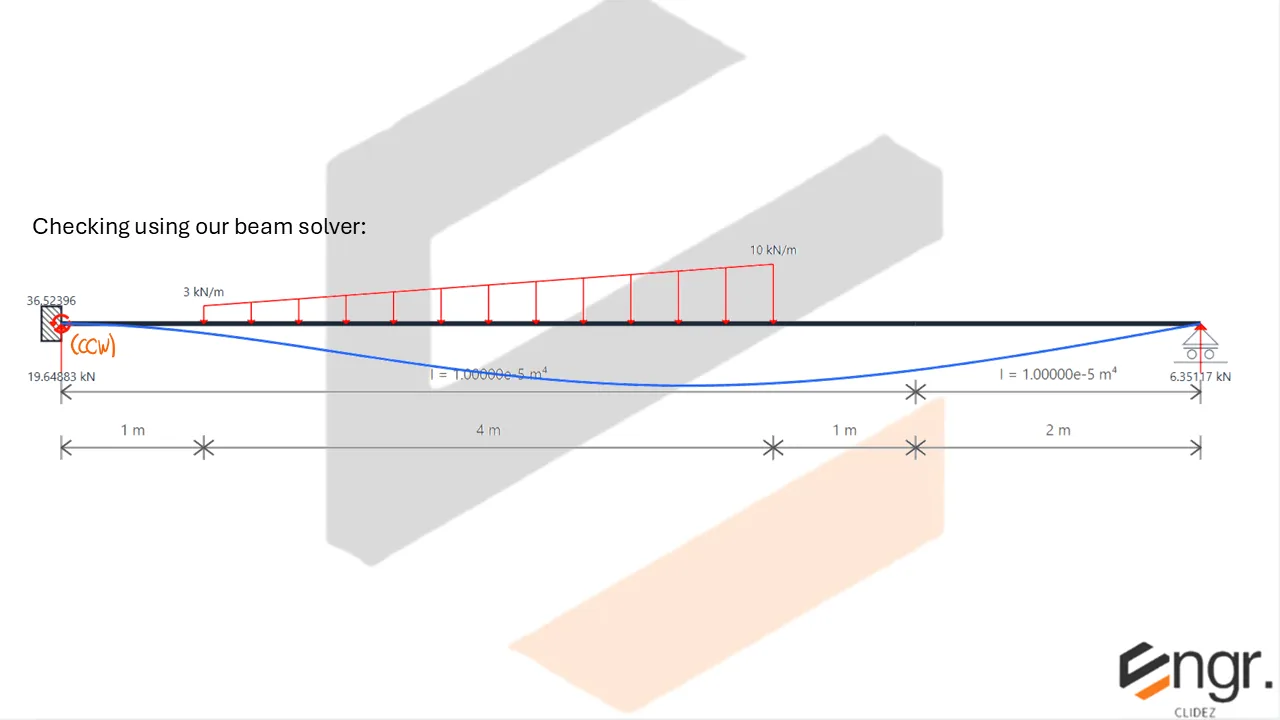
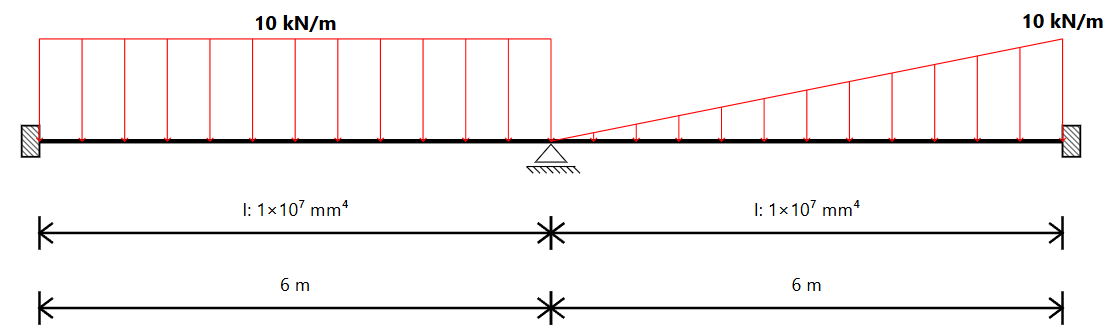
Problem: Propped Beam with Trapezoidal Load
Calculate all support reactions of the given beam.
See images:
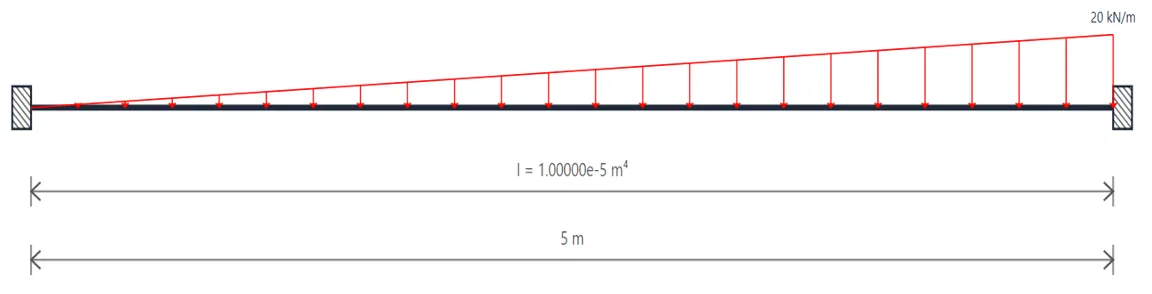
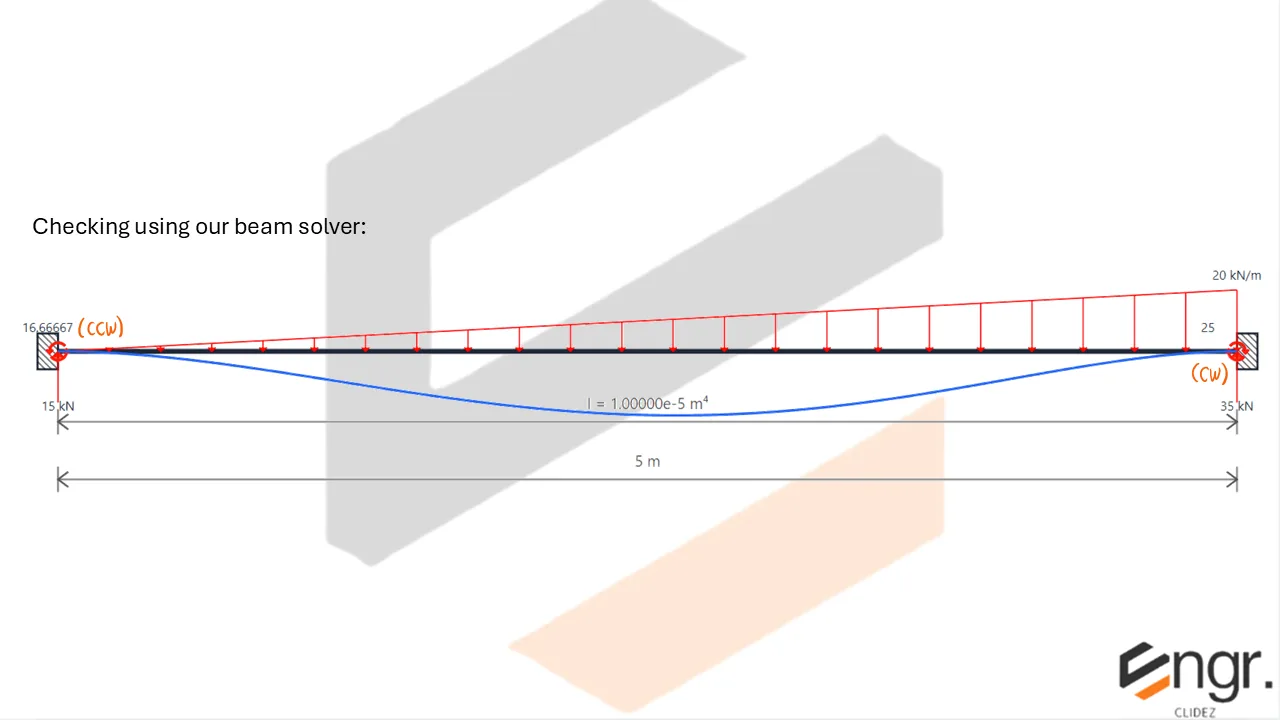
Problem: Fixed-Ended Beam with Triangular Load
Solve all of the support reactions of the fixed-ended beam shown with a triangular load of magnitude 20kN/m acting over the whole span.
See images:
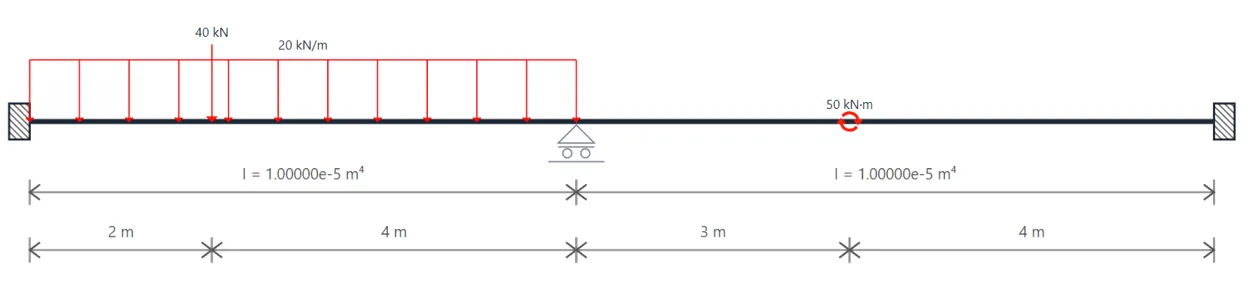
Problem: Fixed-Ended Beam with Support at the Middle
Calculate all of the support reactions of the given beam.
See images:
Indeterminate Beams by Superposition Method
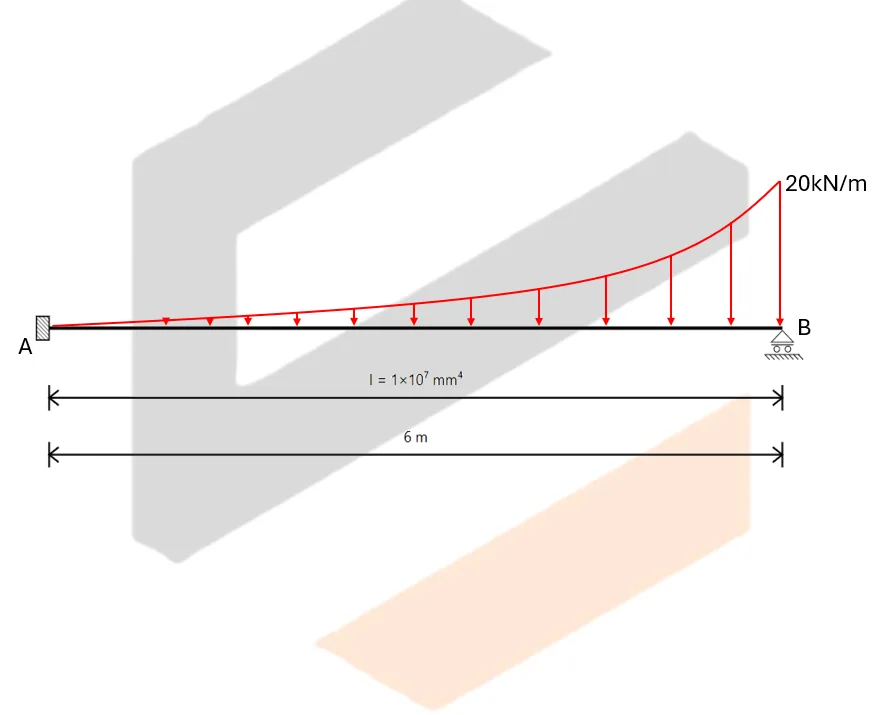
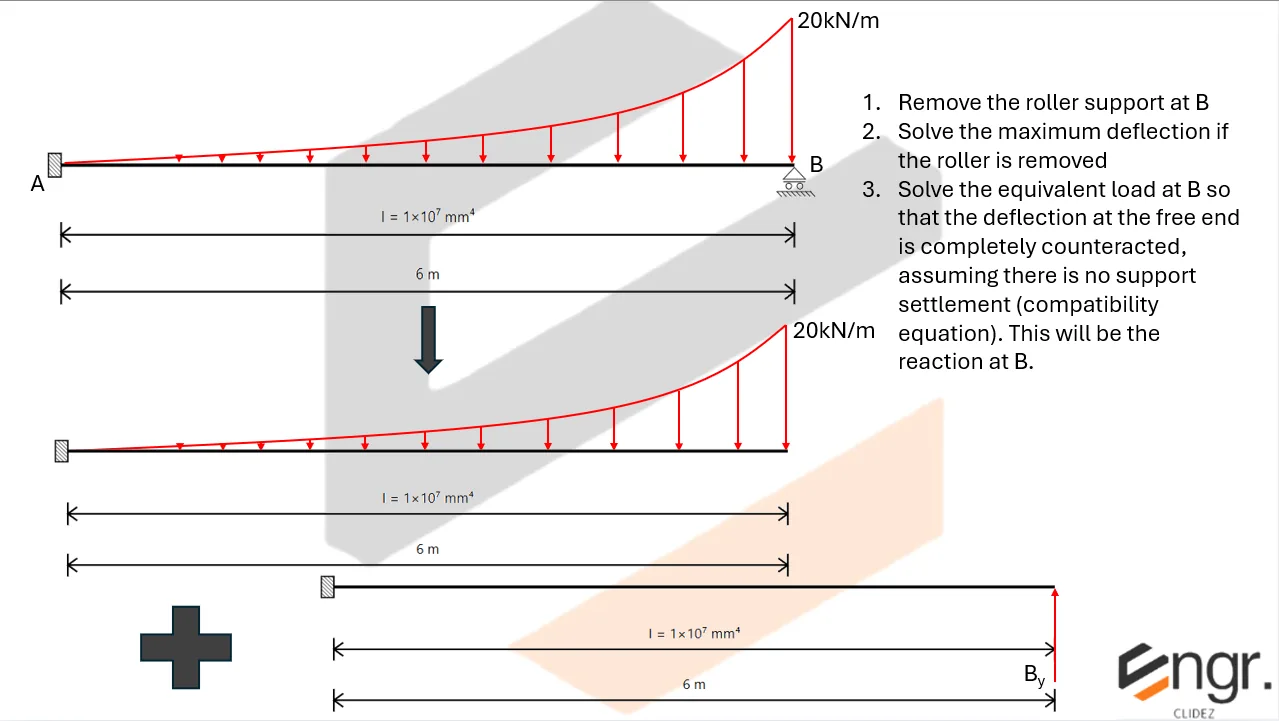
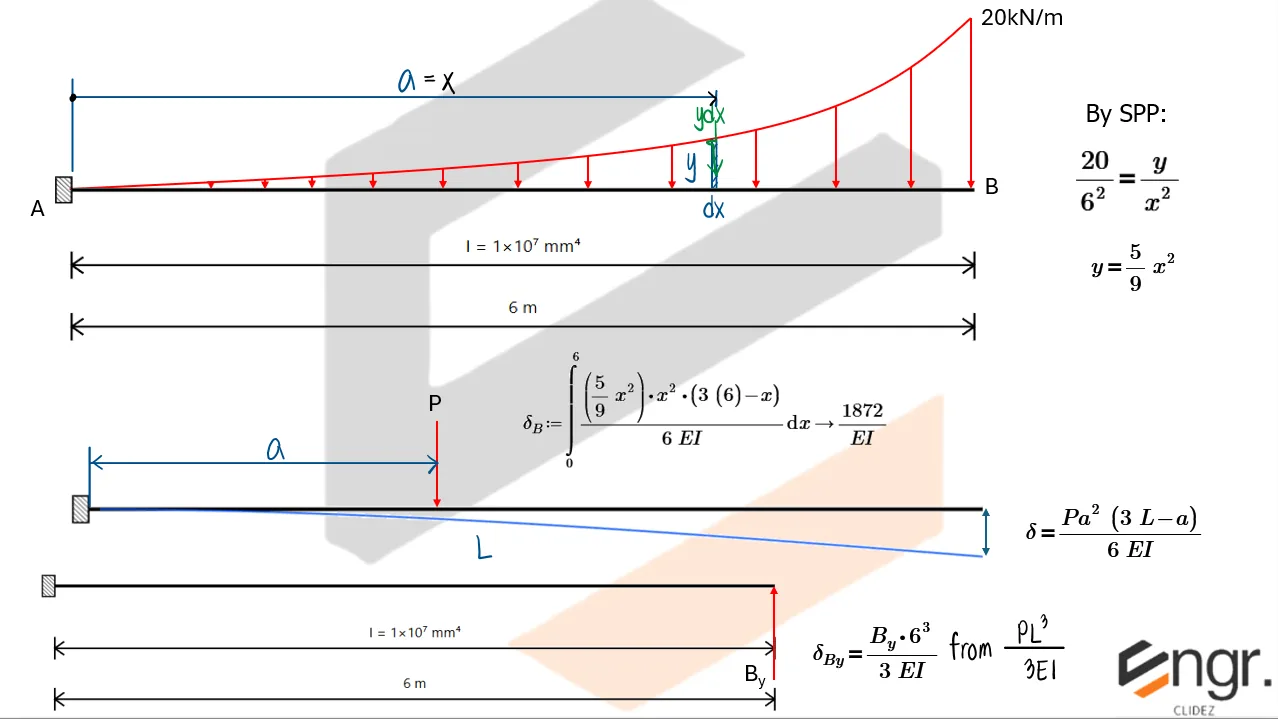
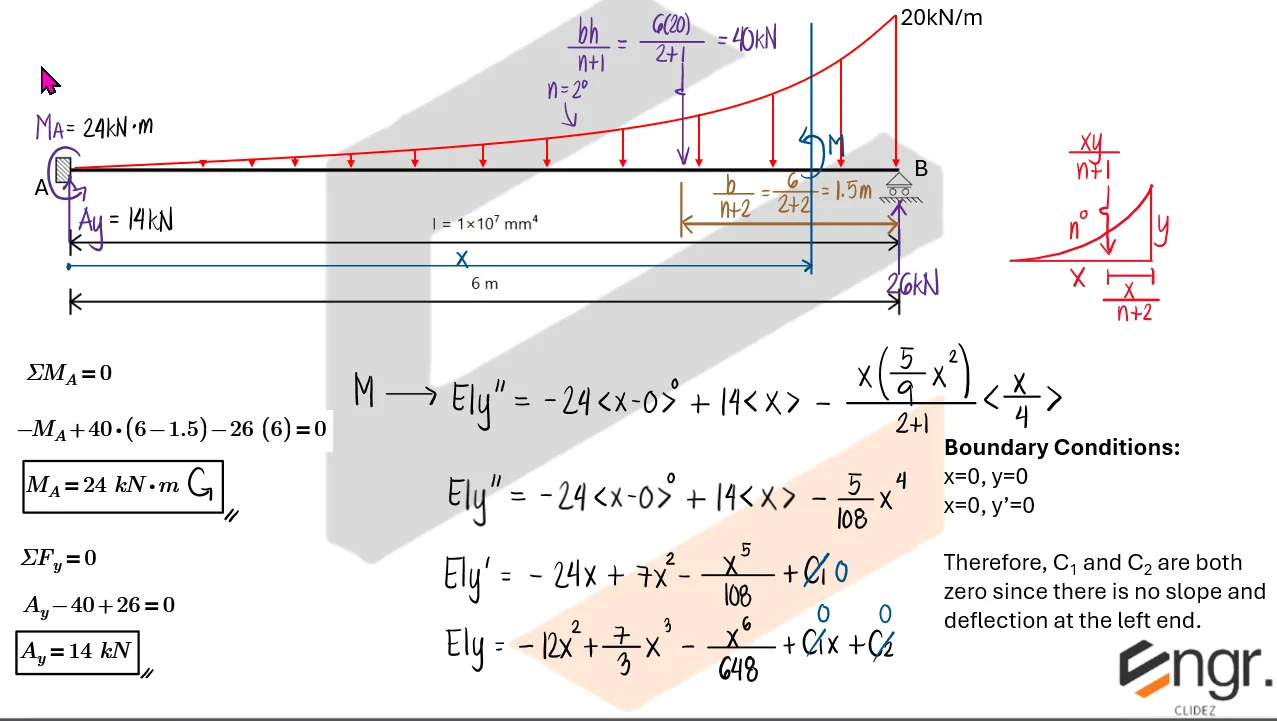
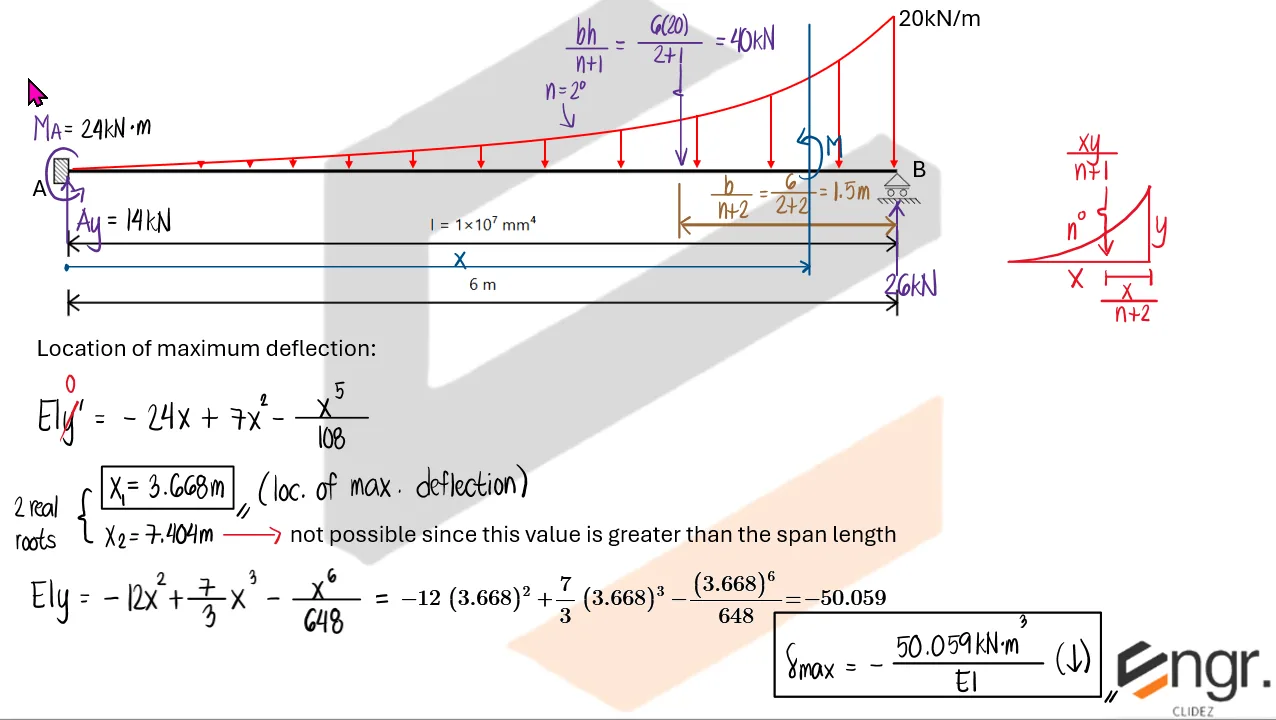
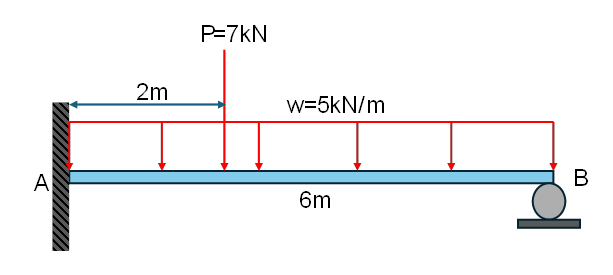
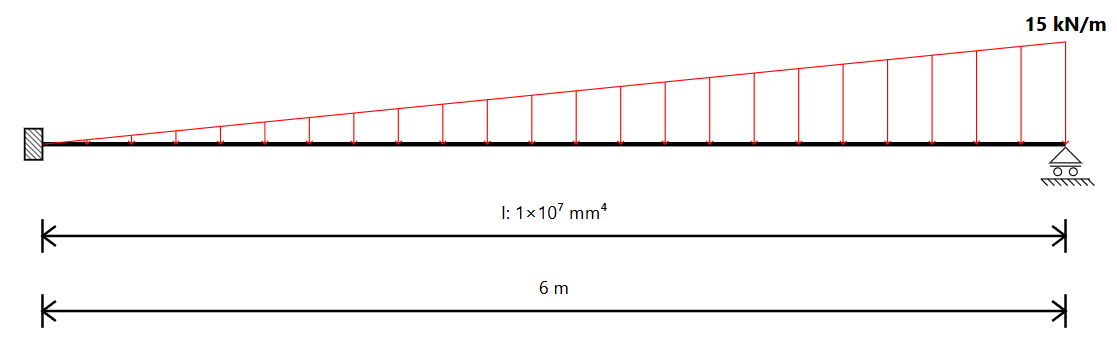
Problem: Propped Beam with Parabolic Load
The beam shown is subjected to a parabolic distributed load. Determine the location and magnitude of the maximum deflection. EI = constant
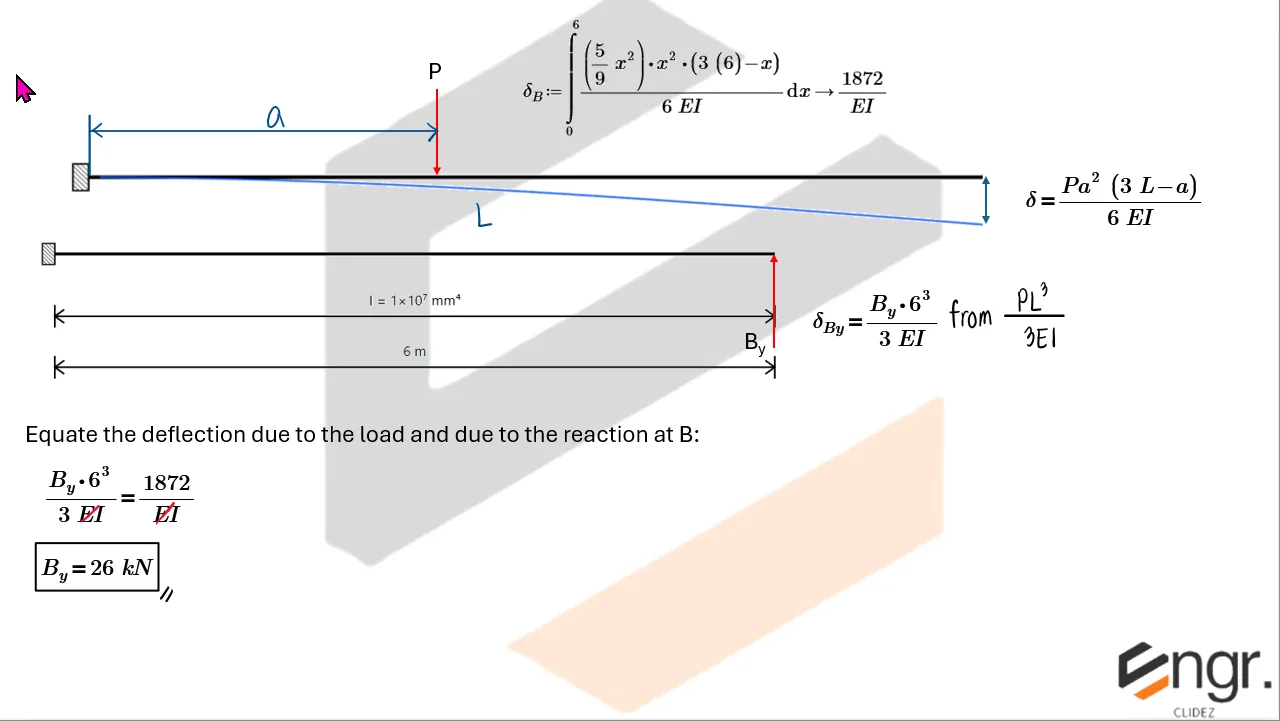
Steps in solving the reactions by the superposition method: 1. Remove the roller support at B
2. Solve the maximum deflection if the roller is removed
3. Solve the equivalent load at B so that the deflection at the free end is completely counteracted, assuming there is no support settlement (compatibility equation). This will be the reaction at B.
Indeterminate Beams by Integration (Point Load Analogous)
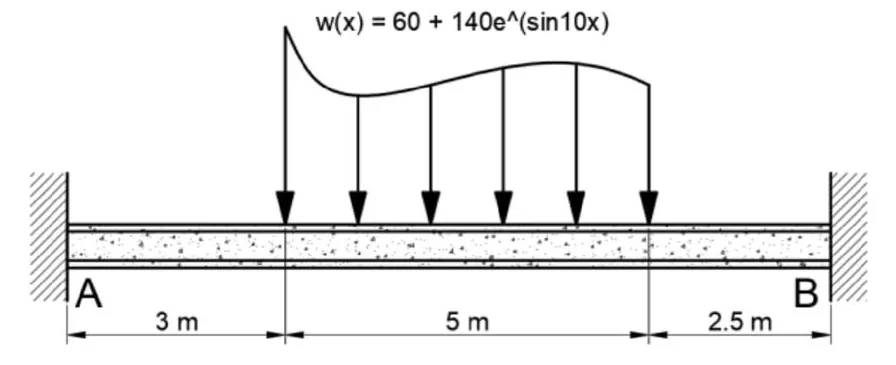
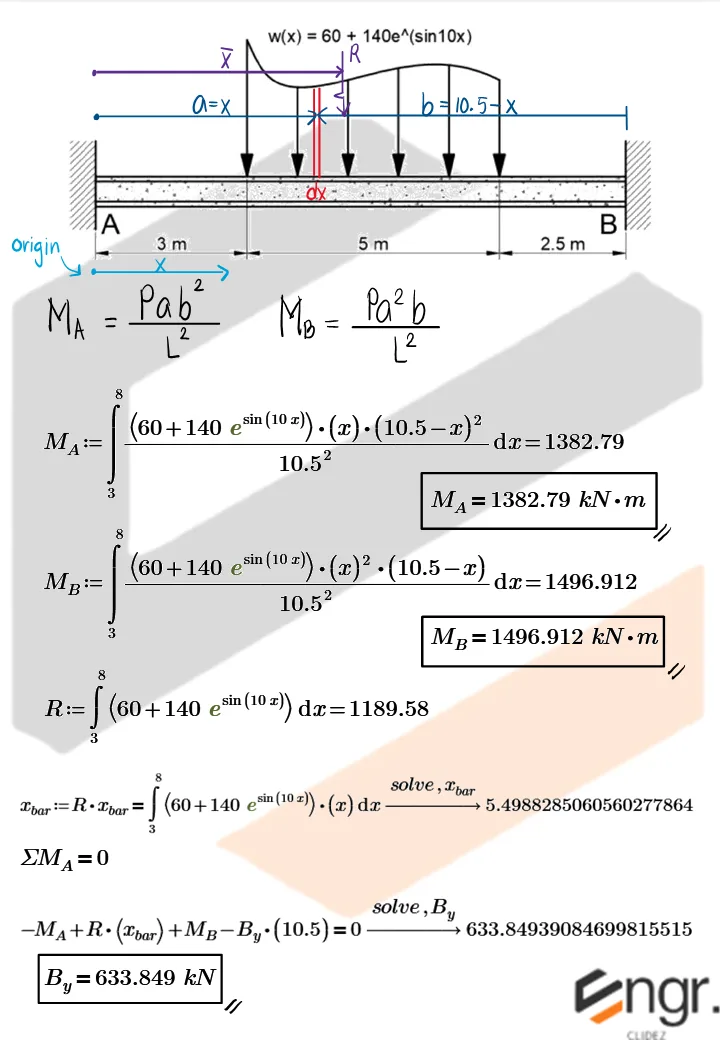
Problem: Fixed-Ended Beam with Irregular Loading Given the Equation of the Curve
For the beam shown, determine the following:
a. The moment at A in kN-m
b. The moment at B in kN-m
c. The vertical reaction at B in kN
Indeterminate Beams by Double Integration Method
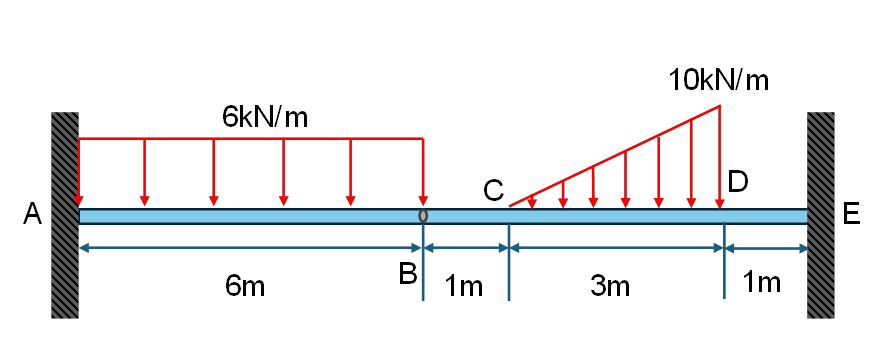
Problem: Fixed-Ended Beam with Internal Hinge
For the beam shown, determine all of the support reactions and draw the shear and moment diagram.
🧭 Jump to:
Scroll to zoom
Exam Generator Problems
Additional board-style practice items for this topic.
CE Board May 2010 A 6m cantilever retaining wall is loaded with an active pressure which varies from zero at the top to 35kN/m at the bottom. Assume EI is constant.
Compute the maximum shear.
105
210
70
86
Compute the maximum moment.
210
315
240
320
If the wall is laterally supported at the free end and fixed at the base, determine the moment at the foundation. Use end moment equation wL²/30 at the top and wL²/20 at the base.
84
42
63
157.5
The triangular lateral load has resultant $W=\tfrac12(35)(6)=105\text{ kN}$ acting $L/3=2\text{ m}$ above the fixed base.
Part 1. $V_{\max}=W=\boxed{105\text{ kN}}$.
Part 2. $M_{\max}=W(2)=\boxed{210\text{ kN-m}}$.
Part 3. For the laterally supported end, use the prescribed fixed-end coefficients and combine the end moments from the triangular-pressure diagram. The foundation end moment is $\boxed{84\text{ kN-m}}$.
### Propped cantilever by compatibility
Take $R_B$ as the redundant. Deflection at $B$ from the UDL and point load is balanced by the upward deflection caused by $R_B$:
$$\frac{5(6)^4}{8EI}+\frac{7(2)^2[3(6)-2]}{6EI}-\frac{R_B(6)^3}{3EI}=0.$$
Thus
$$R_B=\boxed{12.29 \text{kN}}.$$
Then equilibrium gives
$$A_y=5(6)+7-12.29=\boxed{24.71 \text{kN}},$$
$$M_A=-\frac{5(6)^2}{2}-7(2)+12.29(6)=\boxed{30.28 \text{kN}\!\cdot\!\text{m (counterclockwise)}}.$$
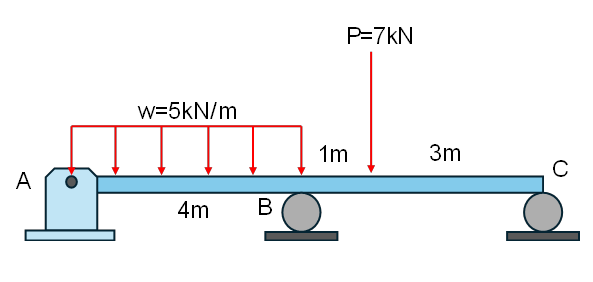
### Continuous-beam reactions
Use the force method with the middle reaction as the redundant, or write the three-moment equation for spans $AB$ and $BC$. Enforce zero vertical deflection at support $B$ after including the UDL and the $7 \text{kN}$ point load.
The reactions are
$$A_y=\boxed{8.18 \text{kN}},\qquad B_y=\boxed{18.90 \text{kN}},\qquad C_y=\boxed{0.074 \text{kN downward}}.$$
The internal support moment is
$$\boxed{M_B=7.297 \text{kN}\!\cdot\!\text{m (counterclockwise)}}.$$
Determine the reactions of the beam shown using the Three Moment Equation. Note that there is an internal hinge at B. Assume EI is constant.
Determine the deflection at B.
445.46/EI
464.54/EI
376.63/EI
363.73/EI
Determine the moment reaction at A in kN-m.
64.12 (CCW)
64.12 (CW)
66.57 (CW)
66.57 (CCW)
Determine the moment reaction at E in kN-m.
66.57 (CW)
66.57 (CCW)
64.12 (CCW)
64.12 (CW)
Determine the vertical reaction at A in kN.
28.69
22.31
29.86
23.21
Determine the vertical reaction at E in kN.
22.31
28.69
23.21
29.86
### Beam with an internal hinge
The internal hinge at $B$ has zero bending moment. Apply the three-moment equation separately on the left and right portions, enforce compatibility of the vertical displacement at the hinge, and then use segment equilibrium.
$$y_B=\boxed{\frac{445.46}{EI}},$$
$$M_A=\boxed{64.12 \text{kN}\!\cdot\!\text{m (CCW)}},\qquad M_E=\boxed{66.57 \text{kN}\!\cdot\!\text{m (CW)}},$$
$$A_y=\boxed{28.69 \text{kN}},\qquad E_y=\boxed{22.31 \text{kN}}.$$
Question Bank: q545
PSAD - Structural Theory / Indeterminate Beams / Engr. Deguma
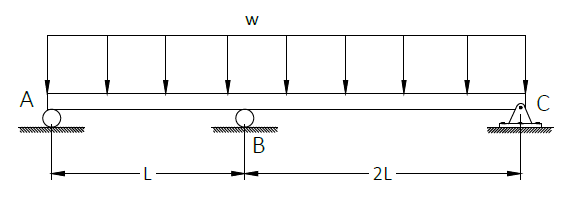
For the beam shown, if L = 4 m, and w = 16 kN/m:
Determine the reaction at A in kN.
8
12
16
20
Determine the reaction at B in kN.
132
124
156
116
Part 1.
Treat the beam as a two-span continuous beam with spans $AB=L=4$ m and $BC=2L=8$ m. With simple end supports, $M_A=M_C=0$. For uniform load on both spans, the three-moment equation gives: $2M_B(L_1+L_2)=-6\left(\frac{A_1\bar{x}_1}{L_1}+\frac{A_2(L_2-\bar{x}_2)}{L_2}\right)$ For the simple-span moment diagrams, this gives $M_B=-96$ kN-m. For span AB: $R_A=\frac{wL_1}{2}+\frac{M_B-M_A}{L_1}$ $R_A=\frac{16(4)}{2}+\frac{-96-0}{4}=8\text{ kN}$ $\boxed{R_A=8\text{ kN}}$
Part 2.
From the left span, the reaction at B is: $R_{B,left}=wL_1-R_A=16(4)-8=56\text{ kN}$ For span BC, using $M_B=-96$ kN-m and $M_C=0$: $R_C=\frac{wL_2}{2}+\frac{M_B-M_C}{L_2}$ $R_C=\frac{16(8)}{2}+\frac{-96}{8}=52\text{ kN}$ $R_{B,right}=wL_2-R_C=128-52=76\text{ kN}$ $R_B=56+76=132\text{ kN}$ $\boxed{R_B=132\text{ kN}}$
Question Bank: q611
PSAD - Structural Theory / Indeterminate Beams / Mastermatician
Given the following beam:
Determine the degree of indeterminacy.
3
1
2
4
Determine the moment reaction at the left end.
34.5kN-m
13.5kN-m
32.25kN-m
18.75kN-m
Determine the vertical reaction at the middle support.
39.00kN
32.25kN
18.75kN
13.50kN
Determine the maximum positive moment in the beam.
17.50kN-m
34.50kN-m
6.56kN-m
13.5kN-m
The beam has three redundants, so its degree of indeterminacy is 3. Enforce compatibility at the intermediate support using the force method/slope-deflection equations. The resulting actions are $M_A=34.5$ kN·m and $R_B=39.00$ kN. From the final shear diagram, $V=0$ locates the maximum positive moment, $M_{max}=17.50$ kN·m. Thus: 3, 34.5 kN·m, 39.00 kN, and 17.50 kN·m.
Question Bank: q612
PSAD - Structural Theory / Indeterminate Beams / Mastermatician
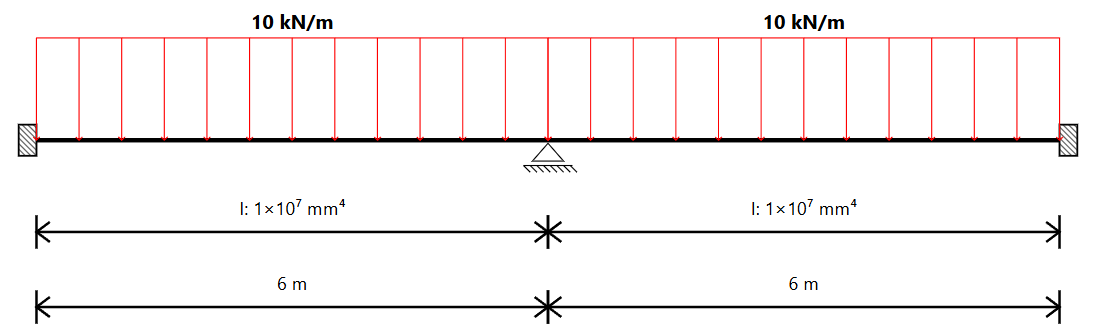
Given the following beam:
Determine the degree of indeterminacy.
1
0
3
2
Determine the moment reaction at the fixed ends.
30kN-m
15kN-m
45kN-m
20kN-m
Determine the vertical reaction at the middle support.
60.00kN
30.00kN
45.00kN
36.50kN
Determine the maximum positive moment in the beam.
15kN-m
30kN-m
45N-m
60kN-m
Determine the maximum deflection of the beam.
33.75mm
36.75mm
31.25mm
38.25mm
There is one redundant reaction, so the degree of indeterminacy is 1. Applying the compatibility condition at the middle support gives fixed-end moments of $30$ kN·m and middle reaction $60.00$ kN. The resulting moment curve has $M_{max,+}=15$ kN·m; integrating $EI v''=M$ gives $\delta_{max}=33.75$ mm. Therefore: 1, 30 kN·m, 60.00 kN, 15 kN·m, and 33.75 mm.
Question Bank: q613
PSAD - Structural Theory / Indeterminate Beams / Mastermatician
Given the following beam:
Determine the reaction at the roller support in kN.
24.75kN
20.25kN
25.50kN
19.50kN
Determine the moment reaction at the fixed support in kN-m
31.5
22.8
27.6
32.9
Determine the location of the point of inflection of the beam.
1.647m
4.250m
1.746m
4.025m
Determine the maximum deflection of the beam.
59.25mm
60.75mm
53.65mm
62.75mm
Use the propped-cantilever compatibility equation (zero deflection at the roller) to obtain $R=24.75$ kN. Whole-beam equilibrium gives fixed-end moment $M_A=31.5$ kN·m. Set the bending-moment equation equal to zero for the interior contraflexure point, giving $x=1.647$ m; integrating the moment equation gives $\delta_{max}=59.25$ mm. Therefore: 24.75 kN, 31.5 kN·m, 1.647 m, and 59.25 mm.
Question Bank: q614
PSAD - Structural Theory / Indeterminate Beams / Mastermatician
An 8-m long propped beam is subjected to a uniform
load varying from 70 kN/m at 1 m from the fixed end to 50 kN/m at
2 m from the roller support.
Calculate the vertical reaction at the roller support (kN).
76.62
112.43
223.38
187.57
Calculate the maximum positive moment within the span.
209.76
275.65
341.54
395.35
Determine the location of the maximum deflection of the beam from the fixed support, in meters.
4.46m
3.17m
3.54m
4.83m
Represent the varying load by its equivalent uniform and triangular components, then impose the propped-cantilever compatibility condition at the roller. This gives $R_B=76.62$ kN. From $V(x)=0$, the maximum positive moment is $209.76$ kN·m. Integrating $EI v''=M(x)$ and setting the slope to zero locates maximum deflection at $x=4.46$ m from the fixed end. Therefore: 76.62 kN, 209.76 kN·m, and 4.46 m.
Question Bank: q618
PSAD - Structural Theory / Indeterminate Beams / Mastermatician
An 8-m high retaining wall is subjected to lateral earth
pressure increasing from 34 kPa at the top to 136 kPa at the base.
Flexural rigidity EI = 4.5x10¹⁴ N-mm2. Analyze per meter length of
the wall.
What is the moment at the base of the cantilever retaining wall,
in kN-m?
2176
3264
707
1469
What is the force to be applied at the propped end to limit the
deflection to 35 mm, in kN?
91.37
69.63
92.29
183.60
What is the moment at the base when the wall is propped at
the top?
707.2
2176.0
3644.8
1468.8
Split the trapezoidal earth pressure into a uniform and triangular load. The base moment is the sum of their moments: $M_B=2176$ kN·m per meter width. Use superposition of cantilever deflections to find the prop force that limits top displacement to 35 mm, $P=91.37$ kN. With the top prop active, compatibility gives base moment $707.2$ kN·m. Therefore: 2176 kN·m, 91.37 kN, and 707.2 kN·m.
Question Bank: q622
PSAD - Structural Theory / Indeterminate Beams / Mastermatician
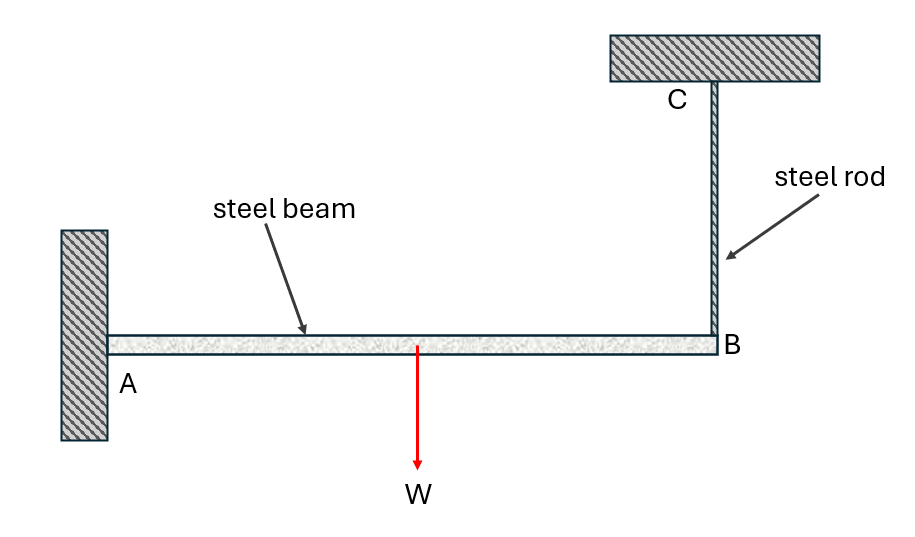
The steel beam is supported by a steel rod as shown. A load W is applied at the midspan.
Beam Properties: I = 198x106mm4 E=200GPa L=3m
Rod Properties: Diameter = 12mm E=200GPa L=2.4m
Due to the load, W, rod BC elongates by 1 mm. Find the force
(kN) in rod BC which caused the elongation.
9.4
4.4
6.4
11.4
Due to the load, W, the force developed in rod BC is 12 kN,
what is the value of W (kN)?
56.33
20.47
6.82
24.00
Due to a load, W = 40 kN, the force developed in rod BC = 10
kN. The diameter of rod BC is 16 mm. Find the moment (kNm)
at the fixed end.
30
90
60
45
The rod force from 1-mm elongation is $F=AE\delta/L$, giving 9.4 kN. For the second case, use beam deflection compatibility: midspan beam deflection equals rod elongation; the load is shared by beam reactions and rod force, which gives 56.33 kN. For $W=40$ kN and rod force 10 kN, fixed-end equilibrium gives 30 kN·m.