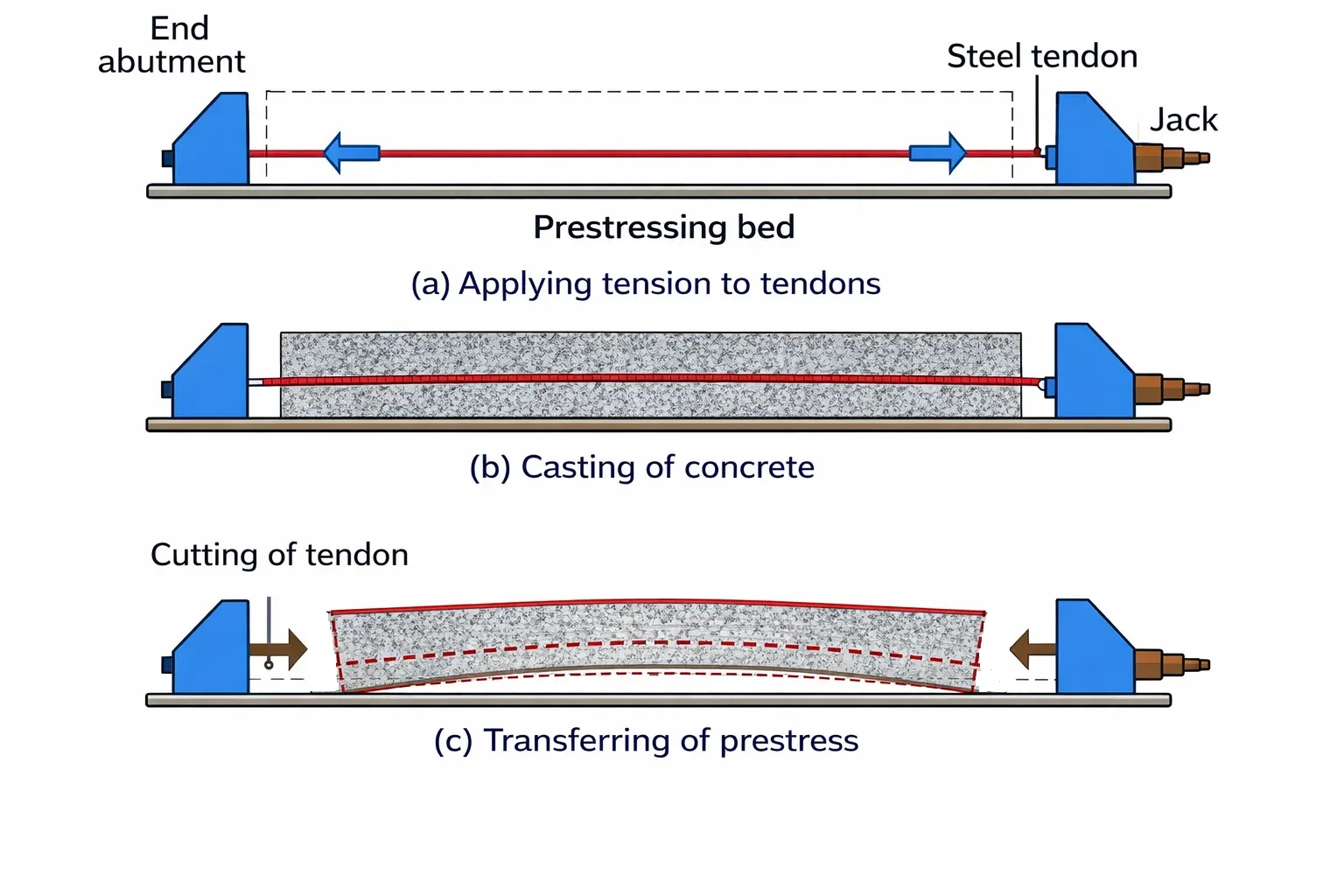
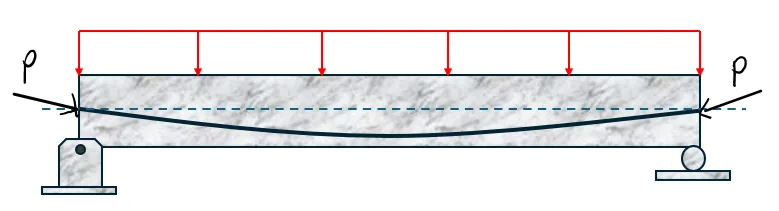
Prestressed reinforced concrete is a structural system in which internal stresses are deliberately introduced into a concrete member before it is subjected to external loads. These internal stresses, applied through high-strength steel tendons, counteract the tensile stresses that would normally develop under service loads, allowing the concrete to remain largely or entirely in compression. By improving crack control, reducing deflections, and increasing load-carrying capacity, prestressing enables longer spans, slimmer structural members, and more efficient use of materials compared to conventional reinforced concrete. Prestressed concrete plays a critical role in modern infrastructure—such as bridges, girders, slabs, and water tanks—where high performance, durability, and structural economy are essential.
Problem: CE Board November 2024
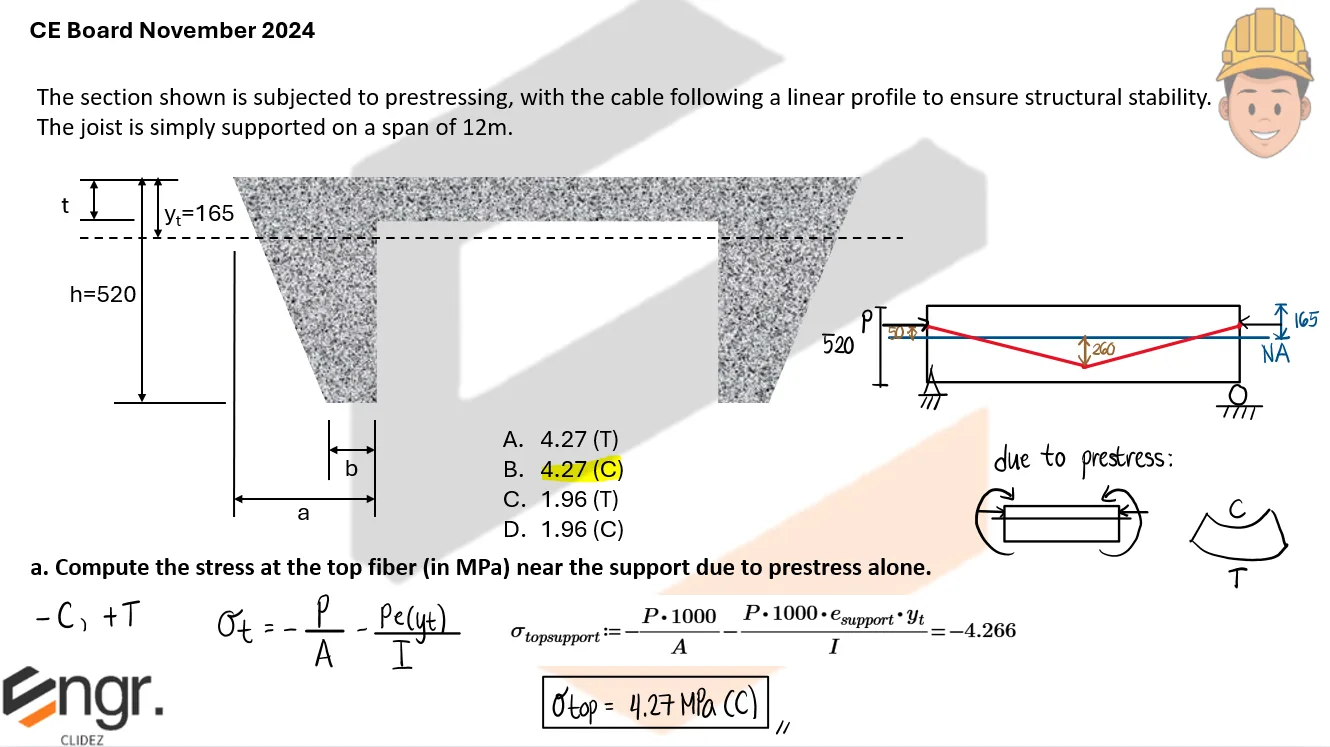
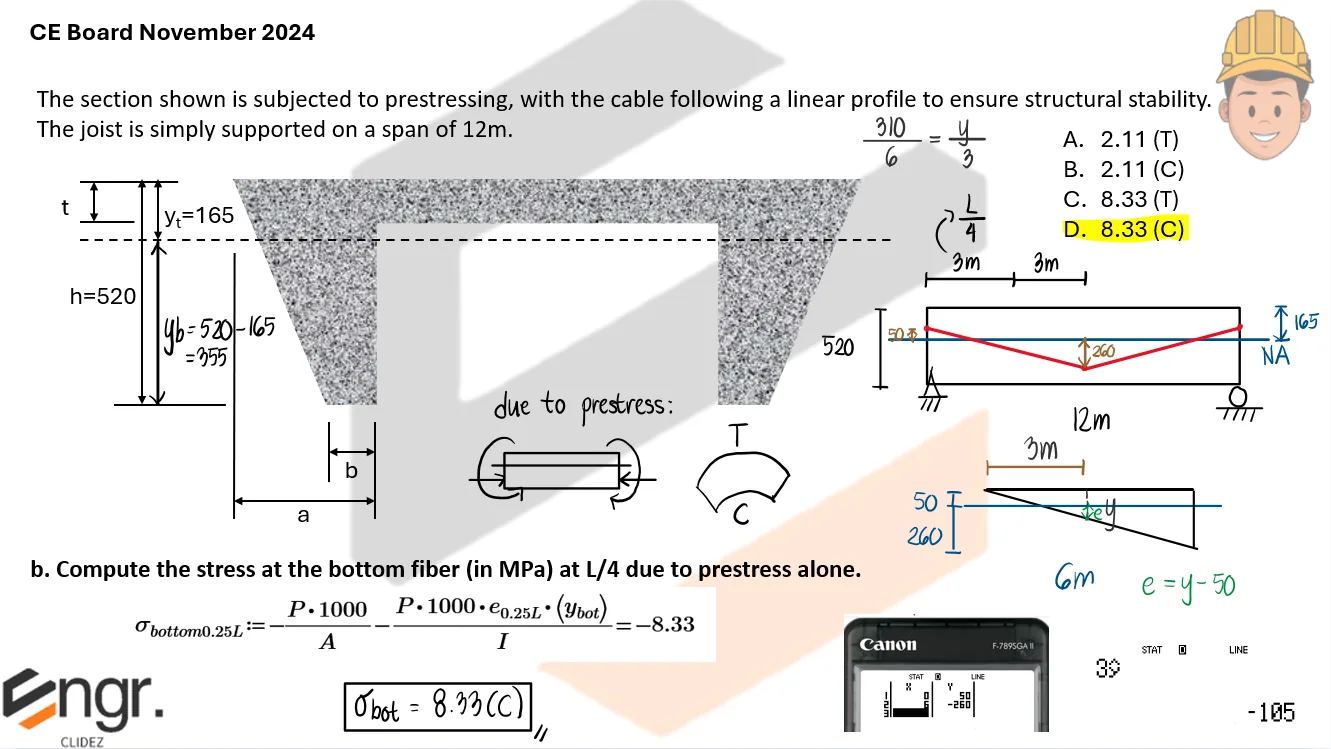
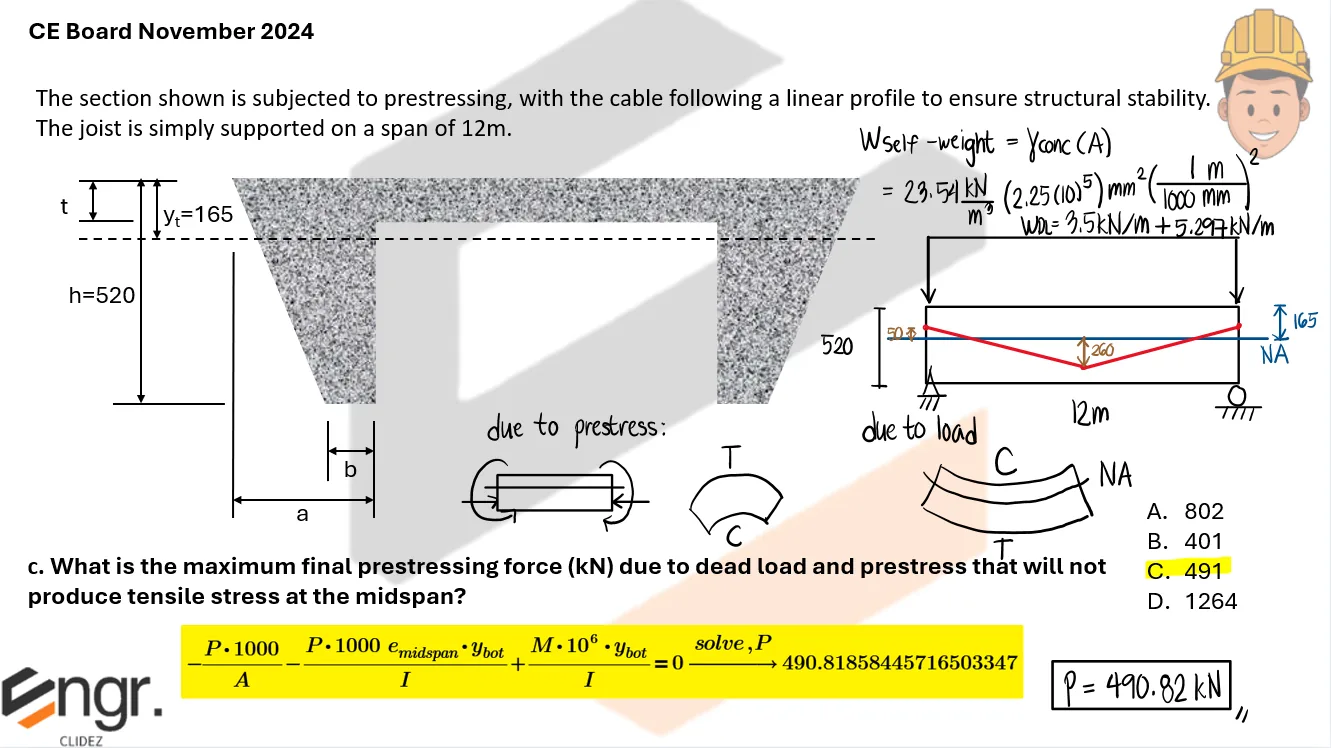
The section shown is subjected to prestressing, with the cable following a linear profile to ensure structural stability. The joist is simply supported on a span of 12m.
Given:
Eccentricity at the supports = 50mm above N.A.
Eccentricity at the midspan = 260mm below N.A.
Section Properties: Area, A=2.25x105mm2 Moment of Inertia, INA5x109mm4 Unit weight of concrete=23.54kN/m3 Superimposed Dead Load=3.5kN/m
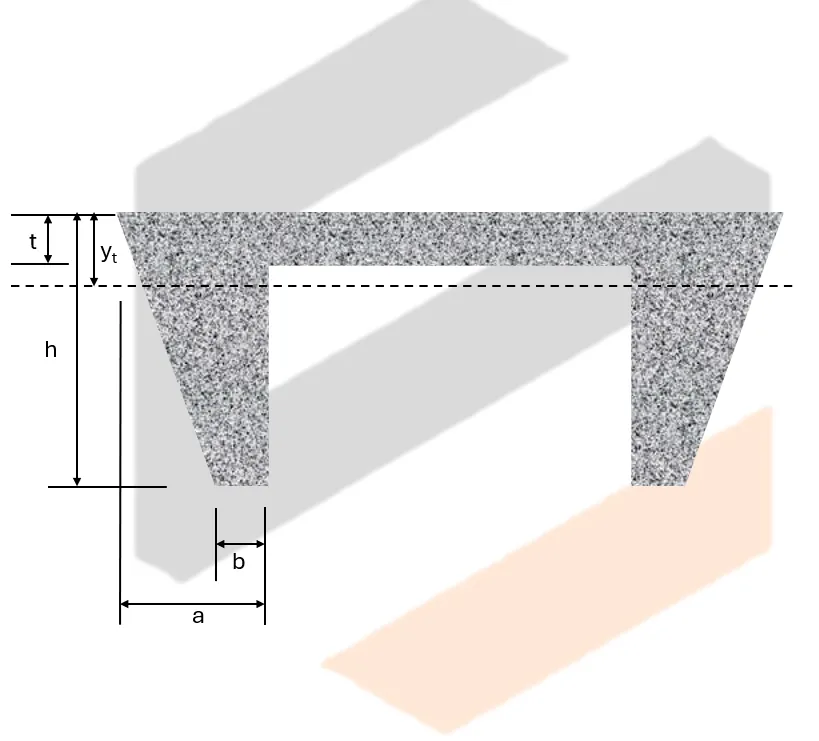
Dimensions: h=520mm, t=75mm yt=165mm, a=150mm, b=75mm Final Prestressing Force, P=700kN
a. Compute the stress at the top fiber (in MPa) near the support due to prestress alone.
b. Compute the stress at the bottom fiber (in MPa) at L/4 due to prestress alone.
c. What is the maximum final prestressing force (kN) due to dead load and prestress that will not produce tensile stress at the midspan?
See images:
Problem: Beam with Parabolic Tendons
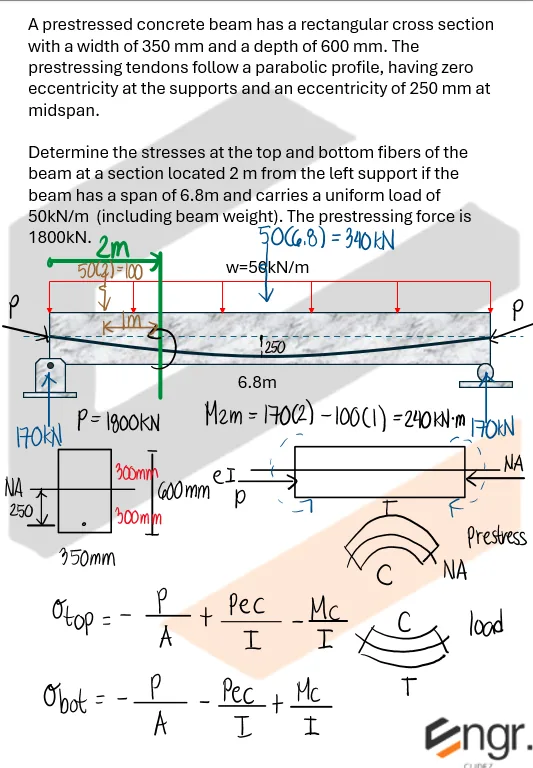
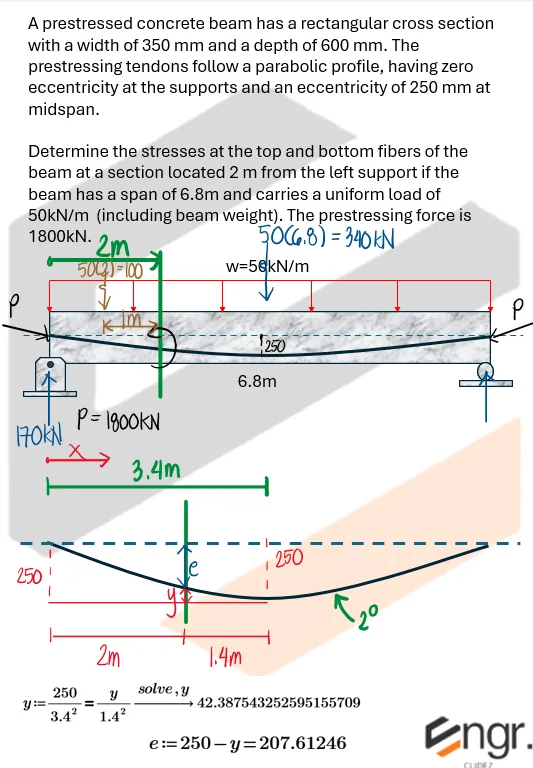
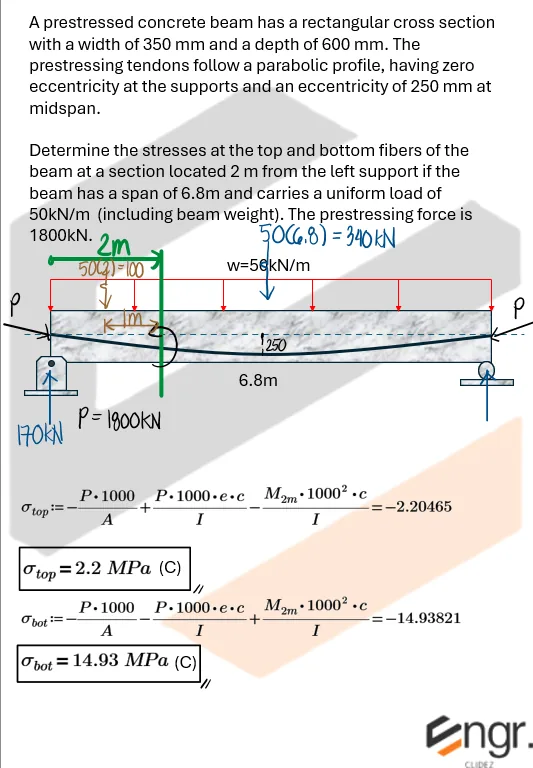
A prestressed concrete beam has a rectangular cross section with a width of 350 mm and a depth of 600 mm. The prestressing tendons follow a parabolic profile, having zero eccentricity at the supports and an eccentricity of 250 mm at midspan.
Determine the stresses at the top and bottom fibers of the beam at a section located 2 m from the left support if the beam has a span of 6.8m and carries a uniform load of 50kN/m (including beam weight). The prestressing force is 1800kN.
The section of a prestressed cantilever beam with a length of 6m is shown below. The prestressing tendon is placed 200mm above the neutral axis. The beam carries a total dead load of 20kN/m and a concentrated load of 15kN at the midspan.
Beam Properties:
s=2.3m
bw=350mm
d=600mm
tf=150mm
If the prestressing force is 1200kN, determine the following:
a. Moment of inertia of the beam in mm4 about the centroidal x-axis.
b. The stresses at the top and bottom fibers (in MPa) at the free end.
c. The stresses at the the top and bottom fibers (in MPa) at the fixed end.
See images:
Problem: Beam with Parabolic Tendons (eccentricity below N.A.)
The beam shown has a length of 9m and carries a superimposed dead load of 20kN/m. It has a rectangular cross-section. The beam width is 400mm while the depth is 750mm. The beam is subjected to a prestressing force of 500kN.
Eccentricity at the supports = 60 mm below N.A.
Eccentricity at the midspan= 260 mm below N.A.
Unit weight of concrete = 23.54kN/m3
a. Determine the stresses at the top and bottom fibers 1.8m from the left support (in MPa).
b. Determine the stresses at the top and bottom fibers at the midspan.
c. By how much should the prestressing force (kN) be increased so that the tensile stress at the midspan is zero?
See images:
Here, we shall do an initial checking as to which fibers are in tension or compression. Calculating the stresses at the midspan at the top and bottom fibers, we observe that the bottom fibers are in tension. Therefore, we shall set the stress at the bottom to zero and use the additional value of P from this equation, unless the value obtained is negative.
Evaluating the two values by setting the bottom fiber stress and top fiber stress to zero, we choose the more conservative value, which is the lesser additional load, so that the compressive stress the beam will experience will also be minimized.
Problem: Irregular Section | Girder with Hollow Rectangular Section
A prestressed concrete beam having a cross-section shown is subjected to a prestressing force of 2450kN acting on the parabolic tendon shown. The beam is simply supported on a span of 8.0m. The beam carries a uniform dead load of 10kN/m excluding its own weight and a concentrated live load at midpoint of 5kN. The concrete weighs 23.54kN/m3. Consider 8% loss of prestress at service loads. Allowable stresses at service loads are 0.25MPa in tension and 15.5MPa in compression.
a. Determine the resulting stress (in MPa) at the top fiber of the beam at midspan after transfer.
b. Determine the resulting stress (in MPa) at the bottom fiber of the beam at midspan at service loads.
c. Determine the resulting stress (in MPa) at the top fiber of the beam at midspan at service loads.
d. Determine the maximum total load (kN/m) (including its own weight) that the beam can be subjected to if the allowable stress at service loads is not to be exceeded.
See images:
In letters b and c, we were able to identify which parts of the fibers are subjected to tension and compression. As such, we consider their initial conditions when we equate the allowable compressive and tensile stresses.
Problem: Parabolic Tendons with Eccentricity Above and Below the Neutral Axis
The beam shown has a width of 400mm and a height of 750mm. The eccentricity at the support is 70mm above the neutral axis, while 240mm below the neutral axis at the midspan. A prestressing force of 980kN is applied on the beam.
a. Calculate the stress in the top and bottom fibers (in MPa) at a point 3m from the support.
b. Calculate the eccentricity at 0.5m from the left support and state which fiber (top or bottom) will be subjected to compression as a result of the prestressing force × eccentricity (moment due to eccentricity).
For ratio and proportion, we use the squared property of a parabola.
CALTECH for the eccentricity: Mode → STAT → Quad → Input the three rows shown below (points on the parabola) → Apps → Reg → 3ŷ
For the input values, we set the origin of x to the left end. The eccentricity at the support is 70mm above the neutral axis, so we use a positive sign. Then, at the midspan (x=4.5m), the eccentricity is 240mm below the neutral axis, so we use a negative sign. Since we are interpolating a function to the second degree, we need to establish a third point, which could conveniently be the location of the right support where x = 9.5m and e = 70mm above the neutral axis.
For part b, we solve it first conventionally and verify using 0.5ŷ. The result is positive 4.93827mm, so it is above the neutral axis. Therefore, the top fiber will be subjected to compression due to prestressing force × eccentricity.
Problem: CE Board November 2025 | Prestressed Concrete Section with Multiple Strands
The concrete beam shown has the following properties:
A=7.89x105mm2
Ixo=1.39x1011mm4
It is also prestressed using 40-15.2𝑚𝑚∅ seven-wire strands arranged at 60 mm spacing, with an effective concrete cover of 50 mm. The initial prestressing force at transfer is 3420kN. During service, time-dependent effects result in a 15% reduction of the prestressing force. The span of the simply supported beam is 7m.
a. Determine the total normal stress in the top fibers after transfer at the midspan.
b. Calculate the stress in the bottom fibers of the beam at service condition.
c. If the external loads (including beam self-weight) produce additional bending stresses of ±6.7 𝑀𝑃𝑎 at the midspan, determine the required eccentricity of the prestressing force so that the tensile stress in the midspan is zero.
We first calculate the centroid of the tendon by using Varignon's theorem. Since the areas of the strands are uniform, the areas in the equation will cancel out. Therefore, we only need to use the number of strands per row and multiply them each by the distance going to the reference axis. In this case, we choose the bottom as our reference axis.
Problem: Prestressed Concrete Design
a. Design a prestressed-concrete beam with the shape shown below. The beam is to carry a total load of 11kN/m on a span of 25m. Use straight post-tensioned 12.7-mm ∅ (uncoated 7-wire stress-relieved strands, Area per strand = 98.71mm2, Grade 1860MPa. The final effective stress is 930MPa after losses. The bottom layer of the strands shall be placed 50mm above the bottom of the beam and spaced 40mm vertically and horizontally. Use f’c=28MPa.
b. Determine the eccentricity and the initial prestressing force that must be applied assuming 20% loss.
c. The allowable stresses at final stage are as follows:
$$\sigma_t = 0.50 \sqrt{f'c}$$
$$\sigma_t = 0.45f'c$$
Investigated the beam designed in (a).