
CECC-483 Reference Formula Sheet — Singly-Reinforced Rectangular Beam (USD)
Complete USD/strength-design formula list from the CECC-483 / NSCP review notes for a Singly-Reinforced Rectangular Beam (SRRB).
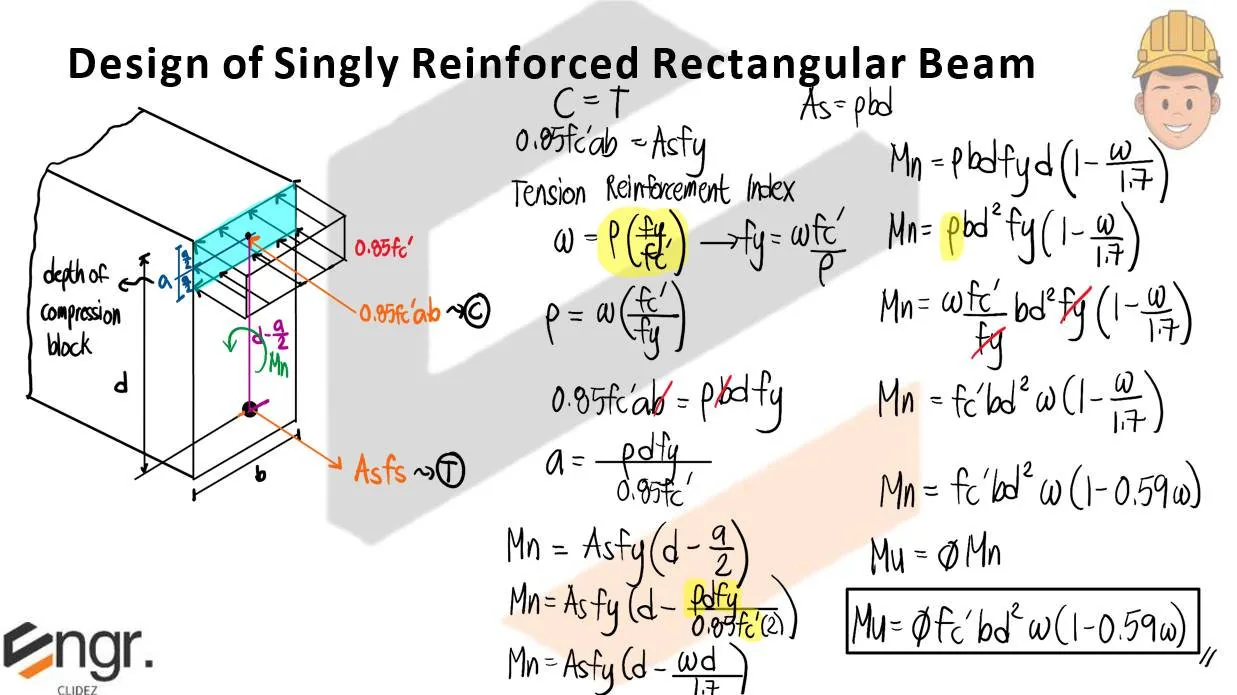
Stress block & force equilibrium (assume steel yields, $f_s=f_y$):
Steel stress from strain diagram:
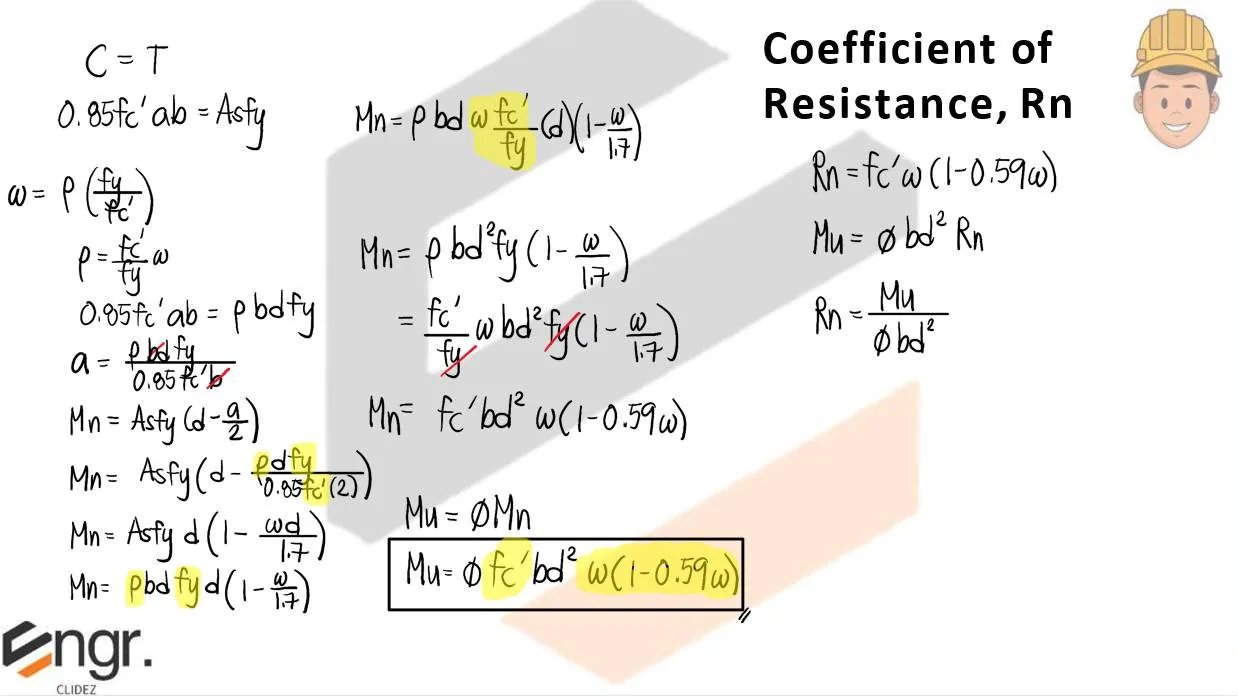
Nominal & ultimate bending moment:
Strength-reduction (moment) factor φ:
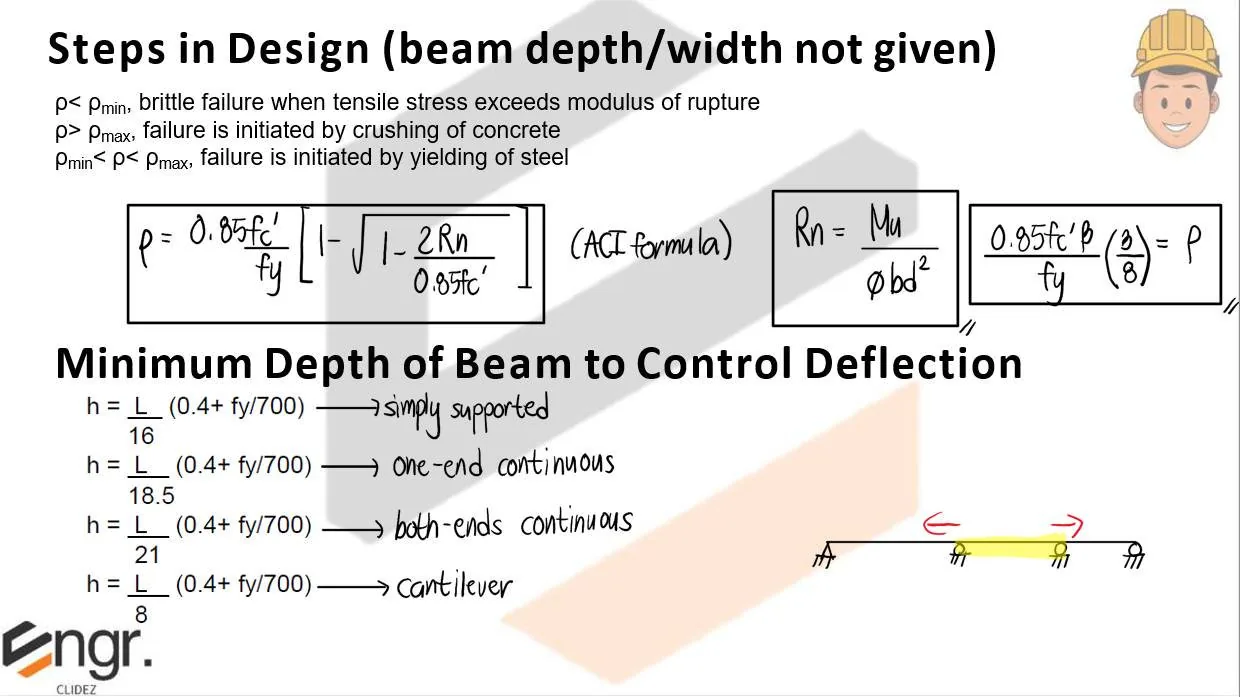
Reinforcement ratios:
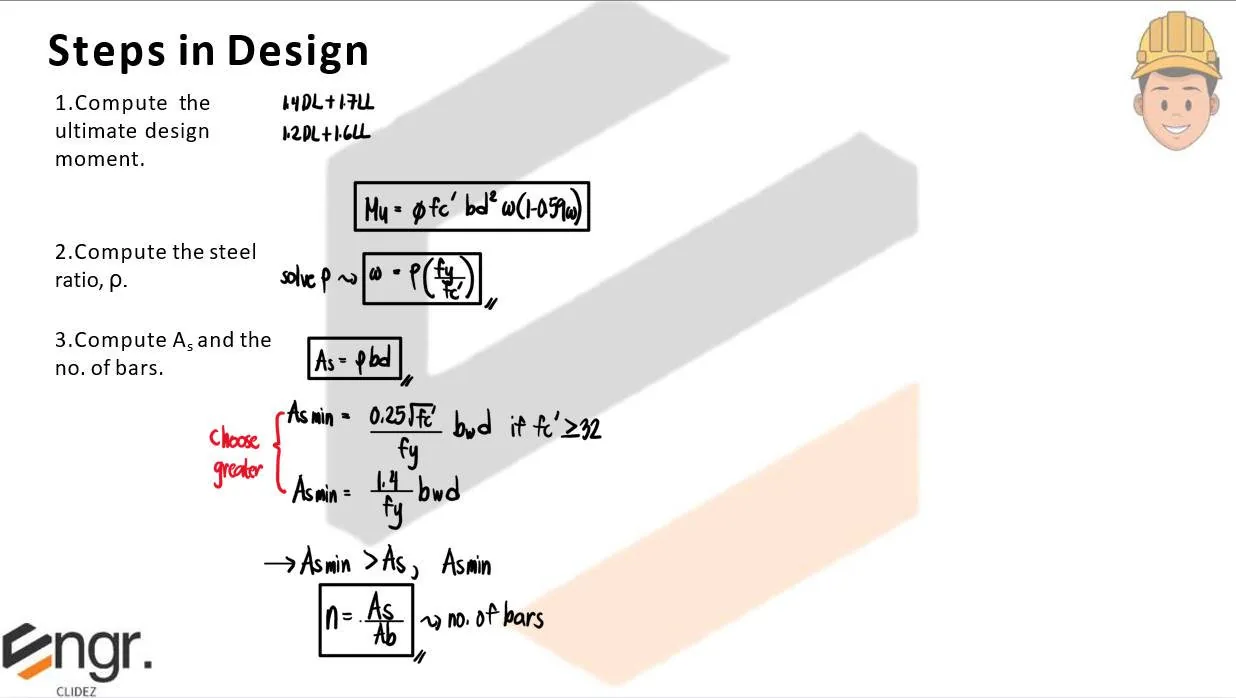
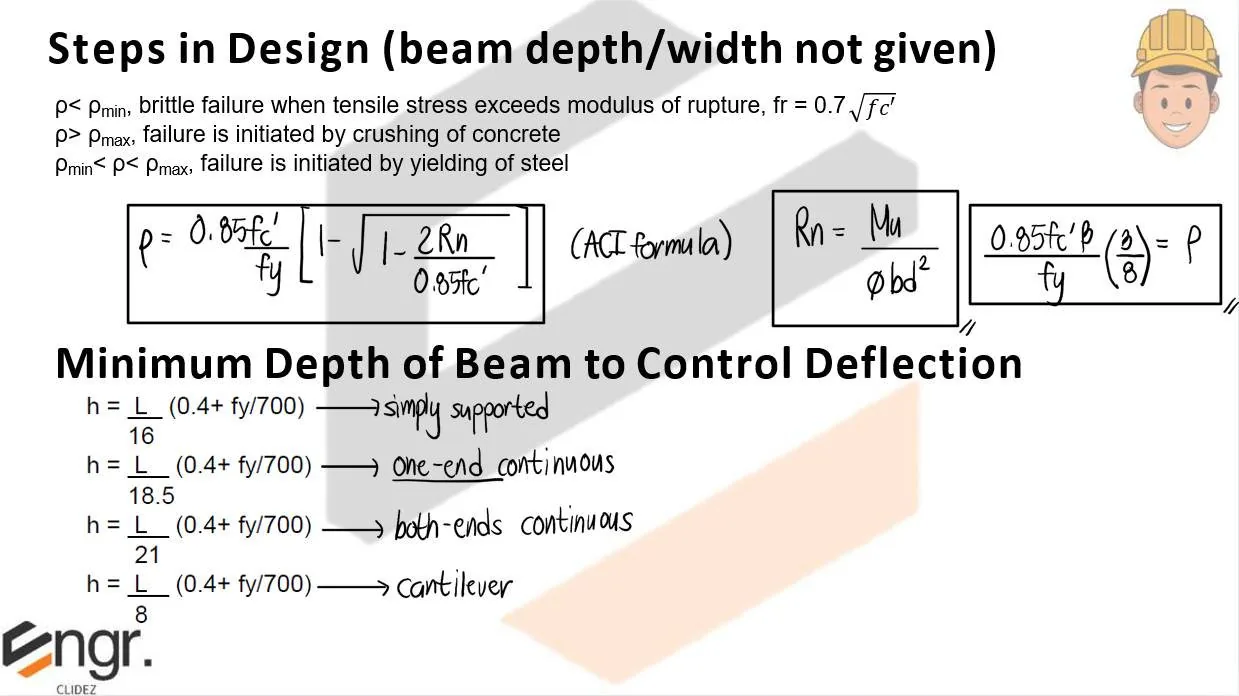
Steps in DESIGN of an SRRB:
- Compute the ultimate applied moment: $M_u = 1.2M_{DL}+1.6M_{LL}$.
- Compute the coefficient of resistance $R_n = M_u/(\phi b d^2)$ with $\phi=0.90$ assumed tension-controlled.
- Compute the actual steel ratio $\rho$ from the quadratic formula above.
- Compare with $\rho_\text{max}$ and $\rho_\text{min}$:
- If $\rho<\rho_\text{max}$, design as singly → proceed to step 5.
- If $\rho>\rho_\text{max}$, design as doubly.
- If $\rho<\rho_\text{min}$, use $\rho_\text{min}$.
- Compute the reinforcement area $A_s = \rho b d$.
- Check tension-controlled assumption: $a = A_s f_y/(0.85f'_c b)$, then $f_s = 600(d-c)/c$; if $f_s\ge 1000$ MPa, assumption holds.
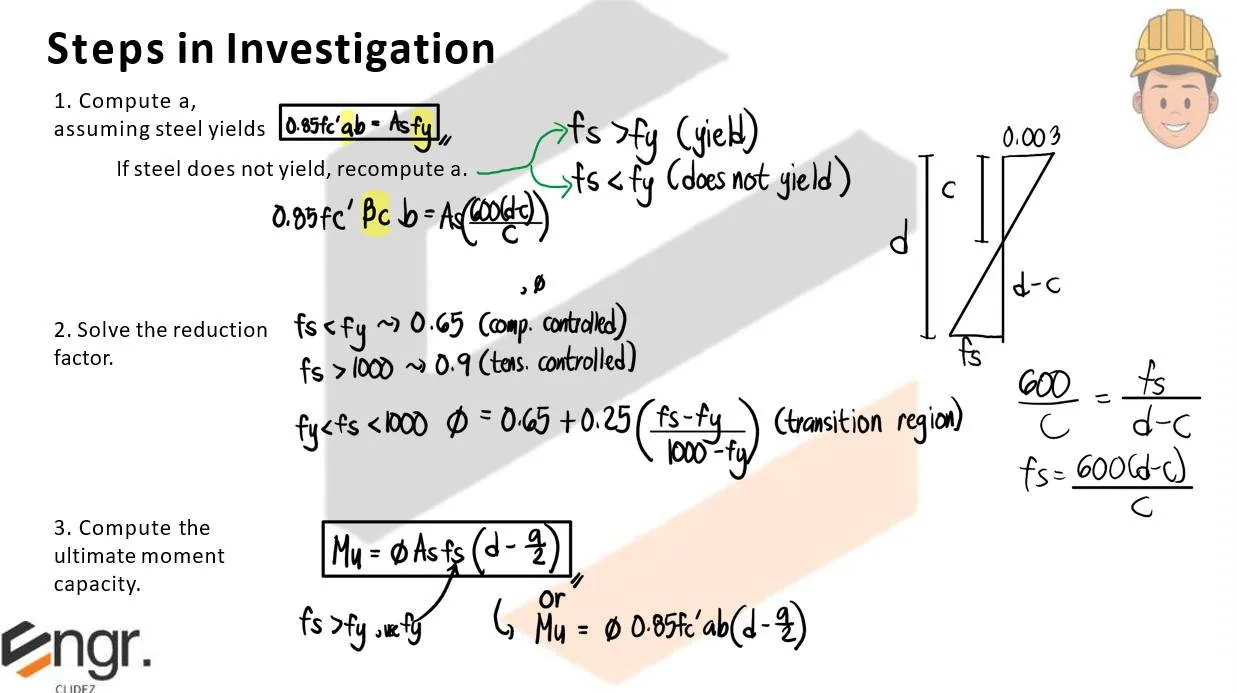
Steps in INVESTIGATION of an SRRB:
- Calculate $a$ and $c$, assuming steel yields: $a = A_s f_y/(0.85f'_c b)$, $c=a/\beta_1$.
- Check whether steel yields: $f_s = 600(d-c)/c$.
- If $f_s\ge f_y$, steel yields → use $f_s = f_y$.
- If $f_s
- Determine $\phi$ based on the computed $f_s$.
- Compute $\phi M_n = \phi\,0.85f'_c\,ab(d-a/2) = \phi A_s f_s(d-a/2)$.
Singly-Reinforced Beams
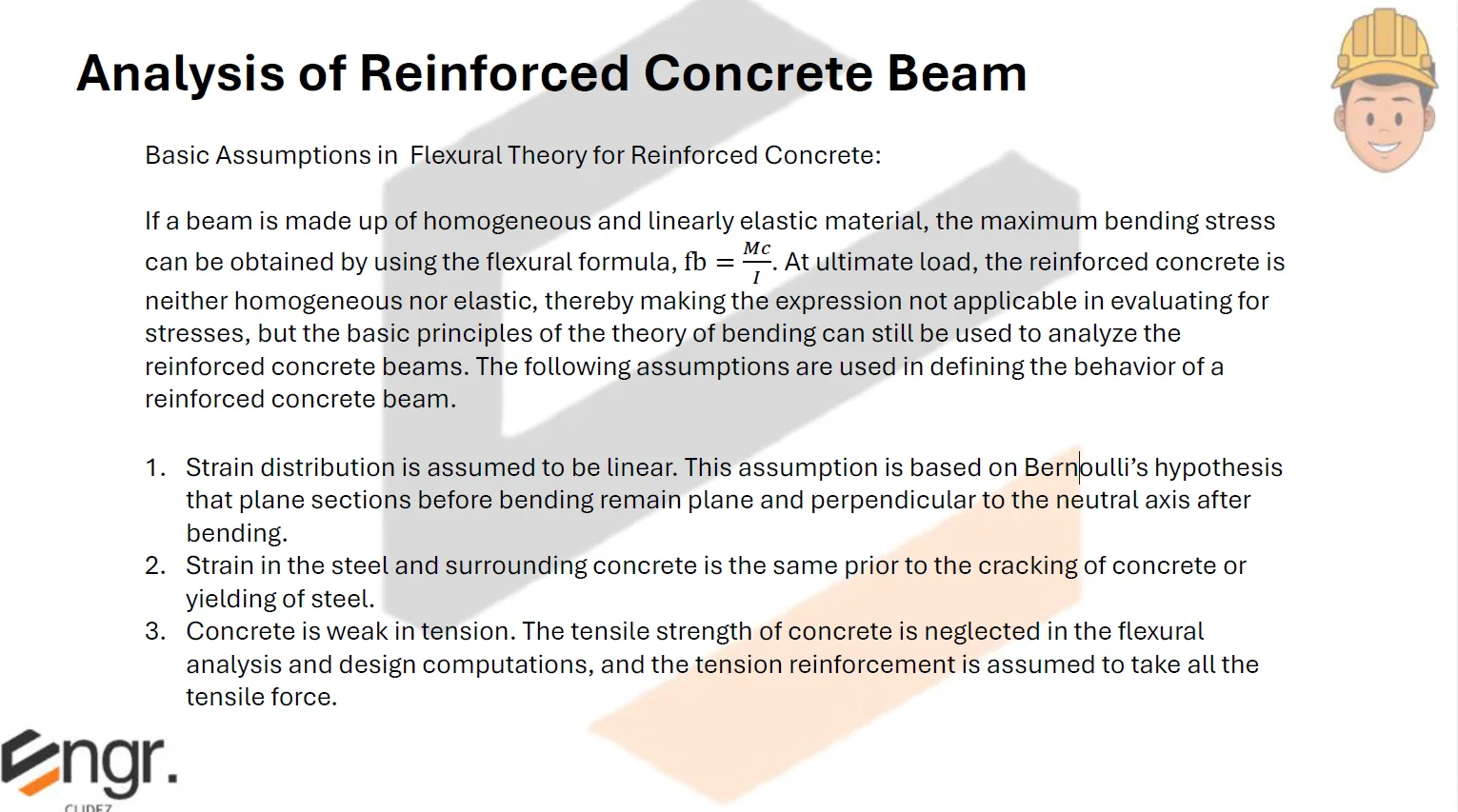
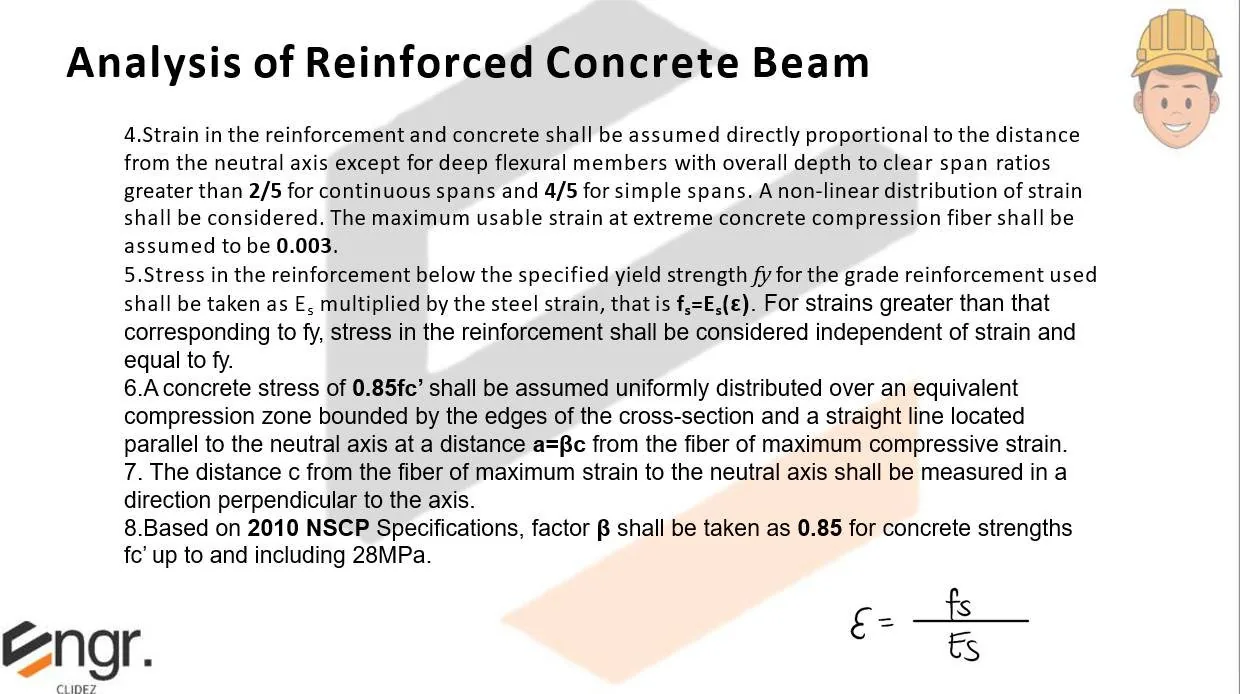
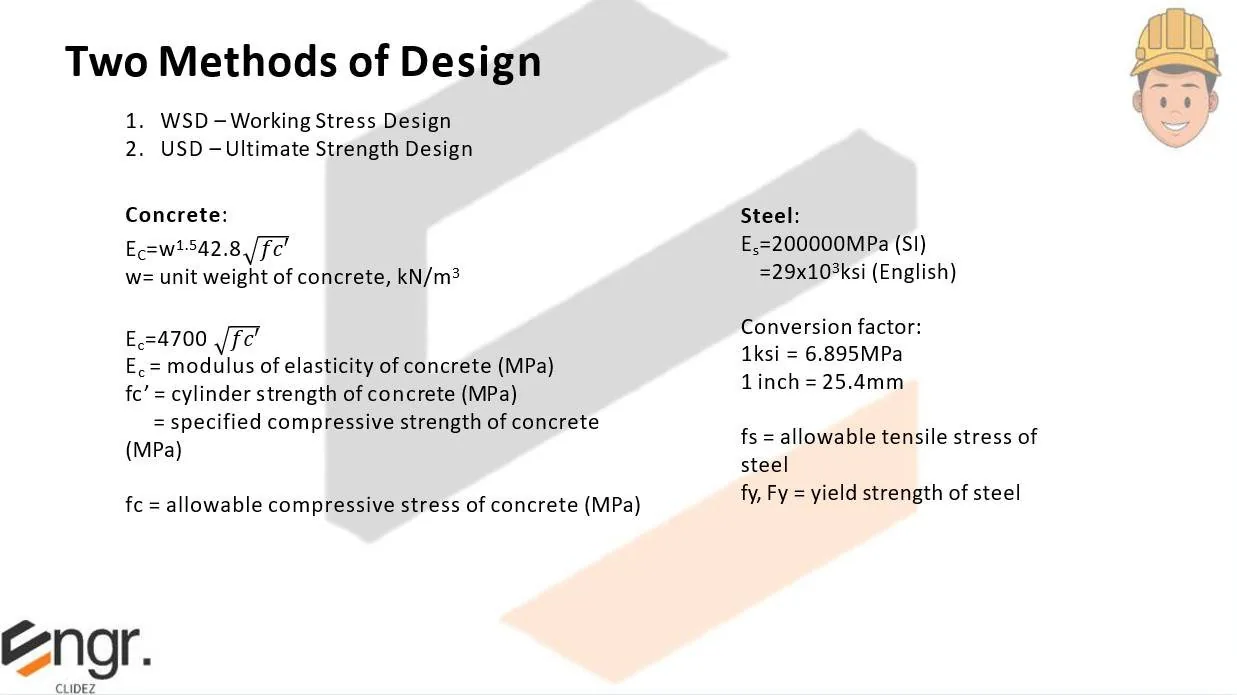
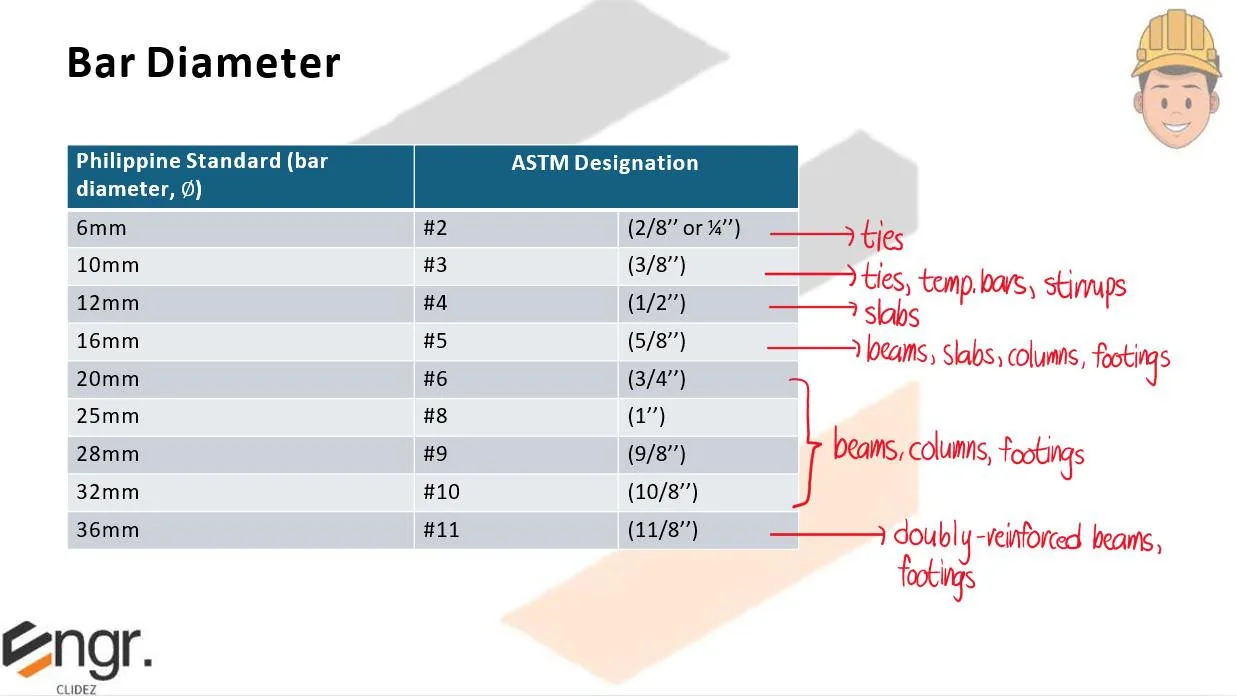
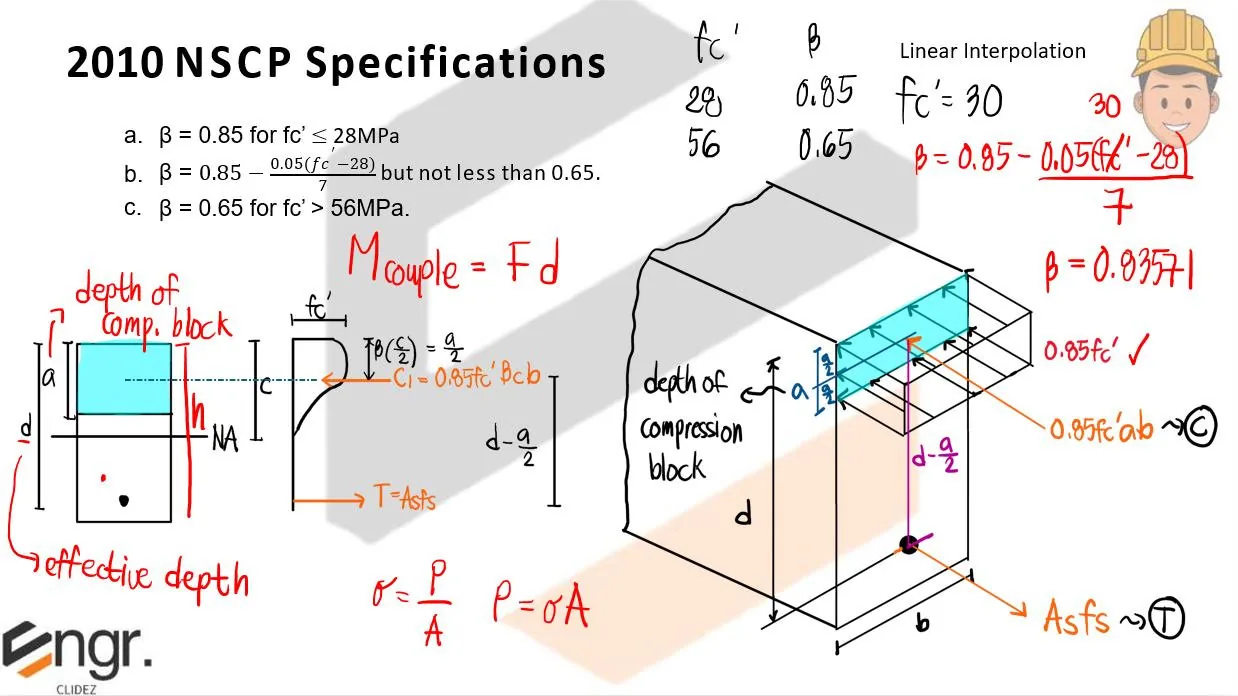
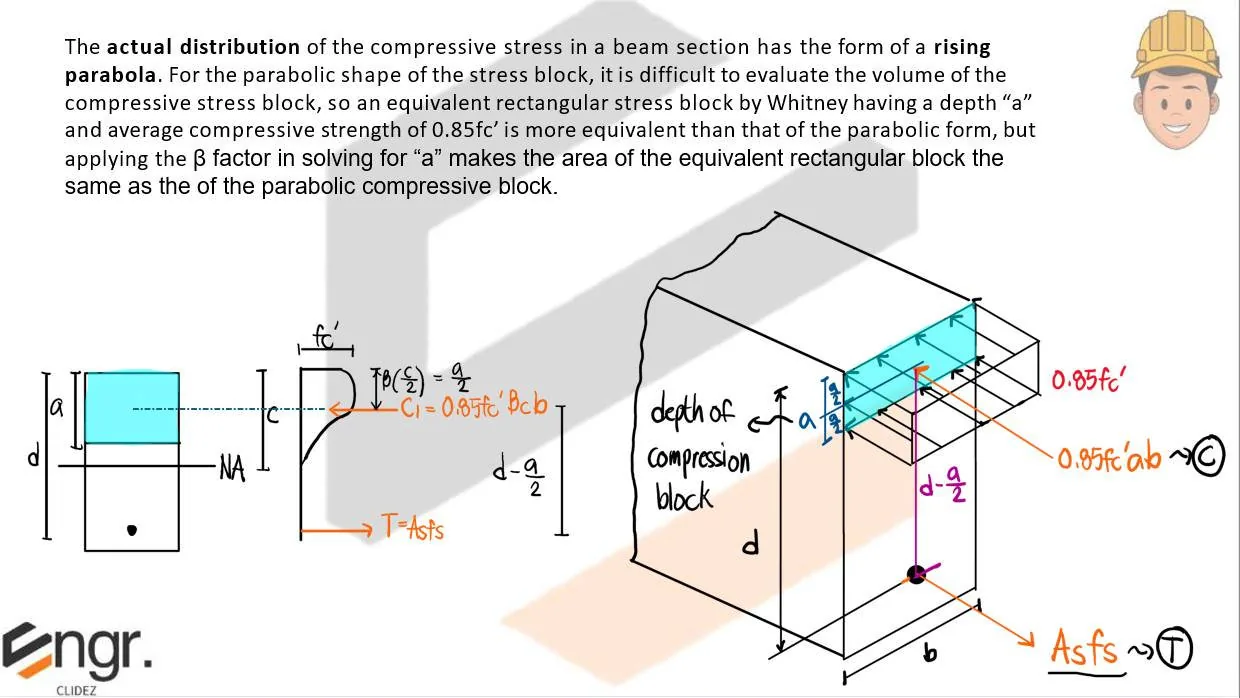
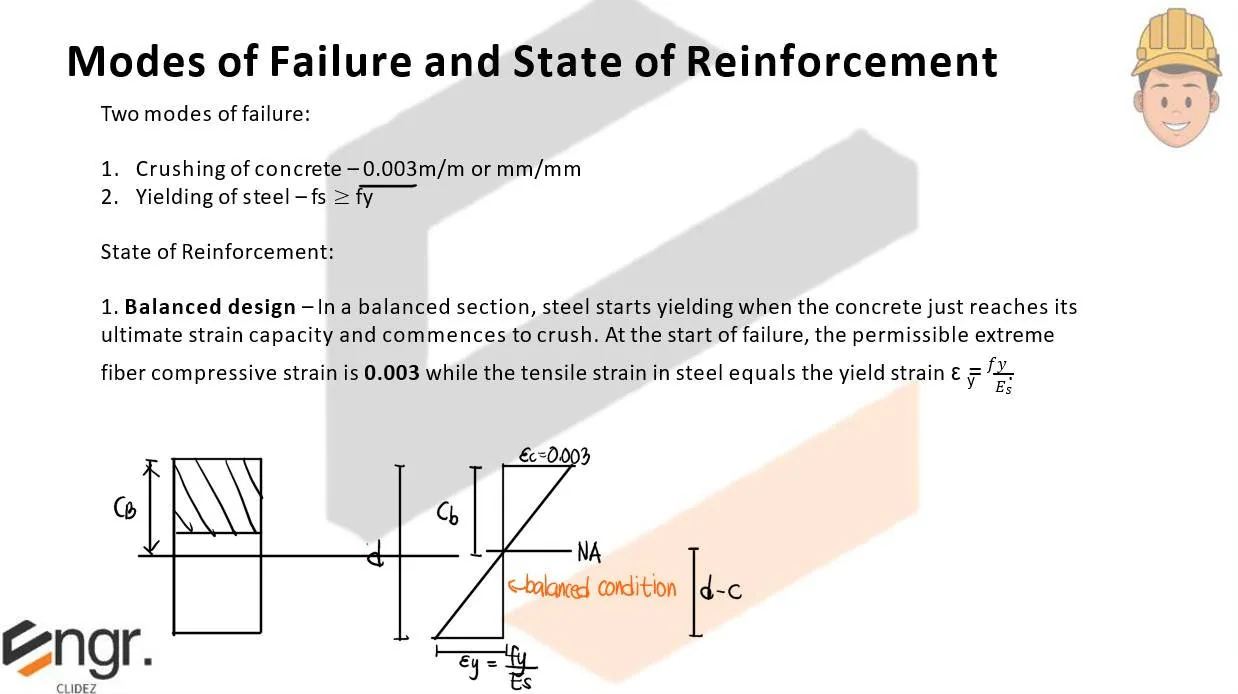
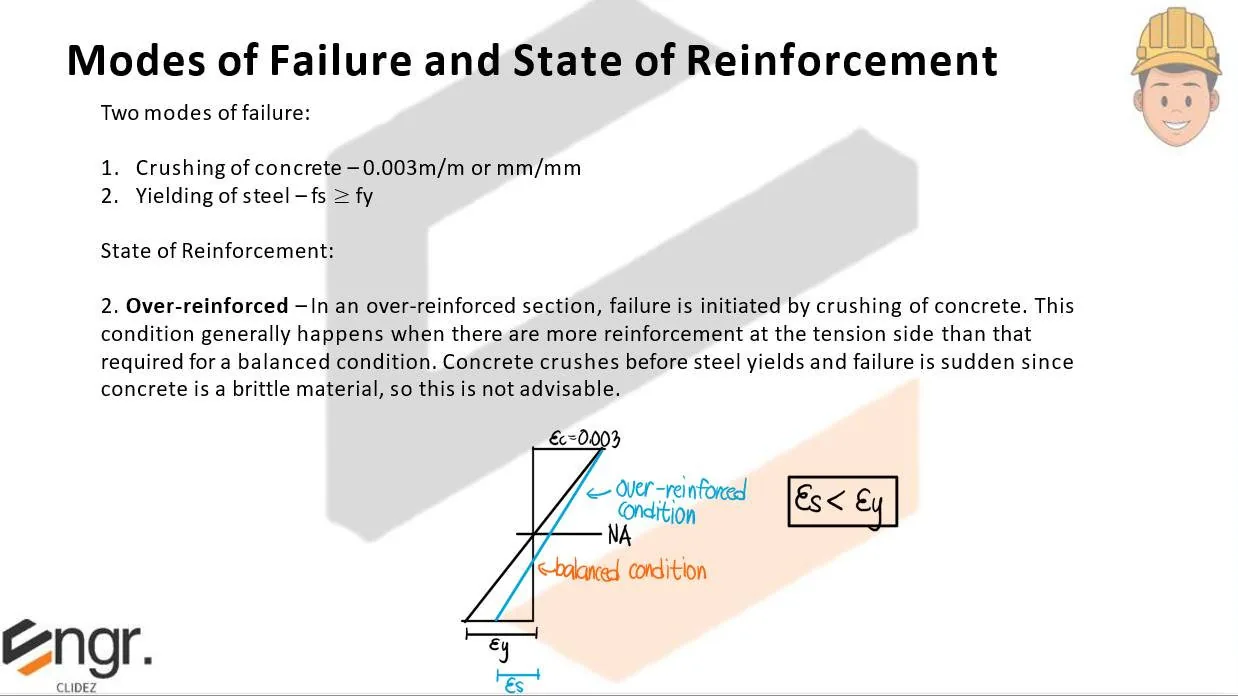
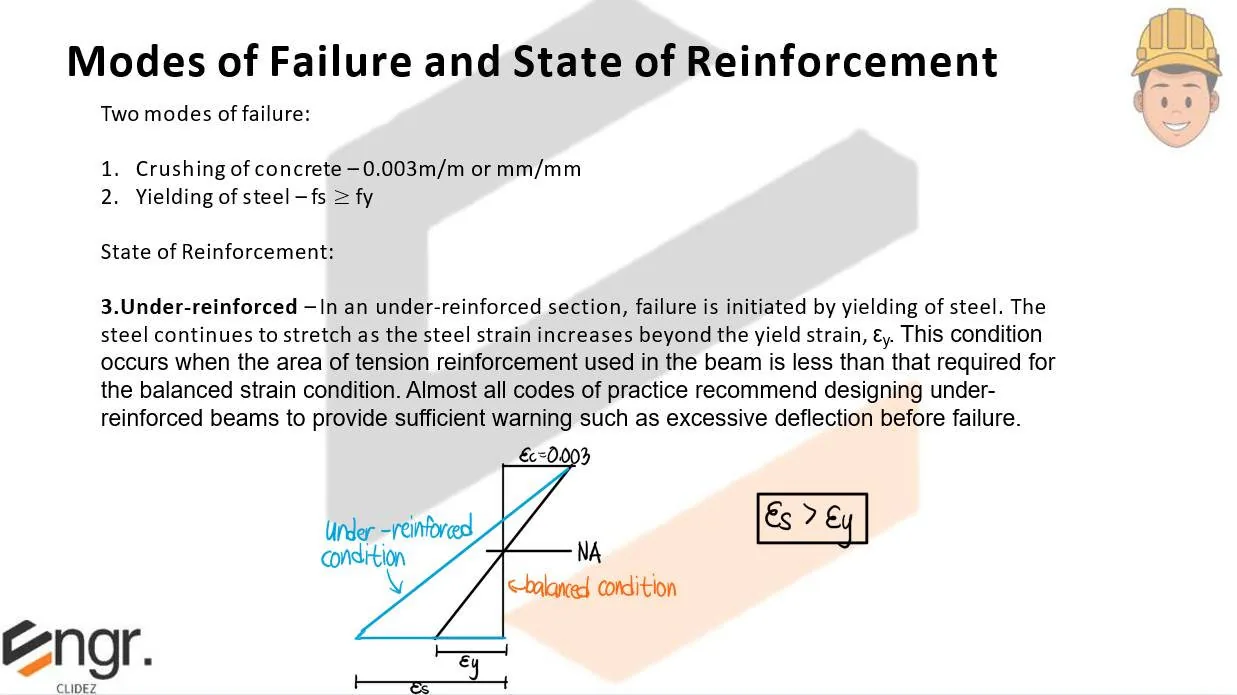
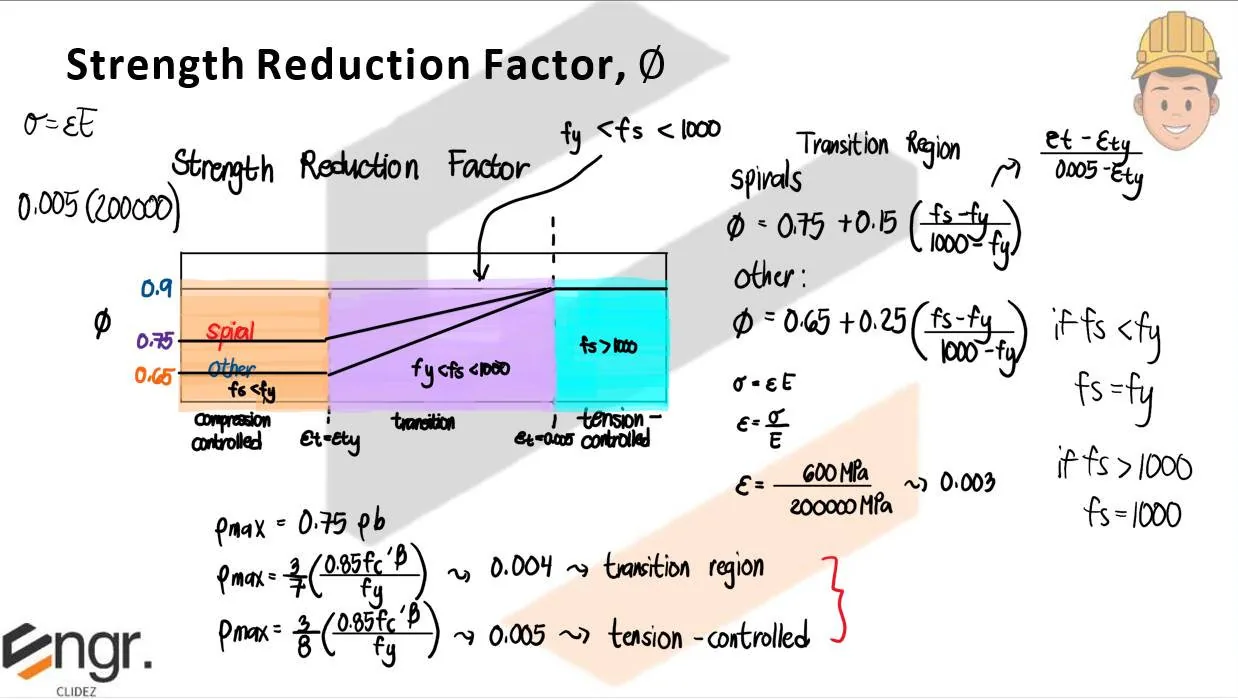
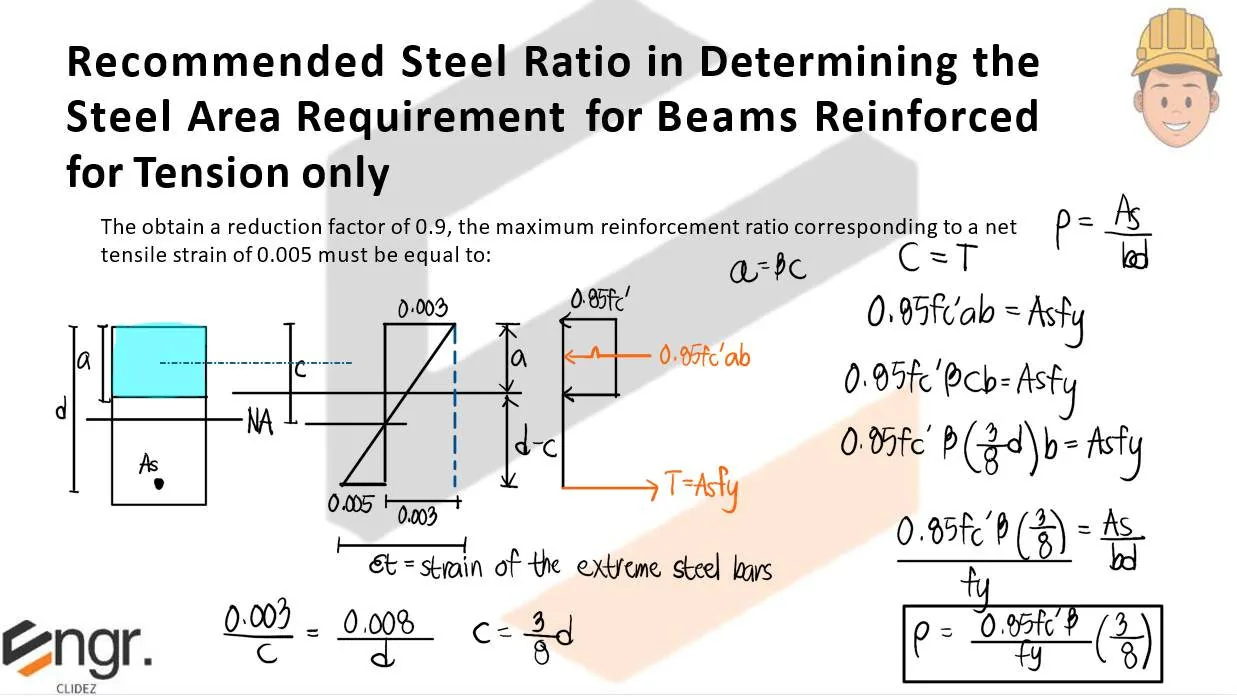
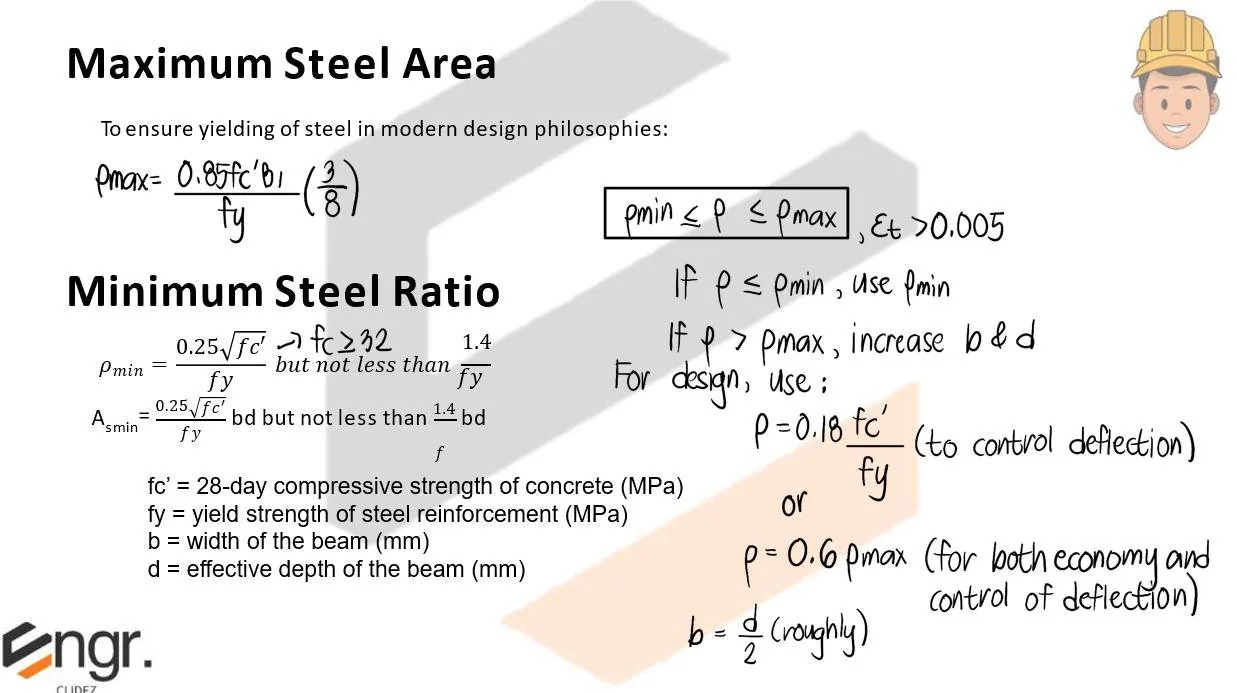
Formula Summary
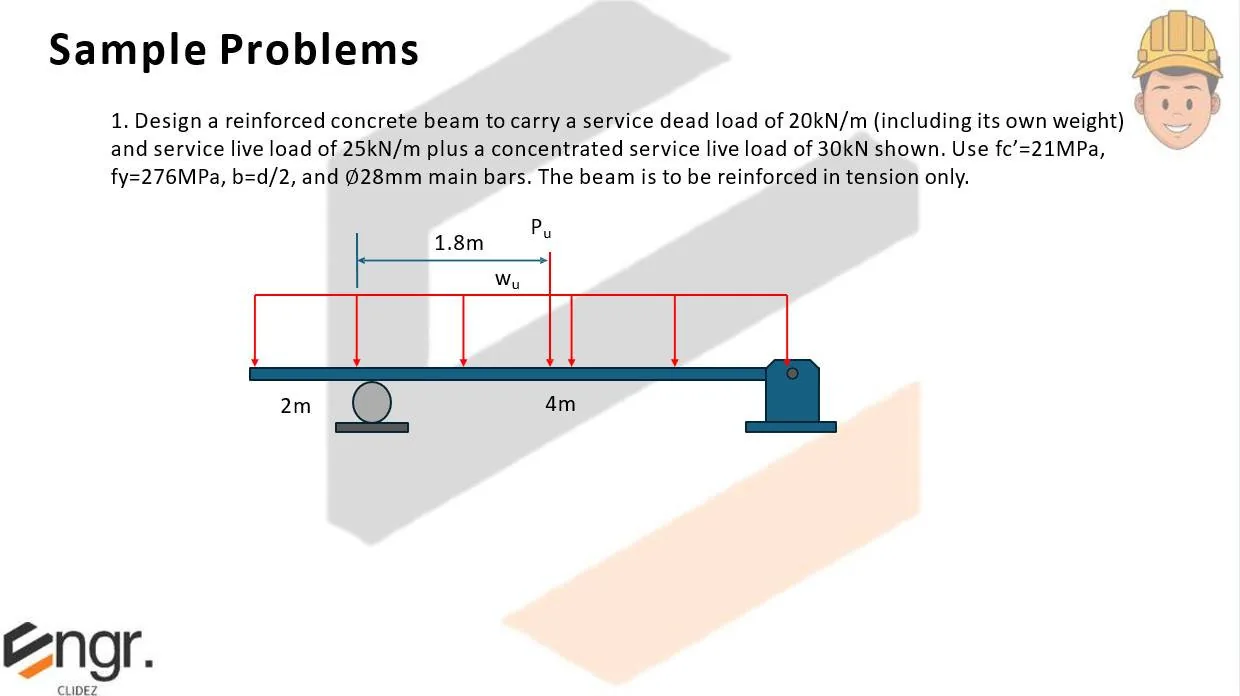
Problem: Design of a Reinforced Concrete Beam
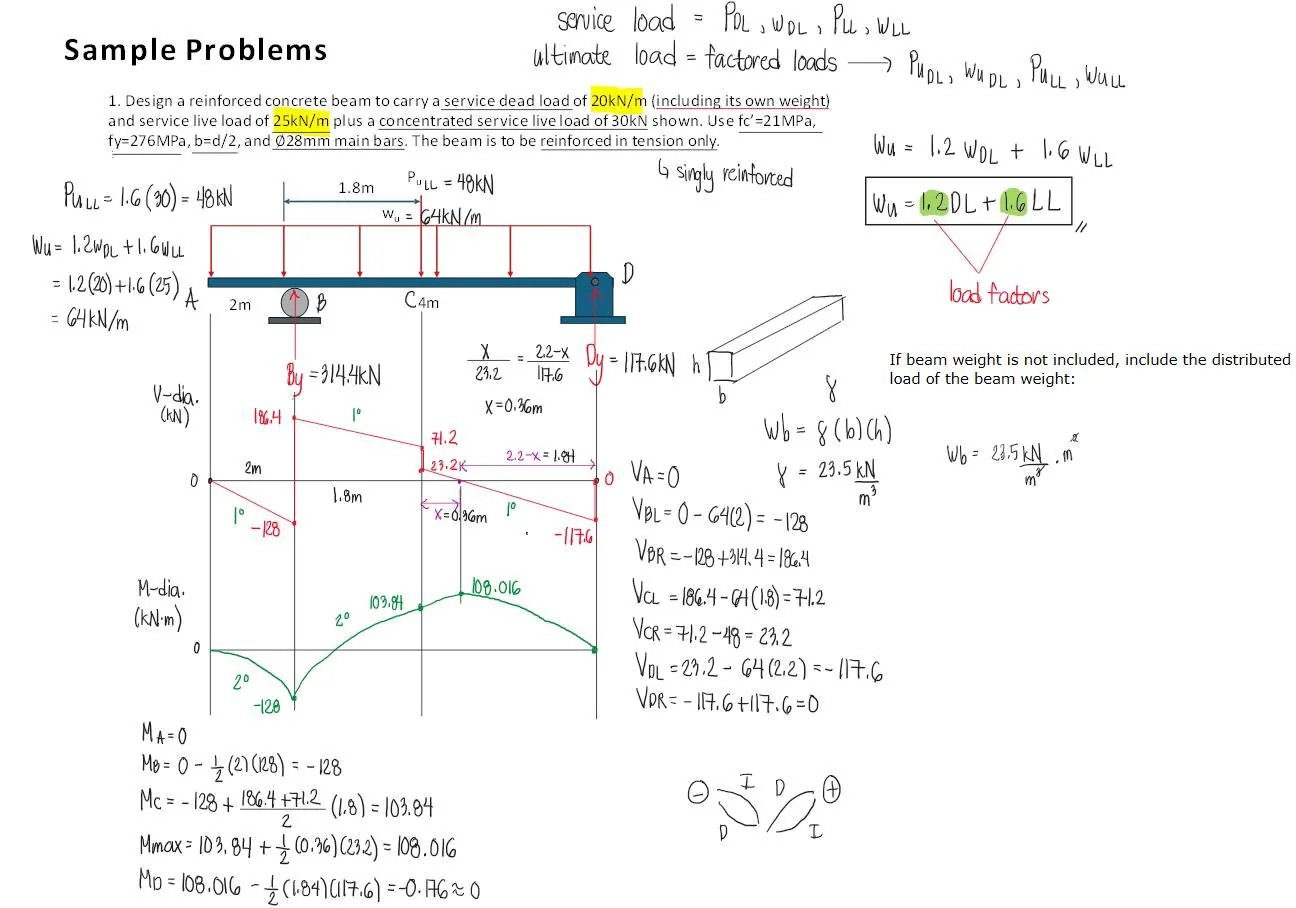
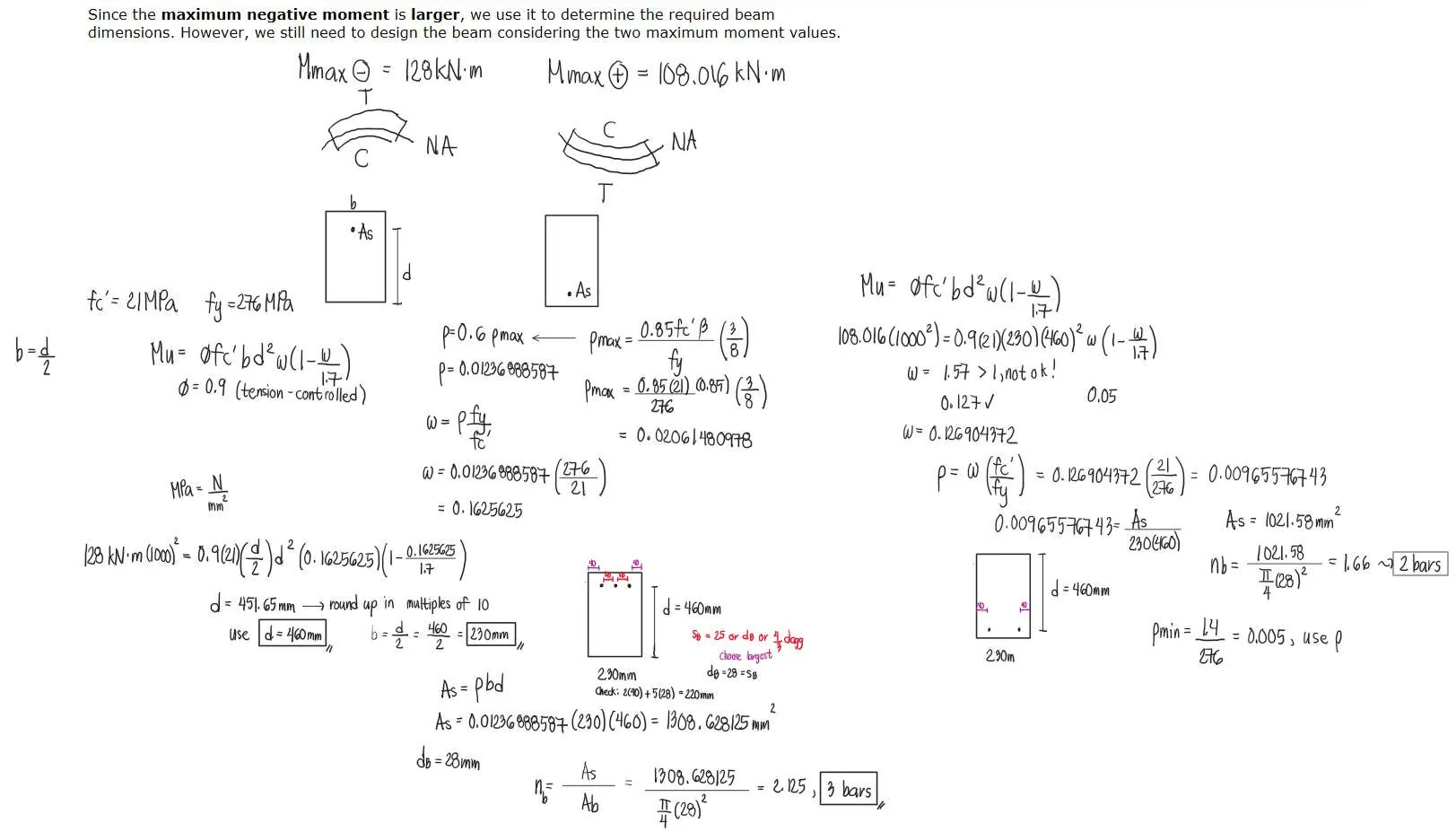
Design a reinforced concrete beam to carry a service dead load of 20kN/m (including its own weight) and service live load of 25kN/m plus a concentrated service live load of 30kN shown. Use f'c=21MPa, fy=276MPa, b=d/2, and ⌀=28mm main bars. The beam is to be reinforced in tension only.


See images:


Problem: Triangular Beam | Investigation Problem
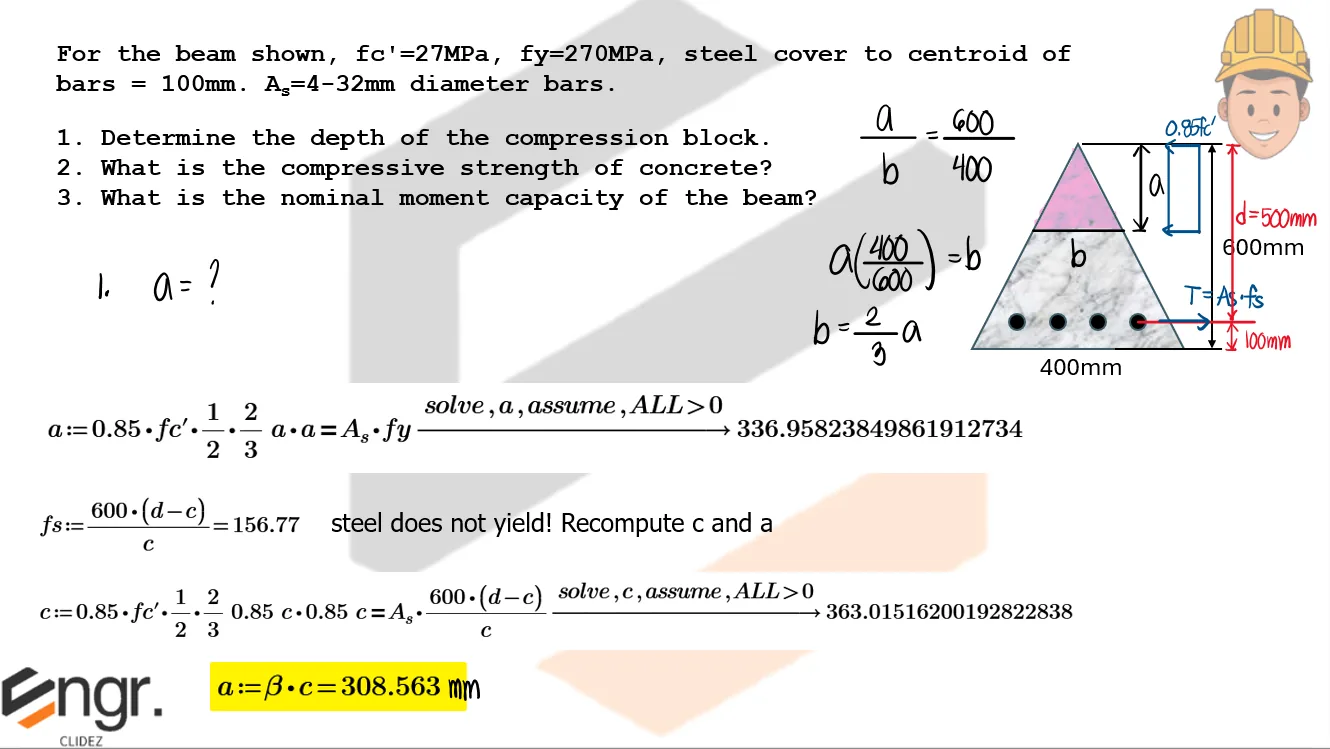
For the beam shown below, f'c=27MPa, fy=270MPa, steel cover to centroid of bars = 100mm. As=4-32mm diameter bars.
a. Determine the depth of the compression block.
b. What is the compressive strength of concrete?
c. What is the nominal moment capacity of the beam?
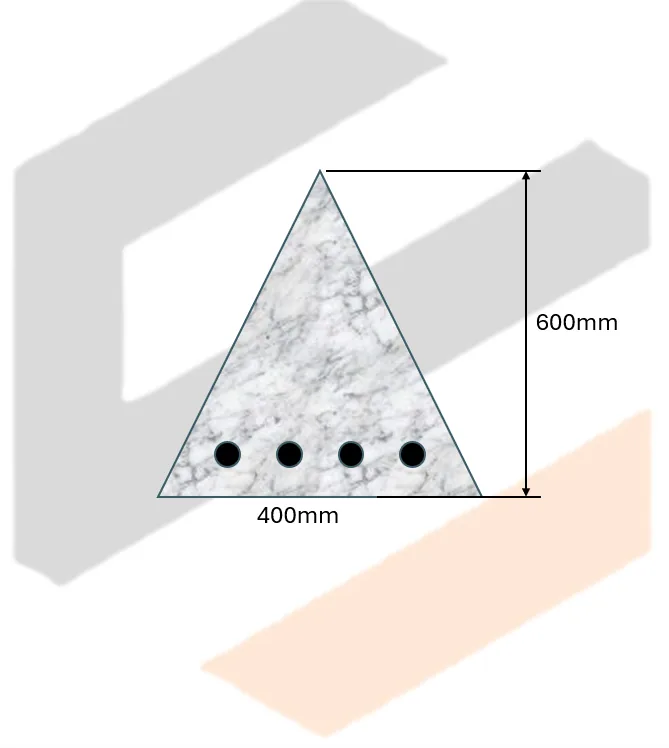


See images:
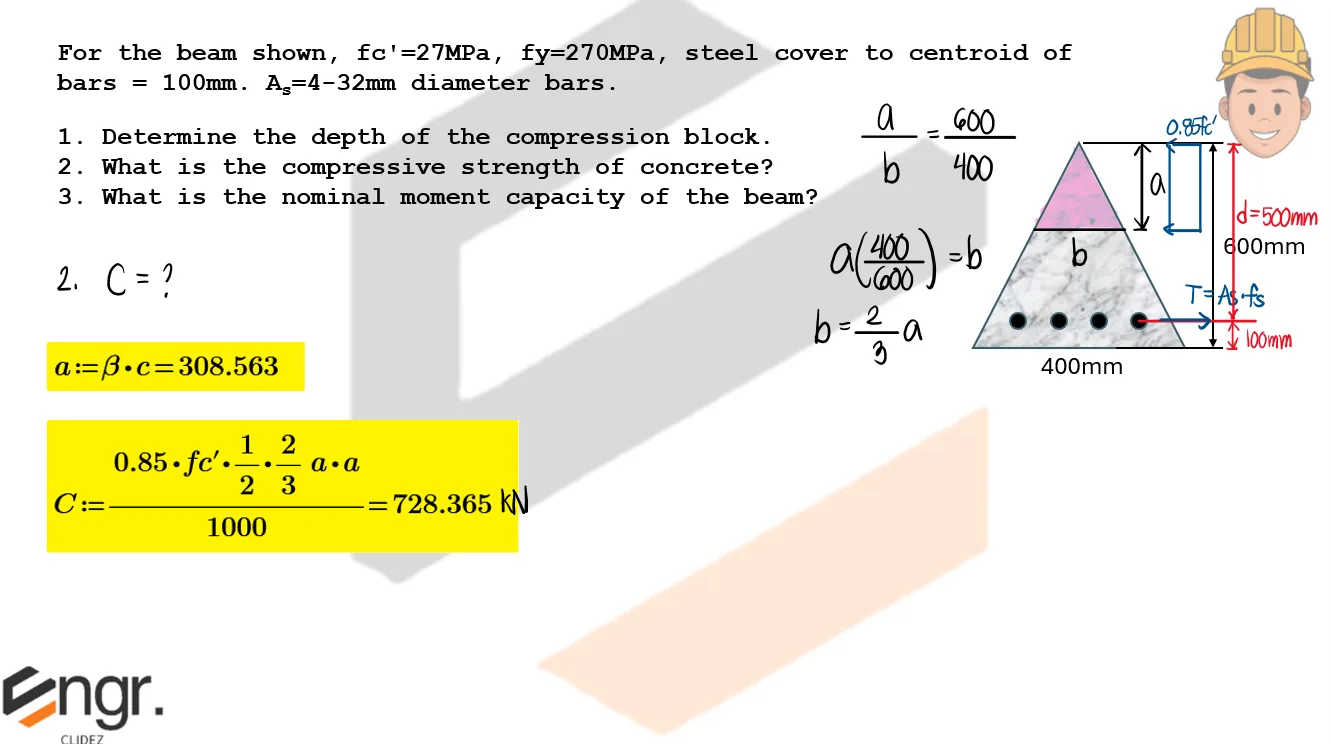
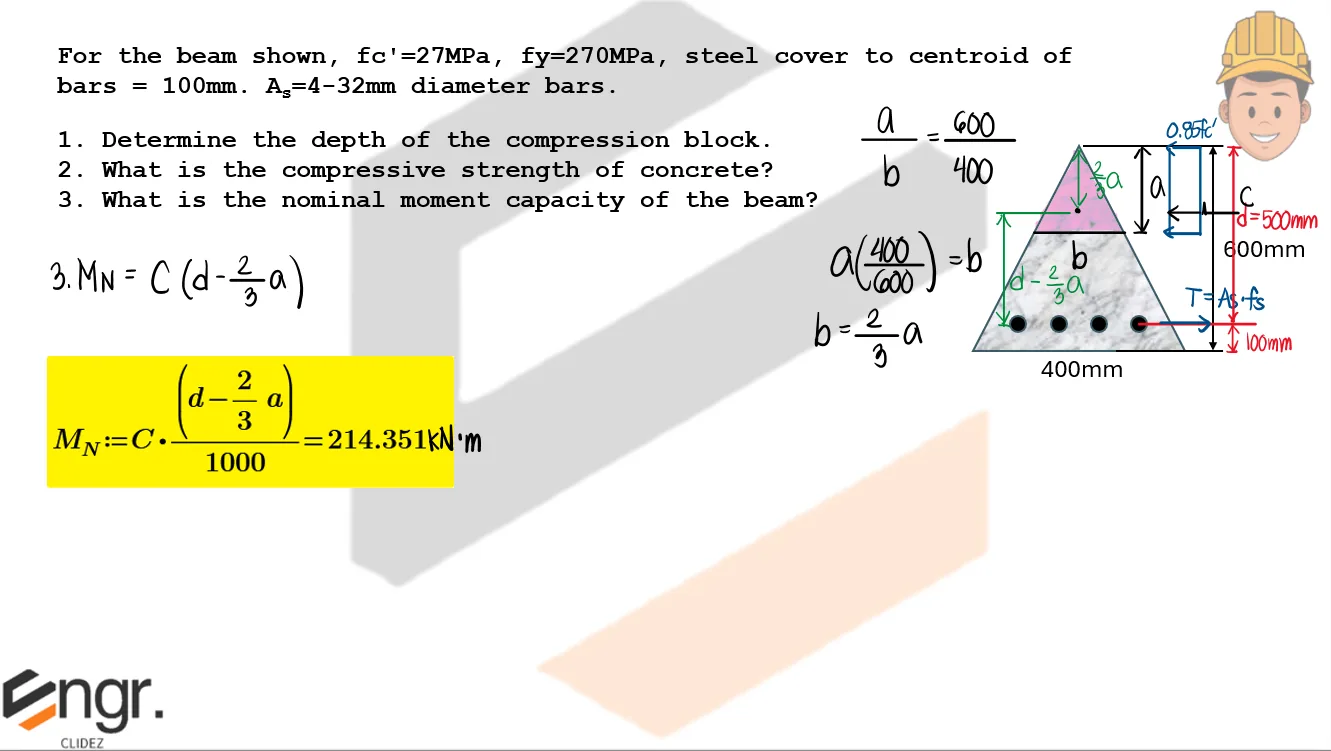

Problem: Rectangular Beam | Investigation Problem
The beam shown is reinforced with 3-28mm⌀ and its width is 300mm. The total height of the beam is 600mm. Assume that the clear cover is 40mm and 10mm⌀ stirrups are used. Use f'c=27.5MPa and fy=414MPa.
a. Compute the depth of the compression block in mm.
b. Determine the ultimate moment capacity of the beam section.
c. What additional service live load at the midspan can the beam carry in addition to a service dead load of 20kN/m (including its own weight)?
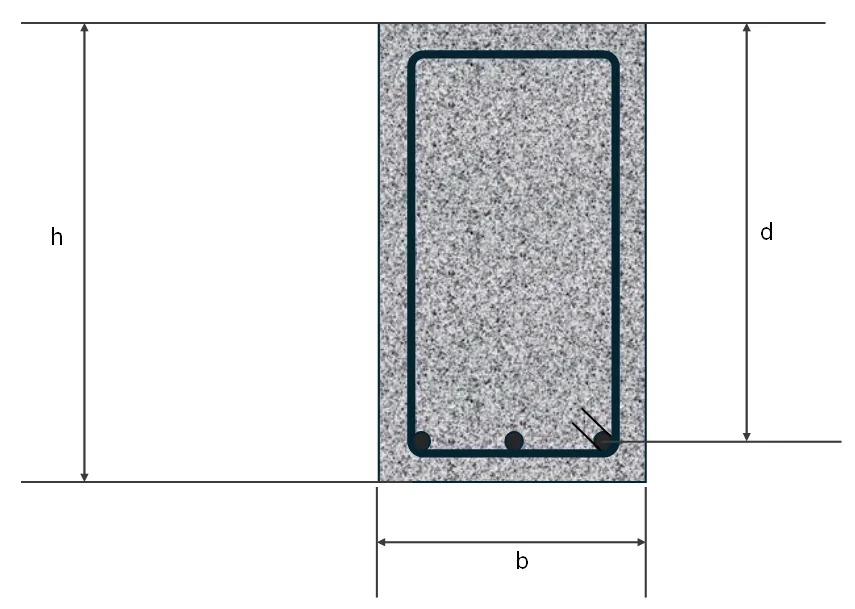


Beam Section and Ratio and Proportion based on strain converted to stresses:
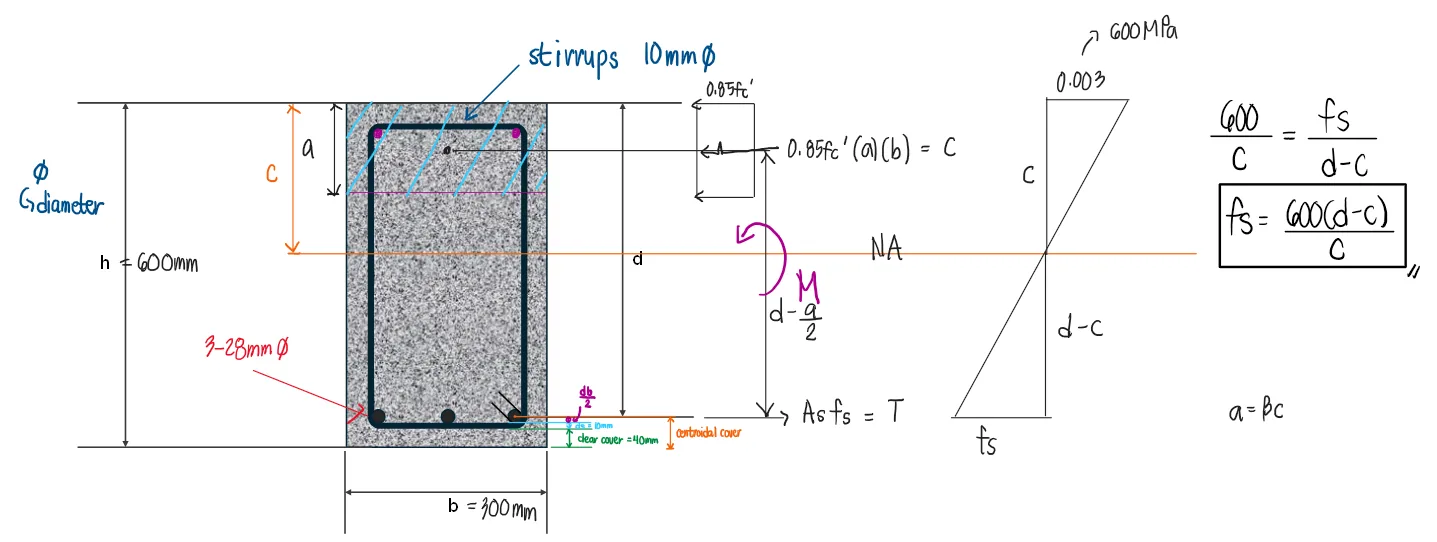
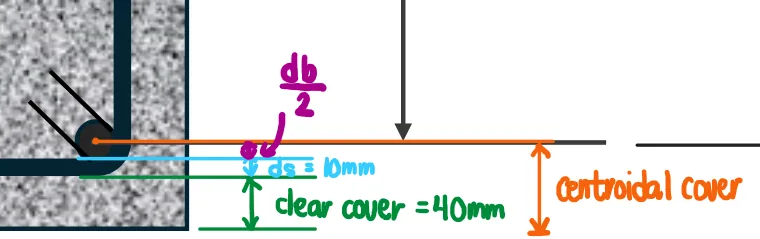
Zoomed-in View of the computation of the centroidal cover:
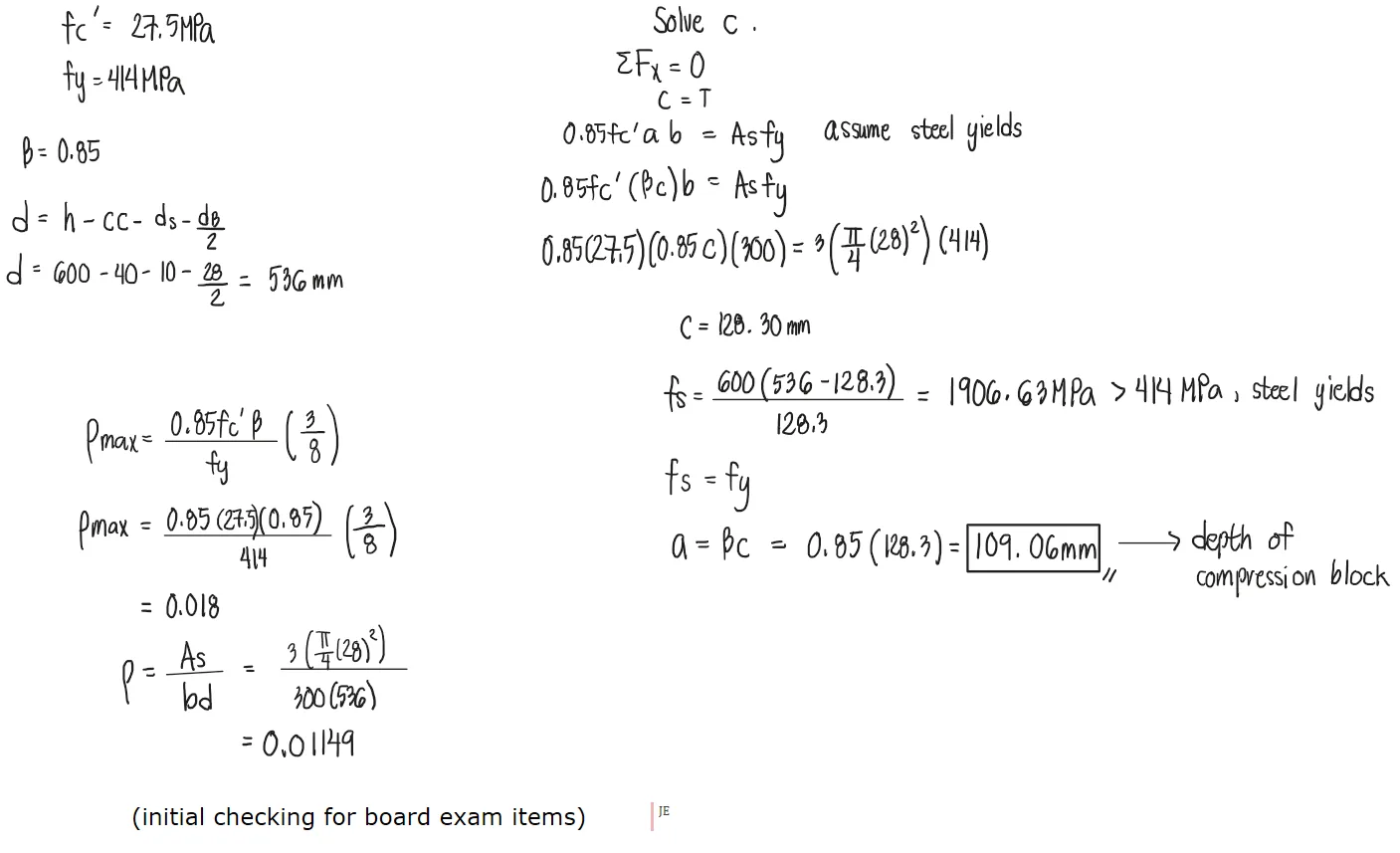
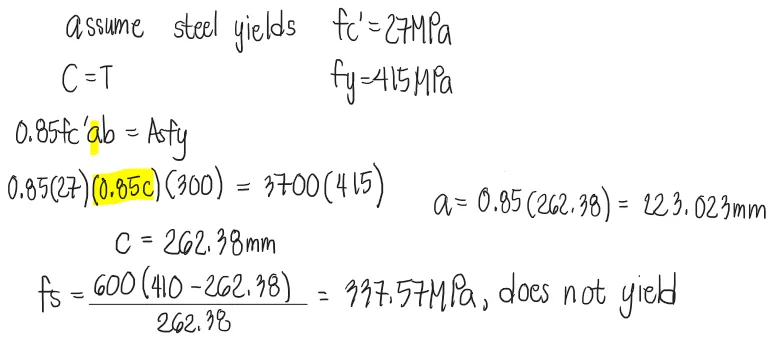
Compute c and check fs if steel yields. If fs > fy, steel yields and we can proceed computing the nominal moment capacity. However, if fs < fy, we must recompute c and express C=T in terms of c.
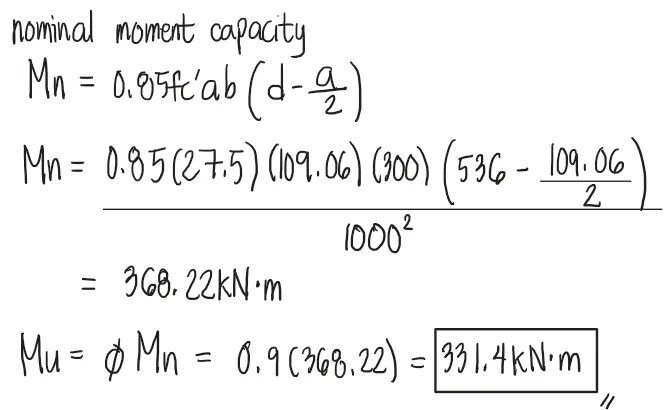
Since steel yields, we keep the value of a and compute the nominal moment capacity by taking the couple moment: $Force\times Distance$. Note that C and T are equal in magnitude and opposite in direction, so they induce a couple moment equivalent to any one of the forces multiplied by the distance between them.
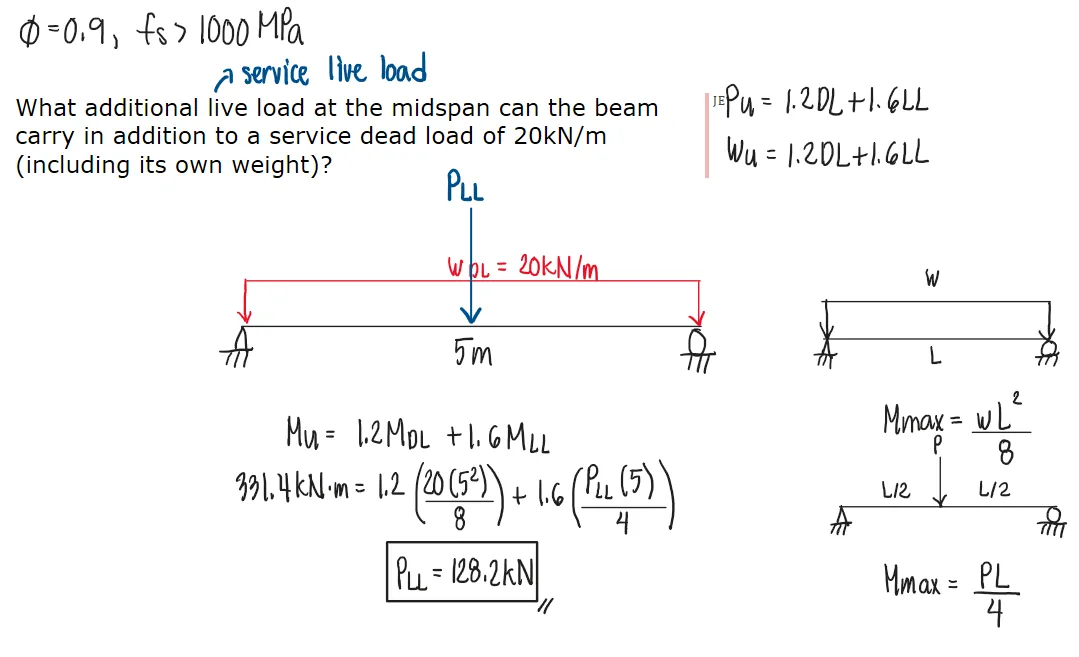
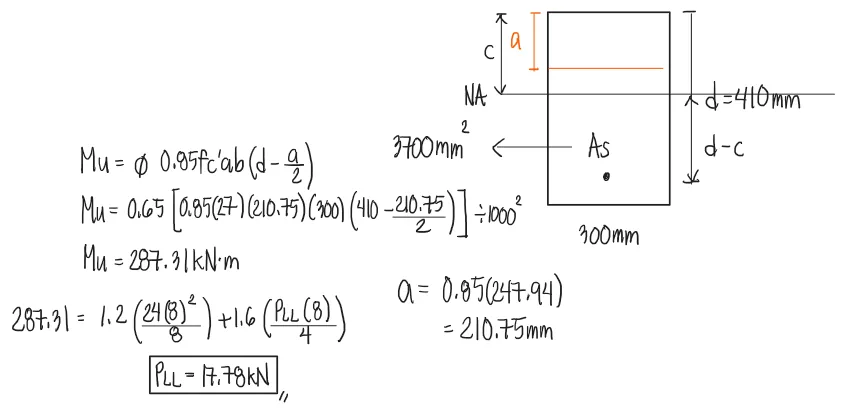
To compute the additional service live load at the midspan that the beam can carry in addition to a service dead load of 20kN/m, we first compute Mu since we must analyze beams at ultimate condition. To obtain Mu, simply multiply the nominal moment Mn by the reduction factor, Φ. Since fs exceeds 1000MPa, Φ=0.9 (tension-controlled). At ultimate condition, we also use the factored load combination: $1.2DL + 1.6LL$. Since the loadings are common, we can use the formulas: $\frac{PL}{4}$ and $\frac{w\cdot L^2}{8}$ for the maximum moments.
Problem: Rectangular Beam | Investigation Problem
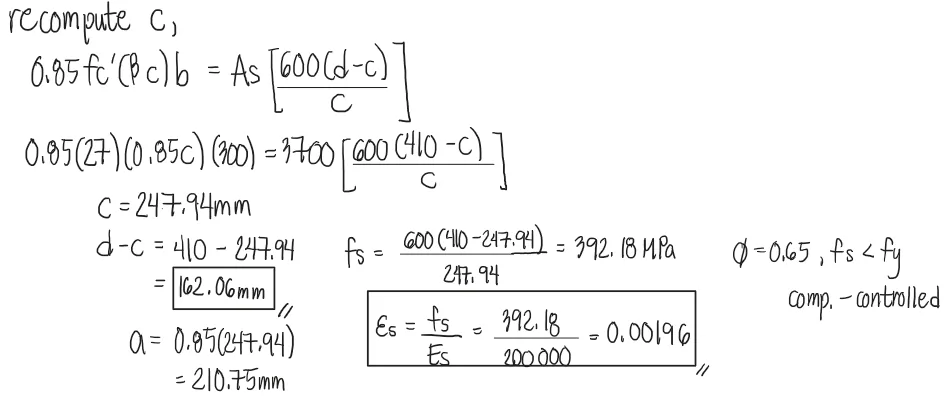
A reinforced concrete beam with width of 300mm and d=410mm is reinforced for tension with a reinforcement area of 3700mm2. Use f'c=27MPa and fy=415MPa.
a. Determine the distance (mm) of the steel reinforcements to the neutral axis.
A. 248
B. 162
C. 262
D. 148
b. Compute the tensile strain in the reinforcements.
A. 0.00196
B. 0.00169
C. 0.00122
D. 0.00244
c. If the beam is 8m long and is simply supported, find the concentrated service live load acting at the midspan that can be supported by the beam if it already carries a total service uniform dead load of 24kN/m.
A. 32.33
B. 52.32
C. 17.78
D. 66.13


See images:

Problem: Singly Reinforced Beam Investigation | Two Layers (3 along first row and 2 along second row)
The beam section shown has the following properties:
bar diameter, db = 25mm
total height, h = 600mm
center to center distance between first and second row bars, a = 27mm
f'c = 32MPa
fy = 414MPa
beam width, bw = 300mm
diameter of stirrups, ds = 12mm
clear cover, cc = 40mm
Determine the following:
a. The ultimate moment, Mu, that the beam can carry
b. The ultimate uniform load that the beam can carry if it has a simply supported span of 7m
c. The ultimate uniform dead load (wuDL) carried by the beam if the service live load is 10kN/m
d. What additional concentrated service live load at the midspan (PLL can the beam carry if it has a service dead load of 20kN/m (including its own weight) and a service live load of 12kN/m?


See images:


Problem: Investigation — Design Moment Capacity φMn
A singly reinforced rectangular beam has the following properties:
b = 280 mm, total height h = 500 mm, 4 – 22 mm ∅ bars (single row)
f'c = 21 MPa, fy = 414 MPa, clear cover = 40 mm, stirrups = 10 mm ∅
- Determine the effective depth d.
- Find the depth of the stress block a and the neutral axis depth c.
- Check whether the section is tension-controlled and determine φ.
- Compute the design moment capacity φMn.
#1 — Effective Depth
#2 — Stress Block and Neutral Axis
β1 = 0.85 (f'c = 21 MPa ≤ 28 MPa)
#3 — Strain Check (Tension-Controlled?)
εt = 0.00589 > 0.005 → Tension-controlled, φ = 0.90 ✓
#4 — Design Moment Capacity
Problem: Design — Using ρmax (ω Method)
Design a simply supported singly reinforced rectangular beam to carry a factored moment Mu = 240 kN·m. Use b = 400 mm, f'c = 28 MPa, fy = 414 MPa, and design for ρ = 0.5ρmax. Use 25 mm ∅ bars.
- Compute ρmax and the design ρ.
- Find the required effective depth d.
- Find the required As and number of bars.
#1 — ρmax and Design ρ
β1 = 0.85 (f'c = 28 MPa)
At ρ = 0.5ρmax, c/d = 0.5 × (3/8) = 0.1875 → εt ≈ 0.013 ≫ 0.005 → tension-controlled, φ = 0.90 ✓
#2 — Required Effective Depth (ω Method)
#3 — Steel Area and Bar Count
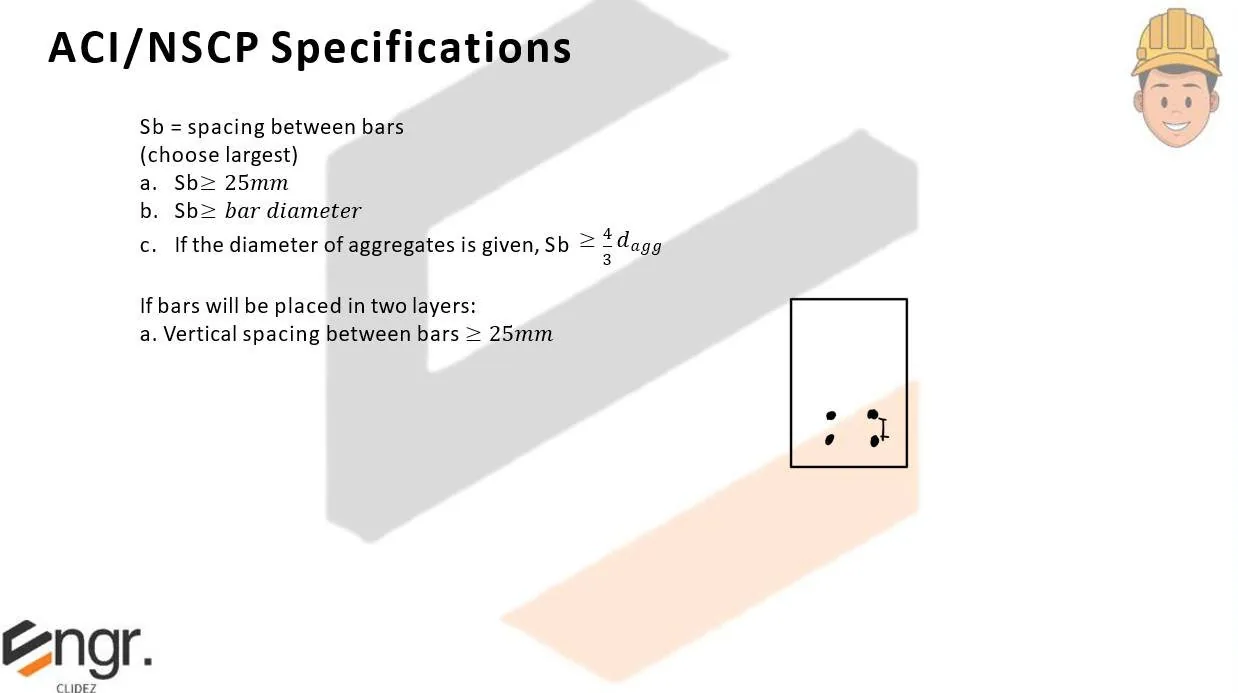
Spacing check (4 – 25mm bars, b = 400 mm, cc = 40, ds = 12): clear width used = 2(40)+2(12)+4(25)+3(26.67) = 284 mm < 400 mm ✓
Check As,min = larger of $\frac{0.25\sqrt{28}}{414}(400)(440)=566$ mm² and $\frac{1.4}{414}(400)(440)=598$ mm² → 598 mm² < 1613 mm² ✓
Problem: Investigation — Maximum Concentrated Live Load at Midspan
A simply supported beam has a span of 6 m and the following section properties: b = 300 mm, d = 460 mm, 3 – 25 mm ∅ bars (single row). f'c = 27.5 MPa, fy = 414 MPa. The service dead load (including self-weight) is 12 kN/m. Determine the maximum service concentrated live load P that can be applied at midspan.
Step 1 — Moment Capacity φMn
As = 3 × π/4(25)² = 1472.6 mm² | β1 = 0.85
Step 2 — Maximum Service P
For a simply supported beam with uniform DL and concentrated LL at midspan:
Problem: Design — ω Method (Uniform Dead + Live Load)
A simply supported beam has a span of 6 m and carries a service dead load of 16 kN/m (including self-weight) and a service live load of 20 kN/m. Use f'c = 27.5 MPa, fy = 414 MPa, b = 300 mm, and design for ρ = 0.5ρmax.
- Determine the factored design moment Mu.
- Find the required effective depth d.
- Find the required steel area As and the number of 20 mm ∅ bars needed.
#1 — Factored Moment
#2 — Required Effective Depth
β1 = 0.85 (f'c = 27.5 ≤ 28 MPa)
At ρ = 0.5ρmax, c/d = 0.5 × (3/8) = 0.1875 → εt ≈ 0.013 ≫ 0.005 → tension-controlled, φ = 0.90 ✓
#3 — Steel Area and Bar Count
Check As,min = larger of $\frac{0.25\sqrt{27.5}}{414}(300)(500) = 475$ mm² and $\frac{1.4}{414}(300)(500) = 507$ mm² → 507 mm² < 1350 mm² ✓
Problem: Investigation — Adequacy Check
A rectangular beam has b = 300 mm, total height h = 500 mm, and is reinforced with 4 – 22 mm ∅ bars. Clear cover = 40 mm, stirrups = 10 mm ∅. Use f'c = 28 MPa, fy = 414 MPa.
- Compute the depth of the compression block a and neutral axis depth c.
- Compute the design moment capacity φMn.
- Is the beam adequate for a 6 m simply supported span carrying service DL = 14 kN/m (including self-weight) and service LL = 18 kN/m?
#1 — Compression Block and Neutral Axis
Effective depth: d = 500 − 40 − 10 − 11 = 439 mm (cc + stirrup + half bar dia)
As = 4 × π/4(22)² = 1520.5 mm²
#2 — Design Moment Capacity
#3 — Adequacy Check
The beam IS adequate. The capacity exceeds the demand by 18.4 kN·m.
Problem: Investigation — Maximum Allowable Live Load
A simply supported beam spanning 8 m has b = 350 mm, h = 500 mm, and is reinforced with 3 – 28 mm ∅ bars at the bottom. Clear cover = 40 mm, stirrups = 10 mm ∅. Use f'c = 21 MPa, fy = 414 MPa. The service dead load (including self-weight) is 10 kN/m.
- Compute the design moment capacity φMn of the beam.
- Determine the maximum allowable service live load (kN/m) the beam can carry.
#1 — Moment Capacity
d = 500 − 40 − 10 − 14 = 436 mm | As = 3 × π/4(28)² = 1847.3 mm² | β1 = 0.85
#2 — Maximum Service Live Load
Problem: Investigation — Transition Zone φ
A singly reinforced rectangular beam has b = 280 mm, d = 430 mm, and is reinforced with 5 – 25 mm ∅ bars. Use f'c = 30 MPa, fy = 415 MPa.
- Compute ρ and compare with ρmax; determine whether the section is tension-controlled.
- Compute a, c, and the net tensile strain εt.
- Determine the appropriate φ factor and compute φMn.
#1 — Steel Ratio vs ρmax
As = 5 × π/4(25)² = 2454.4 mm² | β1 = 0.85 − 0.05(30−28)/7 = 0.8357
#2 — Compression Block and Strain
Since εy = 415/200,000 = 0.002075 < εt = 0.00456 < 0.005 → Transition zone
#3 — Reduced φ and φMn
Note: Using φ = 0.9 would give 328.2 kN·m — a 4.1% overestimate. Always check εt against 0.005.
Problem: Design — Given Mu Directly
Design a singly reinforced rectangular beam to resist a design moment of Mu = 300 kN·m. Use f'c = 21 MPa, fy = 415 MPa, b = 300 mm. Design for ρ = 0.6ρmax.
- Compute ρmax and the design ρ.
- Find the required effective depth d.
- Find the required As and select 25 mm ∅ bars.
#1 — ρmax and Design ρ
β1 = 0.85 (f'c = 21 < 28 MPa)
At ρ = 0.6ρmax, c/d = 0.6 × (3/8) = 0.225 → εt ≈ 0.010 ≫ 0.005 → tension-controlled, φ = 0.90 ✓
#2 — Required Depth
#3 — Steel Area
Check As,min = larger of $\frac{0.25\sqrt{21}}{415}(300)(600) = 496$ mm² and $\frac{1.4}{415}(300)(600) = 607$ mm² → 607 mm² < 1481 mm² ✓
Problem: Investigation — Steel Does NOT Yield (Overreinforced Beam)
A rectangular beam has b = 200 mm, d = 350 mm, and is reinforced with As = 3600 mm². Use f'c = 20.7 MPa, fy = 275 MPa.
- Compare ρ with ρmax and determine whether the steel yields at ultimate.
- If steel does not yield, find the neutral axis depth c by solving the equilibrium equation.
- Compute the design moment capacity φMn.
#1 — Check if Steel Yields
β1 = 0.85 (f'c = 20.7 < 28 MPa)
#2 — Find Neutral Axis (C = T, with fs unknown)
Since fs < fy, use $f_s = 600(d-c)/c$ and set C = T:
Solving via quadratic formula:
#3 — Design Moment Capacity
εt = 0.003(350−258)/258 = 0.00107 < εy = 0.001375 → compression-controlled → φ = 0.65
An overreinforced beam is not permitted by NSCP for new designs (ρ must not exceed ρmax). This problem illustrates the analysis procedure when such a section is encountered in investigation.
Exam Generator Problems
Additional board-style practice items for this topic.
Question Bank: q37
A reinforced concrete beam with b=300mm and d=525mm is reinforced with 5-25mm⌀ bars. Use fc'=21MPa and fy=415MPa.
Which of the following gives the failure classification of the section?
- Transition Controls
- Compression Controls
- Bending Controls
- Tension Controls
Calculate the tensile force (in kN) of the tension reinforcements.
- 1018
- 2346
- 1982
- 767
Calculate the design moment capacity of the beam in kN-m.
- 358
- 245
- 441
- 313
Part 1. $a=T/(0.85f'_cb)=190.1\text{ mm}$ and $c=a/0.85$. The tensile strain is $\epsilon_t=0.003(d-c)/c\approx0.0040$, which lies between 0.002 and 0.005; therefore the section is transition controlled.
Part 2. $T=\boxed{1018\text{ kN}}$.
Part 3. $M_n=T(d-a/2)$ and the transition strain gives the corresponding $\phi$ factor. Thus $\phi M_n=\boxed{358\text{ kN-m}}$.
Question Bank: q42
Precast joists with typical section as shown are cast using a concrete strength, f'c=27.5MPa. THe resulting tensile strength, ft=2.75MPa. The joists are to be simply supported on a span of 6m. Unit weight of concrete = 23.5kN/m3
GIven data:
a=200mm
b=500mm
c=150mm
d=200mm
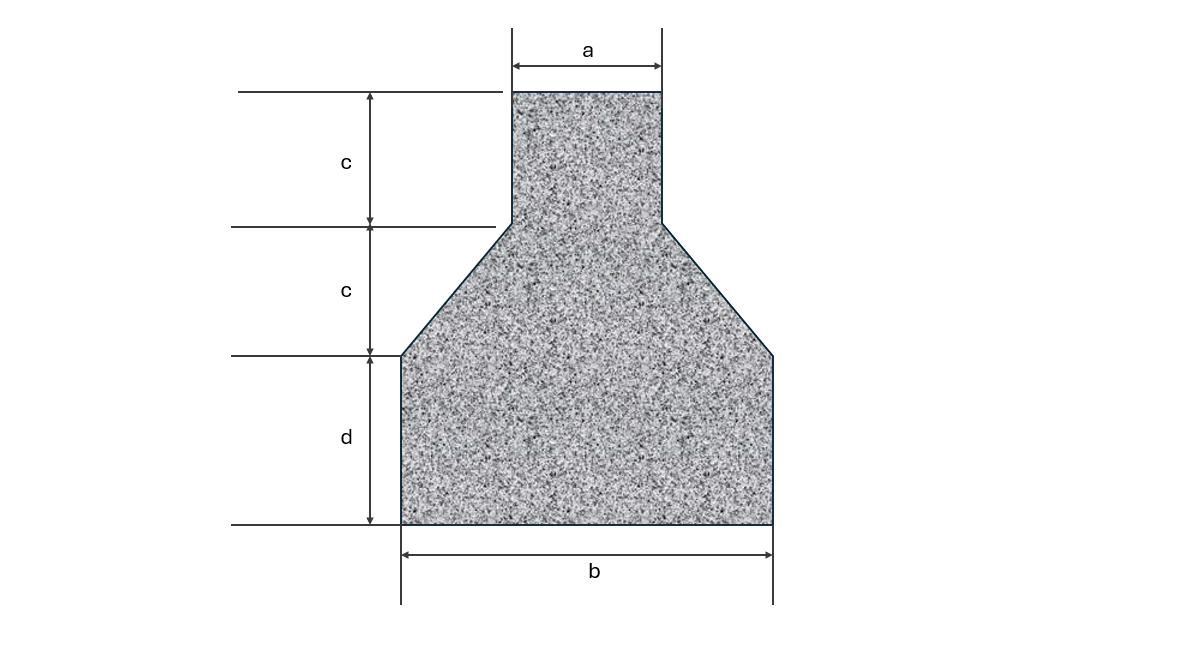
Determine the cracking moment in kN-m.
- 44.09
- 47.08
- 43.67
- 49.32
How much uniform load can the joist safely carry (not including its own weight) if the cracking moment in the beam is 40kN-m?
- 4.6
- 5.8
- 3.2
- 6.3
If the joists are reinforced with 3-25mm⌀ bars with their centroid located at 435mm from the top, determine the cracking moment (kN-m) use modular ratio, n=8.
- 48.3
- 49.6
- 47.5
- 50.2
Part 1. $M_{cr}=f_tI_g/y_t=\boxed{44.09\text{ kN-m}}$.
Part 2. The self-weight is $w_g=23.5(0.1825)=4.29\text{ kN/m}$. Set $(w_g+w_s)L^2/8=40\text{ kN-m}$ for the 6-m span. Thus $w_s=\boxed{4.6\text{ kN/m}}$.
Part 3. Transform the three 25-mm bars with $n=8$, recompute the neutral axis and $I_{tr}$, then use $M_{cr}=f_tI_{tr}/y_t$. The result is $\boxed{48.3\text{ kN-m}}$.
Question Bank: q44
CE Board Nov. 2022
A concrete beam has a depth of 600mm and a width of 300mm. The concrete compressive strength, f'c is 34MPa and the tensile strength ft=3.4MPa.
Calculate the cracking moment of the section.
- 61.2
- 62.1
- 63.4
- 64.3
If the beam is cast with provision for a 180mm diameter pipe located concentrically, calculate the new cracking moment of the section.
- 60.62
- 60.26
- 60.78
- 60.87
If the beam is cast with provision for a square duct 85mmx85mm locatead concentrically, calculate the new cracking moment of the section.
- 61.15
- 61.51
- 63.45
- 63.54
Part 1. $M_{cr}=f_tS=3.4(18.0)=\boxed{61.2\text{ kN-m}}$.
Part 2. For the concentric circular opening, subtract $I_h=\pi(180)^4/64$ from the gross inertia, retain $c=300\text{ mm}$, and compute $f_tI_{net}/c=\boxed{60.62\text{ kN-m}}$.
Part 3. For the concentric square duct, subtract $I_h=85^4/12$ instead. The resulting cracking moment is $\boxed{61.15\text{ kN-m}}$.
Question Bank: q580
A reinforced concrete beam with width of 300mm and d=410mm is reinforced for tension with a reinforcement area of 3700mm2. Use f'c=27MPa and fy=415MPa.
Determine the distance (mm) of the steel reinforcements to the neutral axis.
- 162
- 248
- 262
- 148
Compute the tensile strain in the reinforcements.
- 0.00300
- 0.00196
- 0.00122
- 0.00244
If the beam is 8m long and is simply supported, find the concentrated service live load acting at the midspan that can be supported by the beam if it already carries a total service uniform dead load of 24kN/m.
- 17.78
- 32.33
- 66.13
- 52.32
$$d-c=410-248=162\text{ mm}$$
Using the ultimate concrete strain of $0.003$, the tensile reinforcement strain is:
$$\epsilon_s=0.003\left(\frac{d-c}{c}\right)=0.003\left(\frac{162}{248}\right)=0.00196$$
Use this strain to obtain the steel stress and the moment capacity, then apply the applicable service-load combination to the 8-m simply supported beam:
$$M_{service}=\frac{24(8)^2}{8}+P_L\frac{8}{4}$$
Solving for the allowable midspan service live load gives:
$$P_L=17.78\text{ kN}$$
Therefore, the answers are 162 mm, 0.00196, and 17.78 kN.