CE Board Exam Randomizer

⬅ Back to Subject Topics

Thin-walled Pressure Vessels

$$\text{When} \frac{d}{t}\ge 20 $$
Where d = diameter of the vessel and t=thickness of the wall
The stresses between the inner and outer surfaces of the wall vary by less than 5%.This is what we generally consider a thin-walled pressure vessel.

Circumferential/Tangential Stress

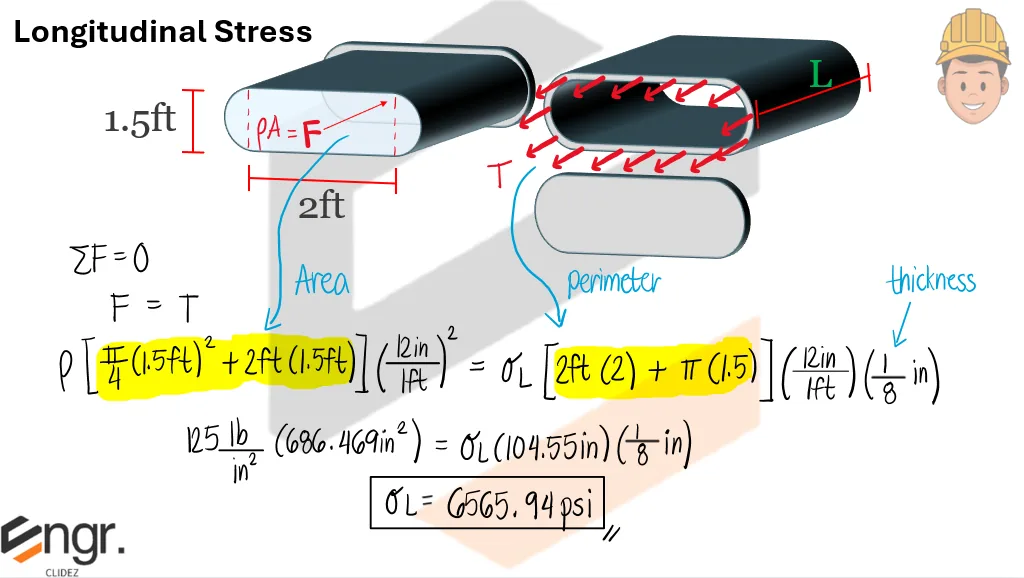
Longitudinal Stress

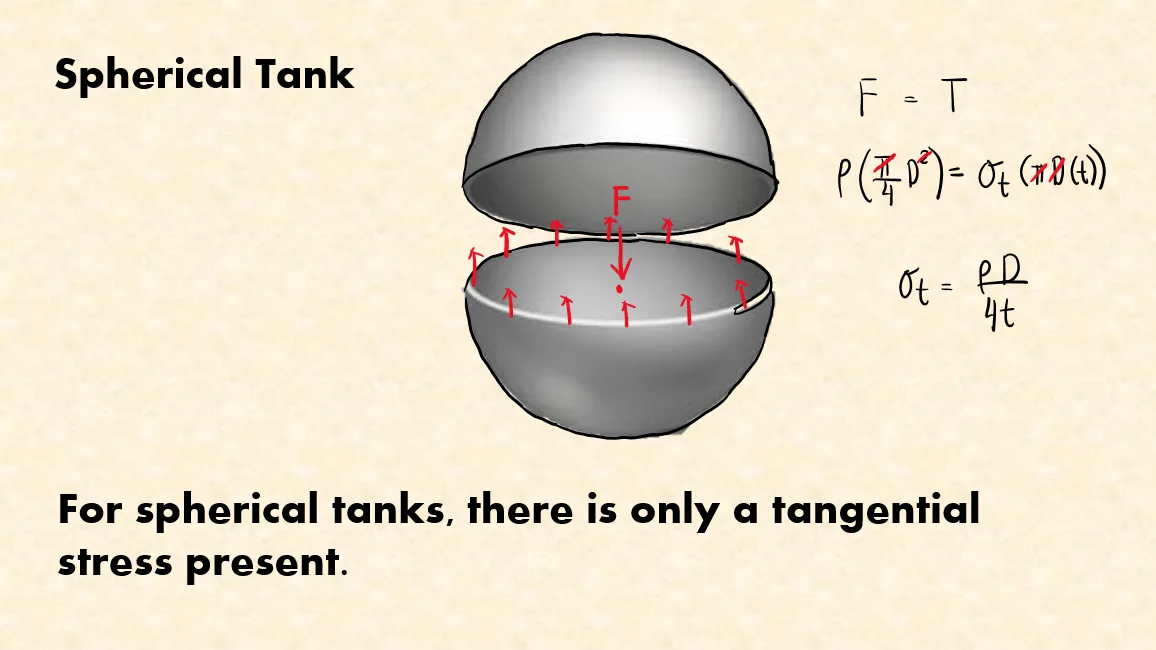
Thin-walled Spherical Vessels

Diagram

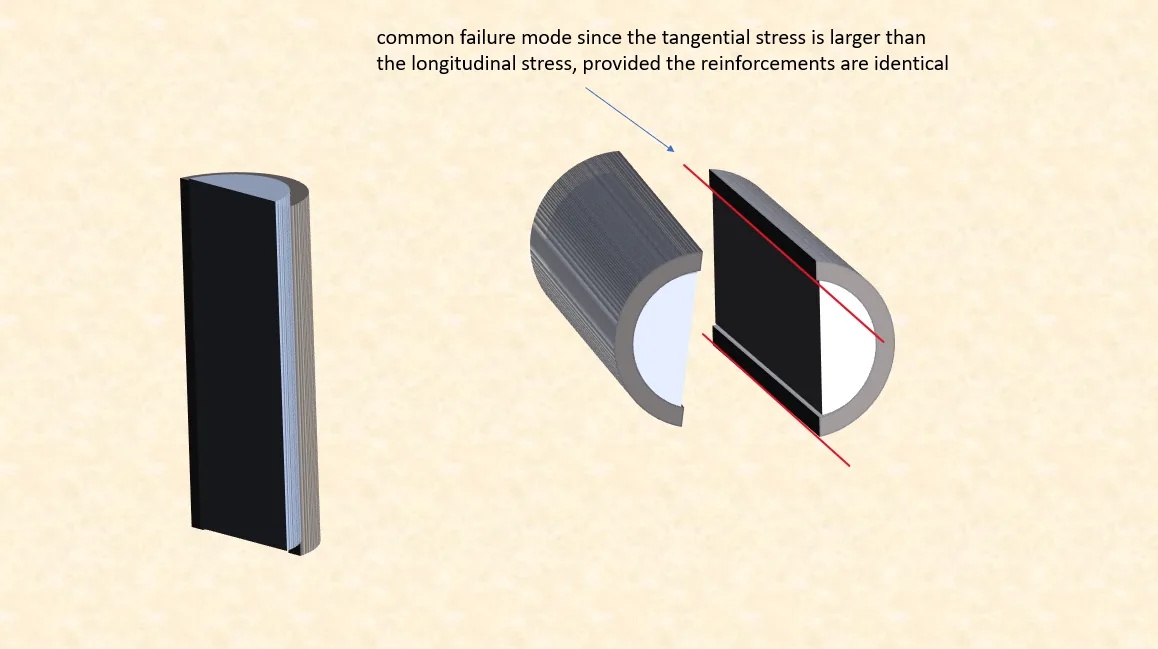
Common Failure Mode

Diagram
The derived formulas here are exclusively for cylindrical and spherical thin-walled pressure vessels. In practical applications, thin-walled tanks do not always follow this configuration. As such, it is important to equip oneself with the nature of the derivation of the formulas above that utilize the concept of simple stresses (axial).

Problem 1:

A cylindrical steel pressure vessel 500mm in diameter with a wall thickness of 20mm is subjected to an internal pressure of 6.7MN/m2.
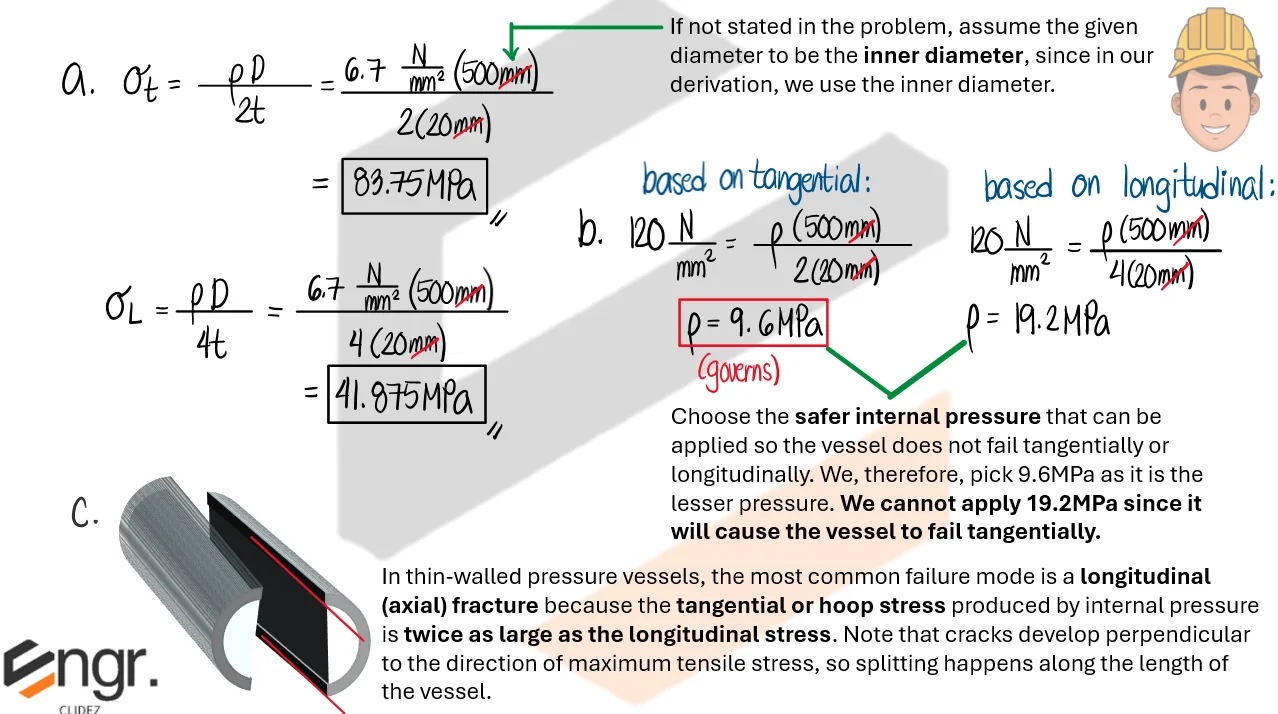
a. Calculate the tangential and longitudinal stresses in the steel.
b. To what value may the internal pressure be increased if the stress in the steel is limited to 120MN/m2?
c. If the internal pressure were increased until the vessel would burst, sketch the type of fracture that would occur.

Thin-walled Pressure Vessels | Mechanics of Deformable Bodies – Problem 1: – Diagram Thin-walled Pressure Vessels | Mechanics of Deformable Bodies – Problem 1: – Diagram Thin-walled Pressure Vessels | Mechanics of Deformable Bodies – Problem 1: – Diagram

Check d/t:
d=500mm
t=20mm
$$\frac{d}{t}=\frac{500}{20}=25$$
Since $\frac{d}{t}\ge25\text{, we consider this a thin-walled pressure vessel}$
For practical purposes, we will deal with thin-walled pressure vessels only in this section, including the succeeding problems. Thin-walled Pressure Vessels | Mechanics of Deformable Bodies – Problem 1: – Diagram Thin-walled Pressure Vessels | Mechanics of Deformable Bodies – Problem 1: – Diagram Thin-walled Pressure Vessels | Mechanics of Deformable Bodies – Problem 1: – Diagram Thin-walled Pressure Vessels | Mechanics of Deformable Bodies – Problem 1: – Diagram
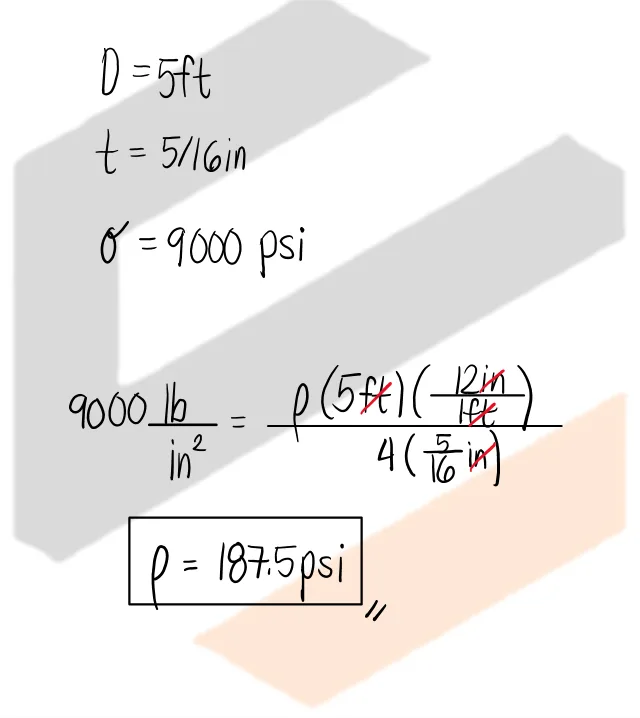
Problem 2:

The wall thickness of a 5-ft diameter spherical tank is 5/16 inch. Claculate the allowable internal pressure if the stress is limited to 9000psi.

Thin-walled Pressure Vessels | Mechanics of Deformable Bodies – Problem 2: – Diagram Thin-walled Pressure Vessels | Mechanics of Deformable Bodies – Problem 2: – Diagram Thin-walled Pressure Vessels | Mechanics of Deformable Bodies – Problem 2: – Diagram
Thin-walled Pressure Vessels | Mechanics of Deformable Bodies – Problem 2: – Diagram Thin-walled Pressure Vessels | Mechanics of Deformable Bodies – Problem 2: – Diagram Thin-walled Pressure Vessels | Mechanics of Deformable Bodies – Problem 2: – Diagram Thin-walled Pressure Vessels | Mechanics of Deformable Bodies – Problem 2: – Diagram

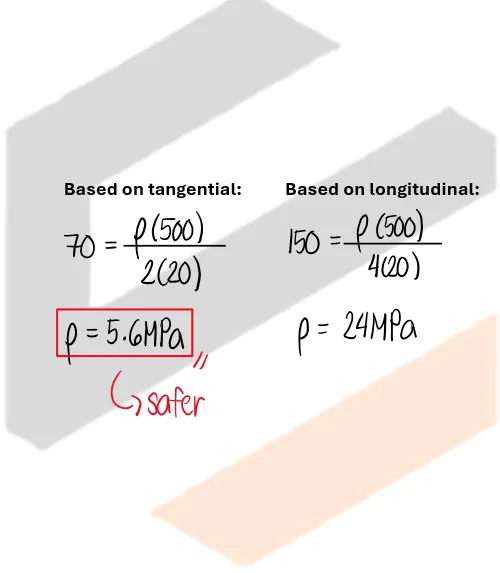
Problem 3:

A cylindrical pressure vessel is fabricated from steel plating that has a thickness of 20mm. The diameter of the pressure vessel is 500mm and its length is 3.0m. Determine the maximum internal pressure that can be applied if the longitudinal stress is limited to 150 MPa, and the circumferential stress is limited to 70 MPa.

Thin-walled Pressure Vessels | Mechanics of Deformable Bodies – Problem 3: – Diagram Thin-walled Pressure Vessels | Mechanics of Deformable Bodies – Problem 3: – Diagram Thin-walled Pressure Vessels | Mechanics of Deformable Bodies – Problem 3: – Diagram

See images:

Thin-walled Pressure Vessels | Mechanics of Deformable Bodies – Problem 3: – Diagram Thin-walled Pressure Vessels | Mechanics of Deformable Bodies – Problem 3: – Diagram Thin-walled Pressure Vessels | Mechanics of Deformable Bodies – Problem 3: – Diagram Thin-walled Pressure Vessels | Mechanics of Deformable Bodies – Problem 3: – Diagram

Problem 4:

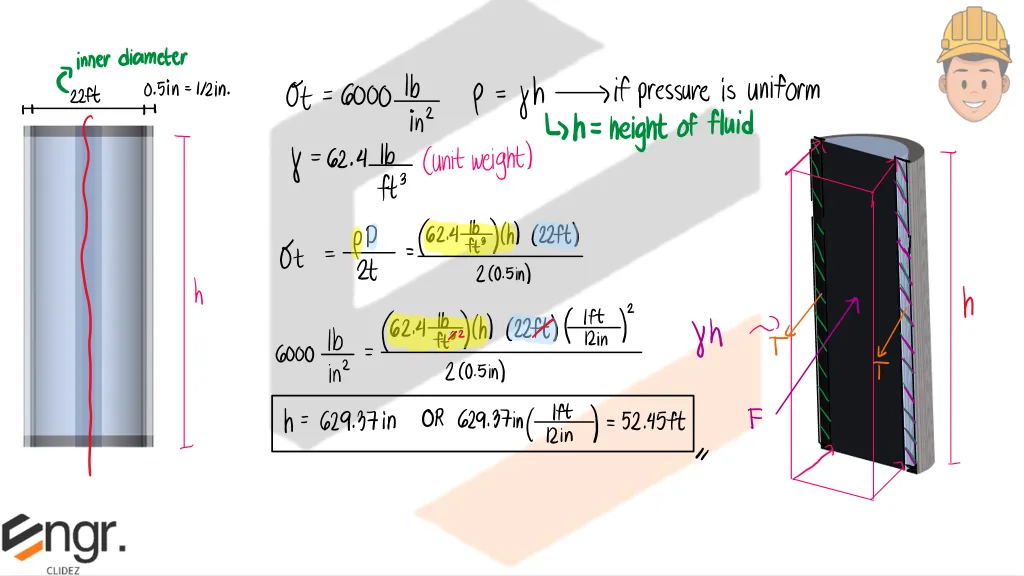
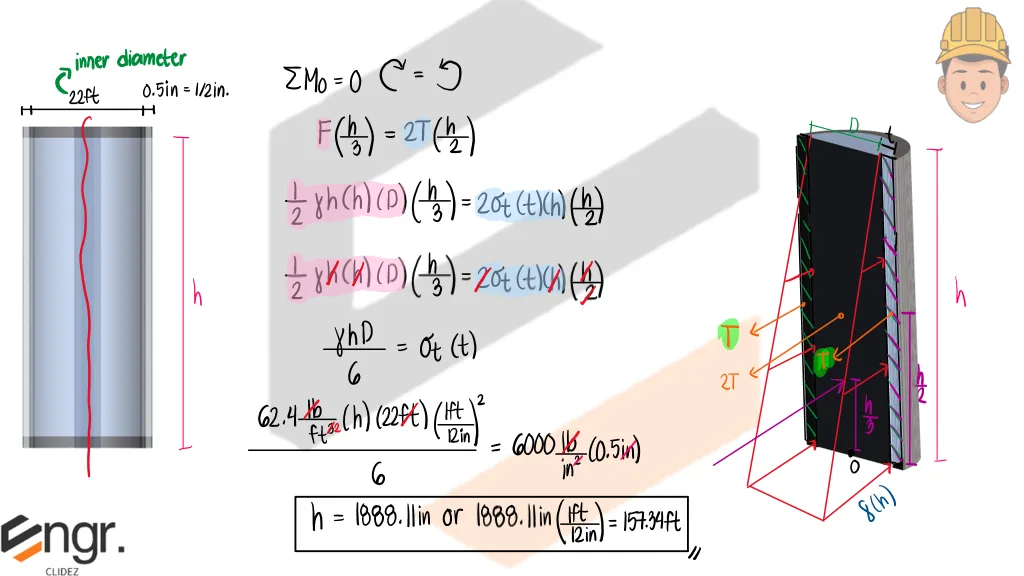
A water tank, 22 ft in diameter, is made from steel plates that are 1/2 in. thick. Find the maximum height to which the tank may be filled if the circumferential stress is limited to 6000 psi. The specific weight of water is 62.4 lb/ft3.
a. Assuming uniform pressure.
b. Considering the actual triangular pressure distribution of water.

Thin-walled Pressure Vessels | Mechanics of Deformable Bodies – Problem 4: – Diagram Thin-walled Pressure Vessels | Mechanics of Deformable Bodies – Problem 4: – Diagram Thin-walled Pressure Vessels | Mechanics of Deformable Bodies – Problem 4: – Diagram

Assuming uniform pressure:

Thin-walled Pressure Vessels | Mechanics of Deformable Bodies – Problem 4: – Diagram

Considering the actual triangular pressure:

Thin-walled Pressure Vessels | Mechanics of Deformable Bodies – Problem 4: – Diagram
Notice that comparing the heights when the pressure is uniform and when the pressure is triangular, the value of the height when the pressure is triangular is thrice that of the height when the pressure is assumed to be uniform. 52.45ft(3)=157.35ft.
Thin-walled Pressure Vessels | Mechanics of Deformable Bodies – Problem 4: – Diagram Thin-walled Pressure Vessels | Mechanics of Deformable Bodies – Problem 4: – Diagram

Problem 5:

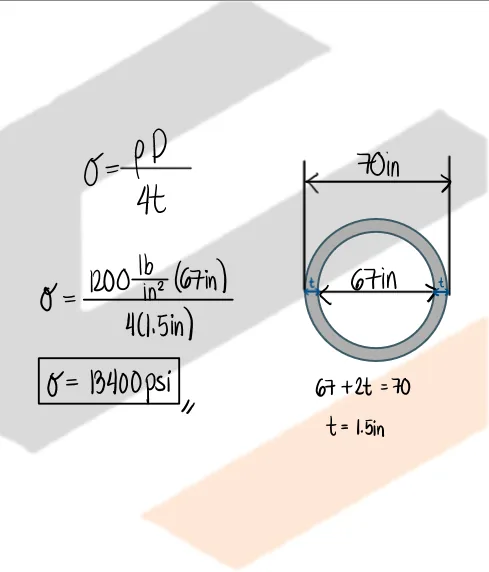
A spherical shell with 70-in. outer diameter and 67-in. inner diameter contains helium at a pressure of 1200psi. Compute the stress in the shell.

Thin-walled Pressure Vessels | Mechanics of Deformable Bodies – Problem 5: – Diagram Thin-walled Pressure Vessels | Mechanics of Deformable Bodies – Problem 5: – Diagram Thin-walled Pressure Vessels | Mechanics of Deformable Bodies – Problem 5: – Diagram

See images:

Thin-walled Pressure Vessels | Mechanics of Deformable Bodies – Problem 5: – Diagram Thin-walled Pressure Vessels | Mechanics of Deformable Bodies – Problem 5: – Diagram Thin-walled Pressure Vessels | Mechanics of Deformable Bodies – Problem 5: – Diagram Thin-walled Pressure Vessels | Mechanics of Deformable Bodies – Problem 5: – Diagram

Problem 6:

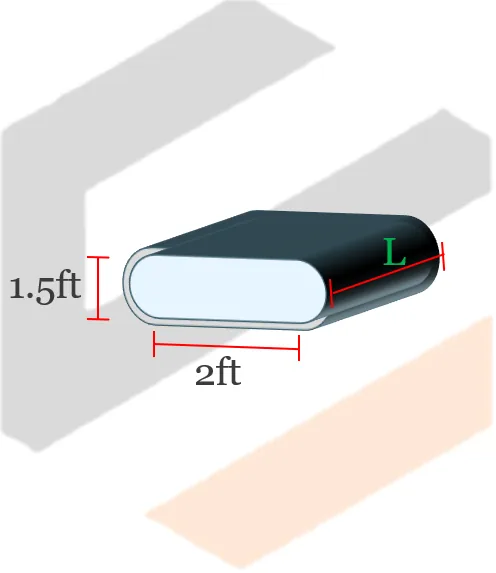
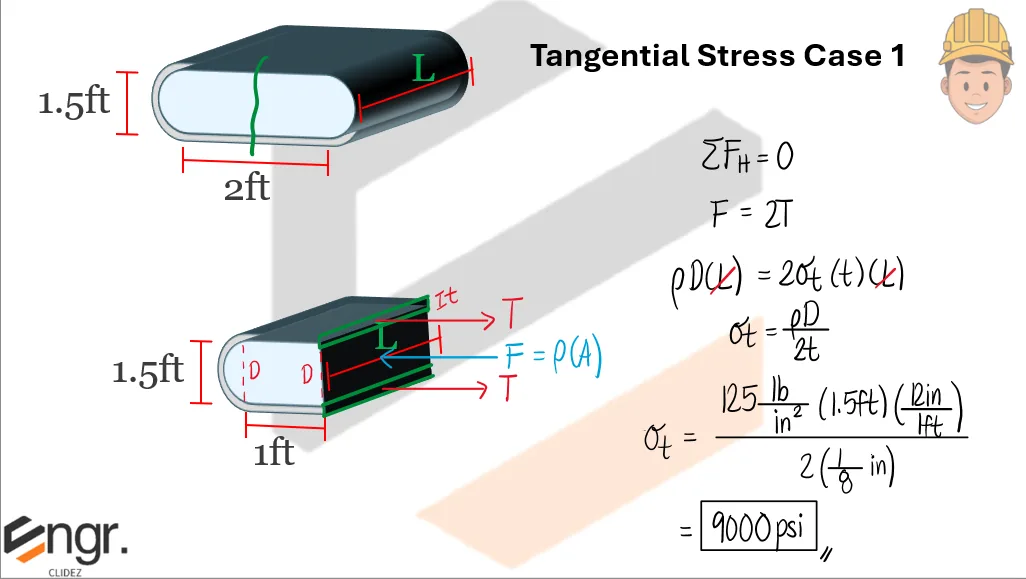
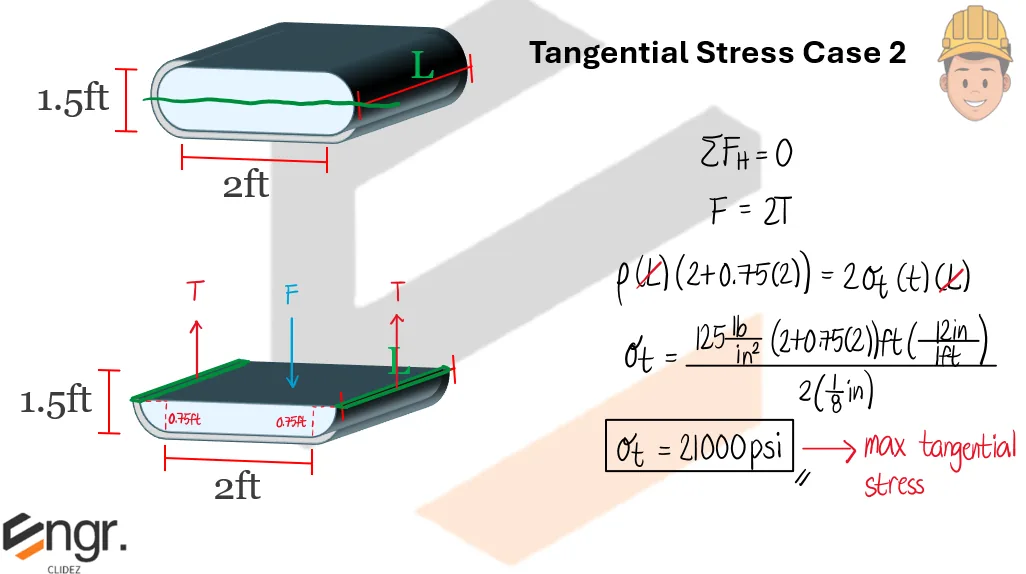
The tank shown is fabricated from 1/8-in steel plate. Calculate the maximum longitudinal and circumferential stress caused by an internal pressure of 125 psi.

Thin-walled Pressure Vessels | Mechanics of Deformable Bodies – Problem 6: – Diagram Thin-walled Pressure Vessels | Mechanics of Deformable Bodies – Problem 6: – Diagram Thin-walled Pressure Vessels | Mechanics of Deformable Bodies – Problem 6: – Diagram

See images:

Thin-walled Pressure Vessels | Mechanics of Deformable Bodies – Problem 6: – Diagram Thin-walled Pressure Vessels | Mechanics of Deformable Bodies – Problem 6: – Diagram Thin-walled Pressure Vessels | Mechanics of Deformable Bodies – Problem 6: – Diagram Thin-walled Pressure Vessels | Mechanics of Deformable Bodies – Problem 6: – Diagram

Problem 7:

Refer to the image shown:

Thin-walled Pressure Vessels | Mechanics of Deformable Bodies – Problem 7: – Diagram Thin-walled Pressure Vessels | Mechanics of Deformable Bodies – Problem 7: – Diagram Thin-walled Pressure Vessels | Mechanics of Deformable Bodies – Problem 7: – Diagram

See images:

Thin-walled Pressure Vessels | Mechanics of Deformable Bodies – Problem 7: – Diagram Thin-walled Pressure Vessels | Mechanics of Deformable Bodies – Problem 7: – Diagram Thin-walled Pressure Vessels | Mechanics of Deformable Bodies – Problem 7: – Diagram Thin-walled Pressure Vessels | Mechanics of Deformable Bodies – Problem 7: – Diagram

Problem 8:

Refer to the image shown:

Thin-walled Pressure Vessels | Mechanics of Deformable Bodies – Problem 8: – Diagram Thin-walled Pressure Vessels | Mechanics of Deformable Bodies – Problem 8: – Diagram Thin-walled Pressure Vessels | Mechanics of Deformable Bodies – Problem 8: – Diagram

See images:

Thin-walled Pressure Vessels | Mechanics of Deformable Bodies – Problem 8: – Diagram Thin-walled Pressure Vessels | Mechanics of Deformable Bodies – Problem 8: – Diagram Thin-walled Pressure Vessels | Mechanics of Deformable Bodies – Problem 8: – Diagram Thin-walled Pressure Vessels | Mechanics of Deformable Bodies – Problem 8: – Diagram
-->
Scroll to zoom