
Cover-Plated Beams (Composite Materials)
COVER-PLATED BEAMS
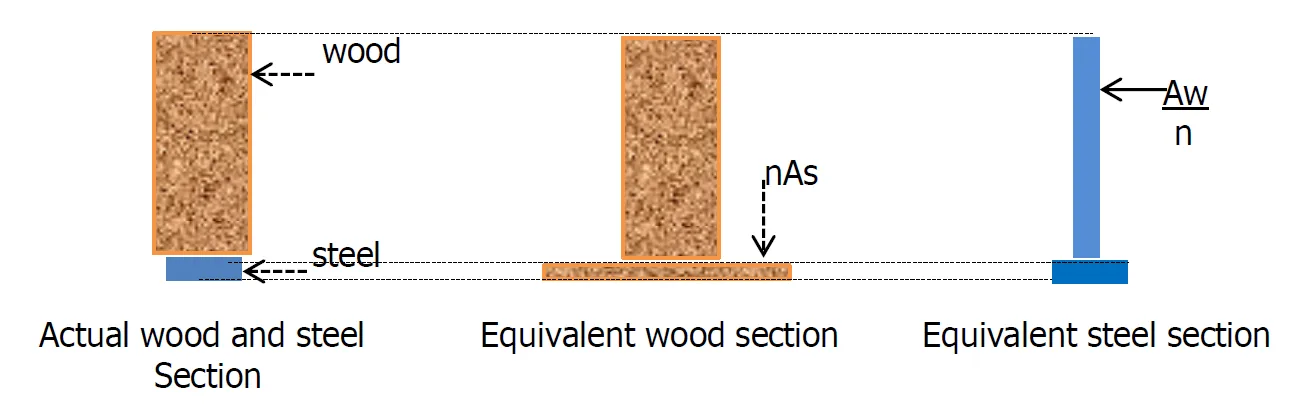
Wooden beams can be strengthened by adding strips of steel at the tension or compression side. For composite sections, the ordinary flexure formula does not directly apply because it assumes homogeneous materials and plane sections that remain plane. To analyze such beams, the cross-section of the stronger material is transformed into an equivalent homogeneous section using the modular ratio.
$$ n = \dfrac{E_{\text{stronger}}}{E_{\text{weaker}}} $$
The stiffer material's area is multiplied (or divided) by this ratio to create an equivalent section. This concept applies not only to wood-steel beams but also to concrete members strengthened with steel cover plates or other composite systems.
Definitions:
- $n$ = modular ratio
- $A_w$ = cross-sectional area of wood
- $A_s$ = cross-sectional area of steel
- $E_s$ = modulus of elasticity of steel (e.g. $200 \times 10^3$ MPa)
- $E_w$ = modulus of elasticity of wood
- $I$ = moment of inertia of the built-up section
- $Q$ = statical moment of the section above the neutral axis discontinuity ($Q = A \bar{y}$)
Resisting Moment or Flexural Capacity of Materials:
Wood or any Weaker Material:
$$ f_w = \dfrac{M_w (y)}{I_x} $$
Steel or any Stronger Material:
$$ \dfrac{f_s}{n} = \dfrac{M_s (y)}{I_x} $$


