Angles of Elevation and Depression: When a point is above the horizontal, the angle looking up is the angle of elevation; looking down is the angle of depression. Both are measured from the horizontal.
Two-observation method: If two angles of elevation $\alpha$ and $\beta$ are observed from two points separated by distance $d$:
A man finds the angle of elevation of the top of a tower to be 30°. He walks 65 m nearer the tower and finds its angle of elevation to be 60°. What is the height of the tower?
Let $h$ = height of the tower, $x$ = distance from the tower when the angle is 60°.
$$\tan60° = \frac{h}{x} \Rightarrow x = \frac{h}{\sqrt{3}}$$
A rectangular piece of wood 4 cm × 12 cm is tilted at an angle of 45°. Find the vertical distance between the lower corner and the upper corner.
The piece is tilted at 45°. Decompose the rectangle's corner-to-corner vector into vertical and horizontal components. The vertical rise from the lowest corner (A) to the highest corner (D) equals:
$$\Delta V = L\sin\theta + W\cos\theta$$
where $L = 12$ cm (length), $W = 4$ cm (width), and $\theta = 45°$:
A ladder 10 m long leans against a vertical wall. If the foot of the ladder makes an angle of 75° with the ground, find: (a) the height the ladder reaches on the wall, and (b) the horizontal distance from the wall to the foot of the ladder.
Let the ladder length be the hypotenuse $h = 10$ m and the angle with the ground be $\theta = 75°$.
A vertical pole casts a shadow 8 m long when the angle of elevation of the sun is 38°. A man standing 2 m from the base of the pole observes the top of the pole. Find: (a) the height of the pole, and (b) the angle of elevation of the top of the pole as seen by the man.
Part (a) — Height of the pole
The shadow length $s = 8$ m and the sun's elevation angle $\theta = 38°$. The pole and its shadow form a right triangle:
A vertical pole 40 feet tall stands on a hillside that makes an angle of 17° with the horizontal. Approximate the minimal length of cable that will reach from the top of the pole to a point 72 feet downhill from the base of the pole.
Answer:
92ft
29ft
56ft
65ft
The downhill point is 72 ft along a 17° slope, so the horizontal separation is $72\cos17^\circ$ and the vertical drop is $72\sin17^\circ$. From the pole top to the downhill point: $\Delta x=72\cos17^\circ$ $\Delta y=40+72\sin17^\circ$ $L=\sqrt{(72\cos17^\circ)^2+(40+72\sin17^\circ)^2}$ $\boxed{L\approx92\text{ ft}}$
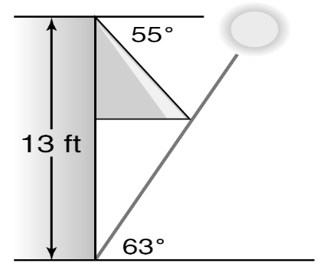
An architect is designing an overhang above a sliding glass door. During the heat of the summer, the architect wants the overhang to prevent the rays of the sun from striking the glass at noon. The overhang has an angle of depression of 55° and starts 13 feet above the ground. If the angle of elevation of the sun during this time is 63°, how long should the architect make the overhang? (See figure on the right)
Answer:
6.7ft
6.3ft
3.6ft
7.6ft
At noon, the limiting sun ray makes $63^\circ$ with the horizontal. The required horizontal projection of the overhang is obtained from the 13-ft vertical rise:
$L=\dfrac{13}{\tan63^\circ}=6.62\text{ ft}\approx\boxed{6.7\text{ ft}}$.
The 55-degree line in the figure identifies the sloping overhang/clearance geometry; the blocking length is controlled by the solar elevation.
A commercial fishing boat uses sonar equipment to detect a school of fish 2 miles east of the boat and traveling in the direction of N 51˚ W at a rate of 8 mi/hr.
If the boat travels at 20 mi/hr, approximate to the nearest 0.1˚ direction it should head to intercept the school of fish.
N75.4ºE
N74.5ºE
N72.36ºE
N72.63ºE
Find to the nearest minute the time will it take the boat to reach the fish
5 minutes
3 minutes
4 minutes
3.5 minutes
Part 1.
Let east be $x$ and north be $y$. The fish starts 2 mi east of the boat and moves N51°W at 8 mi/hr, so its velocity components are $(-8\sin51^\circ,\ 8\cos51^\circ)$. If the boat heads N$\theta$E at 20 mi/hr, its components are $(20\sin\theta,\ 20\cos\theta)$. For interception: $20t\cos\theta=8t\cos51^\circ$ $\cos\theta=\frac{8\cos51^\circ}{20}$ $\theta=75.4^\circ$ $\boxed{\text{N}75.4^\circ\text{E}}$
Part 2.
Using the east-component equation: $20t\sin75.4^\circ=2-8t\sin51^\circ$ $t=0.078\text{ hr}=4.69\text{ min}$ Nearest minute: $\boxed{5\text{ minutes}}$
If one of two parallel lines has 7 points on it and the other has 8, how many triangles can be drawn using these points?
364
168
196
316
A triangle cannot have all three points on one of the parallel lines. Choose 2 points from one line and 1 from the other, either way: $\binom{7}{2}\binom{8}{1}+\binom{8}{2}\binom{7}{1}$ $=21(8)+28(7)=364$ $\boxed{364}$
Question Bank: t316
MSTE - Geometry and Trigonometry / Trigonometry / Gemini mapped Chapter 1 to 3
For the following questions, $\theta$ is the angle from the origin.
Which quadrant/s is $\sec \theta < 0$?
III & IV
III
II
II & III
Which quadrant/s is $\tan \theta < 0$?
IV
II & IV
II & III
II
Which quadrant/s is $\csc \theta < 0$?
III & IV
II & III
IV
III
Part 1.
$\sec\theta=\dfrac{1}{\cos\theta}$, so $\sec\theta<0$ wherever $\cos\theta<0$. $\cos\theta=\dfrac{x}{r}$ is negative when $x<0$, which occurs in Quadrants II and III. $\boxed{\text{II \& III}}$
Part 2.
$\tan\theta=\dfrac{y}{x}$ is negative when $x$ and $y$ have opposite signs. In Quadrant II, $x<0$ and $y>0$; in Quadrant IV, $x>0$ and $y<0$. $\boxed{\text{II \& IV}}$
Part 3.
$\csc\theta=\dfrac{1}{\sin\theta}$, so $\csc\theta<0$ wherever $\sin\theta<0$. $\sin\theta=\dfrac{y}{r}$ is negative when $y<0$, which occurs in Quadrants III and IV. $\boxed{\text{III \& IV}}$
Question Bank: t331
MSTE - Geometry and Trigonometry / Trigonometry / Gemini mapped Chapter 1 to 3
For an acute angle $\theta$, $\cos \theta = 4/5$. What is the value of $\cos 2\theta$?
$13/25$
$8/25$
$7/25$
$9/25$
Use the double-angle identity $\cos 2\theta=2\cos^2\theta-1$. $\cos 2\theta=2\left(\dfrac{4}{5}\right)^2-1=\dfrac{32}{25}-1=\dfrac{7}{25}$. $\boxed{7/25}$
Question Bank: t334
MSTE - Geometry and Trigonometry / Trigonometry / Gemini mapped Chapter 1 to 3
Find the value of $x$ such that the tangent of angle $(2x + 18)$ is equal to the cotangent of the angle $(4x - 12)$.
$16$
$15$
$13$
$14$
Tangent and cotangent are cofunctions, so $\tan\alpha=\cot\beta$ when $\alpha+\beta=90^\circ$. $(2x+18)+(4x-12)=90\Rightarrow 6x+6=90\Rightarrow x=14$. $\boxed{14}$
Question Bank: t345
MSTE - Geometry and Trigonometry / Trigonometry / Gemini mapped Chapter 1 to 3
What is the angle between the hands of a clock at 3:25 pm?
$49.3^\circ$
$45.7^\circ$
$47.5^\circ$
$48.6^\circ$
Minute hand at 25 min: $25\times 6^\circ=150^\circ$. Hour hand at 3:25: $3\times 30^\circ+25\times 0.5^\circ=90^\circ+12.5^\circ=102.5^\circ$. Angle between $=150^\circ-102.5^\circ=47.5^\circ$. $\boxed{47.5^\circ}$
Question Bank: t347
MSTE - Geometry and Trigonometry / Trigonometry / Gemini mapped Chapter 1 to 3
A 6-m long ladder leans against a vertical wall. If the top of the ladder is 4.8 m above the floor, how far is its foot from the wall?
3.6 m
3.8 m
3.4 m
3.2 m
The ladder, wall, and floor form a right triangle with hypotenuse $6$ m and vertical leg $4.8$ m. Distance of foot from wall $=\sqrt{6^2-4.8^2}=\sqrt{36-23.04}=\sqrt{12.96}=3.6$ m. $\boxed{3.6\text{ m}}$
Question Bank: t350
MSTE - Geometry and Trigonometry / Trigonometry / Gemini mapped Chapter 1 to 3
Given a triangle ABC such that A = $40^\circ$, a = 10 m, and b = 15 m. How many possible triangles can be formed?
1
2
3
0
This is the ambiguous SSA case. Compute the altitude $h=b\sin A=15\sin 40^\circ=9.64$ m. Since $h$\boxed{2}$
Question Bank: t357
MSTE - Geometry and Trigonometry / Trigonometry / Gemini mapped Chapter 1 to 3
A triangular lot ABC is to be made such that the range of angle A is from $55^\circ$ to $65^\circ$ and the range of angle C is from $100^\circ$ to $110^\circ$. What is the range of angle B?
$5^\circ$ to $25^\circ$
$15^\circ$ to $35^\circ$
$5^\circ$ to $35^\circ$
$15^\circ$ to $25^\circ$
Since $A+B+C=180^\circ$, $B=180^\circ-A-C$. $B$ is smallest when $A$ and $C$ are largest: $180^\circ-65^\circ-110^\circ=5^\circ$. $B$ is largest when $A$ and $C$ are smallest: $180^\circ-55^\circ-100^\circ=25^\circ$. $\boxed{5^\circ\text{ to }25^\circ}$
Question Bank: t384
MSTE - Geometry and Trigonometry / Trigonometry / Gemini mapped Chapter 1 to 3
A ladder 12 m long with its foot on the street rests against the wall of a house on one side of the street 10 m high. By moving the ladder about its foot, it can reach the wall of the house on the opposite side of the street, but 3 m back of the street line, at a point 6 m high. Find the width of the street.
13 m
15 m
12 m
14 m
Leaning on the first wall (10 m high), the horizontal run is $\sqrt{12^2-10^2}=\sqrt{44}=6.63$ m. Reaching the opposite point (6 m high), the run is $\sqrt{12^2-6^2}=\sqrt{108}=10.39$ m, but that point is 3 m behind the street line, so the run to that street edge is $10.39-3=7.39$ m. Street width $=6.63+7.39\approx14$ m. $\boxed{14\text{ m}}$
Question Bank: t386
MSTE - Geometry and Trigonometry / Trigonometry / Gemini mapped Chapter 1 to 3
A hill slopes at an angle of $33^\circ$ with the horizontal. A path leads up it, making an angle of $48^\circ 30'$ with the line of steepest slope; find the inclination of the path with the horizontal.
$22^\circ 12' 2''$
$20^\circ 24' 2''$
$21^\circ 9' 17''$
$21^\circ 45' 8''$
When a path makes angle $\beta$ with the line of steepest slope on a hill inclined at $\alpha$, the path's inclination $\theta$ satisfies $\sin\theta=\sin\alpha\cos\beta$. $\sin\theta=\sin33^\circ\cos48^\circ30'=0.5446\times0.6626=0.3609$. $\theta=\sin^{-1}(0.3609)=21.16^\circ\approx21^\circ9'17''$. $\boxed{21^\circ 9' 17''}$
Question Bank: t394
MSTE - Geometry and Trigonometry / Trigonometry / Gemini mapped Chapter 1 to 3
A surveyor is 1190 m and 2290 m away from the two edges of a lake. If the angle between measurements is $71^\circ$, what is the width of the lake?
2,124.32 m
2,321.78 m
2,268.45 m
2,210.38 m
The two distances and the included $71^\circ$ angle form a triangle; the lake width is the opposite side. By the Law of Cosines: $w^2=1190^2+2290^2-2(1190)(2290)\cos71^\circ=6{,}660{,}200-1{,}774{,}430=4{,}885{,}770$. $w=\sqrt{4{,}885{,}770}=2210.38$ m. $\boxed{2210.38\text{ m}}$
Question Bank: t2151
MSTE - Geometry and Trigonometry / Trigonometry / Besavilla CE Pre-Board Math & Surveying
The angle of depression of a ship viewed at a particular instant from the top of a 75 m. vertical cliff is 30°. The ship is sailing away from the cliff at this instant at constant speed and 1 minute later its angle of depression from the top of the cliff is 20°. Determine the speed of the ship in kph.
2.36 kph
4.57 kph
3.18 kph
5.68 kph
6.35 kph
For an angle of depression $\theta$, the horizontal distance from the cliff is $x=\frac{75}{\tan\theta}$. Initial distance: $x_1=\frac{75}{\tan30^\circ}=129.90$ m After 1 minute: $x_2=\frac{75}{\tan20^\circ}=206.06$ m Distance traveled in 1 minute: $206.06-129.90=76.16$ m/min Speed $=76.16\times60/1000=4.57$ kph $\boxed{4.57\text{ kph}}$
Question Bank: w22
MSTE - Geometry and Trigonometry / Trigonometry / MSTE May 2019
Given that $\sin 34^\circ = 0.5592$, find an acute angle $\theta$ such that $\cos\theta = 0.5592$.
56°
34°
62°
72°
If $\sin A = \cos B$, then $A + B = 90^\circ$. $34^\circ + \theta = 90^\circ$ $\boxed{\theta = 56^\circ}$
Question Bank: w23
MSTE - Geometry and Trigonometry / Trigonometry / MSTE May 2019
From the top of a lighthouse 120 m above the sea, the angle of depression of a boat is 15°. How far is the boat from the lighthouse?
MSTE - Geometry and Trigonometry / Trigonometry / MSTE May 2022
In order to measure the height of a mountain, a surveyor takes two sightings from a transit 1.5 m high. The sightings are taken 1200 m apart from the same ground elevation. The first measured angle of elevation is 51° and the second is 38°. What is the height of the mountain above the ground elevation?
2554 m
2544 m
2534 m
2444 m
Let $y$ be the height above the transit line. From the two right triangles, the horizontal distances satisfy $AD=y/\tan38^\circ$ and $BD=y/\tan51^\circ$, with $AD-BD=1200$ m. Hence $$\frac{y}{\tan38^\circ}-\frac{y}{\tan51^\circ}=1200.$$ Solving and adding the 1.5 m transit height gives approximately 2554 m.