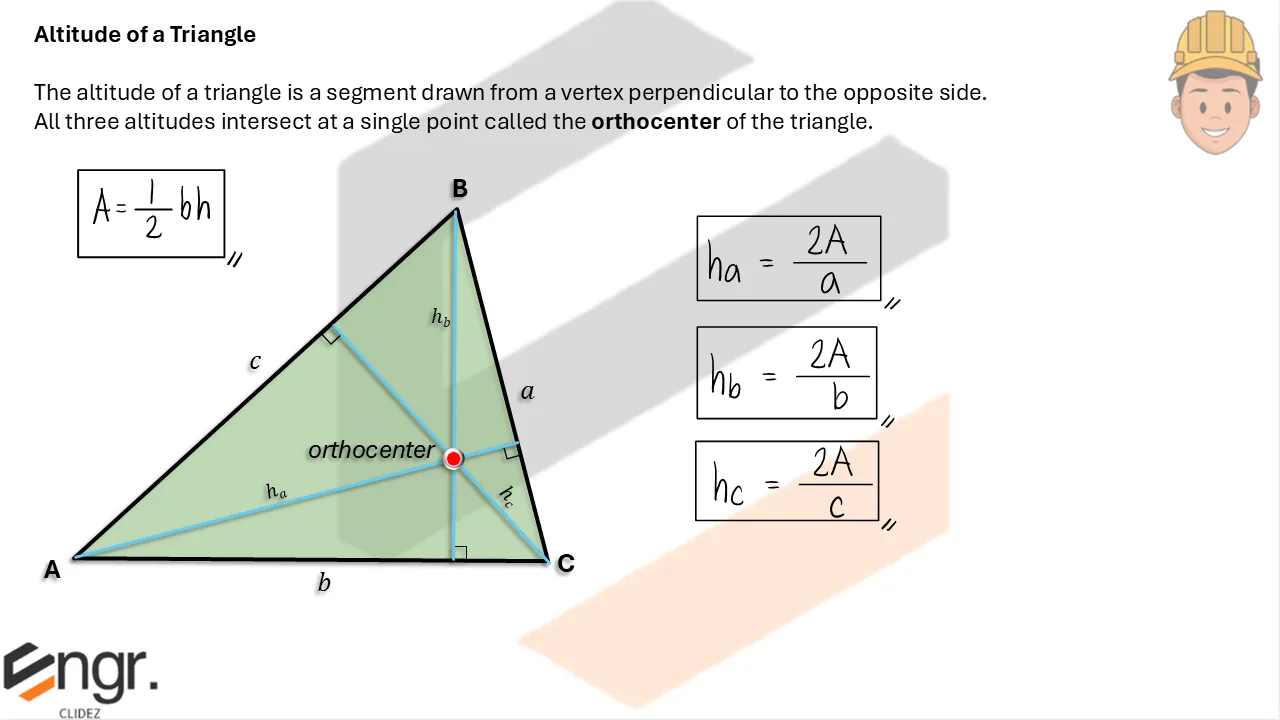
$$h = \frac{s\sqrt{3}}{2}, \quad A = \frac{s^2\sqrt{3}}{4}, \quad r = \frac{s\sqrt{3}}{6}, \quad R = \frac{s\sqrt{3}}{3}$$
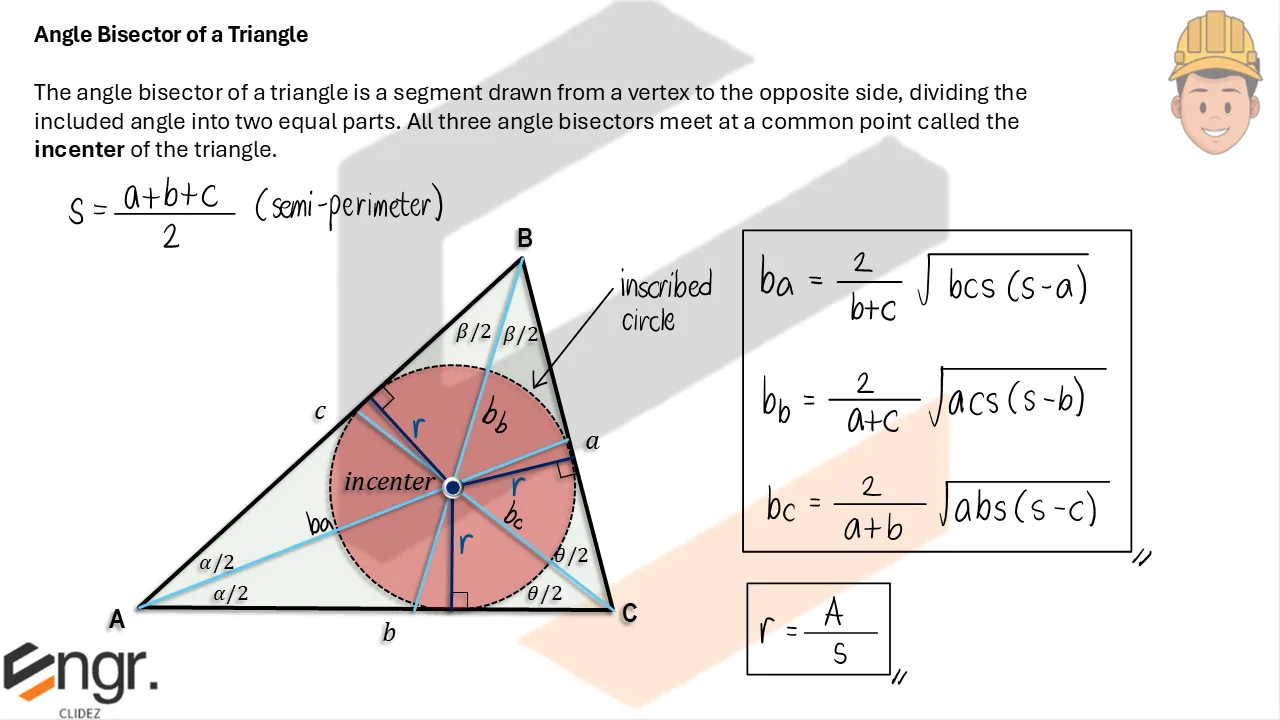
General Triangle — inradius and circumradius, where $s = \frac{a+b+c}{2}$ (semiperimeter):
$$r = \frac{A}{s}, \qquad R = \frac{abc}{4A}$$
For a right triangle (hypotenuse c):
$$r = \frac{a+b-c}{2}, \qquad R = \frac{c}{2}$$
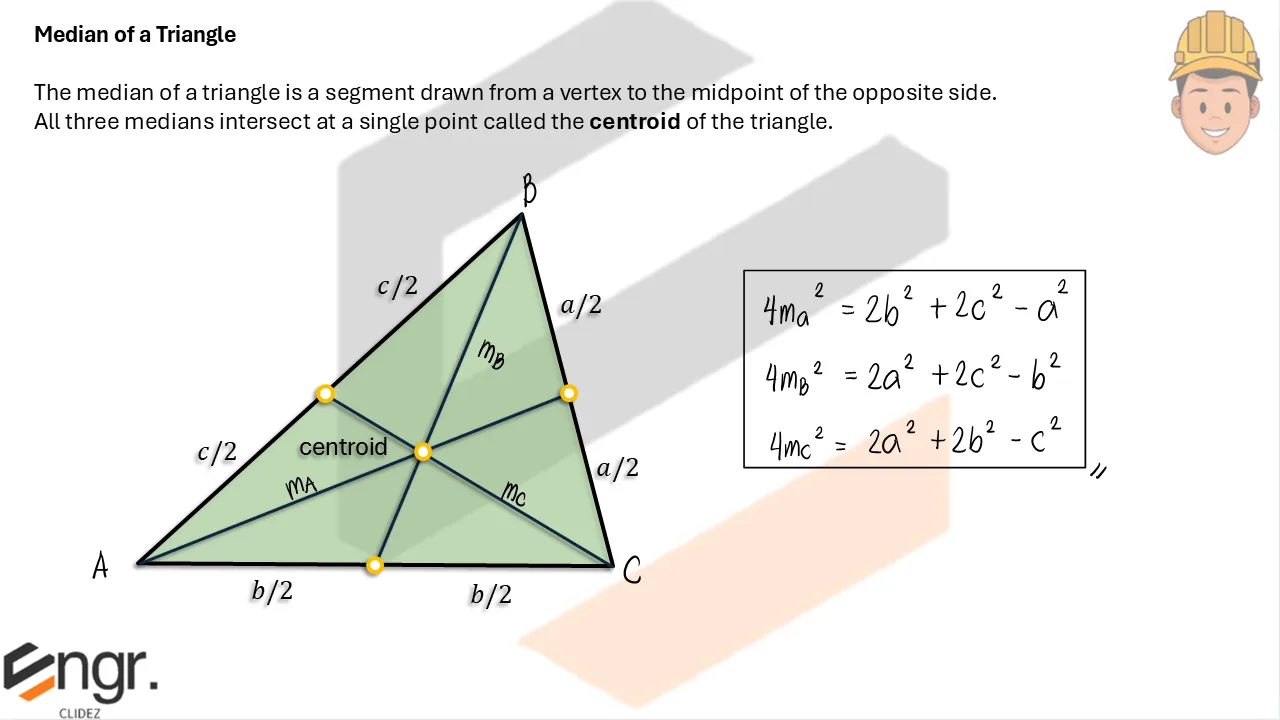
Median length from vertex A to the midpoint of BC:
$$m_a = \frac{1}{2}\sqrt{2b^2 + 2c^2 - a^2}$$
Centroid (intersection of medians): divides each median in ratio 2:1 from the vertex.
Advertisement
Problem: 30-60-90 Special Triangle
The hypotenuse of a 30-60-90 triangle is 20 cm. Find:
a. The shorter leg (opposite 30°)
b. The longer leg (opposite 60°)
c. The area of the triangle
d. The perimeter of the triangle
In a 30-60-90 triangle the sides are in ratio $1 : \sqrt{3} : 2$. With hypotenuse $c = 20$ cm:
An equilateral triangle has a perimeter of 36 cm. Find:
a. The height
b. The area
c. The inradius (radius of the inscribed circle)
d. The circumradius (radius of the circumscribed circle)
An isosceles triangle has equal legs of 13 cm each and an altitude from the vertex angle to the base of 5 cm. Find:
a. The base length
b. The vertex angle
c. The base angles
d. The area
The altitude bisects the base. Let half the base = $x$.
a. Base length (right triangle: leg = 13, altitude = 5):
In triangle ABC, angle A = 55°, angle B = 78°, and side c (the side opposite angle C, i.e., AB) = 20 cm. Find:
a. Angle C
b. Sides a and b
c. The area of the triangle
Problem: Inscribed and Circumscribed Circles of a Right Triangle
A right triangle has legs of 6 cm and 8 cm. Find:
a. The hypotenuse
b. The inradius (radius of the inscribed circle)
c. The circumradius (radius of the circumscribed circle)
d. The area of the inscribed circle
e. The area of the circumscribed circle
Additional board-style practice items for this topic.
Question Bank: t322
MSTE - Geometry and Trigonometry / Trigonometry / Gemini mapped Chapter 1 to 3
Solve the following:
$\tan (11\pi/6) =$
$\sqrt{3} /2$
$-\sqrt{3} /2$
$-\sqrt{3} /3$
$\sqrt{3} /3$
$\tan (-7\pi/6)$
$-\sqrt{3} /3$
$\sqrt{3} /2$
$\sqrt{3} /3$
$-\sqrt{3} /2$
$\tan \pi =$
1
0
undefined
infinity
Part 1.
$\dfrac{11\pi}{6}=330^\circ$, which lies in Quadrant IV with reference angle $30^\circ$. Tangent is negative in Quadrant IV, so $\tan 330^\circ=-\tan 30^\circ=-\dfrac{1}{\sqrt{3}}=-\dfrac{\sqrt{3}}{3}$. $\boxed{-\sqrt{3}/3}$
Part 2.
$-\dfrac{7\pi}{6}=-210^\circ$, which is coterminal with $150^\circ$ (Quadrant II, reference angle $30^\circ$). Tangent is negative in Quadrant II, so $\tan 150^\circ=-\tan 30^\circ=-\dfrac{\sqrt{3}}{3}$. $\boxed{-\sqrt{3}/3}$
Part 3.
$\pi=180^\circ$, where $\sin\pi=0$ and $\cos\pi=-1$. $\tan\pi=\dfrac{\sin\pi}{\cos\pi}=\dfrac{0}{-1}=0$. $\boxed{0}$
Question Bank: t325
MSTE - Geometry and Trigonometry / Trigonometry / Gemini mapped Chapter 1 to 3
If $\sin \theta = 2/3$ and $\cos \theta < 0$, find $\tan \theta$.
$2\sqrt{5} /5$
$-2\sqrt{5} /5$
$\sqrt{5} /3$
$-3/\sqrt{5}$
$\sin\theta=\dfrac{2}{3}$ with $\cos\theta<0$ places $\theta$ in Quadrant II. $\cos\theta=-\sqrt{1-\sin^2\theta}=-\sqrt{1-\tfrac{4}{9}}=-\dfrac{\sqrt{5}}{3}$. $\tan\theta=\dfrac{\sin\theta}{\cos\theta}=\dfrac{2/3}{-\sqrt{5}/3}=-\dfrac{2}{\sqrt{5}}=-\dfrac{2\sqrt{5}}{5}$. $\boxed{-2\sqrt{5}/5}$
Question Bank: t326
MSTE - Geometry and Trigonometry / Trigonometry / Gemini mapped Chapter 1 to 3
If $\cos \theta = 3/5$ and $\csc \theta < 0$, find $\cot \theta$.
$-3/4$
$3/4$
$-4/3$
$4/3$
$\cos\theta=\dfrac{3}{5}$ with $\csc\theta<0$ (so $\sin\theta<0$) places $\theta$ in Quadrant IV. $\sin\theta=-\sqrt{1-\cos^2\theta}=-\sqrt{1-\tfrac{9}{25}}=-\dfrac{4}{5}$. $\cot\theta=\dfrac{\cos\theta}{\sin\theta}=\dfrac{3/5}{-4/5}=-\dfrac{3}{4}$. $\boxed{-3/4}$
Question Bank: t327
MSTE - Geometry and Trigonometry / Trigonometry / Gemini mapped Chapter 1 to 3
If $\tan \theta = -8/3$ and $\csc \theta < 0$, find $\sin \theta$.
$-4\sqrt{73} /73$
$4\sqrt{73} /73$
$8\sqrt{73} /73$
$-8\sqrt{73} /73$
$\tan\theta=-\dfrac{8}{3}$ with $\csc\theta<0$ (so $\sin\theta<0$) places $\theta$ in Quadrant IV. Take opposite $=-8$, adjacent $=3$, so $r=\sqrt{(-8)^2+3^2}=\sqrt{73}$. $\sin\theta=\dfrac{-8}{\sqrt{73}}=-\dfrac{8\sqrt{73}}{73}$. $\boxed{-8\sqrt{73}/73}$
Question Bank: t329
MSTE - Geometry and Trigonometry / Trigonometry / Gemini mapped Chapter 1 to 3
If $\csc (A + x) = \sec (B + 2y)$, then $A + B$ is:
$90^\circ - (y - 2x)$
$90^\circ - (2y - x)$
$90^\circ - (x - 2y)$
$90^\circ - (x + 2y)$
Cosecant and secant are cofunctions: $\csc\alpha=\sec(90^\circ-\alpha)$. So $\csc(A+x)=\sec(90^\circ-(A+x))=\sec(B+2y)$. $90^\circ-(A+x)=B+2y\Rightarrow A+B=90^\circ-x-2y=90^\circ-(x+2y)$. $\boxed{90^\circ-(x+2y)}$
Question Bank: t332
MSTE - Geometry and Trigonometry / Trigonometry / Gemini mapped Chapter 1 to 3
$\sin x = 3/5$, $\tan y = 2/5$. Find $\sin (x + y)$.
$0.485$
$0.845$
$0.548$
$0.854$
From $\sin x=\dfrac{3}{5}$ (acute): $\cos x=\dfrac{4}{5}$. From $\tan y=\dfrac{2}{5}$: $\sin y=\dfrac{2}{\sqrt{29}}$, $\cos y=\dfrac{5}{\sqrt{29}}$. $\sin(x+y)=\sin x\cos y+\cos x\sin y=\dfrac{3}{5}\cdot\dfrac{5}{\sqrt{29}}+\dfrac{4}{5}\cdot\dfrac{2}{\sqrt{29}}=\dfrac{23}{5\sqrt{29}}=0.854$. $\boxed{0.854}$
Question Bank: t333
MSTE - Geometry and Trigonometry / Trigonometry / Gemini mapped Chapter 1 to 3
$\sin x = 0.5$. Find $\cos 2x$.
$0.732$
$0.654$
$0.5$
$0.866$
Use $\cos 2x=1-2\sin^2 x$. $\cos 2x=1-2(0.5)^2=1-0.5=0.5$. $\boxed{0.5}$
Question Bank: t335
MSTE - Geometry and Trigonometry / Trigonometry / Gemini mapped Chapter 1 to 3
$(\sec A - 2)(2 \csc A - 1) = 0$. What quadrant does $A$ terminates?
IV only
II & III
I & IV
I only
Set each factor to zero. $2\csc A-1=0\Rightarrow\csc A=\tfrac{1}{2}\Rightarrow\sin A=2$, impossible. $\sec A-2=0\Rightarrow\cos A=\tfrac{1}{2}$, which is positive, so $A$ lies in Quadrant I or IV. $\boxed{\text{I \& IV}}$
Question Bank: t339
MSTE - Geometry and Trigonometry / Trigonometry / Gemini mapped Chapter 1 to 3
Answer the following problems:
$\frac{1}{2} (\sin 9t + \sin 5t) =$.
$\sin 2t \cos 7t$
$\sin 5t \cos 3t$
$\sin 3t \cos 5t$
$\sin 7t \cos 2t$
$4 \cos 3x \cos x =$.
$2(\cos 4x + \cos 2x)$
$4(\cos 4x + \cos 2x)$
$4(\cos 3x + \cos x)$
$2(\cos 3x + \cos x)$
$(\cos 6x + \cos 2x) / (\sin 6x + \sin 2x) =$.
$\cot 5x$
$\cot 3x$
$\cot 4x$
$\cot 2x$
Part 1.
Sum-to-product: $\sin A+\sin B=2\sin\dfrac{A+B}{2}\cos\dfrac{A-B}{2}$. $\sin 9t+\sin 5t=2\sin 7t\cos 2t$. Half of this is $\sin 7t\cos 2t$. $\boxed{\sin 7t\cos 2t}$
MSTE - Geometry and Trigonometry / Trigonometry / Gemini mapped Chapter 1 to 3
If $\sin \theta = k$, which of the following is not correct:
$\cos \theta = \sqrt{k^2 - 1}$
$\sec \theta = 1 / \sqrt{1 - k^2}$
$\tan \theta = k / \sqrt{1 - k^2}$
$\csc \theta = 1 / k$
With $\sin\theta=k$, the Pythagorean identity gives $\cos\theta=\sqrt{1-k^2}$, not $\sqrt{k^2-1}$. The other relations are all valid: $\sec\theta=1/\sqrt{1-k^2}$, $\tan\theta=k/\sqrt{1-k^2}$, $\csc\theta=1/k$. So the incorrect statement is $\cos\theta=\sqrt{k^2-1}$. $\boxed{\cos\theta=\sqrt{k^2-1}}$
Question Bank: t344
MSTE - Geometry and Trigonometry / Trigonometry / Gemini mapped Chapter 1 to 3
If $\arcsin (6x + 4y) = 1.5708$ and $\arccos (2x + y) = 1.0472$, find $x$.
$1/2$
$2/3$
$-3/2$
$-1/2$
$\arcsin(6x+4y)=1.5708=\dfrac{\pi}{2}$, so $6x+4y=\sin 90^\circ=1$. $\arccos(2x+y)=1.0472=\dfrac{\pi}{3}$, so $2x+y=\cos 60^\circ=0.5$. From the second, $y=0.5-2x$. Substitute: $6x+4(0.5-2x)=1\Rightarrow -2x+2=1\Rightarrow x=\dfrac{1}{2}$. $\boxed{1/2}$
Question Bank: t346
MSTE - Geometry and Trigonometry / Trigonometry / Gemini mapped Chapter 1 to 3
If coversine $\theta = 0.344$, what is the value of $\theta$?
$58^\circ$
$62^\circ$
$41^\circ$
$34^\circ$
Coversine is defined as $\operatorname{covers}\theta=1-\sin\theta$. $1-\sin\theta=0.344\Rightarrow\sin\theta=0.656$. $\theta=\sin^{-1}(0.656)=41^\circ$. $\boxed{41^\circ}$
Question Bank: t395
MSTE - Geometry and Trigonometry / Trigonometry / Gemini mapped Chapter 1 to 3
A truck travels from point M northward for 30 min. then eastward for one hour, then shifted N $30^\circ$ W. If the constant speed is 40 kph, how far directly from M, in km. will be it after 2 hours?
43.5
45.2
47.8
41.6
Legs (speed 40 kph): North 0.5 h $=20$ km, East 1 h $=40$ km, then N30°W for 0.5 h $=20$ km. Position (E, N): $(0,20)\to(40,20)\to(40-20\sin30^\circ,\,20+20\cos30^\circ)=(30,\,37.32)$. Distance from M $=\sqrt{30^2+37.32^2}=\sqrt{2292.8}=47.8$ km. $\boxed{47.8}$
Question Bank: t413
MSTE - Geometry and Trigonometry / Trigonometry / Gemini mapped Chapter 1 to 3
An airplane will fly from Mactan Cebu ($10^\circ 18'$ N, $123^\circ 58'$ E) to Wellington New Zealand ($41^\circ 19'$ S, $174^\circ 48'$ E) following a great circle path with an average speed of 800 kph.
At what longitude will it cross the equator?
$138^\circ 43'$
$128^\circ 15'$
$132^\circ 2'$
$130^\circ 3'$
What course should it leave Mactan?
S $38^\circ 25'$ E
S $34^\circ 43'$ E
S $42^\circ 26'$ E
S $36^\circ 53'$ E
How long will it travel in hours?
8.645
9.675
12.543
6.983
Part 1.
The initial course at Mactan is $S\,38.37^\circ E$ (see next part). In the right spherical triangle from Mactan (lat $10.3^\circ$) down to the equator crossing, with right angle at the foot: $\tan(\Delta\lambda)=\sin(10.3^\circ)\tan(38.37^\circ)=0.1788(0.7918)=0.1416$, so $\Delta\lambda=8.06^\circ$ east. Crossing longitude $=123^\circ58'+8^\circ03'=132^\circ02'$ E. $\boxed{132^\circ 2'}$
Part 2.
Form the pole triangle: co-latitudes $PM=79.7^\circ$, $PW=131.32^\circ$, and $\Delta\lambda=50.83^\circ$ at the pole. The distance $MW=69.62^\circ$ (from the cosine rule). Angle at Mactan: $\cos M=\dfrac{\cos PW-\cos PM\cos MW}{\sin PM\sin MW}=\dfrac{-0.6606-0.0623}{0.9222}=-0.784$, so $M=141.63^\circ$ from north. As a bearing: $180^\circ-141.63^\circ=38.37^\circ$ toward east, i.e. $S\,38^\circ25'\,E$. $\boxed{S\,38^\circ 25'\,E}$
Part 3.
Great-circle arc $MW=69.62^\circ$. Converting to distance ($1^\circ\approx111.2$ km on Earth): $d=69.62^\circ\times111.2=7740$ km. $t=\dfrac{d}{v}=\dfrac{7740}{800}=9.675$ h. $\boxed{9.675}$
Question Bank: t416
MSTE - Geometry and Trigonometry / Plane and Solid Geometry / Gemini mapped Chapter 1 to 3
The distance from A to B is 12 m, from B to C is 4 m, and from C to D is 5 m. What is the minimum distance from A to D?
11 m
0
3 m
7cm
Treat the points as collinear and choose directions to make $AD$ as small as possible. Place $A=0$, $B=12$. $C$ is 4 m from $B$, nearest to $A$ at $12-4=8$. $D$ is 5 m from $C$, nearest to $A$ at $8-5=3$. Minimum $AD=3$ m. $\boxed{3\text{ m}}$
Question Bank: t421
MSTE - Geometry and Trigonometry / Plane and Solid Geometry / Gemini mapped Chapter 1 to 3
The altitude to the hypotenuse of a right triangle is 8 cm. Which of the following is a possible pair of segments of the hypotenuse cut by this altitude?
2 & 32
6 & 8
2 & 34
4 & 24
The altitude to the hypotenuse is the geometric mean of the two segments it creates: $h^2=p\cdot q$. $8^2=64$, so the segments must multiply to 64. Only $2\times32=64$ works among the choices. $\boxed{2\ \&\ 32}$
Question Bank: t422
MSTE - Geometry and Trigonometry / Plane and Solid Geometry / Gemini mapped Chapter 1 to 3
An isosceles right triangle has a hypotenuse of $x\sqrt{6}$ units. What is the area of the triangle?
$x\sqrt{3}$ square units
(3/2)x$^2$ square units
3x square units
3x$^2$ square units
In an isosceles right triangle, leg $=\dfrac{\text{hypotenuse}}{\sqrt{2}}=\dfrac{x\sqrt{6}}{\sqrt{2}}=x\sqrt{3}$. Area $=\dfrac{1}{2}(\text{leg})^2=\dfrac{1}{2}(x\sqrt{3})^2=\dfrac{1}{2}(3x^2)=\dfrac{3}{2}x^2$. $\boxed{\tfrac{3}{2}x^2\text{ square units}}$
Question Bank: t449
MSTE - Geometry and Trigonometry / Plane and Solid Geometry / Gemini mapped Chapter 1 to 3
The base of a parallelogram is 154 cm and its diagonals make angles of $28^\circ$ and $43^\circ$ with the base. Find the length of the longer diagonal.
164.45
598.67
209.18
222.16
The diagonals meet at the center O. In triangle ABO, $\angle A=28^\circ$, $\angle B=43^\circ$, so $\angle AOB=109^\circ$, with $AB=154$. $AO=\dfrac{154\sin43^\circ}{\sin109^\circ}=111.08$, and the longer diagonal $AC=2(AO)=222.16$. $\boxed{222.16}$
Question Bank: t487
MSTE - Geometry and Trigonometry / Plane and Solid Geometry / Gemini mapped Chapter 1 to 3
Line A and B intersect at point O. Line C is perpendicular to both A and B at O. Which of the following is true?
Lines A and B are perpendicular
Line C is oblique to the plane described by lines A and B
Line C is parallel to the plane described by lines A and B
Line C is perpendicular to the plane described by lines A and B
A line perpendicular to two distinct lines at their point of intersection is perpendicular to every line in the plane those two lines determine. By definition, that line is perpendicular to the plane. $\boxed{\text{Line C is perpendicular to the plane described by lines A and B}}$
Question Bank: t488
MSTE - Geometry and Trigonometry / Plane and Solid Geometry / Gemini mapped Chapter 1 to 3
A structural member has a mass of 400 kg. If all the dimensions of the member is reduced by 30%, what is the mass of the new member?
280 kg
137.2 kg
158.7 kg
321.4 kg
Mass scales with volume, i.e. the cube of the linear scale. Reducing dimensions by 30% gives factor $0.7$. New mass $=400\times0.7^3=400\times0.343=137.2$ kg. $\boxed{137.2\text{ kg}}$
Question Bank: t507
MSTE - Geometry and Trigonometry / Plane and Solid Geometry / Gemini mapped Chapter 1 to 3
A trough, whose ends are isosceles right triangle with vertical axis, is 6 m long. If it contains 800 liters of water, how deep is the water in cm?
54.8
21.4
42.8
36.5
With the $90^\circ$ vertex at the bottom, the water surface width is $2d$ for depth $d$, giving cross-section area $\tfrac12(2d)(d)=d^2$. Volume $=6d^2=0.8$ m$^3$ (800 L) $\Rightarrow d^2=0.1333\Rightarrow d=0.365$ m. $\boxed{36.5}$ cm
Question Bank: t523
MSTE - Geometry and Trigonometry / Plane and Solid Geometry / Gemini mapped Chapter 1 to 3
A right circular cylinder has a diameter of 8 cm and altitude of 15 cm. Find the farthest possible distance between any two points on the curved surface of the cylinder.
15.62 cm
17.00 cm
18.54 cm
15.00 cm
The farthest points are diagonally opposite (one on the top rim, the other on the bottom rim across the diameter). Distance $=\sqrt{h^2+d^2}=\sqrt{15^2+8^2}=\sqrt{289}=17$ cm. $\boxed{17.00\text{ cm}}$
Question Bank: t528
MSTE - Geometry and Trigonometry / Plane and Solid Geometry / Gemini mapped Chapter 1 to 3
A right circular cone has a base radius of "a" and an altitude of "5a". What is the lateral area?
15.871 a²
16.547 a²
13.254 a²
16.019 a²
Slant height $l=\sqrt{a^2+(5a)^2}=a\sqrt{26}=5.099a$. Lateral area $=\pi rl=\pi(a)(5.099a)=16.019a^2$. $\boxed{16.019a^2}$
Question Bank: t531
MSTE - Geometry and Trigonometry / Plane and Solid Geometry / Gemini mapped Chapter 1 to 3
What is the volume of a cone with base diameter of 80 cm and altitude of 150 cm?
MSTE - Geometry and Trigonometry / Plane and Solid Geometry / Gemini mapped Chapter 1 to 3
A rectangular pyramid has base dimensions 10 cm by 6 cm and altitude 16 cm. Find the volume of the pyramid.
420 cc
480 cc
360 cc
320 cc
$V=\tfrac13(\text{base area})(\text{height})=\tfrac13(10\times6)(16)=\tfrac13(60)(16)=320$ cc. $\boxed{320\text{ cc}}$
Question Bank: t562
MSTE - Geometry and Trigonometry / Plane and Solid Geometry / Gemini mapped Chapter 1 to 3
The base of a pyramid is a triangle with sides of 8 cm, 10 cm and 16 cm and its altitude is 20cm. Find the volume of the inscribed cone.
72.4 cc
75.3 cc
73.4 cc
77.6 cc
The inscribed cone has the triangle's incircle as its base and the same altitude (20 cm). Semi-perimeter: $s = \frac{8 + 10 + 16}{2} = 17$ cm Area (Heron): $A = \sqrt{17(17-8)(17-10)(17-16)} = \sqrt{1071} = 32.73$ cm2 Inradius: $r = \frac{A}{s} = \frac{32.73}{17} = 1.925$ cm Cone volume: $V = \frac{1}{3}\pi r^2 h = \frac{1}{3}\pi (1.925)^2(20)$ $\boxed{V = 77.6 \text{ cc}}$
Question Bank: t569
MSTE - Geometry and Trigonometry / Plane and Solid Geometry / Gemini mapped Chapter 1 to 3
Spheres of the same size are piled in the form of a pyramid with an equilateral triangle as its base. Compute the total number of spheres in the pile if each side contains 4 spheres.
24
20
18
28
A triangular (tetrahedral) pile with $n$ spheres per side contains a tetrahedral number of spheres: $N = \frac{n(n+1)(n+2)}{6}$ For $n = 4$: $N = \frac{4(5)(6)}{6} = \frac{120}{6}$ $\boxed{N = 20}$
Question Bank: t618
MSTE - Geometry and Trigonometry / Plane and Solid Geometry / Gemini mapped Chapter 1 to 3
A solid has a circular base of base radius 40 cm. Find the volume, in cc, of the solid if every plane section perpendicular to a certain diameter is an isosceles right triangle with one leg in the plane of the base.
153333
170667
160333
180667
Let the base be $x^2 + y^2 = 40^2$ with the chosen diameter along the x-axis. At position $x$, the chord (one leg of the isosceles right triangle, lying in the base) has length: $s = 2\sqrt{40^2 - x^2}$ Cross-section area: $A = \frac{1}{2}s^2 = 2(1600 - x^2)$ $V = \int_{-40}^{40} 2(1600 - x^2)\,dx = 2\left[1600x - \frac{x^3}{3}\right]_{-40}^{40}$ $\boxed{V = 170{,}667 \text{ cc}}$
Question Bank: t619
MSTE - Geometry and Trigonometry / Plane and Solid Geometry / Gemini mapped Chapter 1 to 3
A solid is constructed with a circular base of radius 1 and such that every plane section perpendicular to a certain diameter of the base is an isosceles triangle whose altitude is 2. Find the volume of the solid.
1.5$\pi$
0.5$\pi$
2$\pi$
$\pi$
Base $x^2 + y^2 = 1$, diameter along the x-axis. At position $x$ the chord (triangle base) is $2\sqrt{1 - x^2}$, and the altitude is $2$: $A = \frac{1}{2}(2\sqrt{1 - x^2})(2) = 2\sqrt{1 - x^2}$ $V = \int_{-1}^{1} 2\sqrt{1 - x^2}\,dx = 2\left(\frac{\pi}{2}\right)$ (the integral is the area of a unit semicircle) $\boxed{V = \pi}$
Question Bank: t1696
MSTE - Geometry and Trigonometry / Trigonometry / BEMz
Determine the period and amplitude of the function $y=2\sin5x$.
$2\pi/5, 2$
$3\pi/2, 2$
$\pi/5, 2$
$3\pi/10, 2$
For $y=A\sin bx$, the amplitude is $|A|$ and the period is $$T=\frac{2\pi}{|b|}$$ Here $A=2$ and $b=5$, so $$T=\frac{2\pi}{5},\qquad \text{amplitude}=2$$ Therefore, the answer is $\boxed{2\pi/5,\ 2}$.
Question Bank: t1697
MSTE - Geometry and Trigonometry / Trigonometry / BEMz
Determine the period and amplitude of the function $y=5\cos2x$.
$\pi, 5$
$3\pi/2, 2$
$\pi/5, 2$
$3\pi/10, 2$
For $y=A\cos bx$, the amplitude is $|A|$ and the period is $$T=\frac{2\pi}{|b|}$$ Here $A=5$ and $b=2$, so $$T=\frac{2\pi}{2}=\pi$$ and the amplitude is 5. Therefore, the answer is $\boxed{\pi,\ 5}$.
Question Bank: t1698
MSTE - Geometry and Trigonometry / Trigonometry / BEMz
Determine the period and amplitude of the function $y=5sinx$.
$2\pi, 5$
$3\pi/2, 5$
$\pi/2, 5$
$\pi, 5$
For $y=A\sin bx$, the amplitude is $|A|$ and the period is $$T=\frac{2\pi}{|b|}$$ Here $A=5$ and $b=1$, so $$T=2\pi,\qquad \text{amplitude}=5$$ Therefore, the answer is $\boxed{2\pi,\ 5}$.
Question Bank: t2101
MSTE - Geometry and Trigonometry / Plane and Solid Geometry / Besavilla CE Pre-Board Math & Surveying
A cylinder with an altitude of 15 cm. has a base in the form of a regular octagon inscribed in a square 10 cm. x 10 cm. Find the volume of the cylinder in cu.cm.
1448.8 cu.cm.
1354.7 cu.cm.
1545.5 cu.cm.
1242.6 cu.cm.
1689.6 cu.cm.
A regular octagon inscribed in a 10 cm by 10 cm square is formed by cutting equal isosceles right triangles from the corners. Let each cut length be $x$. Regularity gives $10-2x=x\sqrt2$, so $x=\frac{10}{2+\sqrt2}$. Octagon area: $A=10^2-4\left(\frac{x^2}{2}\right)=100-2x^2\approx82.84\text{ cm}^2$ Volume $=Ah=82.84(15)$ $\boxed{1242.6\text{ cu.cm.}}$
Question Bank: t2112
MSTE - Geometry and Trigonometry / Plane and Solid Geometry / Besavilla CE Pre-Board Math & Surveying
A man cycles 24 km due south and then 20 km due east. Another man, standing at the same point at the same time as the first, cycles 32 km due east and then 7 km due south. Find the distance between the two men.
20.81 km.
25.12 km.
22.12 km.
16.57 km.
18.36 km.
Take east as positive $x$ and south as positive $y$. First man ends at $(20,24)$. Second man ends at $(32,7)$. Difference in position: $\Delta x=32-20=12$, $\Delta y=7-24=-17$. Distance $=\sqrt{12^2+17^2}=\sqrt{433}$ $\boxed{20.81\text{ km}}$
Question Bank: t2158
MSTE - Geometry and Trigonometry / Plane and Solid Geometry / Besavilla CE Pre-Board Math & Surveying
PQR is an equilateral triangle of side 4 cm. When PQ and PR are produced to S and T, respectively, ST is found to be parallel with QR. If PS is 9 cm., find the length of ST.
8 cm.
10 cm.
7 cm.
6 cm.
9 cm.
Since $ST\parallel QR$, triangles $PST$ and $PQR$ are similar. $\frac{ST}{QR}=\frac{PS}{PQ}$ With $QR=PQ=4$ cm and $PS=9$ cm: $\frac{ST}{4}=\frac{9}{4}$ $\boxed{ST=9\text{ cm}}$
Question Bank: w68
MSTE - Geometry and Trigonometry / Plane and Solid Geometry / MSTE November 2019
A 50-m supporting wire is to be attached to a 75-m antenna. Because of surrounding buildings, sidewalks, and roadways, the wire must be anchored exactly 20 m from the base of the antenna. How high from the base of the antenna is the wire attached?
45.83 m
53.85 m
40.58 m
38.57 m
The wire, the ground distance, and the height of attachment form a right triangle with the 50-m wire as the hypotenuse and 20 m as the base: $h = \sqrt{50^2 - 20^2} = \sqrt{2500 - 400} = \sqrt{2100}$ $\boxed{h = 45.83\text{ m}}$
Question Bank: w252
MSTE - Geometry and Trigonometry / Plane and Solid Geometry / MSTE April 2025
A farmer owned a square field measuring exactly 2261 meters on each side. 1898 meters from one corner and 1009 meters from an adjacent corner stood a beech tree. A neighbor offered to purchase a triangular portion of the field, stipulating that a fence should be erected in a straight line from one side of the field to an adjacent side so that the beech tree was part of the fence. The farmer accepted the offer but made sure that the triangular portion was a minimum area. How long was the fence?
2020 meters
2019 meters
2017 meters
2018 meters
For a straight cut through a fixed interior point, the cut-off triangle is a minimum when the point is the midpoint of the fence. The beech tree is then the midpoint of the fence of length $L$.
Locate the tree relative to the corner. By the cosine law on the triangle formed by the two given distances and the side: $1009^{2} = 1898^{2} + 2261^{2} - 2(1898)(2261)\cos\theta$ $\cos\theta = \dfrac{1898^{2} + 2261^{2} - 1009^{2}}{2(1898)(2261)}$ $\theta = 26.268^\circ$
Coordinates of the tree measured from the near corner: $x = 1898\sin\theta = 840\ \text{m}$ $y = 2261 - 1898\cos\theta = 559\ \text{m}$
With the tree at the midpoint, the half-diagonal from the corner is $x^{2} + y^{2} = \left(\dfrac{L}{2}\right)^{2}$ $1009^{2} = \dfrac{L^{2}}{4}$ $\boxed{L = 2018\ \text{m}}$
The corresponding minimum area is $A = 2xy = 939{,}120\ \text{m}^{2}$.
Question Bank: w256
MSTE - Geometry and Trigonometry / Theorems on Triangles and Circles / MSTE April 2025
Near the town of Lunch, Nebraska there is a large triangular plot of land bounded by three straight roads which are 855, 870, and 975 yards long respectively. The owner of the land decided to sell half the plot to a neighbor, but the buyer stipulated that the seller should erect the fence, which was to be a straight one. The cost of fences being high, the seller wanted the fence to be as short as possible. What is the minimum length (in yards) the fence can be?
600
300
500
400
The shortest straight cut that bisects the area of a triangle is drawn across the vertex with the largest angle, i.e. between the two longest sides.
$L = \sqrt{2(s-a)(s-b)}$ where $s = \tfrac{1}{2}(a+b+c)$, with $a$ and $b$ the two longer sides and $c$ the shortest side.