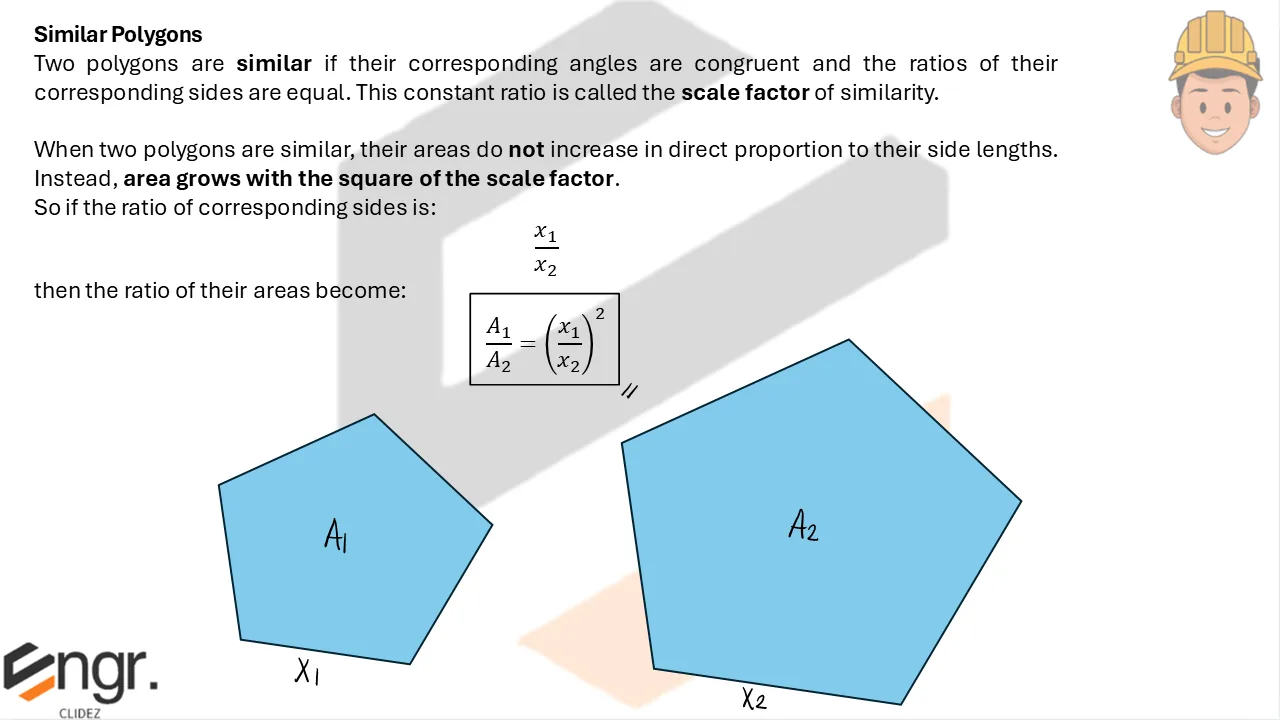
Similar Triangles: Two triangles are similar (AA, SAS, SSS similarity) if their corresponding angles are equal and their sides are proportional, with scale factor k.
Eccentricity, where $c = \sqrt{a^2 - b^2}$ and $0 < e < 1$ for an ellipse:
$$e = \frac{c}{a}$$
Advertisement
Problem: Similar Triangles
Triangle ABC is similar to triangle DEF. If AB = 6 cm, BC = 8 cm, AC = 10 cm, and DE = 9 cm, find:
a. The lengths of EF and DF
b. The area of triangle DEF, given that the area of triangle ABC is 24 cm²
Step 1 — Find the scale factor:
$$k = \frac{DE}{AB} = \frac{9}{6} = \frac{3}{2}$$
a. Missing sides:
$$EF = k \cdot BC = \frac{3}{2}(8) = \boxed{12 \text{ cm}}, \qquad DF = k \cdot AC = \frac{3}{2}(10) = \boxed{15 \text{ cm}}$$
An ellipse has a semi-major axis of $a = 10$ cm and a semi-minor axis of $b = 6$ cm. Find:
a. The area of the ellipse
b. The approximate perimeter using Ramanujan's formula: $P \approx \pi\left[3(a+b) - \sqrt{(3a+b)(a+3b)}\right]$
Additional board-style practice items for this topic.
Question Bank: t417
MSTE - Geometry and Trigonometry / Plane and Solid Geometry / Gemini mapped Chapter 1 to 3
The area of a park on a map is 500 mm$^2$. If the scale of the map is 1 to 40,000 determine the true area of the park in hectares (1 hectare = 10$^4$ m$^2$).
40
80
160
120
Areas scale by the square of the linear scale: true area $=500\text{ mm}^2\times40{,}000^2$. $=500\times1.6\times10^{9}=8\times10^{11}\text{ mm}^2=8\times10^{5}\text{ m}^2$ (since $1\text{ m}^2=10^6\text{ mm}^2$). In hectares: $\dfrac{8\times10^5}{10^4}=80$ ha. $\boxed{80}$
Question Bank: t418
MSTE - Geometry and Trigonometry / Plane and Solid Geometry / Gemini mapped Chapter 1 to 3
The scale of an Ordinance Survey map is 1:2500. A circular sports field has a diameter of 8 cm on the map. Calculate its area in hectares, giving your answer correct to 3 significant figures. (1 hectare=10$^4$ m$^2$)
3.5623
3.1416
2.7843
4.8932
True diameter $=8\text{ cm}\times2500=20{,}000\text{ cm}=200$ m, so radius $=100$ m. Area $=\pi r^2=\pi(100)^2=31{,}416\text{ m}^2$. In hectares: $\dfrac{31{,}416}{10^4}=3.1416$ ha. $\boxed{3.1416}$
Question Bank: t435
MSTE - Geometry and Trigonometry / Plane and Solid Geometry / Gemini mapped Chapter 1 to 3
A rectangular lot has a perimeter of 60 m. Find the area of the lot if one side is 6 m shorter than the other.
224 m$^2$
216 m$^2$
324 m$^2$
196 m$^2$
Perimeter: $l+w=30$. With $l-w=6$: solving gives $l=18$, $w=12$. Area $=18\times12=216$ m$^2$. $\boxed{216\text{ m}^2}$
Question Bank: t436
MSTE - Geometry and Trigonometry / Plane and Solid Geometry / Gemini mapped Chapter 1 to 3
If the one side of a rectangle is increased by 25%, what is the effect on the other side to maintain the same area?
decreased by 80%
decreased by 20%
decreased by 30%
decreased by 10%
Area $=L\times W$ must stay constant. Increasing one side by 25% multiplies it by $1.25$. The other must be multiplied by $\dfrac{1}{1.25}=0.80$, i.e. reduced to 80% — a 20% decrease. $\boxed{\text{decreased by 20\%}}$
Question Bank: t439
MSTE - Geometry and Trigonometry / Plane and Solid Geometry / Gemini mapped Chapter 1 to 3
A square lot 1 kilometer on each side is divided into five equal parts. The parts consist of four equal right triangles and a square at the center of the lot.
What is the dimension of the smaller square in meters?
447.21
336.67
200
420
If this process is continued, what will be the dimension of the next smaller square in meters?
336.67
420
447.21
200
What is the ratio of the area of the smallest square to the original square?
0.2
0.04
0.008
0.5
Part 1.
The lot is divided into 5 equal parts, so the central square has area $\dfrac{1000^2}{5}=200{,}000$ m$^2$. Side $=\sqrt{200{,}000}=447.21$ m. $\boxed{447.21}$
Part 2.
Each new central square has $\tfrac15$ the area of the previous one: $\dfrac{200{,}000}{5}=40{,}000$ m$^2$. Side $=\sqrt{40{,}000}=200$ m. $\boxed{200}$
Part 3.
Each step reduces area by a factor of $\tfrac15$. After two steps: $\left(\tfrac15\right)^2=\tfrac{1}{25}=0.04$. (Check: $40{,}000/1{,}000{,}000=0.04$.) $\boxed{0.04}$
Question Bank: t485
MSTE - Geometry and Trigonometry / Plane and Solid Geometry / Gemini mapped Chapter 1 to 3
What is the area of an ellipse with an aspect ratio of 2 and total perimeter of 18 centimeters?
21.69
22.54
24.78
28.41
Aspect ratio 2 means $a=2b$. Ramanujan: $P\approx\pi[3(a+b)-\sqrt{(3a+b)(a+3b)}]=\pi b[9-\sqrt{35}]=3.084\pi b=18$. $b=\dfrac{18}{3.084\pi}=1.858$, $a=3.716$. Area $=\pi ab=\pi(3.716)(1.858)=21.69$ cm$^2$. $\boxed{21.69}$
Question Bank: t489
MSTE - Geometry and Trigonometry / Plane and Solid Geometry / Gemini mapped Chapter 1 to 3
A car has a mass of 1000 kg. A model of the car is made to a scale of 1 to 50. Determine the mass of the model if the car and its model are made of the same material.
12 grams
8 grams
6 grams
16 grams
Same material, so mass scales with volume $=$ (linear scale)$^3$. $m=1000\text{ kg}\times\left(\dfrac{1}{50}\right)^3=\dfrac{1000}{125{,}000}\text{ kg}=0.008\text{ kg}=8$ g. $\boxed{8\text{ grams}}$
Question Bank: t514
MSTE - Geometry and Trigonometry / Plane and Solid Geometry / Gemini mapped Chapter 1 to 3
A block of copper having a mass of 70 kg is drawn out to make 540 m of wire of uniform cross-section. Given that the density of copper is 8.91 g/cm³, calculate the following:
$A=\dfrac{\pi d^2}{4}\Rightarrow d=\sqrt{\dfrac{4A}{\pi}}=\sqrt{\dfrac{4(14.55)}{\pi}}$. $=4.30$ mm. $\boxed{4.30\text{ mm}}$
Question Bank: t568
MSTE - Geometry and Trigonometry / Plane and Solid Geometry / Gemini mapped Chapter 1 to 3
The diameters of two spherical balls are in the ratio 3:4. What is the ratio of their volumes?
0.5625
0.3826
0.4219
0.4826
Volume scales as the cube of the linear ratio: $\frac{V_1}{V_2} = \left(\frac{d_1}{d_2}\right)^3 = \left(\frac{3}{4}\right)^3 = \frac{27}{64}$ $\boxed{\frac{V_1}{V_2} = 0.4219}$
Question Bank: t590
MSTE - Geometry and Trigonometry / Plane and Solid Geometry / Gemini mapped Chapter 1 to 3
A sphere of radius 20 cm is cut by two horizontal planes. One plane is 8 cm below the center of the sphere and the other is 14 cm above the center of the sphere. Determine the following:
The radius of the lower base.
14.28 cm
12.67 cm
18.33 cm
16.45 cm
The radius of the upper base.
16.45 cm
18.33 cm
12.67 cm
14.28 cm
The volume of the frustum formed between the cutting planes.
24,236.34 cm³
22,512.98 cm³
45,945.43 cm³
48,472.68 cm³
Part 1.
The lower base is 8 cm below the center of the sphere ($R = 20$ cm). Its radius: $a = \sqrt{R^2 - 8^2} = \sqrt{400 - 64} = \sqrt{336}$ $\boxed{a = 18.33 \text{ cm}}$
Part 2.
The upper base is 14 cm above the center. Its radius: $b = \sqrt{R^2 - 14^2} = \sqrt{400 - 196} = \sqrt{204}$ $\boxed{b = 14.28 \text{ cm}}$
Part 3.
The planes lie on opposite sides of the center, so the segment thickness is: $h = 8 + 14 = 22$ cm Volume of the spherical segment with two bases ($a = 18.33$ cm, $b = 14.28$ cm): $V = \frac{\pi h}{6}\left(3a^2 + 3b^2 + h^2\right)$ $V = \frac{\pi (22)}{6}\left(3(336) + 3(204) + 22^2\right) = \frac{\pi (22)}{6}(2104)$ $\boxed{V = 24{,}236.34 \text{ cm}^3}$
Question Bank: t605
MSTE - Geometry and Trigonometry / Plane and Solid Geometry / Gemini mapped Chapter 1 to 3
Given a rectangle ABCD, AB = 2, BC = 5. Find the volume if the area is revolved about a line through side AD.
25π
20π
15π
30π
Revolving the rectangle about one of its sides (line through $AD$, length $5$) generates a cylinder. The axis is side $AD = 5$ (height), and the perpendicular side $AB = 2$ becomes the radius. $V = \pi r^2 h = \pi (2)^2(5)$ $\boxed{V = 20\pi}$
Question Bank: t609
MSTE - Geometry and Trigonometry / Plane and Solid Geometry / Gemini mapped Chapter 1 to 3
A line has an x intercept of (5, 0) and y intercept of (0, 3). Find the volume generated by the area bounded in the first quadrant, revolved about x-axis.
47.12
52.89
65.24
78.54
The line cuts off a right triangle in the first quadrant with legs $5$ (along x) and $3$ (along y). Revolving about the x-axis generates a cone of radius $3$ and height $5$: $V = \frac{1}{3}\pi r^2 h = \frac{1}{3}\pi (3)^2(5)$ $V = 15\pi$ $\boxed{V = 47.12}$
Question Bank: t614
MSTE - Geometry and Trigonometry / Plane and Solid Geometry / Gemini mapped Chapter 1 to 3
The area of the ellipse $x^2/16 + y^2/25 = 1$ is revolved about the line $y + 8 = 0$.
What is the area of the ellipse?
62.8
76.5
54.3
98.7
What is the volume generated?
4567
2876
3675
3158
What is the surface area generated?
1564
1120
1987
1426
Part 1.
From $\frac{x^2}{16} + \frac{y^2}{25} = 1$: semi-axes $a = 4$ and $b = 5$. Area of the ellipse: $A = \pi a b = \pi (4)(5) = 20\pi$ $\boxed{A = 62.8}$
Part 2.
The ellipse center $(0,0)$ is a distance $8$ from the line $y = -8$. By Pappus' theorem: $V = 2\pi d A = 2\pi (8)(20\pi) = 320\pi^2$ $\boxed{V = 3158}$
Part 3.
Perimeter of the ellipse (Ramanujan approximation): $P \approx \pi\left[3(a+b) - \sqrt{(3a+b)(a+3b)}\right] = \pi\left[27 - \sqrt{(17)(19)}\right] = 28.36$ The perimeter's centroid is at the center, a distance $8$ from $y = -8$. By Pappus' theorem for surface area: $S = 2\pi d P = 2\pi (8)(28.36)$ $\boxed{S = 1426}$
Question Bank: t2108
MSTE - Geometry and Trigonometry / Plane and Solid Geometry / Besavilla CE Pre-Board Math & Surveying
The area of a trapezium is 13.5 cm$^2$ and the perpendicular distance between its parallel sides is 3 cm. If the length of one of the parallel sides is 5.6 cm., find the length of the other parallel side.
5.8 cm.
2.5 cm.
4.8 cm.
4.0 cm.
3.4 cm.
Area of a trapezium is $A=\frac{1}{2}(a+b)h$ Substitute $A=13.5\text{ cm}^2$, $h=3$ cm, and one parallel side $a=5.6$ cm. $13.5=\frac{1}{2}(5.6+b)(3)$ $5.6+b=9$ $\boxed{b=3.4\text{ cm}}$
Question Bank: t2155
MSTE - Geometry and Trigonometry / Plane and Solid Geometry / Besavilla CE Pre-Board Math & Surveying
A car has a mass of 1000 kg. A model of the car is made to a scale of 1 to 50. Determine the mass of the model if the car and its model are made of the same material.
0.002 kg
0.008 kg
0.005 kg
0.004 kg
0.007 kg
The scale is 1:50. Since the car and model are made of the same material, mass varies as volume, and volume varies as the cube of the linear scale. $m_{model}=1000\left(\frac{1}{50}\right)^3$ $m_{model}=\frac{1000}{125000}$ $\boxed{m_{model}=0.008\text{ kg}}$
Question Bank: t2164
MSTE - Geometry and Trigonometry / Plane and Solid Geometry / Besavilla CE Pre-Board Math & Surveying
A woodman chops halfway through a tree of diam. 1 m., one face of the cut being horizontal, the other inclined at 45° with the horizontal. Find the volume of the wood in cu.m.
0.067 m3
0.055 m3
0.028 m3
0.048 m3
0.083 m3
For a cylindrical wedge cut halfway through the circular section, use the standard wedge volume $V=\frac{2r^3\tan\theta}{3}$ Here the tree diameter is 1 m, so $r=0.5$ m, and the inclined face makes $\theta=45^\circ$. $V=\frac{2(0.5)^3\tan45^\circ}{3}$ $V=\frac{2(0.125)(1)}{3}=0.0833\text{ m}^3$ $\boxed{V\approx 0.083\text{ m}^3}$