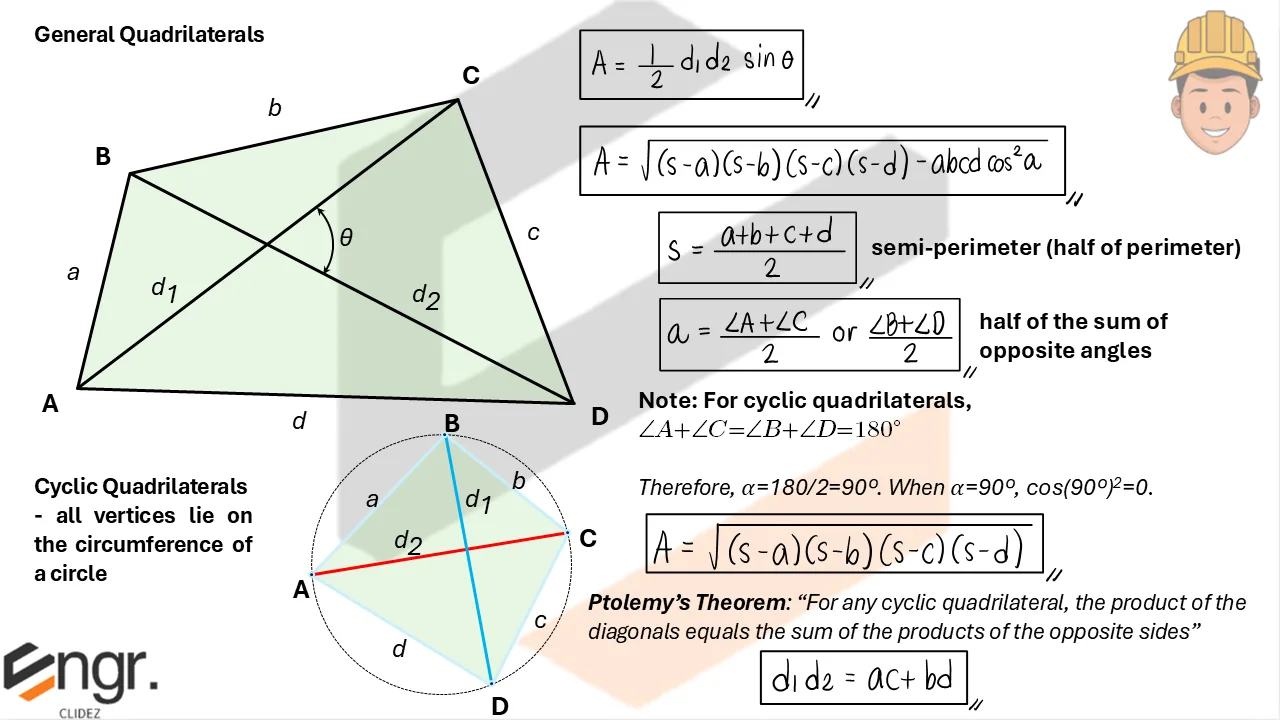
The sides of a cyclic quadrilateral measure 8 cm, 9 cm, 12 cm, and 7 cm, respectively.
a. Find the area of the cyclic quadrilateral.
b. Find the area of the circumscribing circle.
Part a — Area using Brahmagupta's Formula (sides $a=8, b=9, c=12, d=7$):
A building site is in the form of a quadrilateral with the following sides and angles given. AB = 52.4 m, BC = 28.5 m, CD = 34.6 m, angle B = 72°, and angle D = 75°. Determine the area of the site.
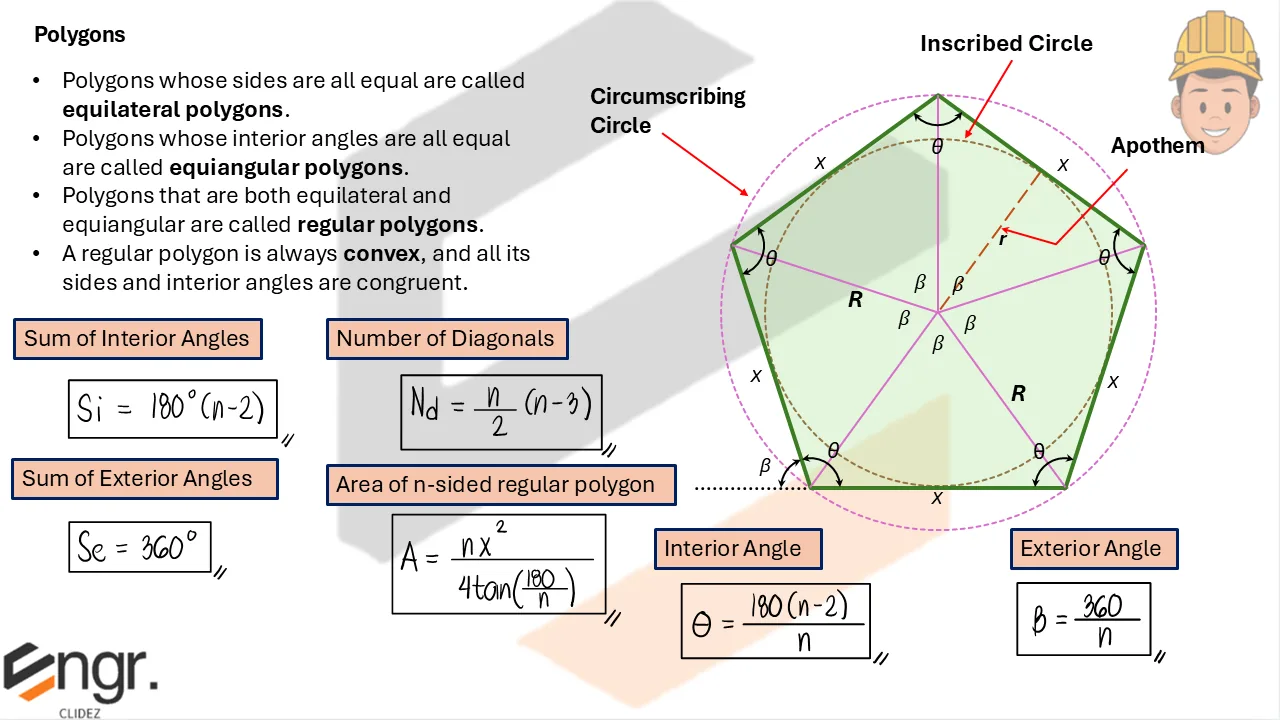
A regular hexagon whose sides measure 30 units each is inscribed in a circle. Determine the following:
a. The number of diagonals
b. The interior angle on each side
c. The radius of the circumscribing circle
d. The length of the apothem
e. The area of the polygon
For a regular hexagon with $n = 6$, side $s = 30$:
A cyclic quadrilateral ABCD is inside a circle with side AD coinciding with the diameter of the circle. AB = 8 cm, BC = 10 cm, CD = 12 cm. Find the area of the circumscribing circle.
Since AD is the diameter, angles ABD and ACD are both 90° (inscribed-angle theorem). Let $D = AD$ (diameter).
In right triangle ABD: $BD = \sqrt{D^2 - 64}$. In right triangle ACD: $AC = \sqrt{D^2 - 144}$.
Apply Ptolemy's theorem ($AC \cdot BD = AB \cdot CD + BC \cdot AD$):
An isosceles trapezoid has parallel bases of 10 cm and 16 cm. The non-parallel legs are each 5 cm. Find:
a. The height of the trapezoid
b. The area of the trapezoid
c. The length of each diagonal
Bases: $b_1 = 10$ cm, $b_2 = 16$ cm; leg $= 5$ cm. The overhang on each side $= (16-10)/2 = 3$ cm.
A regular pentagon is inscribed in a circle of radius 10 cm. Find:
a. The side length of the pentagon
b. The perimeter of the pentagon
c. The area of the pentagon
d. The area of the region inside the circle but outside the pentagon
For a regular pentagon ($n = 5$) inscribed in a circle of $R = 10$ cm:
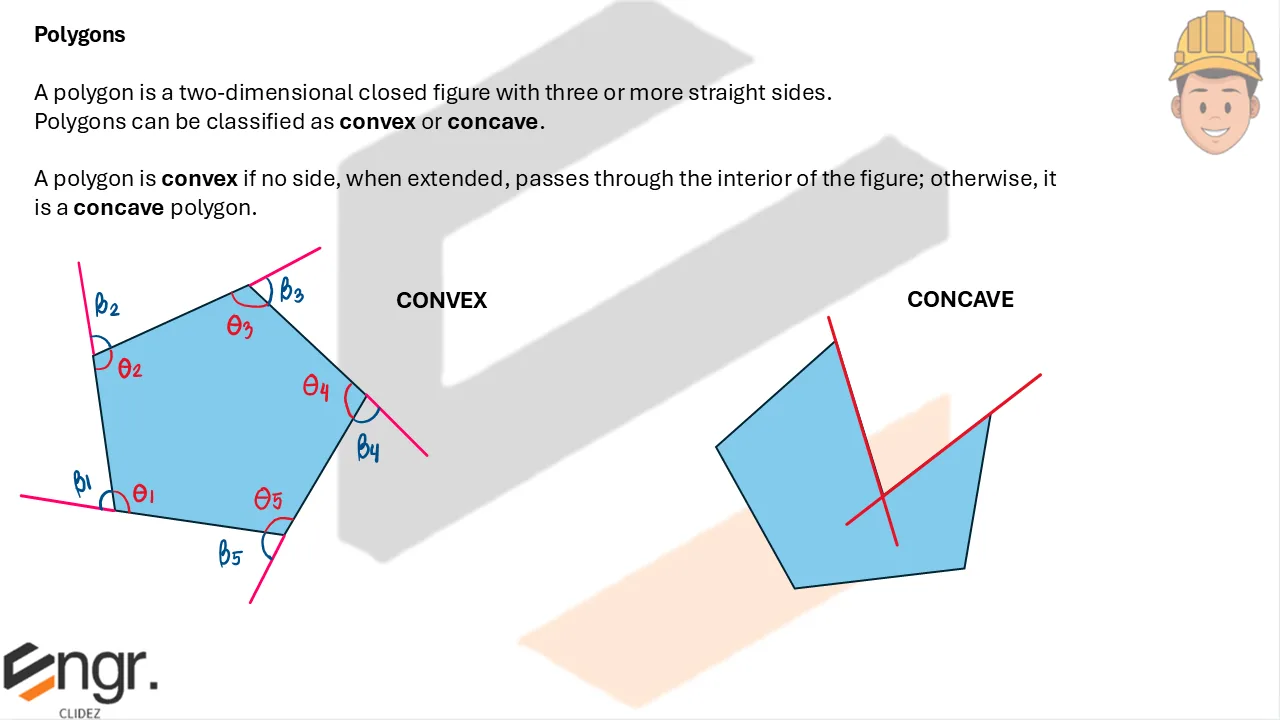
Only two polygons can have a smallest interior angle of 120º with each successive angle 5º greater than its predecessor. One is the nonagon. What is the other?
Answer:
Hexadecagon
Octadecagon
Dodecagon
Tetradecagon
For an $n$-gon, the angle sum is $180(n-2)$. The interior angles form an arithmetic sequence with first term 120° and common difference 5°: $\frac{n}{2}[2(120)+5(n-1)]=180(n-2)$ $n^2-25n+144=0$ $n=9$ or $16$. Since the nonagon is one, the other is: $\boxed{\text{Hexadecagon}}$
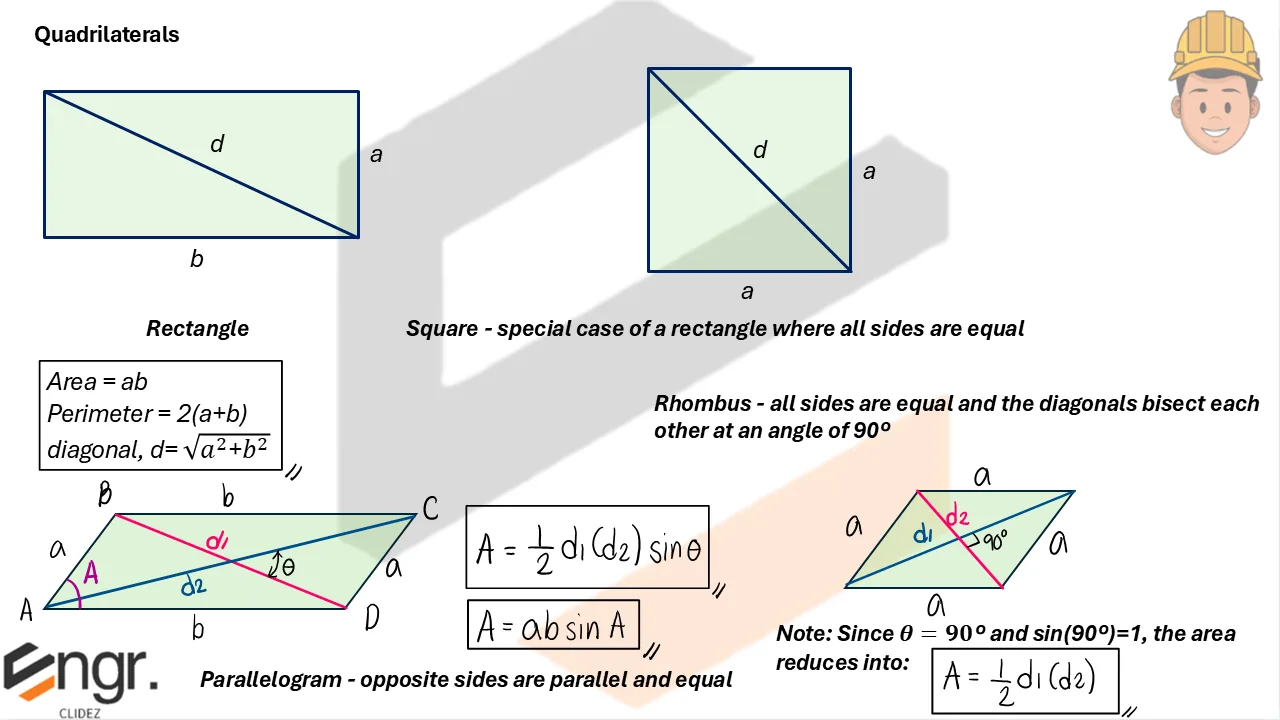
Two sides of a parallelogram measure 68 cm and 83 cm and the shorter diagonal is 42 cm. Determine the smallest interior angle of the parallelogram.
Answer:
30.27º
12.65º
23.87º
49.45º
For the shorter diagonal $d=42$ opposite the smaller angle $\theta$, use the law of cosines: $42^2=68^2+83^2-2(68)(83)\cos\theta$ $\cos\theta=\frac{68^2+83^2-42^2}{2(68)(83)}$ $\theta=30.27^\circ$ $\boxed{30.27^\circ}$
A corner lot of land is 35 m on one street and 25 m on the other street. The angle between the two lines of the street being 82°. The other two lines of the lot are respectively perpendicular to the lines of the streets. What is the worth of the lot of its unit price is P2500 per square meter?
Answer:
P1,884,050
P1,588,045
P2,234,023
P1,978,456
### Area and value of the corner lot
Let the two street frontages meet at $O$, with $OP=35 \text{m}$ and $OQ=25 \text{m}$. The street angle is $82^\circ$. The other lot boundaries are perpendicular to their respective streets, so their intersection is found from the perpendicular offsets.
Using the geometry of the resulting quadrilateral, the perpendicular offset is
$$t=\frac{25-35\cos82^\circ}{\sin82^\circ}.$$
The lot area is the sum of the two triangular components,
$$A=\frac12\left[t(35-25\cos82^\circ)+35(25)\sin82^\circ\right]$$
$$\approx753.62 \text{m}^2.$$
At $2500$ pesos per square metre,
$$\text{Worth}=753.62(2500)=\boxed{\text{P}1{,}884{,}050}. $$
A regular hexagon with equal sides of 30cm has an area of:
Answer:
2338.27cm2
2438.27cm2
2358.27cm2
2388.27cm2
Area of a regular hexagon is six equilateral triangles: $A=6\left(\frac{\sqrt3}{4}s^2\right)$ $A=\frac{3\sqrt3}{2}(30^2)$ $\boxed{2338.27\text{ cm}^2}$
Question Bank: t443
MSTE - Geometry and Trigonometry / Plane and Solid Geometry / Gemini mapped Chapter 1 to 3
Given rectangle whose dimension is 12 cm $\times$ 16 cm. Find the diameter of the smallest circle than can contain the rectangle.
10
20
15
12
The smallest enclosing circle has the rectangle's diagonal as its diameter. Diameter $=\sqrt{12^2+16^2}=\sqrt{400}=20$ cm. $\boxed{20}$
Question Bank: t453
MSTE - Geometry and Trigonometry / Plane and Solid Geometry / Gemini mapped Chapter 1 to 3
A quadrilateral ABCD is inscribed in a semicircle with side AD coinciding with the diameter of the circle. Side AB = 8 cm, BC = 10 cm, and CD = 12 cm.
What is the diameter of the circle in cm?
22.3
20.1
18.5
24.7
What is the length of the diagonal BD in cm?
18.43
19.63
20.14
17.52
What is the area of the quadrilateral in square cm?
154.74
136.85
128.75
189.63
Part 1.
Each chord subtends a central angle; with the diameter $d$, a chord of length $L$ gives $L=d\sin(\theta/2)$. Let the half-angles be $a,b,c$ with $a+b+c=90^\circ$. $d\sin a=8$, $d\sin b=10$, $d\cos(a+b)=12$. Eliminating leads to $d^3-308d-1920=0$. Solving gives $d=20.1$ cm. $\boxed{20.1}$
Part 2.
Since AD is the diameter, angle ABD is inscribed in a semicircle and equals $90^\circ$. So triangle ABD is right-angled at B. $BD=\sqrt{AD^2-AB^2}=\sqrt{20.1^2-8^2}=\sqrt{340}=18.43$ cm. $\boxed{18.43}$
Part 3.
Split along BD. Triangle ABD (right at B): area $=\tfrac12(8)(18.43)=73.7$. Triangle BCD (sides 10, 12, 18.43) by Heron with $s=20.22$: area $=\sqrt{20.22(10.22)(8.22)(1.78)}=55.0$. Total $=73.7+55.0=128.75$ cm$^2$. $\boxed{128.75}$
Question Bank: t456
MSTE - Geometry and Trigonometry / Plane and Solid Geometry / Gemini mapped Chapter 1 to 3
A polygon has twenty-four sides. How diagonals have this polygon?
222
212
232
252
Number of diagonals of an $n$-gon is $\dfrac{n(n-3)}{2}$. $\dfrac{24(24-3)}{2}=\dfrac{24(21)}{2}=252$. $\boxed{252}$
Question Bank: t457
MSTE - Geometry and Trigonometry / Plane and Solid Geometry / Gemini mapped Chapter 1 to 3
If the sum of the interior angles of a regular polygon equals $720^\circ$, and the length of one side of the polygon is $3x^2$, what is the perimeter of the polygon?
$18x^2$
$18x^{12}$
$24x^2$
$24x^{12}$
Interior angle sum $=(n-2)180^\circ=720^\circ\Rightarrow n-2=4\Rightarrow n=6$ sides. Perimeter $=6\times3x^2=18x^2$. $\boxed{18x^2}$
Question Bank: t458
MSTE - Geometry and Trigonometry / Plane and Solid Geometry / Gemini mapped Chapter 1 to 3
A regular hexagon is inscribed in a circle. The area in the circle outside the hexagon is 122.2912 cm$^2$. What is the area of the circle in cm$^2$?
804.25
530.93
615.75
706.86
For a hexagon inscribed in a circle of radius $R$, area outside $=\pi R^2-\dfrac{3\sqrt3}{2}R^2=R^2(\pi-2.598)=0.5435R^2$. $0.5435R^2=122.2912\Rightarrow R^2=225$, so $R=15$. Circle area $=\pi(225)=706.86$ cm$^2$. $\boxed{706.86}$
Question Bank: t459
MSTE - Geometry and Trigonometry / Plane and Solid Geometry / Gemini mapped Chapter 1 to 3
Find the area of regular octagon of side 30 cm.
4,345.58 cm$^2$
4,698.54 cm$^2$
4,105.78 cm$^2$
3,856.36 cm$^2$
Area of a regular octagon of side $a$ is $2(1+\sqrt2)a^2$. $=2(1+\sqrt2)(30)^2=2(2.4142)(900)=4345.58$ cm$^2$. $\boxed{4{,}345.58\text{ cm}^2}$
Question Bank: t460
MSTE - Geometry and Trigonometry / Plane and Solid Geometry / Gemini mapped Chapter 1 to 3
Pentagons ABCDE and FGHIJ are similar. The ratio of each side of pentagon ABCDE to its corresponding side of pentagon FGHIJ is 4:1. If AB and FG are corresponding sides, and the length of AB is $4x + 4$, what is the length of FG?
$x + 1$
$2x + 2$
$4x + 4$
$16x + 16$
ABCDE is 4 times FGHIJ, so $FG=\dfrac{AB}{4}$. $FG=\dfrac{4x+4}{4}=x+1$. $\boxed{x+1}$
Question Bank: t503
MSTE - Geometry and Trigonometry / Plane and Solid Geometry / Gemini mapped Chapter 1 to 3
A swimming pool is rectangular in shape of length 12 m and width 5.5 m. It has a sloping bottom and is 1 m deep on one end and 3.6 m deep on the other end. The water from a full cylindrical reservoir 4 m in diameter and 10 m deep is emptied into the pool. Find the depth of water at the deep end.
2.8 m
3 m
3.1 m
3.2 m
Reservoir volume $=\pi(2)^2(10)=125.66$ m$^3$. Filling the sloping wedge up to the shallow-bottom level uses $5.5\times\tfrac12(12)(2.6)=85.8$ m$^3$. Remaining $=125.66-85.8=39.86$ m$^3$ forms a level layer over the full $12\times5.5=66$ m$^2$ floor: thickness $=39.86/66=0.60$ m. Depth at deep end $=2.6+0.60=3.2$ m. $\boxed{3.2\text{ m}}$
Question Bank: t511
MSTE - Geometry and Trigonometry / Plane and Solid Geometry / Gemini mapped Chapter 1 to 3
A log $8\sqrt{2}$ cm in diameter and 16 cm long is to be cut into equal cubes. If each cube is to be 4 cm on each side, determine the maximum volume of cubes that can be cut from the log.
448
256
1024
512
An $8\times8$ square has diagonal $8\sqrt2$ = the log's diameter, so it inscribes exactly — fitting a $2\times2$ array of 4-cm squares (4 cubes per cross-section). Along the 16-cm length: $16/4=4$ layers, giving $4\times4=16$ cubes. Volume $=16\times4^3=16\times64=1024$ cm$^3$. $\boxed{1024}$
Question Bank: t542
MSTE - Geometry and Trigonometry / Plane and Solid Geometry / Gemini mapped Chapter 1 to 3
The altitude of a regular tetrahedron is 58 cm. Its volume is:
34582 cc
42243 cc
28496 cc
51785 cc
For a regular tetrahedron, altitude $H=a\sqrt{\tfrac23}$, so $a=\dfrac{58}{0.8165}=71.03$ cm. $V=\dfrac{a^3}{6\sqrt2}=\dfrac{71.03^3}{8.485}=42{,}243$ cc. $\boxed{42243\text{ cc}}$
Question Bank: t553
MSTE - Geometry and Trigonometry / Plane and Solid Geometry / Gemini mapped Chapter 1 to 3
The measure of the edge of a solid regular tetrahedron is 50 cm. Find the distance of its center of gravity from its vertex.
38.42 cm
40.43 cm
32.54 cm
30.62 cm
Tetrahedron altitude $H=a\sqrt{\tfrac23}=50(0.8165)=40.82$ cm. The centroid lies $\tfrac14$ of the way up from the base, i.e. $\tfrac34 H$ from the apex. Distance from vertex $=\tfrac34(40.82)=30.62$ cm. $\boxed{30.62\text{ cm}}$
Question Bank: t604
MSTE - Geometry and Trigonometry / Plane and Solid Geometry / Gemini mapped Chapter 1 to 3
A billiard ball, aimed at point A on the edge of the cushion of a horizontal billiard table, rolls along a line making 18° with the cushion. If the cushion overhangs so that its edge is 4 cm above the table and if the diameter of the ball is 5 cm, find the distance (measured along the edge of the cushion) between point A and the point where the ball strikes the cushion.
7.14 cm
5.87 cm
6.16 cm
4.23 cm
The ball (radius $2.5$ cm) rolls with its center at height $2.5$ cm; the overhanging cushion edge is at height $4$ cm. The ball strikes the edge when the center is a perpendicular plan-distance $y$ from the cushion such that: $\sqrt{y^2 + (4 - 2.5)^2} = 2.5 \Rightarrow y^2 + 2.25 = 6.25 \Rightarrow y = 2$ cm The center's plan path makes $18^\circ$ with the cushion and is aimed at $A$, so the distance along the edge is: $d = \frac{y}{\tan 18^\circ} = \frac{2}{\tan 18^\circ}$ $\boxed{d = 6.16 \text{ cm}}$
Question Bank: t2122
MSTE - Geometry and Trigonometry / Plane and Solid Geometry / Besavilla CE Pre-Board Math & Surveying
Calculate the area of a regular octagon if each side is 20 mm and the width across the flats is 48.3 mm.
1825 mm2
1748 mm2
1932 mm2
1645 mm2
1886 mm2
For a regular polygon, area $A=\frac{1}{2}Pa$, where $a$ is the apothem. The width across flats is twice the apothem. $a=\frac{48.3}{2}=24.15$ mm Perimeter of octagon: $P=8(20)=160$ mm $A=\frac{1}{2}(160)(24.15)$ $\boxed{A=1932\text{ mm}^2}$
Question Bank: t2129
MSTE - Geometry and Trigonometry / Polygons / Besavilla CE Pre-Board Math & Surveying
How many diagonals are there in a dodecagon?
50
58
56
54
52
The number of diagonals of an $n$-sided polygon is $D=\frac{n(n-3)}{2}$ For a dodecagon, $n=12$. $D=\frac{12(12-3)}{2}=\frac{12(9)}{2}$ $\boxed{54}$
Question Bank: w28
MSTE - Geometry and Trigonometry / Plane and Solid Geometry / MSTE May 2019
A polyhedron having 12 faces, each face a regular pentagon, is called a dodecahedron. Determine the number of edges.
60
45
15
30
For a regular polyhedron, $E = \frac{nF}{2}$, where $n$ = number of sides per face. $E = \frac{5 \times 12}{2} = \boxed{30\text{ edges}}$
Question Bank: w73
MSTE - Geometry and Trigonometry / Quadrilaterals / MSTE November 2019
Two sides of a quadrilateral are each twice the shortest side, and the fourth side is 2 m more than the shortest side. If the perimeter of the quadrilateral is 29 m, what is the length of the shortest side?
5.5 m
5.0 m
4.5 m
4.0 m
Let $x$ be the shortest side. The four sides are $x$, $2x$, $2x$, and $x+2$: $x + 2x + 2x + (x+2) = 29$ $6x + 2 = 29$ $6x = 27 \Rightarrow x = 4.5$ m $\boxed{x = 4.5\text{ m}}$
Question Bank: w312
MSTE - Geometry and Trigonometry / Plane Geometry / MSTE April 2025
If the length of a rectangle is decreased by 10% and the width increased by 10%, what is the percentage change of the area?
The negative sign means the area went down. $\boxed{1\%\ \text{decreased}}$
Exam trap: equal-and-opposite percentage changes do not cancel — the area always drops.
Question Bank: w326
MSTE - Geometry and Trigonometry / Plane Geometry / MSTE April 2025
Two frames are needed with the same perimeter: one frame in the shape of a square and one in the shape of an equilateral triangle. Each side of the triangle is 6 centimeters longer than each side of the square. Find the side lengths of each frame.
18, 24
19, 25
17, 23
20, 26
Let $x$ = side of the square and $y$ = side of the triangle, with $y = x + 6$.