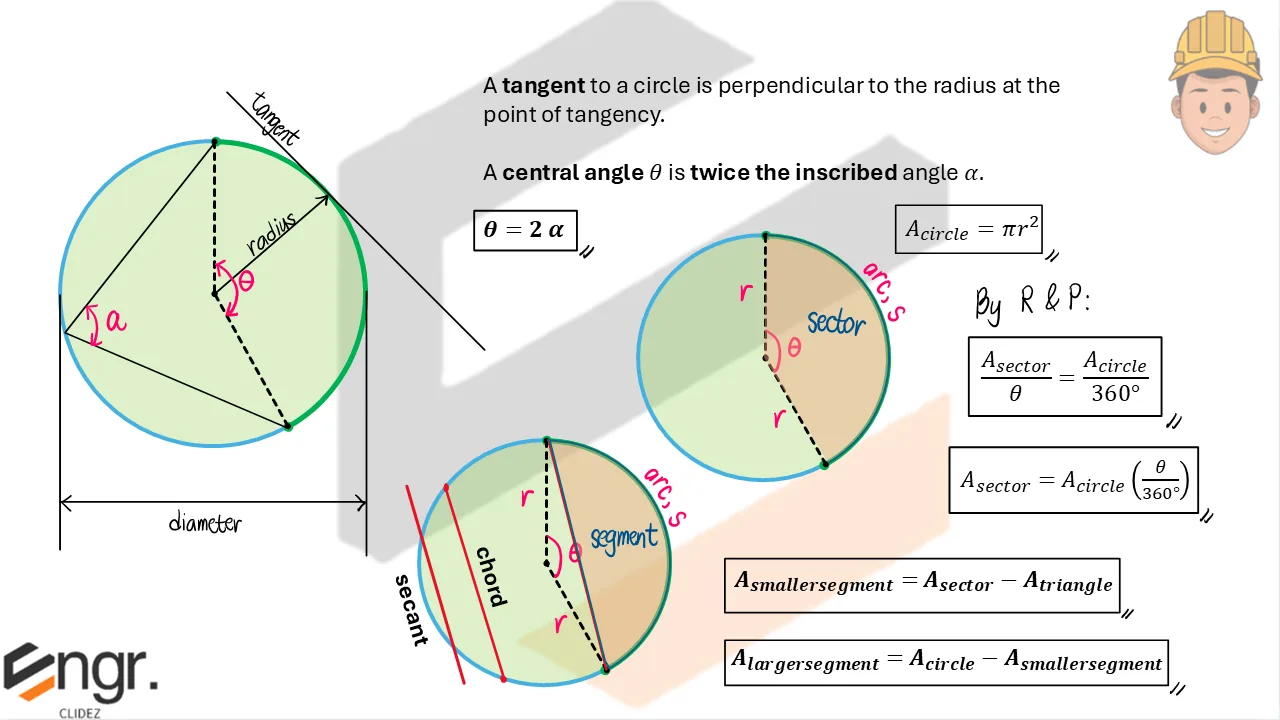
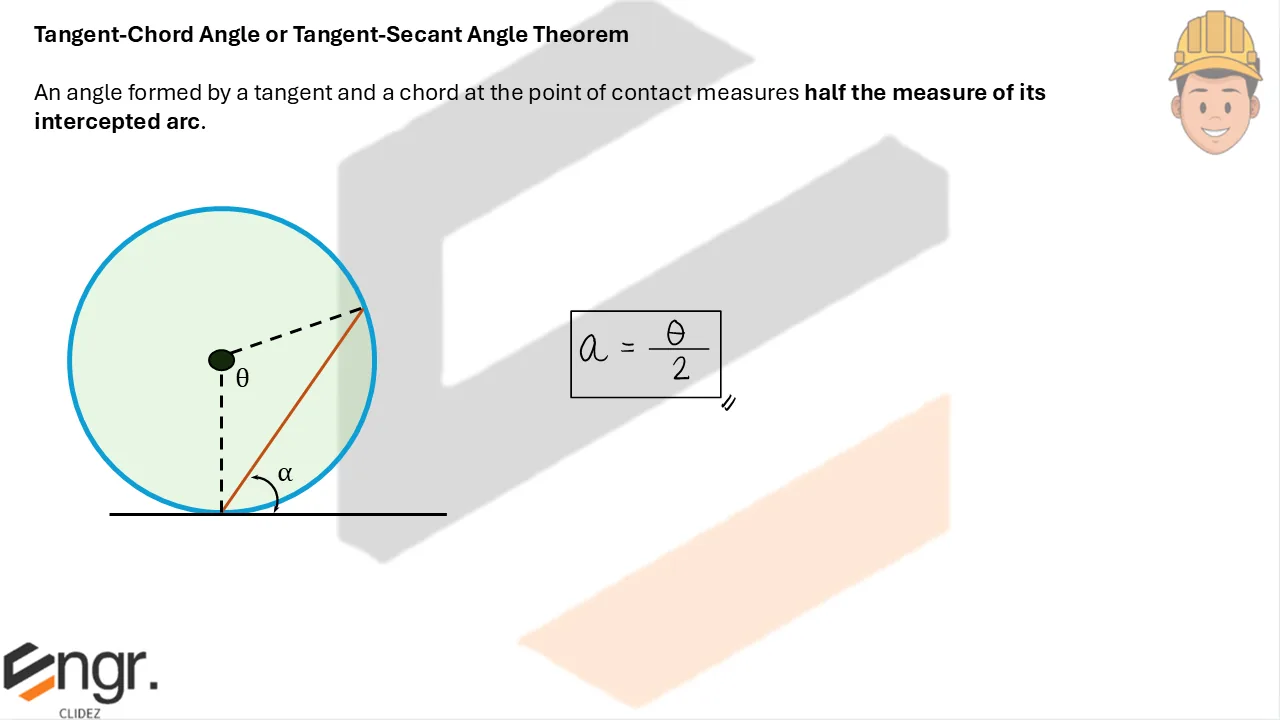
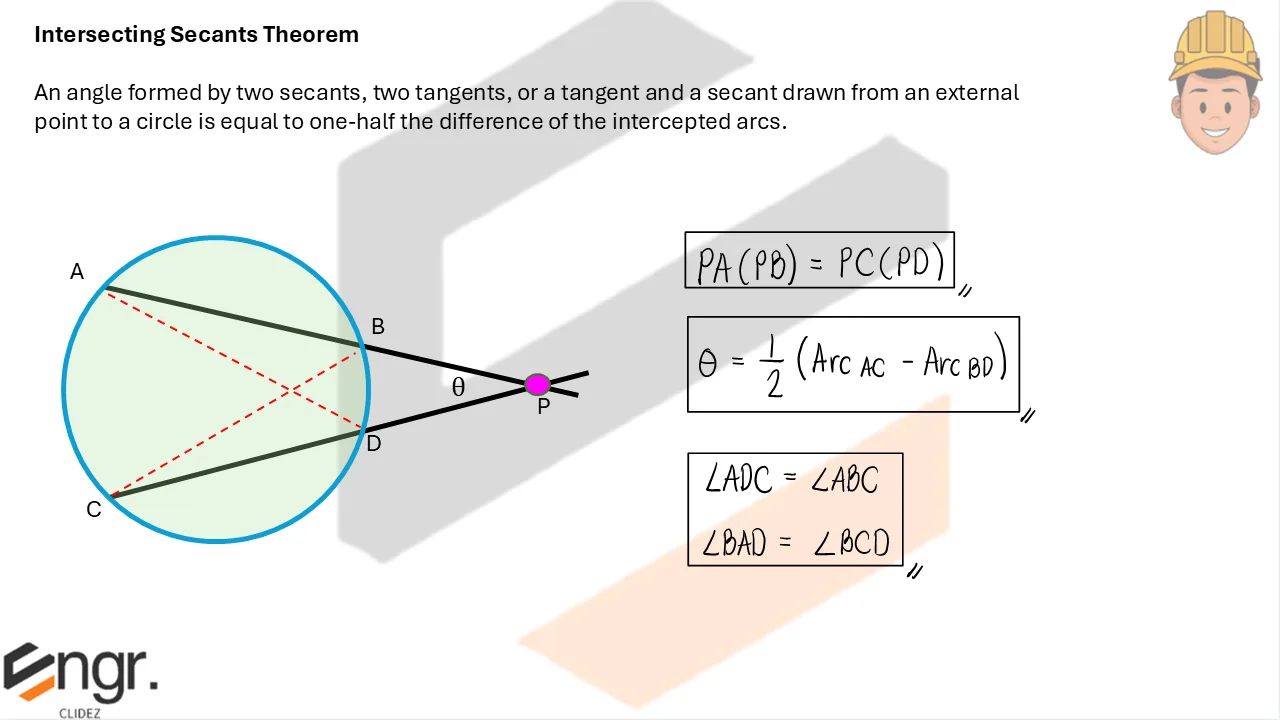
A circle is divided into two parts by a chord, 3 cm away from the center. Find the area of the smaller part, in cm², if the circle has an area of 201 cm².
Problem: Inscribed Angle Theorem (Triangle in Semicircle)
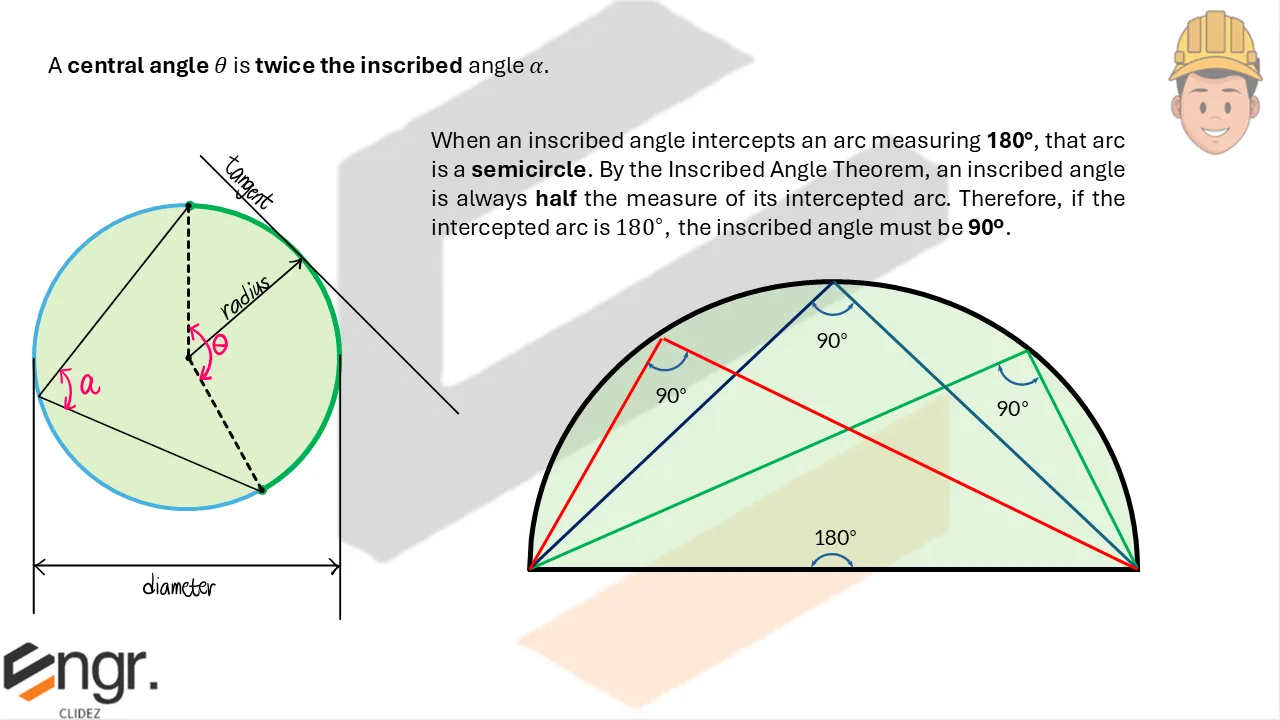
A triangle with an area of 90 cm² is inscribed in a 20 cm diameter semicircle such that its vertices touch the semicircle. If one side of the triangle measures 20 cm, find the other two sides of the triangle.
Since the triangle is inscribed in a semicircle with the 20 cm side as the diameter, the angle opposite that side = 90° (Thales' theorem). The triangle is right-angled.
Using the chord-center geometry: center is at midpoint of AB, so OA = 8, OC = 12, and $\cos\angle AOC = -4/11$ (derived from the circle equation with $r = 19$, center at 11 cm from O along AB).
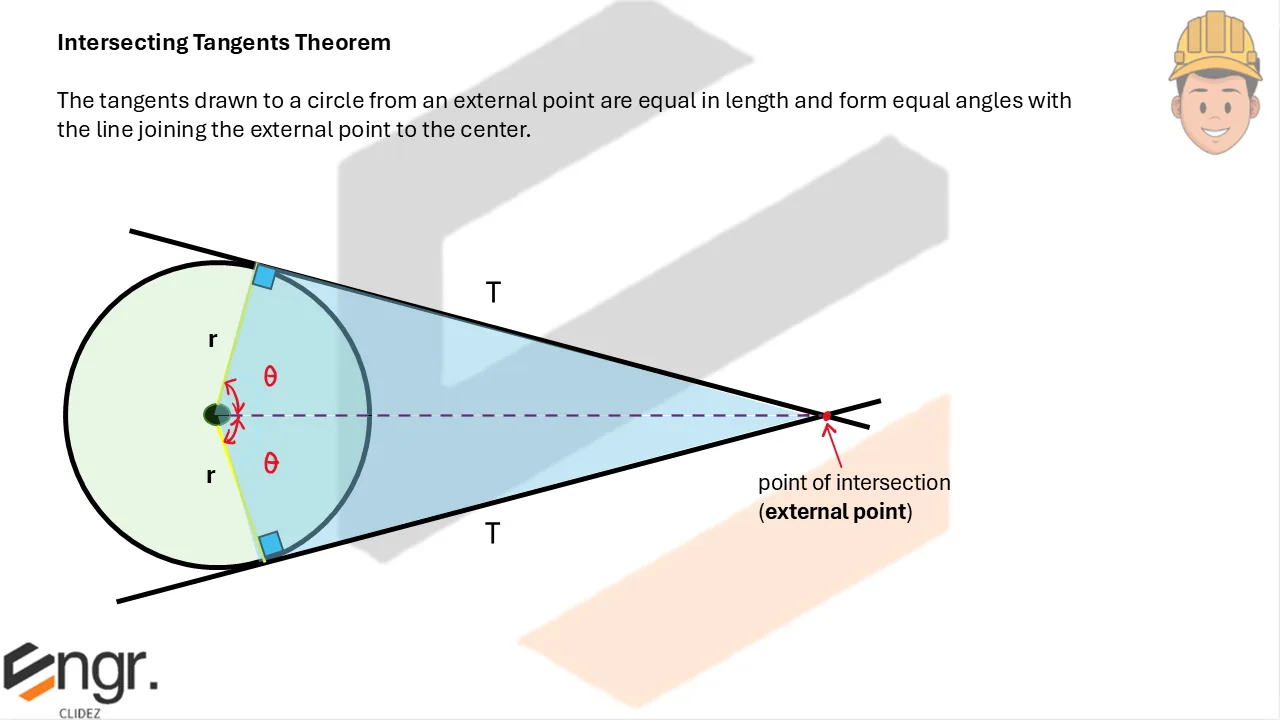
A circular ring (annulus) is formed between two concentric circles. A chord of the outer circle is tangent to the inner circle and has a length of 16 cm. Find the area of the ring.
Let $R$ = outer radius, $r$ = inner radius. The chord of the outer circle is tangent to the inner circle, so the perpendicular from the center to the chord equals $r$. The half-chord = 8 cm.
Problem: Angle Formed by Two Chords Inside a Circle
Two chords AB and CD of a circle intersect at point P inside the circle. The measure of arc AC = 80° and arc BD = 40°. Find:
a. The measure of angle APD
b. The measure of angle APC
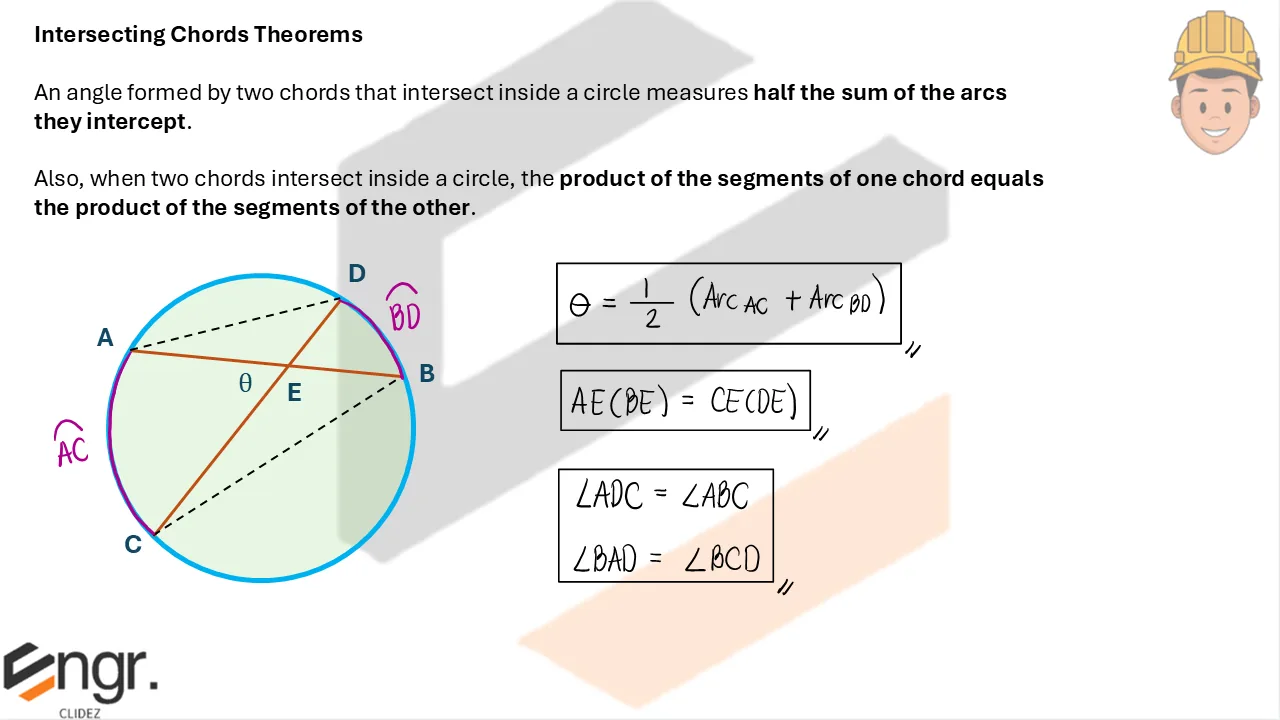
When two chords intersect inside a circle, the measure of the angle formed equals half the sum of the intercepted arcs.
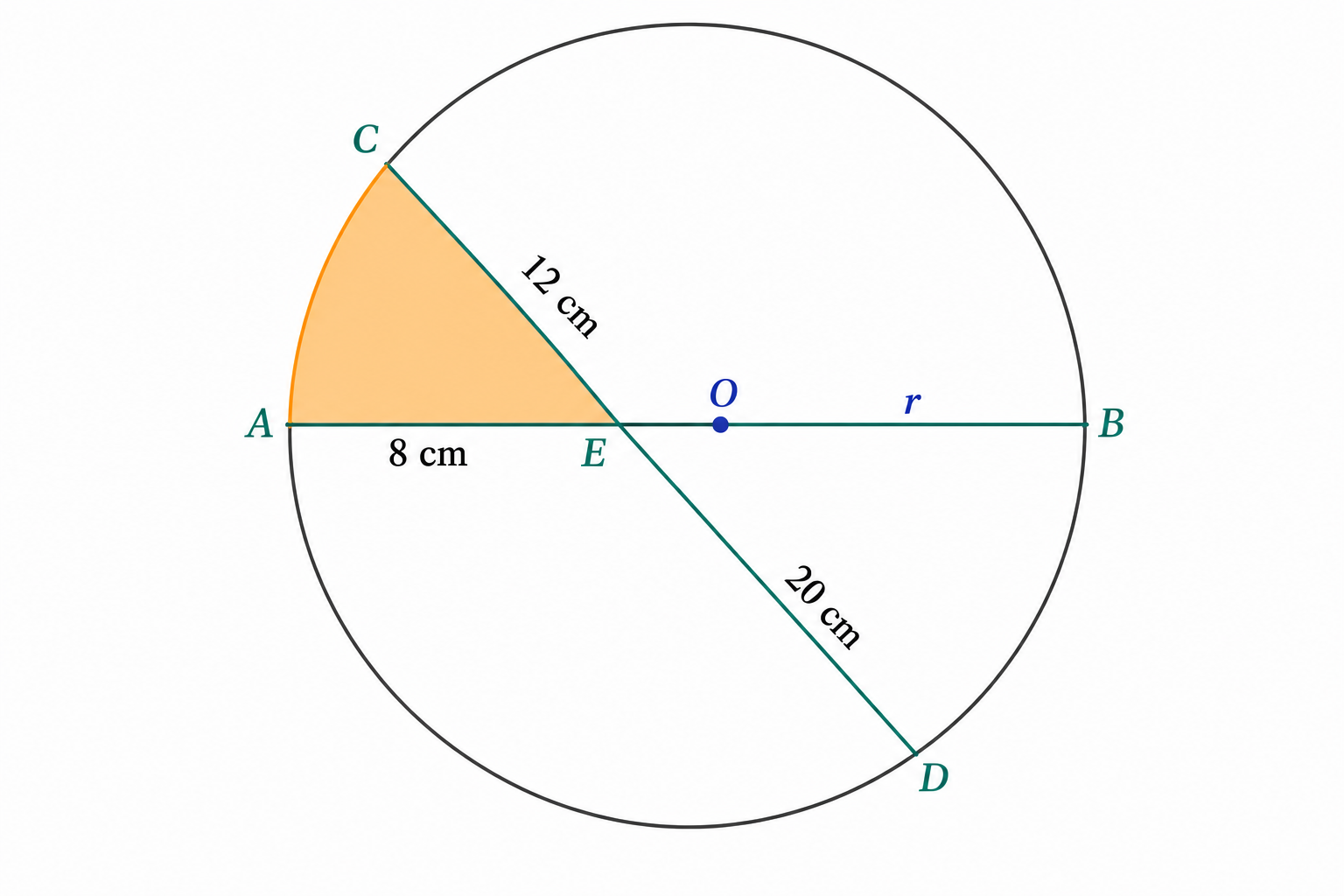
Chords AB and CD intersect at point E. AE = 8 cm, CE = 12 cm, and DE = 20 cm. AB is the diameter of the circle. Calculate the area of the shaded region ACE bounded by arc AC, chord CE, and segment AE.
Answer:
52.05cm2
51.36cm2
53.15cm2
50.87cm2
1. Find the radius. Let r be the radius. Since AB is a diameter, $EB=AB-AE=2r-8$. By the intersecting-chords theorem, $AE\times EB=CE\times DE$ $8(2r-8)=12(20)$ $16r-64=240$, so $r=\boxed{19\text{ cm}}$. Hence $OE=r-8=11\text{ cm}$.
2. Find the central angle. In triangle EOC, $EC=12\text{ cm}$, $EO=11\text{ cm}$, and $OC=19\text{ cm}$. By the cosine law, $12^2=19^2+11^2-2(19)(11)\cos\theta$ $\cos\theta=\dfrac{19^2+11^2-12^2}{2(19)(11)}$, so $\theta=36.04^\circ$.
3. Compute the shaded segment. The shaded region ACE equals sector AOC minus triangle EOC: $A_{ACE}=\dfrac12r^2\theta-\dfrac12r(r-8)\sin\theta$ $A_{ACE}=\dfrac12(19)^2\left(36.04\dfrac{\pi}{180}\right)-\dfrac12(19)(11)\sin36.04^\circ$ $\boxed{A_{ACE}=52.05\text{ cm}^2}$.
The diagonals of a rhombus are 10 cm, and 8 cm, respectively. Its area is:
Answer:
40 sq. cm
60 sq. cm
10 sq. cm
50 sq. cm
The area of a rhombus is one-half the product of its diagonals: $A=\frac{1}{2}d_1d_2$ $A=\frac{1}{2}(10)(8)$ $\boxed{40\text{ sq. cm}}$
Question Bank: q263
MSTE - Geometry and Trigonometry / Theorems on Triangles and Circles / Engr. Janclyde Espinosa (Clidez)
AB is the diameter of a circle, BC is a chord 10 cm long, CD is another chord, and angle BDC = 18°. What is the area of the circle in square cm?
Answer:
822.4
3289.8
1254.4
205.6
The inscribed angle $\angle BDC=18^\circ$ intercepts chord BC, so the central angle subtending BC is $36^\circ$. For chord $BC=10$: $10=2R\sin18^\circ$ $R=\frac{10}{2\sin18^\circ}=16.18$ cm Area: $A=\pi R^2=\pi(16.18)^2$ $\boxed{822.4}$
Question Bank: q268
MSTE - Geometry and Trigonometry / Theorems on Triangles and Circles / Engr. Janclyde Espinosa (Clidez)
A regular octagon is inscribed in a circle of radius 10. Find the area of the octagon.
Answer:
282.8 sq. units
228.2 sq. units
288.2 sq. units
238.2 sq. units
A regular octagon inscribed in a circle of radius 10 can be split into 8 isosceles triangles with included central angle $45^\circ$. $A=8\left(\frac{1}{2}r^2\sin45^\circ\right)$ $A=4(10^2)(0.7071)$ $\boxed{282.8\text{ sq. units}}$
Question Bank: q272
MSTE - Geometry and Trigonometry / Theorems on Triangles and Circles / Engr. Janclyde Espinosa (Clidez)
A highway curve, in the shape of an arc of a circle, is 0.25 miles. The direction of the highway curve changes 45° from one end of the curve to the other. Find the radius of the circle in feet that the curve follows. Hint: 1 mile = 5280 ft.
Answer:
1681 ft
1816 ft
1186 ft
1618 ft
Arc length is $s=r\theta$, with $\theta$ in radians. Convert the curve length: $s=0.25(5280)=1320$ ft $\theta=45^\circ=\pi/4$ rad $r=\frac{s}{\theta}=\frac{1320}{\pi/4}$ $\boxed{r=1681\text{ ft}}$
Question Bank: q277
MSTE - Geometry and Trigonometry / Theorems on Triangles and Circles / Engr. Janclyde Espinosa (Clidez)
The distance between the center of the three circles which are mutually tangent to each other externally are 10, 12 and 14 units. The area of the largest circle is...
Answer:
64π
72π
23π
16π
For three externally tangent circles, the distances between centers are sums of radii: $r_1+r_2=10$ $r_2+r_3=12$ $r_1+r_3=14$ Solving gives radii $6$, $4$, and $8$. The largest radius is 8, so its area is: $A=\pi(8)^2$ $\boxed{64\pi}$
A swimming pool is constructed in the shape of two partially overlapping identical circles. Each of the circles has a radius of 9m and each circle passes through the center of the other. Find the area of the swimming pool.
Answer:
409.44
390.64
378.62
400.42
The pool is the union of two equal circles of radius 9 whose centers are 9 m apart. The overlap area is: $A_o=2r^2\cos^{-1}\left(\frac{d}{2r}\right)-\frac{d}{2}\sqrt{4r^2-d^2}$ With $r=d=9$, $A_o=2(81)(\pi/3)-\frac{9}{2}(9\sqrt3)$. Union area: $2\pi(9^2)-A_o$ $\boxed{409.44}$
AB is the diameter of a circle. BC is a chord 4.73cm long, while CD is another chord, and angle BDC = 17º. What is the area of the circle in square cm?
Answer:
205.6
207.3
210.7
216.2
The inscribed angle $\angle BDC=17^\circ$ intercepts chord BC, so the central angle is $34^\circ$. For chord $BC=4.73$: $4.73=2R\sin17^\circ$ $R=8.09$ cm $A=\pi R^2$ $\boxed{205.6}$
Question Bank: t419
MSTE - Geometry and Trigonometry / Plane and Solid Geometry / Gemini mapped Chapter 1 to 3
If the measure of angle A of triangle ABC is 3x, the measure of angle B is 5x, and the measure of angle C is 4x, what is the value of x?
$15^\circ$
$12^\circ$
$20^\circ$
$30^\circ$
The interior angles of a triangle sum to $180^\circ$. $3x+5x+4x=180^\circ\Rightarrow12x=180^\circ\Rightarrow x=15^\circ$. $\boxed{15^\circ}$
Question Bank: t420
MSTE - Geometry and Trigonometry / Plane and Solid Geometry / Gemini mapped Chapter 1 to 3
If the measure of angle A of triangle ABC is $5x + 10$, the measure of angle B is $x + 10$, and the measure of angle C is $2x$, which of the following is true of triangle ABC?
Triangle ABC is acute and scalene.
Triangle ABC is acute but not scalene.
Triangle ABC is right but not isosceles.
Triangle ABC is obtuse and scalene.
Sum the angles: $(5x+10)+(x+10)+2x=180\Rightarrow8x+20=180\Rightarrow x=20$. Angles: $A=110^\circ$, $B=30^\circ$, $C=40^\circ$. One angle exceeds $90^\circ$ (obtuse) and all three differ (scalene). $\boxed{\text{obtuse and scalene}}$
Question Bank: t423
MSTE - Geometry and Trigonometry / Plane and Solid Geometry / Gemini mapped Chapter 1 to 3
Two interior angles of a triangle measure $48^\circ$ and $62^\circ$. If the perimeter of this triangle is 84 cm, find the longest side of the triangle.
28.91 cm
34.56 cm
30.76 cm
24.33 cm
The third angle is $180^\circ-48^\circ-62^\circ=70^\circ$; the longest side faces it. Sides are proportional to the sines of opposite angles. $\text{longest}=84\times\dfrac{\sin70^\circ}{\sin48^\circ+\sin62^\circ+\sin70^\circ}=84\times\dfrac{0.9397}{2.5658}=30.76$ cm. $\boxed{30.76\text{ cm}}$
Question Bank: t424
MSTE - Geometry and Trigonometry / Plane and Solid Geometry / Gemini mapped Chapter 1 to 3
Two sides of a triangle are measuring 20 cm and 28 cm, respectively. If the area of the triangle is 227.125 cm$^2$, what is the measure of the third sides in cm?
22
23
24
25
From the area: $\dfrac{1}{2}(20)(28)\sin\theta=227.125\Rightarrow\sin\theta=0.8112$, so the (acute) included angle $\theta=54.21^\circ$. Law of Cosines: $c^2=20^2+28^2-2(20)(28)\cos54.21^\circ=1184-655=529$. $c=\sqrt{529}=23$ cm. $\boxed{23}$
Question Bank: t425
MSTE - Geometry and Trigonometry / Plane and Solid Geometry / Gemini mapped Chapter 1 to 3
If all midpoints of the sides of a triangle are connected, what fraction is the area of the smaller triangle formed to the area of the original triangle.
1/3
1/4
1/8
1/2
Joining the midpoints forms the medial triangle, whose sides are each half the corresponding side of the original (a scale factor of $\tfrac12$). Areas scale as the square of the linear ratio: $\left(\tfrac12\right)^2=\tfrac14$. $\boxed{1/4}$
Question Bank: t426
MSTE - Geometry and Trigonometry / Plane and Solid Geometry / Gemini mapped Chapter 1 to 3
Given a triangle whose sides are 10 cm, 24 cm, and 26 cm. Find the perimeter of a smaller triangle that is similar to the given triangle whose shortest side is 6 cm.
32
48
100
36
Similar triangles have proportional perimeters. The scale factor is $\dfrac{6}{10}=0.6$ (shortest sides). Original perimeter $=10+24+26=60$, so the smaller perimeter $=60\times0.6=36$. $\boxed{36}$
Question Bank: t427
MSTE - Geometry and Trigonometry / Plane and Solid Geometry / Gemini mapped Chapter 1 to 3
Three sides of a triangle measure 16 cm, 24 cm, and 20 cm, respectively. What is the median to the 20-cm side?
17.78 cm
18.32 cm
16.92 cm
20.59 cm
The median to the 20-cm side uses $m=\dfrac{1}{2}\sqrt{2b^2+2c^2-a^2}$ with $a=20$ and the other sides $b=16$, $c=24$. $m=\dfrac{1}{2}\sqrt{2(16^2)+2(24^2)-20^2}=\dfrac{1}{2}\sqrt{512+1152-400}=\dfrac{1}{2}\sqrt{1264}=17.78$ cm. $\boxed{17.78\text{ cm}}$
Question Bank: t428
MSTE - Geometry and Trigonometry / Plane and Solid Geometry / Gemini mapped Chapter 1 to 3
The sides of a triangle are 18 cm, 24 cm and 34 cm, respectively. Find the length of the bisector of the smallest angle of the triangle, in cm.
29.48
28.63
25.57
27.15
The smallest angle faces the shortest side (18 cm); it lies between sides $b=24$ and $c=34$. $\cos A=\dfrac{24^2+34^2-18^2}{2(24)(34)}=\dfrac{1408}{1632}=0.8628\Rightarrow A=30.43^\circ$. Bisector: $t=\dfrac{2bc\cos(A/2)}{b+c}=\dfrac{2(24)(34)\cos15.21^\circ}{58}=27.15$ cm. $\boxed{27.15}$
Question Bank: t429
MSTE - Geometry and Trigonometry / Plane and Solid Geometry / Gemini mapped Chapter 1 to 3
The perimeter of a triangle is 584 cm. The interior angles measure $50^\circ$, $60^\circ$, and $70^\circ$, respectively.
What is the length of the shortest side of the triangle in centimeters?
173.95
213.39
196.66
162.41
What is the area of the triangle in square centimeters?
13,552
17,860
15,452
16,073
What is the radius of the largest circle that can be cut from this triangle in centimeters?
55 cm
114
65
87
Part 1.
The shortest side faces the smallest angle ($50^\circ$). Sides are proportional to the sines of opposite angles. $\text{shortest}=584\times\dfrac{\sin50^\circ}{\sin50^\circ+\sin60^\circ+\sin70^\circ}=584\times\dfrac{0.7660}{2.5718}=173.95$ cm. $\boxed{173.95}$
Part 2.
The sides are $173.95$, $196.66$, and $213.39$ cm (from the Law of Sines), with $s=292$. Heron: Area $=\sqrt{292(292-173.95)(292-196.66)(292-213.39)}=\sqrt{292(118.05)(95.34)(78.61)}$. $=16{,}073$ cm$^2$. $\boxed{16{,}073}$
Part 3.
The largest circle that fits inside is the inscribed circle, with radius $r=\dfrac{\text{Area}}{s}$. $r=\dfrac{16{,}073}{292}=55.0$ cm. $\boxed{55\text{ cm}}$
Question Bank: t432
MSTE - Geometry and Trigonometry / Plane and Solid Geometry / Gemini mapped Chapter 1 to 3
The sides of a triangle ABC are AB = 18 cm, BC = 14 cm, and CA = 8 cm. How far is its centroid from vertex B?
9.563
11.127
10.413
10.875
The centroid lies $\tfrac23$ of the way along the median from B to side CA. The median from B uses the two other sides $AB=18$, $BC=14$ and the side $CA=8$: $m_B=\dfrac{1}{2}\sqrt{2(18^2)+2(14^2)-8^2}=\dfrac{1}{2}\sqrt{976}=15.62$ cm. Distance from B $=\tfrac23(15.62)=10.413$ cm. $\boxed{10.413}$
Question Bank: t433
MSTE - Geometry and Trigonometry / Plane and Solid Geometry / Gemini mapped Chapter 1 to 3
Three posts are set in level ground in such a manner that their bases form an equilateral triangle with sides 10 m long. If the heights of the posts are 6 m, 9 m, and 15 m, find the area of the triangle formed by their tops.
89.63 m$^2$
78.54 m$^2$
58.72 m$^2$
63.58 m$^2$
Place the bases at $(0,0,0)$, $(10,0,0)$, $(5,8.66,0)$ and the tops at heights 6, 9, 15. Edge vectors from the first top: $(10,0,3)$ and $(5,8.66,9)$. Their cross product is $(-25.98,-75,86.6)$ with magnitude $117.5$. Area $=\tfrac12(117.5)=58.72$ m$^2$. $\boxed{58.72\text{ m}^2}$
Question Bank: t434
MSTE - Geometry and Trigonometry / Plane and Solid Geometry / Gemini mapped Chapter 1 to 3
The perimeter of a small rectangular industrial lot is 180 m and its diagonal is 65 m. Find the area of the lot in sq. m.
MSTE - Geometry and Trigonometry / Plane and Solid Geometry / Gemini mapped Chapter 1 to 3
The sides of two rectangular posters are in the ratio 5:4. If the bigger poster has an area of 50 square feet, what is the area of the smaller poster?
40 ft$^2$
24 ft$^2$
16 ft$^2$
32 ft$^2$
For similar figures, areas scale as the square of the side ratio: $\left(\dfrac{4}{5}\right)^2=\dfrac{16}{25}$. Smaller area $=50\times\dfrac{16}{25}=32$ ft$^2$. $\boxed{32\text{ ft}^2}$
Question Bank: t442
MSTE - Geometry and Trigonometry / Plane and Solid Geometry / Gemini mapped Chapter 1 to 3
A quadrilateral ABCD is inscribed in a circle. If the sides of the quadrilateral are, respectively, 22.3 cm, 11.7 cm, 26.7 cm and 24.5 cm, find the area of quadrilateral ABCD in sq. cm.
400
425
430
435
For a cyclic quadrilateral, use Brahmagupta's formula with $s=\dfrac{22.3+11.7+26.7+24.5}{2}=42.6$. Area $=\sqrt{(s-a)(s-b)(s-c)(s-d)}=\sqrt{(20.3)(30.9)(15.9)(18.1)}$. $=\sqrt{180{,}521}=425$ cm$^2$. $\boxed{425}$
Question Bank: t445
MSTE - Geometry and Trigonometry / Plane and Solid Geometry / Gemini mapped Chapter 1 to 3
Use the diagram below to answer the following questions. The semicircles to the left and right of the center circle are each exactly half the size of the center circle, and the three figures are adjacent within rectangle ABCD. The diagram is not to scale.
If the length of AB is $x$ units, what is the area of the center circle?
$\pi x^2/16$
$(x^2\pi)/4\pi$
$x^2\pi$
$2x^2\pi$
If the area of one semicircle is $4.5\pi$ square units, what is the area of the rectangle?
72
108
144
162
If the radius of the circle is 4 units, what is the size of the shaded area?
$72 - 16\pi$
$128 - 24\pi$
$128 - 32\pi$
$128 - 16\pi$
Part 1.
Each semicircle has the same radius $r$ as the center circle. Along $AB$: left semicircle ($r$) + circle ($2r$) + right semicircle ($r$) $=4r=x$, so $r=\dfrac{x}{4}$. Center circle area $=\pi r^2=\pi\left(\dfrac{x}{4}\right)^2=\dfrac{\pi x^2}{16}$. $\boxed{\pi x^2/16}$
Part 2.
Semicircle area $=\tfrac12\pi r^2=4.5\pi\Rightarrow r^2=9\Rightarrow r=3$. Rectangle length $AB=4r=12$; height $=$ diameter $=2r=6$. Area $=12\times6=72$ square units. $\boxed{72}$
Part 3.
With $r=4$: rectangle $=4r\times2r=16\times8=128$. Enclosed figures: one full circle plus two semicircles (= one more full circle) $=2\pi r^2=2\pi(16)=32\pi$. Shaded $=128-32\pi$. $\boxed{128-32\pi}$
Question Bank: t448
MSTE - Geometry and Trigonometry / Plane and Solid Geometry / Gemini mapped Chapter 1 to 3
A rectangle has a perimeter of 30 m. If its length is twice its breadth, find the area of the rectangle in square meters.
50
25
30
40
Perimeter: $2(l+b)=30\Rightarrow l+b=15$. With $l=2b$: $3b=15\Rightarrow b=5$, $l=10$. Area $=10\times5=50$ m$^2$. $\boxed{50}$
Question Bank: t450
MSTE - Geometry and Trigonometry / Plane and Solid Geometry / Gemini mapped Chapter 1 to 3
The bases of a trapezoid are 48 m and 98 m. The angles at the ends of the longer base are $63^\circ 52'$ and $71^\circ 48'$.
What is the altitude of the trapezoid in m?
68.3
61
48.8
51.3
What is the area of the trapezoid in m$^2$?
3537
4784
4455.5
3807.7
What is the perimeter of the trapezoid in m?
288.1
261.8
249
278.2
Part 1.
The horizontal projections of the two legs plus the short base equal the long base: $48+h\cot63^\circ52'+h\cot71^\circ48'=98\Rightarrow h(0.4904+0.3304)=50$. $h=\dfrac{50}{0.8208}=61$ m. $\boxed{61}$
Part 2.
Area $=\dfrac{1}{2}(b_1+b_2)h=\dfrac{1}{2}(48+98)(61)$. $=\dfrac{1}{2}(146)(61)=4455.5$ m$^2$. $\boxed{4455.5}$
Part 3.
The legs are $\dfrac{h}{\sin63^\circ52'}=\dfrac{61}{0.8976}=67.96$ m and $\dfrac{h}{\sin71^\circ48'}=\dfrac{61}{0.9500}=64.21$ m. Perimeter $=48+98+67.96+64.21=278.2$ m. $\boxed{278.2}$
Question Bank: t461
MSTE - Geometry and Trigonometry / Plane and Solid Geometry / Gemini mapped Chapter 1 to 3
What is the ratio of area of circle to its radius?
$\pi$
$r$
$2\pi r$
$\pi r$
Ratio $=\dfrac{\text{area}}{\text{radius}}=\dfrac{\pi r^2}{r}=\pi r$. $\boxed{\pi r}$
Question Bank: t462
MSTE - Geometry and Trigonometry / Plane and Solid Geometry / Gemini mapped Chapter 1 to 3
The perimeter of a triangle is 102 cm and its area is 431.1554 square centimeters. Find the radius of the largest circle that can be inscribed in this triangle.
7.63 cm
12.45 cm
9.54 cm
8.45 cm
The largest inscribed circle is the incircle, with radius $r=\dfrac{\text{Area}}{s}$ where $s=\dfrac{102}{2}=51$. $r=\dfrac{431.1554}{51}=8.45$ cm. $\boxed{8.45\text{ cm}}$
Question Bank: t463
MSTE - Geometry and Trigonometry / Plane and Solid Geometry / Gemini mapped Chapter 1 to 3
The area of a triangle inscribed in a circle is 42.23 cm$^2$. One side of the triangle is 18 cm. Find the length of one side of the triangle if the radius of circumscribing circle is 9 cm.
18.321 cm
15.425 cm
16.567 cm
17.327 cm
Since one side $=18=2R$, it is the diameter, so the opposite angle is $90^\circ$ — a right triangle with hypotenuse 18. Area $=\tfrac12bc=42.23\Rightarrow bc=84.46$, and $b^2+c^2=18^2=324$. $(b+c)^2=324+2(84.46)=492.92\Rightarrow b+c=22.20$; $(b-c)^2=324-168.92\Rightarrow b-c=12.45$. $b=\dfrac{22.20+12.45}{2}=17.33$ cm. $\boxed{17.327\text{ cm}}$
Question Bank: t464
MSTE - Geometry and Trigonometry / Plane and Solid Geometry / Gemini mapped Chapter 1 to 3
The sides of a triangle measures 59, 42, and 64. Find the radius of the inscribed circle.
13.65
15.89
13.87
14.61
$s=\dfrac{59+42+64}{2}=82.5$. By Heron, Area $=\sqrt{82.5(23.5)(40.5)(18.5)}=1205.3$. Inradius $r=\dfrac{\text{Area}}{s}=\dfrac{1205.3}{82.5}=14.61$. $\boxed{14.61}$
Question Bank: t465
MSTE - Geometry and Trigonometry / Plane and Solid Geometry / Gemini mapped Chapter 1 to 3
A circle is circumscribed about a triangle. The radius of the circle is 9 cm. The area of the triangle is 43.23 cm$^2$ and one of its side measure 18 cm. Determine the measure of one of the other two sides of the triangle.
15.32 cm
8.98 cm
13.25 cm
17.29 cm
One side $=18=2R$ is the diameter, so the triangle is right-angled with hypotenuse 18. Area $=\tfrac12bc=43.23\Rightarrow bc=86.46$, and $b^2+c^2=324$. $b+c=\sqrt{324+2(86.46)}=22.29$; $b-c=\sqrt{324-172.92}=12.29$. $b=\dfrac{22.29+12.29}{2}=17.29$ cm. $\boxed{17.29\text{ cm}}$
Question Bank: t466
MSTE - Geometry and Trigonometry / Plane and Solid Geometry / Gemini mapped Chapter 1 to 3
Given a circle such that a chord of length 12 cm is 8 cm from its center. What is the area of the circle?
$120\pi$ cm$^2$
$90\pi$ cm$^2$
$100\pi$ cm$^2$
$80\pi$ cm$^2$
The radius, half-chord, and center-to-chord distance form a right triangle: $R^2=8^2+\left(\tfrac{12}{2}\right)^2=64+36=100$. Area $=\pi R^2=100\pi$ cm$^2$. $\boxed{100\pi\text{ cm}^2}$
Question Bank: t471
MSTE - Geometry and Trigonometry / Plane and Solid Geometry / Gemini mapped Chapter 1 to 3
Three circles of different diameter are tangent externally. The triangle formed by the line joining their centers have sides 16 cm, 20 cm, and 24 cm, respectively. Find the area of the biggest circle in square cm.
897.67
543.21
678.98
615.75
Each side joining two centers equals the sum of those two radii: $r_1+r_2=16$, $r_2+r_3=20$, $r_1+r_3=24$. Adding all: $2(r_1+r_2+r_3)=60\Rightarrow$ sum $=30$. So $r_3=30-16=14$ (largest). Area $=\pi(14)^2=615.75$ cm$^2$. $\boxed{615.75}$
Question Bank: t472
MSTE - Geometry and Trigonometry / Plane and Solid Geometry / Gemini mapped Chapter 1 to 3
Three circles tangent externally to each other are tangent internally to a larger circle. If one the three circles has a radius of 5 cm and the circumscribing circle has a radius of 10 cm, find the radii of the two other equal circles.
6.66 cm
4.44 cm
7.77 cm
5.55 cm
Place the big circle's center O at the origin. The 5-cm circle's center is at distance $10-5=5$; each equal circle's center at distance $10-r$. The two equal circles touch each other, so their centers are at $(x,\pm r)$. From the tangencies: $x=3r-10$ and $x^2+r^2=(10-r)^2$. $(3r-10)^2+r^2=(10-r)^2\Rightarrow9r^2-40r=0\Rightarrow r=\dfrac{40}{9}=4.44$ cm. $\boxed{4.44\text{ cm}}$
Question Bank: t473
MSTE - Geometry and Trigonometry / Plane and Solid Geometry / Gemini mapped Chapter 1 to 3
A chord is 24 cm long and its mid-point is 8 cm from the midpoint of its shorter arc. Find the radius of the circle.
13 cm
5 cm
8 cm
15 cm
The distance from the chord's midpoint to the arc is the sagitta $h=8$, and the half-chord is $12$. Using $(\text{half-chord})^2=h(2R-h)$: $12^2=8(2R-8)\Rightarrow144=16R-64$. $16R=208\Rightarrow R=13$ cm. $\boxed{13\text{ cm}}$
Question Bank: t474
MSTE - Geometry and Trigonometry / Plane and Solid Geometry / Gemini mapped Chapter 1 to 3
A circle having an area of 50.27 is tangent to the coordinate axes. Find the area of the smaller circle that is tangent to the given circle and to the coordinate axes.
1.02 sq. units
2.45 sq. units
1.98 sq. units
1.48 sq. units
Big circle: $R=\sqrt{50.27/\pi}=4$, center $(4,4)$. The small corner circle has center $(r,r)$, both on the line $y=x$ at distance $\sqrt2(4-r)$, equal to $R+r$. $\sqrt2(4-r)=4+r\Rightarrow r=\dfrac{4(\sqrt2-1)}{\sqrt2+1}=4(3-2\sqrt2)=0.686$. Area $=\pi(0.686)^2=1.48$ sq. units. $\boxed{1.48\text{ sq. units}}$
Question Bank: t475
MSTE - Geometry and Trigonometry / Plane and Solid Geometry / Gemini mapped Chapter 1 to 3
The angle subtended by an arc of a circle of radius 60 cm is $152^\circ$.
What is the length of the minor arc?
178.34 cm
234.86 cm
159.17 cm
217.82 cm
What is the length of the major arc?
217.82 cm
159.17 cm
178.34 cm
234.86 cm
What is the area of the bigger sector?
7,234.98 cm²
6,321.39 cm²
6,534.51 cm²
4,775.22 cm²
Part 1.
Arc length $=r\theta$ with $\theta$ in radians: $152^\circ=2.6529$ rad. $s=60(2.6529)=159.17$ cm. $\boxed{159.17\text{ cm}}$
Part 2.
The major arc subtends $360^\circ-152^\circ=208^\circ=3.6303$ rad. $s=60(3.6303)=217.82$ cm. $\boxed{217.82\text{ cm}}$
Part 3.
The bigger sector spans $208^\circ=3.6303$ rad. Sector area $=\tfrac12r^2\theta$. $=\tfrac12(60)^2(3.6303)=1800(3.6303)=6534.51$ cm$^2$. $\boxed{6{,}534.51\text{ cm}^2}$
Question Bank: t478
MSTE - Geometry and Trigonometry / Plane and Solid Geometry / Gemini mapped Chapter 1 to 3
A circle having an area of 1809.6 square centimeters is cut into two segments by a chord 8 cm from the center. What is the ratio of the area of the larger segment to the smaller segment?
MSTE - Geometry and Trigonometry / Plane and Solid Geometry / Gemini mapped Chapter 1 to 3
Find the area (in square cm) of a regular five-pointed star inscribed in a circle of radius 180 cm.
34256
36371
42128
38754
The star is a 10-vertex figure alternating outer radius $R=180$ (the 5 points) and inner radius $r=R/\varphi^2=0.382R=68.76$, where $\varphi$ is the golden ratio. It is made of 10 triangles, each with sides $R$, $r$ and included angle $36^\circ$: Area $=10\cdot\tfrac12Rr\sin36^\circ=5Rr\sin36^\circ$. $=5(180)(68.76)(0.5878)=36{,}371$ cm$^2$. $\boxed{36371}$
Question Bank: t482
MSTE - Geometry and Trigonometry / Plane and Solid Geometry / Gemini mapped Chapter 1 to 3
The axes of an elliptical track are 200 m and 100 m, respectively. Find the perimeter of the track in meters.
523.45
484.42
443.87
632.58
Semi-axes: $a=100$, $b=50$. Use Ramanujan's approximation $P\approx\pi\left[3(a+b)-\sqrt{(3a+b)(a+3b)}\right]$. $P=\pi\left[3(150)-\sqrt{(350)(250)}\right]=\pi[450-295.8]=\pi(154.2)$. $P=484.42$ m. $\boxed{484.42}$
Question Bank: t484
MSTE - Geometry and Trigonometry / Plane and Solid Geometry / Gemini mapped Chapter 1 to 3
A race track is formed by two concentric ellipses. The outer ellipse has a major axis of 270 m and minor axis of 170 m. The inner ellipse has a major axis of 250 m and minor axis of 150 m. Find the area of the track.
5,874.43 m²
7,389.59 m²
6,945.32 m²
6,597.35 m²
Ellipse area $=\pi ab$ (semi-axes). Outer: $a=135$, $b=85$; inner: $a=125$, $b=75$. Track area $=\pi(135\cdot85-125\cdot75)=\pi(11{,}475-9{,}375)=\pi(2100)$. $=6597.35$ m$^2$. $\boxed{6{,}597.35\text{ m}^2}$
Question Bank: t486
MSTE - Geometry and Trigonometry / Plane and Solid Geometry / Gemini mapped Chapter 1 to 3
Given two planes A and B. Line C is perpendicular to plane A and also perpendicular to plane B. Which of the following is true?
A and B intersect but not perpendicular
A and B are perpendicular
A and B are parallel
A and B are skew
If a single line is perpendicular to two planes, both planes have that line as a common normal direction. Planes sharing the same normal are parallel. $\boxed{\text{A and B are parallel}}$
Question Bank: t490
MSTE - Geometry and Trigonometry / Plane and Solid Geometry / Gemini mapped Chapter 1 to 3
A rectangular block have sides measuring 3 cm by 4 cm by 12 cm. Determine the perimeter of the triangle formed by the diagonals of three adjacent faces.
29.50 cm
30.37 cm
29.20 cm
30.02 cm
The three face diagonals are $\sqrt{3^2+4^2}=5$, $\sqrt{4^2+12^2}=12.65$, and $\sqrt{3^2+12^2}=12.37$. Perimeter $=5+12.65+12.37=30.02$ cm. $\boxed{30.02\text{ cm}}$
Question Bank: t502
MSTE - Geometry and Trigonometry / Plane and Solid Geometry / Gemini mapped Chapter 1 to 3
A cubical block of wood 8 cm on each side is cut by a plane parallel to one face. What additional surface area is produced?
the same
256 cm²
64 cm²
128 cm²
Cutting through creates two new exposed faces, each $8\times8=64$ cm$^2$. Additional area $=2\times64=128$ cm$^2$. $\boxed{128\text{ cm}^2}$
Question Bank: t524
MSTE - Geometry and Trigonometry / Plane and Solid Geometry / Gemini mapped Chapter 1 to 3
An 8-cm diameter (ID) pipe is filled to a depth equal to one-third of its diameter. What is the area of flow?
13.25
14.67
12.47
15.24
Depth $=\tfrac13(8)=2.667$ cm, $r=4$. Central angle: $\cos(\theta/2)=\dfrac{r-h}{r}=\dfrac{1.333}{4}=0.333\Rightarrow\theta=141.06^\circ=2.4621$ rad. Segment area $=\tfrac12r^2(\theta-\sin\theta)=\tfrac12(16)(2.4621-0.6285)=14.67$ cm$^2$. $\boxed{14.67}$
Question Bank: t533
MSTE - Geometry and Trigonometry / Plane and Solid Geometry / Gemini mapped Chapter 1 to 3
A cone was formed by rolling a thin sheet of metal in the form of a sector of a circle 72 cm in diameter with a central angle of 150 degrees. Find the volume of the cone in cc.
7733
7722
7744
7711
The sector radius becomes the slant height $l=36$. Arc length $=\tfrac{150}{360}(2\pi\cdot36)=30\pi$ equals the base circumference $2\pi r$, so $r=15$. $h=\sqrt{36^2-15^2}=\sqrt{1071}=32.726$. $V=\tfrac13\pi r^2 h=\tfrac13\pi(225)(32.726)=7711$ cc. $\boxed{7711}$
Question Bank: t574
MSTE - Geometry and Trigonometry / Plane and Solid Geometry / Gemini mapped Chapter 1 to 3
A solid sphere is cut by a plane 30 cm from its center. The area of the small circle cut by the plane is 5026.55 cm².
What is the volume of the sphere in cc?
432287
324568
196338
523599
What is the volume of the smaller segment in cc?
54454
67856
469145
423982
What is the total surface area of the larger segment is cm²?
25133
30159
35876
22567
Part 1.
The plane is 30 cm from the center and cuts a circle of area 5026.55 cm2. Circle radius: $\pi r^2 = 5026.55 \Rightarrow r = 40$ cm Sphere radius: $R = \sqrt{r^2 + 30^2} = \sqrt{1600 + 900} = 50$ cm Volume of the sphere: $V = \frac{4}{3}\pi R^3 = \frac{4}{3}\pi (50)^3$ $\boxed{V = 523{,}599 \text{ cc}}$
Part 2.
The smaller segment is the cap beyond the cutting plane, with height: $h = R - 30 = 50 - 30 = 20$ cm Volume of the spherical segment: $V = \pi h^2\left(R - \frac{h}{3}\right) = \pi (20)^2\left(50 - \frac{20}{3}\right)$ $V = \pi (400)(43.33)$ $\boxed{V = 54{,}454 \text{ cc}}$
Part 3.
The larger segment's curved (zone) surface plus its flat base circle. Zone height of the larger part: $h = R + 30 = 50 + 30 = 80$ cm Curved zone area: $A_z = 2\pi R h = 2\pi (50)(80) = 25{,}132.7$ cm2 Base circle area: $A_b = \pi r^2 = \pi (40)^2 = 5026.55$ cm2 Total surface area: $A = 25{,}132.7 + 5026.55$ $\boxed{A = 30{,}159 \text{ cm}^2}$
Question Bank: t580
MSTE - Geometry and Trigonometry / Plane and Solid Geometry / Gemini mapped Chapter 1 to 3
What is the curved surface area of a spherical segment (with two bases) if the diameters of the bases, which are 25 cm apart, are 100 cm and 140 cm, respectively?
11,673.43 cm²
10,567.93 cm²
13,783.34 cm²
12,328.75 cm²
Base radii: $a = 50$ cm and $b = 70$ cm, bases $h = 25$ cm apart. Both bases lie on the same side of the center, so: $\sqrt{R^2 - a^2} - \sqrt{R^2 - b^2} = 25$ $\sqrt{R^2 - 2500} - \sqrt{R^2 - 4900} = 25$ Solving gives $R = 78.49$ cm. Curved surface area of the zone: $A = 2\pi R h = 2\pi (78.49)(25)$ $\boxed{A = 12{,}328.75 \text{ cm}^2}$
Question Bank: t595
MSTE - Geometry and Trigonometry / Plane and Solid Geometry / Gemini mapped Chapter 1 to 3
A sphere having a volume of 2000 cm³ is cut by a plane 4 cm from its center.
What is the area of the small circle cut by the plane?
187.54 cm²
163.74 cm²
125.47 cm²
141.65 cm²
What is the volume of the smaller segment cut by the plane?
352.45 cm³
299.36 cm³
254.78 cm³
368.87 cm³
What is the curved surface area of the smaller segment cut by the plane?
187.4 cm²
196.5 cm²
145.2 cm²
247.9 cm²
Part 1.
Find the sphere radius from its volume: $\frac{4}{3}\pi R^3 = 2000 \Rightarrow R = 7.816$ cm The plane is 4 cm from the center, so the small circle radius is: $a = \sqrt{R^2 - 4^2} = \sqrt{61.09 - 16} = 6.715$ cm Area of the small circle: $A = \pi a^2 = \pi (45.09)$ $\boxed{A = 141.65 \text{ cm}^2}$
Part 3.
The smaller segment is the cap of height $h = R - 4 = 7.816 - 4 = 3.816$ cm. Curved surface area is the spherical zone: $A = 2\pi R h = 2\pi (7.816)(3.816)$ $\boxed{A = 187.4 \text{ cm}^2}$
Question Bank: t603
MSTE - Geometry and Trigonometry / Plane and Solid Geometry / Gemini mapped Chapter 1 to 3
A spherical sector has a radius of 60 cm and an angle of 30°. What is the volume?
28,984.34 cm³
37,221.99 cm³
15,414.79 cm³
13,873.23 cm³
Spherical sector volume: $V = \frac{2}{3}\pi R^2 h$, where $h$ is the zone height for a central angle of $30^\circ$ (half-angle $15^\circ$): $h = R\left(1 - \cos 15^\circ\right) = 60(1 - 0.96593) = 2.044$ cm $V = \frac{2}{3}\pi (60)^2(2.044)$ $\boxed{V = 15{,}414.79 \text{ cm}^3}$
Question Bank: t2097
MSTE - Geometry and Trigonometry / Plane and Solid Geometry / Besavilla CE Pre-Board Math & Surveying
A circle is circumscribed about a hexagon. The area outside the hexagon but inside the circle is 15 m$^2$. What is the area of the hexagon in m$^2$?
75.48 m2
71.70 m2
73.12 m2
80.58 m2
78.21 m2
For a regular hexagon inscribed in a circle of radius $R$, the hexagon side is $R$. Circle area $=\pi R^2$ Hexagon area $=\frac{3\sqrt3}{2}R^2$ Area outside hexagon but inside circle: $\left(\pi-\frac{3\sqrt3}{2}\right)R^2=15$ Thus $A_{hex}=15\frac{(3\sqrt3/2)}{\pi-(3\sqrt3/2)}$ $\boxed{A_{hex}\approx71.70\text{ m}^2}$
Question Bank: t2117
MSTE - Geometry and Trigonometry / Plane and Solid Geometry / Besavilla CE Pre-Board Math & Surveying
A piece of thin card board in the form of a sector of a circle of radius 36 cm. is rolled into a cone. Find the volume of the cone if the angle of the sector is 60°.
1126.2 cu.cm.
1878.5 cu.cm.
1338.3 cu.cm.
1456.8 cu.cm.
1545.5 cu.cm.
The sector radius becomes the cone slant height, so $l=36$ cm. The sector arc becomes the cone base circumference. Arc length $=\frac{60^\circ}{360^\circ}(2\pi)(36)=12\pi$ cm $2\pi r=12\pi \Rightarrow r=6$ cm Cone height: $h=\sqrt{36^2-6^2}=\sqrt{1260}=35.50$ cm $V=\frac{1}{3}\pi r^2h=\frac{1}{3}\pi(6)^2(35.50)$ $\boxed{V\approx1338.3\text{ cu.cm.}}$
Question Bank: t2131
MSTE - Geometry and Trigonometry / Plane and Solid Geometry / Besavilla CE Pre-Board Math & Surveying
The area of a circle inscribed in a nonagon is 76 m$^2$. What is the area of the nonagon?
75.5 m2
67.4 m2
82.3 m2
85.7 m2
79.2 m2
The inscribed circle is the incircle of the regular nonagon, so its radius is the apothem $a$. $\pi a^2=76 \Rightarrow a^2=\frac{76}{\pi}$ Area of a regular $n$-gon in terms of apothem: $A=na^2\tan\left(\frac{\pi}{n}\right)$ For $n=9$: $A=9\left(\frac{76}{\pi}\right)\tan20^\circ$ $\boxed{A\approx 79.2\text{ m}^2}$
Question Bank: t2132
MSTE - Geometry and Trigonometry / Plane and Solid Geometry / Besavilla CE Pre-Board Math & Surveying
A circle having an area of 452 m$^2$ is cut into two segments by a chord which is 6 m. from the center of the circle. Compute the area of the biggest segment.
375.42 m2
350.33 m2
312.24 m2
332.15 m2
363.68 m2
From the circle area, $\pi r^2=452$, so $r=\sqrt{452/\pi}\approx 12.00$ m. The chord is 6 m from the center. The smaller segment area is $A_s=r^2\cos^{-1}\left(\frac{6}{r}\right)-6\sqrt{r^2-6^2}$ Using $r\approx12$: $A_s=144\cos^{-1}(0.5)-6\sqrt{144-36}$ $A_s\approx 88.32\text{ m}^2$ Big segment $=452-88.32$ $\boxed{363.68\text{ m}^2}$
Question Bank: t2143
MSTE - Geometry and Trigonometry / Plane and Solid Geometry / Besavilla CE Pre-Board Math & Surveying
A circle with a diameter of 8 cm. is inscribed in a circular sector with a central angle of 80°. What is the area of the sector?
72.96 cm2
75.36 cm2
83.16 cm2
66.68 cm2
80.72 cm2
The inscribed circle has radius $r=4$ cm. Its center lies on the sector bisector, and the distance from the sector center to the circle center is $\frac{r}{\sin(\theta/2)}$. Sector radius: $R=r+\frac{r}{\sin40^\circ}=4\left(1+\csc40^\circ\right)$ $R\approx 10.222$ cm Sector area $=\frac{80^\circ}{360^\circ}\pi R^2$ $A=\frac{80}{360}\pi(10.222)^2$ $\boxed{A\approx 72.96\text{ cm}^2}$
Question Bank: t2146
MSTE - Geometry and Trigonometry / Plane and Solid Geometry / Besavilla CE Pre-Board Math & Surveying
A square having an area of 48 sq.cm. is inscribed in a circle which is inscribed in a hexagon. Compute the area of the hexagon.
77.42 sq.cm.
72.05 sq.cm.
86.15 sq.cm.
92.75 sq.cm.
83.23 sq.cm.
The square area is 48 sq.cm, so its side is $\sqrt{48}$. The circle through the square has diameter equal to the square diagonal. Square diagonal $=\sqrt{2(48)}=\sqrt{96}$, so the circle radius is $\frac{\sqrt{96}}{2}=\sqrt{24}$. This circle is inscribed in the regular hexagon, so it is the hexagon apothem $a=\sqrt{24}$. Area of a regular hexagon in terms of apothem: $A=2\sqrt3a^2$ $A=2\sqrt3(24)=83.14\text{ sq.cm.}$ $\boxed{83.23\text{ sq.cm.}}$
Question Bank: t2149
MSTE - Geometry and Trigonometry / Plane and Solid Geometry / Besavilla CE Pre-Board Math & Surveying
Find the diameter of the circle that maybe inscribed in a triangle whose area and perimeter are 212 sq.m. and 136 m. respectively.
6.24 m.
5.23 m.
7.52 m.
8.66 m.
4.15 m.
For a triangle with an inscribed circle, area $A=rs$, where $r$ is the inradius and $s$ is the semiperimeter. $s=\frac{136}{2}=68$ m $r=\frac{A}{s}=\frac{212}{68}=3.1176$ m Diameter $=2r=6.235$ m $\boxed{d\approx 6.24\text{ m}}$
Question Bank: w6
MSTE - Geometry and Trigonometry / Plane and Solid Geometry / MSTE May 2019
If the perimeter of a rectangle is 68 meters and the length is 14 m more than the width, what is the area of the rectangle in square meters?
360
240
120
480
Let width $= y$ and length $= y + 14$. $P = 2[(y+14) + y] = 68 \Rightarrow y = 10\text{ m}$ Length $= 24\text{ m}$ $A = 24 \times 10 = \boxed{240\text{ m}^2}$
Question Bank: w25
MSTE - Geometry and Trigonometry / Theorems on Triangles and Circles / MSTE May 2019
$AB$ is the diameter of a circle, $BC$ is a chord 10 cm long, and $CD$ is another chord. Angle $BDC = 18^\circ$. What is the area of the circle in square cm?
3289.8
1254.4
822.4
205.6
Angles subtended by the same arc $BC$ are equal, so $\angle BAC = 18^\circ$. Since $AB$ is a diameter, $\angle ACB = 90^\circ$. $\sin 18^\circ = \frac{BC}{AB} \Rightarrow AB = \frac{10}{\sin 18^\circ} = 32.36\text{ cm}$ $r = 16.18\text{ cm}$ $A = \pi r^2 = \boxed{822.4\text{ cm}^2}$
Question Bank: w67
MSTE - Geometry and Trigonometry / Theorems on Triangles and Circles / MSTE November 2019
While framing an addition to an existing home, a carpenter used the Pythagorean theorem to determine whether a wall was "square" — that is, whether the wall formed a right angle with the floor. He used a triangle whose sides are three consecutive integers. Find a right triangle whose sides are three consecutive integers.
3, 4, and 5 units
4, 5, and 6 units
5, 6, and 7 units
6, 7, and 8 units
For a right triangle, $a^2 + b^2 = c^2$. Testing the consecutive integers $3, 4, 5$: $3^2 + 4^2 = 9 + 16 = 25 = 5^2$ ✓ The other sets fail (e.g. $4^2 + 5^2 = 41 \ne 6^2$). The 3-4-5 triangle is the only set of three consecutive integers forming a right triangle. $\boxed{3,\ 4,\ \text{and } 5\text{ units}}$
Question Bank: w72
MSTE - Geometry and Trigonometry / Theorems on Triangles and Circles / MSTE November 2019
Solve the triangle with sides 3, 5, 12.
21
impossible triangle
9
12
By the triangle inequality, the sum of any two sides must exceed the third side. $3 + 5 = 8 < 12$ Since this condition fails, no triangle can be formed with sides 3, 5, and 12. $\boxed{\text{impossible triangle}}$
Question Bank: w183
MSTE - Geometry and Trigonometry / Trigonometry / MSTE May 2022
A 20-inch belt connects a pulley with a very small shaft on a motor. The distance between the shaft and the large pulley is 4 inches. Assuming the shaft as a single point, find the radius of the large pulley to the nearest tenth of an inch. The length of belt in contact with the pulley is 8.5 inches.
2.41 inches
2.53 inches
1.82 inches
2.18 inches
The two straight belt portions have equal length $x$. Thus $$8.5+x+x=20,\qquad x=5.75\text{ in}.$$ From the right triangle formed by the shaft, tangent point, and pulley center, $$(4+r)^2=x^2+r^2.$$ Substitution gives $r\approx2.131$ in. The printed key selects 2.18 inches.
Question Bank: w284
MSTE - Geometry and Trigonometry / Plane Geometry / MSTE April 2025
A circle of radius 1 inch is inscribed in an equilateral triangle. A smaller circle is inscribed at each vertex, tangent to the circle and two sides of the triangle. The process is continued with progressively smaller circles. What is the sum of the circumference of all the circles?
$5\pi$ inches
$6\pi$ inches
$7\pi$ inches
$4\pi$ inches
Work along one vertex bisector. The half-angle at a vertex of an equilateral triangle is 30°, so for the incircle of radius 1 the distance from the vertex to the center is $\sin 30^\circ = \dfrac{1}{y}\ \Rightarrow\ y = 2\ \text{inches}$
The chain of shrinking circles occupies the gap between the vertex and the incircle, so the sum of all their diameters along that bisector is $\Sigma d = y - 1 = 1\ \text{inch}$
Total circumference = incircle + the three vertex chains: $C = \pi(2) + 3(\Sigma\pi d) = 2\pi + 3\pi(1)$ $\boxed{C = 5\pi\ \text{inches}}$