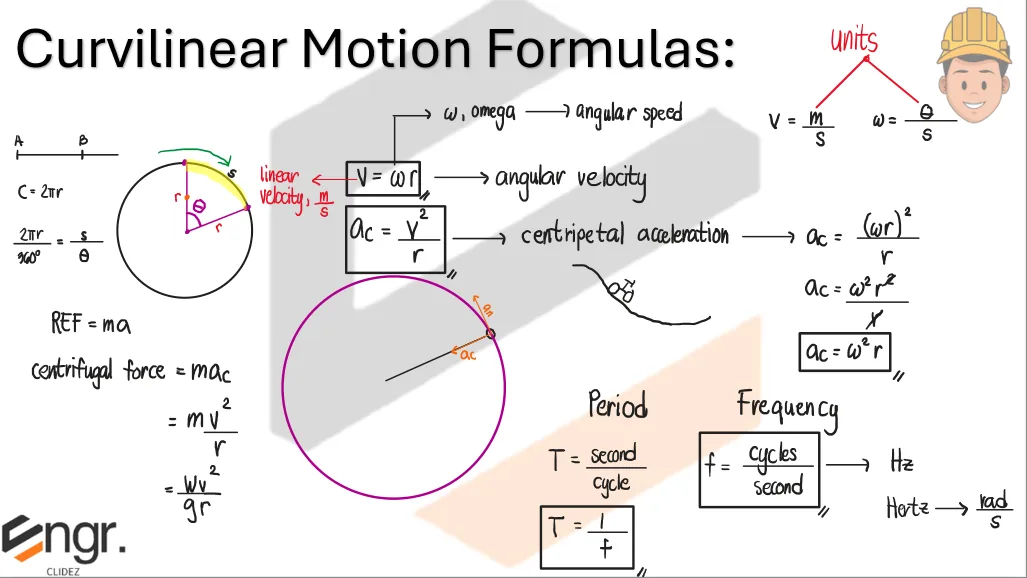
Curvilinear motion refers to the motion of a particle along a curved path.
At any point on the path, the motion can be described using tangential
and normal components, involving angular speed, angular displacement,
and centripetal acceleration.
The following are the fundamental formulas used to describe circular and curvilinear motion.
Variable Definitions
r → radius of circular path (meters)
s → arc length (meters)
θ → angular displacement (radians)
ω → angular speed (rad/s)
v → linear speed (m/s)
ac → centripetal (normal) acceleration (m/s²)
T → period — time for one revolution (seconds)
f → frequency (Hz)
m → mass of object (kg)
Fc → centripetal force (N)
1. Angular Kinematics
$$ \omega = \frac{\theta}{t} $$
$$ s = r \theta $$
2. Linear and Angular Velocity Relationship
$$ v = \omega r $$
3. Centripetal (Normal) Acceleration
$$ a_c = \frac{v^2}{r} $$
$$ a_c = \omega^2 r $$
$$ a_c = \frac{\omega^2 r^2}{r} $$
4. Centripetal Force
$$ F_c = m a_c $$
$$ F_c = m \frac{v^2}{r} $$
$$ F_c = m \omega^2 r $$
5. Period and Frequency
$$ T = \frac{1}{f} $$
$$ f = \frac{1}{T} $$
$$ f = \frac{\text{cycles}}{\text{second}} $$
Frequency is measured in Hz (Hertz), where
1 Hz = 1 cycle per second.
Problem:
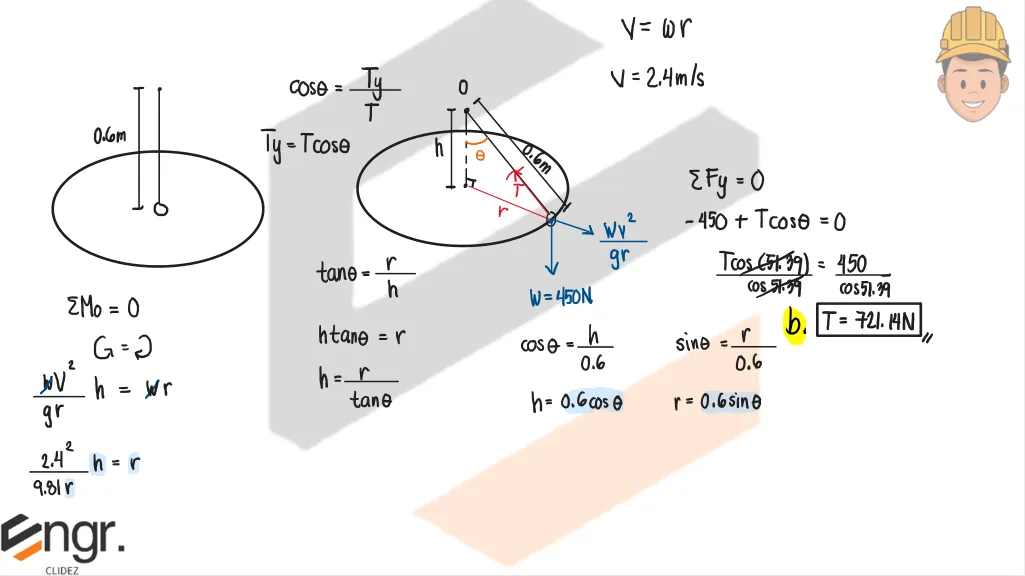
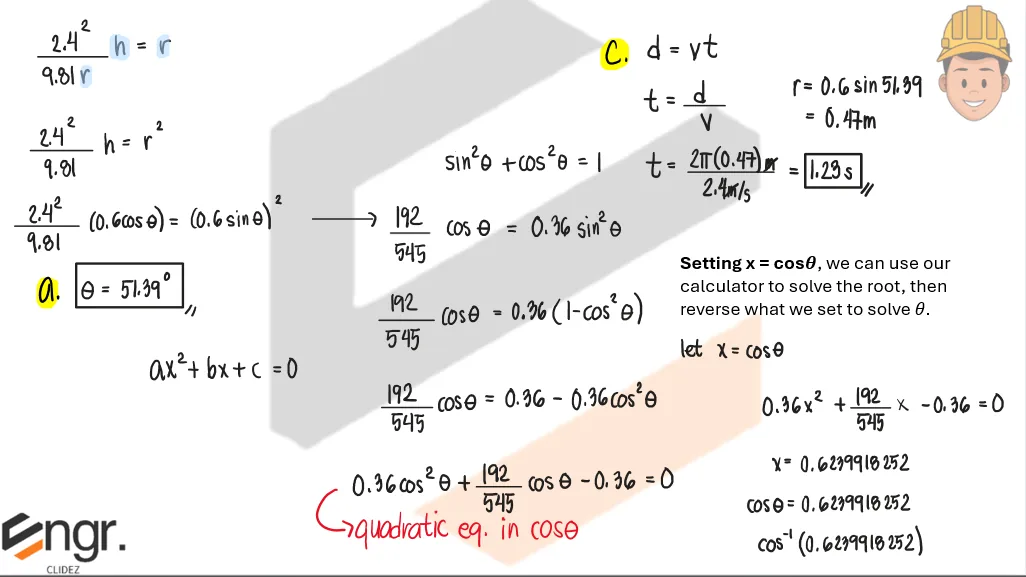
A bob of weight W is moving with a constant velocity of 2.4m/s and is suspended on a 0.6m string. If the weight of the bob is 450N, compute the required inclination, θ, Tension T in the string, and the time required for one complete revolution.
$$
a_y = \frac{dv_y}{dt}
$$
$$
a_y = \frac{d}{dt}(c t^2) = 2 c t
$$
Final Answers:
$$
a_x = \frac{3}{4\sqrt{t}} \sqrt{\frac{c}{3b}},
\qquad
a_y = 2 c t
$$
Problem:
The velocity of a particle is given by
$$ \mathbf{v} = \{ 16 t^2 \} \mathbf{i} + \{ 4 t^3 \} \mathbf{j} + \{ 5t + 2 \} \mathbf{k} \ \text{m/s}, $$
where $t$ is in seconds.
If the particle is at the origin when $t = 0$, determine the magnitude of the particle's acceleration when $t = 2$ s.
Also, find the $x$, $y$, and $z$ coordinate position of the particle at this instant.
Step 1: Compute acceleration by differentiating velocity.
A particle travels along the circular path
$ x^2 + y^2 = r^2. $
If the y-component of the particle's velocity is
$ v_y = 2r \cos 2t, $
determine the $x$ and $y$ components of its acceleration at any instant.
$$
a_x = \pm 4 r \cos 2t,
\qquad
a_y = -4 r \sin 2t
$$
Problem:
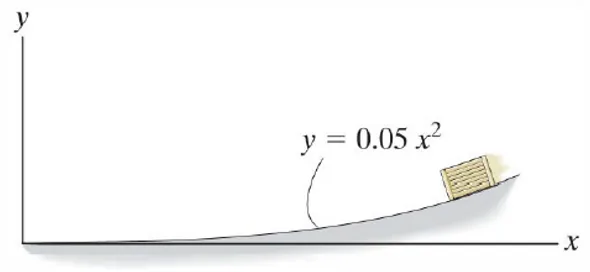
The box slides down the slope described by the equation
$$ y = 0.05 x^2 $$
where $x$ is in meters.
If the box has $x$ components of velocity and acceleration of
$v_x = -3 \, \text{m/s}$ and $a_x = -1.5 \, \text{m/s}^2$ at $x = 5$ m,
determine the $y$ components of the velocity and acceleration of the box at this instant.
1. Differentiate $y = 0.05 x^2$ with respect to time to find $v_y$.
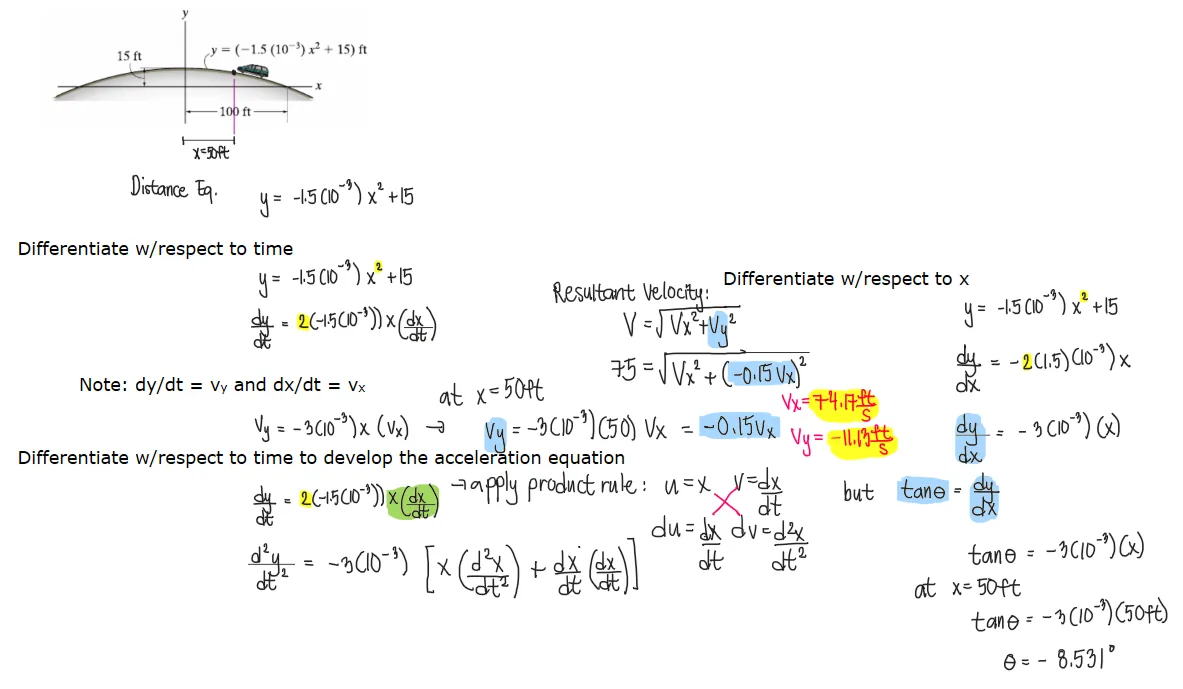
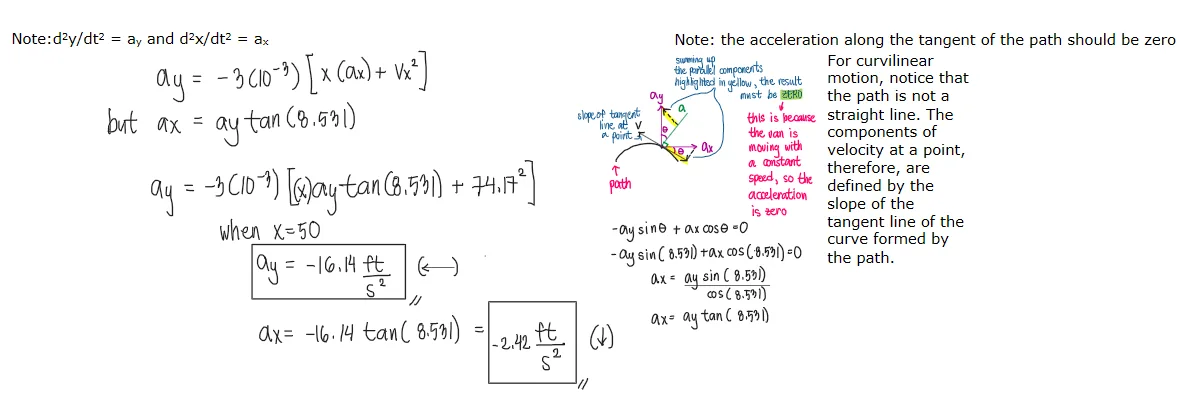
The van travels over the hill described by $y=[-1.5x10^{-3}x^2+15]ft$. If it has a constant speed of 75ft/s, determine the x and y components of the van's velocity and acceleration when x=50ft.
Problem: Rotated Drum
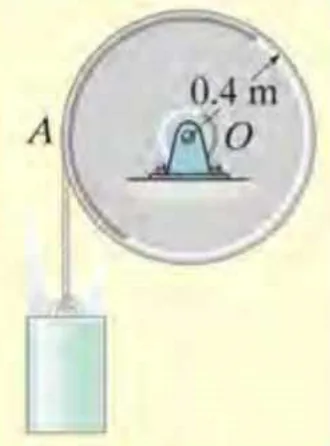
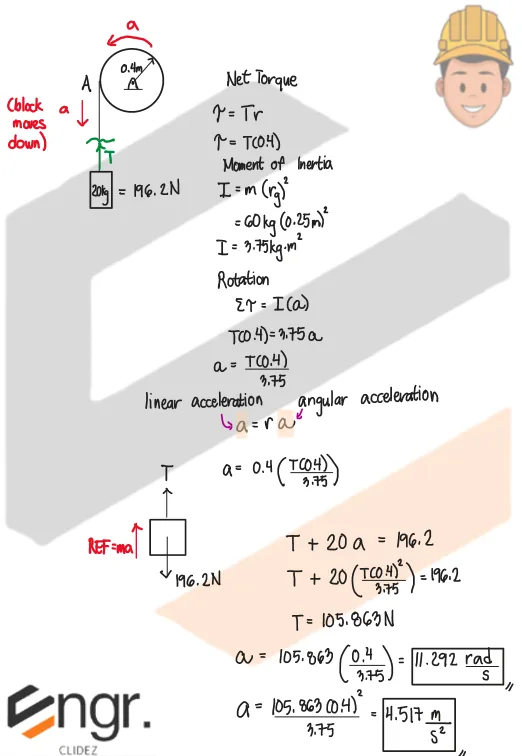
A 60kg drum shown has a radius of gyration of 0.25m. A cord of negligible mass is wrapped around the periphery of the drum and attached to the block having a mass of 20kg. How long will the block reach a distance of 4 meters starting from rest, if the velocity is given by $v={8s^2-2s)m/s$, where is is in meters?
Problem: Radius of Curvature of the Path of a Stone Thrown at an Angle
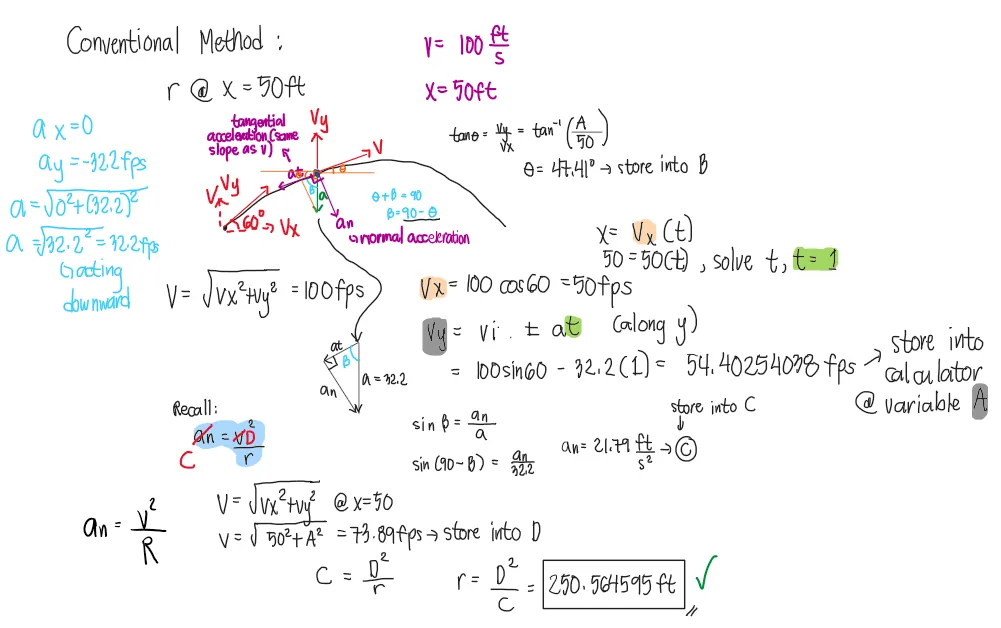
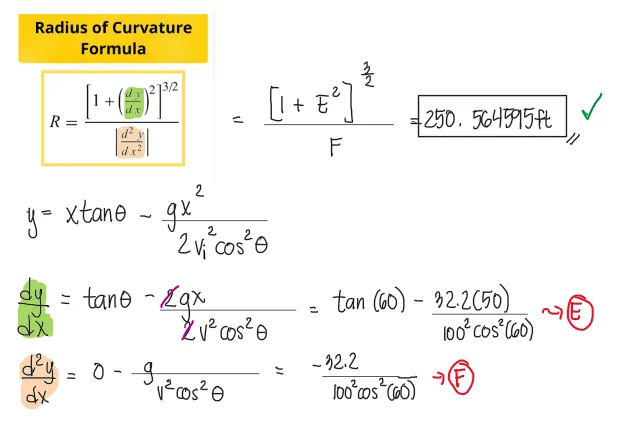
A stone is thrown with an initial velocity of 100ft per second upward at 60° to the horizontal. Compute the radius of curvature of its path at the point where it is 50ft horizontally from its initial position.
Problem: Radius of Curvature of the Path of a Stone Thrown Horizontally
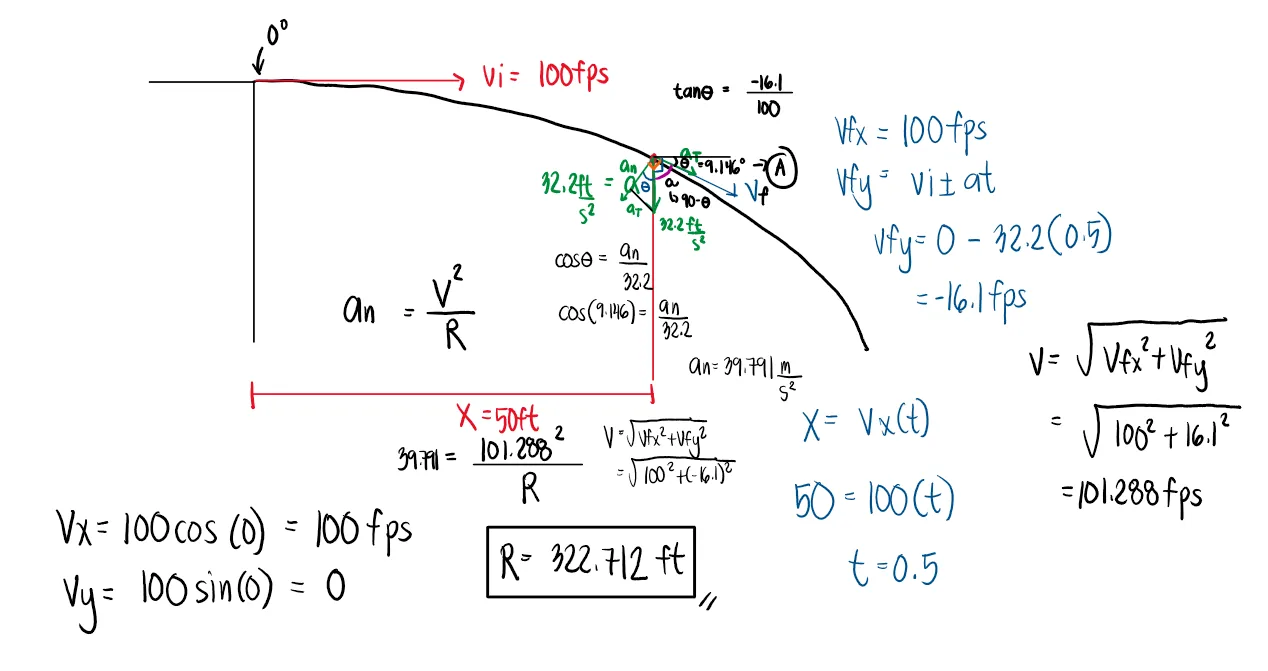
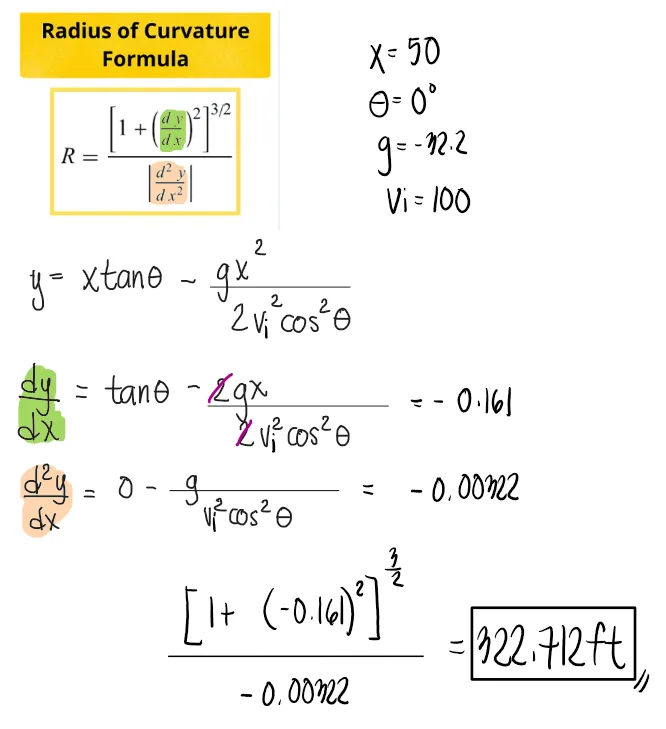
A stone is thrown with an initial velocity of 100ft per second with the horizontal. Compute the radius of curvature of its path at the point where it is 50ft horizontally from its initial position.
Exam Generator Problems
Additional board-style practice items for this topic.
Given the following vectors:
A = 6i − 2j − k
B = 2i + 5j + 2k
P = 2i − 4j + k
Q = −6i + 12j − 3k
Which of the following is true?
A&B are orthogonal; P&Q are parallel
A&B are parallel; P&Q are parallel
A&B are parallel; P&Q are orthogonal
A&B are orthogonal; P&Q are orthogonal
Check dot product and scalar multiples: $A\cdot B=6(2)+(-2)(5)+(-1)(2)=12-10-2=0$, so A and B are orthogonal. $Q=-3P$ because $-3(2i-4j+k)=-6i+12j-3k$, so P and Q are parallel. $\boxed{\text{A&B are orthogonal; P&Q are parallel}}$
A block weighing 200 N in placed 2.5 m from the center of a circular rotating platform having a radius of 4 m. If the coefficient of friction between the bottom of the block and the platform is 0.59, how fast (in rpm) can the platform be rotated without causing the block to move?
20.55
2.15
14.53
1.52
Friction supplies the centripetal force; on the verge of sliding $\mu m g = m\omega^2 r$ (the 4 m platform radius is not used — only the 2.5 m radial position matters): $$\omega^2 = \frac{\mu g}{r} = \frac{0.59(9.81)}{2.5} = 2.315$$ $$\omega = 1.522 \text{ rad/s}$$ Convert to rpm: $1.522 \times \dfrac{60}{2\pi}$ $$\boxed{N = 14.53 \text{ rpm}}$$
Normal (centripetal) acceleration at $v = 2$ m/s: $$a_n = \frac{v^2}{r} = \frac{2^2}{0.5} = \boxed{8 \text{ m/s}^2}$$
Part 3.
Absolute acceleration combines tangential and normal components: $$a = \sqrt{a_t^2 + a_n^2} = \sqrt{0.656^2 + 8^2} = \boxed{8.027 \text{ m/s}^2}$$
Question Bank: t1898
MSTE - Dynamics / Rotation and Curvilinear Motion / BEMz
A solid homogenous circular cylinder and a solid homogenous sphere are placed at equal distances from the end of an inclined plane. Assuming that no slipping occurs as the two bodies roll down the plane, which of them will reach the end of the plane first? Assume that they have the same weight and radius.
sphere
cylinder
both cylinder and sphere
none of these
For rolling without slipping down an incline, $$a=\frac{g\sin\theta}{1+I/(mR^2)}$$ For a solid sphere, $I/(mR^2)=2/5$. For a solid cylinder, $I/(mR^2)=1/2$. Thus, $$a_{sphere}=\frac{g\sin\theta}{1+2/5}$$ $$a_{cylinder}=\frac{g\sin\theta}{1+1/2}$$ Since $1+2/5 < 1+1/2$, the sphere has the larger acceleration and reaches the end first. Therefore, the answer is $\boxed{\text{sphere}}$.
Question Bank: t1899
MSTE - Dynamics / Rotation and Curvilinear Motion / BEMz
A homogenous sphere rolls down as inclined plane making an angle of 30° with the horizontal. Determine the minimum value of the coefficient of friction which will prevent slipping.
0.165
0.362
1.028
0.625
For a solid sphere rolling without slipping down an incline, $$f=\frac{I/R^2}{m+I/R^2}mg\sin\theta$$ With $I=\frac{2}{5}mR^2$, $$f=\frac{2/5}{1+2/5}mg\sin\theta=\frac{2}{7}mg\sin\theta$$ The minimum coefficient is $$\mu=\frac{f}{N}=\frac{(2/7)mg\sin\theta}{mg\cos\theta}=\frac{2}{7}\tan\theta$$ $$\mu=\frac{2}{7}\tan30^\circ=0.165$$ Therefore, the minimum coefficient of friction is $\boxed{0.165}$.
Question Bank: t1900
MSTE - Dynamics / Rotation and Curvilinear Motion / BEMz
At what weight “h” above the billiard table surface should a billiard ball of radius 3cm be struck by a horizontal impact in order that the ball will start moving with no friction between the ball and the table?
4.9 cm
3.4 cm
4.2 cm
5.5 cm
For the ball to start rolling without friction, the impact must produce $v=\omega R$ immediately. Linear impulse gives $$v=\frac{J}{m}$$ Angular impulse about the center gives $$I\omega=J(h-R)$$ For a solid sphere, $I=\frac{2}{5}mR^2$. Since $v=\omega R$, $$\frac{J}{m}=\frac{J(h-R)R}{I}$$ $$h-R=\frac{I}{mR}=\frac{2}{5}R$$ $$h=\frac{7}{5}R=\frac{7}{5}(3)=4.2\text{ cm}$$ Therefore, the ball should be struck at $\boxed{4.2\text{ cm}}$ above the table surface.
Question Bank: t1901
MSTE - Dynamics / Rotation and Curvilinear Motion / BEMz
A common swing 7.5 m high is designed for a static load of 1500 N (tension in the rope is equal to 1500 N). Two boys each weighing 500 N are swinging on it. How much many degrees on each side of the vertical can they swing without exceeding the designed load?
41.41°
45.45°
30.35°
54.26°
The two boys have total weight $W=1000\text{ N}$. At the lowest point, the rope tension is $$T=W+\frac{W}{g}\frac{v^2}{L}$$ From energy for a swing released at angle $\theta$, $$v^2=2gL(1-\cos\theta)$$ So, $$T=W+2W(1-\cos\theta)=W(3-2\cos\theta)$$ Use the design tension $T=1500\text{ N}$: $$1500=1000(3-2\cos\theta)$$ $$\cos\theta=0.75$$ $$\theta=41.41^\circ$$ Therefore, they can swing $\boxed{41.41^\circ}$ on each side of the vertical.
Question Bank: t1902
MSTE - Dynamics / Rotation and Curvilinear Motion / BEMz
A wooden block weighing 20N rests on a turn table having a radius of 2m at a distance on 1m from the center. The coefficient of friction between the block and the turn table is 0.30. The rotation of the table is governed by the equation Ø = $4t^{2}$ where Ø is in radians and t in seconds. If the table starts rotating from rest at $t=0$, determine the time elapsed before the block will begin to slip.
$0.21 \sec$
$0.55 \sec$
$1.05 \sec$
$0.10 \sec$
Using the keyed centripetal-friction check, the block begins to slip when $$\mu g=r\omega^2$$ From $\theta=4t^2$, $$\omega=\frac{d\theta}{dt}=8t$$ At $r=1\text{ m}$, $$0.30(9.81)=1(8t)^2$$ $$t=\sqrt{\frac{2.943}{64}}=0.214\text{ s}$$ Thus, the keyed time is $\boxed{0.21\text{ s}}$. Note: including the tangential acceleration from $\alpha=8\text{ rad/s}^2$ would make the friction demand exceed the limit immediately, so the source key is using the simplified centripetal-only condition.
Question Bank: t1903
MSTE - Dynamics / Rotation and Curvilinear Motion / BEMz
A ball at the end of a cord 121 cm long is swinging with a complete vertical circle just enough velocity to keep it in the top. If the ball is released from the cord where it is at the top point of its path, where will it strike the ground 245 cm below the center of the circle.
297.61 cm
332.64 cm
258.37 cm
263.63 cm
For just enough velocity at the top of a vertical circle, $$v=\sqrt{gr}=\sqrt{(9.81)(1.21)}=3.445\text{ m/s}$$ The release point is 1.21 m above the center, while the ground is 2.45 m below the center, so $$y=1.21+2.45=3.66\text{ m}$$ Time to fall: $$t=\sqrt{\frac{2y}{g}}=\sqrt{\frac{2(3.66)}{9.81}}=0.864\text{ s}$$ Horizontal distance: $$x=vt=(3.445)(0.864)=2.976\text{ m}=297.6\text{ cm}$$ Therefore, it strikes the ground $\boxed{297.61\text{ cm}}$ from the vertical through the release point.
Question Bank: t1904
MSTE - Dynamics / Rotation and Curvilinear Motion / BEMz
At what RPM is the ferriswheel turning when the riders feel “weightless” or zero gravity every time the each rider is at the topmost part of the wheel 9m in radius?
9.97 rpm
8.58 rpm
10.73 rpm
9.15 rpm
At the top of the wheel, apparent weightlessness means the normal force is zero, so gravity alone supplies the centripetal force. $$mg=m\omega^2r$$ $$\omega=\sqrt{\frac{g}{r}}=\sqrt{\frac{9.81}{9}}=1.044\text{ rad/s}$$ Convert to rpm: $$n=\frac{1.044}{2\pi}(60)=9.97\text{ rpm}$$ Thus, the Ferris wheel turns at $\boxed{9.97\text{ rpm}}$.
Question Bank: t1905
MSTE - Dynamics / Rotation and Curvilinear Motion / BEMz
A wooden block having a weight of 50 N is placed at a distance 1.5m from the center of a circular platform rotating at a speed of 2 radians per second. Determine the minimum coefficient of friction of the blocks so that it will not slide. Radius of circular platform is 3m.
0.61
0.84
0.21
1.03
Static friction must supply the centripetal force for the block at radius 1.5 m. $$\mu W=\frac{W}{g}r\omega^2$$ Thus, $$\mu=\frac{r\omega^2}{g}=\frac{(1.5)(2^2)}{9.81}=0.612$$ Therefore, the minimum coefficient of friction is $\boxed{0.61}$.
Question Bank: t1906
MSTE - Dynamics / Rotation and Curvilinear Motion / BEMz
A 2N weight is swing in a vertical circle of 1m radius and the end of the cable will break if the tension exceeds 500 N. Which of the following most nearly gives the angular velocity of the weight when the cable breaks?
$49.4 rad/\sec$
$37.2 rad/\sec$
$24.9 rad/\sec$
$58.3 rad/\sec$
The maximum cable tension occurs at the bottom of the vertical circle. $$T-W=m\omega^2r$$ Since $m=W/g$, $$500-2=\left(\frac{2}{9.81}\right)\omega^2(1)$$ $$\omega=49.43\text{ rad/s}$$ Therefore, the cable breaks at about $\boxed{49.4\text{ rad/s}}$.
Question Bank: t1907
MSTE - Dynamics / Rotation and Curvilinear Motion / BEMz
A weight is attached to a chord and forms a conical pendulum when it is rotated about the vertical axis. If the period of rotation is 0.2 sec, determine the velocity of the weight if the chord makes an angle of 25° with the vertical.
0.146 m/s
0.823 m/s
1.028 m/s
0.427 m/s
For a conical pendulum, combine $\tan\theta=v^2/(rg)$ with $v=2\pi r/T$. This gives $$v=\frac{gT\tan\theta}{2\pi}$$ Substitute the given period and angle: $$v=\frac{(9.81)(0.2)\tan25^\circ}{2\pi}=0.1455\text{ m/s}$$ Thus, the velocity of the weight is $\boxed{0.146\text{ m/s}}$.
Question Bank: t1908
MSTE - Dynamics / Rotation and Curvilinear Motion / BEMz
A ball having a weight of 4N is attached to a cord 1.2 m long and is revolving around a vertical axis so that the cord makes an angle of 20° with the vertical axis. Determine the rpm.
28.17
24.16
22.12
25.18
For a conical pendulum, $$\omega^2=\frac{g}{L\cos\theta}$$ The weight cancels from the force equations. $$\omega=\sqrt{\frac{9.81}{(1.2)\cos20^\circ}}=2.95\text{ rad/s}$$ Convert to rpm: $$n=\frac{\omega}{2\pi}(60)=\frac{2.95}{2\pi}(60)=28.17\text{ rpm}$$ Therefore, the rotational speed is $\boxed{28.17\text{ rpm}}$.
Question Bank: t1909
MSTE - Dynamics / Rotation and Curvilinear Motion / BEMz
A wheel is rotating at 4000 rpm. If it experience a deceleration of 20 $rad/\sec^{2}$ through how many revolutions will it rotate before it stops?
400
698
520
720
Use angular motion with constant deceleration. $$\omega_0=4000\left(\frac{2\pi}{60}\right)=418.88\text{ rad/s}$$ With final angular speed zero, $$0=\omega_0^2+2\alpha\theta$$ $$\theta=\frac{\omega_0^2}{2(20)}=4386.5\text{ rad}$$ Convert to revolutions: $$N=\frac{4386.5}{2\pi}=698.2$$ Thus, the wheel rotates about $\boxed{698}$ revolutions before stopping.
Question Bank: t1910
MSTE - Dynamics / Rotation and Curvilinear Motion / BEMz
Find the maximum acceleration of a mass at the end of a 2m long string. It swing like a pendulum with a maximum angle of 30°.
$4.91 m/s^{2}$
$3.61 m/s^{2}$
$6.21 m/s^{2}$
$7.21 m/s^{2}$
At the extreme position of the pendulum, the speed is zero and the acceleration is tangential. $$a_t=g\sin\theta$$ $$a_t=9.81\sin30^\circ=4.905\text{ m/s}^2$$ Therefore, the maximum acceleration is $\boxed{4.91\text{ m/s}^2}$.
Question Bank: t1911
MSTE - Dynamics / Rotation and Curvilinear Motion / BEMz
A turbine started from rest to 180 rpm in 6 min at a constant acceleration. Find the number of revolution that it makes within the elapsed time.
550 revolutions
540 revolutions
630 revolutions
500 revolutions
With constant angular acceleration from rest, the average angular speed is $$\omega_{avg}=\frac{0+180}{2}=90\text{ rpm}$$ For 6 minutes, $$N=\omega_{avg}t=(90)(6)=540\text{ revolutions}$$ Thus, the turbine makes $\boxed{540\text{ revolutions}}$.
Question Bank: t1912
MSTE - Dynamics / Rotation and Curvilinear Motion / BEMz
Traffic travels at 65 mph around banked highway curved with a radius of 3000 feet. What banking angle is necessary such that friction will not be required to resist the centrifugal force?
3.2°
2.5°
5.4°
18°
For a banked curve with no friction required, $$\tan\theta=\frac{v^2}{rg}$$ Convert the speed: $$v=65\left(\frac{5280}{3600}\right)=95.33\text{ ft/s}$$ Then, $$\tan\theta=\frac{95.33^2}{(3000)(32.2)}=0.0941$$ $$\theta=5.38^\circ$$ Therefore, the required banking angle is $\boxed{5.4^\circ}$.
Question Bank: t1913
MSTE - Dynamics / Rotation and Curvilinear Motion / BEMz
The rated speed of a highway curve of 60m radius of 50 kph. If the coefficient of friction between the tires and the road is 0.60, what is the maximum speed at which a car can round a curve without skidding?
93.6 kph
84.2 kph
80.5 kph
105.2 kph
The rated speed gives the banking angle for no friction. $$\tan\theta=\frac{v^2}{rg}$$ With $v=50/3.6=13.89\text{ m/s}$, $$\tan\theta=\frac{13.89^2}{(60)(9.81)}=0.3277$$ For maximum speed with friction, $$\frac{v_{max}^2}{rg}=\frac{\tan\theta+\mu}{1-\mu\tan\theta}$$ $$v_{max}=\sqrt{(60)(9.81)\left(\frac{0.3277+0.60}{1-0.60(0.3277)}\right)}=26.0\text{ m/s}$$ $$v_{max}=26.0(3.6)=93.6\text{ kph}$$ Thus, the maximum speed is $\boxed{93.6\text{ kph}}$.
Question Bank: t1914
MSTE - Dynamics / Rotation and Curvilinear Motion / BEMz
A solid disk flywheel (I = 200 kg.m) is rotating with a speed of 900 rpm. What is the rotational kinetic energy?
$730 x 10^{3} J$
$680 x 10^{3} J$
$888 x 10^{3} J$
$1100 x 10^{3} J$
Rotational kinetic energy is $$KE=\frac{1}{2}I\omega^2$$ Convert the angular speed: $$\omega=900\left(\frac{2\pi}{60}\right)=94.25\text{ rad/s}$$ Then, $$KE=\frac{1}{2}(200)(94.25)^2=8.88\times10^5\text{ J}$$ Therefore, the rotational kinetic energy is $\boxed{888\times10^3\text{ J}}$.
Question Bank: t1915
MSTE - Dynamics / Rotation and Curvilinear Motion / BEMz
A cyclist on a circular track of radius r = 800ft travelling at 27 ft/s. His speed at the tangential direction increases at the rate of 3 $ft/s^{2}$. What is the cyclist’s total acceleration?
$2.8 ft/s^{2}$
$-3.12 ft/s^{2}$
$-5.1 ft/s^{2}$
$3.31 ft/s^{2}$
Tangential and normal acceleration are perpendicular components. $$a_n=\frac{v^2}{r}=\frac{27^2}{800}=0.911\text{ ft/s}^2$$ $$a=\sqrt{a_t^2+a_n^2}=\sqrt{3^2+0.911^2}=3.14\text{ ft/s}^2$$ Using the given data, the standard result is about $3.14\text{ ft/s}^2$, which is not listed. The source answer key selects $\boxed{3.31\text{ ft/s}^2}$.
Question Bank: t1916
MSTE - Dynamics / Rotation and Curvilinear Motion / BEMz
An automobile travels on a perfectly horizontal, unbanked circular track of radius R. The coefficient of friction between the tires and the track is 0.3. If the car’s velocity is 15 m/s, what is the smallest radius it may travel without skidding?
68m
69.4 m
76.5 m
71.6 m
On a horizontal unbanked curve, friction supplies the centripetal force. $$\mu mg=\frac{mv^2}{R}$$ $$R=\frac{v^2}{\mu g}=\frac{15^2}{(0.3)(9.81)}=76.45\text{ m}$$ Therefore, the smallest radius without skidding is $\boxed{76.5\text{ m}}$.
Question Bank: t1917
MSTE - Dynamics / Rotation and Curvilinear Motion / BEMz
Determine the angle of super elevation for a highway curves of 183 m radius, so that there will be no “slide thrust” for a speed of 72 kilometer per hour. At what speed will skidding impend if the coefficient of friction is 0.3?
12.57°; 31.72 m/s
13.58°; 25.49 m/s
15.29°; 34.24 m/s
10.33°; 30.57 m/s
For no side thrust on a banked curve, $$\tan\theta=\frac{v^2}{rg}$$ With $v=72/3.6=20\text{ m/s}$, $$\tan\theta=\frac{20^2}{(183)(9.81)}=0.2228$$ $$\theta=12.57^\circ$$ For impending skid at the higher speed, $$\frac{v^2}{rg}=\frac{\tan\theta+\mu}{1-\mu\tan\theta}$$ $$v=\sqrt{(183)(9.81)\left(\frac{0.2228+0.3}{1-0.3(0.2228)}\right)}=31.72\text{ m/s}$$ Thus, $\boxed{\theta=12.57^\circ;\ v=31.72\text{ m/s}}$.
Question Bank: t1918
MSTE - Dynamics / Rotation and Curvilinear Motion / BEMz
A child places a picnic basket on the outer rim of merry go round that has a radius of 4.6m and revolves once every 24 sec. How large must the coefficient of static friction be for the basket to stay on the merry go round?
0.032
0.024
0.045
0.052
Static friction supplies the required centripetal force. $$\mu_s mg=\frac{mv^2}{r}$$ The rim speed is $$v=\frac{2\pi r}{T}=\frac{2\pi(4.6)}{24}=1.204\text{ m/s}$$ Thus, $$\mu_s=\frac{v^2}{rg}=\frac{1.204^2}{(4.6)(9.81)}=0.0321$$ Therefore, the required coefficient of static friction is $\boxed{0.032}$.
Question Bank: t1919
MSTE - Dynamics / Rotation and Curvilinear Motion / BEMz
A driver’s manual that a driver traveling at 48kph and desiring to stop as quickly as possible travels 4m before the foot reaches the brake. The car travels and additional 21 m before coming to rest. What coefficient of friction is assumed in this calculation?
0.43
0.34
0.56
0.51
The 4 m is the perception/reaction distance before braking, so the braking distance is 21 m. $$v=48\left(\frac{1000}{3600}\right)=13.33\text{ m/s}$$ For stopping under friction, $$0=v^2-2\mu g s$$ $$\mu=\frac{v^2}{2gs}=\frac{13.33^2}{2(9.81)(21)}=0.431$$ Thus, the coefficient of friction assumed is $\boxed{0.43}$.
Question Bank: t1920
MSTE - Dynamics / Rotation and Curvilinear Motion / BEMz
A point on the rim of a rotating flywheel changes its speed its speed from 1.5m/s to 9 m/s while it moves 60 m. If the radius of the wheel is 1m, compute the normal acceleration at the instant when its speed is 6m/s.
$36 m/s^{2}$
$24 m/s^{2}$
$18 m/s^{2}$
$20 m/s^{2}$
For normal acceleration at a specified speed, use only the instantaneous speed and radius. $$a_n=\frac{v^2}{r}$$ $$a_n=\frac{6^2}{1}=36\text{ m/s}^2$$ Therefore, the normal acceleration is $\boxed{36\text{ m/s}^2}$.
Question Bank: t1921
MSTE - Dynamics / Rotation and Curvilinear Motion / BEMz
The angular speed of a rotating flywheel a radius of 0.5m, is 180/π rpm. Compute the value of its normal acceleration and the tangential speed.
$16 m/s^{2}; 2 m/s$
$18 m/s^{2}; 3 m/s$
$14 m/s^{2}; 1.5 m/s$
$12 m/s^{2}; 1.0 m/s$
Convert angular speed from rpm to rad/s: $\omega=\frac{180}{\pi}\frac{2\pi}{60}=6\text{ rad/s}$ Tangential speed: $v=\omega r=6(0.5)=3\text{ m/s}$ Normal acceleration: $a_n=\omega^2r=6^2(0.5)=18\text{ m/s}^2$ $\boxed{18\text{ m/s}^2;\ 3\text{ m/s}}$
Question Bank: t1922
MSTE - Dynamics / Rotation and Curvilinear Motion / BEMz
A pulley has an angular velocity of 2 rad/sec, and a tangential speed of 4 m/s. Compute the normal acceleration.
$8 m/\sec^{2}$
$6 m/\sec^{2}$
$4 m/\sec^{2}$
$3 m/\sec^{2}$
Normal acceleration can be written as $a_n=v\omega$ because $v=r\omega$. $a_n=v\omega=4(2)$ $\boxed{8\text{ m/sec}^2}$
Question Bank: t1923
MSTE - Dynamics / Rotation and Curvilinear Motion / BEMz
A 10.7 kN car travelling at 134 m/s attempts to round an unbanked curve with a radius of 61 m. What force of friction is required to keep the car on its circular path?
3211 N
3445 N
3123 N
4434 N
The keyed answer corresponds to a speed of $13.4\text{ m/s}$, so the printed $134\text{ m/s}$ appears to be missing a decimal point. Centripetal friction force: $F=\frac{W}{g}\frac{v^2}{r}$ $F=\frac{10{,}700}{9.81}\frac{(13.4)^2}{61}$ $\boxed{F\approx3211\text{ N}}$
Question Bank: t1924
MSTE - Dynamics / Rotation and Curvilinear Motion / BEMz
A rotating wheel has a radius of 2 feet and 6 inches. A point on the rim of the wheel moves 30ft in 2sec. Find the angular velocity of the wheel.
MSTE - Dynamics / Rotation and Curvilinear Motion / BEMz
A prismatic AB bar 6m long has a weight of 500 N. It is pin connected at one end at A. If it is rotated about a vertical axis at Ai how fast would it be rotated when it makes an angle of 30° with the vertical?
$1.68 rad/\sec$
$2.58 rad/\sec$
$1.22 rad/\sec$
$2.21 rad/\sec$
For a uniform bar rotating about one end, moment equilibrium gives $\frac{m\omega^2L^2}{3}\sin\theta\cos\theta=\frac{mgL}{2}\sin\theta$ So $\omega^2=\frac{3g}{2L\cos\theta}$ With $L=6\text{ m}$ and $\theta=30^\circ$: $\omega=\sqrt{\frac{3(9.81)}{2(6)\cos30^\circ}}$ $\boxed{\omega\approx1.68\text{ rad/sec}}$
Question Bank: t1926
MSTE - Dynamics / Rotation and Curvilinear Motion / BEMz
A prismatic bar weighing 25 kg is rotated horizontally about one of its ends at a speed of 2.5 rad/sec. Compute the length of the prismatic bar when it makes an angle of 45° with the vertical.
6.5 m
3.33 m
6.20 m
7.35 m
For a uniform bar rotating about one end and making angle $\theta$ with the vertical, take moments about the pivot. The distributed centrifugal force gives $\frac{m\omega^2L^2}{3}\sin\theta\cos\theta=\frac{mgL}{2}\sin\theta$ Cancel common terms: $L=\frac{3g}{2\omega^2\cos\theta}$ With $\omega=2.5\text{ rad/s}$ and $\theta=45^\circ$: $L=\frac{3(9.81)}{2(2.5)^2\cos45^\circ}$ $\boxed{L\approx3.33\text{ m}}$
Question Bank: w37
MSTE - Dynamics / Engineering Mechanics / MSTE May 2019
If 300 pounds of force is required to push a 1000 pound safe up a ramp, what is the angle of inclination of the ramp?
19.36°
14.11°
22.25°
17.46°
Neglecting friction, the applied force balances the weight component along the ramp: $\sin\theta = \frac{F}{W} = \frac{300}{1000}$ $\boxed{\theta = 17.46^\circ}$
Question Bank: w39
MSTE - Dynamics / Rotation and Curvilinear Motion / MSTE May 2019
A 2 kg body is tied to the end of a chord and whirled in a horizontal circle of radius 1.5 m at 3 revolutions per second. Neglecting the attraction due to gravity, find the acceleration of the body toward the center of the circle in m/s².
MSTE - Dynamics / Rotation and Curvilinear Motion / MSTE May 2022
A 150-g ball at the end of a string is revolving uniformly in a horizontal circle of radius 0.600 m. The ball makes 2 revolutions in a second. What is its centripetal acceleration?
97.54 m/s2
97.45 m/s2
95.74 m/s2
94.75 m/s2
The angular speed is $\omega=2(2\pi)=4\pi$ rad/s. Thus $$a_c=\omega^2r=(4\pi)^2(0.600)=94.75\text{ m/s}^2.$$



 where $x$ is in meters.
If the box has $x$ components of velocity and acceleration of
$v_x = -3 \, \text{m/s}$ and $a_x = -1.5 \, \text{m/s}^2$ at $x = 5$ m,
determine the $y$ components of the velocity and acceleration of the box at this instant.
where $x$ is in meters.
If the box has $x$ components of velocity and acceleration of
$v_x = -3 \, \text{m/s}$ and $a_x = -1.5 \, \text{m/s}^2$ at $x = 5$ m,
determine the $y$ components of the velocity and acceleration of the box at this instant.