Impulsive Force— a large force acting for a short period of time
The impulse of a force (I) is defined as the product of the force and the time during
which it acts.
$$ I = F \times t $$
Where:
I → impulse (N·s)
F → force (N)
t → time in seconds
Only external forces give impulses to a body. The direction of the impulse is the same as the direction of the force involved.
Momentum is a quantity of motion. It is the property of a body that determines the time required to bring it to rest.
It is the product of its mass m and instantaneous velocity v.
$$ \text{Momentum} = m \times v $$
5. The unit of momentum derived from mass and velocity is kg·m/s.
Conservation of Momentum
If two bodies collide, then the sum of the momenta before collision is equal to the sum of the momenta after collision.
$$ m_1 v_1 + m_2 v_2 = m_1 v_1' + m_2 v_2' $$
Where:
m1 → mass of the first body
m2 → mass of the second body
v1 → velocity of the first body before collision
v2 → velocity of the second body before collision
v1' → velocity of the first body after collision
v2' → velocity of the second body after collision
Sign Convention for Velocities:
v is positive (+) if its direction is to the right (before or after collision).
v is negative (−) if its direction is to the left (before or after collision).
$$ m v_1 + F_{\text{pos}} \, t \; - \; F_{\text{neg}} \, t = m v_2 $$
Coefficient of Restitution
The relative velocity of two bodies before collision is v1 − v2
and the relative velocity after collision is v1′ − v2′.
The coefficient of restitution (e) is the ratio of the relative velocity after
impact to that before impact.
$$ e = \frac{(v_2' - v_1')}{(v_1 - v_2)} $$
For perfectly inelastic bodies, e = 0
For perfectly elastic bodies, e = 1
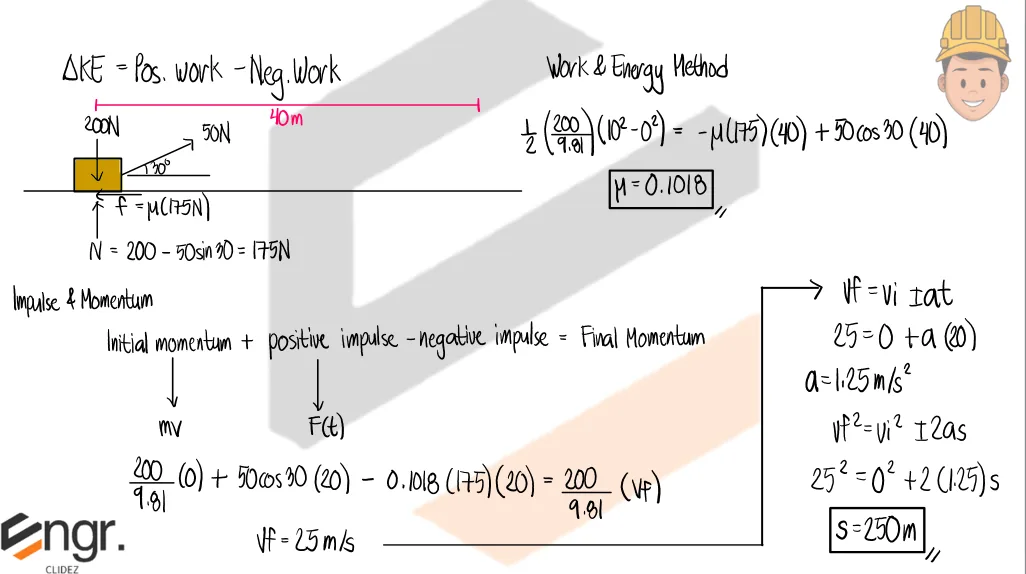
Problem: Work and Energy Method & Impulse and Momentum
A tensile force of 50N inclined 30° from the horizontal is applied on a 200N block which is at rest.
a. Determine the coefficient of friction between the block and the horizontal plane if after it moves a distance of 40 meters, its velocity is 10m/s.
b. Compute the distance (meters) traveled by the block at the end of 20 seconds.
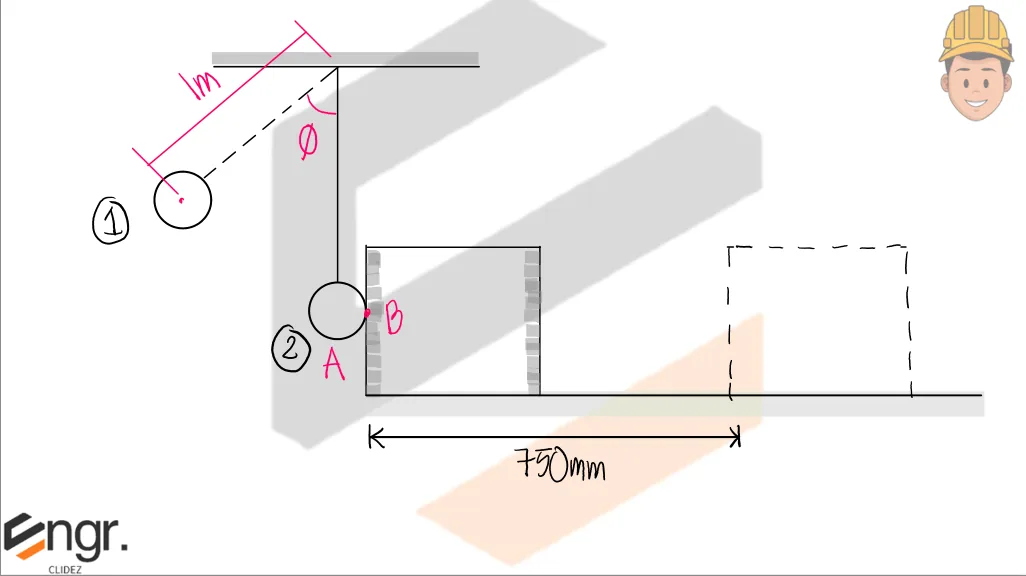
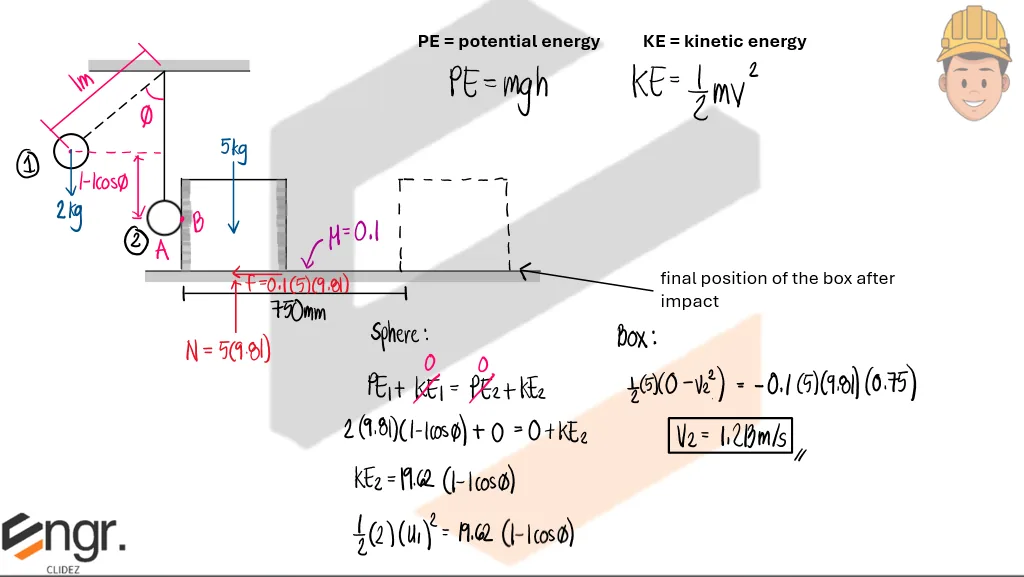
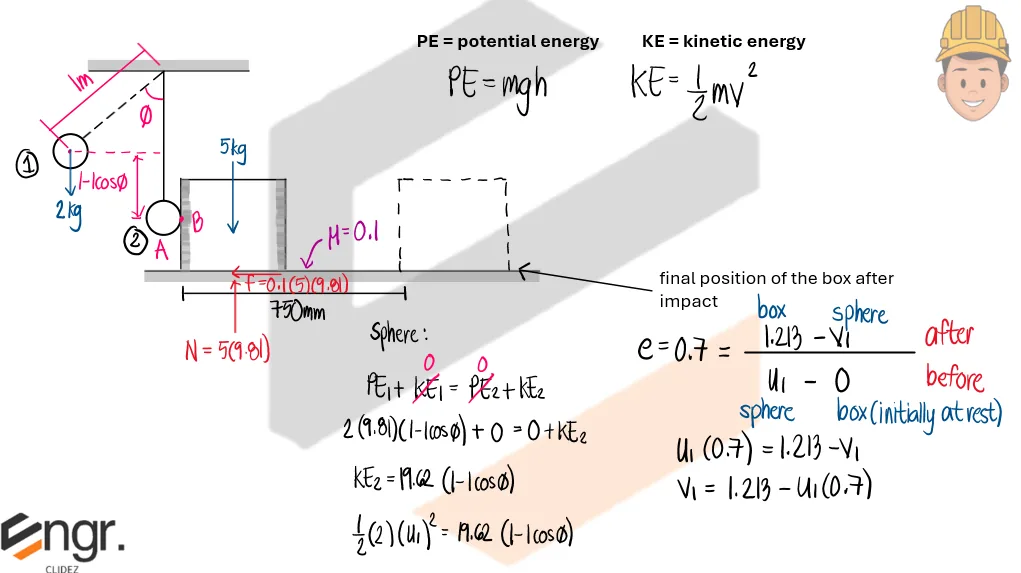
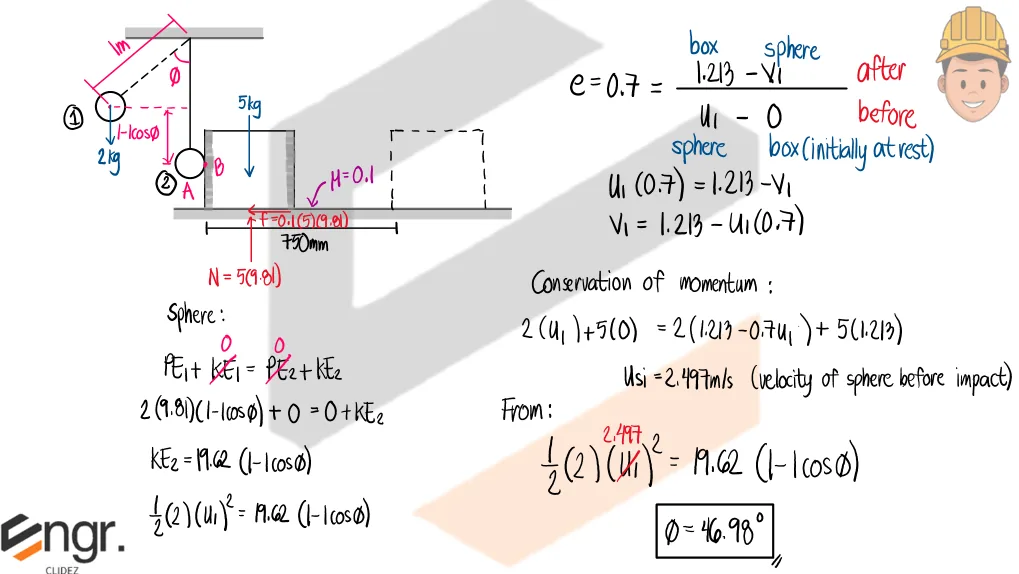
Problem: Sphere Swinging down to Hit a Box
The 2-kg sphere is released from rest and swings down, striking the 5-kg box B. The distance from the ceiling to the center of the sphere is 1 meter. The coefficient of restitution for the collision is 0.70 and the coefficient of friction between the box and the floor is 0.10. If the box slides 750mm after the impact before it comes to rest again,
a. Determine the velocity (in m/s) of the box immediately after the impact.
b. Determine the angle 𝜙 at which the sphere A was released.
Problem: Sphere Swinging down to Hit a Box
Object A approaches object B which is stationary. The velocity of object A is V=28i+5j-3k in m/s. Mass of A =10kg and that of B =4kg. If the impact is perfectly inelastic,
a. Compute the x-component of the velocity after impact.
b. Compute the y-component of the velocity after impact.
c. Compute the z-component of the velocity after impact.
Exam Generator Problems
Additional board-style practice items for this topic.
The temperature in a rectangular box is approximated by
T(x,y,z) = xyz(1 − x)(2 − y)(3 − z)
0 ≤ x ≤ 1 0 ≤ y ≤ 2 0 ≤ z ≤ 3
If the mosquito is located at (1/2, 1, 1), in which direction should it fly to cool off as rapidly as possible?
−1/4 k
−1/3 k
−1/2 k
−1/5 k
The fastest cooling direction is opposite the gradient. For $T=xyz(1-x)(2-y)(3-z)$, at $(1/2,1,1)$ the $x$ and $y$ partials are zero by symmetry. The $z$ partial is: $T_z=xy(1-x)(2-y)(3-2z)$ At $(1/2,1,1)$: $T_z=(1/2)(1)(1/2)(1)(1)=1/4$ Opposite gradient is: $\boxed{-\frac{1}{4}k}$
A ball fell from a height of 2.6 m. The coefficient of restitution between the ball and the ground is 0.60. To what height will the ball bounce?
0.764 m
0.936 m
0.321 m
1.56 m
The coefficient of restitution relates rebound to drop height through velocity. Since $v = \sqrt{2gh}$ and $e = v_2/v_1$: $$h_2 = e^2 h_1 = (0.60)^2(2.6)$$ $$\boxed{h_2 = 0.936 \text{ m}}$$
An object falling from a certain height strikes a concrete floor with a velocity of 12 m/s. The coefficient of restitution between the object and the floor is 0.85.
From what height did the ball fell?
7.34 m
8.67 m
6.54 m
7.93 m
What is the velocity of the object after impact with the floor?
8.17 m/s
9.3 m/s
11.1 m/s
10.2 m/s
To what height will the object bounce?
6.5 m
5.9 m
4.7 m
5.3 m
Part 1.
Using $v^2 = 2gh$ for the free fall onto the floor: $$h = \frac{v^2}{2g} = \frac{12^2}{2(9.81)} = \boxed{7.34 \text{ m}}$$
Part 2.
Rebound velocity from the coefficient of restitution: $$v' = e\,v = 0.85(12) = \boxed{10.2 \text{ m/s}}$$
Part 3.
Rebound height from the rebound velocity: $$h' = \frac{v'^2}{2g} = \frac{10.2^2}{2(9.81)} = \boxed{5.3 \text{ m}}$$
Object A has a mass of 10 kg and a velocity of $v_A = 12i - 23j + 14k$, in m/s. Object B has a mass of 15 kg and a velocity of $v_B = 6i + 12j + 16k$, in m/s. The two objects collide and stick together after collision. Determine the following:
The x-component of the velocity after collision, in m/s.
-2
15.2
2.3
8.4
The y- component of the velocity after collision, in m/s.
8.4
2.3
-2
15.2
The z- component of the velocity after collision, in m/s.
15.2
8.4
2.3
-2
Part 1.
Conservation of momentum (perfectly plastic): $v = \dfrac{m_Av_A + m_Bv_B}{m_A + m_B}$. For the x-component: $$v_x = \frac{10(12) + 15(6)}{25} = \frac{210}{25} = \boxed{8.4 \text{ m/s}}$$
Part 2.
For the y-component: $$v_y = \frac{10(-23) + 15(12)}{25} = \frac{-50}{25} = \boxed{-2 \text{ m/s}}$$
Part 3.
For the z-component: $$v_z = \frac{10(14) + 15(16)}{25} = \frac{380}{25} = \boxed{15.2 \text{ m/s}}$$
Question Bank: t1862
MSTE - Dynamics / Friction / BEMz
The pull required to overcome the rolling resistance of a wheel is 90 N acting at the c enter of the wheels. If the weight of the wheel is 18 000 N and the diameter of the wheel is 300mm, determine the coefficient of rolling resistance.
0.60 mm
0.75 mm
0.50 mm
0.45 mm
For rolling resistance of a wheel pulled at the center, $$P=W\frac{e}{r}$$ Thus, $$e=\frac{Pr}{W}$$ With $r=300/2=150\text{ mm}$, $$e=\frac{(90)(150)}{18000}=0.75\text{ mm}$$ Therefore, the coefficient of rolling resistance is $\boxed{0.75\text{ mm}}$.
Question Bank: t1863
MSTE - Dynamics / Friction / BEMz
A 1000 kN weight is to be moved by using 50 mm diameter rollers. If the coefficient of the rolling resistance for the rollers and floor is 0.08 mm and that for rollers and weight is 0.02 mm. determine the pull required.
2000 N
1500 N
2500 N
1000 N
For rollers, the pull may be computed from the rolling-resistance offsets at the floor and at the load contact: $$P=W\frac{e_1+e_2}{D}$$ Here, $W=1000\text{ kN}=1.0\times10^6\text{ N}$, $e_1=0.08\text{ mm}$, $e_2=0.02\text{ mm}$, and $D=50\text{ mm}$. $$P=(1.0\times10^6)\frac{0.08+0.02}{50}=2000\text{ N}$$ Therefore, the required pull is $\boxed{2000\text{ N}}$.
Question Bank: t1978
MSTE - Dynamics / Impulse and Momentum / BEMz
A 100 kg body moves to the right 5 m/s and another 140 kg body moves to the left at 3 m/s. They collided and after impact the 100 kg body rebounds to the left at 2 m/s. Compute the coefficient of restitution.
0.40
0.50
0.30
0.60
Take right as positive. First find the second body's final velocity from momentum: $100(5)+140(-3)=100(-2)+140v_2$ $80=-200+140v_2 \Rightarrow v_2=2\text{ m/s}$ Coefficient of restitution: $e=\frac{v_2-v_1}{u_1-u_2}=\frac{2-(-2)}{5-(-3)}$ $\boxed{e=0.50}$
Question Bank: t1979
MSTE - Dynamics / Impulse and Momentum / BEMz
A ball is dropped from an initial height of 6m above a solid floor, how high will the ball rebound if the coefficient of restitution is e = 0.92?
5.08
5.52
5.41
5.12
For a vertical rebound, the rebound height is related to the drop height by $h_2=e^2h_1$ $h_2=(0.92)^2(6)$ $h_2=5.0784$ $\boxed{5.08}$
Question Bank: t1980
MSTE - Dynamics / Impulse and Momentum / BEMz
A ball strikes the ground at an angle of 30° with the ground surface; the ball then rebounds at a certain angle θ with the ground surface. If the coefficient of restitution is 0.80, find the value of θ.
24.79°
18.48°
32.2°
26.7°
For impact with a smooth horizontal surface, the horizontal component is unchanged and the vertical component after impact is multiplied by $e$. $\tan\theta=e\tan30^\circ$ $\tan\theta=0.80\tan30^\circ$ $\theta=\tan^{-1}(0.80\tan30^\circ)$ $\boxed{\theta=24.79^\circ}$
Question Bank: t1981
MSTE - Dynamics / Impulse and Momentum / BEMz
A ball is thrown with an initial horizontal velocity of 30m/s from a height of 3m above the ground and 40 m from a vertical wall. How high above the ground will the ball strike if the coefficient of restitution is 0.70?
1.46 m
2.52 m
1.11 m
0.89 m
The ball first reaches the ground before it reaches the wall. Time to first hit the ground: $t_1=\sqrt{\frac{2(3)}{9.81}}=0.782\text{ s}$ Horizontal distance traveled before bounce: $x_1=30(0.782)=23.46\text{ m}$ Vertical speed just before bounce is $\sqrt{2gh}=7.67\text{ m/s}$, so after bounce: $v_y=0.70(7.67)=5.37\text{ m/s}$ Remaining horizontal distance to wall: $40-23.46=16.54\text{ m}$, so $t_2=16.54/30=0.551\text{ s}$. Height at wall: $y=5.37(0.551)-\frac{1}{2}(9.81)(0.551)^2$ $\boxed{y\approx1.46\text{ m}}$
Question Bank: t1982
MSTE - Dynamics / Impulse and Momentum / BEMz
Two cars having equal weights of 135 kN are traveling on a straight horizontal track with velocities of 3m/s to the right and 1.5 m/s to the left respectively. They collide and are coupled during impact. Neglecting friction due to skidding, determine their final common velocity and the gain or loss in kinetic energy after impact.
7.74 m/s; 69.67 kN-m
1.25 m/s; 66.35 kN-m
2.06 m/s; 57.25 kN-m
3.12 m/s; 77.36 kN-m
For equal masses coupled after impact, conservation of momentum gives $m(3)+m(-1.5)=2mv$ $v=0.75\text{ m/s}$ Initial kinetic energy: $KE_i=\frac{1}{2}\left(\frac{135}{9.81}\right)(3^2+1.5^2)=77.41\text{ kN-m}$ Final kinetic energy: $KE_f=\frac{1}{2}\left(\frac{270}{9.81}\right)(0.75^2)=7.74\text{ kN-m}$ Loss $=77.41-7.74=69.67\text{ kN-m}$. The printed keyed choice lists $7.74\text{ m/s}$, but $7.74$ is the final kinetic energy in kN-m, not the velocity. $\boxed{0.75\text{ m/s};\ 69.67\text{ kN-m loss}}$
Question Bank: t1983
MSTE - Dynamics / Impulse and Momentum / BEMz
A man weighing 68 kg jumps from a pier with horizontal velocity of 6 m/s onto a boat that is rest on the water. If the boat weighs 100 kg, what is the velocity of the boat when the man comes to rest relative to the boat?
2.43 m/s
3.53 m/s
2.88 m/s
1.42 m/s
The man and boat move together after he lands, so conserve horizontal momentum. $68(6)+100(0)=(68+100)v$ $408=168v$ $v=2.43\text{ m/s}$ $\boxed{2.43\text{ m/s}}$
Question Bank: t1984
MSTE - Dynamics / Impulse and Momentum / BEMz
A man weighing 68 kg jumps from a pier with horizontal velocity of 5 m/s onto a 100 kg boat moving towards the dock at 4m/s What would be the velocity of the boat after the man lands on it?
-0.56 m/s
-0.36 m/s
-0.78 m/s
-1.33 m/s
Take the man's jump direction as positive. The boat moves toward the dock, opposite to the man, so $u_b=-4\text{ m/s}$. After landing, man and boat move together. $68(5)+100(-4)=(68+100)v$ $340-400=168v$ $v=-0.357\text{ m/s}$ $\boxed{-0.36\text{ m/s}}$
Question Bank: t1985
MSTE - Dynamics / Impulse and Momentum / BEMz
A ball is thrown at an angle of 40° from the horizontal toward a smooth foor and it rebounds at an angle of 25° with the horizontal floor. Compute the value of coefficient of restitution.
0.56
0.66
0.46
0.76
For impact with a smooth horizontal floor, the horizontal velocity component is unchanged, while the vertical component after rebound is multiplied by $e$. Thus $\tan\theta_{rebound}=e\tan\theta_{approach}$ $e=\frac{\tan25^\circ}{\tan40^\circ}$ $\boxed{e\approx0.56}$
Question Bank: t1986
MSTE - Dynamics / Impulse and Momentum / BEMz
Car B is moving at a speed of 12 m/s and is struck by car A which is moving at a speed of 20 m/s. The weight of car A is 14 tons and of car B is 10 tons. Determine the velocities of the car after impact assuming that the bumpers got locked after impact. Both cars are moving in the same direction to the right.
16.67 m/s
14.25 m/s
15.42 m/s
13.62 m/s
The bumpers lock, so the cars move together after impact. Conserve momentum: $14(20)+10(12)=(14+10)v$ $280+120=24v$ $v=16.67\text{ m/s}$ $\boxed{16.67\text{ m/s}}$
Question Bank: t1987
MSTE - Dynamics / Impulse and Momentum / BEMz
Two cars A and B have weights equal to 12 tons and 8 tons respectively are moving in opposite directions. The speed of car A is 22m/s to the right and that of car B is 18 m/s to the left. Two cars bumped each other. Determine the velocity of the cars after impact assuming the bumpers get locked.
6 m/s
8 m/s
4 m/s
3 m/s
Take right as positive. The cars lock together, so conserve momentum: $12(22)+8(-18)=(12+8)v$ $264-144=20v$ $v=6\text{ m/s}$ $\boxed{6\text{ m/s}}$
Question Bank: t1988
MSTE - Dynamics / Impulse and Momentum / BEMz
A 6000 N drop hammer falling freely trough a height of 0.9 m drives a 3000N pile 150mm vertically to the ground. Assuming the hammer and the pile to cling together after the impact, determine the average resistance to penetration of the pile.
32 976 N
42 364 N
30 636 N
28 476 N
Speed of the hammer before impact: $v_h=\sqrt{2gh}=\sqrt{2(9.81)(0.9)}=4.20\text{ m/s}$ Since hammer and pile cling together after impact: $v=\frac{6000}{6000+3000}(4.20)=2.80\text{ m/s}$ During penetration $s=0.15$ m, kinetic energy plus work of weight is absorbed by soil resistance: $Rs=\frac{1}{2}\left(\frac{9000}{9.81}\right)v^2+9000(0.15)$ $R=\frac{\frac{1}{2}(9000/9.81)(2.80)^2+1350}{0.15}$ $\boxed{R\approx32{,}976\text{ N}}$
Question Bank: t1990
MSTE - Dynamics / Impulse and Momentum / BEMz
A 16gm mass is moving at 30 cm/s while a 4gm mass is moving opposite direction at 50cm/sec. They collide head on and stick together. Their velocity after collision is:
0.14 m/s
0.21 m/s
0.07 m/s
0.28 m/s
Take the 16 g mass direction as positive. Since the bodies stick together, conserve momentum: $m_1u_1+m_2u_2=(m_1+m_2)v$ $16(30)+4(-50)=(16+4)v$ $480-200=20v$ $v=14\text{ cm/s}=0.14\text{ m/s}$ $\boxed{0.14\text{ m/s}}$
Question Bank: t1991
MSTE - Dynamics / Impulse and Momentum / BEMz
A bullet weighing 0.014 kg and moving horizontally with a velocity of 610 m/s strikes centrally a block of wood having a mass of 4.45 kg which is suspended by a cord from a point 1.2 m above the center of the block. To what angle from the vertical will the block and embedded bullet swing?
31.79°
29.32°
30.12°
28.64°
Momentum during embedding: $m_bu=(m_b+m_B)v$ $v=\frac{0.014(610)}{0.014+4.45}=1.91\text{ m/s}$ After impact, kinetic energy converts to rise of the pendulum: $\frac{1}{2}(m_b+m_B)v^2=(m_b+m_B)gh$ $h=\frac{v^2}{2g}$ With cord length $L=1.2\text{ m}$: $h=L(1-\cos\theta)$ $\theta=\cos^{-1}\left(1-\frac{h}{L}\right)$ $\boxed{\theta\approx31.79^\circ}$
Question Bank: t1992
MSTE - Dynamics / Impulse and Momentum / BEMz
A body having a mass of 100kg and having velocity of 10m/s to the right collides with an 80 kg mass having a velocity of 5 m/s to the left. If the coefficient of restitution is 0.5, determine the loss of kinetic energy after impact.
3750 N-m
4260 N-m
3640 N-m
4450 N-m
For direct impact, the kinetic energy loss is $\Delta KE=\frac{1}{2}\frac{m_1m_2}{m_1+m_2}(1-e^2)(u_1-u_2)^2$ Here $m_1=100\text{ kg}$, $m_2=80\text{ kg}$, $e=0.5$, and relative approach speed $=10-(-5)=15\text{ m/s}$. $\Delta KE=\frac{1}{2}\frac{100(80)}{180}(1-0.5^2)(15)^2$ $\boxed{\Delta KE=3750\text{ N-m}}$
Question Bank: t1993
MSTE - Dynamics / Impulse and Momentum / BEMz
A 0.44N bullet is fired horizontally to an 89.18 N block of wood resting on a horizontal surface which the coefficient of friction is 0.30. If the block is moved a distance 375 mm along the surface, what was the velocity of the bullet before striking?
303.49 m/s
204.61 m/s
142.52 m/s
414.25 m/s
After impact, the embedded bullet-block system slides to rest under friction. Speed just after impact: $v=\sqrt{2\mu gs}=\sqrt{2(0.30)(9.81)(0.375)}=1.486\text{ m/s}$ Use momentum during impact. Since mass is proportional to weight: $0.44u=(89.18+0.44)(1.486)$ $u=\frac{89.62}{0.44}(1.486)$ $\boxed{u\approx303.49\text{ m/s}}$
Question Bank: t1994
MSTE - Dynamics / Impulse and Momentum / BEMz
A 60 ton rail car moving at 1 mile per hour is instantaneously coupled to a stationary 40 to rail car. What is the speed of the coupled cars?
0.88 mi/hr
1.0 mi/hr
0.60 mi/hr
0.40 mi/hr
The cars couple, so this is a perfectly inelastic collision. Momentum is conserved: $60(1)+40(0)=(60+40)v$ $60=100v$ $\boxed{v=0.60\text{ mi/hr}}$
Question Bank: t1995
MSTE - Dynamics / Impulse and Momentum / BEMz
What momentum does a 40 lbm projectile posses if the projectile is moving 420 mph?
$24 640 lbf-\sec$
$16 860 lbf-\sec$
$765 lbf-\sec$
$523.6 lbf-\sec$
Convert lbm to slugs and mph to ft/s. $m=\frac{40}{32.2}=1.242\text{ slugs}$ $v=420\left(\frac{5280}{3600}\right)=616\text{ ft/s}$ Momentum: $p=mv=1.242(616)$ $\boxed{p\approx765\text{ lbf-sec}}$
Question Bank: t1996
MSTE - Dynamics / Impulse and Momentum / BEMz
A 300 kg block is in contact with a level of coefficient of kinetic friction is 0.10. if the block is acted upon by a horizontal force of 50kg what time will elapse before the block reaches a velocity of 48.3 m/min from rest? If the 50 kg is then removed, hos much longer will the block continue to move?
$12.08 \sec; 8.05 \sec$
$15.28 \sec; 9.27 \sec$
$10.42 \sec; 7.64 \sec$
$13.52 \sec; 10.53 \sec$
The keyed answer corresponds to a target speed of about $483\text{ m/min}=8.05\text{ m/s}$, not the printed $48.3\text{ m/min}$. Applied force $=50\text{ kgf}$, friction $=0.10(300)=30\text{ kgf}$, so net force $=20\text{ kgf}$. Acceleration: $a=\frac{20}{300}g=0.654\text{ m/s}^2$ Time to reach $8.05\text{ m/s}$: $t_1=\frac{8.05}{0.654}\approx12.08\text{ sec}$ After the force is removed, deceleration is $\mu g=0.981\text{ m/s}^2$, so $t_2=\frac{8.05}{0.981}\approx8.05\text{ sec}$ $\boxed{12.08\text{ sec};\ 8.05\text{ sec}}$
Question Bank: t1997
MSTE - Dynamics / Impulse and Momentum / BEMz
A 100kg body moves to the right at 5m/s and another body of mass W is moves to the left 3m/s. they meet each other and after impact the 100kg body rebounds to the left at 2m/s. Determine the mass of the body if coefficient of restitution is 0.5.
140 kg
150 kg
100 kg
200 kg
Take right as positive. For the 100 kg body: $u_1=5\text{ m/s}$ and $v_1=-2\text{ m/s}$. For the unknown body: $u_2=-3\text{ m/s}$. Restitution: $e=\frac{v_2-v_1}{u_1-u_2}$ $0.5=\frac{v_2-(-2)}{5-(-3)} \Rightarrow v_2=2\text{ m/s}$ Momentum: $100(5)+m(-3)=100(-2)+m(2)$ $500-3m=-200+2m$ $700=5m$ $\boxed{m=140\text{ kg}}$
Question Bank: t1998
MSTE - Dynamics / Impulse and Momentum / BEMz
A wood block weighing 44.75 N rests on a rough horizontal plane, the coefficient of friction being 0.40. if a bullet weighing 0.25 N is fired horizontally into the block with the velocity of 600m/s, how far will the block be displaced from its initial position? Assume that the bullet remains inside the block.
1.41 m
2.42 m
1.89 m
0.98 m
First use momentum for the perfectly inelastic impact. The total weight after impact is $44.75+0.25=45\text{ N}$. $m_bu=(m_b+m_B)v$; since mass is proportional to weight, $v=\frac{0.25}{45}(600)=3.333\text{ m/s}$ After impact, friction stops the block-bullet system: $\frac{1}{2}mv^2=\mu mgs$ $s=\frac{v^2}{2\mu g}=\frac{3.333^2}{2(0.40)(9.81)}$ $\boxed{s\approx1.41\text{ m}}$
Question Bank: t1999
MSTE - Dynamics / Impulse and Momentum / BEMz
The system is used to determine experimentally the coefficient of restitution. If ball A is released from rest an ball B swings through $\theta=53.1^{\circ}$, after being struck, determine the coefficient of restitution. Weight of A is 150 N while that of b is 100 N.
0.537
0.291
1.083
0.926
From ball B's swing angle, use energy to determine its velocity just after impact: $\frac{1}{2}m_Bv_B^2=m_BgL(1-\cos53.1^\circ)$ Ball A's release height from the source figure gives its velocity just before impact. Then apply the impact equations: $m_Au_A=m_Av_A+m_Bv_B$ $e=\frac{v_B-v_A}{u_A}$ Substituting the source geometry and weights $W_A=150\text{ N}$ and $W_B=100\text{ N}$ gives $\boxed{e=0.291}$
Question Bank: t2000
MSTE - Dynamics / Impulse and Momentum / BEMz
The ball A and B are attached to stiff rods of negligible weight. Ball A is released from rest and allowed to strike B. If the coefficient of restitution is 0.60, determine the angle θ through which ball B will swing. If the impact lasts for 0.01 sec, also find the average impact force. Mass of A is 15kg and that of B is 10kg.
64.85° ; 6720 N
60.58° ; 6270 N
57.63° ; 7660 N
73.32° ; 7670 N
Use energy to get ball A's speed just before impact, then apply conservation of momentum and the coefficient of restitution during impact. After impact, use energy again for ball B's swing: $\frac{1}{2}m_Bv_B^2=m_BgL(1-\cos\theta)$ The average impact force follows from impulse: $F_{avg}\Delta t=m_Bv_B$ Using the dimensions from the source figure with $e=0.60$, $m_A=15\text{ kg}$, $m_B=10\text{ kg}$, and $\Delta t=0.01\text{ s}$ gives $\boxed{64.85^\circ;\ 6720\text{ N}}$
Question Bank: t2001
MSTE - Dynamics / Impulse and Momentum / BEMz
A 1500N block is in contact with a level plane whose coefficient of kinetic friction is 0.10. If the block is acted upon a horizontal force of 250 N, at what time will elapse before the block reaches a velocity of 14.5m/s starting from rest?
$22.17 \sec$
$18.36 \sec$
$21.12 \sec$
$16.93 \sec$
Friction force: $F_f=\mu W=0.10(1500)=150\text{ N}$ Net horizontal force: $F=250-150=100\text{ N}$ Mass of block: $m=\frac{W}{g}=\frac{1500}{9.81}=152.91\text{ kg}$ Acceleration: $a=\frac{100}{152.91}=0.654\text{ m/s}^2$ Starting from rest, $v=at$: $t=\frac{14.5}{0.654}$ $\boxed{t\approx22.17\text{ sec}}$
Question Bank: t2002
MSTE - Dynamics / Impulse and Momentum / BEMz
A 1600N block is in contact with a level plane whose coefficient of kinetic friction is 0.20. If the block is acted upon a horizontal force of 300 N initially when the block is at rest and the force is removed when the velocity of the block reaches 16m/s. How much longer will the block continue to move?
$8.15 \sec$
$6.25 \sec$
$4.36 \sec$
$5.75 \sec$
After the horizontal force is removed, only kinetic friction slows the block. Friction deceleration: $a=\mu g=0.20(9.81)=1.962\text{ m/s}^2$ Starting from $v=16\text{ m/s}$ after the force is removed: $t=\frac{v}{a}=\frac{16}{1.962}$ $\boxed{t\approx8.15\text{ sec}}$
Question Bank: t2003
MSTE - Dynamics / Impulse and Momentum / BEMz
A bullet weighing 0.30N is moving 660m/s penetrates an 50N body and emerged with a velocity of 180 m/s. For how long will the body moves before it stops? Coefficient of friction is 0.40.
$7.34 \sec$
$6.84 \sec$
$5.24 \sec$
$8.36 \sec$
During penetration, impulse-momentum gives the body's speed after the bullet emerges: $m_b(u_1-u_2)=m_Bv$ The keyed answer corresponds to bullet weight $3.0\text{ N}$ rather than the printed $0.30\text{ N}$. With $m_b=3/9.81$ and $m_B=50/9.81$: $v=\frac{3(660-180)}{50}=28.8\text{ m/s}$ The body stops under friction deceleration $a=\mu g=0.40(9.81)=3.924\text{ m/s}^2$. $t=\frac{v}{a}=\frac{28.8}{3.924}$ $\boxed{t\approx7.34\text{ sec}}$
Question Bank: t2004
MSTE - Dynamics / Impulse and Momentum / BEMz
A 1000N block is resting on an incline plane whose slope is 3 vertical to 4 horizontal. If a force of 1500 N acting parallel to the inclined plane pushes the block up the inclined plane, determine the time required to increase the velocity of the block from 3m/s to 15m/s. Coefficient of friction between the block and the plane is 0.20.
$1.65 \sec$
$1.86 \sec$
$2.17 \sec$
$3.64 \sec$
For the 3-4-5 incline, $\sin\theta=3/5$ and $\cos\theta=4/5$. Normal reaction: $N=1000\cos\theta=1000(4/5)=800\text{ N}$ Friction: $F_f=0.20(800)=160\text{ N}$ Weight component down the plane: $W\sin\theta=1000(3/5)=600\text{ N}$ Net force up the plane: $F=1500-600-160=740\text{ N}$ Mass $=1000/9.81=101.94\text{ kg}$, so $a=740/101.94=7.26\text{ m/s}^2$. $t=\frac{15-3}{7.26}$ $\boxed{t\approx1.65\text{ sec}}$
Question Bank: t2005
MSTE - Dynamics / Impulse and Momentum / BEMz
The 9kg block is moving to the right with a velocity of 0.6 m/s on the horizontal surface when a force P is applied to it at $t=0$. Calculate the velocity V2 of the block when the $t=0.4$ sec. the kinetic coefficient of friction is Mk = 0.30.
1.82 m/s
1.23 m/s
2.64 m/s
2.11 m/s
Use impulse-momentum over the interval $0\le t\le0.4$ s: $m(v_2-v_1)=\int_0^{0.4}P\,dt-\mu_kmg(0.4)$ With $m=9\text{ kg}$, $v_1=0.6\text{ m/s}$, and $\mu_k=0.30$, the source force-time diagram supplies the impulse of $P$. Substituting the diagram area gives $\boxed{v_2=1.82\text{ m/s}}$
Question Bank: t2009
MSTE - Dynamics / Impulse and Momentum / BEMz
A bullet weighing 50g is fired into a block of wood weighing 20 lbs on a top of a horizontal table. The block moves 45 cm. the coefficient of friction between the block and table is 0.30. What is the speed of the bullet in kph before hitting the block? Assume that the bullet is embedded of the block.
1068.77 kph
1843.53 kph
1144.38 kph
1683.78 kph
After impact, the embedded bullet-block system slides to rest under friction. Convert 20 lb to mass: $20\text{ lb}=9.072\text{ kg}$ and bullet mass $m_b=0.05\text{ kg}$. Speed just after impact from work-energy: $\frac{1}{2}(M+m_b)v^2=\mu(M+m_b)gs$ $v=\sqrt{2\mu gs}=\sqrt{2(0.30)(9.81)(0.45)}=1.627\text{ m/s}$ Momentum during impact: $m_bu=(M+m_b)v$ $u=\frac{9.072+0.05}{0.05}(1.627)=296.88\text{ m/s}$ Convert to kph: $296.88(3.6)$ $\boxed{1068.77\text{ kph}}$
Question Bank: t2010
MSTE - Dynamics / Impulse and Momentum / BEMz
A block weighing 60 N is subjected to a horizontal force P = (10 + $t^{3})$ and a friction resisting equal to (6 + $t^{2})$. Compute the velocity of the block 2 s after it has started from rest.
2.4 m/s
1.8 m/s
2.8 m/s
1.4 m/s
Use impulse-momentum. The keyed answer corresponds to the net force expression $F=(10+t^3)-(6-t^2)=4+t^3+t^2$. Impulse from $t=0$ to $t=2$: $J=\int_0^2(4+t^3+t^2)\,dt$ $J=\left[4t+\frac{t^4}{4}+\frac{t^3}{3}\right]_0^2=14.667\text{ N-s}$ Mass of the block: $m=\frac{W}{g}=\frac{60}{9.81}=6.116\text{ kg}$ $J=mv \Rightarrow v=\frac{14.667}{6.116}$ $\boxed{v\approx2.4\text{ m/s}}$
Problem: Impulse from Change in Velocity
A 2 kg object changes velocity from 3 m/s to 9 m/s in the same direction. Find the impulse.
$$J=m(v_2-v_1)=2(9-3)=12\text{ N-s}$$
Answer: The impulse is 12 N-s.
Problem: Perfectly Inelastic Collision
A 4 kg cart moving at 5 m/s sticks to a 6 kg cart initially at rest. Find their common speed.