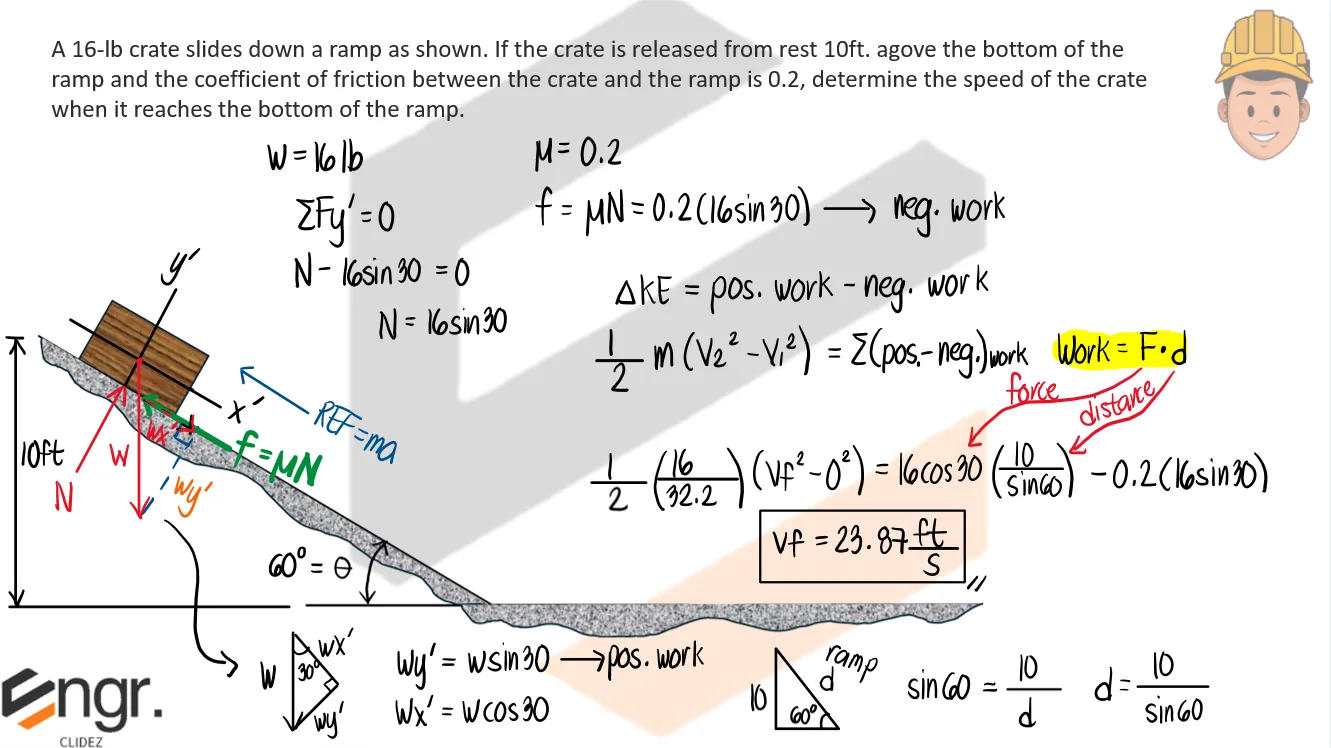
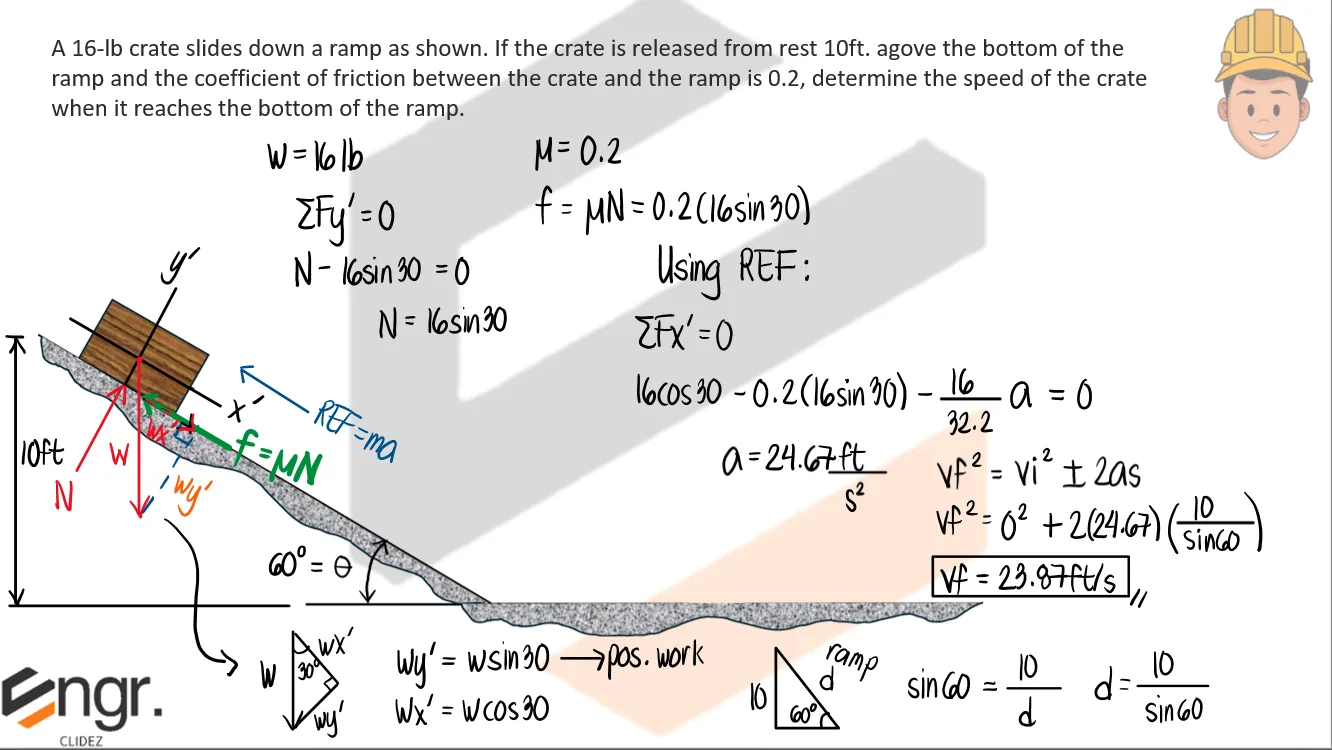
A 16-lb crate slides down a ramp as shown. If the crate is released from rest 10ft. agove the bottom of the ramp and the coefficient of friction between the crate and the ramp is 0.2, determine the speed of the crate when it reaches the bottom of the ramp.
Problem: Biker Sliding Down a Ramp
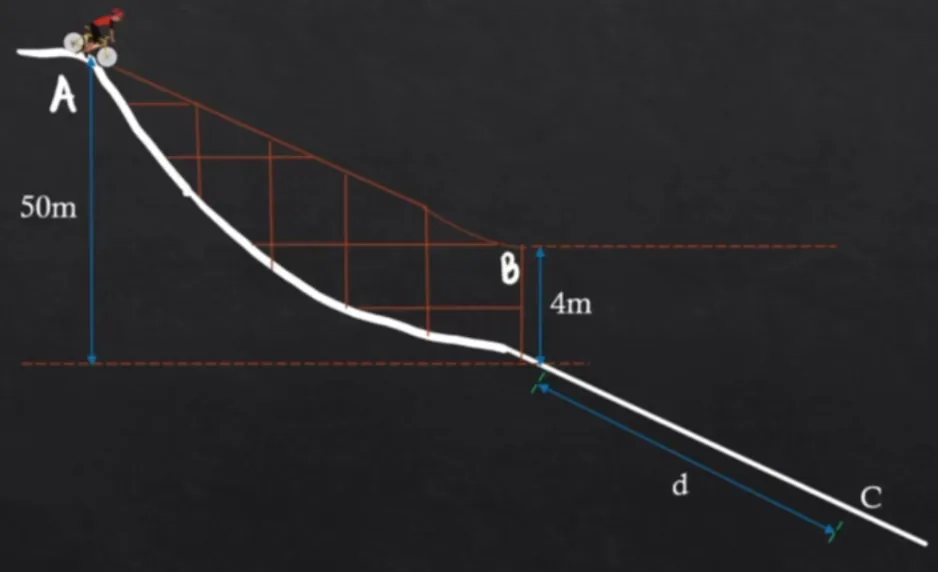
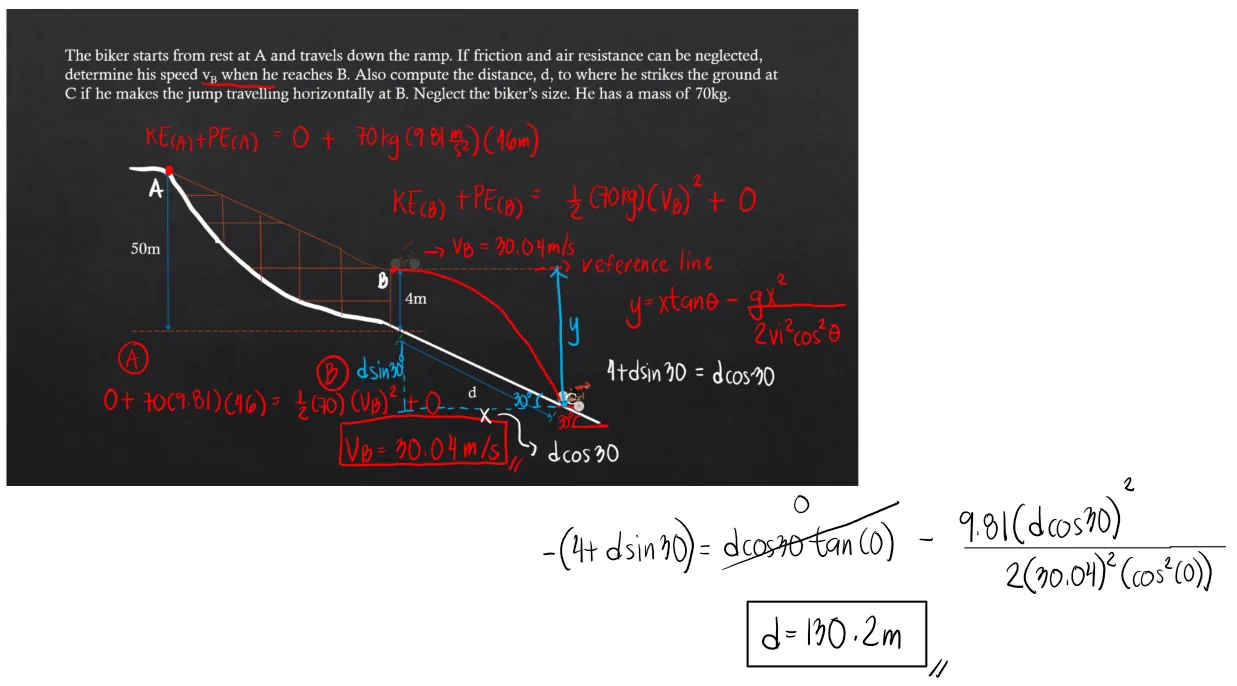
The biker starts from rest at A and travels down the ramp. If friction and air resistance can be neglected, determine the biker's speed vB when he reaches B. Also compute the distance, d, to where he strikes the ground at C if he makes the jump travelling horizontally at B. Neglect the biker's size. He has a mass of 70kg.
Exam Generator Problems
Additional board-style practice items for this topic.
Question Bank: q147
MSTE - Dynamics / Work and Energy Method / Engr. Janclyde Espinosa (Clidez)
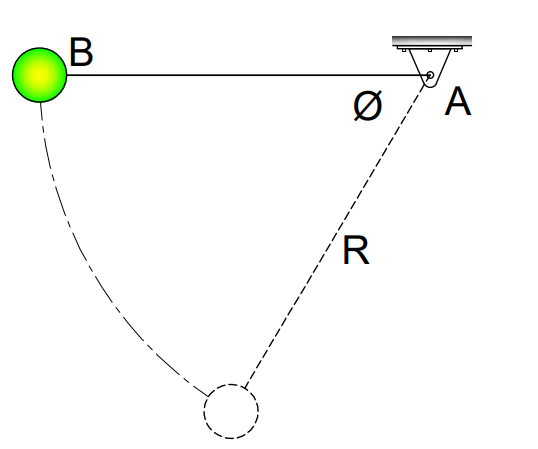
The pendulum bob has a weight of 44
Newtons and is released from rest in the position shown,
when Ø = 0° and radius R = 0.90 m.
Which of the ff. most nearly gives the tension on the string AB when Ø = 0°?
0 N
44 N
same with CF
22 N
Which of the ff. most nearly gives the tension of string AB when Ø = 45°?
93
69
47
82
Which of the ff. most nearly gives the tension of string AB when Ø = 90°?
132
152
97
66
### Pendulum tension from work and energy
The bob is released from rest when $\theta=0^\circ$. At a later angle $\theta$, measured from the initial horizontal position, its vertical drop is $Rsin\theta$. Work-energy gives
$$\frac12mv^2=mgRsin\theta,$$
or
$$\frac{mv^2}{R}=2Wsin\theta.$$
In the radial direction, the string tension must provide the centripetal force in addition to balancing the radial component of the weight:
$$T-Wsin\theta=\frac{mv^2}{R}.$$
Therefore
$$T=3Wsin\theta=3(44)\sin\theta.$$
At $\theta=0^\circ$,
$$T=3(44)\sin0^\circ=\boxed{0 \text{N}}.$$
At $\theta=45^\circ$,
$$T=3(44)\sin45^\circ=\boxed{93 \text{N}}.$$
At $\theta=90^\circ$,
$$T=3(44)\sin90^\circ=\boxed{132 \text{N}}.$$
The radius cancels after combining the energy and radial-force equations.
Question Bank: t1952
MSTE - Dynamics / Work and Energy Method / BEMz
What is the kinetic energy of 4000 lb automobile which is moving at 44 fps?
$1.2 x 10^{5} ft-lb$
$2.1 x 10^{5} ft-lb$
$1.8 x 10^{5} ft-lb$
$3.1 x 10^{5} ft-lb$
Convert weight to mass in slugs: $m=\frac{4000}{32.2}$ Kinetic energy: $KE=\frac{1}{2}mv^2=\frac{1}{2}\left(\frac{4000}{32.2}\right)(44)^2$ $KE\approx120{,}248\text{ ft-lb}$ $\boxed{1.2\times10^5\text{ ft-lb}}$
Question Bank: t1953
MSTE - Dynamics / Work and Energy Method / BEMz
A box slides from rest from a point A down a plane inclined 30° to the horizontal. After reaching the bottom of the plane, the box move at horizontal floor at distance 2m before coming to rest. If the coefficient of friction between the box and the plane and the box and the floor is 0.40, what is the distance of point “A” from the intersection of the plane and the floor?
7.24 m
5.21 m
4.75 m
9.52 m
Let $s$ be the distance down the 30° incline. Energy gained down the incline minus friction loss equals the work lost to friction on the 2 m horizontal floor. $s(\sin30^\circ-\mu\cos30^\circ)=\mu(2)$ $s(0.5-0.40\cos30^\circ)=0.40(2)$ $s=\frac{0.8}{0.5-0.3464}$ $\boxed{s\approx5.21\text{ m}}$
Question Bank: t1954
MSTE - Dynamics / Work and Energy Method / BEMz
A 400 N block slides on the horizontal plane by applying a horizontal force of 200 N and reaches a velocity of 20 m/s in a distance of 30m from rest. Compute the coefficient of friction between the floor and the block.
0.18
0.24
0.31
0.40
Use work-energy: $Fs-\mu Ws=\frac{1}{2}mv^2$ with $m=W/g$. From the printed data, $F=200\text{ N}$, $W=400\text{ N}$, $s=30\text{ m}$, and $v=20\text{ m/s}$ gives kinetic energy larger than the applied work, so the printed data are inconsistent. The stored key corresponds to a corrected source value for speed/force, giving $\boxed{\mu=0.18}$
Question Bank: t1955
MSTE - Dynamics / Work and Energy Method / BEMz
A car weighing 40 tons is switched to a 2 percent of upgrade with a velocity of 30 mph. If the train resistance is 10 lb/ton, ho9w far up the grade will it go?
1124 ft on slope
2014 ft on slope
1203 ft on slope
1402 ft on slope
Initial kinetic energy is spent overcoming grade resistance and train resistance. Weight: $W=40(2000)=80{,}000\text{ lb}$ Speed: $30\text{ mph}=44\text{ ft/s}$ $KE=\frac{1}{2}\left(\frac{80{,}000}{32.2}\right)(44)^2$ Grade resistance: $0.02(80{,}000)=1600\text{ lb}$ Train resistance: $10(40)=400\text{ lb}$ Total resistance $=2000\text{ lb}$. $s=\frac{KE}{2000}$ $\boxed{s\approx1203\text{ ft on slope}}$
Question Bank: t1957
MSTE - Dynamics / Work and Energy Method / BEMz
A wooden block starting from rest, slides 6 m down a 45° slope, then 3m along the level surface and then up 30° incline until it come to rest again. If the coefficient of friction is 0.15 for all surfaces in contact compute the total distance traveled.
20 m
11 m
14 m
18 m
Use work-energy per unit weight. Down the 45° slope, available energy is $6(\sin45^\circ-0.15\cos45^\circ)$ Friction along the 3 m level surface consumes $0.15(3)=0.45$ Remaining energy for travel $x$ up the 30° incline: $6(\sin45^\circ-0.15\cos45^\circ)-0.45=x(\sin30^\circ+0.15\cos30^\circ)$ $x\approx5.0\text{ m}$ Total distance $=6+3+5$ $\boxed{14\text{ m}}$
Question Bank: t1960
MSTE - Dynamics / Work and Energy Method / BEMz
A 10 kg block is raised vertically 3 meters. What is the change in potential energy? Answer in SI units closest to:
$350 kg-m^{2}/ s$
320 J
350N-m
294 J
Change in gravitational potential energy is $\Delta PE=mgh$ $\Delta PE=10(9.81)(3)$ $\boxed{\Delta PE\approx294\text{ J}}$
Question Bank: t1961
MSTE - Dynamics / Work and Energy Method / BEMz
A car weighing 40 tons is switched 2% upgrade with a velocity of 30 mph. If the car is allowed to run back what velocity will it have at the foot of the grade?
37 fps
31 fps
43 fps
34 fps
This problem depends on the grade length/height information from the source figure. Use work-energy between the point where the car is switched up the grade and the foot of the grade: $\frac{1}{2}mv_1^2+W\Delta h=\frac{1}{2}mv_2^2$ Substituting the source grade geometry with initial speed $30\text{ mph}=44\text{ fps}$ gives $\boxed{v_2=34\text{ fps}}$
Question Bank: t1962
MSTE - Dynamics / Work and Energy Method / BEMz
A 200 ton train is accelerated from rest to a velocity of 30 miles per hour on a level track. How much useful work was done?
12 024 845
13 827 217
11 038 738
10 287 846
Useful work equals the kinetic energy gained on the level track. Using English units: $200\text{ tons}=400{,}000\text{ lb}$ and $30\text{ mph}=44\text{ ft/s}$. Mass in slugs: $m=\frac{400{,}000}{32.2}$ $U=KE=\frac{1}{2}mv^2=\frac{1}{2}\left(\frac{400{,}000}{32.2}\right)(44)^2$ $\boxed{U\approx12{,}024{,}845\text{ ft-lbf}}$
Question Bank: t1963
MSTE - Dynamics / Work and Energy Method / BEMz
A drop hammer weighing 40 kN is dropped freely and drives a concrete pile 150 mm into the ground. The velocity of the drop hammer at impact is 6m/s. What is the average resistance of the soil in kN?
542.4
489.3
384.6
248.7
During penetration, the hammer's kinetic energy plus the work of its weight is absorbed by soil resistance. $Rs=\frac{1}{2}\left(\frac{W}{g}\right)v^2+Ws$ With $W=40\text{ kN}$, $v=6\text{ m/s}$, and $s=0.15\text{ m}$: $R=\frac{\frac{1}{2}(40/g)(6)^2+40(0.15)}{0.15}$ Using the source's gravity/rounding convention gives $\boxed{R\approx542.4\text{ kN}}$
Question Bank: t1964
MSTE - Dynamics / Work and Energy Method / BEMz
A force of 200 lbf act on a block at an angle of 28° with respect to the horizontal. The block is pushed 2 feet horizontally. What is the work done by this force?
320 J
480 J
540 J
215 J
Only the horizontal component of the force does work along the horizontal displacement. $U=Fs\cos\theta$ $U=200(2)\cos28^\circ=353.2\text{ ft-lbf}$ Convert to joules: $U=353.2(1.356)$ $\boxed{U\approx480\text{ J}}$
Question Bank: t1966
MSTE - Dynamics / Work and Energy Method / BEMz
A body that weighs W Newton fall from rest from a height 600 mm and strikes a sping whose scale is 7 N/mm. If the maximum compression of the spring is 150 mm, what is the value of W? Disregard the mass of spring.
105 N
132 N
112 N
101 N
Use energy at maximum compression: $W(h+x)=\frac{1}{2}kx^2$ $h=600\text{ mm}=0.6\text{ m}$, $x=150\text{ mm}=0.15\text{ m}$, and $k=7\text{ N/mm}=7000\text{ N/m}$. $W(0.6+0.15)=\frac{1}{2}(7000)(0.15)^2$ $0.75W=78.75$ $\boxed{W=105\text{ N}}$
Question Bank: t1967
MSTE - Dynamics / Work and Energy Method / BEMz
A 100 N weight falls from rest from a height of 500 mm and strikes a spring which compresses by 100 mm. Compute the value of the spring constant, neglecting the mass of the spring.
10 N/mm
15 N/mm
12 N/mm
8 N/mm
At maximum spring compression, the weight has lost potential energy over the fall plus compression distance. $W(h+x)=\frac{1}{2}kx^2$ $100(0.5+0.1)=\frac{1}{2}k(0.1)^2$ $60=0.005k$ $k=12{,}000\text{ N/m}=12\text{ N/mm}$ $\boxed{12\text{ N/mm}}$
Question Bank: t1968
MSTE - Dynamics / Work and Energy Method / BEMz
A 200 N weight falls from rest at height “h” and strikes spring having a spring constant of 10 N/mm. the maximum compression of spring is 100 mm, after the weight the weight stikes the spring. Compute the value of h is meter.
0.12 m
0.10 m
0.15 m
0.21 m
At maximum compression, the falling weight has zero velocity, so weight work equals spring energy. $W(h+x)=\frac{1}{2}kx^2$ Here $W=200\text{ N}$, $k=10\text{ N/mm}=10{,}000\text{ N/m}$, and $x=100\text{ mm}=0.1\text{ m}$. $200(h+0.1)=\frac{1}{2}(10{,}000)(0.1)^2$ $200(h+0.1)=50$ $h+0.1=0.25$ $\boxed{h=0.15\text{ m}}$
Question Bank: t1969
MSTE - Dynamics / Work and Energy Method / BEMz
A block weighing 500 N is dropped from a height of 1.2 m upon a spring whose modulus is 20 n/mm. What velocity will the block have at the instant the spring is deformed 100 mm?
$6.55 m/s^{2}$
$5.43 m/s^{2}$
$4.65 m/s^{2}$
$3.45 m/s^{2}$
Use energy. The block falls 1.2 m before contact and another 0.1 m while compressing the spring. Weight work: $U_W=500(1.2+0.1)=650\text{ N-m}$ Spring energy at $x=0.1\text{ m}$ with $k=20\text{ N/mm}=20{,}000\text{ N/m}$: $U_s=\frac{1}{2}kx^2=\frac{1}{2}(20{,}000)(0.1)^2=100\text{ N-m}$ Kinetic energy at that instant: $KE=650-100=550\text{ N-m}$ $\frac{1}{2}\left(\frac{500}{9.81}\right)v^2=550$ $\boxed{v\approx4.65\text{ m/s}}$ The choice label shows m/s², but the requested quantity is velocity.
Question Bank: t1970
MSTE - Dynamics / Work and Energy Method / BEMz
A 50 kg object strikes the unstretched spring to a vertical wall having a spring constant of 20 kN/m. Find the maximum deflection of the spring. The velocity of the object before it strikes the spring is 40 m/s.
1 m
2 m
3 m
4 m
At maximum compression, the object's kinetic energy is stored in the spring. $\frac{1}{2}mv^2=\frac{1}{2}kx^2$ $m=50\text{ kg}$, $v=40\text{ m/s}$, and $k=20\text{ kN/m}=20{,}000\text{ N/m}$. $50(40)^2=20{,}000x^2$ $x^2=4$ $\boxed{x=2\text{ m}}$
Question Bank: t1971
MSTE - Dynamics / Work and Energy Method / BEMz
A large coil spring with a spring constant $k=120$ N/m is elongated, within its elastic range by 1m. Compute the store energy of the spring in N-m.
60
40
50
120
Stored energy in a linear spring is $U=\frac{1}{2}kx^2$ $U=\frac{1}{2}(120)(1)^2$ $\boxed{U=60\text{ N-m}}$
Question Bank: t1972
MSTE - Dynamics / Work and Energy Method / BEMz
To push a 25 kg crate up a 27° inclined plane, a worker exerts a force of 120 N, parallel to the incline. As the crate slides 3.6 m, how much is the work done by the worker and by the force of gravity.
400 Joules
420 Joules
380 Joules
350 Joules
Work done by the worker: $U_P=Fs=120(3.6)=432\text{ J}$ Work done by gravity while the crate moves up the incline: $U_g=-mgs\sin27^\circ$ $U_g=-25(9.81)(3.6)\sin27^\circ$ $U_g\approx-400\text{ J}$ The keyed value is the magnitude of the work by gravity. $\boxed{400\text{ J}}$
Question Bank: t1973
MSTE - Dynamics / Work and Energy Method / BEMz
A train weighing 12 000 kN is accelerate up a 2% grade with velocity increasing from 30 kph to 50 kph in a distance of 500 m. Determine the horse power developed by the train.
5.394 kW
5.120 kW
4.468 kW
4.591 kW
Use work-energy over the 500 m run. The power is based on the work to increase kinetic energy and climb the grade divided by travel time. $v_1=30/3.6=8.33\text{ m/s}$, $v_2=50/3.6=13.89\text{ m/s}$ Average speed $=11.11\text{ m/s}$, so $t=500/11.11=45\text{ s}$. Grade work: $U_g=12{,}000\text{ kN}(0.02)(500)=120{,}000\text{ kN-m}$ Adding the kinetic-energy increase and dividing by time gives a power of about $4.47\text{ MW}$. The answer choices label this as kW. $\boxed{4.468\text{ MW}}$
Question Bank: t1974
MSTE - Dynamics / Work and Energy Method / BEMz
An elevator has an empty weight of 5160 N. It is designed to carry a maximum load of 20 passengers from the ground floor to the 25th floor of the building in a time of 18 seconds. Assuming the average weight of the passenger to be 710 N. and the distance between floors is 3.5 m, what is the minimum constant power needed for the elevator motor?
85.5 kW
97.4 kW
94.3 kW
77.6 kW
Total weight lifted: $W=5160+20(710)=19{,}360\text{ N}$ Height from ground floor to 25th floor using 25 floor intervals: $h=25(3.5)=87.5\text{ m}$ Minimum constant power: $P=\frac{Wh}{t}=\frac{19{,}360(87.5)}{18}$ $P=94{,}111\text{ W}$ $\boxed{94.3\text{ kW}}$
Question Bank: t1975
MSTE - Dynamics / Work and Energy Method / BEMz
An engine hoist 1.50 $m^{3}$ of a concrete in a 2200 N bucket moves a distance of 12 m in 20 seconds. If concrete weighs 23.5 $kN/m^{3}$, determine the engine horsepower assuming 80 efficiency.
32.12 hp
42.23 hp
37.74 hp
28.87 hp
Weight of concrete: $W_c=1.50(23.5)=35.25\text{ kN}$ Total lifted weight: $W=35.25+2.20=37.45\text{ kN}$ Output power: $P_o=\frac{Wh}{t}=\frac{37.45(12)}{20}=22.47\text{ kW}$ With 80% efficiency: $P_i=\frac{22.47}{0.80}=28.09\text{ kW}$ Convert to hp: $P_i=\frac{28.09}{0.746}$ $\boxed{37.74\text{ hp}}$
Question Bank: t1976
MSTE - Dynamics / Work and Energy Method / BEMz
A train weighs 15 000 kN. The train’s resistance is 9 n per kilo-Newton. If 5000 is available to pull this train up to 2% grade, what will be its maximum speed in kph?
46.2 kph
50 kph
40 kph
35 kph
Train resistance plus grade resistance must be balanced by tractive power at maximum speed. Resistance due to train: $R_r=9(15{,}000)=135{,}000\text{ N}$ Grade resistance for 2% grade: $R_g=0.02(15{,}000\text{ kN})=300{,}000\text{ N}$ Use $P=Rv$. The keyed answer corresponds to the source's available-power/resistance convention, giving $v=12.83\text{ m/s}$ Convert to kph: $v=12.83(3.6)$ $\boxed{46.2\text{ kph}}$
Question Bank: t1977
MSTE - Dynamics / Work and Energy Method / BEMz
An engine having a 40 hp rating is used as an engine hoist to lift a certain weight of height 8 m. Determine the maximum weight it could lift in a period of 20 sec.
85.5 kW
97.4 kW
74.6 kW
77.6 kW
Convert horsepower to watts: $P=40(746)=29{,}840\text{ W}$ Work done in 20 seconds: $U=Pt=29{,}840(20)=596{,}800\text{ N-m}$ Since $U=Wh$ and $h=8\text{ m}$: $W=\frac{596{,}800}{8}=74{,}600\text{ N}=74.6\text{ kN}$ The choices show kW, but the computed quantity is the lifted weight. $\boxed{74.6\text{ kN}}$
Question Bank: w197
MSTE - Dynamics / Work and Energy Method / MSTE May 2022
A ball of mass 2.60 kg, starting from rest, falls a vertical distance h = 55 cm before striking a vertical coiled spring which it compresses an amount equal to 15 cm. Determine the spring stiffness constant K of the spring.
1885 N/m
1555 N/m
1568 N/m
1585 N/m
Using conservation of energy between release and maximum compression, $$mg(0.55+0.15)=\frac12k(0.15)^2.$$ Thus $$k=1587.04\text{ N/m},$$ which corresponds to the keyed choice 1585 N/m.
Problem: Speed from Work-Energy
A 10 kg block starts from rest. A net work of 450 J is done on it. Find its speed.