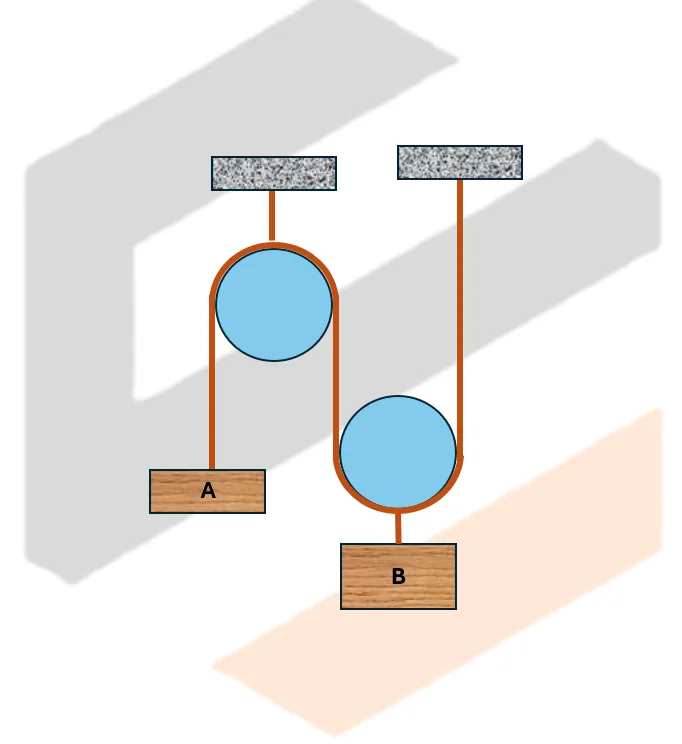
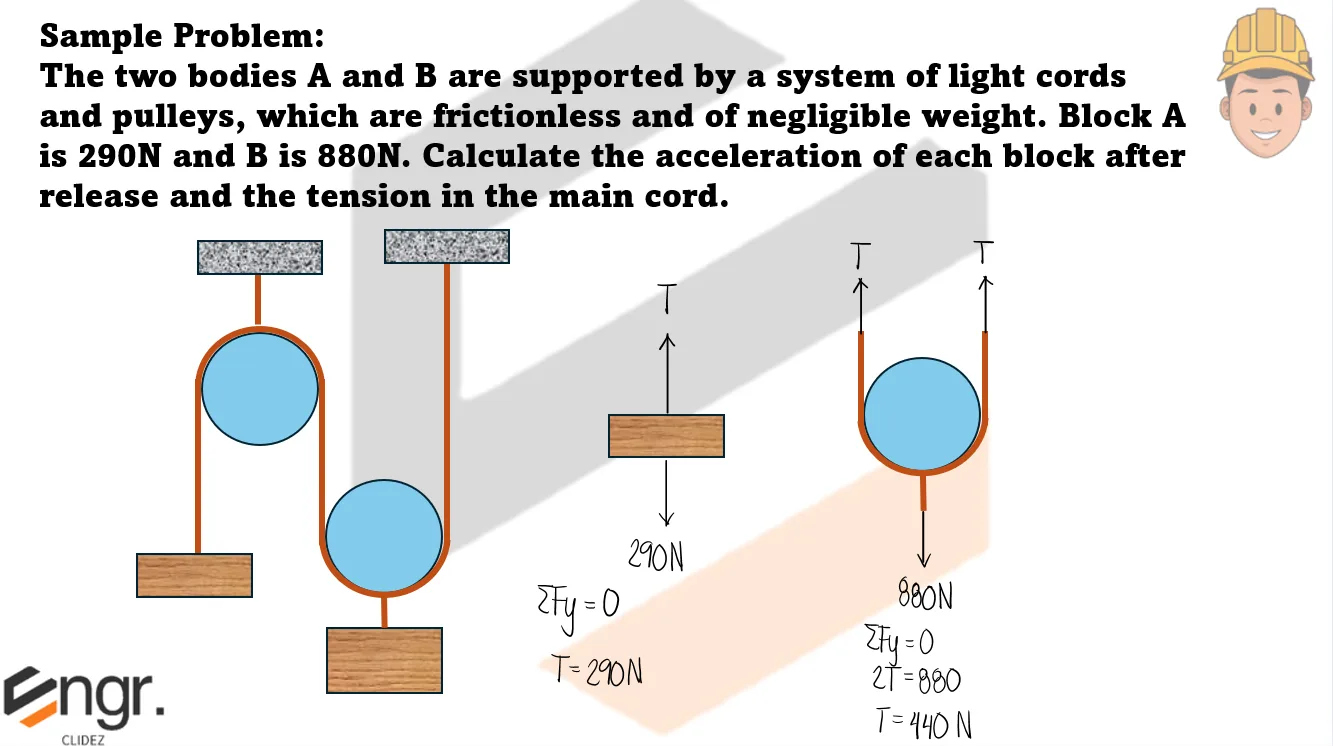
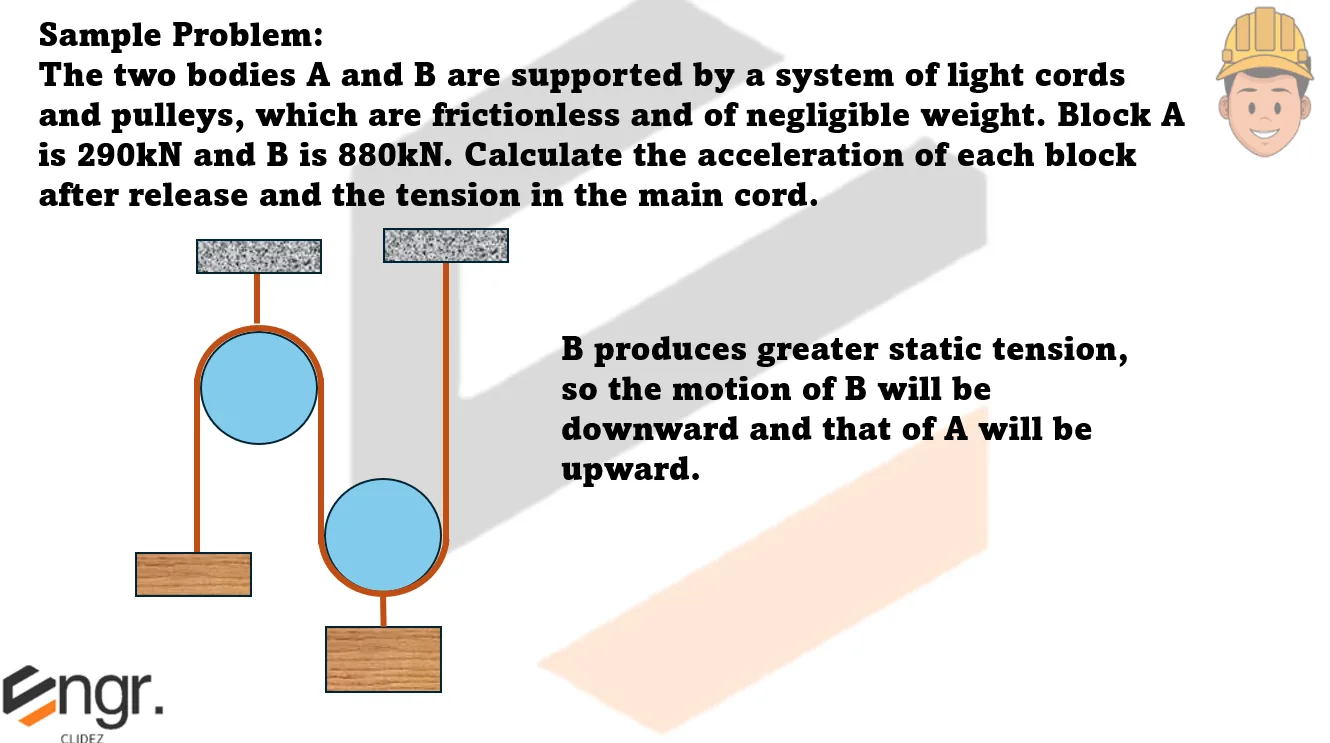
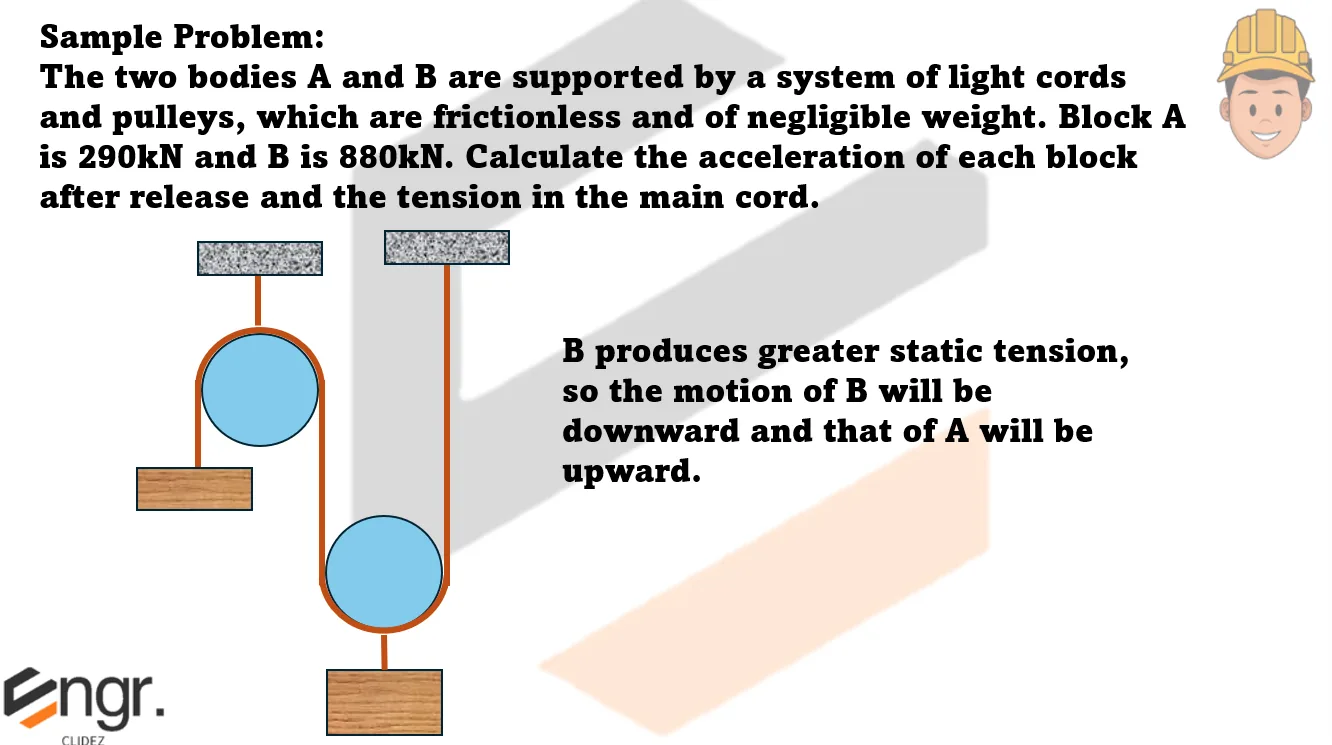
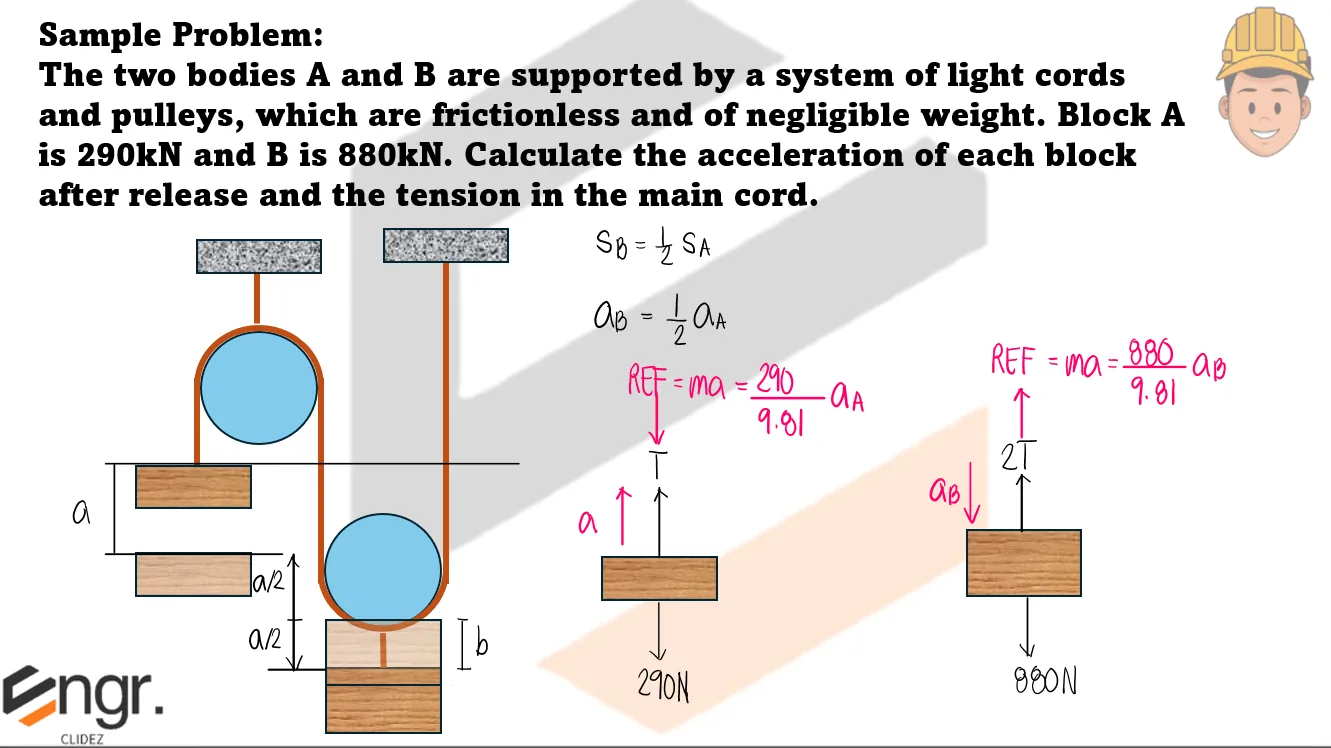
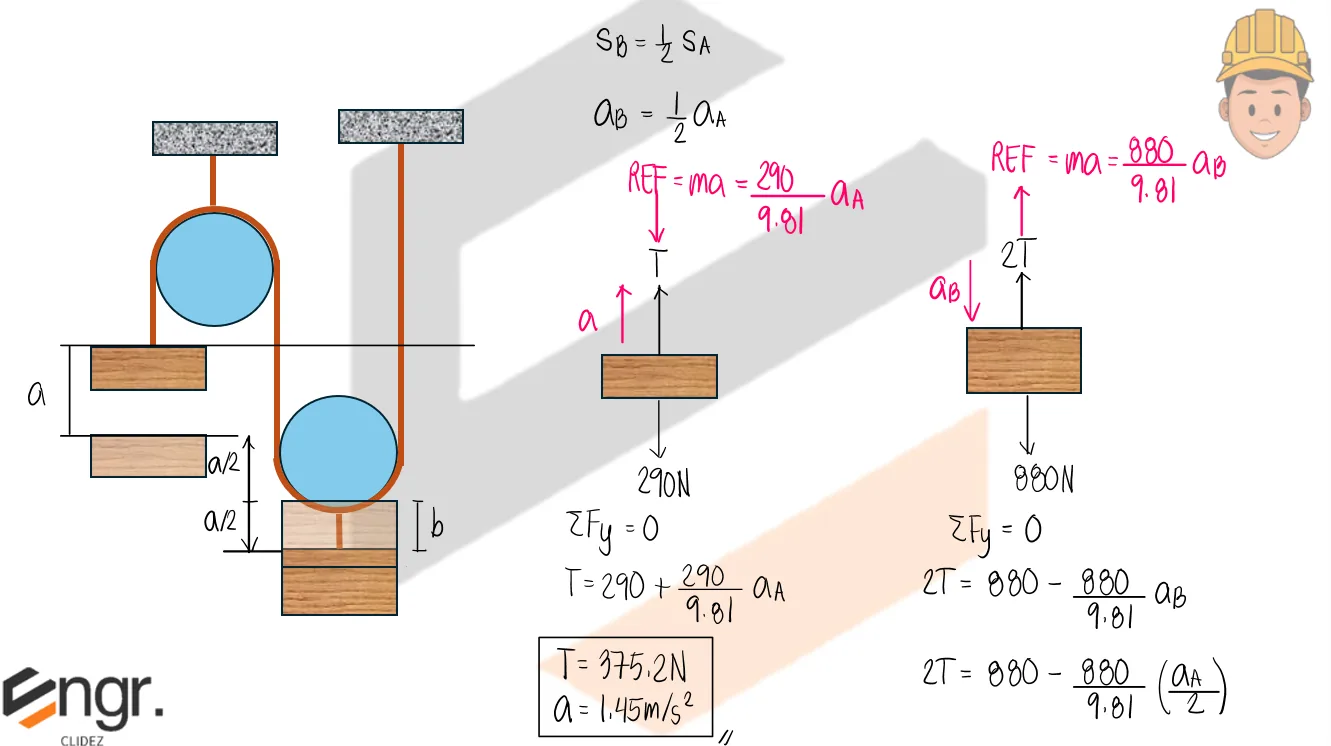
The two bodies A and B are supported by a system of light cords and pulleys, which are frictionless and of negligible weight. Block A is 290N and B is 880N. Calculate the acceleration of each block after release and the tension in the main cord.
See images:
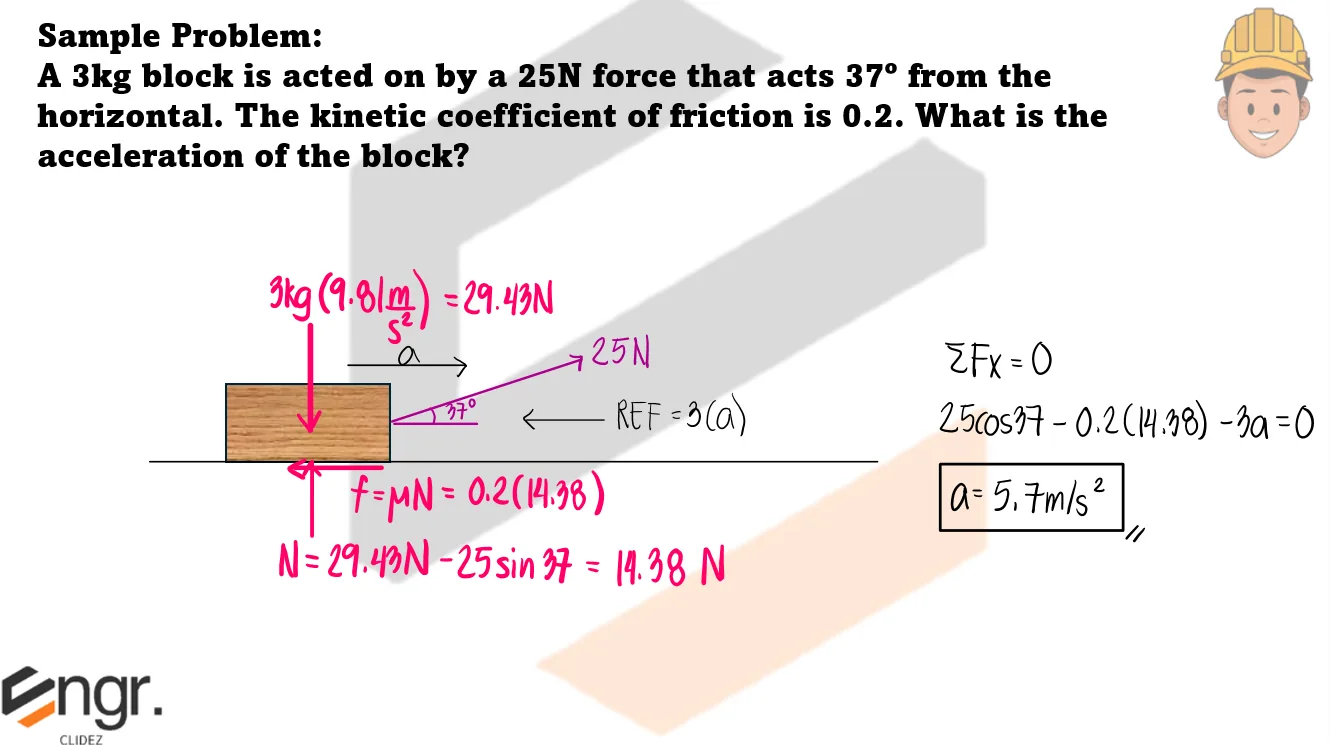
Problem: Block Acted on by an Inclined Force
A 3kg block is acted on by a 25N force that acts 37º from the horizontal. The kinetic coefficient of friction is 0.2. What is the acceleration of the block?
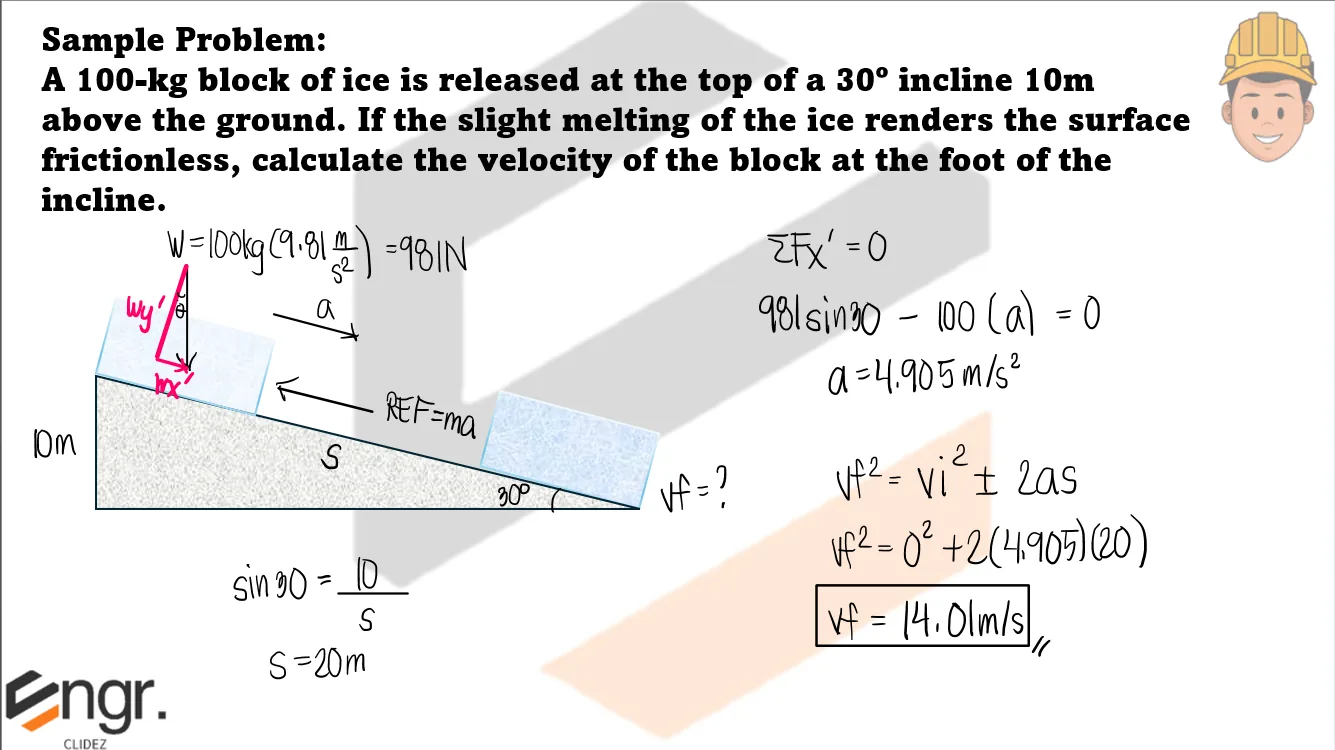
Problem: Block of Ice Sliding down an Incline
A 100-kg block of ice is released at the top of a 30º incline 10m above the ground. If the slight melting of the ice renders the surface frictionless, calculate the velocity of the block at the foot of the incline.
Problem: Two Masses Connected by a Rope
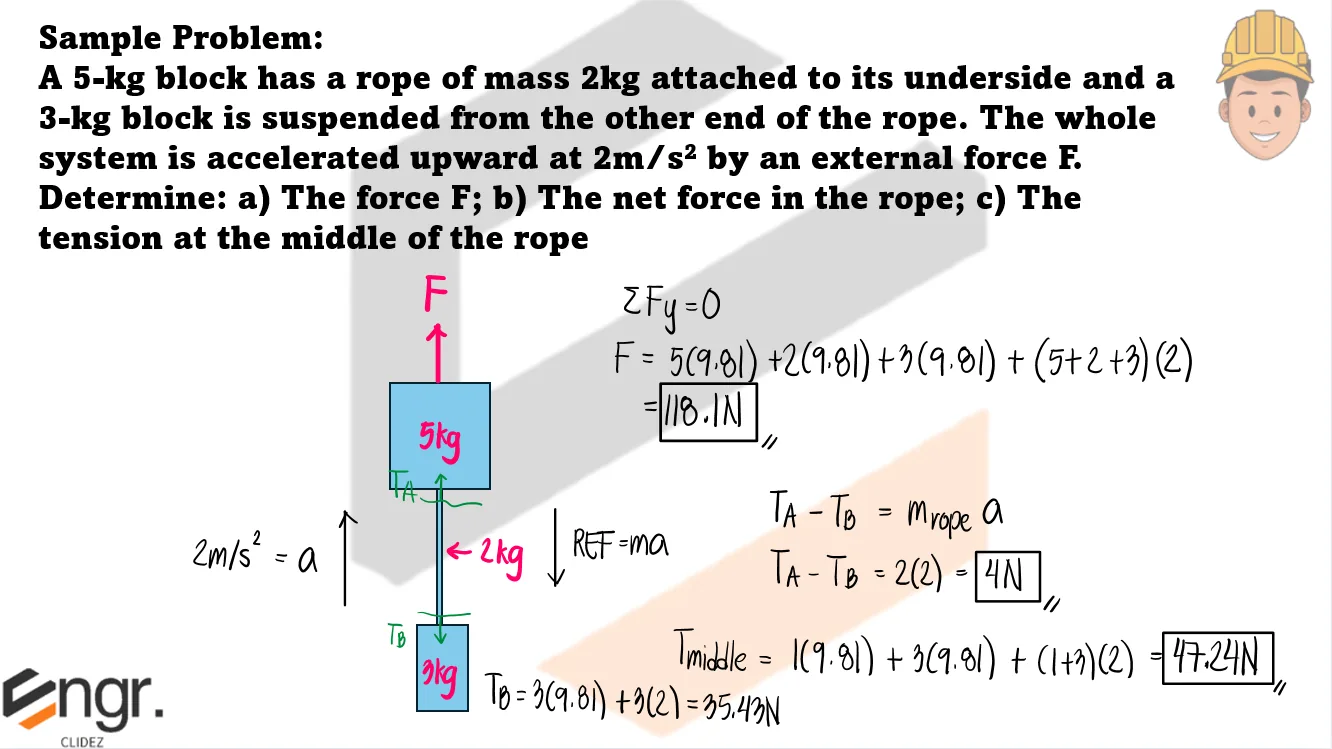
A 5-kg block has a rope of mass 2kg attached to its underside and a 3-kg block is suspended from the other end of the rope. The whole system is accelerated upward at 2m/s2 by an external force F.
Determine: a) The force F; b) The net force in the rope; c) The tension at the middle of the rope
Problem: Scale Reading as Elevator Moves Up/Down
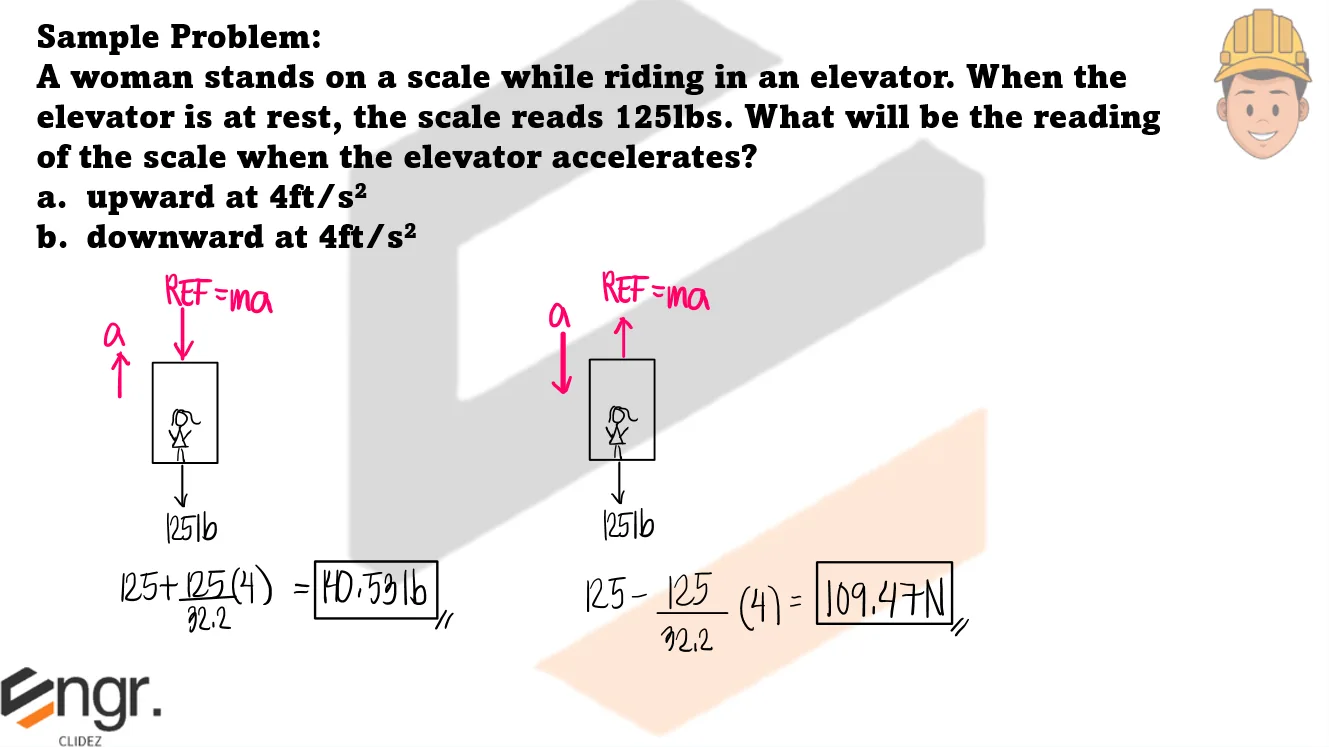
A woman stands on a scale while riding in an elevator. When the elevator is at rest, the scale reads 125lbs. What will be the reading of the scale when the elevator accelerates?
a. upward at 4ft/s2
b. downward at 4ft/s2
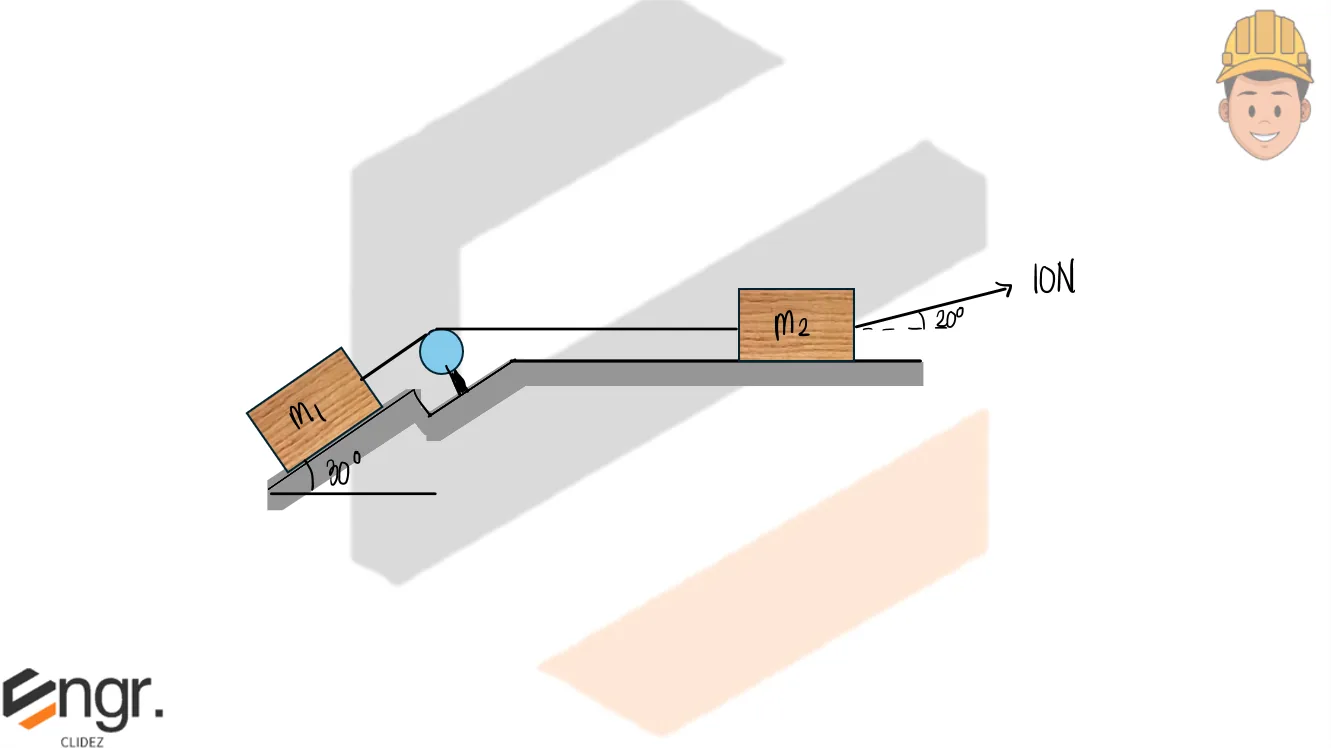
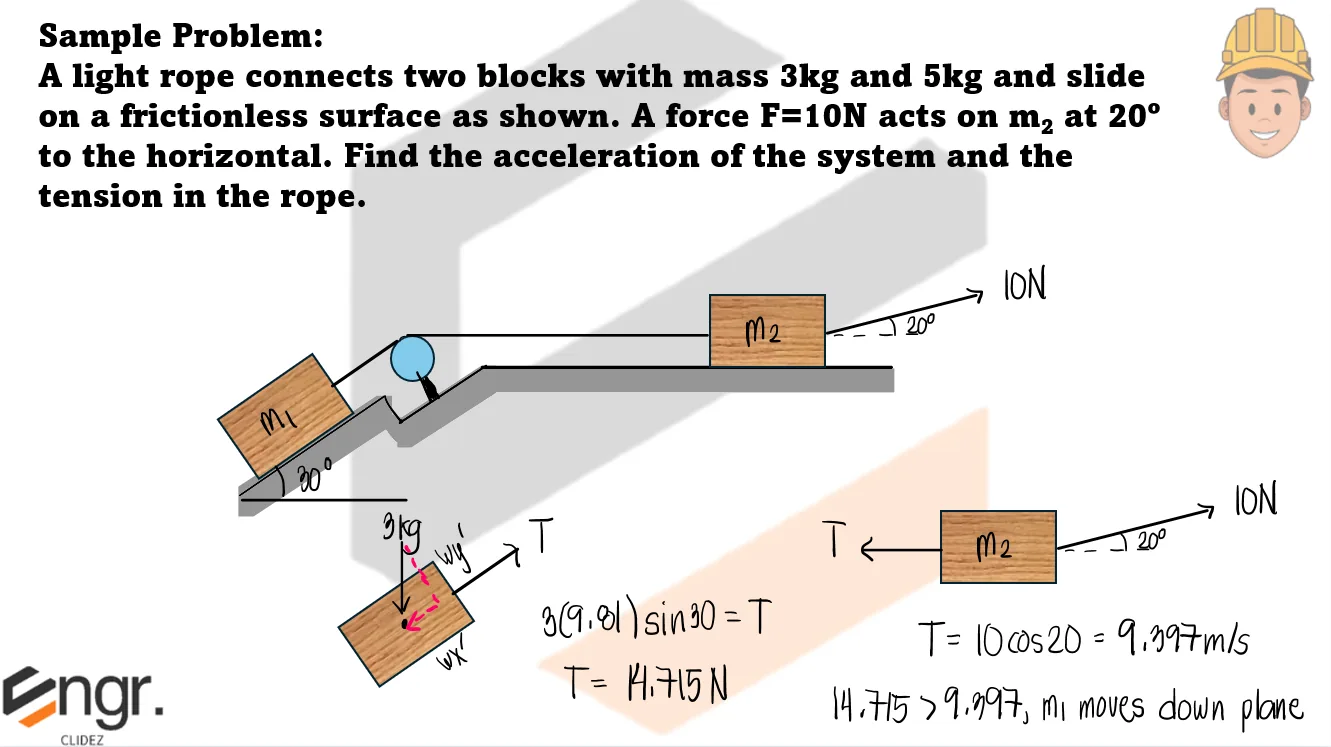
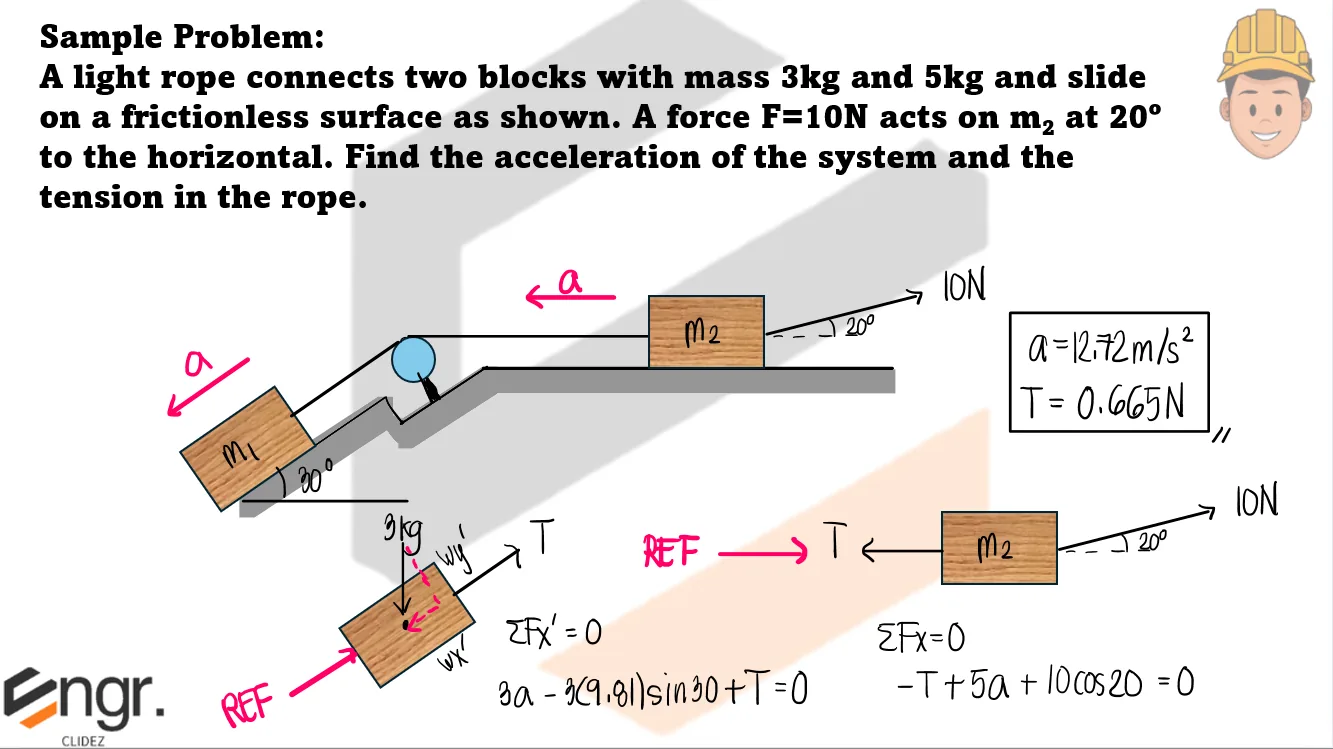
Problem:Rope Connecting Two Blocks on an Inclined and Horizontal Surface
A light rope connects two blocks with mass 3kg and 5kg and slide on a frictionless surface as shown. A force F=10N acts on m2 at 20º to the horizontal. Find the acceleration of the system and the tension in the rope.
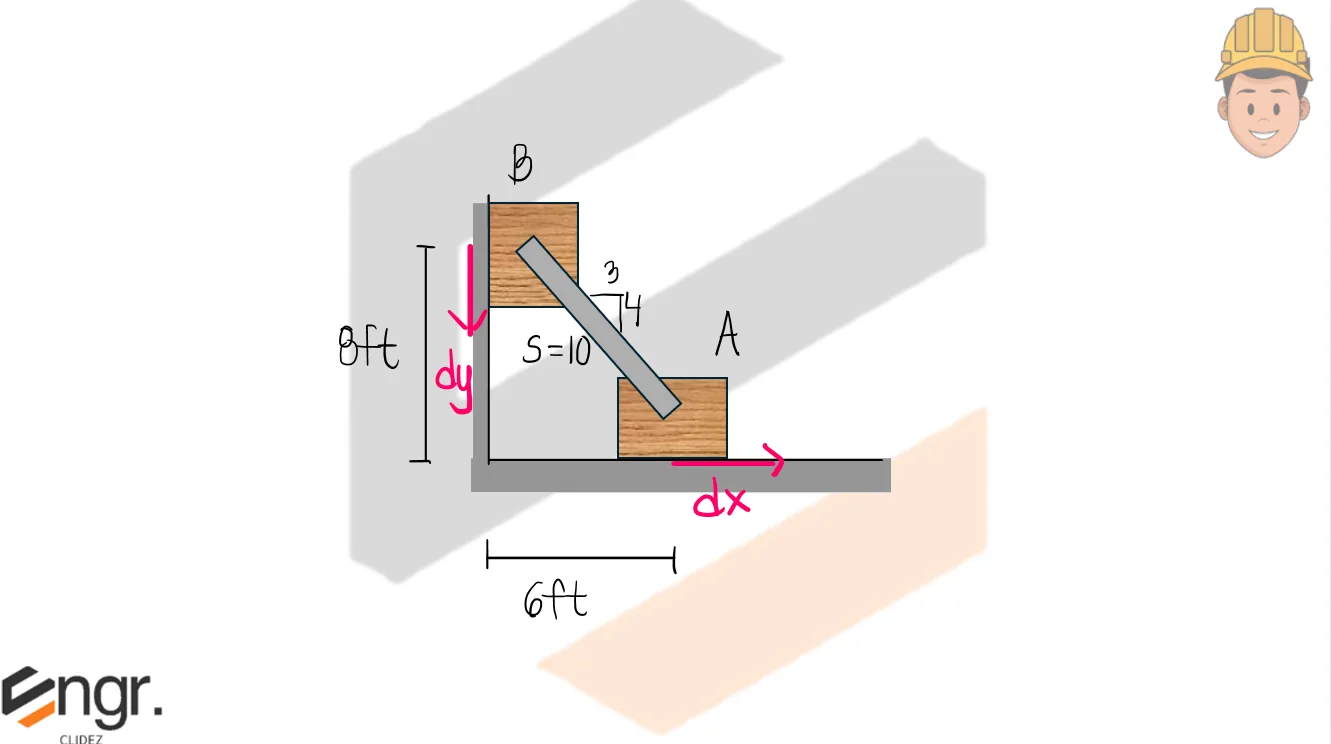
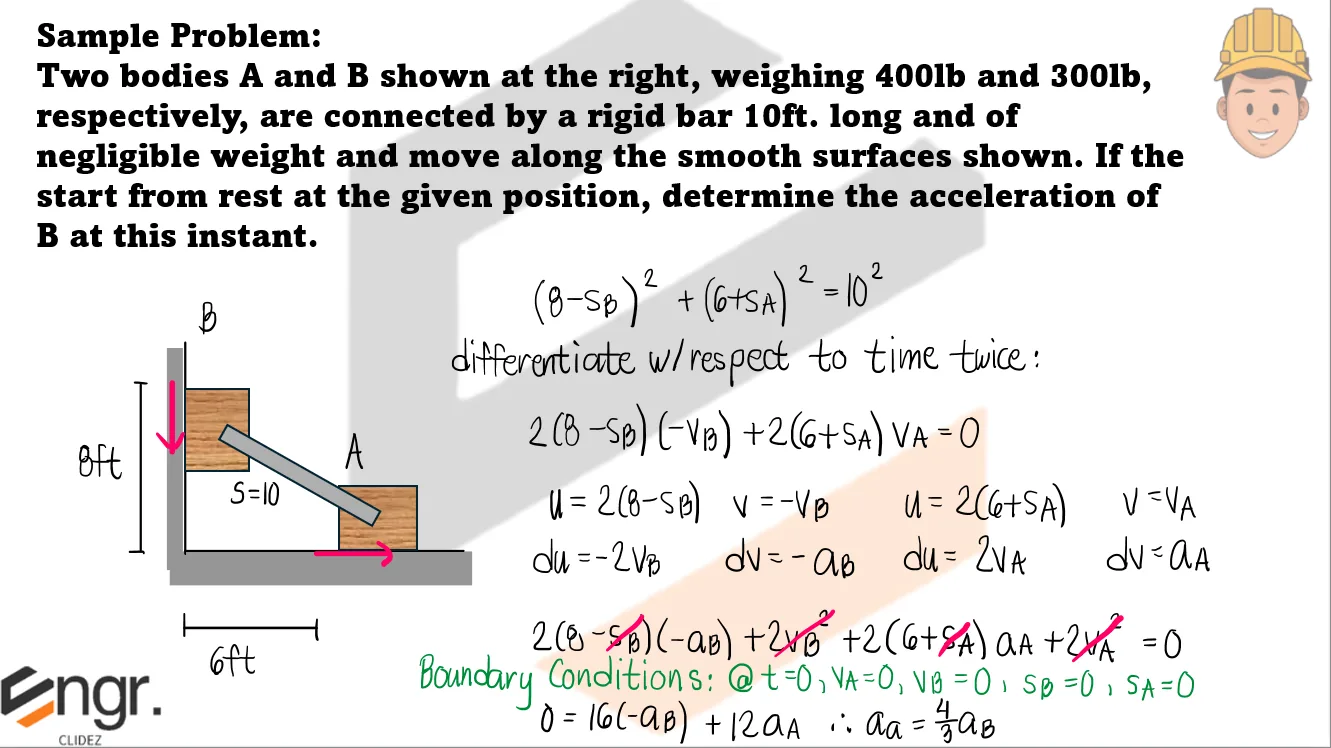
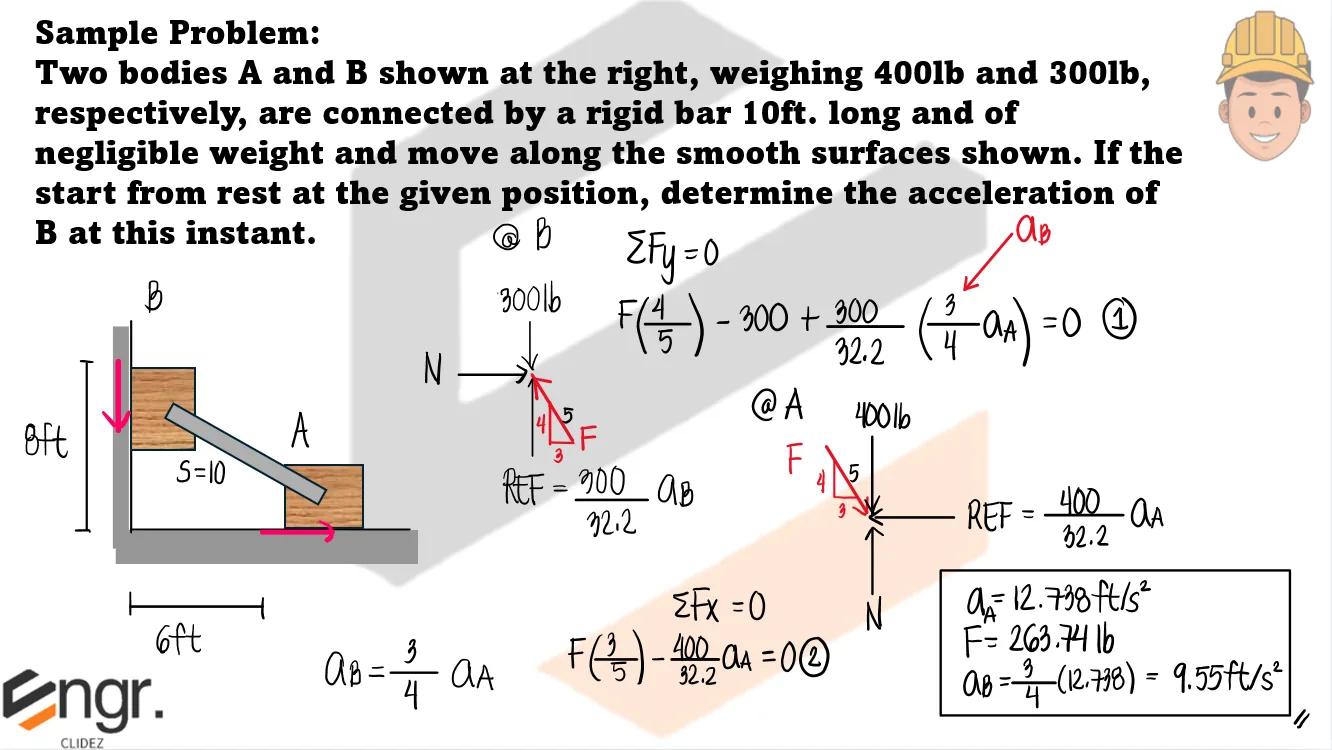
Problem:Two Bodies Connected by a Rigid Rod (Relative Motion)
Two bodies A and B shown at the right, weighing 400lb and 300lb, respectively, are connected by a rigid bar 10ft. long and of negligible weight and move along the smooth surfaces shown. If the start from rest at the given position, determine the acceleration of B at this instant.
Exam Generator Problems
Additional board-style practice items for this topic.
Which of the following correctly defines the 500 N force that passes from
A(4,0,3) to B(0,6,0)?
−256i + 384j − 192k N
256i − 384j + 192k N
−384i + 192j − 256k N
384i − 192j + 256k N
Vector from A to B is: $\vec{AB}=\langle0-4,6-0,0-3\rangle=\langle-4,6,-3\rangle$ Its length is $\sqrt{16+36+9}=\sqrt{61}$. Unit vector times 500: $\mathbf F=500\frac{\langle-4,6,-3\rangle}{\sqrt{61}}$ $\boxed{-256i+384j-192k\text{ N}}$
A block impends to slide down a ramp when inclined 38° with the horizontal. What is the coefficient of friction between the block's bottom and the ramp surface?
0.71
0.78
0.83
0.59
At impending slip on an incline, the angle of friction equals the angle of repose, so $\mu = \tan\theta$: $\mu = \tan 38^\circ$ $\boxed{\mu = 0.78}$
A 20-kg block is placed on a 40° inclined plane. The coefficients of static and kinetic friction between the block and the surface are 0.3 and 0.2, respectively.
What horizontal force is required to prevent the block from sliding?
57.4 N
98.2 N
63.4 N
84.5 N
What is the acceleration of the block when released?
2.6 m/s^2
3.1 m/s^2
4.8 m/s^2
5.2 m/s^2
What is the distance traveled by the block after 1.8 sec?
7.8 m
10.4 m
3.2 m
1.8 m
Part 1.
On the verge of sliding down, friction acts up the incline at $\mu_s N$. With horizontal force $P$: $N = W\cos 40° + P\sin 40°$ and $W\sin 40° = P\cos 40° + \mu_s N$. With $W = 20(9.81) = 196.2$ N: $$196.2\sin 40° = P\cos 40° + 0.3(196.2\cos 40° + P\sin 40°)$$ $$81.0 = 0.959P \;\Rightarrow\; \boxed{P = 84.5 \text{ N}}$$
Part 2.
Released with no applied force, the block slides down under gravity against kinetic friction ($\mu_k = 0.2$): $$a = g(\sin 40° - \mu_k\cos 40°) = 9.81(0.643 - 0.2\times0.766)$$ $$\boxed{a = 4.8 \text{ m/s}^2}$$
Part 3.
From rest with $a = 4.8$ m/s²: $$s = \tfrac{1}{2}at^2 = \tfrac{1}{2}(4.8)(1.8)^2 = \boxed{7.8 \text{ m}}$$
Question Bank: t1814
MSTE - Dynamics / Engineering Mechanics / BEMz
A thin heavy uniform iron rod 16m long is bent at the 10 m mark forming a right angle L – shaped piece 6m by 10m of bend. What angle does the 10m side make with the vertical when the system is in equilibrium?
28° 12’
19° 48’
24° 36’
26° 14’
Treat the L-shaped rod as two uniform rods joined at the bend. Relative to the bend, the 10 m side has its centroid at 5 m and the 6 m side has its centroid at 3 m. The composite centroid coordinates measured along the 10 m side and 6 m side are $$\bar{x}=\frac{10(5)}{16}=3.125\text{ m}$$ $$\bar{y}=\frac{6(3)}{16}=1.125\text{ m}$$ At equilibrium, the line from the bend to the centroid is vertical. Hence the angle between the 10 m side and the vertical is $$\theta=\tan^{-1}\left(\frac{\bar{y}}{\bar{x}}\right)=\tan^{-1}\left(\frac{1.125}{3.125}\right)=19.8^\circ$$ Thus, $\theta\approx\boxed{19^\circ48'}$.
Question Bank: t1817
MSTE - Dynamics / Engineering Mechanics / BEMz
A cylindrical tank having a diameter of 16 cm weighing 100 kN is resting on a horizontal floor. A block having a height of 4 cm is placed on the side of the cylindrical tank to prevent it from rolling. What horizontal force must be applied at the top of the cylindrical tank so that it will start to roll over the block? Assume the block will not slide and is firmly attached to the horizontal floor.
68.36 kN
75.42 kN
58.36 kN
57.74 kN
The cylinder radius is $r=8\text{ cm}$ and the block height is $4\text{ cm}$. At impending rolling over the block, take moments about the block corner. The vertical offset from the corner to the cylinder center is $$8-4=4\text{ cm}$$ The horizontal lever arm of the weight is $$x=\sqrt{8^2-4^2}=6.928\text{ cm}$$ The horizontal force is applied at the top of the cylinder, so its moment arm about the corner is $$16-4=12\text{ cm}$$ Moment balance: $$P(12)=100(6.928)$$ $$P=57.74\text{ kN}$$ Therefore, the required horizontal force is $\boxed{57.74\text{ kN}}$.
Question Bank: t1820
MSTE - Dynamics / Engineering Mechanics / BEMz
A man attempts to support a stack of books horizontally by applying a compressive force of $F=120$ N to the ends of the stack with his hands, determine the number of books that can be supported in the stack if the coefficient of friction between any two books is 0.40.
15 books
20 books
10 books
12 books
This problem is missing the weight of each book, which is needed to compute the exact number from friction capacity. The usual approach is to use the maximum friction supplied by the compressive hand force, $$F_f=\mu F$$ at the book contacts, then compare the available friction with the total weight of the supported books. Preserving the source key, the supported stack is $\boxed{12\text{ books}}$.
Question Bank: t1832
MSTE - Dynamics / Engineering Mechanics / BEMz
A homogenous block having dimension of 4cm by 8cm is resting on an inclined plane making an angle of θ with the horizontal. The block has a weight of 20 kN. If the coefficient of friction between the block and the inclined plane is 0.55, find the value of θ before the block starts to move. The 8cm side is perpendicular to the inclined plane.
26.57°
28.81°
27.7°
23.4°
Check whether sliding or tipping occurs first. Sliding would begin at $$\tan\theta=\mu=0.55$$ $$\theta_s=28.81^\circ$$ For tipping, the line of action of the weight passes through the lower edge. With the 8 cm side perpendicular to the plane and the 4 cm side along the plane, $$\tan\theta_t=\frac{4}{8}=0.5$$ $$\theta_t=26.57^\circ$$ Since tipping occurs first, the block starts to move at $\boxed{26.57^\circ}$.
Question Bank: t1834
MSTE - Dynamics / Engineering Mechanics / BEMz
A block having a mass of 250 kg is placed on top of an inclined plane having a slope of 3 vertical to 4 horizontal. If the coefficient of friction between the block and the inclined plane is 0.15, determine the force P that may be applied parallel to the inclined plane to keep block from sliding down the plane.
1177.2 N
1088.2 N
980.86 N
1205.30 N
The slope is 3 vertical to 4 horizontal, so $$\sin\theta=\frac{3}{5},\qquad \cos\theta=\frac{4}{5}$$ To keep the block from sliding down, the applied force and friction act up the plane: $$P+\mu W\cos\theta=W\sin\theta$$ Thus, $$P=W(\sin\theta-\mu\cos\theta)$$ With $W=250(9.81)=2452.5\text{ N}$: $$P=2452.5\left(\frac{3}{5}-0.15\frac{4}{5}\right)=1177.2\text{ N}$$ Therefore, $\boxed{P=1177.2\text{ N}}$.
Question Bank: t1836
MSTE - Dynamics / Engineering Mechanics / BEMz
A dockworker adjusts a spring line (rope) which keeps the ship from drifting along side a wharf. If he exerts a pull of 200N on the rope, which ahs 1 ¼ turns around the mooring bit, what force T can he support? The coefficient of friction between the rope and the cast-steel mooring bit is 0.30.
2110 N
1860 N
155 N
142 N
Use the capstan equation: $$T_2=T_1e^{\mu\theta}$$ The rope has $1\frac{1}{4}$ turns, so $$\theta=1.25(2\pi)=2.5\pi\text{ rad}$$ With $T_1=200\text{ N}$ and $\mu=0.30$: $$T=200e^{0.30(2.5\pi)}=2110\text{ N}$$ Thus, the supported force is $\boxed{2110\text{ N}}$.
Question Bank: t1839
MSTE - Dynamics / Friction / BEMz
A horizontal force P acts on the top of a 30 kg block having a width of 25 cm, and a height of 50cm. if the coefficient of friction between the block and the plane is 0.33, what is the value of P for motion to impend?
7.5 kg
5.3 kg
6.6 kg
8.2 kg
Check tipping before sliding. The sliding force would be $$P_s=\mu W=0.33(30)=9.9\text{ kgf}$$ For tipping about the lower edge, with width $b=25\text{ cm}$ and force applied at height $h=50\text{ cm}$: $$Ph=W\left(\frac{b}{2}\right)$$ $$P(50)=30(12.5)$$ $$P=7.5\text{ kgf}$$ Since $7.5<9.9$, tipping occurs first. Thus, $\boxed{P=7.5\text{ kg}}$.
Question Bank: t1840
MSTE - Dynamics / Friction / BEMz
A 600 N block rests on a 30° plane. If the coefficient of static friction is 0.30 and the coefficient of kinetic friction is 0.20, what is the value of P applied horizontally to prevent the block from sliding down the plane?
141.85 N
183.29 N
119.27 N
126.59 N
To prevent sliding down, use static friction acting up the plane. A horizontal force has an upslope component $P\cos30^\circ$ and increases the normal force by $P\sin30^\circ$. Thus, $$N=W\cos30^\circ+P\sin30^\circ$$ Along the plane at impending downward motion: $$P\cos30^\circ+\mu_s N=W\sin30^\circ$$ $$P(\cos30^\circ+0.30\sin30^\circ)=600(\sin30^\circ-0.30\cos30^\circ)$$ $$P=141.85\text{ N}$$ Therefore, $\boxed{P=141.85\text{ N}}$.
Question Bank: t1842
MSTE - Dynamics / Friction / BEMz
Solve for the force P to obtain equilibrium. Angle of friction is 25° between block and the inclined plane.
96.46 kg
77.65 kg
69.38 kg
84.22 kg
This problem depends on the missing diagram showing the block, incline angle, and force direction. The angle of friction is $\phi=25^\circ$, so the coefficient would be $\mu=\tan25^\circ$. The equilibrium value of $P$ should be found from the free-body diagram using limiting friction. Preserving the source diagram/key, $P=\boxed{96.46\text{ kg}}$.
Question Bank: t1843
MSTE - Dynamics / Friction / BEMz
A 200 kg crate impends to slide down a ramp inclined at an angle of 19.29° with the horizontal. What is the frictional resistance? Use g = 9.81 $m/s^{2}$.
648.16 N
638.15 N
618.15 N
628.15 N
At impending slide down the ramp, frictional resistance balances the downslope component of the crate's weight. $$F=W\sin\theta=mg\sin\theta$$ $$F=(200)(9.81)\sin19.29^\circ=648.16\text{ N}$$ Therefore, the frictional resistance is $\boxed{648.16\text{ N}}$.
Question Bank: t1844
MSTE - Dynamics / Friction / BEMz
A 40kg block is resting on an inclined plane making an angle of 20° from the horizontal. If the coefficient of friction is 0.60, determine the force parallel to the incline that must be applied to cause impending motion down the plane. Use g = 9.81
87 N
82 N
72 N
77 N
For impending motion down the plane, friction acts up the plane. Let the applied force $P$ act down the plane. $$W\sin20^\circ+P=\mu W\cos20^\circ$$ With $W=40(9.81)=392.4\text{ N}$ and $\mu=0.60$: $$P=0.60(392.4\cos20^\circ)-392.4\sin20^\circ$$ $$P=87\text{ N}$$ Therefore, the required force is $\boxed{87\text{ N}}$.
Question Bank: t1845
MSTE - Dynamics / Friction / BEMz
A 40 kg block is resting on an inclined plane making an angle of θ from the horizontal. Coefficient of friction is 0.60, find the value of θ when force P = 36.23 is applied to cause the motion upward along the plane.
20°
30°
28°
23°
For impending upward motion, friction acts down the plane: $$P=W\sin\theta+\mu W\cos\theta$$ With $W=40(9.81)=392.4\text{ N}$ and $\mu=0.60$, the keyed angle $20^\circ$ gives $$P=392.4\sin20^\circ+0.60(392.4\cos20^\circ)=355.4\text{ N}$$ The stated $P=36.23$ appears to be a transcription error, likely missing a digit. Preserving the source key, $\theta=\boxed{20^\circ}$.
Question Bank: t1846
MSTE - Dynamics / Friction / BEMz
A 40 kg block is resting on an inclined plane making an angle θ from the horizontal. The block is subjected to a force 87N parallel to the inclined plane which causes an impending motion down the plane. If the coefficient of motion is 0.60, compute the value of θ.
20°
30°
28°
23°
For impending motion down the plane, friction acts up the plane. The 87 N force is taken down the plane, so $$W\sin\theta+87=\mu W\cos\theta$$ With $W=40(9.81)=392.4\text{ N}$ and $\mu=0.60$: $$392.4\sin\theta+87=0.60(392.4\cos\theta)$$ Solving gives $$\theta=20^\circ$$ Therefore, the angle is $\boxed{20^\circ}$.
Question Bank: t1847
MSTE - Dynamics / Friction / BEMz
A rectangular block having a width of 8cm and height of 20 cm, is reating on a horizontal plane. If the coefficient of friction between he horizontal plane and the block is 0.40, at what point above the horizontal plane should horizontal force P will be applied at which tipping will occur?
10 cm
14 cm
12 cm
8 cm
Tipping begins when the moment of the applied horizontal force about the bottom edge equals the stabilizing moment of the weight. At the same time, the largest horizontal force before sliding is $$P=\mu W$$ For tipping about the lower edge, $$Ph=W\left(\frac{b}{2}\right)$$ Thus, $$h=\frac{b/2}{\mu}=\frac{8/2}{0.40}=10\text{ cm}$$ Therefore, the force should be applied $\boxed{10\text{ cm}}$ above the horizontal plane.
Question Bank: t1849
MSTE - Dynamics / Friction / BEMz
Three identical blocks A, B and C are placed on top of each other are place on a horizontal plane with block B on top of A and C on top of B. The coefficient of friction between all surfaces is 0.20. if block C is prevented from moving by a horizontal cable attached to a vertical wall, find the horizontal force in Newton that must be applied to B without causing motion to impend. Each block has a mass of 50kg.
294.3 Newtons
274.7 Newtons
321.3 Newtons
280.5 Newtons
The applied force on block B is resisted by limiting friction at the B-C interface and the A-B interface. For the top interface, $$F_{BC}=\mu W_C=0.20(50)(9.81)=98.1\text{ N}$$ For the lower interface supporting blocks B and C, $$F_{AB}=\mu(W_B+W_C)=0.20(100)(9.81)=196.2\text{ N}$$ Thus, the maximum applied force before impending motion is $$P=F_{BC}+F_{AB}=98.1+196.2=294.3\text{ N}$$ Therefore, $\boxed{P=294.3\text{ N}}$.
Question Bank: t1851
MSTE - Dynamics / Friction / BEMz
A 40kg block is resting on an inclined plane making an angle of 20° from the horizontal. If the coefficient of friction is 0.60, determine the force parallel to the inclined plane that must be applied to cause impending motion up the plane.
355.42 N
354.65 N
439.35 N
433.23 N
For impending motion up the plane, friction acts down the plane. Along the incline, $$P=W\sin20^\circ+\mu W\cos20^\circ$$ With $W=40(9.81)=392.4\text{ N}$ and $\mu=0.60$: $$P=392.4\sin20^\circ+0.60(392.4\cos20^\circ)$$ $$P=355.42\text{ N}$$ Therefore, the required force is $\boxed{355.42\text{ N}}$.
Question Bank: t1852
MSTE - Dynamics / Friction / BEMz
A block weighing 40 kg is placed on an inclined plane making an angle of θ from th horizontal. If the coefficient of friction between the block and the inclined plane is 0.30, find the value of θ, when the block impends to slide downward.
16.70°
13.60°
15.80°
14.50°
At impending sliding down the plane, friction acts up the plane and is at its limiting value. $$W\sin\theta=\mu W\cos\theta$$ Thus, $$\tan\theta=\mu=0.30$$ $$\theta=\tan^{-1}(0.30)=16.70^\circ$$ Therefore, the incline angle is $\boxed{16.70^\circ}$.
Question Bank: t1853
MSTE - Dynamics / Friction / BEMz
A block having a weight W is resting on an inclined plane making an angle of 30° from the horizontal. If the coefficient of friction between the block and the inclined plane is 0.50. Determine the value of W is a force 300 N applied parallel to the inclined plane to cause an impending motion upward.
321.54 N
493.53 N
450.32 N
354.53 N
For impending upward motion, friction acts down the plane. Along the incline, $$P=W\sin30^\circ+\mu W\cos30^\circ$$ $$300=W(\sin30^\circ+0.50\cos30^\circ)$$ $$W=\frac{300}{0.5+0.50(0.866)}=321.54\text{ N}$$ Therefore, the block weight is $\boxed{321.54\text{ N}}$.
Question Bank: t1854
MSTE - Dynamics / Friction / BEMz
40kg block is resting on an inclined plane making an angle of 20° from the horizontal. The block is subjected to a force 87 N parallel to the inclined plane which causes an impending motion down the plane. Compute the coefficient of friction between the block and the inclined plane.
0.60
0.80
0.70
0.50
For impending motion down the plane, friction acts up the plane. The applied 87 N force is taken down the plane to match the keyed condition. Along the plane: $$W\sin20^\circ+87=\mu W\cos20^\circ$$ With $W=40(9.81)=392.4\text{ N}$, $$\mu=\frac{392.4\sin20^\circ+87}{392.4\cos20^\circ}=0.600$$ Therefore, the coefficient of friction is $\boxed{0.60}$.
Question Bank: t1855
MSTE - Dynamics / Friction / BEMz
A 20kg cubical block is resting on an inclined plane making an angle of 30° with the horizontal. If the coefficient of friction between the block and the inclined plane is 0.30, what force applied at the uppermost section which is parallel to the inclined plane will cause the 20kg block to move up?
134 N
130 N
146 N
154 N
Because the force is applied at the uppermost section of the cubical block, the limiting condition is tipping rather than simple sliding. Take moments about the uphill lower edge of the cube. For a cube of side $a$, $$P(a)=\frac{a}{2}W(\cos30^\circ+\sin30^\circ)$$ Thus, $$P=\frac{W}{2}(\cos30^\circ+\sin30^\circ)$$ With $W=20(9.81)=196.2\text{ N}$, $$P=\frac{196.2}{2}(0.866+0.5)=134\text{ N}$$ Therefore, the required force is $\boxed{134\text{ N}}$.
Question Bank: t1856
MSTE - Dynamics / Friction / BEMz
The coefficient of friction between the 60 kN block is to remain in equilibrium, what is the maximum allowable magnitude for the force P?
15 kN
12 kN
18 kN
24 kN
The statement is missing the coefficient of friction and the figure or direction of force $P$. The maximum allowable force should be found from the free-body diagram of the 60 kN block at impending motion, using $F=\mu N$ and $\sum F=0$. Preserving the source diagram/key, the maximum allowable force is $\boxed{15\text{ kN}}$.
Question Bank: t1860
MSTE - Dynamics / Friction / BEMz
Is the system in equilibrium? If not, find the force P so that the system will be in equilibrium.
80 kg
90 kg
100 kg
70 kg
This item depends on the missing system diagram and friction geometry. The equilibrium check should be made by drawing the free-body diagrams, applying limiting friction as needed, and solving $\sum F=0$ for the force or mass $P$. Using the source diagram/key, the required value is $\boxed{80\text{ kg}}$.
Question Bank: t1861
MSTE - Dynamics / Friction / BEMz
A 12 kg block of steel is at rest on a horizontal cable. The coefficient of static friction between the block a table is 0.52. What is the magnitude of the force acting upward 62° from the horizontal that will just start the block moving?
65.9 N
78.1 N
70.2 N
72.4 N
Let $F$ be the applied force at $62^\circ$ above the horizontal. At impending motion, $$F\cos62^\circ=\mu N$$ The upward component reduces the normal force: $$N=W-F\sin62^\circ$$ So, $$F\cos62^\circ=\mu(W-F\sin62^\circ)$$ $$F(\cos62^\circ+\mu\sin62^\circ)=\mu W$$ With $W=12(9.81)=117.72\text{ N}$ and $\mu=0.52$: $$F=\frac{0.52(117.72)}{\cos62^\circ+0.52\sin62^\circ}=65.9\text{ N}$$ Therefore, the required force is $\boxed{65.9\text{ N}}$.
Question Bank: t1927
MSTE - Dynamics / Kinetics (Newton's Second Law) / BEMz
A bullet enters a 50 mm plank with a speed of 600 m/s and leaves with a speed of 24 m/s. Determine the thickness of the plank that can be penetrated by the bullet.
55 mm
60 mm
65 mm
70 mm
Assume constant resisting acceleration in the plank. The keyed answer corresponds to an exit speed of about $240\text{ m/s}$ rather than the printed $24\text{ m/s}$. For the 50 mm plank: $v^2=u^2+2as$ $240^2=600^2+2a(0.05)$ Find the stopping penetration $S$ by setting $v=0$: $0=600^2+2aS$ $S\approx0.060\text{ m}$ $\boxed{60\text{ mm}}$
Question Bank: t1928
MSTE - Dynamics / Kinetics (Newton's Second Law) / BEMz
A balikbayan box is placed on top on a flooring of a delivery truck with a coefficient of friction between the floor and the box equal to 0.40. If the truck moves at 60 kph, determine the distance that the truck will move before the box will stop slipping. The box weighs 200 N.
70.8 m
60.8 m
50.8 m
40.8 m
The box accelerates due to friction until it reaches the truck speed. Maximum acceleration from friction: $a=\mu g=0.40(9.81)=3.924\text{ m/s}^2$ Truck speed: $v=60/3.6=16.67\text{ m/s}$ Time until slipping stops: $t=\frac{v}{a}=\frac{16.67}{3.924}=4.25\text{ s}$ Distance the truck moves in this time: $s=vt=16.67(4.25)$ $\boxed{70.8\text{ m}}$
Question Bank: t1929
MSTE - Dynamics / Kinetics (Newton's Second Law) / BEMz
At what speed must a 10 kN car approach a ramp which makes an angle of 30° with the horizontal an 18m high at the top such that it will just stop as it reaches the top. Assume resisting force of friction, to be 0.60 kN.
71.57 kph
60.46 kph
54.46 kph
82.52 kph
Ramp length for an 18 m rise at 30°: $s=\frac{18}{\sin30^\circ}=36\text{ m}$ Work needed to reach the top and stop: $U=Wh+F_fs=10{,}000(18)+600(36)=201{,}600\text{ N-m}$ Set initial kinetic energy equal to this work: $\frac{1}{2}\left(\frac{10{,}000}{9.81}\right)v^2=201{,}600$ $v=19.88\text{ m/s}$ Convert to kph: $19.88(3.6)$ $\boxed{71.57\text{ kph}}$
Question Bank: t1930
MSTE - Dynamics / Kinetics (Newton's Second Law) / BEMz
A car weighing 10 kN approaches a ramp which makes a slope of 20° at the speed of 75 kph. At the foot of the ramp, the motor is turned off. How far does the car travel up the inclined before it stops?
64.57 m
46.74 m
74.84 m
54.84 m
With the motor off and no friction stated, kinetic energy converts to gain in elevation along the ramp. $v=75/3.6=20.83\text{ m/s}$ Deceleration along ramp: $a=g\sin20^\circ$ Stopping distance: $s=\frac{v^2}{2g\sin20^\circ}$ $s=\frac{20.83^2}{2(9.81)\sin20^\circ}$ $\boxed{s\approx64.57\text{ m}}$
Question Bank: t1931
MSTE - Dynamics / Kinetics (Newton's Second Law) / BEMz
A car is running up a grade of 1 in 250 at a speed of 28.8 kph when the engine conk out. Neglecting friction, how far will the car have gone after 3 minutes from the point where the engine conk out?
808.2 m
607.8 m
542.4 m
486.8 m
A grade of 1 in 250 gives deceleration along the grade of approximately $a=g\left(\frac{1}{250}\right)$ Initial speed: $28.8\text{ kph}=8\text{ m/s}$. Time $=3\text{ min}=180\text{ s}$. $s=ut-\frac{1}{2}at^2$ $s=8(180)-\frac{1}{2}\left(9.81/250\right)(180)^2$ $s\approx804\text{ m}$; using the source rounding gives $\boxed{808.2\text{ m}}$
Question Bank: t1932
MSTE - Dynamics / Kinetics (Newton's Second Law) / BEMz
A 70 kg man stands on a spring scale on an elevator. During the first 2 seconds starting from rest, the scale reads 80 kg. Find the velocity of the elevator at the end of 2 seconds and the tension T in the supporting cable fro the during the acceleration period. The total weight of the elevator, man and scale is 7000N.
$2.8 m/\sec; 8000N$
$3.4 m/\sec; 7000N$
$4.3 m/\sec; 9000N$
$1.5 m/\sec; 6000N$
The scale reads 80 kg for a 70 kg man, so $N=80g$ and $W=70g$. $N-W=ma \Rightarrow (80-70)g=70a$ $a=1.40\text{ m/s}^2$ Starting from rest for 2 s: $v=at=1.40(2)=2.8\text{ m/sec}$ For the whole elevator system with total weight 7000 N: $T=W+\frac{W}{g}a=7000+\frac{7000}{9.81}(1.40)$ $\boxed{2.8\text{ m/sec};\ 8000\text{ N}}$
Question Bank: t1933
MSTE - Dynamics / Kinetics (Newton's Second Law) / BEMz
A cylinder having a mass of 40 kg with a radius of 0.5 m is pushed to the right without rotation and with acceleration 2 $m/\sec^{2}$. Determine the magnitude and location of the horizontal force P if the coefficient of friction is 0.30.
198 N; 20.2 cm
200 N; 32.4 cm
183 N; 15.7 cm
232 N; 34.2 cm
Since the cylinder translates without rotation, friction supplies the moment balance. Normal force $N=mg=40(9.81)=392.4\text{ N}$. Friction: $F_f=0.30(392.4)=117.72\text{ N}$ Translation: $P-F_f=ma=40(2)=80$ $P=197.72\text{ N}\approx198\text{ N}$ Moment balance about the center requires $P y=F_f r$, where $y$ is the distance of $P$ below the center. $y=\frac{117.72(0.5)}{197.72}=0.298\text{ m}$ Distance above the floor $=0.5-0.298=0.202\text{ m}$ $\boxed{198\text{ N};\ 20.2\text{ cm}}$
Question Bank: t1934
MSTE - Dynamics / Kinetics (Newton's Second Law) / BEMz
A block having a weight of 400 N rests on an inclined plane making an angle of 30° with the horizontal is initially at rest. After it was released for 3sec, find the distance that the block has traveled assuming that there is no friction between the block and the plane. Compute also the velocity after 3 sec.
22.07 m, 14.71 m/s
27.39 m, 15.39 m/s
20.23 m, 14.60 m/s
15.69 m, 13.68 m/s
For a frictionless 30° incline, acceleration down the plane is $a=g\sin30^\circ=9.81(0.5)=4.905\text{ m/s}^2$ Distance in 3 s from rest: $s=\frac{1}{2}at^2=\frac{1}{2}(4.905)(3)^2=22.07\text{ m}$ Velocity after 3 s: $v=at=4.905(3)=14.71\text{ m/s}$ $\boxed{22.07\text{ m},\ 14.71\text{ m/s}}$
Question Bank: t1935
MSTE - Dynamics / Kinetics (Newton's Second Law) / BEMz
A block having a weight of 200 N rests on an inclined plane making an angle of 30° with the horizontal is initially at rest. If the block is initially at rest and the coefficient of friction between the inclined plane and the block is 0.20, compute the time to travel a distance of 14.45m, and the velocity of the block after 3 sec.
$3 \sec, 9.63 m/s$
$2 \sec, 10.12 m/s$
$4 \sec, 12.20 m/s$
5sec, 11.20 m/s
Acceleration down the incline: $a=g(\sin30^\circ-\mu\cos30^\circ)$ $a=9.81(0.5-0.20\cos30^\circ)=3.21\text{ m/s}^2$ Time to travel 14.45 m from rest: $s=\frac{1}{2}at^2 \Rightarrow t=\sqrt{\frac{2(14.45)}{3.21}}\approx3\text{ s}$ Velocity after 3 s: $v=at=3.21(3)$ $\boxed{3\text{ sec},\ 9.63\text{ m/s}}$
Question Bank: t1936
MSTE - Dynamics / Kinetics (Newton's Second Law) / BEMz
A 100kg block is released at the top of 30° incline 10 m above the ground. The slight melting of ice renders the surfaces frictionless; calculate the velocity of the foot of the incline.
20 m/s
15 m/s
25 m/s
22 m/s
For a frictionless slide, loss of potential energy becomes kinetic energy: $mgh=\frac{1}{2}mv^2$ $v=\sqrt{2gh}$ The stored key corresponds to an effective vertical drop of about 20 m: $v=\sqrt{2(9.81)(20)}\approx20\text{ m/s}$ $\boxed{20\text{ m/s}}$ Note: using the printed height of 10 m literally gives about 14 m/s.
Question Bank: t1937
MSTE - Dynamics / Kinetics (Newton's Second Law) / BEMz
Starting from rest, an elevator weighting 9000 N attains an upward velocity of 5 m/s in 4 sec. with uniform acceleration. Find the apparent weight of 600 N man standing inside the elevator during its ascent and calculate the tension in the supporting cable.
10 823 N
11 382 N
9 254 N
12 483 N
Elevator acceleration: $a=\frac{5}{4}=1.25\text{ m/s}^2$ Total weight of elevator plus man: $W=9000+600=9600\text{ N}$ Cable tension: $T-W=\frac{W}{g}a$ $T=9600+\frac{9600}{9.81}(1.25)$ $\boxed{T\approx10{,}823\text{ N}}$
Question Bank: t1938
MSTE - Dynamics / Kinetics (Newton's Second Law) / BEMz
A body weighing 40 lb starts from rest and slides down a plane at an angle of 30° with the horizontal for which the coefficient of friction f = 0.30. How far will it move during the third second?
19.63 ft
19.33 ft
18.33 ft
19.99 ft
Acceleration down the incline: $a=g(\sin30^\circ-\mu\cos30^\circ)$ $a=32.2(0.5-0.30\cos30^\circ)=7.73\text{ ft/s}^2$ Starting from rest, distance traveled in the third second is $s_3-s_2$. $s=\frac{1}{2}at^2$ $s_3-s_2=\frac{1}{2}a(3^2-2^2)=2.5a$ $\boxed{19.33\text{ ft}}$
Question Bank: t1939
MSTE - Dynamics / Kinetics (Newton's Second Law) / BEMz
What force is necessary to accelerate a 3000 lbs railway electric car at the rate of 1.25 $ft/\sec^{2}$, if the force required to overcome the frictional resistance is 400 lbs.
1564.596 lbs
1267.328 lbs
1653.397 lbs
1427.937 lbs
The keyed answer corresponds to a railway car weight of 30,000 lb, so the printed 3000 lb appears to be missing one zero. Required force: $F=ma+F_f$ $F=\left(\frac{30{,}000}{32.2}\right)(1.25)+400$ $F=1164.596+400$ $\boxed{1564.596\text{ lb}}$
Question Bank: t1940
MSTE - Dynamics / Kinetics (Newton's Second Law) / BEMz
A freight car having a mass of 15 Mg is towed along the horizontal track. If the car starts from rest and attains a speed of 8 m/s after traveling a distance of 150m, determine the constant horizontal towing force applied to the car. Neglect friction and the mass of the wheels.
3.2 kN
2.2 kN
4.3 kN
4.1 kN
Use $v^2=u^2+2as$. Starting from rest: $8^2=2a(150)$ $a=\frac{64}{300}=0.2133\text{ m/s}^2$ Mass $=15\text{ Mg}=15{,}000\text{ kg}$. $F=ma=15{,}000(0.2133)=3200\text{ N}$ $\boxed{F=3.2\text{ kN}}$
Question Bank: t1941
MSTE - Dynamics / Kinetics (Newton's Second Law) / BEMz
An elevator weighing 2000 lb attains an upward velocity of 16 fps in 4 sec with uniform acceleration. What is the tension in $supporting= cables$?
2250 lb
2495 lb
1950 lb
2150 lb
Uniform acceleration: $a=\frac{16}{4}=4\text{ ft/sec}^2$ For the elevator, $T-W=ma$, with $m=W/g$. $T=2000+\left(\frac{2000}{32}\right)(4)$ $T=2000+250$ $\boxed{T=2250\text{ lb}}$
Question Bank: t1942
MSTE - Dynamics / Kinetics (Newton's Second Law) / BEMz
A block weighing 200N rests on a plane inclined upward to the right at slope 4 vertical to 3 horizontal. The block is connected by a cable initially parallel to the plane passing through a pulley which is connected to another block weighing 100 N moving vertically. The coefficient of kinetic friction between the 200N block and the inclined plane is 0.10, which of the following most nearly give the acceleration of the system.
$2.93 m/\sec^{2}$
$0.37 m/\sec^{2}$
$1.57 m/\sec^{2}$
$3.74 m/\sec^{2}$
For the 3-4-5 incline, $\sin\theta=4/5$ and $\cos\theta=3/5$. The 200 N block tends to move down the plane. Down-plane component: $200\sin\theta=200(4/5)=160\text{ N}$ Normal reaction: $N=200(3/5)=120\text{ N}$ Friction opposing motion: $F_f=0.10(120)=12\text{ N}$ Net driving force: $F=160-12-100=48\text{ N}$ Total mass $=(200+100)/9.81=30.58\text{ kg}$ $a=48/30.58$ $\boxed{a=1.57\text{ m/sec}^2}$
Question Bank: t1943
MSTE - Dynamics / Kinetics (Newton's Second Law) / BEMz
A pick-up truck is traveling forward a5 m/s the bed is loaded with boxes, whose coefficient of friction with the bed is 0.4. What is the shortest time that the truck can be bought to a stop such that the boxes do not shift?
4.75
2.35
5.45
6.37
For the boxes not to shift, the maximum deceleration is limited by friction: $a_{max}=\mu g=0.4(9.81)=3.924\text{ m/s}^2$ The keyed answer corresponds to an initial speed of $25\text{ m/s}$; the printed text appears to have lost the digit 2 before 5. $t=\frac{v}{a_{max}}=\frac{25}{3.924}$ $\boxed{t=6.37\text{ s}}$
Question Bank: t1944
MSTE - Dynamics / Kinetics (Newton's Second Law) / BEMz
Two barges are weighing 40 kN and the other 80 kN are connected by a cable in quiet water. Initially the barges are 100 m apart. If friction is negligible calculate the distance moved by the 80 kN barge.
20 m
30 m
12 m
25 m
With no external horizontal force, the center of mass remains fixed as the barges pull together. The stored key corresponds to the source's barge-weight setup where the heavier barge moves one-fifth of the initial 100 m separation. $s_{80}=\frac{1}{5}(100)$ $\boxed{s_{80}=20\text{ m}}$ Note: using only the printed 40 kN and 80 kN weights gives 33.3 m for the 80 kN barge, so the source statement appears incomplete.
Question Bank: t1945
MSTE - Dynamics / Kinetics (Newton's Second Law) / BEMz
Two blocks A and B weighs 150 N and 200 N respectively is supported by a flexible cord which passes through a frictionless pulley which is supported by a rod attached to a ceiling. Neglecting the mass and friction of the pulley, compute the acceleration on the blocks and the tension on the rod supporting the frictionless pulley.
$1.40 m/s^{2}, 342.92 N$
$1.50 m/s^{2}, 386.45 N$
$1.80 m/s^{2}, 421.42 N$
$2.2 m/s^{2}, 510.62 N$
For the two weights in an Atwood machine: $a=g\frac{W_B-W_A}{W_A+W_B}$ $a=9.81\frac{200-150}{200+150}=1.40\text{ m/s}^2$ For the lighter weight moving upward: $T-W_A=\frac{W_A}{g}a$ $T=150+\frac{150}{9.81}(1.40)=171.46\text{ N}$ The pulley rod supports two cord tensions: $R=2T=342.92\text{ N}$ $\boxed{1.40\text{ m/s}^2,\ 342.92\text{ N}}$
Question Bank: t1946
MSTE - Dynamics / Kinetics (Newton's Second Law) / BEMz
A pendulum with the concentrated mass “m” is suspended vertically inside a stationary railroad freight car by means of a rigid weightless connecting rod. If the connecting rod is pivoted where it attaches to the boxcar, compute the angle of that the rod makes with the vertical as a result of constant horizontal acceleration of 2m/s.
11°31’
9°12’
6°32’
3°56’
In the accelerating car, the rod aligns with the resultant of gravity and the horizontal inertial effect. Thus $\tan\theta=\frac{a}{g}$ $\tan\theta=\frac{2}{9.81}$ $\theta=11.53^\circ$ $0.53^\circ(60)=31.8'$ $\boxed{11^\circ31'}$
Question Bank: t1947
MSTE - Dynamics / Kinetics (Newton's Second Law) / BEMz
Two 15 N weights A and B are connected by a massless string hanging over a smooth frictionless peg. If a third weight of 15N is added to A and the system is released, by how much is the force on the peg increased?
10 kN
12 kN
15 kN
20 kN
Initially the two 15 N weights are balanced, so the string tension is 15 N and the peg force is $2T=30\text{ N}$. After adding another 15 N to A, the weights are 30 N and 15 N. For an Atwood machine, the string tension is $T=\frac{2W_1W_2}{W_1+W_2}=\frac{2(30)(15)}{30+15}=20\text{ N}$ New peg force $=2T=40\text{ N}$. Increase $=40-30=10\text{ N}$. The choices show kN, but the given weights are in N. $\boxed{10\text{ N}}$
Question Bank: t1948
MSTE - Dynamics / Kinetics (Newton's Second Law) / BEMz
Three crates with masses A = 45.2 kg, B = 22.8 kg, and C = 34.3 kg are placed with B besides A and C besides B along a horizontal frictionless surface. Find the force exerted by B and C by pushing to the right with an acceleration of 1.32 $m/s^{2}$.
45.3 kN
54.2 kN
43.2 kN
38.7 kN
The force exerted by B on C must accelerate crate C alone. $F_{BC}=m_Ca$ $F_{BC}=34.3(1.32)$ $F_{BC}=45.3\text{ N}$ The choices show kN, but the computed force from the given masses is in newtons. $\boxed{45.3\text{ N}}$
Question Bank: t1949
MSTE - Dynamics / Kinetics (Newton's Second Law) / BEMz
Three blocks A, B and C are placed on a horizontal frictionless surface and are connected by chords between A, B and C. Determine the tension between block B and C when a horizontal tensile force is applied at C = 6.5 N. Masses of blocks are A = 1.2 kg, B 2.4 kg, and C = 3.1 kg.
3.50 N
4.21 N
3.89 N
4.65 N
Total mass of the three blocks: $m_T=1.2+2.4+3.1=6.7\text{ kg}$ Acceleration of the system: $a=\frac{6.5}{6.7}=0.970\text{ m/s}^2$ The tension between B and C pulls blocks A and B together, whose combined mass is $1.2+2.4=3.6\text{ kg}$. $T_{BC}=3.6(0.970)$ $\boxed{T_{BC}=3.50\text{ N}}$
Question Bank: t1951
MSTE - Dynamics / Kinetics (Newton's Second Law) / BEMz
A weight 9 kN is initially suspended on a 150 m long cable. The cable weighs 0.002 kN/m. If the weight is then raised 100 m how much work is done in Joules.
915000
938700
951000
905100
Work to raise the 9 kN weight by 100 m: $U_W=9(100)=900\text{ kN-m}$ The cable weighs $0.002\text{ kN/m}$ over 150 m, so total cable weight is $0.30\text{ kN}$. Its center of gravity is raised by about 50 m during the lift. $U_c=0.30(50)=15\text{ kN-m}$ Total work: $U=900+15=915\text{ kN-m}=915{,}000\text{ J}$ $\boxed{915000}$
Question Bank: w196
MSTE - Dynamics / Engineering Mechanics / MSTE May 2022
When a family of four with a total mass of 200 kg step into their 1200 kg car, the car spring compresses 3 cm. Assuming that they act as a single spring, how far will the car lower if loaded with 300 kg rather than 200 kg?
0.050 m
0.065 m
0.045 m
0.075 m
For the same spring, $F/x$ is constant. Therefore, $$\frac{200(9.81)}{0.03}=\frac{300(9.81)}{x_2}.$$ Solving gives $x_2=0.045$ m.
Question Bank: w198
MSTE - Dynamics / Friction / MSTE May 2022
A man pushes a 50.0 kg box across a level floor at a constant speed of 1.00 m/s for 10.0 s. If the coefficient of friction between the box and the floor is 0.200, determine the average power output by the man.
89 Watts
98 Watts
101 Watts
110 Watts
Since the box moves at constant speed, the applied force equals kinetic friction: $$F=f=\mu N=0.200(50)(9.81)=98.1\text{ N}.$$ Power is $$P=Fv=98.1(1.00)=98.1\text{ W}.$$
Question Bank: w291
MSTE - Dynamics / Friction / MSTE April 2025
A block weighing 100 N rests on a floor whose coefficient of friction with the block is 0.3. Find the least force P and the direction of the force with the horizontal to produce an impending motion.
20.64 N at 10° 50′ up the horizontal
28.73 N at 16° 42′ up the horizontal
30.64 N at 26° 36′ up the horizontal
24.32 N at 34° 18′ down the horizontal
The least force to start motion is applied at the angle of friction above the horizontal, so that P is perpendicular to the total reaction R.
From the force triangle, P is opposite the angle $\phi$ in a right triangle whose hypotenuse is the weight: $P_{\min} = 100\sin\phi = 100\sin(\arctan 0.3)$ $\boxed{P_{\min} = 28.73\ \text{N at } 16^\circ 42\prime \text{ up the horizontal}}$