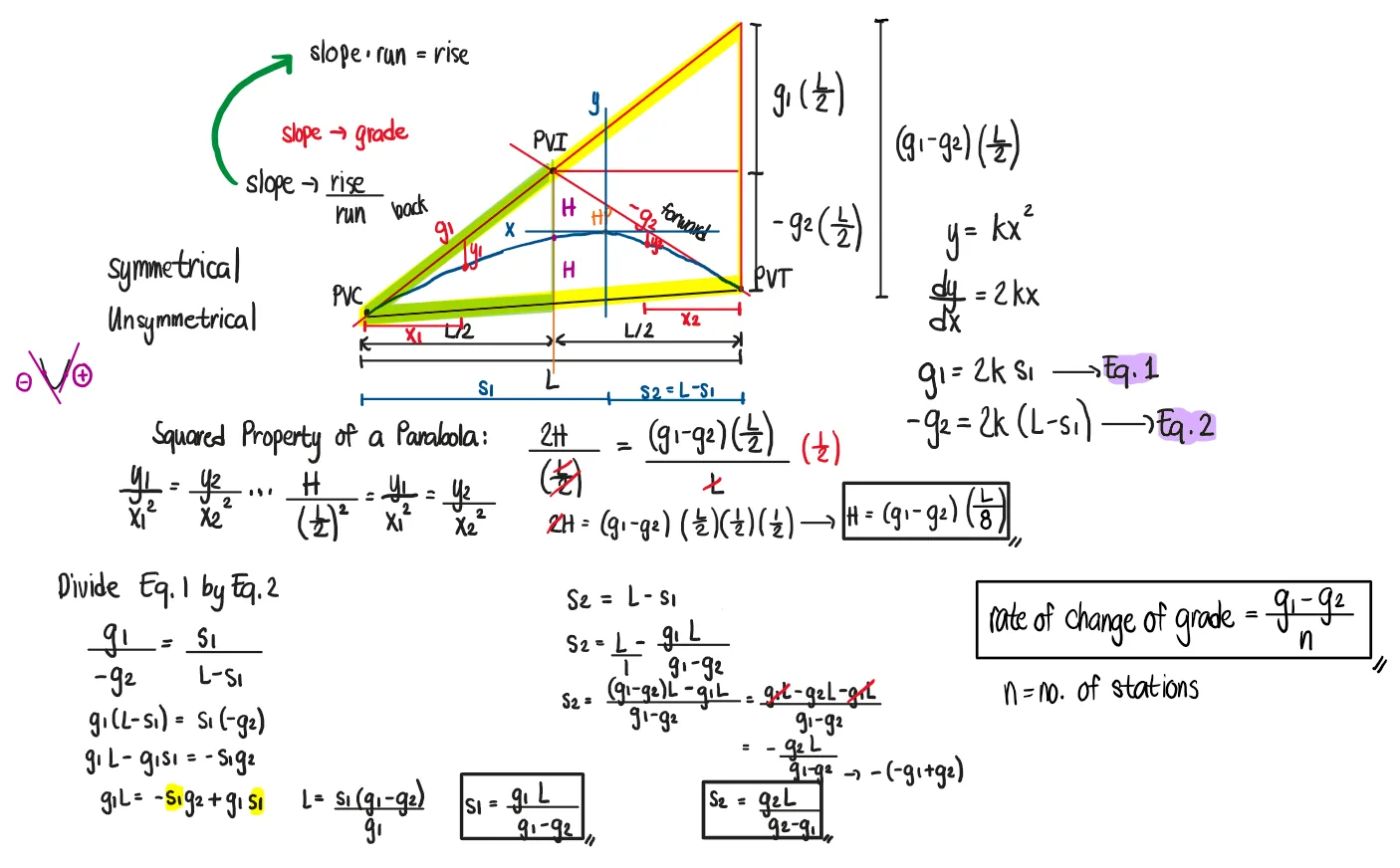
In highway practice, an abrupt change in the vertical direction of moving vehicles should be avoided.
To provide a gradual change in vertical direction, a parabolic vertical curve is adopted because its
slope varies at a constant rate with respect to horizontal distance.
The vertical offsets from the tangent to the curve are proportional to the squares of the distances
from the point of tangency.
The curve bisects the distance between the vertex and the midpoint of the long chord.
If the algebraic difference in the rates of grade of the two slopes is positive, i.e., $(g_1-g_2)>0$,
we have a summit curve. Otherwise, we have a sag curve.
The length $L$ of a vertical parabolic curve refers to the horizontal distance from the PC to the PT.
The stationing of vertical parabolic curves is measured not along the curve, but along a horizontal line.
For a symmetrical parabolic curve, the number of stations to the left must be equal to the number of
stations to the right of the intersection of the slopes (forward and backward tangents).
The slope of the parabola varies uniformly along the curve.
The maximum offset $H$ is $\tfrac{1}{8}$ of the product of the algebraic difference between the two rates
of grade and the length of curve.
Summary of Formulas in Symmetrical Parabolic Curves
Location of the highest point from PC:
$$s_1=\frac{g_1L}{g_1-g_2}$$
Location of the highest point from PT:
$$s_2=\frac{g_2L}{g_2-g_1}$$
$$H=(g_1-g_2)\cdot\frac{L}{8}$$
$$\text{rate of change of grade}=\frac{g_1-g_2}{n}$$
n = no. of stations
1 station = 100ft in English Units
1 station = 20m in S.I. Units
Grade Diagram for Vertical Parabolic Curves
A grade diagram is a graphical representation of how the slope (grade) varies along the horizontal distance of the curve.
Since the slope of a parabolic curve varies uniformly, the grade diagram is a straight line.
Steps in Constructing the Grade Diagram
Determine the algebraic difference in grade:
Compute
$$ A = g_2 - g_1 $$
where $g_1$ is the initial grade and $g_2$ is the final grade.
Determine the length of curve:
Let $L$ be the horizontal length from PC to PT.
Compute the rate of change of grade:
$$ r = \frac{g_2 - g_1}{L} $$
This represents the constant rate at which the slope changes per unit horizontal distance.
Establish horizontal axis:
Lay out the horizontal distance from PC (0) to PT ($L$).
Plot the initial and final grades:
At $x = 0$, ordinate = $g_1$.
At $x = L$, ordinate = $g_2$.
Join the two grade points with a straight line:
Since the slope varies uniformly, the grade diagram is linear.
Important Interpretations of the Grade Diagram
The ordinate of the grade diagram at any horizontal distance $x$ represents the
slope (grade) of the curve at that point.
The area under the grade diagram between two points represents the
difference in elevation between those two points.
Mathematically, since grade is defined as the rate of change of elevation:
$$ g = \frac{dy}{dx} $$
The elevation difference between two points is therefore:
$$ \Delta y = \int g \, dx $$
Thus, the grade diagram is essentially a graphical integration tool —
the area under the grade line gives the vertical change in elevation.
Problem: Symmetrical Vertical Summit Curve with Allowable Rate of Change of Grade
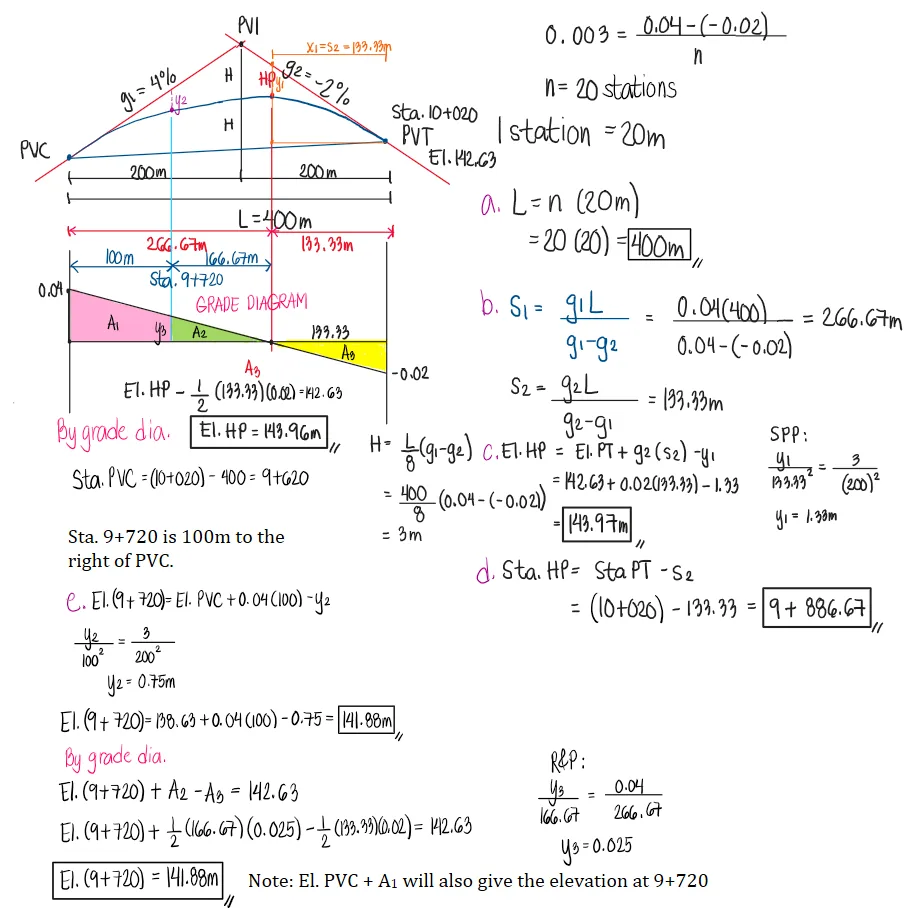
A symmetrical vertical summit curve has tangents of +4% and -2%. The allowable rate of change of grade is 0.3% per meter station. The stationing and elevation of PT is 10+020 and 142.63m, respectively.
a. Compute the length of curve.
b. Compute the distance of the highest point of the curve from the PC.
c. Compute the elevation of the highest point of the curve.
d. Determine the stationing of the highest point of the curve.
e. Determine the elevation of a point at station 9+720.
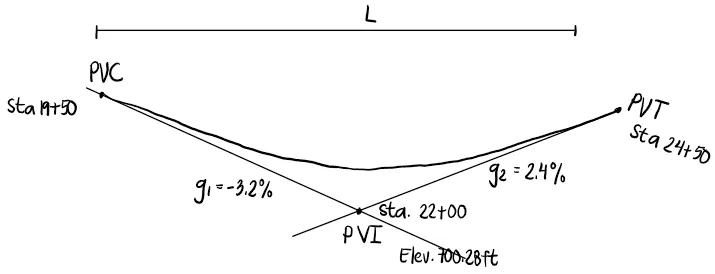
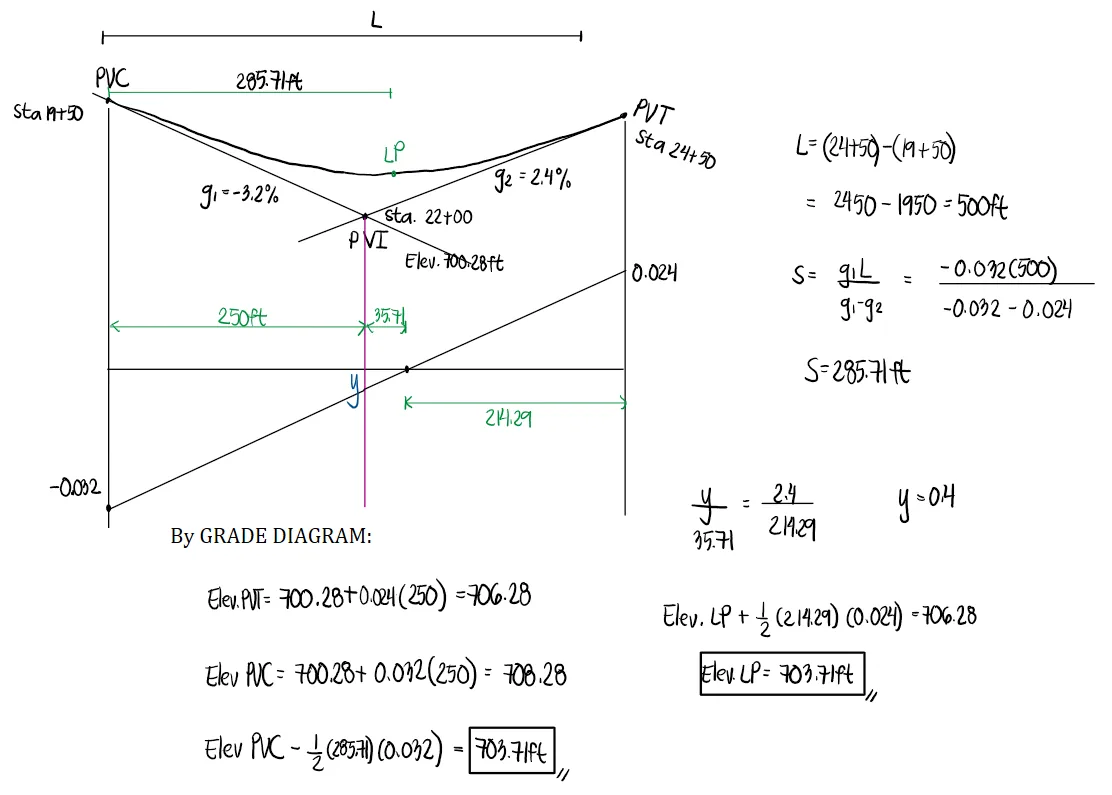
Problem: Sag Vertical Curve with English Units
A symmetrical sag vertical curve is shown. Determine the elevation of the lowest point of the curve.
Problem: Symmetrical Sag Vertical Curve | Invert Elevation and all Possible Cases of the Grade Diagram
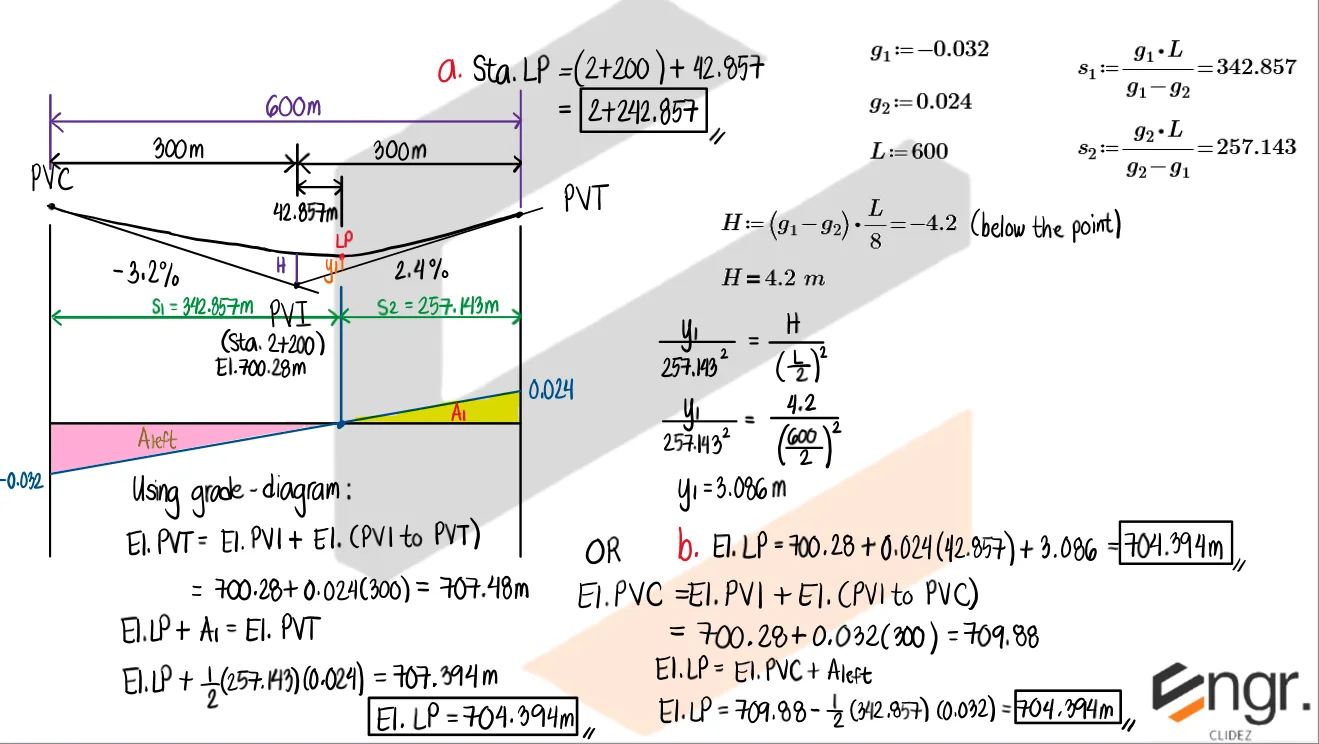
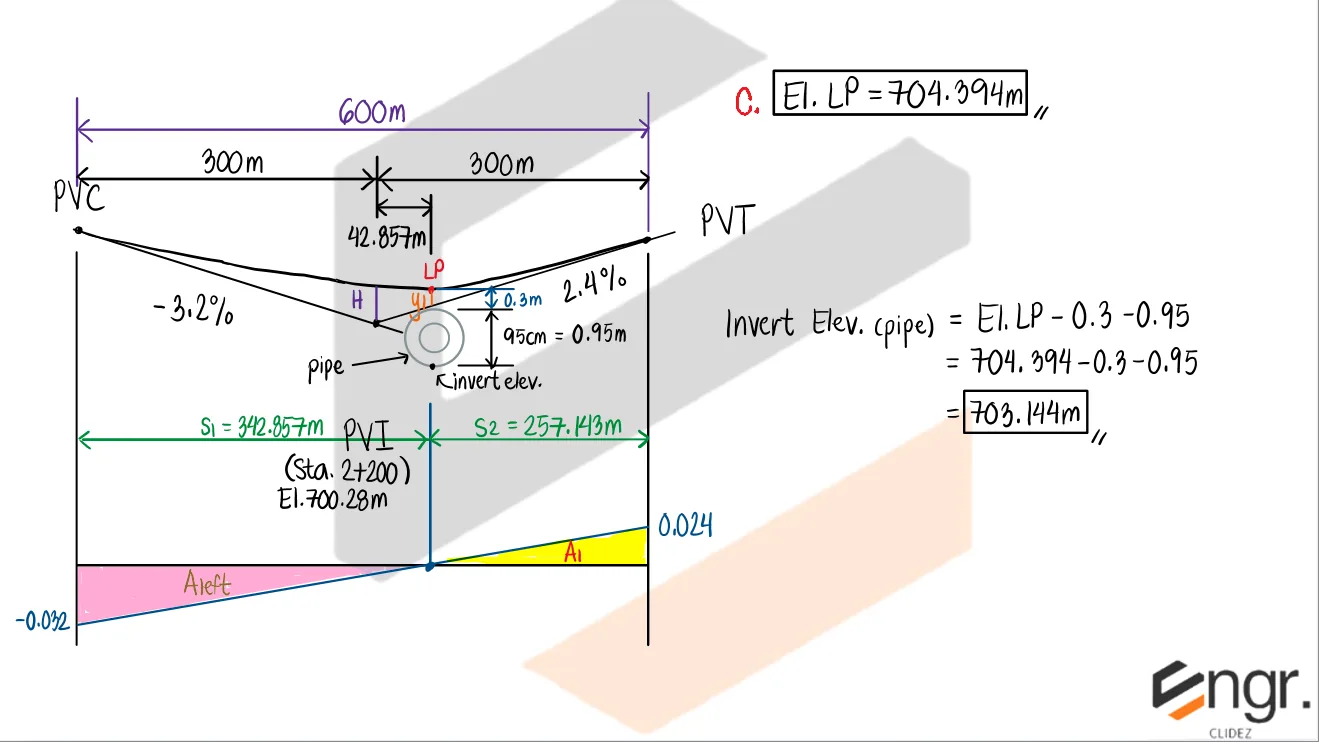
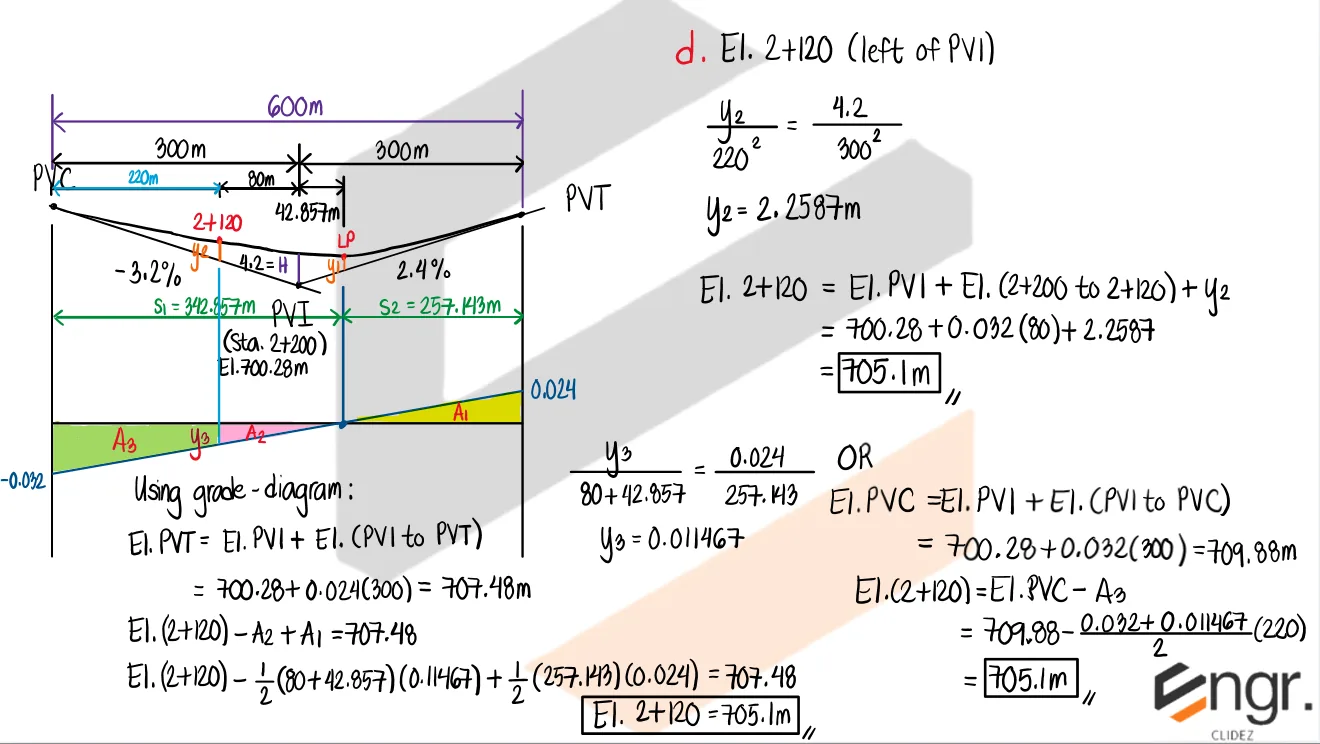
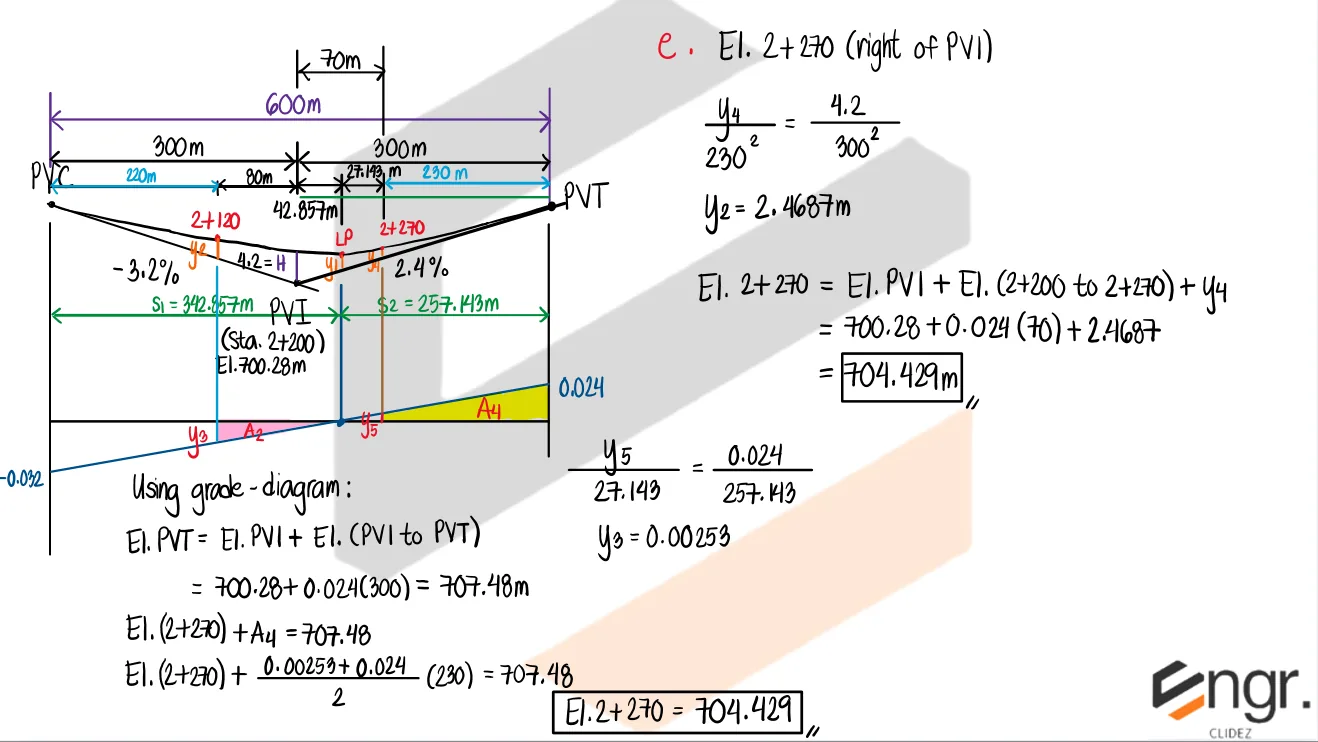
A symmetrical sag vertical curve has a back tangent grade of -3.2% and a forward tangent grade of 2.4%, intersecting at the point PVI whose stationing is 2+200 at an elevation of 700.28m. The stationing of PVC is 1+900.
a. At what station should the cross-drainage pipes be situated?
b. What is the elevation of the lowest point?
c. If the overall outside dimensions of the reinforced concrete pipe to be installed is 95cm, and the top of the culvert is 0.3m below the subgrade, what will be the invert elevation (elevation of the lowest point of the pipe)?
d. Determine the elevation at station 2+120.
e. Determine the elevation at station 2+270.
Exam Generator Problems
Additional board-style practice items for this topic.
A symmetrical vertical summit curve has tangents of +4% and -2%. The allowable rate of change of grade is 0.3% per meter station. The stationing and elevation of PT is at 10+020 and 142.63m respectively.
Compute the length of curve.
400m
410m
420m
430m
Compute the distance of the highest point of the curve from the PC.
266.67m
256.67m
246.67m
276.67m
Compute the elevation of the highest point of the curve.
143.97m
142.56m
145.64m
146.89m
Determine the stationing of the highest point, HP
9+886.67
9+876.67
9+856.67
9+896.67
Determine the elevation of the point at station 9+720
141.88m
142.856m
140.32m
139.86m
Part 1.
The algebraic difference in grades is: $A=4\%-(-2\%)=6\%$ The allowable rate of change is 0.3% per 20 m station, so: $L=\frac{A}{0.3\%}(20)=\frac{6}{0.3}(20)=400$ m $\boxed{L=400\text{ m}}$
Part 2.
The highest point occurs where the grade is zero: $g=g_1+\frac{g_2-g_1}{L}x$ $0=0.04+\frac{-0.06}{400}x$ $x=266.67$ m from PC $\boxed{266.67\text{m}}$
Part 3.
Since PT is at Sta. 10+020 and $L=400$ m, PC is at Sta. 9+620. The PC elevation is found from the vertical curve equation at PT: $E_{PT}=E_{PC}+g_1L+\frac{g_2-g_1}{2L}L^2$ $142.63=E_{PC}+0.04(400)+\frac{-0.06}{800}(400)^2$ $E_{PC}=138.63$ m At $x=266.67$ m: $E=138.63+0.04x+\frac{-0.06}{800}x^2=143.97$ m $\boxed{143.97\text{m}}$
Part 4.
PC station is $10+020-400=9+620$. The highest point is 266.67 m from PC: $Sta._{HP}=9+620+266.67=9+886.67$ $\boxed{9+886.67}$
Part 5.
Station 9+720 is 100 m from PC. Use the vertical curve equation: $E=E_{PC}+g_1x+\frac{g_2-g_1}{2L}x^2$ $E=138.63+0.04(100)+\frac{-0.06}{800}(100)^2$ $E=141.88$ m $\boxed{141.88\text{m}}$
A tangent of -4.2% grade intersects another tangent with a grade of 3% at Sta. 11+488 of elevation 20.8 meters. These two center gradelines are to be connected by a 260m vertical parabolic curve.
At what station should the cross-drainage pipes be situated?
11+509.67
11+512.67
11+515.67
11+518.67
What is the elevation at 11+470?
23.29m
21.26m
20.45m
19.65m
If the overall outside dimensions of the reinforced concrete pipe to be installed is 95cm and the top of the culvert is 30cm below the subgrade, what will be the elevation of the lowest oint of the culvert (also called invert elevation)?
21.83m
20.68m
23.57m
19.65m
Part 1.
For a sag vertical curve, the drainage point is at the lowest point where grade is zero. The PVC is half the curve length before the PVI: $PVC=11+488-130=11+358$ Grade along the curve: $g=g_1+\frac{A}{L}x$ $0=-4.2+\frac{7.2}{260}x$ $x=151.67$ m from PVC Station: $11+358+151.67=11+509.67$ $\boxed{11+509.67}$
Part 2.
PVC is at Sta. $11+488-130=11+358$. Its elevation is: $E_{PVC}=20.8-(-0.042)(130)=26.26$ m Station 11+470 is $x=112$ m from PVC. Use: $E=E_{PVC}+g_1x+\frac{A}{2L}x^2$ $E=26.26-0.042(112)+\frac{0.072}{520}(112)^2=23.29$ m $\boxed{23.29\text{m}}$
Part 3.
The drainage point is the low point at Sta. 11+509.67. Its elevation is: $E=26.26-0.042(151.67)+\frac{0.072}{520}(151.67)^2=23.08$ m The invert is 0.95 m pipe depth plus 0.30 m cover below subgrade: $E_{invert}=23.08-0.95-0.30=21.83$ m $\boxed{21.83\text{m}}$
Question Bank: q765
MSTE - Highway Engineering / Symmetrical Parabolic Curves / Val
Formula-mode item rendered with fixed values for lecture/PDF export.
A symmetrical sag vertical curve has a back tangent grade of -3.6% and a forward tangent grade of 2.2%, intersecting at the point PVI whose stationing is 2+350 at an elevation of 703.38m. If PVC is at station 2+0, determine the following:
At what distance from PVC is the location of the lowest point (in meters)?
434.4827586206896
265.51724137931035
333.7
366.3
What is the elevation of the lowest point of the curve (in meters)?
708.1593103448276
698.6006896551723
695.5593103448275
706.3006896551725
Convert the grades from percent to decimals, and let $L$ be the curve length. The grade at a distance $x$ from PVC is
$$g(x)=g_1+\frac{g_2-g_1}{L}x.$$
The lowest point of a sag curve occurs where the grade is zero. Hence,
$$x=-\frac{g_1L}{g_2-g_1}.$$
Find the PVC elevation from the PVI data, then substitute $x$ in the parabolic-curve equation
$$E(x)=E_{PVC}+g_1x+\frac{g_2-g_1}{2L}x^2.$$
These two results give the requested distance from PVC and the elevation of the lowest point.
MSTE - Highway Engineering / Symmetrical Parabolic Curves / Val
Formula-mode item rendered with fixed values for lecture/PDF export.
A symmetrical summit vertical curve has a back tangent grade of 3.3% and a forward tangent grade of -2.8%, intersecting at the point PVI whose stationing is 2+470 at an elevation of 712.08m. If PVC is at station 1+960, determine the following:
At what distance from PVC is the location of the highest point (in meters)?
551.8032786885246
468.1967213114754
310.98
709.02
What is the elevation of the highest point of the curve (in meters)?
704.3547540983607
686.1452459016393
719.8052459016394
705.5252459016394
Convert the grades from percent to decimals. At a distance $x$ from PVC, the grade on the parabolic curve is
$$g(x)=g_1+\frac{g_2-g_1}{L}x.$$
The highest point of a summit curve has zero grade, so
$$x=-\frac{g_1L}{g_2-g_1}.$$
Obtain the PVC elevation from the PVI and then evaluate
$$E(x)=E_{PVC}+g_1x+\frac{g_2-g_1}{2L}x^2.$$
The calculated $x$ and $E(x)$ are the distance from PVC and elevation of the highest point.
MSTE - Highway Engineering / Curves, Earthworks, and Traffic Engineering / Gemini mapped Chapter 7 to 10
A vertical sag parabolic curve CD, 620 meters long is connected by tangents having a downgrade of 6.2% and an upgrade of 4.2% intersecting at Station 18 + 254.4 and elevation 54.25 m. Find the distance from D to the lowest point of the curve.
369.6 m
250.4 m
321.7 m
287.4 m
Solution pending in psadquestions/t1241.json.
Question Bank: t1242
MSTE - Highway Engineering / Curves, Earthworks, and Traffic Engineering / Gemini mapped Chapter 7 to 10
A vertical parabolic curve AB connects two tangent grades of +7% and -4%. The elevation of point A is 35.62 m. If the summit is at elevation 43.64 m, what is the length of the curve AB?
420 m
300 m
350 m
360 m
Solution pending in psadquestions/t1242.json.
Question Bank: t1243
MSTE - Highway Engineering / Curves, Earthworks, and Traffic Engineering / Gemini mapped Chapter 7 to 10
A vertical sag parabolic curve is to connect a -2% grade to a +3% grade. The change in grade per meter station must be 0.2%. The PT of the curve is at Station 25 + 325 and elevation 25.42 m.
What is the elevation of the PC of the curve?
21.12 m
26.44 m
23.45 m
22.92 m
What is the length of the curve?
450 m
550 m
500 m
600 m
What is the stationing of the PC of the curve?
24 + 750
24 + 865
24 + 825
24 + 625
Solution pending in psadquestions/t1243.json.
Question Bank: t1246
MSTE - Highway Engineering / Curves, Earthworks, and Traffic Engineering / Gemini mapped Chapter 7 to 10
A 6 percent downgrade is to be connected to a 4 percent upgrade by a parabolic curve. The change in grade must not exceed 0.5 percent per 20-meter station. The stationing and elevation of PC are 10 + 992 & 45.78 m respectively.
What must be the minimum length of the curve?
400 m
200 m
300 m
500 m
Using the minimum length obtained above, at what station must the culvert be constructed?
11 + 152
11 + 232
11 + 268
11 + 188
Using the minimum length obtained above, what must be the elevation of the invert of the culvert if it is to be situated 1.5 m below the pavement?
36.45 m
37.76 m
38.58 m
37.08 m
Solution pending in psadquestions/t1246.json.
Question Bank: t1249
MSTE - Highway Engineering / Curves, Earthworks, and Traffic Engineering / Gemini mapped Chapter 7 to 10
The grade from point A to vertex V is -6 percent and from V to point B is +3 percent. It is desired to connect these grades with a vertical symmetrical parabolic curve that shall pass 1.8 m directly above V.
Determine the length of the curve in meters.
160
150
140
170
What is the difference in elevation between A and B?
2.55 m
2.1 m
2.25 m
2.4 m
How far is the lowest point of the curve from B in meters?
106.7
53.3
87.7
72.3
Solution pending in psadquestions/t1249.json.
Question Bank: t1252
MSTE - Highway Engineering / Curves, Earthworks, and Traffic Engineering / Gemini mapped Chapter 7 to 10
A -6% grade and a +2% grade intersect at STA 12 + 200 whose elevation is at 45.673 m. The two grades are to be connected by a parabolic curve, 160 m long. Find the elevation of the first quarter point on the curve.
47.863 m
8.213 m
48.673 m
48.473 m
Solution pending in psadquestions/t1252.json.
Question Bank: t1253
MSTE - Highway Engineering / Curves, Earthworks, and Traffic Engineering / Gemini mapped Chapter 7 to 10
A symmetrical parabolic curve 120 m long passes through point X whose elevation is 27.79 m and 54 m away from PC. The back tangent of the curve has a grade of +2%. If PC is at elevation 27.12, what is the elevation of the summit?
27.19 m
28.81 m
29.57 m
27.83 m
Solution pending in psadquestions/t1253.json.
Question Bank: t1257
MSTE - Highway Engineering / Curves, Earthworks, and Traffic Engineering / Gemini mapped Chapter 7 to 10
A vertical curve must begin at the center of manhole 1 (Sta. 56 + 000, Elev. 60 m) and end at manhole 2 (Sta. 56 + 266, Elev. 58.78 m). The entering grade (at manhole 1) of -4% and the exiting grade (at manhole 2) of +3% cannot be changed. It is required to design an asymmetrical (unsymmetrical) vertical curve from manhole 1 to manhole 2.
At what distance from manhole 1 will the two grades intersect?
135.2
128.6
131.4
125.4
What is the grade of the line connecting the PI of the first vertical curve with the PI of the second vertical curve (g₃) through the asymmetrical curve?
0.87%
0.52%
-0.46%
-0.39%
What is the elevation of the CVC (compound vertical curvature point).
56.78 m
58.63 m
55.24 m
57.07 m
Solution pending in psadquestions/t1257.json.
Question Bank: t1260
MSTE - Highway Engineering / Curves, Earthworks, and Traffic Engineering / Gemini mapped Chapter 7 to 10
A vertical summit curve has tangent grades of +2.8% and -1.6%. The curve will be designed such that a motorist whose eyesight is 1.5 m above the roadway can sight the top of a visible object 100 mm high at the right side of the summit, at a distance of 130 m.
Calculate the length of curve in meters.
165.75
147.56
156.57
174.64
What is the required change in grade per 20-m station?
0.562%
0.423%
0.321%
0.248%
How much farther is the summit from PC than from PT?
99.64
56.94
65.47
42.7 m
Solution pending in psadquestions/t1260.json.
Question Bank: t1263
MSTE - Highway Engineering / Curves, Earthworks, and Traffic Engineering / Gemini mapped Chapter 7 to 10
A vertical summit curve has tangent grades of 2.2% and -1.8%. The required stopping sight distance 150 m. What length of the curve is required?
142 m
185 m
258 m
211 m
Solution pending in psadquestions/t1263.json.
Question Bank: t1305
MSTE - Highway Engineering / Curves, Earthworks, and Traffic Engineering / Gemini mapped Chapter 7 to 10
The number of accidents in 6 years recorded in a certain section of a highway is 2,456. If the accident rate is 1,420 per million entering vehicles, what is the average daily traffic (ADT)?
790
850
910
680
Solution pending in psadquestions/t1305.json.
Question Bank: t1344
MSTE - Highway Engineering / Curves, Earthworks, and Traffic Engineering / Gemini mapped Chapter 7 to 10
The driver decides what action to take in response to the stimulus; for example, to step on the brake pedal, to pass, to swerve, or to change lanes.
identification
emotion
reaction or volition
perception
Solution pending in psadquestions/t1344.json.
Question Bank: t1351
MSTE - Highway Engineering / Curves, Earthworks, and Traffic Engineering / Gemini mapped Chapter 7 to 10
System of interconnecting roadways in conjunction with one or more grade separations, providing for the movement of traffic between two or more roadways on different levels.
road change
interconnection
flyover
interchange
Solution pending in psadquestions/t1351.json.
Question Bank: t1357
MSTE - Highway Engineering / Curves, Earthworks, and Traffic Engineering / Gemini mapped Chapter 7 to 10
An optical instrument consisting of a rotating telescopic sight, used by a surveyor to measure horizontal and vertical angles.
stadia
theodolite
plane table
none of these
Solution pending in psadquestions/t1357.json.
Question Bank: t2116
MSTE - Highway Engineering / Symmetrical Parabolic Curves / Besavilla CE Pre-Board Math & Surveying
A vertical summit curve has its highest point of the curve at a distance 48 m. from the P.T. The back tangent has a grade of + 6% and a forward grade of - 4%. The curve passes thru point A on the curve at station 25 + 140. The elevation of the grade intersection is 100 m. at station 25 + 160. Compute the length of curve.
125 m.
135 m.
120 m.
130 m.
115 m.
For a summit parabolic curve, the highest point occurs where the grade is zero. The distance from P.C. to the zero-grade point is $x=\frac{g_1L}{g_1-g_2}$ With $g_1=+0.06$ and $g_2=-0.04$: $x=\frac{0.06L}{0.06-(-0.04)}=0.60L$ The highest point is 48 m from P.T., so $L-x=48$. $L-0.60L=48 \Rightarrow 0.40L=48$ $\boxed{L=120\text{ m}}$
Question Bank: w95
MSTE - Highway Engineering / Curves, Earthworks, and Traffic Engineering / MSTE November 2019
The difference between the actual travel time of a given segment of a transportation system and some ideal travel time for that segment.
travel time
service time
queue time
delay
Delay (travel-time delay) is the additional time a traveler spends on a segment compared with the ideal or expected travel time, caused by congestion, accidents, weather, or other disruptions. $\boxed{\text{delay}}$
Problem: Algebraic Difference in Grades
A vertical curve connects +3.5% and -1.5% grades. Find the algebraic grade difference.
$$A=g_2-g_1=-1.5\%-3.5\%=-5.0\%$$
Answer: The magnitude of the grade difference is 5.0%.
Problem: Parabolic Offset at Midpoint
For a symmetrical vertical curve with length 200 m and grade difference A = 4%, find the midpoint offset from the tangent.