Compound curves are horizontal curves in highway and railway engineering that consist of two or more simple circular arcs of different radii, joined together and curving in the same direction, with a common tangent at their point of connection. They are used when site conditions or alignment constraints make a single-radius curve impractical, allowing a smoother transition between tangents while fitting the roadway within limited right-of-way or difficult terrain.
Problem: Length of Common Tangent and Common Chord
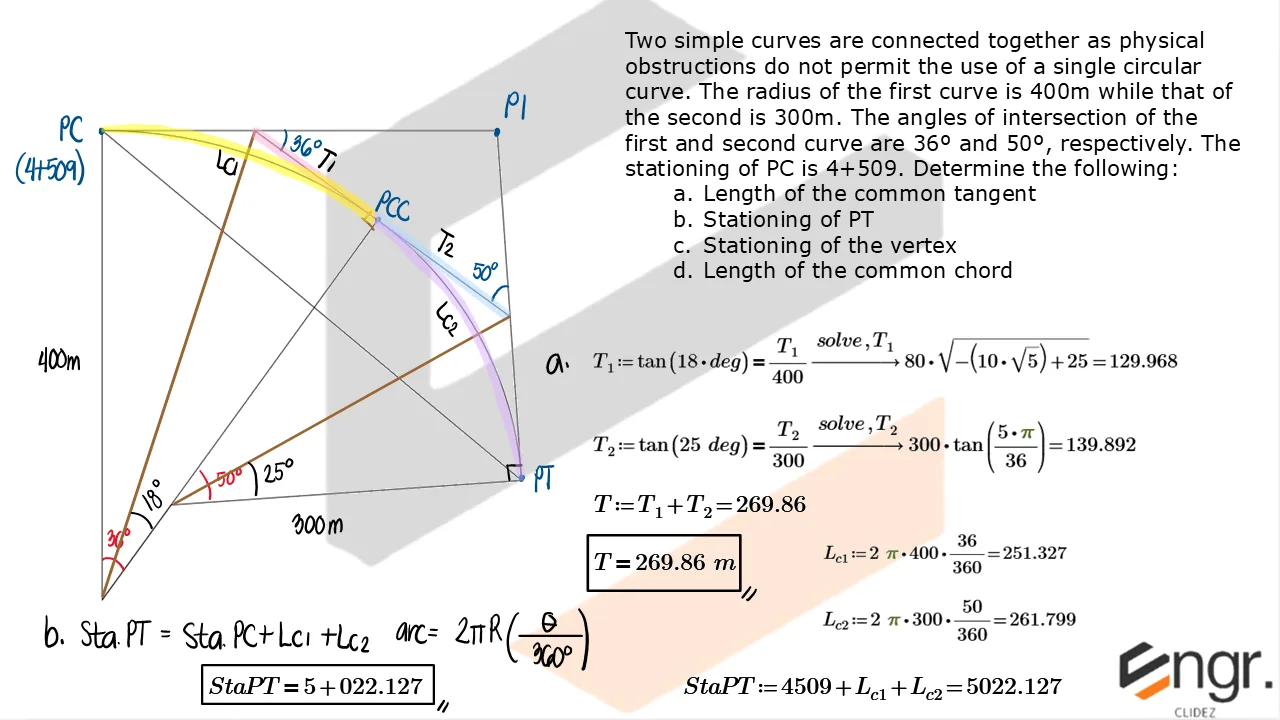
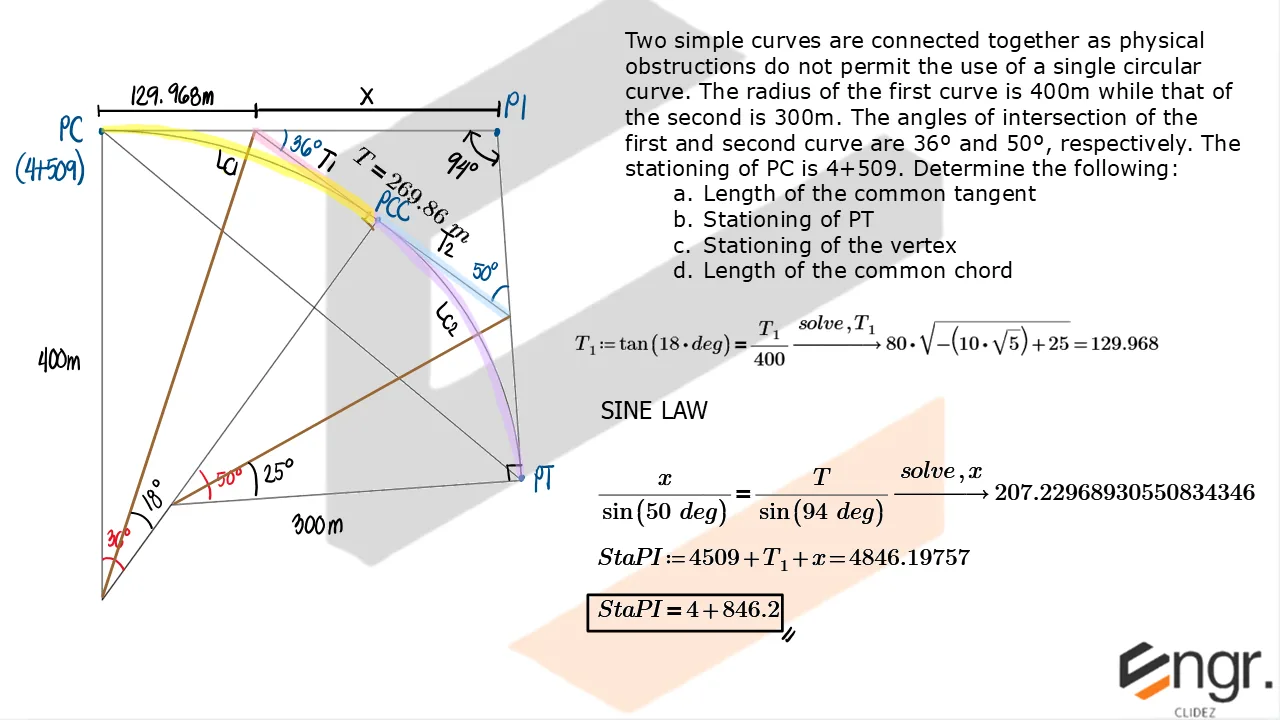
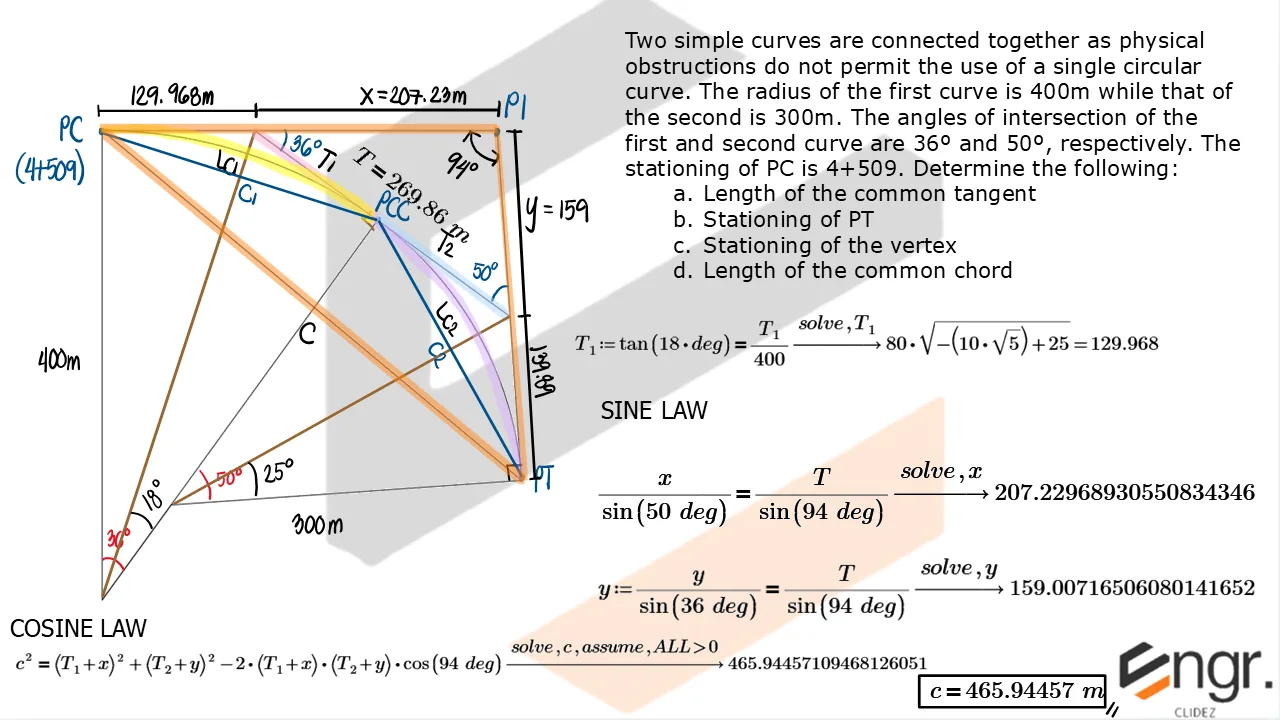
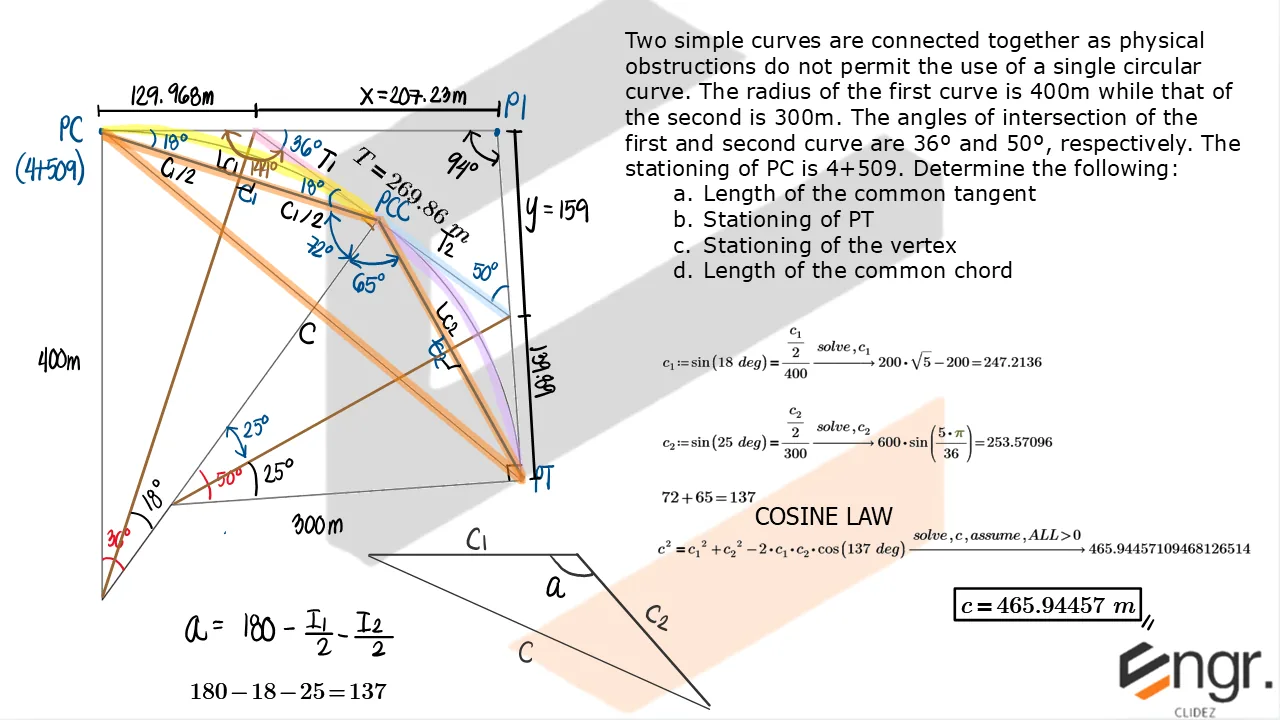
Two simple curves are connected together as physical obstructions do not permit the use of a single circular curve. The radius of the first curve is 400m while that of the second is 300m. The angles of intersection of the first and second curves are 36º and 50º, respectively. The stationing of PC is 4+509. Determine the following:
a. Length of the common tangent
b. Stationing of PT
c. Stationing of the vertex
d. Length of the common chord
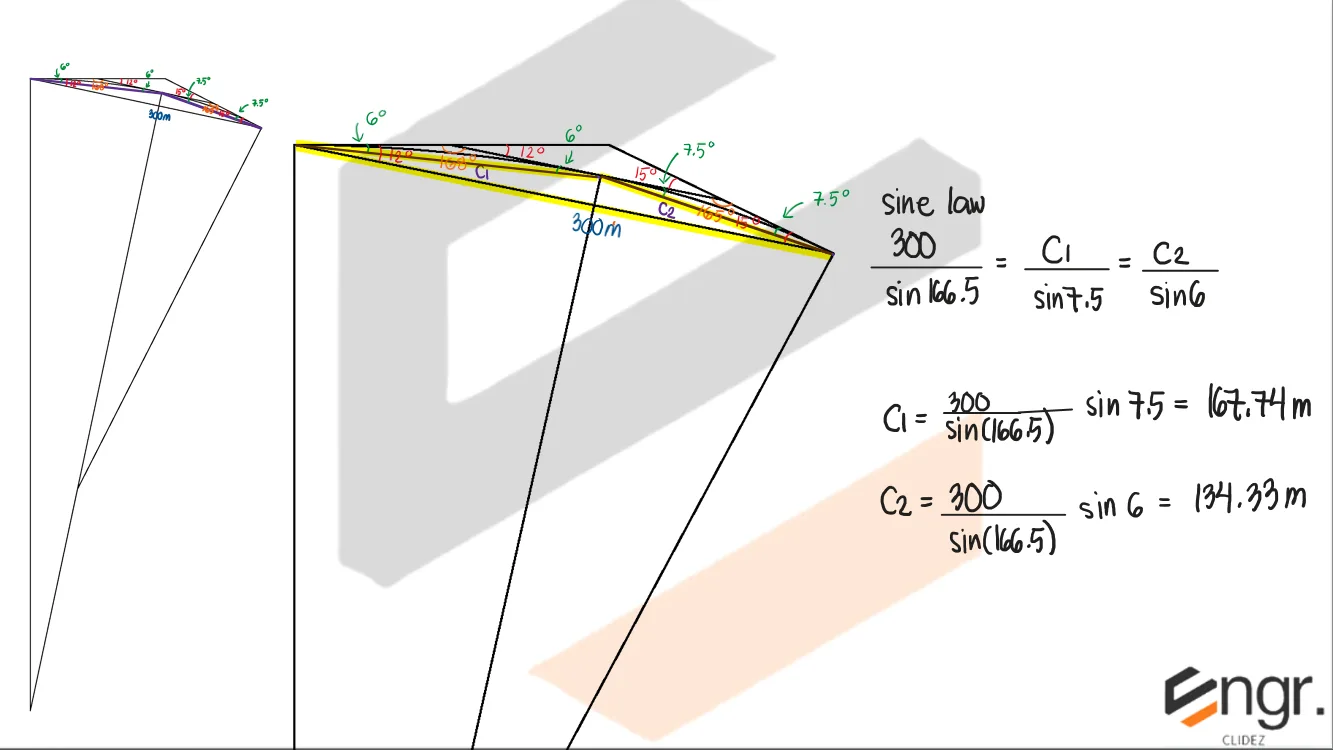
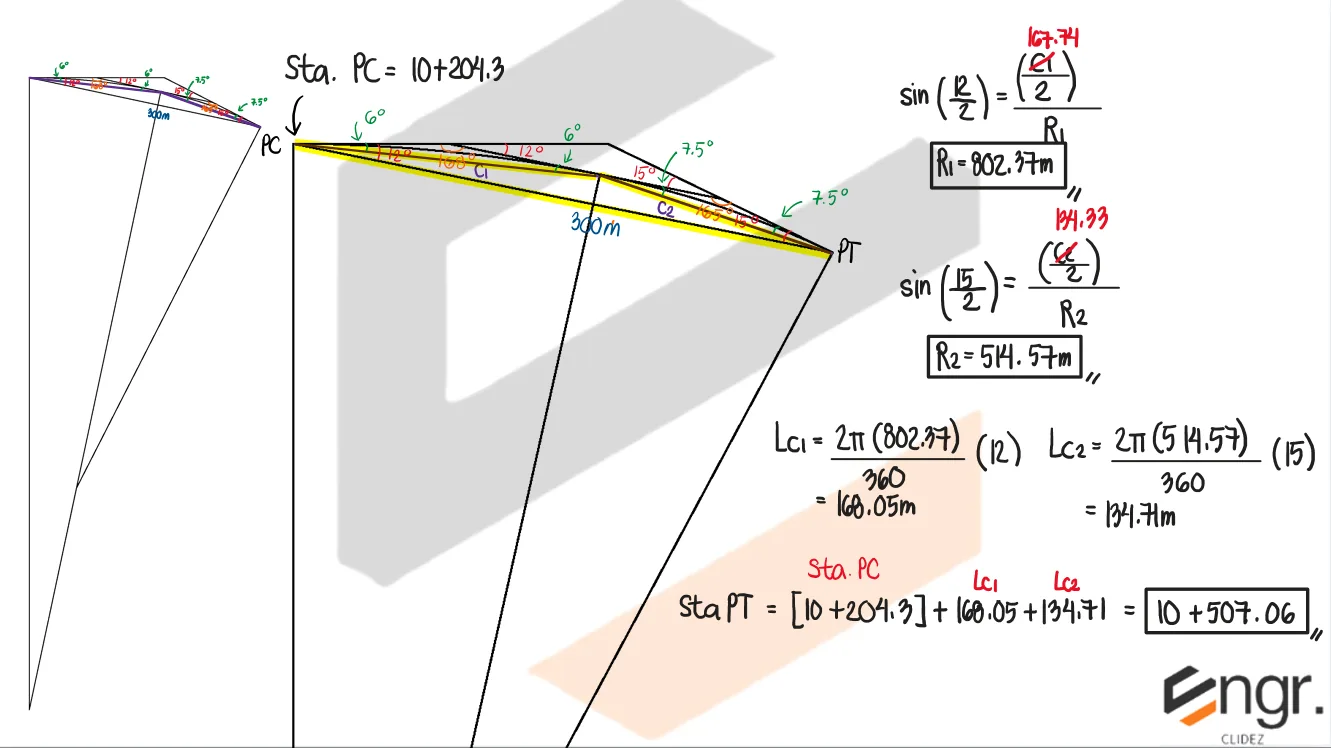
Problem: Compound Curve where the Common Tangent is Parallel to the Long Chord
The long chord from the PC to the PT of a compound curve is 300 meters long and the angles it makes with the longer and shorter tangents are 12º and 15º respectively. If the common tangent is parallel to the long chord.
a. Find the radius of the first curve.
b. Find the radius of the second curve.
c. If the stationing of PC is 10+204.30, find the stationing of PT.
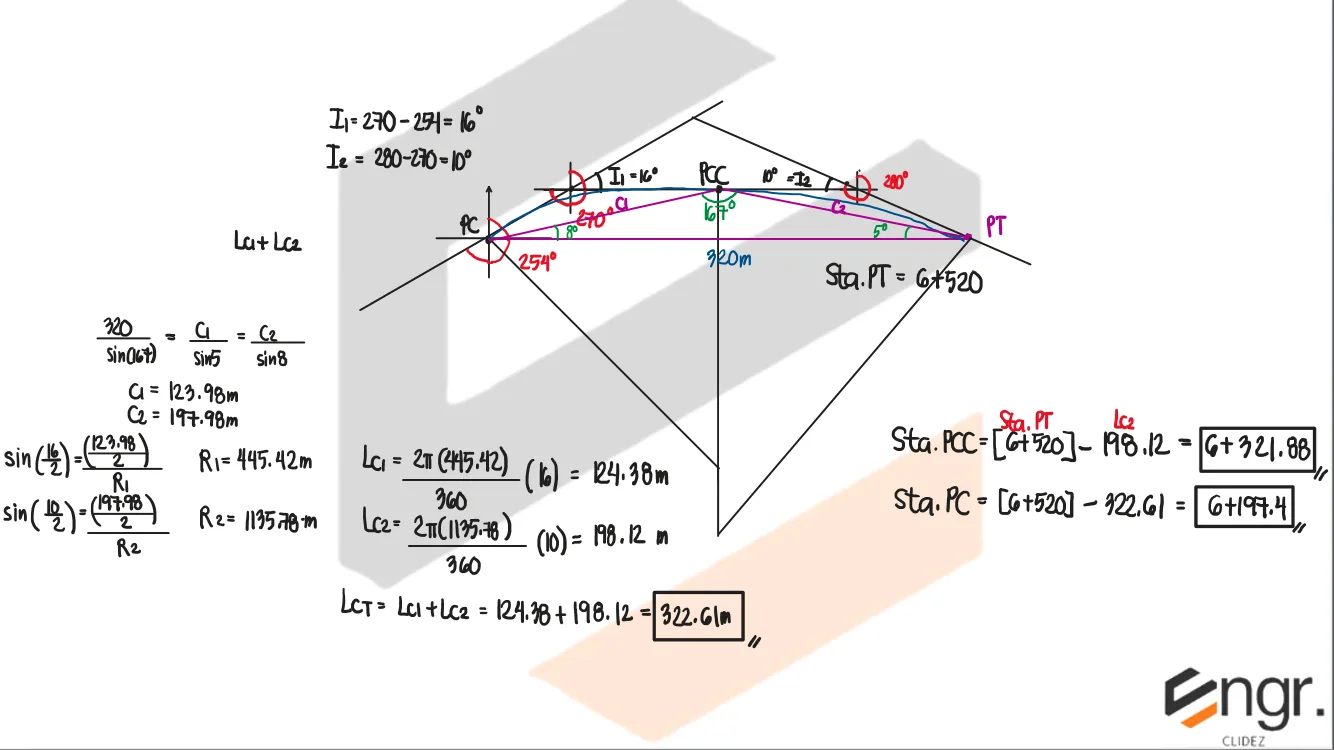
Problem: Compound Curve Given Three Tangents with Respective Azimuths
A compound curve connects three tangents having azimuths of 254º, 270º, and 280º, respectively. The length of the chord is 320m long measured from the PC to the PT of the curve, and it is parallel to the common tangent having an azimuth of 270º. If the stationing of PT is 6+520:
a. Determine the total length of the curve.
b. Determine the stationing of the PCC.
c. Determine the stationing of PC.
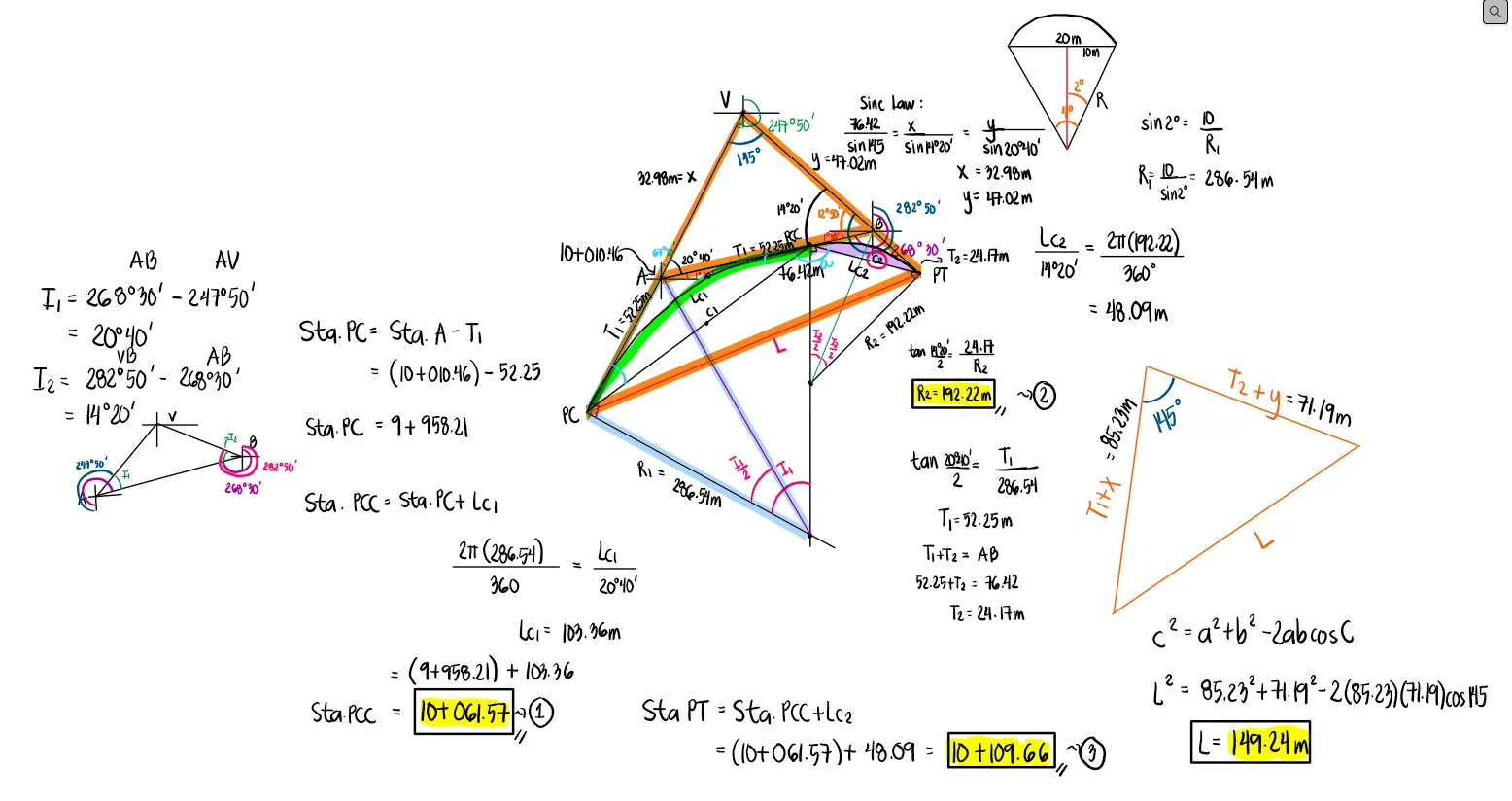
Problem: Compound Curve Given the Length of the Common Tangent and Azimuths | Chord Basis
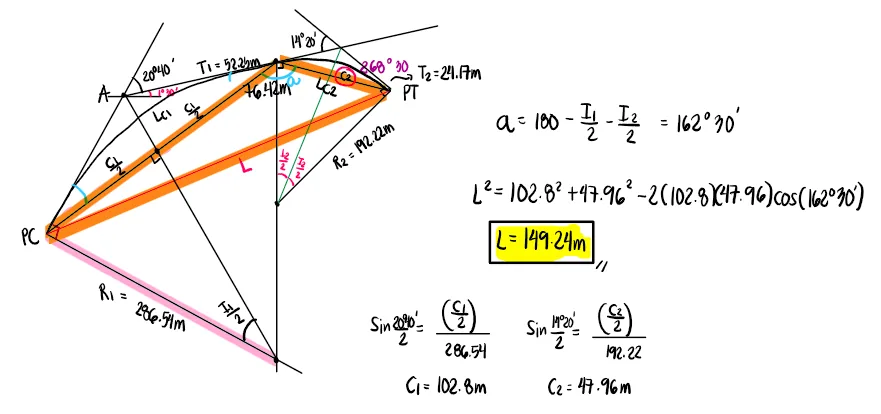
The common tangent AB of a compound curve is 76.42m with an azimuth of 268º30', the vertex V being inacessible. The azimuths of the tangents AV and VB were measured to be 247º50' and 282º50', respectively. The stationing at A is 10+010.46 and the degree of the first curve is 4º based on the 20m chord. Use chord basis.
a. Compute the stationing of PCC
b. Compute the radius of the second curve
c. Compute the stationing of PT
d. Compute the length of the common chord.
Exam Generator Problems
Additional board-style practice items for this topic.
The common tangent AB of a compound curve is 76.42m with an azimuth of 268º30', the vertex V being inaccessible. The azimuth of the tangents AV and VB was measured to be 247º50'; and 282º50' respectively. The stationing at A is 10+010.46 and the degree of the first curve is 4º based on the 20m chord. Use chord basis.
Compute the stationing of PCC
10+062.70
10+010.46
10+051.67
10+075.16
Compute the radius of the second curve
192.27m
187.26m
195.43m
185.33m
Compute the stationing of PT
10+110.80
9+958.21
9+993.21
10+103.47
Compute the length of the common chord
149.25m
85.23m
100.64m
71.19m
The intersection angles with the common tangent are obtained from the azimuth differences: $$I_1=268^\circ30'-247^\circ50'=20^\circ40'$$ $$I_2=282^\circ50'-268^\circ30'=14^\circ20'$$ For the first $4^\circ$ curve on a 20-m chord basis: $$R_1=\frac{10}{\sin(4^\circ/2)}=286.54\text{ m}$$ $$T_1=R_1\tan\frac{I_1}{2}=286.54\tan10^\circ20'=52.24\text{ m}$$ The remaining portion of the 76.42-m common tangent is: $$T_2=76.42-52.24=24.18\text{ m}$$ Thus the radius of the second curve is: $$R_2=\frac{T_2}{\tan(I_2/2)}=\frac{24.18}{\tan7^\circ10'}=192.27\text{ m}$$
The PCC station is: $$\text{Sta. PCC}=10+010.46+52.24=10+062.70$$ The second-curve length is: $$L_2=\frac{\pi R_2I_2}{180}=48.10\text{ m}$$ $$\text{Sta. PT}=10+062.70+48.10=10+110.80$$
For the long (common) chord, resolve the end coordinates from the two tangent lengths. Its length is: $$C=149.25\text{ m}$$
Therefore, the answers are 10+062.70, 192.27 m, 10+110.80, and 149.25 m.
The long chord from the PC to the PT of a compound curve is 300 meters long and the angle it makes with the longer and shorter tangents are 12º and 15º respectively. If the common tangent is parallel to the long chord,
Find the radius of the first curve.
802.36m
514.55m
167.74m
134.33m
Find the radius of the second curve
514.55m
802.36m
167.74m
134.33m
If the stationing of PC is 10+204.30, find the stationing of PT
10+507.05
11+521.21
11+215.12
10+550.70
Because the common tangent is parallel to the 300-m long chord, the perpendicular components of the two curve offsets are equal. Let $R_1$ correspond to $12^\circ$ and $R_2$ to $15^\circ$: $$R_1(1-\cos12^\circ)=R_2(1-\cos15^\circ)$$ The horizontal components make up the long chord: $$R_1\sin12^\circ+R_2\sin15^\circ=300$$ Solving these two equations gives: $$R_1=802.36\text{ m},\qquad R_2=514.55\text{ m}$$ The respective arc lengths are: $$L_1=\frac{\pi(802.36)(12)}{180}=168.04\text{ m}$$ $$L_2=\frac{\pi(514.55)(15)}{180}=134.71\text{ m}$$ $$L=L_1+L_2=302.75\text{ m}$$ Therefore: $$\text{Sta. PT}=10+204.30+302.75=10+507.05$$
Thus the first radius is 802.36 m, the second radius is 514.55 m, and the PT station is 10+507.05.
A compound curve connects three tangents having azimuths of 254º, 270º, and 280º, respectively. The length of the chord measured from the PC to the PT of the curve is 320m, and this chord is parallel to the common tangent. If the stationing of the PT is 6+520
Determine the total length of the curve
322.61m
445.42m
1135.17m
608.38m
Determine the stationing of the PCC
6+321.77
6+312.66
6+316.21
6+328.44
Determine the stationing of the PC
6+197.39
6+204.31
6+179.93
6+203.14
The two central angles are the azimuth changes: $$I_1=270^\circ-254^\circ=16^\circ,\qquad I_2=280^\circ-270^\circ=10^\circ$$ Since the long chord is parallel to the common tangent, set the transverse offsets equal and make the longitudinal components sum to $320\text{ m}$: $$R_1(1-\cos16^\circ)=R_2(1-\cos10^\circ)$$ $$R_1\sin16^\circ+R_2\sin10^\circ=320$$ Solving gives approximately $R_1=445.42\text{ m}$ and $R_2=1135.17\text{ m}$. Hence: $$L_1=\frac{\pi(445.42)(16)}{180}=124.38\text{ m}$$ $$L_2=\frac{\pi(1135.17)(10)}{180}=198.23\text{ m}$$ $$L=L_1+L_2=322.61\text{ m}$$ Starting from the known PT station: $$\text{Sta. PCC}=6+520-198.23=6+321.77$$ $$\text{Sta. PC}=6+321.77-124.38=6+197.39$$
Therefore, the total curve length is 322.61 m, the PCC station is 6+321.77, and the PC station is 6+197.39.
An unsymmetrical parabolic curve has a forward tangent of -8% and a back tangent of +5%. The length of curve on the left side of the curve is 40m long while that of the right side is 60m long. The PC is at station 6+780 and has an elevation of 110m. An outcrop is found at station 6+800 and has an elevation of 108.4m
Compute the height of fill needed to cover the outcrop.
2.21m
11+512.67
11+515.67
11+518.67
Compute the elevation of curve at station 6+820.
110.44m
110.23m
109.65m
109.73m
Compute the elevation of the highest opint of the curve.
110.64m
110.56m
110.72m
110.87m
Let the PVI be at station $6+820$. The left and right lengths are $L_1=40\text{ m}$ and $L_2=60\text{ m}$, with grades $g_1=+0.05$ and $g_2=-0.08$. The back tangent elevation at the PVI is: $$E_{PVI}=110+0.05(40)=112.00\text{ m}$$ The forward tangent elevation at the PVT is $112-0.08(60)=107.20\text{ m}$. Let the common grade at the PVI be $g_m$. The total elevation change along the two parabolas must be $107.20-110=-2.80\text{ m}$: $$\frac{g_1+g_m}{2}(40)+\frac{g_m+g_2}{2}(60)=-2.80$$ $$g_m=-0.028$$ For the left parabola, with $x$ measured from the PC: $$E=110+0.05x+\frac{g_m-g_1}{2L_1}x^2=110+0.05x-0.000975x^2$$ At station $6+800$, $x=20$ m, so $E=110.61$ m. The required fill over the 108.40-m outcrop is: $$110.61-108.40=2.21\text{ m}$$ At station $6+820$, $x=40$ m and $E=110.44$ m. The high point occurs where the grade is zero: $$0=0.05-0.00195x\quad\Rightarrow\quad x=25.64\text{ m}$$ $$E_{max}=110+0.05(25.64)-0.000975(25.64)^2=110.64\text{ m}$$
Therefore, the fill is 2.21 m, the elevation at $6+820$ is 110.44 m, and the highest elevation is 110.64 m.
Two simple curves are connected together as physical obstructions do not permit the use of a single circular curve. The radius of the first curve is 400m, while that of the second is 300m. The angles of intersection of the first and second curves are 36º and 50º, respectively. The stationing of PC is 4+509. Determine the following:
Length of the common tangent
269.86m
139.89m
129.97m
399.83m
Stationing of PT
5+022.127
4+760.327
5+014.639
4+814.915
Stationing of the vertex
4+846.2
4+814.9
4+836.6
4+864.3
Length of the common chord
465.94m
247.21m
253.57m
432.65m
For the two curves: $$T_1=R_1\tan\frac{36^\circ}{2}=400\tan18^\circ=129.97\text{ m}$$ $$T_2=R_2\tan\frac{50^\circ}{2}=300\tan25^\circ=139.89\text{ m}$$ $$T_c=T_1+T_2=269.86\text{ m}$$ The arc lengths are $L_1=\pi(400)(36)/180=251.33$ m and $L_2=\pi(300)(50)/180=261.80$ m. Thus: $$\text{Sta. PT}=4+509+251.33+261.80=5+022.127$$ Using the tangent-intersection geometry gives the vertex station $4+846.2$ and the long/common chord $465.94$ m.
Therefore, the answers are 269.86 m, 5+022.127, 4+846.2, and 465.94 m.
The perpendicular distance between two parallel tangents of a reversed curve is 7.5m, and the length of the long chord is 65m. Compute the common radius of the reversed curve.
140.83m
207.46m
150.67m
210.17m
For an equal-radius reverse curve between parallel tangents, use
$$R=\frac{c^2}{4h},$$
where $c$ is the long chord and $h$ is the perpendicular distance between the tangents. Thus,
MSTE - Highway Engineering / Curves, Earthworks, and Traffic Engineering / Gemini mapped Chapter 7 to 10
A simple curve of a railroad has a degree of 6 degrees and a length of 140 m. What is the central angle of the curve? Use chord basis.
32°
28°
36°
42°
Solution pending in psadquestions/t1197.json.
Question Bank: t1201
MSTE - Highway Engineering / Curves, Earthworks, and Traffic Engineering / Gemini mapped Chapter 7 to 10
A 5-degree simple curve is has a central angle of 50°. From the center of the curve, a line is drawn intersecting the tangent through PT at an angle of 60°, and passing through a point E on the curve. What is the length of the curve from E to PT?
120 m
110 m
115 m
125 m
Solution pending in psadquestions/t1201.json.
Question Bank: t1213
MSTE - Highway Engineering / Curves, Earthworks, and Traffic Engineering / Gemini mapped Chapter 7 to 10
The common tangent AB of a compound curve is 82.38 m. The angles the common tangent makes with the tangents through PC and PT of the compound curve are 21° 10' and 15° 20', respectively. If the degree of the first curve is 3° 30', what is the radius of the second curve?
132 m
184 m
178 m
158 m
Solution pending in psadquestions/t1213.json.
Question Bank: t1214
MSTE - Highway Engineering / Curves, Earthworks, and Traffic Engineering / Gemini mapped Chapter 7 to 10
Two tangents AV and BV are connected by a compound curve, where A is at PC, B is at PT, and V is at PI. Chord AB is 350 m long, angle VAB is 30°, angle VBA = 41°. The radius of the curve through PC is 100 m. What is the radius of the other curve in meters?
321.98
287.43
234.54
269.77
Solution pending in psadquestions/t1214.json.
Question Bank: t1215
MSTE - Highway Engineering / Curves, Earthworks, and Traffic Engineering / Gemini mapped Chapter 7 to 10
The long chord of a compound curve makes an angle of 20° and 38°, respectively with the tangents. The common tangent of the compound curve is parallel to the long chord that is 185 meters long.
What is the radius of the smaller curve?
107.26 m
99.01 m
110.02 m
101.76 m
What is the radius of the bigger curve?
357.72 m
377.06 m
386.72 m
348.05 m
What is the length of the curve?
207.96 m
192.36 m
202.76 m
187.16 m
Solution pending in psadquestions/t1215.json.
Question Bank: t1219
MSTE - Highway Engineering / Curves, Earthworks, and Traffic Engineering / Gemini mapped Chapter 7 to 10
A reversed curve consist of two curves of equal radius. The curve is to connect two parallel roads that are 60 meters apart. The length of the common tangent is 180 meters.
What is the angle of intersection of the curve?
18.1°
15.6°
19.5°
21.4°
What is the radius of the curve?
875.65 m
421.87 m
524.56 m
635.65 m
What is the length of the curve from PC to PT?
356.53 m
452.63 m
314.78 m
568.87 m
Solution pending in psadquestions/t1219.json.
Question Bank: t1232
MSTE - Highway Engineering / Curves, Earthworks, and Traffic Engineering / Gemini mapped Chapter 7 to 10
A central curve having a degree of 6 has a spiral curve 100 m long on two sides. At what comfortable speed can a car travel along the spiral? Use arc basis.
81 kph
86 kph
75 kph
94 kph
Solution pending in psadquestions/t1232.json.
Question Bank: t1265
MSTE - Highway Engineering / Curves, Earthworks, and Traffic Engineering / Gemini mapped Chapter 7 to 10
A car traveling at 130 kph locks up it wheel and skids up a 3% incline before crashing into a stationary massive concrete pedestal and coming to a complete stop. The skid marks leading up to the pedestal are 90 m long. The coefficient of friction between the tires and the road is 0.35.
How far would the car have skidded if it had not hit the pedestal?
96.3 m
62.3 m
84.9 m
75.2 m
What was the speed of the car at impact?
63.2 kph
78.6 kph
85.4 kph
90.6 kph
Solution pending in psadquestions/t1265.json.
Question Bank: t1284
MSTE - Highway Engineering / Curves, Earthworks, and Traffic Engineering / Gemini mapped Chapter 7 to 10
A levee built on level ground is parallel to a river channel. The width of the levee on the top is 10 m. The side slope of the river side is 3:1 and on the land side is 2:1. The levee is 4.5 m high at its center. What is the volume of the levee (in m^3) if it is 2.5 km long?
239,063
256,214
214,785
287,635
Solution pending in psadquestions/t1284.json.
Question Bank: t1316
MSTE - Highway Engineering / Curves, Earthworks, and Traffic Engineering / Gemini mapped Chapter 7 to 10
To determine the traffic density on a single-lane highway, a surveillance was made to measure the occupancy on a 400-m stretch of the highway. Ten vehicles pass the stretch. From the aerial photograph, the lengths (in meters) of each vehicle were found as follows: 3.5, 6.3, 4.2, 5.4, 3.4, 3.6, 6.1, 7.2, 5.1, & 3.8.
What is the occupancy rate in m per kilometer.
121.5
132.5
114.3
110.7
What is the average length of vehicles in meters.
4.86
4.42
4.57
5.12
What is the traffic density in vehicles per kilometer?
20
22
30
25
Solution pending in psadquestions/t1316.json.
Question Bank: t1319
MSTE - Highway Engineering / Curves, Earthworks, and Traffic Engineering / Gemini mapped Chapter 7 to 10
The average speed per lane of a freeway is 60 kph. The average length of cars moving on that lane is 5.3 m. The PIEV (perception, identification, emotion and volition) time is 1.1 second.
What is the required center-to-center spacing of vehicles, in meters.
32.6
23.6
18.5
45.2
What is the traffic density in vehicles per kilometer.
54
31
42
22
What is the minimum time headway per vehicle in seconds?
1.42
1.54
1.12
1.67
Solution pending in psadquestions/t1319.json.
Question Bank: t1333
MSTE - Highway Engineering / Curves, Earthworks, and Traffic Engineering / Gemini mapped Chapter 7 to 10
A location on a coast or shore containing one or more harbors where ships can dock and transfer people or cargo to or from land.
port
pier
wharf
beach
Solution pending in psadquestions/t1333.json.
Question Bank: t1335
MSTE - Highway Engineering / Curves, Earthworks, and Traffic Engineering / Gemini mapped Chapter 7 to 10
A structure on the shore of a harbor where ships may dock to load and unload cargo or passengers.
port
pier
wharf
beach
Solution pending in psadquestions/t1335.json.
Question Bank: t2095
MSTE - Highway Engineering / Compound Curves / Besavilla CE Pre-Board Math & Surveying
A compound curve has the following data: $I_1 = 28°$, $I_2 = 38°$, $R_1 = 380$ m., $R_2 = 220$ m. If P.C. is at sta. 20 + 100. Compute the length of the common tangent.
162.28 m.
170.49 m.
166.75 m.
184.38 m.
180.26 m.
For this compound curve setup, the common tangent length is the sum of the tangent lengths for the two component curves: $T=R_1\tan\frac{I_1}{2}+R_2\tan\frac{I_2}{2}$ $T=380\tan14^\circ+220\tan19^\circ$ $T=94.76+75.73$ $\boxed{T=170.49\text{ m}}$
Problem: Total Central Angle of a Compound Curve
A compound curve has component central angles 28° and 36°. Find the total central angle.