A simple curve is a horizontal curve formed by one continuous circle, used to change the direction of an alignment gradually instead of abruptly at an intersection of straight lines.
Problem: Situation Involving Multiple Unknowns and Given the Bearings of Two Tangent Lines
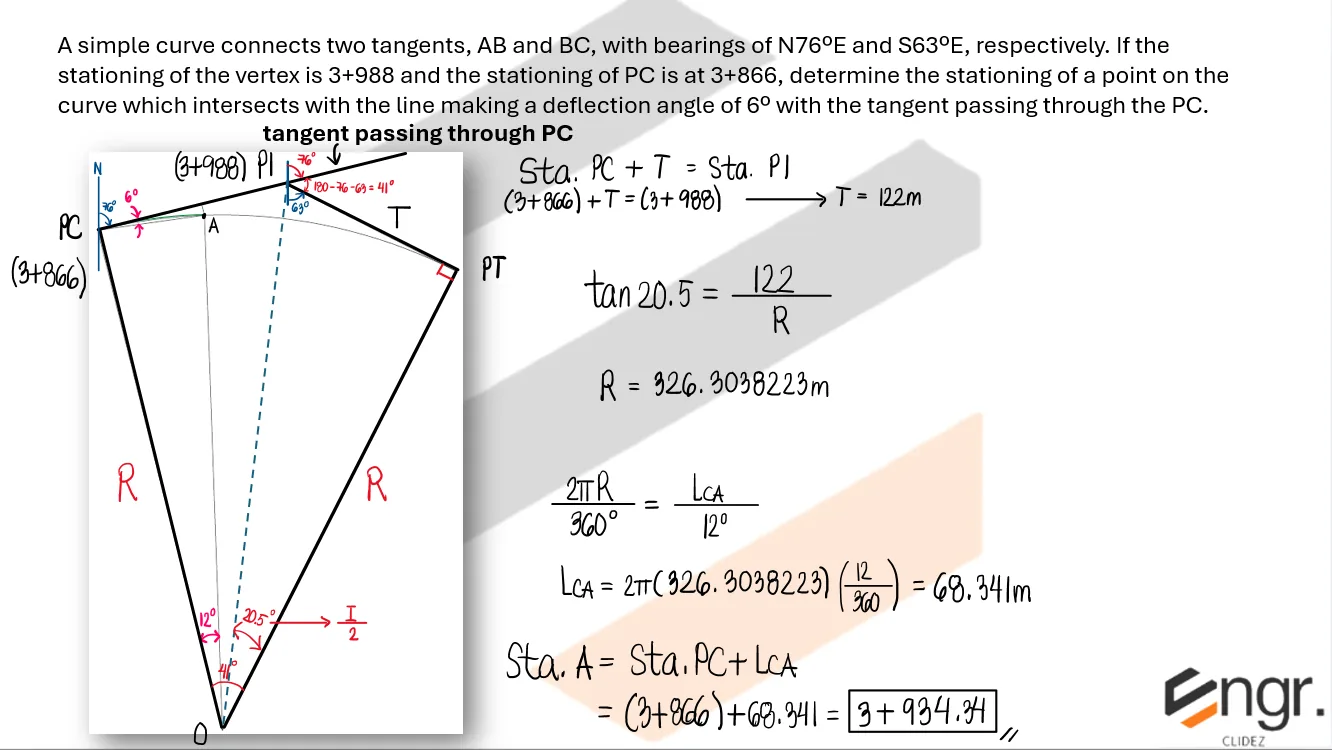
A simple curve connects two tangents, AB and BC, with bearings of N76ºE and S63ºE, respectively. If the stationing of the vertex is 3+988 and the stationing of PC is at 3+866, determine the stationing of a point on the curve which intersects with the line making a deflection angle of 6º with the tangent passing through the PC.
Problem: Offset Distance
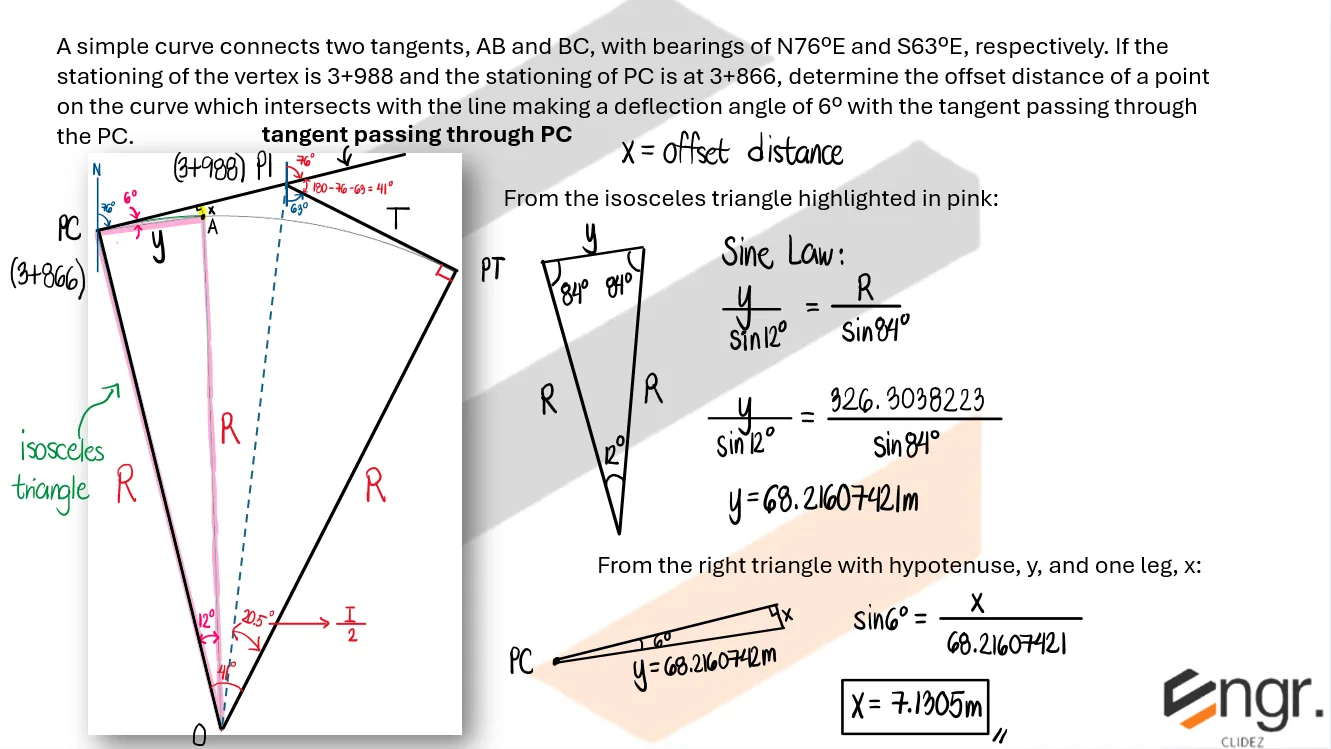
A simple curve connects two tangents, AB and BC, with bearings of N76ºE and S63ºE, respectively. If the stationing of the vertex is 3+988 and the stationing of PC is at 3+866, determine the offset distance of a point on the curve which intersects with the line making a deflection angle of 6º with the tangent passing through the PC.
Problem: Arc Basis and Fillet of Curve
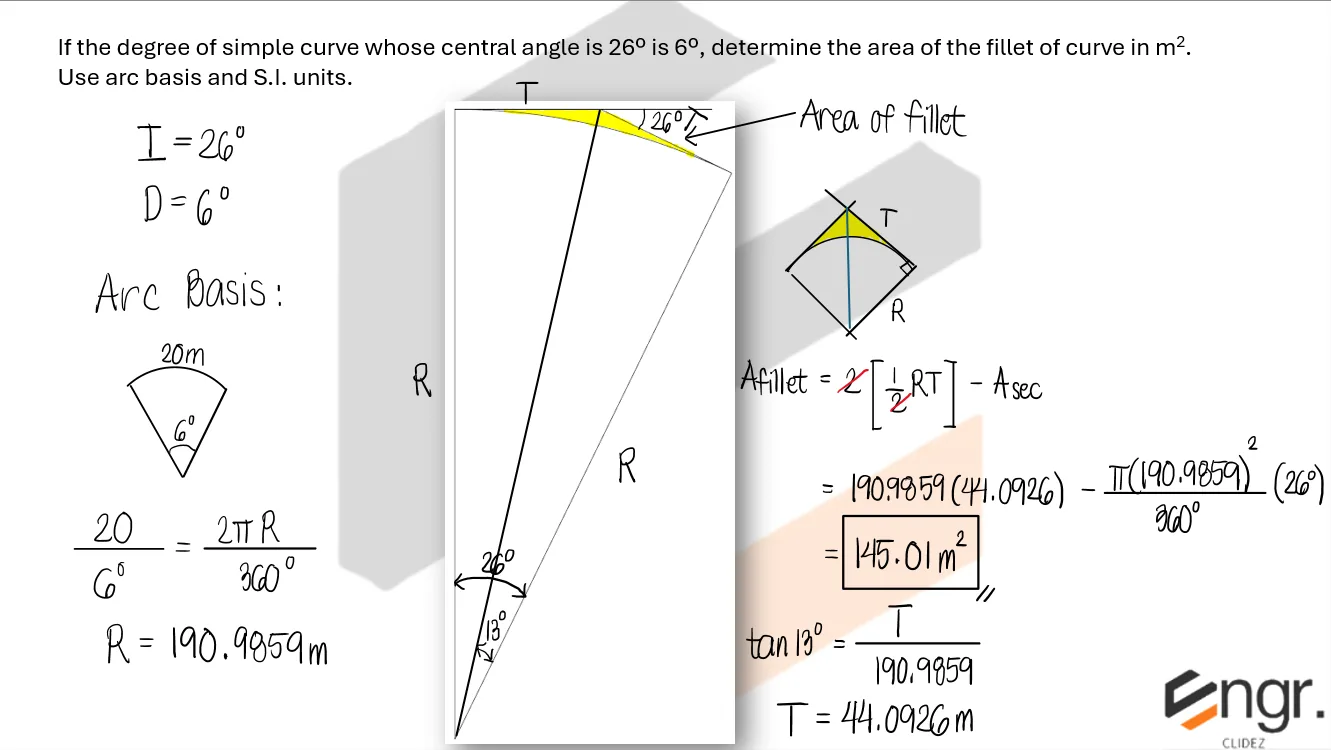
If the degree of simple curve whose central angle is 26º is 6º, determine the area of the fillet of curve in m2. Use arc basis and S.I. units.
Problem: Radius of Curve Given the Angle of Intersection and Middle Ordinate
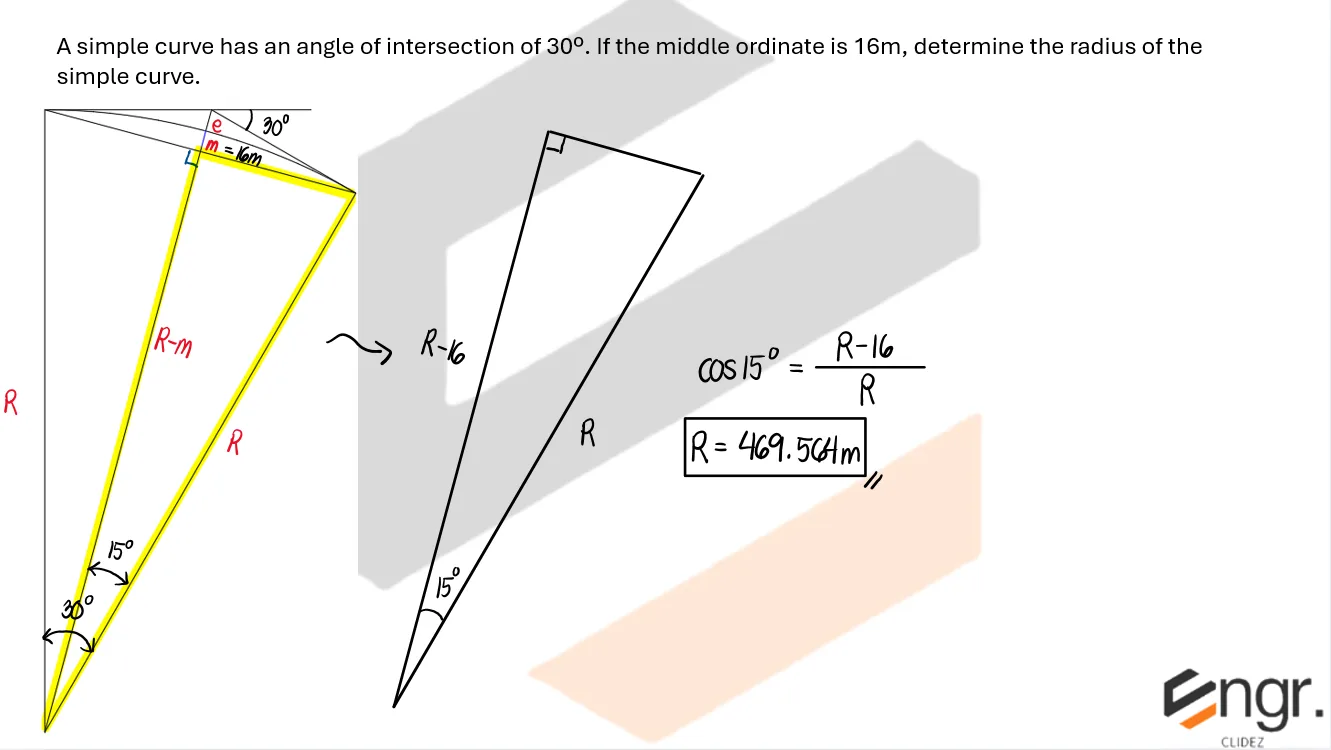
A simple curve has an angle of intersection of 30º. If the middle ordinate is 16m, determine the radius of the
simple curve.
Problem: Chord Basis with English Units
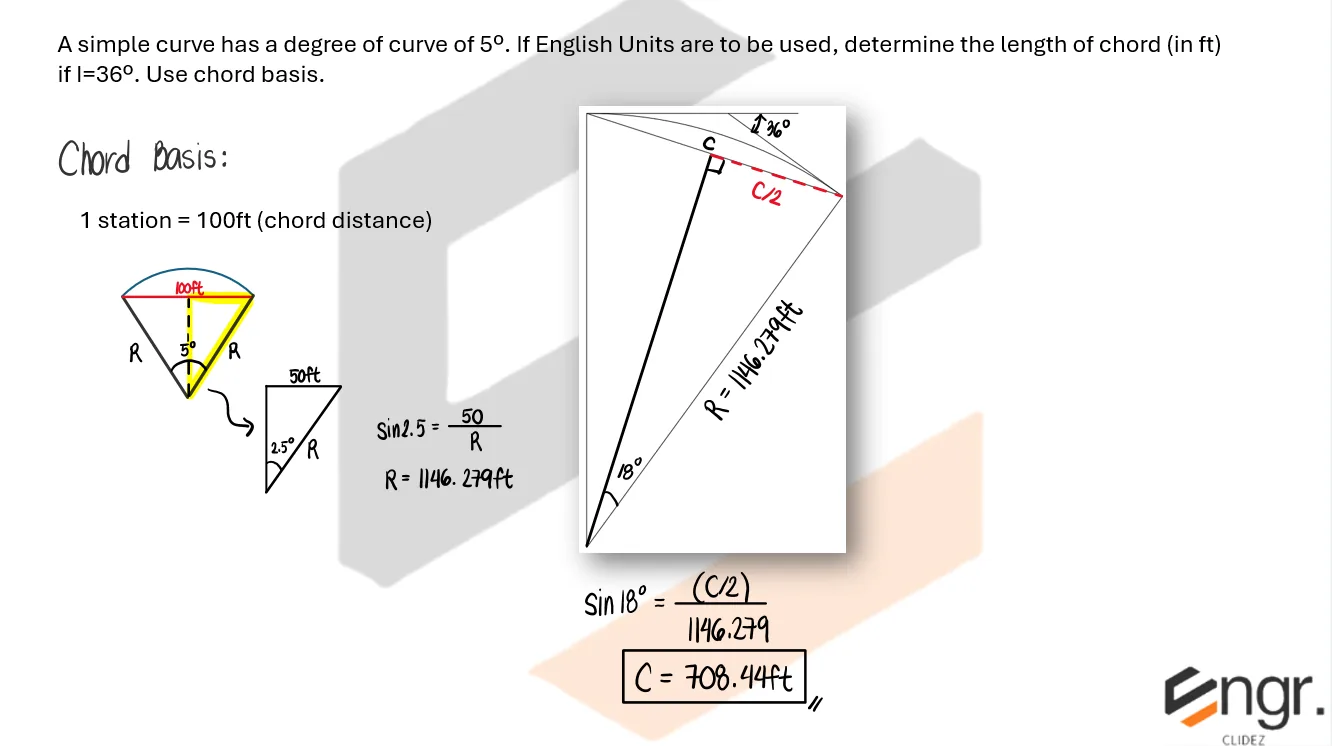
A simple curve has a degree of curve of 5º. If English Units are to be used, determine the length of chord (in ft)
if I=36º. Use chord basis.
Problem: Offset Distance from PT
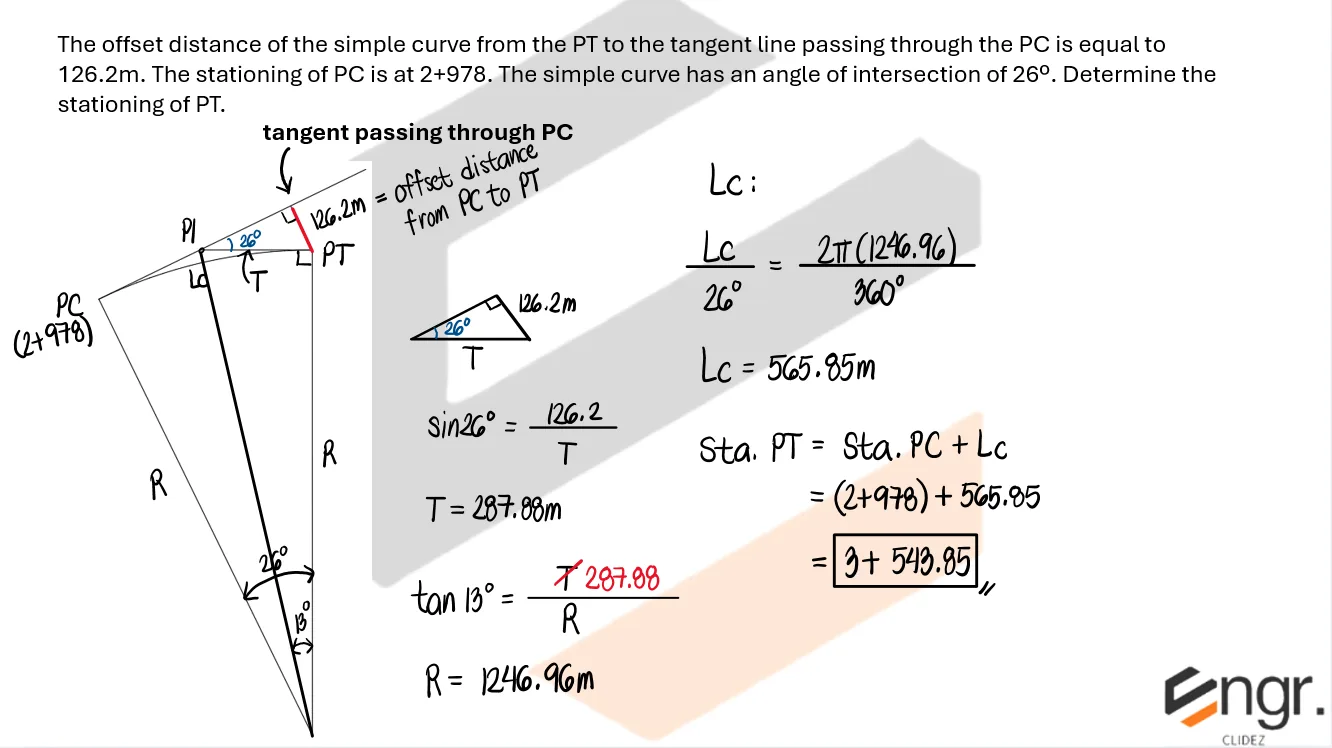
The offset distance of the simple curve from the PT to the tangent line passing through the PC is equal to
126.2m. The stationing of PC is at 2+978. The simple curve has an angle of intersection of 26º. Determine the
stationing of PT.
Exam Generator Problems
Additional board-style practice items for this topic.
A simple curve connects two tangents, AB and BC, with bearings of N81ºE and S63ºE, respectively. If the stationing of the vertex is 4+358 and the stationing of PC is 4+301, determine the following:
Radius of the curve
175.428m
170.345m
180.675m
143.908m
External distance
9.028m
8.046m
8.406m
9.820m
Middle ordinate
8.586m
6.658m
7.438m
8.437m
Chord distance
108.42m
110.225m
104.82m
112.025m
Length of the curve
110.225m
108.42m
104.82m
112.025m
Stationing of PT
4+411.225
4+409.42
4+421.125
4+404.942
Stationing of a point on the curve which intersects with the line making a deflection angle of 7º with the tangent passing through the PC
4+343.865
4+336.852
4+347.945
4+331.965
The offset distance, x, of such a point along the curve
5.21m
4.30m
6.12m
4.78m
Part 1.
The intersection angle is the change in bearing from N81°E to S63°E. These azimuths are 81° and 117°, so: $I=117^\circ-81^\circ=36^\circ$ The tangent distance is the station difference: $T=4+358-(4+301)=57$ m For a simple curve: $T=R\tan\frac{I}{2}$ $R=\frac{57}{\tan18^\circ}=175.428$ m $\boxed{R=175.428\text{m}}$
Part 2.
External distance for a simple curve: $E=R\left(\sec\frac{I}{2}-1\right)$ $E=175.428(\sec18^\circ-1)=9.028$ m $\boxed{E=9.028\text{m}}$
Part 3.
Middle ordinate: $M=R\left(1-\cos\frac{I}{2}\right)$ $M=175.428(1-\cos18^\circ)=8.586$ m $\boxed{M=8.586\text{m}}$
Part 4.
Long chord: $LC=2R\sin\frac{I}{2}$ $LC=2(175.428)\sin18^\circ=108.42$ m $\boxed{LC=108.42\text{m}}$
Part 5.
Length of curve using arc length: $L=\frac{\pi RI}{180}$ $L=\frac{\pi(175.428)(36)}{180}=110.225$ m $\boxed{L=110.225\text{m}}$
Part 6.
Station of PT is station of PC plus curve length: $PT=4+301+110.225=4+411.225$ $\boxed{4+411.225}$
Part 7.
For a point with tangential deflection $\delta=7^\circ$, the central angle from PC is $2\delta=14^\circ$. Arc length from PC: $l=\frac{\pi R(14)}{180}=\frac{\pi(175.428)(14)}{180}=42.865$ m Station: $4+301+42.865=4+343.865$ $\boxed{4+343.865}$
Part 8.
The offset from the tangent to the curve at central angle $14^\circ$ is: $x=R(1-\cos14^\circ)$ $x=175.428(1-\cos14^\circ)=5.21$ m $\boxed{x=5.21\text{m}}$
A 5º curve intersects a property line CD at point D. The back tangent intersects the propertly line at point C, which si 105.72m from the PC, which is at station 2+040. The angle that the property line CD makes with the back tangent is 110º50'. Assume that the vertex angle at D is obtuse. Compute the following:
The length of curve from the PC to point D.
124.24m
229.18m
162.43m
142.64m
The stationing of point D
2+164.24
2+146.14
2+153.41
2+135.42
The distance CD
35.2m
36.8m
34.1m
33.7m
Use the metric arc definition for a $5^\circ$ curve: $$R=\frac{20(180)}{\pi(5)}=229.18\text{ m}$$ Set the PC at the origin and the back tangent along the $x$-axis. Point $C$ is $105.72\text{ m}$ from the PC on the tangent. Because the angle at $D$ is obtuse, the acute direction of $CD$ from the positive tangent direction is: $$\alpha=180^\circ-110^\circ50'=69^\circ10'$$ Let $s=CD$. A point on $CD$ is $(105.72+s\cos\alpha,\ s\sin\alpha)$. It lies on the circular curve, whose equation is $x^2+(y-R)^2=R^2$. Substitution gives: $$s^2+2\left(105.72\cos\alpha-R\sin\alpha\right)s+(105.72)^2=0$$ Taking the smaller positive root gives: $$CD\approx35.2\text{ m}$$ The corresponding point on the curve gives the central angle $\Delta\approx31.05^\circ$. Hence the arc length from PC to $D$ is: $$L=\frac{\pi R\Delta}{180}\approx124.24\text{ m}$$ The station of $D$ is then: $$\text{Sta. }D=2+040+124.24=2+164.24$$
Therefore, the curve length is 124.24 m, the station of $D$ is 2+164.24, and $CD$ is 35.2 m.
The tangents of a simple curve intersect at an angle of 32º. It has a radius of 402.21m.
Compute the degree of the curve using arc basis.
2.85º
2.58º
3.29º
3.92º
Determine the area of the fillet of the curve in m2
1211.37
1237.11
1217.31
1271.31
Part 1.
Using arc basis with a 20 m arc, the degree of curve is: $D=\frac{1145.916}{R}$ $D=\frac{1145.916}{402.21}=2.849^\circ$ $\boxed{D\approx2.85^\circ}$
Part 2.
The fillet area is the tangent triangle minus the circular segment: $A_f=\frac{1}{2}T^2\sin I-\frac{R^2}{2}(I-\sin I)$ $T=R\tan\frac{I}{2}=402.21\tan16^\circ=115.33$ m $A_f=\frac{1}{2}(115.33)^2\sin32^\circ-\frac{(402.21)^2}{2}(0.5585-\sin32^\circ)$ $\boxed{A_f\approx1211.37}$
Determine the degree of simple curve whose central angle is 26º if the shortest distance from the curve to the point of intersection is 7.54m. Use arc basis.
Answer:
4º
3º
5º
2º
The shortest distance from the curve to the PI is the external distance: $E=R\left(\sec\frac{I}{2}-1\right)$ $7.54=R(\sec13^\circ-1)$ $R=286.65$ m Using arc basis: $D=\frac{1145.916}{R}=\frac{1145.916}{286.65}=3.998^\circ$ $\boxed{D\approx4^\circ}$
The offset distance of the simple curve from the PT to the tangent line passing through the PC (OR from PC to PT) is equal to 120.2m. The simple curve has an angle of intersection of 50º.
Find the radius of the simple curve
336.49m
363.49m
346.94m
334.69m
If the stationing of PT is 45+158.32, what is the stationing of PI?
45+021.59
44+864.68
44+241.89
45+011.59
Part 1.
The offset from PT to the tangent through PC is: $O=R(1-\cos I)$ $120.2=R(1-\cos50^\circ)$ $R=\frac{120.2}{1-\cos50^\circ}=336.49$ m $\boxed{R=336.49\text{m}}$
Part 2.
First compute tangent and curve length: $T=R\tan\frac{I}{2}=336.49\tan25^\circ=156.91$ m $L=\frac{\pi RI}{180}=\frac{\pi(336.49)(50)}{180}=293.65$ m The PI station is before PT by $L-T$: $PI=45+158.32-(293.65-156.91)=45+021.59$ $\boxed{45+021.59}$
A reverse curve connects two converging tangents with an angle of intersection of 32º. The distance from PI of the second curve to this point of intersection is 180m. The deflection angle of the common tangent from the back tangent is 22º and its degree of curve is 5º.
Determine the radius of the 2nd curve
229.18m
227.92m
226.39m
225.43m
Determine the tangent distance of the 2nd curve
116.77m
117.76m
119.32m
120.59m
Determine the degree of curve of the 1st curve by arc basis
1.62º
2.61º
1.36º
3.16º
If the stationing of PC is 3+600, determine the stationing of PT
4+088.32
4+092.48
4+076.84
4+081.53
For a reverse curve, the two arcs turn in opposite directions. The common tangent is deflected $22^\circ$ from the back tangent; hence the first central angle is $\Delta_1=22^\circ$. Since the two outside tangents converge by $32^\circ$, the second central angle is: $$\Delta_2=32^\circ+22^\circ=54^\circ$$ For the $5^\circ$ second curve on the metric arc basis: $$R_2=\frac{20(180)}{\pi(5)}=229.18\text{ m}$$ $$T_2=R_2\tan\frac{\Delta_2}{2}=229.18\tan27^\circ=116.77\text{ m}$$ Using the given 180-m tangent geometry between the two PIs and resolving along the common tangent gives $R_1\approx707.36\text{ m}$. Its degree on the arc basis is: $$D_1=\frac{20(180)}{\pi R_1}=1.62^\circ$$ The total curved length is: $$L=\frac{\pi R_1(22^\circ)}{180}+\frac{\pi R_2(54^\circ)}{180}=488.32\text{ m}$$ $$\text{Sta. PT}=3+600+488.32=4+088.32$$
Therefore, the answers are 229.18 m, 116.77 m, 1.62°, and 4+088.32.
A reverse curve connects two converging tangents intersecting at an angle of 30º. The distance of this intersection from the PI of the curve is 150m. The deflection angle of the common tangent from the back tangent is 20º, and the azimuth of the common tangent is 320º. The dgree of curve of the second simple curve is 6º, and the stationing of the point of intersection of the first curve is 4+450.
Determine the radius of the first curve.
738.68m
742.96m
731.23m
746.93m
Determine the stationing of PRC.
4+577.81
4+518.77
4+564.32
4+546.23
Determine the stationing of PT
4+744.48
4+474.84
4+736.81
4+763.18
The first curve deflects $20^\circ$ from the back tangent. Since the outside tangents intersect at $30^\circ$, the reverse second curve has: $$\Delta_2=30^\circ+20^\circ=50^\circ$$ For the second $6^\circ$ simple curve on the metric arc basis: $$R_2=\frac{20(180)}{\pi(6)}=190.99\text{ m}$$ Using the 150-m PI geometry and the $20^\circ$ common-tangent deflection, solve the tangent triangle for the first curve. This gives: $$R_1=738.68\text{ m}$$ The computed distance from the first PI to the point of reverse curvature is $127.81\text{ m}$, hence: $$\text{Sta. PRC}=4+450+127.81=4+577.81$$ The second arc length is: $$L_2=\frac{\pi R_2\Delta_2}{180}=\frac{\pi(190.99)(50)}{180}=166.67\text{ m}$$ $$\text{Sta. PT}=4+577.81+166.67=4+744.48$$
Therefore, the first radius is 738.68 m, the PRC station is 4+577.81, and the PT station is 4+744.48.
If the degree of simple curve whose central angle is 26º is 6º, determine the area of the fillet of curve in m2. Use arc basis and S.I. units.
145.01
143.56
143.78
147.26
For a $6^\circ$ curve on the 20-m arc basis: $$R=\frac{20(180)}{\pi(6)}=190.986\text{ m}$$ The area of the fillet between the tangents and the circular arc is: $$A=R^2\left[\tan\left(\frac\Delta2\right)-\frac\Delta2\right]$$ where $\Delta/2$ is in radians. With $\Delta=26^\circ$: $$A=(190.986)^2[\tan13^\circ-13^\circ(\pi/180)]=145.01\text{ m}^2$$
Two tangents AB and BC intersect at an angle of 24º. A point P situated along the curve is located 21.03m from point B and has a perpendicular distance of 2.79m from line AB. Calculate the radius of the simple curve, assuming that it is greater than 200m.
285.20m
295.67m
340.62m
150.39m
Let $B$ be the intersection of the tangents. The tangent length is $T=R\tan12^\circ$. Resolve the coordinates of point $P$ using its measured distance from $B$, $BP=21.03$ m, and its perpendicular offset from $AB$, $2.79$ m. Substitute the resulting point coordinates into the circle equation whose center is $R$ normal to tangent $AB$. The physically applicable root, specified as greater than 200 m, is: $$R=285.20\text{ m}$$
The radius of a simple circular curve is 400m. PC is at Sta. 4+456.21. Determine the deflection angle at Sta. 4+645.64.
13.567º
11.500º
15.763º
16.213º
The arc length from PC to the required station is: $$L=4645.64-4456.21=189.43\text{ m}$$ The central angle is $\Delta=L/R$ in radians. The deflection angle is one-half of the central angle: $$\delta=\frac{L}{2R}=\frac{189.43}{2(400)}=0.23679\text{ rad}$$ $$\delta=13.567^\circ$$
Therefore, the deflection angle is 13.567°.
Question Bank: t1188
MSTE - Highway Engineering / Curves, Earthworks, and Traffic Engineering / Gemini mapped Chapter 7 to 10
A circular curve with a radius of 280 m, a central angle of 70°, and its PC at station 10 + 300 must be stalled by deflection angles and chords. What is the deflection angle to station 10 + 450?
15.35°
12.41°
19.36°
8.54°
Solution pending in psadquestions/t1188.json.
Question Bank: t1190
MSTE - Highway Engineering / Curves, Earthworks, and Traffic Engineering / Gemini mapped Chapter 7 to 10
A 3-degree simple curve is used to connect two highways whose bearings are S 11° W and S 47° W. Use arc basis.
What is the length of the curve in meters?
240
260
230
250
What is the external distance in meters?
19.66
18.69
21.33
17.52
What is the tangent distance in meters?
126.35
128.97
124.11
136.54
What is the middle ordinate in meters?
21.33
17.52
19.66
18.69
Solution pending in psadquestions/t1190.json.
Question Bank: t1194
MSTE - Highway Engineering / Curves, Earthworks, and Traffic Engineering / Gemini mapped Chapter 7 to 10
From point A on a simple curve, the perpendicular distance to the tangent, at point Q, is x m. The tangent passes through the PC. The distance from Q to PC is 450 m. Find x if the radius of the curve is 1600 m.
64.59 m
72.45 m
53.24 m
86.32 m
Solution pending in psadquestions/t1194.json.
Question Bank: t1195
MSTE - Highway Engineering / Curves, Earthworks, and Traffic Engineering / Gemini mapped Chapter 7 to 10
The offset distance from PC to PT of a simple curve is 8 m. If the length of the curve is 60 m, what is the radius of the curve?
223.7 m
268.4 m
185.4 m
139.9 m
Solution pending in psadquestions/t1195.json.
Question Bank: t1196
MSTE - Highway Engineering / Curves, Earthworks, and Traffic Engineering / Gemini mapped Chapter 7 to 10
The angle of intersection of a circular curve is 45° 30' and its radius is 198.17 m. PC is at Sta. 0 + 700. Compute the right angle offset from Sta. 0 + 736.58 on the curve to tangent through PC.
2.98 m
3.09 m
3.87 m
3.37 m
Solution pending in psadquestions/t1196.json.
Question Bank: t1198
MSTE - Highway Engineering / Curves, Earthworks, and Traffic Engineering / Gemini mapped Chapter 7 to 10
A 4-degree simple curve have tangents with bearings of N 20° E and N 60° E, respectively. The stationing of PI is 3 + 980.
Determine the middle ordinate in meters.
15.67
17.28
18.54
16.33
Determine the stationing of PT.
3 + 986.67
4 + 123.45
3 + 995.73
4 + 075.73
Determine the stationing of a point Q on the curve whose deflection angle from PC is 12°.
4 + 075.73
3 + 986.67
3 + 995.73
4 + 123.45
Solution pending in psadquestions/t1198.json.
Question Bank: t1202
MSTE - Highway Engineering / Curves, Earthworks, and Traffic Engineering / Gemini mapped Chapter 7 to 10
The offset distances of two points A and B of a simple curve are 2 m and 6 m, respectively. The chord length from PC to A is 30 m.
What is the radius of the curve?
185 m
200 m
265 m
225 m
What is the chord length from PC to B in meters?
50.24
51.96
53.62
48.63
What is the length of curve from PC to B in meters?
54.87
52.87
53.21
52.08
Solution pending in psadquestions/t1202.json.
Question Bank: t1205
MSTE - Highway Engineering / Curves, Earthworks, and Traffic Engineering / Gemini mapped Chapter 7 to 10
A simple curve is to connect two tangents whose angle of intersection is 36°. The curve is to pass a point B whose perpendicular distance from the tangent through PC (at point C) is 12 m. Point C is 36 m from the point of intersection of the tangents.
What is the distance from PI to B in meters?
39.74
36.54
37.95
41.22
What is the radius of the curve in meters?
438.4
416.15
389.24
469.87
Find the length of the curve in meters.
275.45
244.57
261.5
295.23
Solution pending in psadquestions/t1205.json.
Question Bank: t1208
MSTE - Highway Engineering / Curves, Earthworks, and Traffic Engineering / Gemini mapped Chapter 7 to 10
What is the superelevation of the outer rail above inner rail of a 3° railroad curve with 100 kph design speed if friction factor is neglected? Use chord basis.
0.11
0.15
0.29
0.21
Solution pending in psadquestions/t1208.json.
Question Bank: t1209
MSTE - Highway Engineering / Curves, Earthworks, and Traffic Engineering / Gemini mapped Chapter 7 to 10
A 1800-kg truck travels at 85 kph around a banked curve with a radius of 250 m. What should the superelevation be so that the tire friction is not needed to prevent the car from sliding?
0.12
0.17
0.32
0.23
Solution pending in psadquestions/t1209.json.
Question Bank: t1210
MSTE - Highway Engineering / Curves, Earthworks, and Traffic Engineering / Gemini mapped Chapter 7 to 10
Two tangents intersecting at V with bearings N 75° 12' E and S 78° 36' E are connected with a 4 degree simple curve. Without changing the direction of the two tangents and with the same angle of intersection, it is required to shorten the curve to 100 m starting from the PC.
By how much shall the point of intersection of the tangent be moved?
29.92 m
15.77 m
30.72 m
6.96 m
What is the distance between the two parallel tangents?
29.92 m
15.77 m
30.72 m
6.96 m
By how much shall the PT be moved and in what direction from the old tangent?
30.72 m, 13.1°
15.77 m, 13.1°
29.92 m, 13.1°
6.96 m, 13.1°
Solution pending in psadquestions/t1210.json.
Question Bank: t1218
MSTE - Highway Engineering / Curves, Earthworks, and Traffic Engineering / Gemini mapped Chapter 7 to 10
A reversed curve of a railroad track has the following properties: D1 = 3°, D2 = 2°, Stationing of PT = 32 + 121. What is the stationing of PC? Use chord basis.
31 + 752
31 + 761
31 + 821
32 + 125
Solution pending in psadquestions/t1218.json.
Question Bank: t1229
MSTE - Highway Engineering / Curves, Earthworks, and Traffic Engineering / Gemini mapped Chapter 7 to 10
A reversed curve with diverging tangent is to be designed to connect to three traversed lines for the portion of the proposed highway. The lines AB is 185 m, BC is 122.40 m, and CD is 285 m. The azimuth are Due East, 242°, and 302° respectively. The following are the cost index and specification: Type of Pavement = Item 311 (Portland Concrete), Number of Lanes = Two Lanes, Width of Pavement = 3.05 m per lane, Thickness of Pavement = 20 cm, Unit Cost = P780 per square meter. It is necessary that the PRC (Point of Reversed Curvature) must be one-fourth the distance BC from B.
Find the radius of the first curve.
123 m
156 m
182 m
143 m
Find the length of road from A to D. Use arc basis.
552
637 m
574 m
468 m
Find the cost of the concrete pavement from A to D.
P3,123,980
P2,731,480
P2,342,890
P1,983,210
Solution pending in psadquestions/t1229.json.
Question Bank: t1239
MSTE - Highway Engineering / Curves, Earthworks, and Traffic Engineering / Gemini mapped Chapter 7 to 10
A spiral easement curve has a length of 100 m with a central curve having a radius of 300 m. Determine the offset distance from the tangent to the third-quarter point of the spiral.
3.52 m
2.34 m
1.57 m
2.96 m
Solution pending in psadquestions/t1239.json.
Question Bank: t1264
MSTE - Highway Engineering / Curves, Earthworks, and Traffic Engineering / Gemini mapped Chapter 7 to 10
A car traveling at 105 kph applies a brake and stopped at a distance of 105 m. The coefficient of friction between the tires and the road is 0.5. If the perception-reaction time is 1.5 seconds, what is the grade of the road?
20.8%
-15.5%
10.2%
-15.8%
Solution pending in psadquestions/t1264.json.
Question Bank: t1309
MSTE - Highway Engineering / Curves, Earthworks, and Traffic Engineering / Gemini mapped Chapter 7 to 10
The following data were taken on five cars traversing a 1.5-km highway. [Table omitted] Determine the space mean speed.
75 kph
72 kph
81 kph
62 kph
Solution pending in psadquestions/t1309.json.
Question Bank: t1323
MSTE - Highway Engineering / Curves, Earthworks, and Traffic Engineering / Gemini mapped Chapter 7 to 10
A raised structure, including bridge and building supports and walkways, over water, typically supported by widely spread piles or pillars.
port
pier
wharf
beach
Solution pending in psadquestions/t1323.json.
Question Bank: t1324
MSTE - Highway Engineering / Curves, Earthworks, and Traffic Engineering / Gemini mapped Chapter 7 to 10
Refers to number of vehicles on a given stretch of road.
traffic flow
traffic density
traffic quantity
none of these
Solution pending in psadquestions/t1324.json.
Question Bank: t1325
MSTE - Highway Engineering / Curves, Earthworks, and Traffic Engineering / Gemini mapped Chapter 7 to 10
A method of locating the position of an object by observing the direction and/or distance to the object from two or more observation points.
traversing
triangulation
surveying
none of these
Solution pending in psadquestions/t1325.json.
Question Bank: t1326
MSTE - Highway Engineering / Curves, Earthworks, and Traffic Engineering / Gemini mapped Chapter 7 to 10
The uppermost layer of a sealed pavement. It provides the riding surface for the road users.
binder course
base
wearing course
subgrade
Solution pending in psadquestions/t1326.json.
Question Bank: t1327
MSTE - Highway Engineering / Curves, Earthworks, and Traffic Engineering / Gemini mapped Chapter 7 to 10
A premixed asphalt surfacing is sometimes laid in two layers of different materials. The lower layer of such a construction is known as the:
binder course
subgrade
wearing course
sub-base
Solution pending in psadquestions/t1327.json.
Question Bank: t1328
MSTE - Highway Engineering / Curves, Earthworks, and Traffic Engineering / Gemini mapped Chapter 7 to 10
The main load-spreading layer of a pavement.
subgrade
base
wearing course
sub-base
Solution pending in psadquestions/t1328.json.
Question Bank: t1329
MSTE - Highway Engineering / Curves, Earthworks, and Traffic Engineering / Gemini mapped Chapter 7 to 10
The secondary load-spreading layer of a pavement.
binder course
base
subgrade
sub-base
Solution pending in psadquestions/t1329.json.
Question Bank: t1330
MSTE - Highway Engineering / Curves, Earthworks, and Traffic Engineering / Gemini mapped Chapter 7 to 10
The soil acting as a foundation for the pavement.
binder course
base
wearing course
subgrade
Solution pending in psadquestions/t1330.json.
Question Bank: t1331
MSTE - Highway Engineering / Curves, Earthworks, and Traffic Engineering / Gemini mapped Chapter 7 to 10
The process by which a soil is improved and made more stable.
compaction
grading
stabilization
soil improvement
Solution pending in psadquestions/t1331.json.
Question Bank: t1332
MSTE - Highway Engineering / Curves, Earthworks, and Traffic Engineering / Gemini mapped Chapter 7 to 10
A black to dark brown sticky material, composed principally of high molecular-weight hydrocarbons.
bitumen
carbon
black concrete
dark pavement
Solution pending in psadquestions/t1332.json.
Question Bank: t1337
MSTE - Highway Engineering / Curves, Earthworks, and Traffic Engineering / Gemini mapped Chapter 7 to 10
May consist of pedestrians, ridden or herded animals, vehicles, streetcars and other conveyances, either singly or together, while using the public way for purposes of travel.
flow
transport
none of these
traffic
Solution pending in psadquestions/t1337.json.
Question Bank: t1340
MSTE - Highway Engineering / Curves, Earthworks, and Traffic Engineering / Gemini mapped Chapter 7 to 10
A bridge, road, railway or similar structure that crosses over another road or railway.
overway
flyover
skyway
underpass
Solution pending in psadquestions/t1340.json.
Question Bank: t1341
MSTE - Highway Engineering / Curves, Earthworks, and Traffic Engineering / Gemini mapped Chapter 7 to 10
A person traveling on foot, whether walking or running.
commuter
jaywalker
jogger
pedestrian
Solution pending in psadquestions/t1341.json.
Question Bank: t1342
MSTE - Highway Engineering / Curves, Earthworks, and Traffic Engineering / Gemini mapped Chapter 7 to 10
The driver sees a control device, warning sign, or object on the road.
emotion
reaction or volition
identification
perception
Solution pending in psadquestions/t1342.json.
Question Bank: t1343
MSTE - Highway Engineering / Curves, Earthworks, and Traffic Engineering / Gemini mapped Chapter 7 to 10
The driver identifies the object or control device and thus understands the stimulus.
identification
perception
emotion
reaction or volition
Solution pending in psadquestions/t1343.json.
Question Bank: t1345
MSTE - Highway Engineering / Curves, Earthworks, and Traffic Engineering / Gemini mapped Chapter 7 to 10
The driver actually executes the action decided on during the emotion sub-process.
emotion
perception
identification
reaction or volition
Solution pending in psadquestions/t1345.json.
Question Bank: t1346
MSTE - Highway Engineering / Curves, Earthworks, and Traffic Engineering / Gemini mapped Chapter 7 to 10
Distance traveled by a vehicle from the point of application of force to the brake control to the point at which the vehicle reaches a full stop.
stopping distance
braking distance
safe distance
skidding distance
Solution pending in psadquestions/t1346.json.
Question Bank: t1347
MSTE - Highway Engineering / Curves, Earthworks, and Traffic Engineering / Gemini mapped Chapter 7 to 10
Distance within which material is moved without extra compensation.
freeload
overhaul
freehaul
free distance
Solution pending in psadquestions/t1347.json.
Question Bank: t1350
MSTE - Highway Engineering / Curves, Earthworks, and Traffic Engineering / Gemini mapped Chapter 7 to 10
Pavement structure that maintains intimate contact with, and distributes loads to the subgrade and depends on aggregate interlock, particle friction, and cohesion for stability.
none of these
flexible pavement
rigid pavement
variable pavement
Solution pending in psadquestions/t1350.json.
Question Bank: t1352
MSTE - Highway Engineering / Curves, Earthworks, and Traffic Engineering / Gemini mapped Chapter 7 to 10
Transport of excavation beyond specified limits.
limiting haul
freehaul
over limit
overhaul
Solution pending in psadquestions/t1352.json.
Question Bank: t1355
MSTE - Highway Engineering / Curves, Earthworks, and Traffic Engineering / Gemini mapped Chapter 7 to 10
The shortest distance from a circular curve to the point of intersection of the tangents.
tangent distance
long chord
middle ordinate
external distance
Solution pending in psadquestions/t1355.json.
Question Bank: t1356
MSTE - Highway Engineering / Curves, Earthworks, and Traffic Engineering / Gemini mapped Chapter 7 to 10
A curve of constantly changing radius.
parabolic curve
reverse curve
transition curve
simple curve
Solution pending in psadquestions/t1356.json.
Question Bank: t2150
MSTE - Highway Engineering / Simple Curves / Besavilla CE Pre-Board Math & Surveying
The perpendicular offset distance from point A on a simple curve to Q on the tangent line is 64 m. If the distance from the P.C. to Q on the tangent is 260 m. Compute the radius of the simple curve.
525.36 m.
587.15 m.
512.12 m.
541.96 m.
560.13 m.
For an offset from the tangent to a simple circular curve, use $x^2=2Ry-y^2$ where $x=260$ m is the distance from P.C. to Q on the tangent and $y=64$ m is the perpendicular offset. $R=\frac{x^2+y^2}{2y}$ $R=\frac{260^2+64^2}{2(64)}=\frac{67{,}600+4{,}096}{128}$ $\boxed{R=560.13\text{ m}}$
An engineer designs a simple curve at a certain point of a highway. The data are: $I = 44^\circ$, $R = 400$ feet, PC is at Station $11 + 10.57$, PI is at Station $12 + 72.18$, and PT is at Station $14 + 17.75$. What is the deflection angle of Station $13 + 00$?
13.57°
27.13°
17.25°
15.24°
Arc from PC to Station $13+00$: $c = 1300 - 1110.57 = 189.43\text{ ft}$. $c = \frac{\pi R\theta}{180^\circ} \Rightarrow 189.43 = \frac{\pi(400)\theta}{180^\circ} \Rightarrow \theta = 27.134^\circ$ Deflection angle $= \frac{\theta}{2} = \boxed{13.57^\circ}$
Question Bank: w51
MSTE - Highway Engineering / Curves, Earthworks, and Traffic Engineering / MSTE May 2019
An 80-m spiral connects a tangent with a 180-m radius circular curve. The maximum velocity in kph that a car could pass through the curve without skidding is nearest to:
72.58
78.54
71.24
73.68
Minimum spiral length based on the rate of change of centripetal acceleration: $L_s = \frac{0.036\,v^3}{R}$ $80 = \frac{0.036\,v^3}{180}$ $\boxed{v = 73.68\text{ kph}}$
Question Bank: w53
MSTE - Highway Engineering / Curves, Earthworks, and Traffic Engineering / MSTE May 2019
The cross-sectional area of a road with a width of 10 m is 42.9 square meters. The cross-section (format = height/distance) is as follows: $\dfrac{9.8}{2.4}\quad \dfrac{0}{x}\quad \dfrac{7.4}{1.2}$ Determine the value of $x$.
3.45 m
3.70 m
3.94 m
2.45 m
Using the cross-section area by the coordinate (half-width = 5 m) method: $42.9 = \tfrac{1}{2}[5(2.4) + x(9.8) + x(7.4) + 5(1.2)]$ $\boxed{x = 3.94\text{ m}}$
Question Bank: w54
MSTE - Highway Engineering / Curves, Earthworks, and Traffic Engineering / MSTE May 2019
In the measures of congestion of highway capacity, what will happen as the density continues to increase?
Running speed and traffic flow is minimum
The point is reached at which speed declines noticeably
Minimum rate flow is eventually reached
Increase speeds and reduced flow rate
As traffic density keeps increasing toward the congested regime, the operation reaches the point at which speed declines noticeably. $\boxed{\text{The point is reached at which speed declines noticeably}}$
The table below lists data for an asphalt paving mix design — Asphalt cement: specific gravity 1.03, 6.0% of weight; Mineral filler: 3.10, 8.0%; Fine aggregates: 30.0% (bulk sp. gr. 2.690); Coarse aggregates: 56.0% (bulk sp. gr. 2.611). If the maximum specific gravity of the mixture is 2.535, determine the effective specific gravity of the aggregates in the mix.
2.796
2.697
2.967
2.976
Using the effective specific gravity formula with $G_{mm} = 2.535$ and asphalt $= 6\%$ at $G_{asp} = 1.03$: $G_{agg,eff} = \dfrac{100 - P_{asp}}{\dfrac{100}{G_{mm}} - \dfrac{P_{asp}}{G_{asp}}} = \dfrac{100 - 6}{\dfrac{100}{2.535} - \dfrac{6}{1.03}}$ $\boxed{G_{agg,eff} = 2.796}$
For an asphalt paving mixture, the maximum specific gravity of the paving mix is 2.535 and the bulk specific gravity of the compacted paving mix is 2.384. Determine the air voids in the compacted mix, in percent.
5.5
6.0
5.0
6.5
Air voids compare the bulk specific gravity $G_{mb}$ with the maximum $G_{mm}$: $V_a = \dfrac{G_{mm} - G_{mb}}{G_{mm}}\times 100\% = \dfrac{2.535 - 2.384}{2.535}\times 100\% = 5.96\%$ $\boxed{V_a \approx 6.0\%}$
Question Bank: w94
MSTE - Highway Engineering / Curves, Earthworks, and Traffic Engineering / MSTE November 2019
Ways of avoiding traffic conflicts:
grade separation
space-sharing
time-sharing
All of these
Traffic conflicts can be avoided by grade separation (vertical separation via overpasses/underpasses), space-sharing (shared or bike lanes), and time-sharing (reversible lanes, time-of-day restrictions). All three are valid methods. $\boxed{\text{All of these}}$
Cracks approximately at right angles to the pavement centerline. These may be caused by shrinkage or differential thermal stress of the asphalt concrete, or may be reflective cracks.
transverse cracks
longitudinal cracks
alligator crack
block crack
Transverse cracks run roughly perpendicular to the pavement centerline and are caused by shrinkage or differential thermal stress in the asphalt concrete, or by reflection from underlying cracks. Longitudinal cracks run parallel to the centerline; alligator cracks resemble interconnected scales; block cracks form a rectangular block pattern. $\boxed{\text{transverse cracks}}$
Question Bank: w97
MSTE - Highway Engineering / Curves, Earthworks, and Traffic Engineering / MSTE November 2019
The provision of safety sight distance depends on the characteristics of the road environment such as: I. Road geometry, II. Road surface, III. Road illumination at night, IV. Road topography.
II and IV only
I and IV only
All of the above
I, II, and III only
The provision of safety sight distance depends on all of the listed road-environment characteristics — road geometry, road surface, road illumination at night, and road topography — since each affects a driver's ability to see and respond to hazards. $\boxed{\text{All of the above}}$
Question Bank: w98
MSTE - Highway Engineering / Curves, Earthworks, and Traffic Engineering / MSTE November 2019
One of the provisions of safety sight distance depends on the characteristics of the vehicle, which are as follows: I. Type of vehicle (car or truck), II. friction between the tire and the road, III. eye height of the driver, IV. speed of vehicle.
II and III only
IV only
All of the above
III only
Of those listed, only the friction between tire and road (II) and the driver's eye height (III) are characteristics of the vehicle itself. The type of vehicle (I) and speed (IV) affect the required sight distance but are not characteristics of the vehicle as such. $\boxed{\text{II and III only}}$
Wearing away of the pavement surface caused by dislodging of aggregate particles and binder. This is usually a result of insufficient asphalt binder in the mix or stripping of asphalt from particles of aggregate.
raveling
bleeding
joint crack spalling
flushing
Raveling is the progressive wearing away of the pavement surface as aggregate particles and binder dislodge, usually from insufficient asphalt binder in the mix or stripping of asphalt from the aggregate. Bleeding and flushing involve excess binder rising to the surface; joint crack spalling is the breaking of concrete at joints. $\boxed{\text{raveling}}$