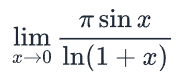
### Evaluate the limit
Rewrite the expression so that it contains standard limits:
$$lim_{x\to0}\frac{pisin x}{\ln(1+x)}
=pileft(lim_{x\to0}\frac{\sin x}{x}\right)
\left(lim_{x\to0}\frac{x}{\ln(1+x)}\right).$$
Using
$$lim_{x\to0}\frac{\sin x}{x}=1$$
and
$$lim_{x\to0}\frac{\ln(1+x)}{x}=1,$$
both factors equal 1. Hence
$$\boxed{\pi}. $$
Question Bank: q432
MSTE - Differential Calculus / Angle Between Two Curves / Engr. Janclyde Espinosa (Clidez)
Find the angle of intersection between the curves: y=x2+1 and y=x+x-1.
Answer:
63.44º
71.57º
45º
18.43º
Solve the intersection: $x^2+1=x+x^{-1}$ gives $x=1$, so the point is $(1,2)$. Slopes: $m_1=2x=2$ $m_2=1-x^{-2}=0$ $\tan\theta=\left|\frac{2-0}{1+0}\right|=2$ $\boxed{\theta=63.44^\circ}$
Question Bank: q433
MSTE - Differential Calculus / Equation of Tangent Line and Normal Line / Engr. Janclyde Espinosa (Clidez)
At what point of the parabola y=x2-3x-5 is the tangent line parallel to 3x-y=3?
Answer:
(3,-5)
(3,5)
(-3,-5)
(-3,5)
The line $3x-y=3$ has slope 3. For $y=x^2-3x-5$: $y'=2x-3$ $2x-3=3$, so $x=3$. Then: $y=9-9-5=-5$ $\boxed{(3,-5)}$
Question Bank: q434
MSTE - Differential Calculus / Equation of Tangent Line and Normal Line / Engr. Janclyde Espinosa (Clidez)
For the curve y=x2+x, at what point does the normal line at (0,0) intersect the tangent line at (1,2).
Answer:
(1/4,1/4)
(-1/4,1/4)
(-1/4,-1/4)
(1/4,-1/4)
For $y=x^2+x$, differentiate to obtain the slope of the tangent: $$\frac{dy}{dx}=2x+1$$
At $(0,0)$, the tangent slope is $1$, so the normal slope is $-1$. Its equation is: $$y=-x$$ At $(1,2)$, the tangent slope is $2(1)+1=3$. Its equation is: $$y-2=3(x-1)\quad\Rightarrow\quad y=3x-1$$ At the intersection: $$-x=3x-1\quad\Rightarrow\quad4x=1\quad\Rightarrow\quad x=\frac14$$ $$y=-x=-\frac14$$
Therefore, the normal and tangent lines intersect at $(1/4,-1/4)$.
Find the angle that the line 2y-9x-18=0 makes with the x-axis.
Answer:
77.47º
47.77º
74.77º
4.5º
Rewrite the line: $2y-9x-18=0\Rightarrow y=\frac{9}{2}x+9$ The angle with the x-axis is: $\theta=\tan^{-1}(9/2)$ $\boxed{77.47^\circ}$
Question Bank: q459
MSTE - Differential Calculus / Angle Between Two Curves / Engr. Janclyde Espinosa (Clidez)
Find the acute angle of intersection between the curves x2=8y and xy=8.
Answer:
71º34'
74º31'
73º14'
73º41'
The curves intersect where $x^2=8y$ and $xy=8$. Substituting $y=x^2/8$ gives $x=4$, $y=2$. Slopes: For $x^2=8y$, $y'=x/4=1$. For $xy=8$, $y'=-y/x=-1/2$. $\tan\theta=\left|\frac{1-(-1/2)}{1+1(-1/2)}\right|=3$ $\boxed{71^\circ34'}$
Question Bank: q460
MSTE - Differential Calculus / Equation of Tangent Line and Normal Line / Engr. Janclyde Espinosa (Clidez)
Find the equation of the tangent to the curve y=x+2x1/3 through point (8,12).
Answer:
7x-6y+16=0
8x+5y+21=0
5x-6y-15=0
6x-7y+16=0
For $y=x+2x^{1/3}$: $y'=1+\frac{2}{3}x^{-2/3}$ At $x=8$, $y'=1+\frac{2}{3}(1/4)=7/6$. The tangent through $(8,12)$ is: $y-12=\frac{7}{6}(x-8)$ $\boxed{7x-6y+16=0}$
Find the equation of the line parallel to 2x + y = 3 and normal to the curve y = x⁴.
8x + 4y + 9 = 0
8x - 4y + 9 = 0
32x + 16y - 17 = 0
16x - 32y - 17 = 0
Find the angle of intersection of the curves x + xy = 1 and y^3 = (x + 1)^2.
63.8°
68.4°
70.4°
75.6°
Find the value of the second derivative of the curve y = x^2 e^x at x = -1.
- 0.368
-0.421
-0.587
-0.699
Part 1.
The line $2x + y = 3$ has slope $-2$. The required line is normal to $y = x^4$ with slope $-2$, so the curve's tangent slope there is $\frac{1}{2}$. $y' = 4x^3 = \frac{1}{2} \Rightarrow x = \frac{1}{2}$, $y = \frac{1}{16}$. Line of slope $-2$ through $\left(\frac{1}{2}, \frac{1}{16}\right)$: $y - \frac{1}{16} = -2\left(x - \frac{1}{2}\right)$ $\boxed{32x + 16y - 17 = 0}$
The motion of a particle moving along a straight line is given by the equation $S = 4t^3 - t^4$. What is the maximum displacement of the particle during the interval $-1 \le t \le 4$.
16
27
36
42
$S = 4t^3 - t^4$: $S' = 12t^2 - 4t^3 = 4t^2(3 - t) = 0 \Rightarrow t = 0, 3$. Evaluate $S$ at the critical points and endpoints $[-1, 4]$: $S(-1) = -5,\ S(0) = 0,\ S(3) = 108 - 81 = 27,\ S(4) = 0$ The maximum displacement is: $\boxed{27}$
The motion of a body along a straight line is defined by the following equation: $x(t) = t^3 - 8t^2 - 12t - 5$. At what range of "t" is the distance increasing?
-2/3 < t > 6
6 > t < -2/3
t > 6 only
6 < t or t < -2/3
Distance increases where velocity is positive. $v = x'(t) = 3t^2 - 16t - 12$ Roots: $t = \frac{16 \pm \sqrt{256 + 144}}{6} = \frac{16 \pm 20}{6} = 6,\ -\frac{2}{3}$ The upward parabola is positive outside its roots: $\boxed{6 < t \text{ or } t < -\tfrac{2}{3}}$
Evaluate the integral: $\int_{\pi/3}^{2\pi/3} \csc x \cot x dx$.
1
0
1/2
-1
The antiderivative of $\csc x\cot x$ is $-\csc x$: $\left[-\csc x\right]_{\pi/3}^{2\pi/3} = -\csc\frac{2\pi}{3} + \csc\frac{\pi}{3}$ Since $\sin\frac{2\pi}{3} = \sin\frac{\pi}{3}$, the two terms are equal: $-1.1547 + 1.1547$ $\boxed{0}$
Use the Wallis formula for $\int_0^{\pi/2}\cos^8 x\,dx$: $\frac{7}{8}\cdot\frac{5}{6}\cdot\frac{3}{4}\cdot\frac{1}{2}\cdot\frac{\pi}{2} = \frac{105}{384}\cdot\frac{\pi}{2}$ $\boxed{0.4295}$
Use the Wallis formula for $\int_0^{\pi/2}\sin^2 x\cos^6 x\,dx$ (both even): $\frac{(1)(5\cdot3\cdot1)}{8\cdot6\cdot4\cdot2}\cdot\frac{\pi}{2} = \frac{15}{384}\cdot\frac{\pi}{2}$ $\boxed{0.0614}$
Integrate by parts ($\int\tan x\,dx = -\ln|\cos x|$): $\int x\tan x\,dx = -x\ln|\cos x| + \int \ln|\cos x|\,dx$ The remaining integral has no elementary form, so evaluate numerically over $[2, 3]$: $\boxed{\approx -2.015}$
The amount of germs in a certain culture increases at a rate proportional to the number present. If the amount of germs doubles every year, how many years will the number of germs triple?
1.952
4.214
2.568
1.585
Exponential growth $N = N_0 e^{kt}$. Doubling every year gives $k = \ln 2$. For tripling, $3 = e^{kt} \Rightarrow t = \frac{\ln 3}{\ln 2}$ $\boxed{t = 1.585 \text{ years}}$
A particle moves in a plane according to the parametric equations of motions: $x=t^{2}, y=t^{3}$. Find the magnitude of the acceleration when $t=2/3$.
4.47
5.10
4.90
6.12
Acceleration is the second derivative of position. $$x=t^2,\quad y=t^3$$ $$\frac{d^2x}{dt^2}=2,\quad \frac{d^2y}{dt^2}=6t$$ At $t=2/3$: $$\vec a=(2,4)$$ The magnitude is $$|\vec a|=\sqrt{2^2+4^2}=\sqrt{20}=4.47$$ $$\boxed{4.47}$$
A particle moves along a path whose parametric equations are $x=t^{3}$ and $y=2t^{2}$. What is the acceleration when $t=3\sec$.
$18.44 m/\sec^{2}$
$15.93 m/\sec^{2}$
$23.36 m/\sec^{2}$
$10.59 m/\sec^{2}$
Acceleration is obtained by differentiating each coordinate twice. $$x=t^3,\qquad y=2t^2$$ $$\frac{d^2x}{dt^2}=6t,\qquad \frac{d^2y}{dt^2}=4$$ At $t=3$: $$\vec a=(18,4)$$ The acceleration magnitude is $$|\vec a|=\sqrt{18^2+4^2}=\sqrt{340}=18.44$$ $$\boxed{18.44\text{ m/sec}^2}$$
Question Bank: t2073
MSTE - Differential Calculus / Derivatives / Besavilla CE Pre-Board Math & Surveying
Evaluate $\frac{dy}{dx}$ when $x = 1$ if $y = 3e^{4x} - \frac{5}{2e^{3x}} + 8\ln 5x$.
634.5
678.4
628.3
663.6
685.2
Differentiate term by term: $y=3e^{4x}-\frac{5}{2e^{3x}}+8\ln5x=3e^{4x}-\frac{5}{2}e^{-3x}+8\ln5x$ $\frac{dy}{dx}=12e^{4x}+\frac{15}{2}e^{-3x}+\frac{8}{x}$ At $x=1$: $\frac{dy}{dx}=12e^4+\frac{15}{2}e^{-3}+8$ $\boxed{\frac{dy}{dx}\approx663.6}$
Question Bank: t2081
MSTE - Differential Calculus / Derivatives / Besavilla CE Pre-Board Math & Surveying
Given $f(\theta) = 5\ln 2\theta - 4\ln 3\theta$. Determine $f'(\theta)$.
$\frac{1}{2}\theta$
$\frac{3}{4}\theta$
$\theta$
$2\theta$
$1/\theta$
Use $\frac{d}{d\theta}\ln(k\theta)=\frac{1}{\theta}$ for constant $k$. $f(\theta)=5\ln2\theta-4\ln3\theta$ $f'(\theta)=5\left(\frac{1}{\theta}\right)-4\left(\frac{1}{\theta}\right)$ $\boxed{f'(\theta)=\frac{1}{\theta}}$
Question Bank: t2098
MSTE - Differential Calculus / Derivatives / Besavilla CE Pre-Board Math & Surveying
Differentiate term by term: $\frac{d}{dx}\left(\frac{3}{x^2}\right)=\frac{d}{dx}(3x^{-2})=-6x^{-3}=-\frac{6}{x^3}$ $\frac{d}{dx}(-2\sin4x)=-8\cos4x$ $\frac{d}{dx}\left(\frac{2}{e^x}\right)=\frac{d}{dx}(2e^{-x})=-2e^{-x}=-\frac{2}{e^x}$ $\frac{d}{dx}(\ln5x)=\frac{1}{x}$ $\boxed{-8\cos4x-\frac{6}{x^3}-\frac{2}{e^x}+\frac{1}{x}}$
Question Bank: t2124
MSTE - Differential Calculus / Derivatives / Besavilla CE Pre-Board Math & Surveying
MSTE - Differential Calculus / Derivatives / Besavilla CE Pre-Board Math & Surveying
Differentiate with respect to $x$ if $y = 5e^{3x}$.
$15e^{3x}$
$13e^{3x}$
$14e^{3x}$
$12e^{3x}$
$10e^{3x}$
Use $\frac{d}{dx}(e^{u})=e^u\frac{du}{dx}$. $y=5e^{3x}$ $\frac{dy}{dx}=5e^{3x}(3)$ $\boxed{\frac{dy}{dx}=15e^{3x}}$
Question Bank: t2139
MSTE - Differential Calculus / Limits / Besavilla CE Pre-Board Math & Surveying
Evaluate the following limit: $\lim_{x \to 0} \frac{\tan x - x}{x - \sin x}$
1
3
2
0
4
Use the standard series near $x=0$. $\tan x=x+\frac{x^3}{3}+\cdots$ and $\sin x=x-\frac{x^3}{6}+\cdots$ $\tan x-x=\frac{x^3}{3}+\cdots$ $x-\sin x=\frac{x^3}{6}+\cdots$ $\lim_{x\to0}\frac{\tan x-x}{x-\sin x}=\frac{1/3}{1/6}$ $\boxed{2}$
Question Bank: t2161
MSTE - Differential Calculus / Derivatives / Besavilla CE Pre-Board Math & Surveying
Differentiate with respect to $x$ if $y = \frac{2}{7e^{2x}}$.
$\frac{-6}{7e^{2x}}$
$\frac{-2}{7e^{2x}}$
$\frac{-5}{7e^{2x}}$
$\frac{-3}{7e^{2x}}$
$\frac{-4}{7e^{2x}}$
Rewrite the function as $y=\frac{2}{7}e^{-2x}$. $\frac{dy}{dx}=\frac{2}{7}(-2)e^{-2x}$ $\frac{dy}{dx}=-\frac{4}{7e^{2x}}$ $\boxed{\frac{dy}{dx}=\frac{-4}{7e^{2x}}}$
Question Bank: t2163
MSTE - Differential Calculus / Derivatives / Besavilla CE Pre-Board Math & Surveying
Differentiate the following equation $f(t) = \frac{4}{3e^{5t}}$.
$\frac{-20}{3e^{5t}}$
$\frac{-22}{3e^{5t}}$
$\frac{-25}{3e^{5t}}$
$\frac{-30}{3e^{5t}}$
$\frac{-28}{3e^{5t}}$
Rewrite the function using a negative exponent. $f(t)=\frac{4}{3e^{5t}}=\frac{4}{3}e^{-5t}$ $f'(t)=\frac{4}{3}(-5)e^{-5t}$ $f'(t)=-\frac{20}{3e^{5t}}$ $\boxed{f'(t)=\frac{-20}{3e^{5t}}}$
Question Bank: t2166
MSTE - Differential Calculus / Derivatives / Besavilla CE Pre-Board Math & Surveying
If $f(t) = 4\ln t + 2$, evaluate $f'(t)$ when $t = 0.25$.
16
15
14
17
18
Differentiate $f(t)=4\ln t+2$. $f'(t)=\frac{4}{t}$ At $t=0.25$: $f'(0.25)=\frac{4}{0.25}$ $\boxed{f'(0.25)=16}$
The height s above the ground of a ball dropped from Vista de Mines View Park is s = −4.9t² + 192, where s is in meters and t in seconds. Find the instantaneous velocity at t = 3 sec.
−24.9 m/s
−29.4 m/s
24.9 m/s
29.4 m/s
Velocity is the derivative of height: $v(t)=s'(t)=-9.8t$. Thus $v(3)=-29.4$ m/s.