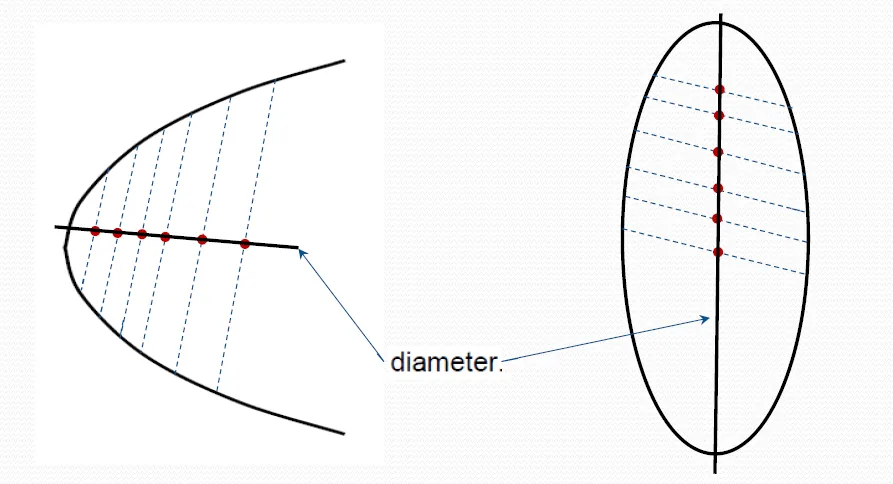
The diameter of a conic is the locus of the midpoints of a family of parallel chords drawn to the conic.
For any conic, parallel chords share a common direction.
Let the slope of these parallel chords be $m$.
To find the equation of the diameter corresponding to slope $m$:
1. Differentiate the conic equation to obtain $y'$.
2. Substitute $y' = m$ into the derivative.
3. The resulting equation represents the locus of midpoints — the diameter.
Geometrically, each chord midpoint lies on a straight line (the diameter),
and every chord in the family is parallel to the others.
Summary:
The diameter associated with slope $m$ is determined by enforcing
$$ y' = m $$
on the conic equation.
This produces a linear locus describing all midpoint positions of the parallel chords.
Diameter of an Ellipse from Chords of Equal Slope
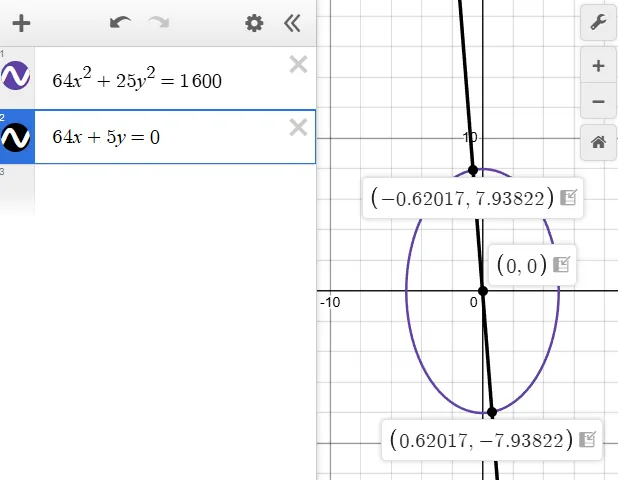
The chords of the ellipse $64x^2 + 25y^2 = 1600$ having equal slopes of $1/5$
are bisected by its diameter. Determine the equation of this diameter.
Answer: The diameter is the horizontal line $y=2$.
🧭 Jump to:
Scroll to zoom
Exam Generator Problems
Additional board-style practice items for this topic.
Question Bank: q702
MSTE - Analytic Geometry / Equation of the Diameter / Engr. Janclyde Espinosa (Clidez)
A parabola has the equation
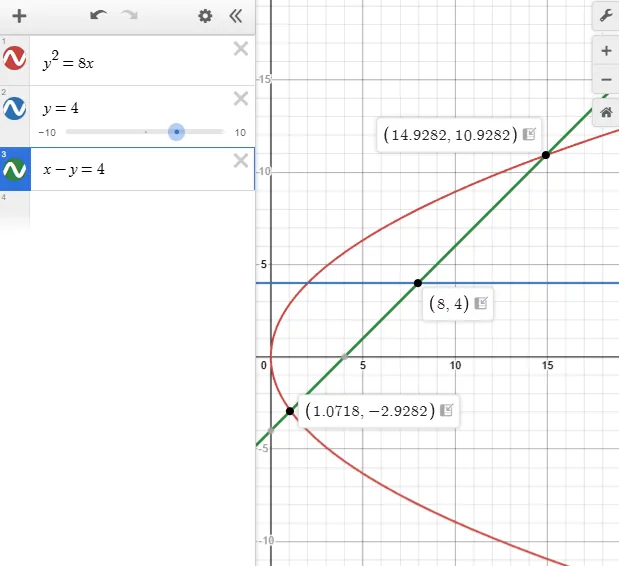
y2 = 8x
Find the equation of the diameter of the parabola which bisects chords parallel to the line x-y=4.
y = 4
y = 2
y = 3
y = 1
For $y^2=4ax$, $4a=8$ so $a=2$. The diameter bisecting chords of slope $m$ is $y=2am$. Chords parallel to $x-y=4$ have slope $m=1$. Therefore: $y=2(2)(1)$ $\boxed{y=4}$
What is the equation of the ellipse with respect to the pole whose coordinate is (-6, 4)?
$4x^2 + 9y^2 + 32x + 72y + 144 = 0$
$4x^2 + 9y^2 + 32x - 64y + 144 = 0$
$4x^2 + 9y^2 - 48x + 72y + 144 = 0$
$4x^2 + 9y^2 - 48x - 56y - 144 = 0$
What is the equation of the diameter bisecting the chords having equal slope of -1/3?
$3x - 4y = 0$
$4x - 3y = 0$
$3x + 4y = 0$
$4x + 3y = 0$
What is the equation of the diameter bisecting the chords having equal slope of 1/2?
$8x + 9y = 0$
$8x - 9y = 0$
$9x - 8y = 0$
$9x + 8y = 0$
Part 1.
Shift the origin to the pole $(-6, 4)$ via $x \to x - 6$, $y \to y + 4$ in $4x^2 + 9y^2 = 144$: $4(x-6)^2 + 9(y+4)^2 = 144$ $4x^2 - 48x + 144 + 9y^2 + 72y + 144 = 144$ $\boxed{4x^2 + 9y^2 - 48x + 72y + 144 = 0}$
Part 2.
For $\frac{x^2}{36} + \frac{y^2}{16} = 1$ ($a^2 = 36$, $b^2 = 16$), the diameter bisecting chords of slope $m$ has slope $-\frac{b^2}{a^2 m}$. With $m = -\frac{1}{3}$: $\text{slope} = -\frac{16}{36\left(-\frac{1}{3}\right)} = \frac{16}{12} = \frac{4}{3}$ So $y = \frac{4}{3}x$: $\boxed{4x - 3y = 0}$
Part 3.
Using the same rule, slope of the bisecting diameter $= -\frac{b^2}{a^2 m}$ with $m = \frac{1}{2}$: $\text{slope} = -\frac{16}{36\left(\frac{1}{2}\right)} = -\frac{16}{18} = -\frac{8}{9}$ So $y = -\frac{8}{9}x$: $\boxed{8x + 9y = 0}$
What is the equation of its diameter bisecting the chords having equal slope of -1/2?
72x - 25y = 0
36x + 25y = 0
72x + 25y = 0
72x - 50y = 0
What is the curvature of the curve at x = 3?
-1.25
-0.67
- 0.31
-0.86
What is the second eccentricity of the curve?
0.524
0.663
0.725
0.825
Part 1.
Rewrite: $\frac{x^2}{25} + \frac{y^2}{36} = 1$ ($a^2 = 25$ under $x^2$, $b^2 = 36$ under $y^2$). The diameter bisecting chords of slope $m$ has slope $-\frac{b^2}{a^2 m}$. With $m = -\frac{1}{2}$: $\text{slope} = -\frac{36}{25\left(-\frac{1}{2}\right)} = \frac{36}{12.5} = \frac{72}{25}$ So $y = \frac{72}{25}x$: $\boxed{72x - 25y = 0}$
Part 3.
For $\frac{x^2}{25} + \frac{y^2}{36} = 1$, the major semi-axis is $a = 6$ and minor $b = 5$, with $c = \sqrt{a^2 - b^2} = \sqrt{11}$. The second eccentricity uses the minor semi-axis: $e' = \frac{c}{b} = \frac{\sqrt{11}}{5}$ $\boxed{e' = 0.663}$
Question Bank: w235
MSTE - Analytic Geometry / Equation of the Diameter / MSTE April 2025
A parabola has an equation of $y^{2} = 8x$. Find the equation of the diameter of the parabola, which bisects chords parallel to the line $x - y = 4$.
$y = 2$
$y = 3$
$y = 4$
$y = 1$
The diameter of a conic is the locus of midpoints of a family of parallel chords. It passes through the points where the tangent slope equals the slope of the chords.
Slope of the chords, from $x - y = 4$ or $y = x - 4$: $y' = 1$