CE Board Exam Randomizer

⬅ Back to Analytic Geometry Topics

Hyperbola

A hyperbola is the locus of all points for which the absolute difference of the distances to two fixed points (foci) is constant.

Standard form (horizontal transverse axis):

$$ \frac{(x-h)^2}{a^2} - \frac{(y-k)^2}{b^2} = 1 $$
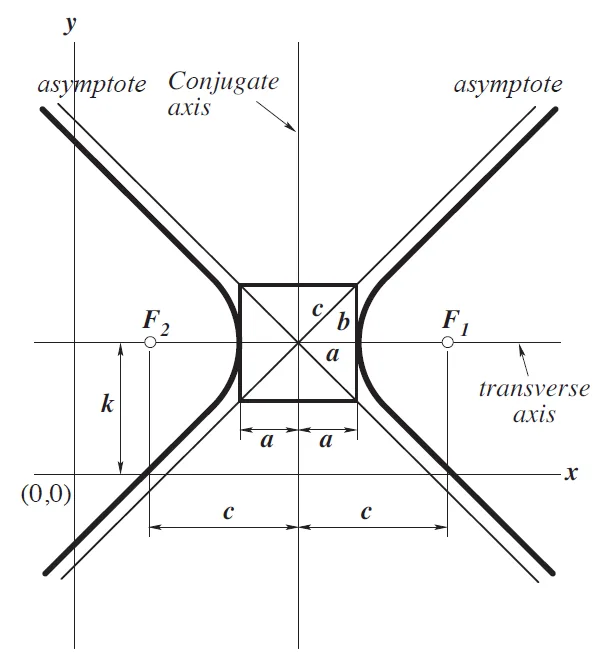
Concept

where $c^2 = a^2 + b^2$.

Standard form (vertical transverse axis):
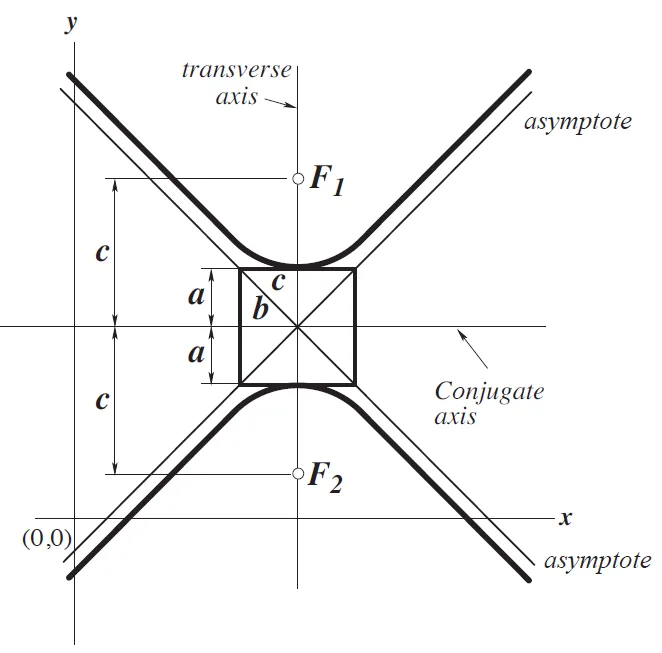
Concept
$$ \frac{(y-k)^2}{a^2} - \frac{(x-h)^2}{b^2} = 1 $$

where $c^2 = a^2 + b^2$.

The center of the hyperbola is at $(h,k)$.
Note: Equilateral hyperbolas are hyperbolas whose transverse and conjugate axes have the same length and whose asymptotes are perpendicular to each other.

Equation of asymptotes

$$ y - k = \pm \frac{a}{b}(x - h) $$

Latus rectum (latera recta) of a hyperbola:

$$ L = \frac{2b^2}{a} $$

Angle Between a Hyperbola Asymptote and the x-axis

What is the angle in degrees between an asymptote of the hyperbola $x^2 - 4y^2 - 2x - 63 = 0$ and the x-axis?

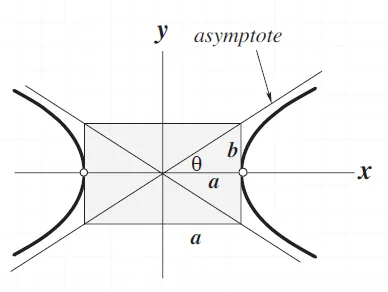
Angle Between a Hyperbola Asymptote and the x-axis – Diagram

Complete the square:

$$x^2 - 2x + 1 - 4y^2 - 63 = 1$$ $$(x - 2)^2 - 4y^2 = 64$$ $$\frac{(x - 2)^2}{64} - \frac{y^2}{16} = 1$$

Thus, $$a^2 = 64,\qquad b^2 = 16$$ $$a = 8,\qquad b = 4$$

For a horizontal hyperbola, the asymptote angle satisfies: $$\tan\theta = \frac{b}{a}$$

$$\tan\theta = \frac{4}{8} = \frac{1}{2}$$ $$\theta = 26.6^\circ$$

Final Answer:

$$\boxed{26.6^\circ}$$

Length of the Latus Rectum of a Hyperbola

The equation of an asymptote of a hyperbola is $y = 2x$, and it passes through the point $\left(\frac{5}{2},\, 3\right)$. Determine the length of the latus rectum.

Length of the Latus Rectum of a Hyperbola – Diagram

Start with the standard hyperbola: $$\frac{x^2}{a^2} - \frac{y^2}{b^2} = 1$$

Substitute the point $\left(\frac{5}{2},\, 3\right)$:

$$ \frac{\left(\frac{5}{2}\right)^2}{a^2} - \frac{3^2}{b^2} = 1 $$ $$ \frac{25}{4a^2} - \frac{9}{b^2} = 1 $$

Since the asymptote has slope $m = 2$, $$m = \frac{b}{a} \quad\Rightarrow\quad b = 2a$$

Substitute $b = 2a$:

$$ \frac{25}{4a^2} - \frac{9}{(2a)^2} = 1 $$ $$ \frac{25}{4a^2} - \frac{9}{4a^2} = 1 $$ $$ \frac{16}{4a^2} = 1 $$ $$ a^2 = 4,\quad a = 2 $$

Then: $$b = 2a = 4$$

The hyperbola becomes: $$ \frac{x^2}{4} - \frac{y^2}{16} = 1 $$

Latus Rectum Length

For a horizontal hyperbola $\dfrac{x^2}{a^2} - \dfrac{y^2}{b^2} = 1$, the latus rectum length is: $$L = \frac{2b^2}{a}$$

$$ L = \frac{2(4^2)}{2} = \frac{2 \cdot 16}{2} = 16 $$

Final Answer:

$$\boxed{16}$$

Determine the Type of Curve Defined by $Ax^2 + By^2 + F = 0$

If the curve $Ax^2 + By^2 + F = 0$ passes through the points $(0,3)$ and $(4,6)$, what kind of curve is it?

Determine the Type of Curve Defined by $Ax^2 + By^2 + F = 0$ – Diagram

Start with the general equation: $$Ax^2 + By^2 + F = 0$$ Divide by $A$: $$x^2 + \frac{B}{A}y^2 + \frac{F}{A} = 0$$

Substitute the point $(0,3)$:

$$ 0 + \frac{B}{A}(3^2) + \frac{F}{A} = 0 $$ $$ 9\frac{B}{A} + \frac{F}{A} = 0 $$ $$ \frac{F}{A} = -9\frac{B}{A} $$

Substitute the point $(4,6)$:

$$ (4)^2 + \frac{B}{A}(6^2) + \frac{F}{A} = 0 $$ $$ 16 + 36\frac{B}{A} + \frac{F}{A} = 0 $$ Substitute $\frac{F}{A} = -9\frac{B}{A}$: $$ 16 + 36\frac{B}{A} - 9\frac{B}{A} = 0 $$ $$ 16 + 27\frac{B}{A} = 0 $$ $$ \frac{B}{A} = -\frac{16}{27} $$

So the equation becomes: $$ x^2 - \frac{16}{27}y^2 - 9 = 0 $$

Multiply by 27: $$ 27x^2 - 16y^2 - 243 = 0 $$

Conclusion:

The equation has one positive and one negative squared term $$27x^2 - 16y^2 + 144 = 0$$ which is the equation of a hyperbola since A and C have opposite signs in the general form: $Ax^2+Bxy+Cy^2+Dx+Ey+F=0$.

$$\boxed{\text{The curve is a hyperbola.}}$$

Eccentricity of the Hyperbola

Find the eccentricity of the hyperbola whose equation is $$\frac{y^2}{2} - \frac{(x - 1)^2}{36} = 1$$

Eccentricity of the Hyperbola – Diagram

For a vertical hyperbola of the form $$\frac{y^2}{a^2} - \frac{(x - h)^2}{b^2} = 1,$$ we identify: $$a^2 = 2,\quad b^2 = 36.$$

So: $$a = \sqrt{2}, \qquad b = 6.$$

The relationship between $a$, $b$, and $c$ for hyperbolas is: $$c^2 = a^2 + b^2.$$

Substitute: $$c^2 = 2 + 36 = 38,$$ $$c = \sqrt{38}.$$

Eccentricity is: $$e = \frac{c}{a} = \frac{\sqrt{38}}{\sqrt{2}}.$$

Simplify: $$e = \sqrt{\frac{38}{2}} = \sqrt{19} \approx 4.4.$$

Final Answer:

$$\boxed{e \approx 4.4}$$

Foci and Asymptotes of the Hyperbola $9x^2 - 4y^2 = 36$

Find the foci and the equations of the asymptotes of the hyperbola $$9x^2 - 4y^2 = 36$$

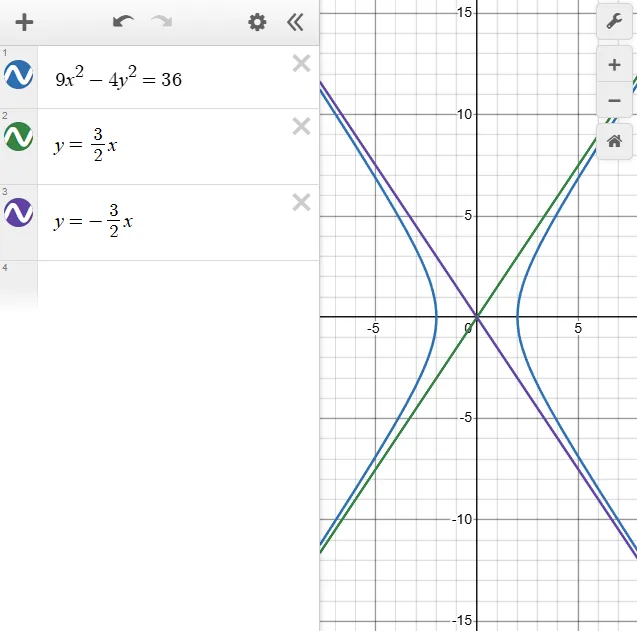
Foci and Asymptotes of the Hyperbola $9x^2 - 4y^2 = 36$ – Diagram

Step 1: Rewrite in standard form.

$$ \frac{x^2}{4} - \frac{y^2}{9} = 1 $$ Thus, $$ a^2 = 4,\quad a = 2 $$ $$ b^2 = 9,\quad b = 3 $$

Step 2: Find the foci.

For hyperbolas: $$ c^2 = a^2 + b^2 = 4 + 9 = 13 $$ $$ c = \sqrt{13} $$ Since the transverse axis is horizontal: $$ F\left(\sqrt{13},\,0\right),\quad F'\left(-\sqrt{13},\,0\right) $$

Step 3: Use the general asymptote formula.

For a hyperbola $$ \frac{(x-h)^2}{a^2} - \frac{(y-k)^2}{b^2} = 1, $$ the asymptotes are: $$ y - k = \pm \frac{b}{a}(x - h) $$ Here, the center is $(h,k) = (0,0)$. So: $$ y = \pm \frac{b}{a}x $$ Substitute $a = 2,\ b = 3$: $$ y = \pm \frac{3}{2}x $$

Final Answers:

Foci:

$$ \boxed{F(\sqrt{13},0)},\qquad \boxed{F'(-\sqrt{13},0)} $$

Asymptotes:

$$ \boxed{y = \frac{3}{2}x},\qquad \boxed{y = -\frac{3}{2}x} $$

Find the Equation, Foci, and Asymptotes of a Hyperbola with Vertices $(\pm 3,0)$ Passing Through $P(5,2)$

Find the Equation, Foci, and Asymptotes of a Hyperbola with Vertices $(\pm 3,0)$ Passing Through $P(5,2)$ – Diagram

Since the vertices are $(\pm 3,0)$, the hyperbola is centered at the origin with horizontal transverse axis, so:

$$ \frac{x^2}{a^2} - \frac{y^2}{b^2} = 1 $$

Given the vertices, $a = 3$ so:

$$ a^2 = 9 $$

Use the point $P(5,2)$:

$$ \frac{5^2}{9} - \frac{2^2}{b^2} = 1 $$ $$ \frac{25}{9} - \frac{4}{b^2} = 1 $$ $$ \frac{25}{9} - 1 = \frac{4}{b^2} $$ $$ \frac{16}{9} = \frac{4}{b^2} $$ $$ b^2 = \frac{9}{4} $$

The standard equation becomes:

$$ \frac{x^2}{9} - \frac{y^2}{\frac{9}{4}} = 1 $$

Multiply through to simplify:

$$ x^2 - 4y^2 = 9 $$

Foci

$$ c^2 = a^2 + b^2 = 9 + \frac{9}{4} = \frac{45}{4} $$ $$ c = \frac{3\sqrt{5}}{2} $$

Thus the foci are:

$$ F\left(\frac{3\sqrt{5}}{2},\,0\right),\qquad F'\left(-\frac{3\sqrt{5}}{2},\,0\right) $$

Asymptotes

General asymptote equation for a hyperbola centered at $(h,k)$:

$$ y - k = \pm \frac{b}{a}(x - h) $$

Here $(h,k) = (0,0)$, $a = 3$, $b = \frac{3}{2}$:

$$ y = \pm \frac{b}{a}x = \pm \frac{\frac{3}{2}}{3}x $$ $$ y = \pm \frac{1}{2}x $$

Final Answers

Equation of hyperbola:

$$ \boxed{x^2 - 4y^2 = 9} $$

Foci:

$$ \boxed{F\left(\frac{3\sqrt{5}}{2},0\right)},\quad \boxed{F'\left(-\frac{3\sqrt{5}}{2},0\right)} $$

Asymptotes:

$$ \boxed{y = \frac{1}{2}x},\qquad \boxed{y = -\frac{1}{2}x} $$

Find the Foci and Equations of the Asymptotes of the Hyperbola $4y^2 - 2x^2 = 1$

Find the Foci and Equations of the Asymptotes of the Hyperbola $4y^2 - 2x^2 = 1$ – Diagram

Rewrite the hyperbola in standard form:

$$ 4y^2 - 2x^2 = 1 $$ Divide by 1: $$ \frac{y^2}{\frac{1}{4}} - \frac{x^2}{\frac{1}{2}} = 1 $$ So: $$ a^2 = \frac{1}{4},\qquad b^2 = \frac{1}{2} $$

Compute $a$, $b$, and $c$.

$$ a = \frac{1}{2} $$ $$ b = \frac{1}{\sqrt{2}} = \frac{\sqrt{2}}{2} $$ For hyperbolas: $$ c^2 = a^2 + b^2 $$ $$ c^2 = \frac{1}{4} + \frac{1}{2} = \frac{3}{4} $$ $$ c = \frac{\sqrt{3}}{2} $$

Foci: For a vertical hyperbola, the foci are $(0,\pm c)$.

$$ \boxed{(0,\pm \frac{\sqrt{3}}{2})} $$

Asymptotes

General formula for a vertical hyperbola centered at $(h,k)$: $$ y - k = \pm \frac{a}{b}(x - h) $$ Here $(h,k) = (0,0)$, so: $$ y = \pm \frac{a}{b}x $$ Substitute: $$ \frac{a}{b} = \frac{\frac{1}{2}}{\frac{\sqrt{2}}{2}} = \frac{1}{\sqrt{2}} = \frac{\sqrt{2}}{2} $$ Thus: $$ \boxed{y = \pm \frac{\sqrt{2}}{2}x} $$

Final Answers

Foci:

$$ \boxed{(0,\pm \frac{\sqrt{3}}{2})} $$

Asymptotes:

$$ \boxed{y = \frac{\sqrt{2}}{2}x},\qquad \boxed{y = -\frac{\sqrt{2}}{2}x} $$

Rutherford Scattering and Hyperbolic Particle Path

In an experiment that led to the discovery of the atomic structure of matter, Lord Rutherford (1871–1937) shot high-energy alpha particles toward a thin sheet of gold. Because many were reflected, Rutherford showed the existence of the nucleus of a gold atom. The alpha particle is repelled by the nucleus at the origin; it travels along the hyperbolic path $$4x^2 - y^2 = 16.$$ How close does the particle come to the nucleus?

Rutherford Scattering and Hyperbolic Particle Path – Diagram

Rewrite the equation in standard hyperbola form:

$$ 4x^2 - y^2 = 16 $$ Divide by 16: $$ \frac{x^2}{4} - \frac{y^2}{16} = 1 $$

This is a hyperbola centered at $(0,0)$ with:

$$ a^2 = 4,\quad a = 2 $$ $$ b^2 = 16,\quad b = 4 $$

For a hyperbola of the form $$\frac{x^2}{a^2} - \frac{y^2}{b^2} = 1,$$ the shortest distance from the center to the curve (closest approach to the nucleus) occurs at the vertex $(\pm a, 0)$.

Thus, the particle comes within

$$ \boxed{a = 2} $$

units of distance from the nucleus.

Scroll to zoom