CE Board Exam Randomizer

β¬… Back to Analytic Geometry Topics

Ellipse

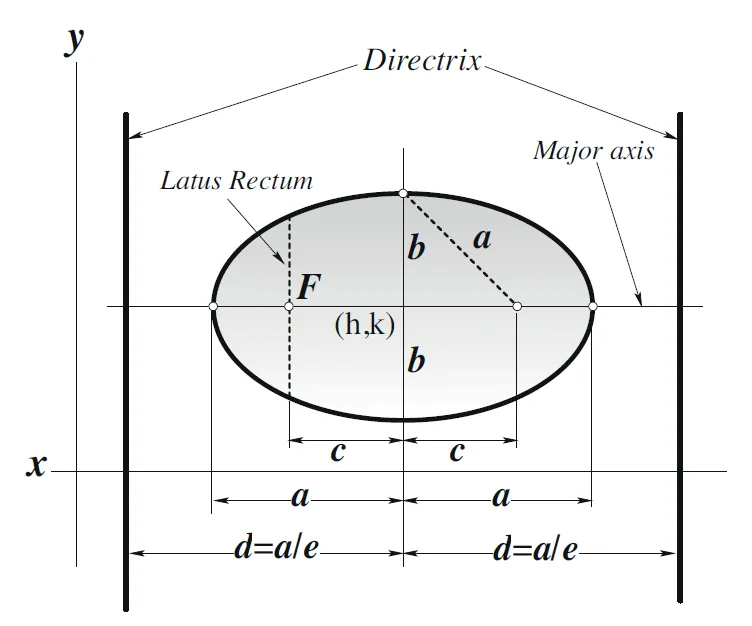
An ellipse is the locus of all points for which the sum of the distances to two fixed points (foci) is constant.

Standard form (horizontal major axis):

$$ \frac{(x-h)^2}{a^2} + \frac{(y-k)^2}{b^2} = 1 $$
Concept Concept

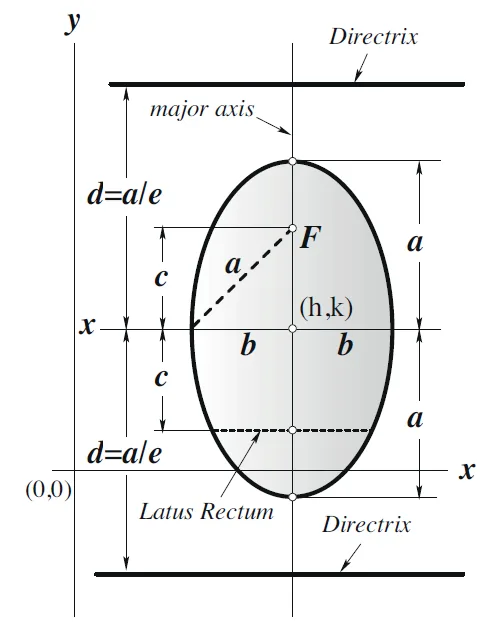
where $a^2 = b^2 + c^2$.

The center of the ellipse is at $(h,k)$.
Note: $a^2$ and $b^2$ may interchange depending on the location of the major axis.

Latus rectum (latera recta) of an ellipse:

$$ L = \frac{2b^2}{a} $$

Equation of an Ellipse with Given Vertices and Foci

Find an equation of the ellipse with vertices $(\pm 4, 0)$ and foci $(\pm 2, 0)$.

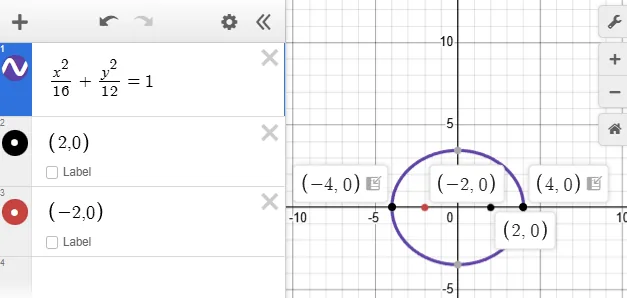
Equation of an Ellipse with Given Vertices and Foci – Diagram

Standard form of a horizontal ellipse centered at the origin: $$ \frac{x^2}{a^2} + \frac{y^2}{b^2} = 1 $$

The vertices are at $(\pm 4, 0)$, so $$ a = 4 $$

The foci are at $(\pm 2, 0)$, so $$ c = 2 $$

Relationship for ellipses: $$ a^2 = b^2 + c^2 $$

Substitute values: $$ 4^2 = b^2 + 2^2 $$ $$ 16 = b^2 + 4 $$ $$ b^2 = 12 $$

Final Equation:

$$ \boxed{\frac{x^2}{16} + \frac{y^2}{12} = 1} $$

Equation of an Ellipse with Focus at $(2,0)$ and x-intercept 5

Find an equation of the ellipse that has $(2,0)$ as a focus and an $x$-intercept of $5$.

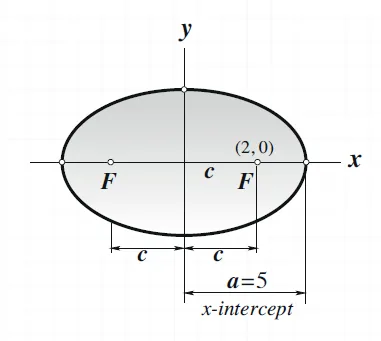
Equation of an Ellipse with Focus at $(2,0)$ and x-intercept 5 – Diagram

The ellipse is horizontal and centered at the origin, so its equation is $$ \frac{x^2}{a^2} + \frac{y^2}{b^2} = 1 $$

Since the ellipse has an $x$-intercept of $5$, $$ a = 5 $$

Given a focus at $(2,0)$, $$ c = 2 $$

For ellipses: $$ b^2 = a^2 - c^2 $$

Substitute values: $$ b^2 = 25 - 4 $$ $$ b^2 = 21 $$

Final Equation:

$$ \boxed{\frac{x^2}{25} + \frac{y^2}{21} = 1} $$

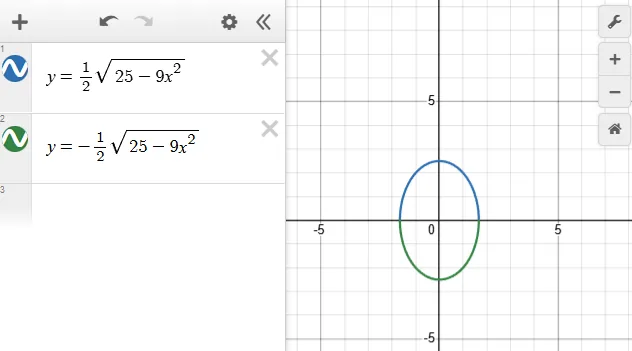
Equations for the Upper, Lower, Left, and Right Halves of the Ellipse $9x^2 + 4y^2 = 25$

Equations for the Upper, Lower, Left, and Right Halves of the Ellipse $9x^2 + 4y^2 = 25$ – Diagram

Start with the ellipse equation: $$9x^2 + 4y^2 = 25$$

Solve for $y$ to obtain the upper and lower halves:

$$4y^2 = 25 - 9x^2$$ $$y^2 = \frac{25 - 9x^2}{4}$$ $$y = \pm \frac{1}{2}\sqrt{25 - 9x^2}$$

Upper half:

$$y = \frac{1}{2}\sqrt{25 - 9x^2}$$

Lower half:

$$y = -\frac{1}{2}\sqrt{25 - 9x^2}$$ Equations for the Upper, Lower, Left, and Right Halves of the Ellipse $9x^2 + 4y^2 = 25$ – Diagram

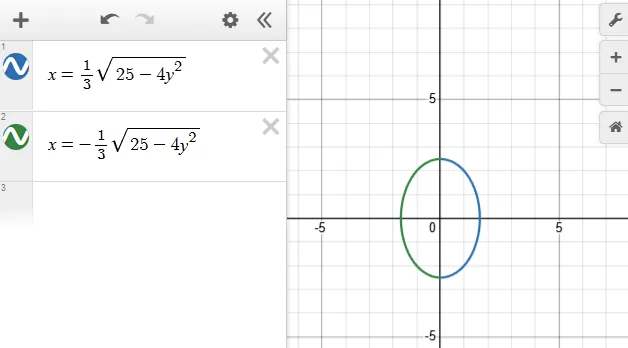
Left and Right Halves

Solve for $x$:

$$9x^2 = 25 - 4y^2$$ $$x^2 = \frac{25 - 4y^2}{9}$$ $$x = \pm \frac{1}{3}\sqrt{25 - 4y^2}$$

Left half:

$$x = -\frac{1}{3}\sqrt{25 - 4y^2}$$

Right half:

$$x = \frac{1}{3}\sqrt{25 - 4y^2}$$ Equations for the Upper, Lower, Left, and Right Halves of the Ellipse $9x^2 + 4y^2 = 25$ – Diagram

Final Answers:

Upper half: $$\boxed{y = \frac{1}{2}\sqrt{25 - 9x^2}}$$ Lower half: $$\boxed{y = -\frac{1}{2}\sqrt{25 - 9x^2}}$$ Left half: $$\boxed{x = -\frac{1}{3}\sqrt{25 - 4y^2}}$$ Right half: $$\boxed{x = \frac{1}{3}\sqrt{25 - 4y^2}}$$

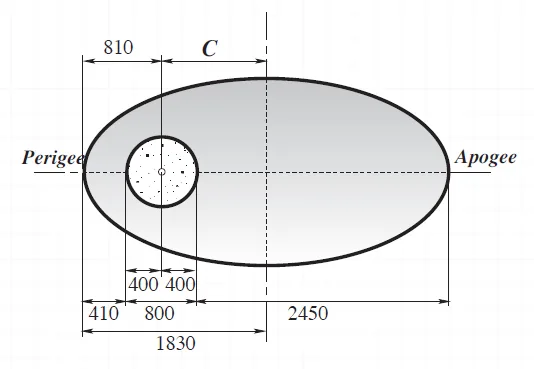
Eccentricity of a Satellite Orbit from Apogee and Perigee Distances

An earth satellite has an apogee of 2450 miles and a perigee of 410 miles. Assuming the earth’s radius is 400 miles, find the eccentricity of the ellipse whose center is at the earth's center and whose apogee and perigee satisfy these conditions.

Eccentricity of a Satellite Orbit from Apogee and Perigee Distances – Diagram

Total major axis length:

$$2a = 410 + 400 + 400 + 2450$$ $$2a = 3660$$ $$a = 1830$$

Distance between center and perigee:

$$c = a - 810$$ $$c = 1830 - 810$$ $$c = 1020$$

Using $c = ae$:

$$1020 = 1830e$$ $$e = 0.557$$

Final Answer:

$$\boxed{e = 0.557}$$

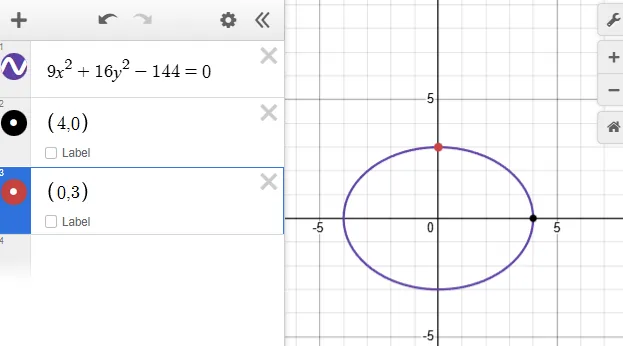
Determine the Equation of the Curve Passing Through $(4,0)$ and $(0,3)$

A curve has a general equation $$Ax^2 + By^2 + F = 0.$$ Determine the equation of the curve which passes through the points $(4,0)$ and $(0,3)$.

Determine the Equation of the Curve Passing Through $(4,0)$ and $(0,3)$ – Diagram

Step 1: Substitute $(4,0)$ into the equation.

$$A(4)^2 + B(0)^2 + F = 0$$ $$16A + F = 0$$ $$\frac{F}{A} = -16$$

Step 2: Substitute $(0,3)$.

$$A(0)^2 + B(3)^2 + F = 0$$ $$9B + F = 0$$ $$B = -\frac{F}{9}$$

Step 3: Divide original equation by $A$.

$$x^2 + \frac{B}{A}y^2 + \frac{F}{A} = 0$$

Substitute $\frac{F}{A} = -16$ and $\frac{B}{A} = \frac{16}{9}$:

$$x^2 + \frac{16}{9}y^2 - 16 = 0$$

Final Answer:

$$\boxed{9x^2 + 16y^2 - 144 = 0}$$

Clearance of a Truck Under a Semi-Elliptical Archway

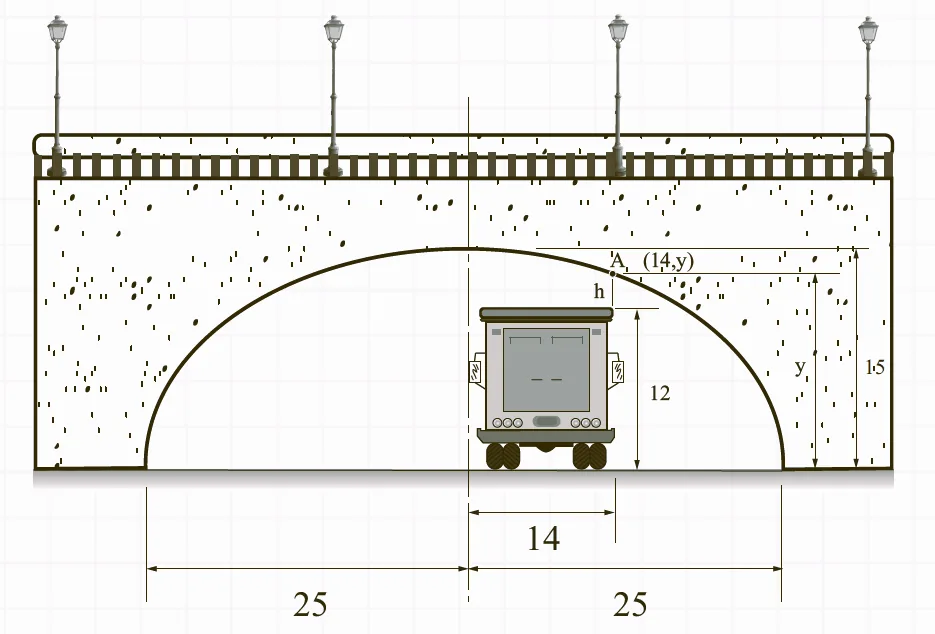
A semi-elliptical archway has a height of 15 ft at the center and a width of 50 ft. The width consists of a two-lane road. A truck drives under the archway without crossing the road centerline. If the truck is 14 ft wide and 12 ft high, determine the clearance of the truck below the archway.

Clearance of a Truck Under a Semi-Elliptical Archway – Diagram

The ellipse equation is $$\frac{x^2}{a^2} + \frac{y^2}{b^2} = 1$$ Here, the semi-major axis is $a = 25$ ft and the semi-minor axis is $b = 15$ ft: $$\frac{x^2}{25^2} + \frac{y^2}{15^2} = 1$$

The truck's right side is 14 ft from the centerline, so evaluate the arch height at $x = 14$: $$\frac{14^2}{25^2} + \frac{y^2}{15^2} = 1$$

Solve for $y$: $$y^2 = 154.44$$ $$y = 12.43 \text{ ft}$$

The truck is 12 ft tall, so clearance is: $$h = 12.43 - 12 = 0.43 \text{ ft}$$

Final Answer:

$$\boxed{0.43\text{ ft of clearance}}$$
Scroll to zoom