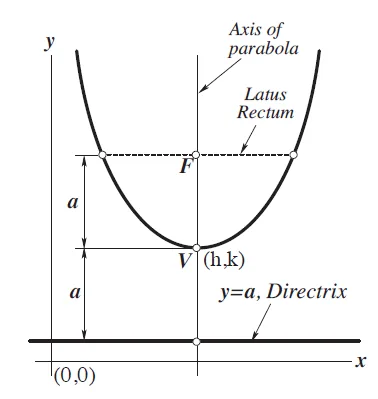
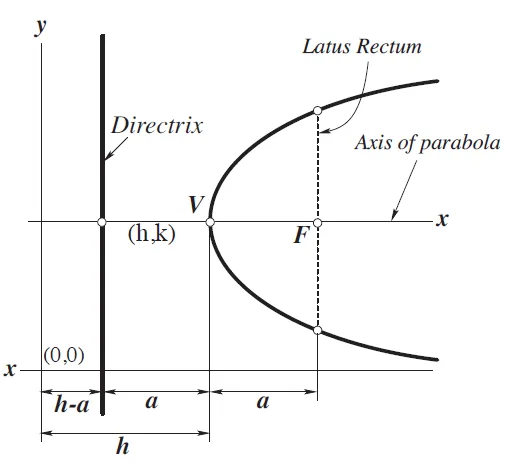
A parabola is the locus of all points equidistant from a fixed point (focus) and a fixed line (directrix).
Standard forms:
Horizontal axis:
$$ (y-k)^2 = 4a(x-h) $$
Vertical axis:
$$ (x-h)^2 = 4a(y-k) $$
(h,k) is the vertex of the parabola
Distance From the Center of a Parabolic Dish to Its Focus
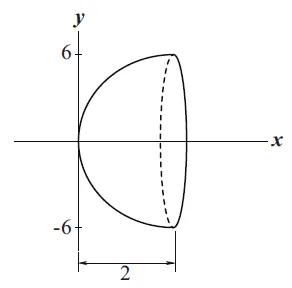
The interior of a satellite TV antenna is a dish shaped like a finite paraboloid.
The dish has a diameter of 12 meters and is 2 meters deep.
Find the distance from the center of the dish to the focus.
A vertical parabola opening to the right has the form
$$y^2 = 4ax$$
The radius of the dish is half the diameter:
$$6 \text{ meters}$$
The depth of the dish is
$$2 \text{ meters}$$
Substitute the point on the rim of the parabola:
$$y = 6, \quad x = 2.$$
Plug into the parabola equation:
$$(6)^2 = 4a(2)$$
$$36 = 8a$$
$$a = 4.5.$$
Final Answer:
$$\boxed{4.5 \text{ meters}}$$
Focus and Directrix of the Parabola
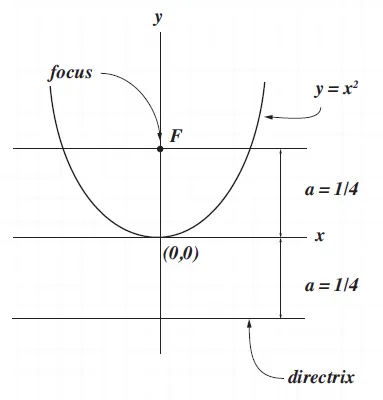
Find the focus and directrix of the parabola whose equation is
$y = x^2$
Write the parabola in the form $y = 4ax^2$
Compare coefficients:
$4a = 1$
$a = \frac{1}{4}$
The focus of $y = 4ax^2$ is
$(0, a) = \left(0, \frac{1}{4}\right)$
Height of the Gateway Arch at a Point 100 ft From Its Foundation
The shape of the Gateway Arch in St. Louis is approximately a parabola with a base of 630 ft and a height of 630 ft.
How high is the arch 100 feet from its foundation?
Using similar triangles:
$\dfrac{315^2}{630} = \dfrac{215^2}{630 - y}$
Solve for $y$:
$630 - y = 293.49$
$y = 336.50$
Final Answer:
$\boxed{337\ \text{ft}}$
Equation of a Suspension Bridge Cable and Its Height 30 m From the Center
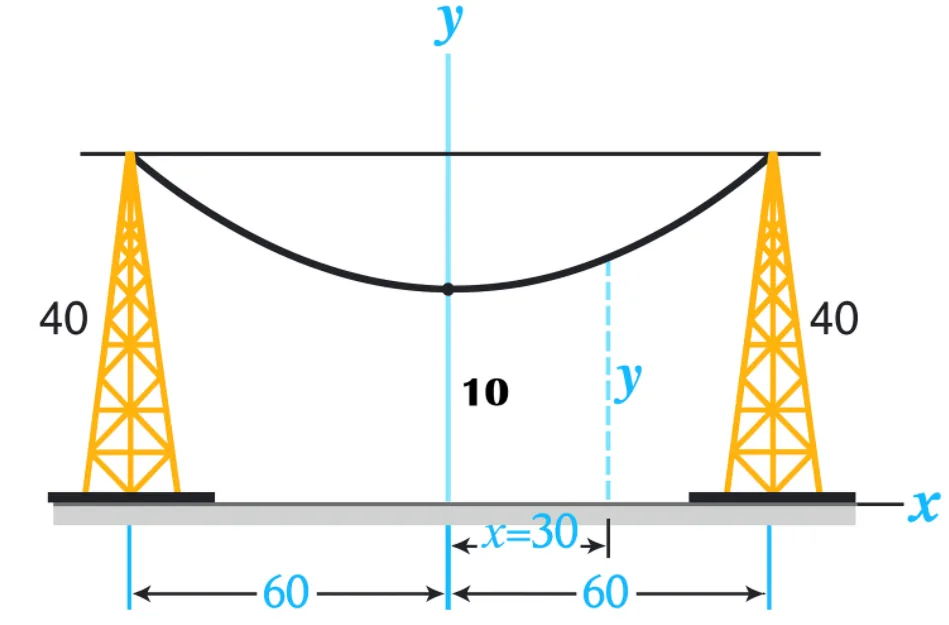
The cables of a horizontal suspension bridge are supported by two towers 120 m apart and 40 m high.
If the cable is 10 m above the floor of the bridge at the center and the midpoint of the bridge is taken as the origin,
find the equation of the parabola and the vertical distance above the bridge floor to the cable at a distance of 30 m from the center.
Vertex at the origin gives the form
$x^2 = 4a(y - 10)$
Equation of the cable:
$x^2 = 120(y - 10)$
Height at 30 m from center:
$17.5\ \text{m}$
Ceiling Height in a Parabolic Hut
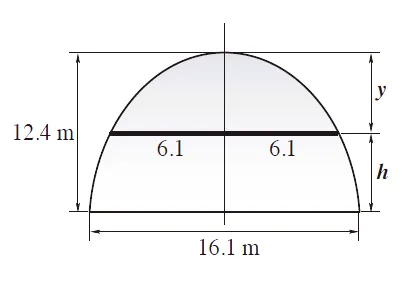
A construction worker built a parabolic hut which is 16.1 m wide at the base and 12.4 m high at the center.
How high above the base should a ceiling 12.2 m wide be constructed?
By the squared property of a parabola:
$\dfrac{8.05^2}{12.4} = \dfrac{6.1^2}{y}$
Equation of a Parabola in the Form $y = ax^2 + bx + c$
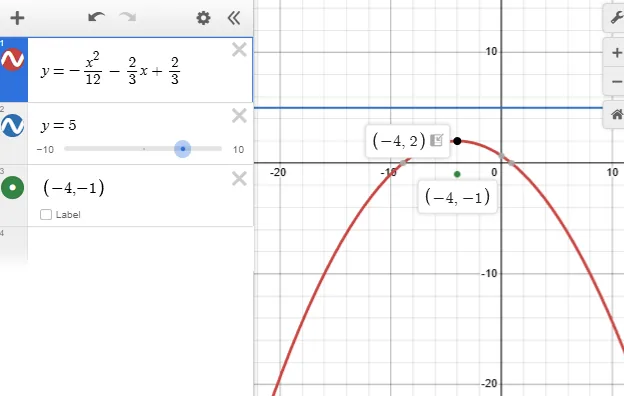
A parabola has vertex $V(-4, 2)$ and directrix $y = 5$.
Express the equation of the parabola in the form $y = ax^2 + bx + c$.
A vertical parabola opening downward has the form
$$ (x - h)^2 = -4a(y - k) $$
This opens downward because the parabola always faces away from the directrix. Since the directrix is above y=2 (vertex), the parabola is concave downward.
Equation of a Parabola With Vertex $V(2,3)$ and Passing Through $(5,1)$
Find an equation of a parabola that has vertex $V(2,3)$, has a vertical axis
(note: this means a vertical axis of symmetry), and passes through the point $(5,1)$.
Vertex form for a vertically oriented parabola:
$$ (x - h)^2 = -4a(y - k) $$
Here, $h = 2$ and $k = 3$.
Substitute the point $(5,1)$:
$$ (5 - 2)^2 = -4a(1 - 3) $$
$$ 9 = 8a $$
$$ a = \frac{9}{8} $$
Substitute $a$ back into the vertex form:
$$ y - 3 = -\frac{2}{9}(x - 2)^2 $$
Final equation:
$$ y = -\frac{2}{9}(x - 2)^2 + 3 $$
Final Answer:
$$ \boxed{\,y = -\frac{2}{9}(x - 2)^2 + 3\,} $$
Find the Vertex of the Parabola $y = 2x^2 - 6x + 4$
For a parabola $y = ax^2 + bx + c$:
$$x_\text{vertex} = -\frac{b}{2a}$$
Find a polar equation that has the same graph as the parabola x2= 8(2-y)
Answer:
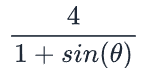
Convert the Cartesian equation to polar form using $x=r\cos\theta$ and $y=r\sin\theta$. $x^2=8(2-y)$ $r^2\cos^2\theta=16-8r\sin\theta$ Using $\cos^2\theta=1-\sin^2\theta$, this is satisfied by $r=\frac{4}{1+\sin\theta}$: $r^2\cos^2\theta=\frac{16(1-\sin^2\theta)}{(1+\sin\theta)^2}=\frac{16(1-\sin\theta)}{1+\sin\theta}$ $8(2-r\sin\theta)=16-\frac{32\sin\theta}{1+\sin\theta}=\frac{16(1-\sin\theta)}{1+\sin\theta}$ $\boxed{r=\frac{4}{1+\sin\theta}}$
Two vertices of a square are (-3, 2) and (-3, -6). Which of the following is cannot be a vertex of the square.
(-7, -2)
(5, 2)
(-11, -6)
(1, 2)
The given points $(-3,2)$ and $(-3,-6)$ are $8$ units apart on the line $x = -3$. If they are a side (length 8), the other pair is at $x = 5$ or $x = -11$: giving $(5,2)$, $(5,-6)$, $(-11,2)$, $(-11,-6)$. If they are a diagonal, the center is $(-3,-2)$ and the other diagonal (horizontal, half-length 4) gives $(1,-2)$ and $(-7,-2)$. Thus $(-7,-2)$, $(5,2)$, and $(-11,-6)$ are all possible, but $(1,2)$ fits none. $\boxed{(1,\ 2) \text{ cannot be a vertex}}$
A parabola with axis horizontal and focus along x- axis passes through (3, 4). What is the area bounded by the parabola and its latus rectum?
3.54
8.42
5.63
4.74
With vertex at the origin and horizontal axis, $y^2 = 4ax$. Through $(3, 4)$: $16 = 4a(3) \Rightarrow 4a = \frac{16}{3}, \quad a = \frac{4}{3}$ The area between the parabola and its latus rectum (from vertex to $x = a$) is: $A = \int_0^a 2\sqrt{4ax}\,dx = \frac{8}{3}a^2 = \frac{8}{3}\left(\frac{4}{3}\right)^2$ $\boxed{A = 4.74}$
The directrix of the parabola is y - 5 = 0 and its focus is at (4, -3). Find the length of its latus rectum.
16
12
2
4
The distance from the focus $(4, -3)$ to the directrix $y = 5$ is: $|{-3} - 5| = 8$ This distance equals $2a$, so $a = 4$. Length of the latus rectum: $LR = 4a = 4(4)$ $\boxed{LR = 16}$
The interior of a satellite TV antenna is a finite paraboloid with diameter 12 m and depth 2 m. Find the distance from the center of the dish to the focus.
5.8 m
4.5 m
3 m
6 m
Use $x^2=4ay$ for the parabola. With $(x,y)=(6,2)$, $36=8a$, so $a=4.5$ m.
Mines in a harbor during wartime are so placed that a ship going to a certain port within the harbor, to avoid hitting them, must follow a path which is at all times equidistant from a point 9 km north of another port and a line whose bearing is due east. One point of this line is 3 km south of the port. Considering the port as the origin, find the equation of the path of the ship.
$x^2-24y+72=0$
$x^2+24y+72=0$
$x^2-24y-72=0$
$x^2+24y-72=0$
Let $P(x,y)$ be a point on the ship's path. The focus is $F(0,9)$ and the directrix is $y=-3$. Equating the distance to the focus and directrix gives $$\sqrt{x^2+(9-y)^2}=y+3.$$ Squaring and simplifying, $$x^2+81-18y+y^2=y^2+6y+9,$$ so $$x^2-24y+72=0.$$