Circle
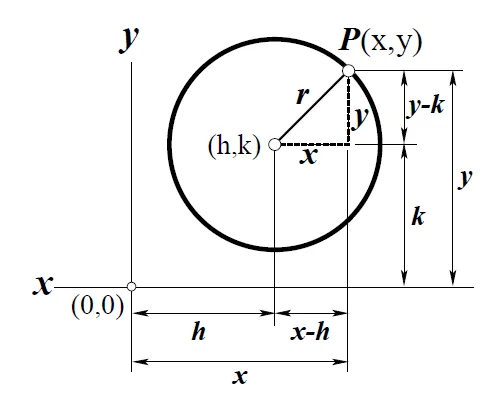
A circle is the locus of all points that are a fixed distance (radius) from a fixed point (center).
Standard form:
$$ (x - h)^2 + (y - k)^2 = r^2 $$
(h,k) is the center of the circle

A circle is the locus of all points that are a fixed distance (radius) from a fixed point (center).
Standard form:
(h,k) is the center of the circle
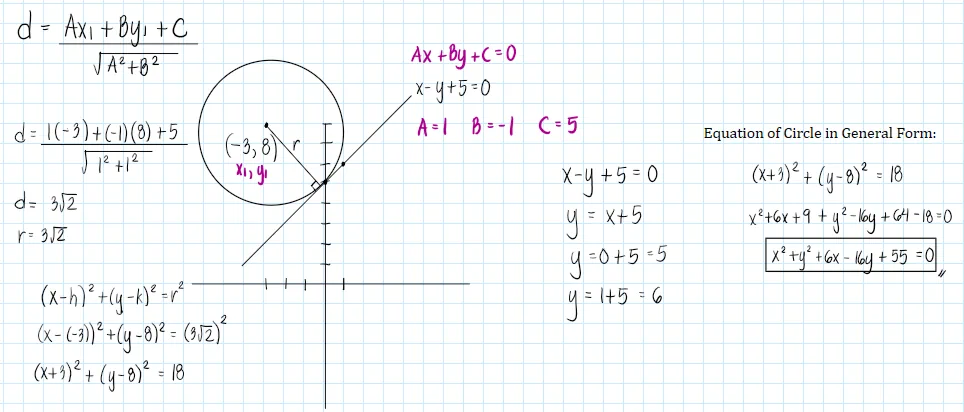
Find the equation of the circle with center at (-3,8) and tangent to the line x-y+5=0.




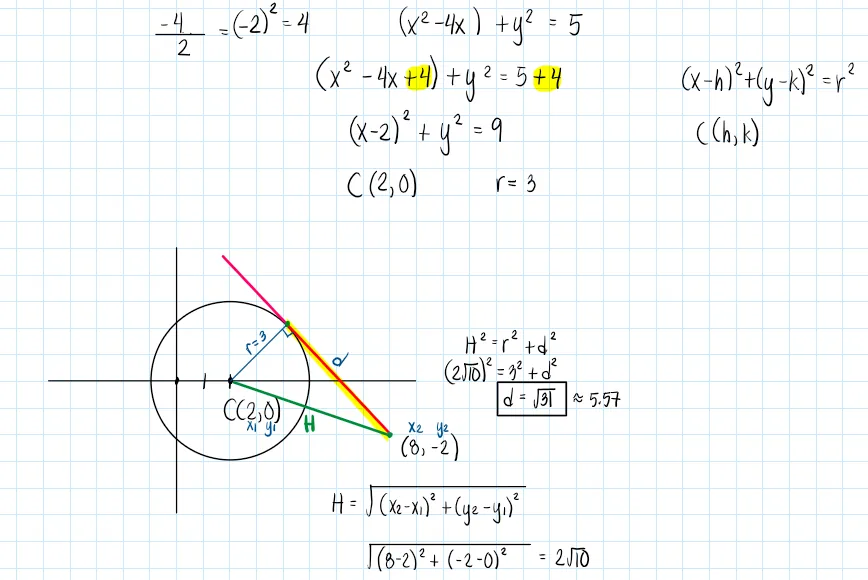
Determine the length of the tangent to the circle x2+y2-4x-5=0 from (8,-2).
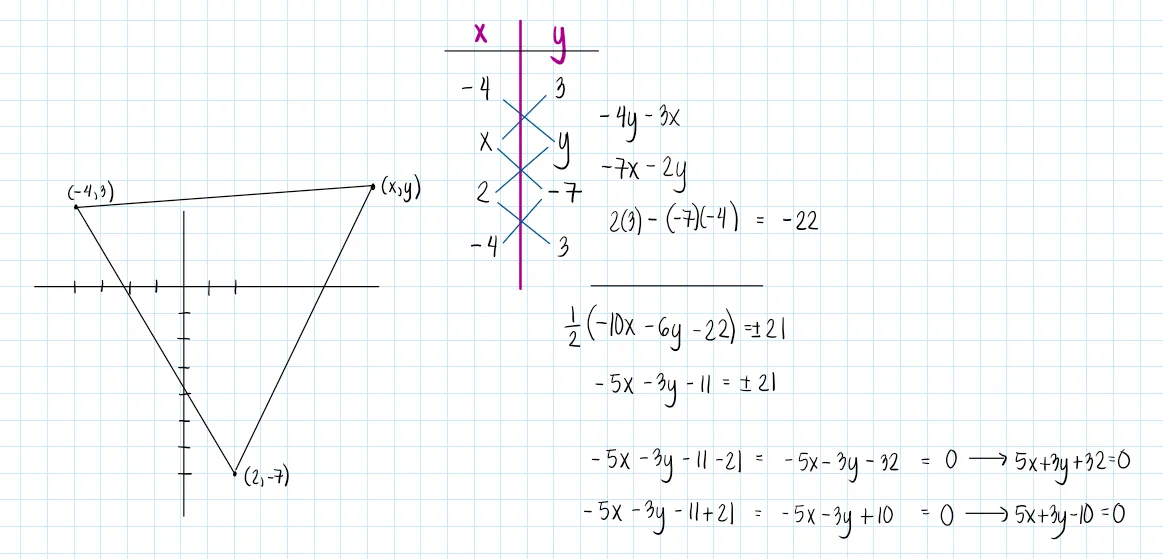
Find the locus of a moving point which forms a triangle of area 21 square units with the point (2, -7) and (-4, 3).
Ans. 5x+3y+32=0 or 5x+3y-10=0
There is a fixed circle having a radius of 6 with center at (10, 12). Find the equation of the curve connecting the centers of all circles that are tangent to the fixed circle and the x axis.
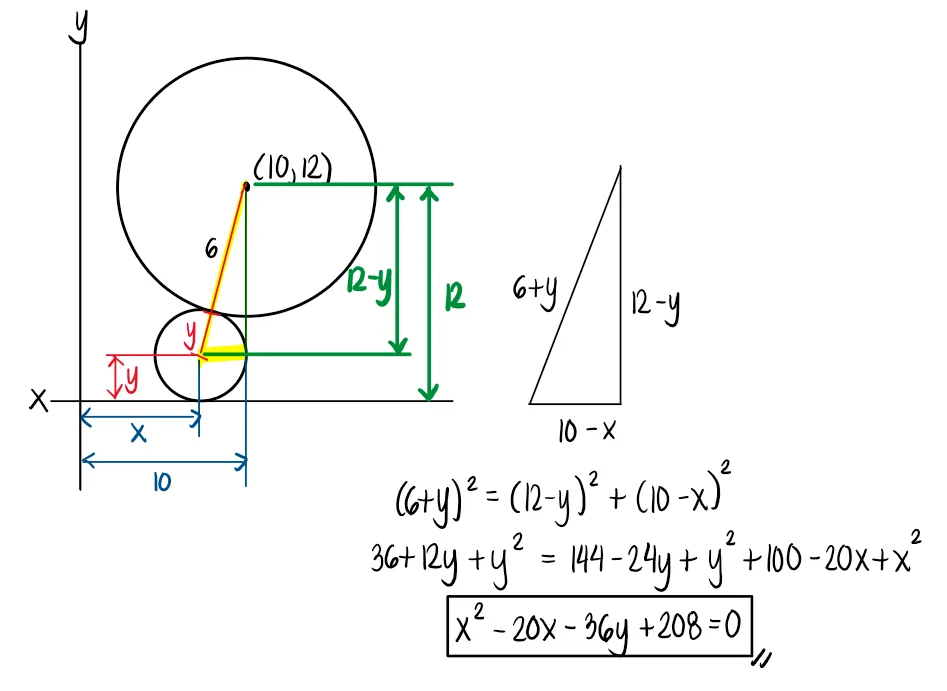
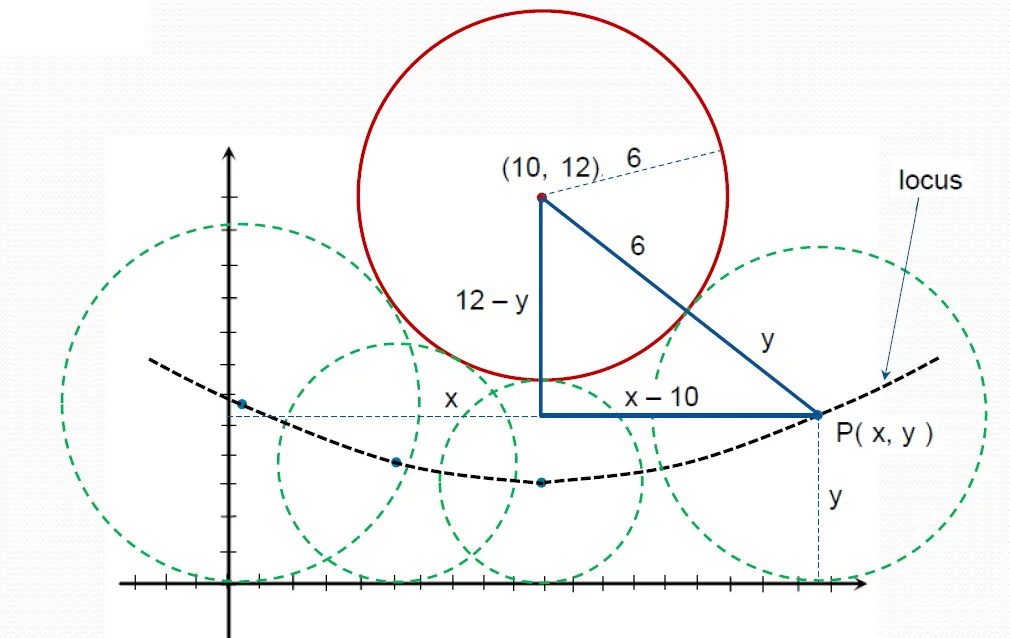
Observation: The equation is quadratic in $x$ but only first degree in $y$. A curve of the form $$Ax^2 + Ey + F = 0$$ is a parabola. Hence, the locus is a parabola.
Given the equations of two circles:
C₁: x² + y² + 2x + 4y − 3 = 0
C₂: x² + y² − 8x − 6y + 7 = 0
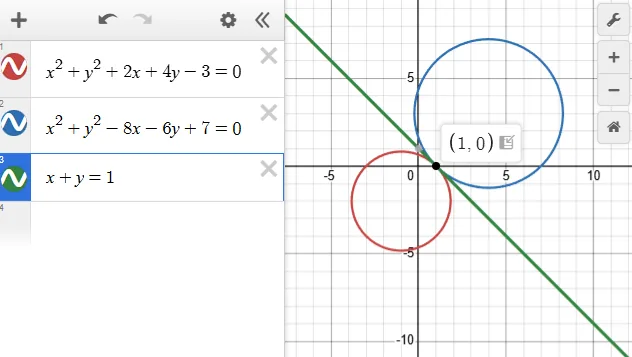
Determine the equation of the common tangent at their point of contact.

Step 1: Subtract the equations of the two circles
C₁:  x² + y² + 2x + 4y − 3 = 0
C₂:  x² + y² − 8x − 6y + 7 = 0
--------------------------------
       10x + 10y − 10 = 0
Simplifying:
$\boxed{x + y = 1}$This line is the common tangent at the point of contact.
When two circles are tangent internally or externally, their point of tangency lies on a line that is perpendicular to the line joining the centers. The key idea: The difference of the equations of two circles gives the radical axis—the locus of points having equal power with respect to both circles.
If two circles intersect at two points, the radical axis is their common chord. But if the circles touch at exactly one point (tangent), the radical axis collapses to the common tangent at the point of contact.
Therefore, since subtracting C₂ from C₁ yields a linear equation, it must represent the common tangent.
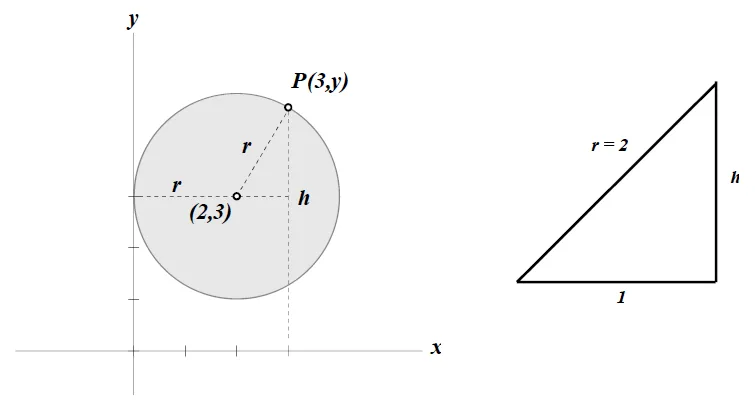
A circle has its center at (2, 3). If the circle is tangent to the y-axis and a tangent line has its point of tangency at P(3, y), determine the value of y.
Step 1: Determine the radius using the tangency to the y-axis
The distance from the center $(2,3)$ to the y-axis $(x = 0)$ is: $$ r = |2| = 2 $$
Step 2: Use the right triangle formed by the center and point of tangency
Let the point of tangency be $P(3, y)$. The horizontal distance from the center to $P$ is: $$ 3 - 2 = 1 $$
Let the vertical distance be $h$. Using the Pythagorean relationship: $$ h^2 + 1^2 = r^2 $$ $$ h^2 + 1 = 4 $$ $$ h^2 = 3 $$ $$ h = \sqrt{3} $$
Step 3: Compute the y-coordinate
$$ y = 3 + h $$ $$ y = 3 + \sqrt{3} $$
Final Answer:
$$ \boxed{y = 3 + \sqrt{3}} $$
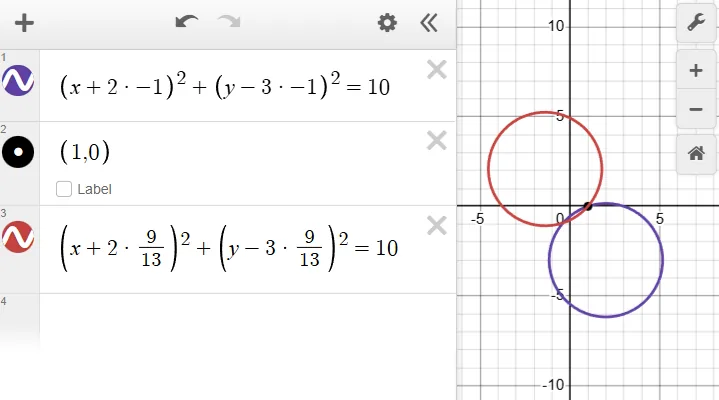
For what value of k does the circle $ (x + 2k)^2 + (y - 3k)^2 = 10 $ pass through the point (1,0)?
Substitute the point (1,0) into the circle equation:
\[ (1 + 2k)^2 + (0 - 3k)^2 = 10 \]Expand each term:
\[ (1 + 2k)^2 = 1 + 4k + 4k^2 \] \[ (-3k)^2 = 9k^2 \]Sum them:
\[ 1 + 4k + 4k^2 + 9k^2 = 10 \]Combine like terms:
\[ 13k^2 + 4k + 1 = 10 \]Move 10 to the left:
\[ 13k^2 + 4k - 9 = 0 \]Solve the quadratic:
\[ k = \frac{-4 \pm \sqrt{4^2 - 4(13)(-9)}}{2(13)} \] \[ k = \frac{-4 \pm \sqrt{16 + 468}}{26} \] \[ k = \frac{-4 \pm \sqrt{484}}{26} \] \[ k = \frac{-4 \pm 22}{26} \]Thus, the two possible values are:
\[ k = \frac{18}{26} = \frac{9}{13}, \qquad k = \frac{-26}{26} = -1 \]Final Answer:
\[ \boxed{k = -1 \quad \text{or} \quad k = \frac{9}{13}} \]
Determine the farthest distance from the point $(8,10)$ to the circle $x^2 + y^2 = 16y.$
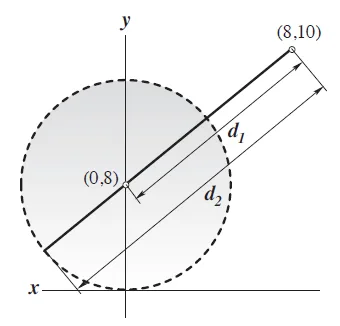
Step 1: Rewrite the circle in standard form
$$x^2 + y^2 - 16y = 0$$ Complete the square: $$x^2 + (y^2 - 16y + 64) = 64$$ $$(y - 8)^2 + x^2 = 8^2$$ The center is $(0,8)$ and the radius is $$r = 8.$$Step 2: Find the distance from the point to the center
$$d_1 = \sqrt{(8 - 0)^2 + (10 - 8)^2}$$ $$d_1 = \sqrt{64 + 4} = \sqrt{68} = 8.25$$Step 3: Farthest distance = center-to-point distance + radius
$$d_2 = d_1 + r$$ $$d_2 = 8.25 + 8 = 16.25$$Final Answer:
$$\boxed{16.25}$$Additional board-style practice items for this topic.
Two vertices of a triangle are at (2, 4) and (-2, 3) and the area is 2 square units. The locus of the third vertex is:
What is the circumference of the circle 2x^2 + 2y^2 - 3x + 5y + 2 = 0.
Given the circle: (x + 3)^2 + y^2 = 13. Find the center and radius.
What is the equation of a circle with center at (-3, 4) and passing through (3, 6).
Where is the center of the circle x^2 + y^2 + 14x - 6y + 22 = 0?
The radius of a circle is 5 and its center is at (-3, -4). Find the length of chord that is bisected at (-11/2, -13/2).
Find the farthest distance from the point (12, 2) to the circle x^2 + y^2 + 6x - 16y + 24 = 0.
What is the equation of the radical axis of the circles x^2 + y^2 = 3 and x^2 + y^2 - 6x + 6y + 11 = 0?
Find the equation of the radical axis of the circles x^2 + y^2 - 6x + 4y - 10 = 0 and 3x^2 + 3y^2 - 3x + 6y - 20 = 0.
Given the circle x^2 + y^2 + 4x - 6y - 12 = 0.
What is the location of the center of the circle?
Find the area of the circle.
Find the slope of the line tangent to the circle at (2, 6).
Part 1.
For $x^2 + y^2 + 4x - 6y - 12 = 0$, the center is $\left(-\frac{D}{2}, -\frac{E}{2}\right) = \left(-\frac{4}{2}, -\frac{-6}{2}\right)$:Part 2.
Radius: $r = \sqrt{2^2 + 3^2 + 12} = \sqrt{25} = 5$Part 3.
The tangent is perpendicular to the radius at the point of tangency.A point P(x, y) moves such that it is always twice as far from (-5, -6) as it is from (2, -3).
What is the equation of the locus of P.
Where is the center of the locus of P?
What is the area bounded by the locus of the point?
Part 1.
The condition is $\text{dist to }(-5,-6) = 2\,(\text{dist to }(2,-3))$:Part 2.
Divide the locus by 3:Part 3.
From $x^2 + y^2 - \frac{26}{3}x + 4y - 3 = 0$, center $\left(\frac{13}{3}, -2\right)$, radius:Find the equation of the line joining the points of intersection of the circles x^2 + y^2 - 4x - 20y + 68 = 0 and x^2 + y^2 - 20x - 8y + 52 = 0.
Given the circle x^2 + y^2 - 6x + 12y + 9 = 9.
What is the radius of the circle?
Where is the center of the circle?
Find the shortest distance from the line y = 2x + 10 to the center of the circle.
Part 1.
Rewrite: $x^2 + y^2 - 6x + 12y + 9 = 9 \Rightarrow x^2 + y^2 - 6x + 12y = 0$.Part 2.
From $(x-3)^2 + (y+6)^2 = 45$, the center is:The curve $y = x^2 + 1$ is symmetric with respect to:
A circle with radius of 5 has its center at (4, 8). Find the equation of the centers of family of circles tangent to the given circle and the X- axis.
A circle is defined by the equation $x^2 + y^2 + 2x - 4y = 4$.
The center of the circle is at:
Find the equation of the diameter of the circle that is parallel to the line $3x + 5y = 4$.
Find the equation of the centers of family of circles that is tangent to the given circle and the Y-axis.
Part 1.
Rewrite as $x^2 + y^2 + 2x - 4y - 4 = 0$. The center is $\left(-\frac{D}{2}, -\frac{E}{2}\right) = \left(-\frac{2}{2}, -\frac{-4}{2}\right)$:Part 2.
A diameter passes through the center $(-1, 2)$. Parallel to $3x + 5y = 4$ means the form $3x + 5y = C$:Part 3.
Let a family circle have center $(x, y)$ and radius $r$. Tangent to the Y-axis means $r = x$. Tangent (internally) to the given circle (center $(-1,2)$, radius 3) means the center distance equals $3 - r$:What is the equation of the tangent to the curve $y = 3x^3 - 15$ at $x = 2$?
Solution pending in psadquestions/t715.json.
A line is tangent to the circle $x^2 + y^2 = 25$ at (3, 4), find the length of the sub-tangent.
A line tangent to the circle $x^2 + y^2 + 6x - 16y + 24 = 0$ passes through point A(12, 2). Find the distance from the point of tangency to point A.
The polar curve $r = 3 / (3 + 2\cos\theta)$ is:
The points A(1, 0, -1), B(3, -1, -5), and C(4, 2, 0) are vertices of a triangle.
What is the area of the triangle?
What is the distance from point C to the line through A and B?
Part 1.
Area $= \frac{1}{2}|\vec{AB} \times \vec{AC}|$, with $\vec{AB} = (2, -1, -4)$ and $\vec{AC} = (3, 2, 1)$:Part 2.
The distance from $C$ to line $AB$ follows from the triangle area: $A = \frac{1}{2}(AB)(d)$.Find the vector that is perpendicular to the plane passing through the points a(1, 2, 6), b(4, 4, 1), and c(2, 3, 5).
The graph of the function $f(x) = x^2$ is translated 3 units to the left and reflected over the x-axis. If the resulting function is represented by $g(x)$, what is the value of g(5)?
Solution pending in psadquestions/t744.json.
A circle passing through (-1, 1) and (1, 3) have its center on the x-axis.
Where is the center of the circle?
What is the equation of the circle?
What is the equation of the circle with respect to translated axes whose origin is at coordinates is (-5, 7)?
Part 1.
Let the center be $(h, 0)$ on the x-axis, equidistant from both points:Part 2.
Radius squared from center $(2,0)$ to $(-1,1)$:Part 3.
Translate to the new origin $(-5, 7)$ via $x = x' - 5$, $y = y' + 7$ in $x^2 + y^2 - 4x - 6 = 0$:Given the sinusoidal curve y = a sin (bx + c) + d. Which of the following must be increased to increase the amplitude & period of the curve?
Given the sinusoidal function f(t) = 3 sin 2t. Determine the following:
The amplitude of the curve.
The period of the curve.
The frequency of the curve.
Part 1.
For $f(t) = A\sin(Bt)$, the amplitude is $|A|$.Part 2.
Period $= \frac{2\pi}{B}$ with $B = 2$:Part 3.
Frequency is the reciprocal of the period:Given the curve y = (π/2) sin (3t/2).
What is the period of the curve?
What is the frequency of the curve?
What is the amplitude of the curve?
Part 1.
For $y = A\sin(Bt)$ the period is $T = \dfrac{2\pi}{B}$. Here $B = \tfrac{3}{2}$:Part 2.
Frequency is the reciprocal of the period:Part 3.
The amplitude is the coefficient $A$ multiplying the sine:Given the curve: y = (x^2 + 1) / (x^2 - 1). Which of the following is NOT true?
Find a polar equation that has the same graph as the circle $x^2 + y^2 = 4y$.