
CE Board Exam Randomizer

⬅ Back to Analytic Geometry Topics

Conic Sections and Locus Problem Set

Locus: Equidistant From Two Points

A point moves so that it is equidistant from the points $(1,4)$ and $(5,2)$. Find the equation of its locus.

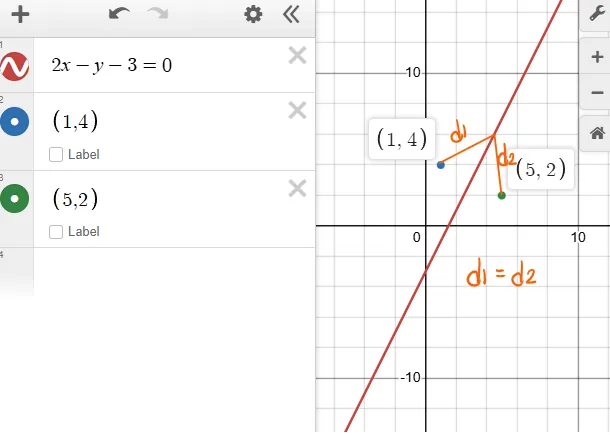
Locus: Equidistant From Two Points – Diagram

Since the point $P(x,y)$ is equidistant from $(1,4)$ and $(5,2)$:

$$ \sqrt{(x-1)^2 + (y-4)^2} = \sqrt{(x-5)^2 + (y-2)^2} $$ Square both sides: $$ (x-1)^2 + (y-4)^2 = (x-5)^2 + (y-2)^2 $$ Expand: $$ x^2 - 2x + 1 + y^2 - 8y + 16 = x^2 - 10x + 25 + y^2 - 4y + 4 $$ Combine like terms: $$ 10x - 2x - 8y + 4y - 12 = 0 $$ Simplify: $$ 8x - 4y - 12 = 0 $$ Divide by 4: $$ 2x - y - 3 = 0 $$

The locus is the line:

$$ \boxed{2x - y - 3 = 0} $$

Locus: Distance to a Point is Half the Distance to a Line

Point $P(x,y)$ moves so that its distance from the point $(0,1)$ is one half of its distance from the line $y=4$. Compute the eccentricity of the resulting curve.
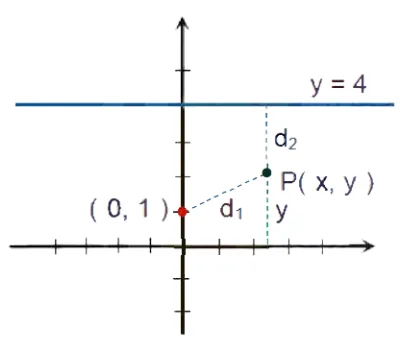
Locus: Distance to a Point is Half the Distance to a Line – Diagram

The condition is:

$$ d_1 = \tfrac12 d_2 $$ Distance to the point $(0,1)$: $$ d_1 = \sqrt{(x-0)^2 + (y-1)^2} $$ Distance to the line $y=4$: $$ d_2 = |4 - y| $$ Impose the condition: $$ \sqrt{(x)^2 + (y-1)^2} = \tfrac12 (4 - y) $$ Square both sides: $$ x^2 + (y-1)^2 = \tfrac14 (4 - y)^2 $$ Expand: $$ x^2 + y^2 - 2y + 1 = \tfrac14 (16 - 8y + y^2) $$ Multiply both sides by 4: $$ 4x^2 + 4y^2 - 8y + 4 = 16 - 8y + y^2 $$ Simplifying, we obtain the equation of an ellipse. $$ 4x^2 + 3y^2 = 12 $$ Divide by 12: $$ \frac{x^2}{3} + \frac{y^2}{4} = 1 $$ Thus the ellipse has center $(0,0)$, with: $$ a = 2,\quad b = \sqrt{3} $$ Compute $c$: $$ c^2 = a^2 - b^2 = 4 - 3 = 1 $$ $$ c = 1 $$ Eccentricity: $$ e = \frac{c}{a} = \frac12 $$

Therefore, the eccentricity is:

$$ \boxed{\frac12} $$

Problem: Parabola Locus from Focus and Directrix

Find the equation of the locus of a point that is equidistant from the focus F(2, 0) and the directrix x = -2.

$$\sqrt{(x-2)^2+y^2}=|x+2|$$
$$(x-2)^2+y^2=(x+2)^2 \Rightarrow y^2=8x$$

Answer: The locus is the parabola $y^2=8x$.

Problem: Ellipse from Constant Sum of Distances

A point moves so that the sum of its distances from (-3, 0) and (3, 0) is 10. Write the standard equation of the locus.

$$2a=10 \Rightarrow a=5,\qquad c=3$$
$$b^2=a^2-c^2=25-9=16$$

Answer: The locus is $\dfrac{x^2}{25}+\dfrac{y^2}{16}=1$.

Problem: Hyperbola from Constant Difference

The absolute difference of the distances from a point to (-5, 0) and (5, 0) is 8. Find the equation of the hyperbola.

$$2a=8 \Rightarrow a=4,\qquad c=5$$
$$b^2=c^2-a^2=25-16=9$$

Answer: The hyperbola is $\dfrac{x^2}{16}-\dfrac{y^2}{9}=1$.

Scroll to zoom

Exam Generator Problems

Additional board-style practice items for this topic.

Question Bank: t664

MSTE - Analytic Geometry / Analytic Geometry / Gemini mapped Chapter 4 to 6

Two conic sections have the following equations: x^2 + y^2 - 8x + 4y - 16 = 0, y^2 - 16x + 4y + 68 = 0.

Which of the following defines these conics?

  1. ellipse and parabola
  2. circle and parabola
  3. circle and ellipse
  4. ellipse and hyperbola the next batch of questions (46–60)!

Which of the following is a point of intersection of the conics?

  1. (5, 3.66)
  2. (6, 2.32)
  3. (6, 3.66)
  4. (5, 2.32)

What is the distance between their points of intersection?

  1. 11.875
  2. 10.932
  3. 11.314
  4. 12.342

Part 1.

The first equation, $x^2 + y^2 - 8x + 4y - 16 = 0$, has equal $x^2$ and $y^2$ coefficients → a circle.
The second, $y^2 - 16x + 4y + 68 = 0$, has only a $y^2$ term (no $x^2$) → a parabola.
$\boxed{\text{circle and parabola}}$

Part 2.

From the circle, $y^2 + 4y = -x^2 + 8x + 16$; from the parabola, $y^2 + 4y = 16x - 68$. Equate:
$16x - 68 = -x^2 + 8x + 16 \Rightarrow x^2 + 8x - 84 = 0 \Rightarrow x = 6$ (real root)
Substitute into the parabola: $y^2 + 4y - 28 = 0 \Rightarrow y = -2 \pm \sqrt{32}$
$y = 3.66$ or $y = -7.66$, giving:
$\boxed{(6,\ 3.66)}$

Part 3.

Both intersection points share $x = 6$, with $y = 3.66$ and $y = -7.66$. The distance is the difference in $y$:
$d = 3.66 - (-7.66) = 2\sqrt{32}$
$\boxed{d = 11.314}$

Question Bank: t668

MSTE - Analytic Geometry / Analytic Geometry / Gemini mapped Chapter 4 to 6

What is the focal length of the parabola $y^2 + 8x - 6y + 25 = 0$?

  1. 6
  2. 8
  3. 4
  4. 2
Complete the square in $y$:
$y^2 - 6y = -8x - 25$
$(y - 3)^2 = -8x - 16 = -8(x + 2)$
Comparing with $(y - k)^2 = 4ax$, $4a = 8 \Rightarrow a = 2$.
The focal length (vertex-to-focus distance) is:
$\boxed{a = 2}$

Question Bank: t675

MSTE - Analytic Geometry / Analytic Geometry / Gemini mapped Chapter 4 to 6

Given the parabola $y = x^2 - 2x + 3$. What is the abscissa of the point in the parabola where the tangent is normal to the line $x + 3y + 3 = 0$?

  1. -5/2
  2. -2/5
  3. 2/5
  4. 5/2
The line $x + 3y + 3 = 0$ has slope $-\frac{1}{3}$. A tangent that is normal (perpendicular) to it has slope $3$.
For $y = x^2 - 2x + 3$: $\frac{dy}{dx} = 2x - 2$.
Set equal to $3$:
$2x - 2 = 3 \Rightarrow 2x = 5$
$\boxed{x = \frac{5}{2}}$

Question Bank: t695

MSTE - Analytic Geometry / Analytic Geometry / Gemini mapped Chapter 4 to 6

Determine the equation of the curve such that the sum of the distances of any point of the curve from two points whose coordinates are (-3, 0) and (3, 0) is always equal to 8.

  1. 4x^2 + 49y^2 - 343 = 0
  2. 7x^2 - 16y^2 - 112 = 0
  3. 7x^2 + 16y^2 + 112 = 0
  4. 7x^2 + 16y^2 - 112 = 0
The constant sum of distances to two fixed points (foci) defines an ellipse, with $2a = 8 \Rightarrow a = 4$ and foci at $(\pm 3, 0)$ so $c = 3$.
$b^2 = a^2 - c^2 = 16 - 9 = 7$
$\frac{x^2}{16} + \frac{y^2}{7} = 1$
Multiply by 112:
$\boxed{7x^2 + 16y^2 - 112 = 0}$

Question Bank: t727

MSTE - Analytic Geometry / Analytic Geometry / Gemini mapped Chapter 4 to 6

Find the distance of the following points in three- dimensional space: (0, 0, 0) and (5, 6, 7).

  1. 10.49
  2. 12.76
  3. 11.76
  4. 9.54
3-D distance formula:
$d = \sqrt{5^2 + 6^2 + 7^2} = \sqrt{25 + 36 + 49} = \sqrt{110}$
$\boxed{d = 10.49}$

Question Bank: t749

MSTE - Analytic Geometry / Analytic Geometry / Gemini mapped Chapter 4 to 6

Which of the following curves has twice the amplitude but half the period than the curve $y = \sin x$?

  1. $y = 2 \sin (2x)$
  2. $y = 2 \sin (x/2)$
  3. $y = \sin (2x)$
  4. $y = 2 \sin (x)$
For $y = A\sin(Bx)$: amplitude is $A$ and period is $\frac{2\pi}{B}$.
Twice the amplitude of $y=\sin x$ means $A = 2$. Half the period means $\frac{2\pi}{B} = \frac{2\pi}{2}$, so $B = 2$.
$\boxed{y = 2\sin(2x)}$