Conic Sections — Definitions, Locus, and General Equation
General Second-Degree Equation of a Conic
Any conic section can be represented by the general quadratic equation:
$$ Ax^2 + Bxy + Cy^2 + Dx + Ey + F = 0 $$
The presence of the $Bxy$ term indicates a possible rotation of axes.
Circles, ellipses, parabolas, and hyperbolas can all appear rotated when $B \neq 0$.
How to Distinguish Conics Using A, B, and C
Ignoring rotation (or after rotating axes so that $B = 0$), the nature of the conic is determined by the signs of $A$ and $C$:
Circle: $A = C$ and $B = 0$
Ellipse: $A$ and $C$ have the same sign but not equal
Parabola: either $A = 0$ or $C = 0$ (but not both)
Hyperbola: $A$ and $C$ have opposite signs
With rotation included ($B \neq 0$), the classification is done using the discriminant:
$$ \Delta = B^2 - 4AC $$
Ellipse: $\Delta < 0$ (includes circles)
Parabola: $\Delta = 0$
Hyperbola: $\Delta > 0$
Eccentricity of Conic Sections
The eccentricity of a conic section describes the shape and “flatness” of the curve.
It is defined as:
$$ e = \frac{\text{distance to focus}}{\text{distance to directrix}} $$
This value fully determines the nature of the conic:
Circle: $e = 0$
Ellipse: $0 < e < 1$
Parabola: $e = 1$
Hyperbola: $e > 1$
1. Eccentricity of an Ellipse
For the ellipse
$$ \frac{(x-h)^2}{a^2} + \frac{(y-k)^2}{b^2} = 1, $$
the first eccentricity is:
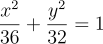
Determine the distance between the foci of the following ellipse:
Answer:
4
2
3
8
The ellipse shown is: $$\frac{x^2}{36}+\frac{y^2}{32}=1$$ For an ellipse, $a^2$ is the larger denominator and $c^2=a^2-b^2$. Thus: $$a^2=36,\qquad b^2=32$$ $$c^2=36-32=4\quad\Rightarrow\quad c=2$$ The foci are $2c$ units apart, so: $$2c=2(2)=4$$
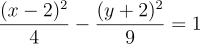
The hyperbola shown is: $$\frac{(x-2)^2}{4}-\frac{(y+2)^2}{9}=1$$ This has the standard horizontal form: $$\frac{(x-h)^2}{a^2}-\frac{(y-k)^2}{b^2}=1$$ where $(h,k)=(2,-2)$, $a=2$, and $b=3$. Its asymptotes are: $$y-k=\pm\frac ba(x-h)$$ $$y+2=\pm\frac32(x-2)$$ One of the asymptotes is therefore: $$\boxed{y+2=\frac32(x-2)}$$
A construction worker built a parabolic hut which is 16.1 m wide at the base and 12.4 m high at the center. How high above the base should a ceiling 12.2 m wide be constructed?
Answer:
5.28
7.12
6.86
4.32
Model the hut as a downward parabola with vertex height 12.4 m and half-width 8.05 m at the base: $y=12.4\left(1-\frac{x^2}{8.05^2}\right)$ A 12.2-m ceiling has half-width $x=6.1$ m: $y=12.4\left(1-\frac{6.1^2}{8.05^2}\right)$ $\boxed{5.28\text{ m}}$
The eccentricity of an ellipse is 0.6 and the distance between its foci is 6 units. Find the distance between its directrices.
8.33
15.67
16.67
21.33
Distance between foci $2c = 6 \Rightarrow c = 3$. Eccentricity $e = \frac{c}{a} = 0.6 \Rightarrow a = \frac{3}{0.6} = 5$. Directrices are at $x = \pm\frac{a}{e}$, so their separation is: $\frac{2a}{e} = \frac{2(5)}{0.6}$ $\boxed{16.67}$
Find the distance from the end of the major axis to the end of the minor axis of the ellipse $9x^2 + 25y^2 - 225 = 0$.
5.83
4.27
6.32
2.00 numbers the sub-questions as 2, 3, and 3 instead of 1, 2, and 3. This has been transcribed exactly as it appears in the source material.)
Rewrite: $\frac{x^2}{25} + \frac{y^2}{9} = 1$, so $a = 5$ (major) and $b = 3$ (minor). End of major axis $(5, 0)$, end of minor axis $(0, 3)$. Distance: $d = \sqrt{5^2 + 3^2} = \sqrt{34}$ $\boxed{d = 5.83}$
A sphere of radius 15 units have its center at the origin. Given three points P1(6, 8, 9), P2(5, 8, 10), and P3(4, 3, 12). Which of the following is/are inside the sphere.
P2 and P3 only
P1 only
P1, P2, and P3
P1 and P2 only
A point is inside the sphere if $x^2 + y^2 + z^2 < R^2 = 225$. $P_1: 36 + 64 + 81 = 181$ $P_2: 25 + 64 + 100 = 189$ $P_3: 16 + 9 + 144 = 169$ All are less than 225, so all three lie inside. $\boxed{P_1, P_2, \text{ and } P_3}$
A sphere of radius 6 units have its center at the origin. Which of the following points is outside the sphere?
(3, 1, 4)
(2, 5, 1)
(3, 4, 3)
(2, 4, 5)
A point is outside the sphere if $x^2 + y^2 + z^2 > R^2 = 36$. $(3,1,4): 9+1+16 = 26$ $(2,5,1): 4+25+1 = 30$ $(3,4,3): 9+16+9 = 34$ $(2,4,5): 4+16+25 = 45 > 36$ $\boxed{(2,\ 4,\ 5)}$
Question Bank: t2102
MSTE - Analytic Geometry / Conic Sections / Besavilla CE Pre-Board Math & Surveying
Find the equation of the circle whose center is on the x-axis and which passes through the points (1, 3) and (4, 6).
$x^2 + y^2 + 14x + 3 = 0$
$x^2 + y^2 - 12x + 4 = 0$
$x^2 + y^2 - 14x + 5 = 0$
$x^2 + y^2 + 14x + 4 = 0$
$x^2 + y^2 - 14x + 4 = 0$
Let the center be $(h,0)$ since it lies on the x-axis. Equal distances to $(1,3)$ and $(4,6)$ give $(1-h)^2+3^2=(4-h)^2+6^2$ $h=7$ Radius squared: $R^2=(1-7)^2+3^2=45$ Circle equation: $(x-7)^2+y^2=45$ $\boxed{x^2+y^2-14x+4=0}$
Question Bank: t2104
MSTE - Analytic Geometry / Conic Sections / Besavilla CE Pre-Board Math & Surveying
Find the equations of the tangents to the circle $x^2 + y^2 = 5$ which make an angle of 45° with the x-axis.
$x + y = \pm\sqrt{10}$
$x - y = \pm\sqrt{10}$
$x - y = \frac{\sqrt{10}}{2}$
$x^2 - y^2 = \pm\sqrt{10}$
$x + y = \pm 5$
A line making $45^\circ$ with the x-axis has slope 1, so write it as $y=x+b$, or $x-y+b=0$. For tangency to $x^2+y^2=5$, the distance from the center $(0,0)$ to the line must equal the radius $\sqrt5$. $\frac{|b|}{\sqrt{1^2+(-1)^2}}=\sqrt5$ $|b|=\sqrt{10}$ Thus $x-y=\pm\sqrt{10}$. $\boxed{x-y=\pm\sqrt{10}}$
Question Bank: t2106
MSTE - Analytic Geometry / Conic Sections / Besavilla CE Pre-Board Math & Surveying
Find the equation of the hyperbola with center (1, 3), vertex (4, 3) and end of conjugate axis (1, 1).
$4x^2 - 3y^2 - 4x + 50y - 113 = 0$
$4x^2 - 9y^2 - 8x + 54y - 113 = 0$
$4x^2 - 6y^2 - 6x + 64y - 113 = 0$
$4x^2 - 9y^2 - 10x + 58y - 113 = 0$
$4x^2 - 9y^2 - 9x + 56y - 113 = 0$
The center is $(1,3)$. Since the vertex is $(4,3)$, the transverse axis is horizontal and $a=3$. The end of the conjugate axis is $(1,1)$, so $b=2$. Standard form: $\frac{(x-1)^2}{9}-\frac{(y-3)^2}{4}=1$ Multiply by 36: $4(x-1)^2-9(y-3)^2=36$ Expand and simplify: $\boxed{4x^2-9y^2-8x+54y-113=0}$
Question Bank: t2107
MSTE - Analytic Geometry / Conic Sections / Besavilla CE Pre-Board Math & Surveying
A circular rotonda passes through the three points A(-4, 3), B(2, 1) and C(-2, -5). Determine the radius of this circular rotonda.
5.58
3.26
6.15
4.87
4.27
Use the circle form $x^2+y^2+Dx+Ey+F=0$ and substitute the three points. For $A(-4,3)$: $25-4D+3E+F=0$ For $B(2,1)$: $5+2D+E+F=0$ For $C(-2,-5)$: $29-2D-5E+F=0$ Solving gives $D=\frac{42}{11}$ and $E=\frac{16}{11}$, so the center is $\left(-\frac{21}{11},-\frac{8}{11}\right)$. Radius using point $B$: $R=\sqrt{\left(2+\frac{21}{11}\right)^2+\left(1+\frac{8}{11}\right)^2}$ $\boxed{R\approx4.27}$
Question Bank: t2170
MSTE - Analytic Geometry / Conic Sections / Besavilla CE Pre-Board Math & Surveying
Determine the equation of the radical axis of the circles $x^2 + y^2 - 18x - 14y + 121 = 0$ and $x^2 + y^2 - 6x + 6y + 14 = 0$.
$12x + 20y - 107 = 0$
$12x + 20y + 107 = 0$
$12x - 20y - 107 = 0$
$12x - 20y + 107 = 0$
$12x - 20y + 105 = 0$
For the radical axis, subtract the second circle equation from the first so the $x^2$ and $y^2$ terms cancel. $(x^2+y^2-18x-14y+121)-(x^2+y^2-6x+6y+14)=0$ $-12x-20y+107=0$ Multiplying by $-1$ gives $\boxed{12x+20y-107=0}$
A parabolic dish is in the form of a paraboloid 12 m in diameter and 2 m deep. Find the distance of the receiver from the vertex of the paraboloid.
2.6
4.5
6.25
4.0
With the vertex at the origin and $y^2 = 4ax$, the rim point is $(2, 6)$ (depth 2 m, radius 6 m): $6^2 = 4a(2) \Rightarrow a = 4.5$ The receiver sits at the focus: $\boxed{a = 4.5\text{ m}}$