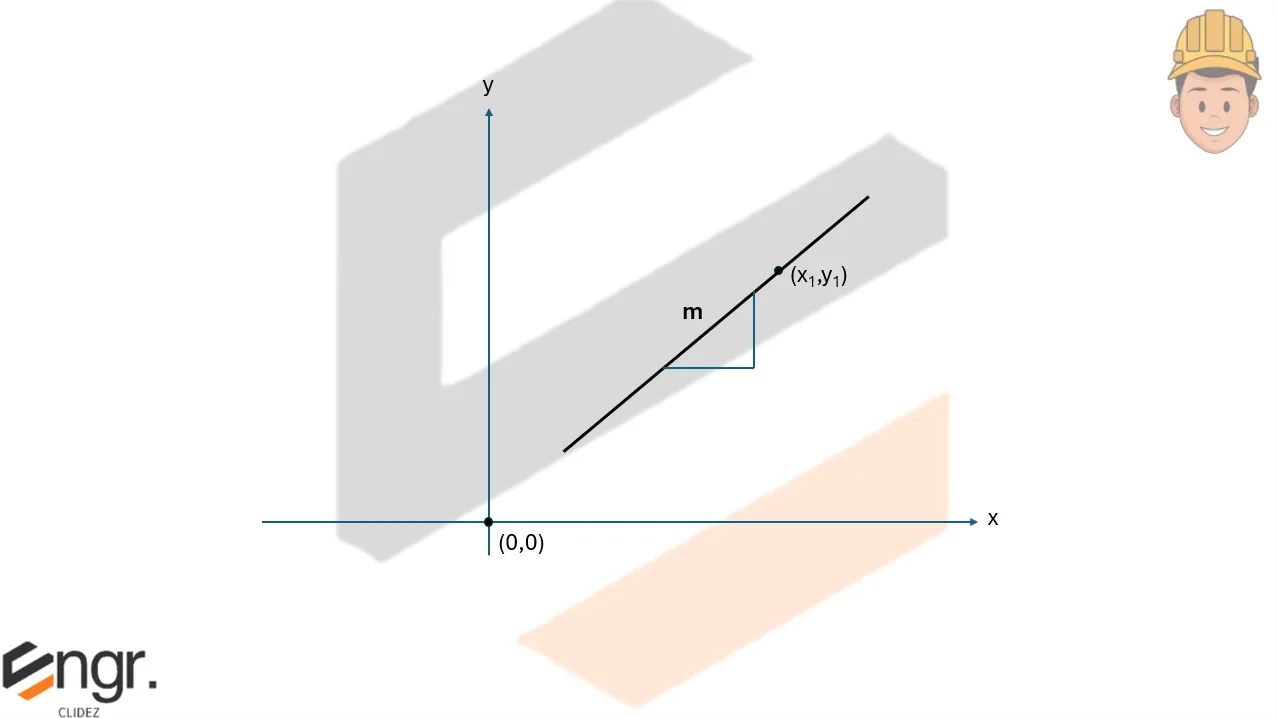
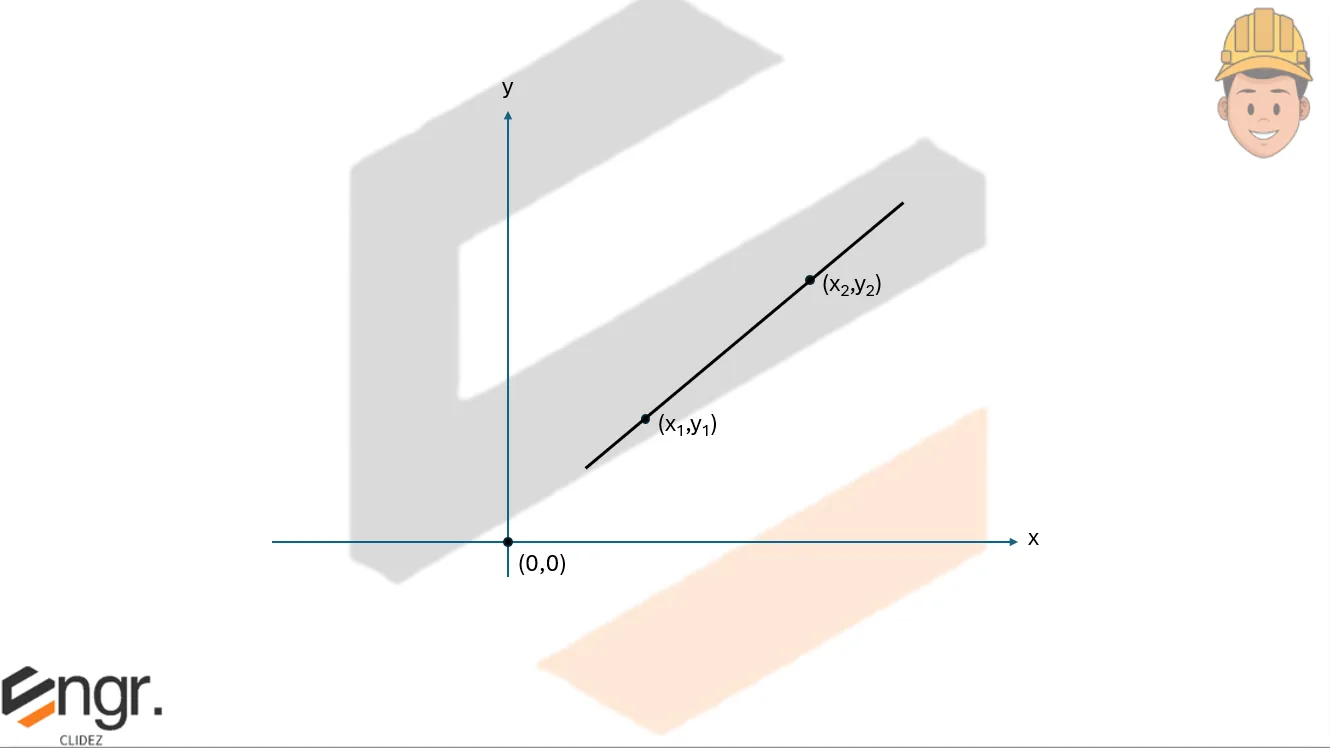
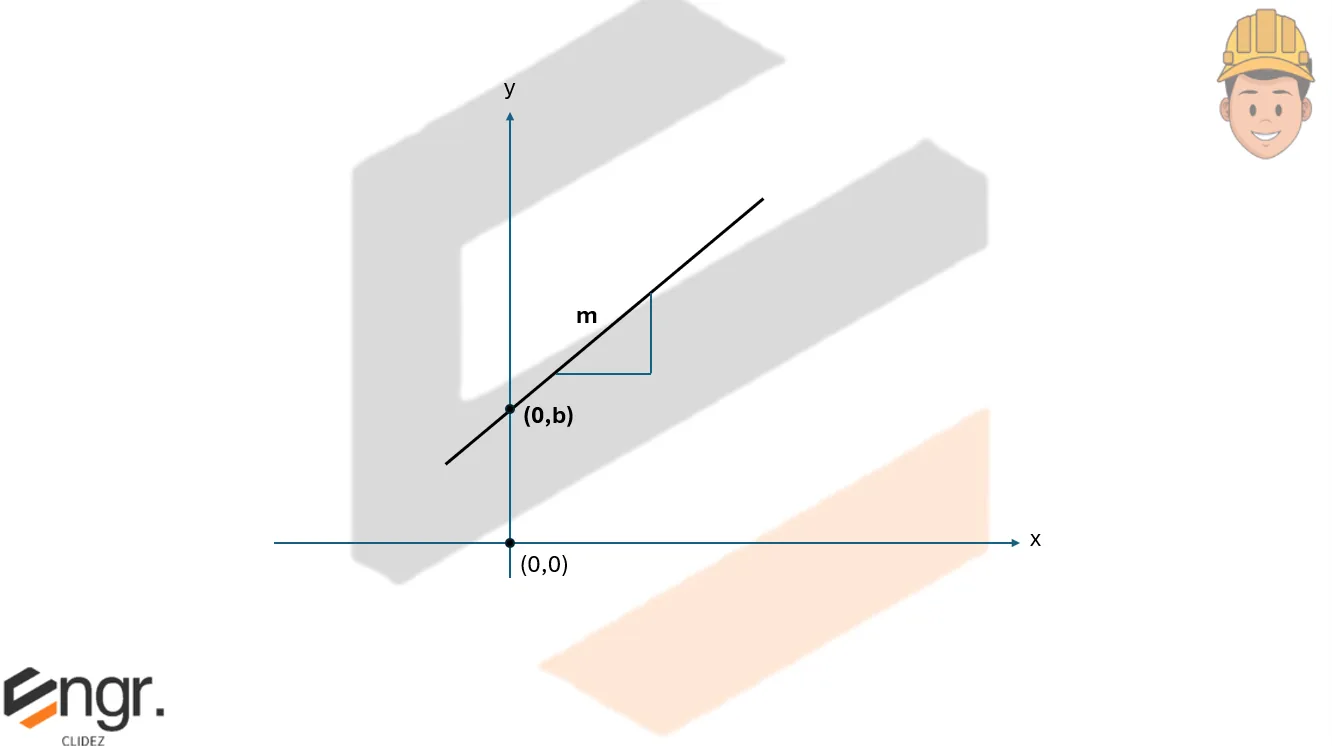
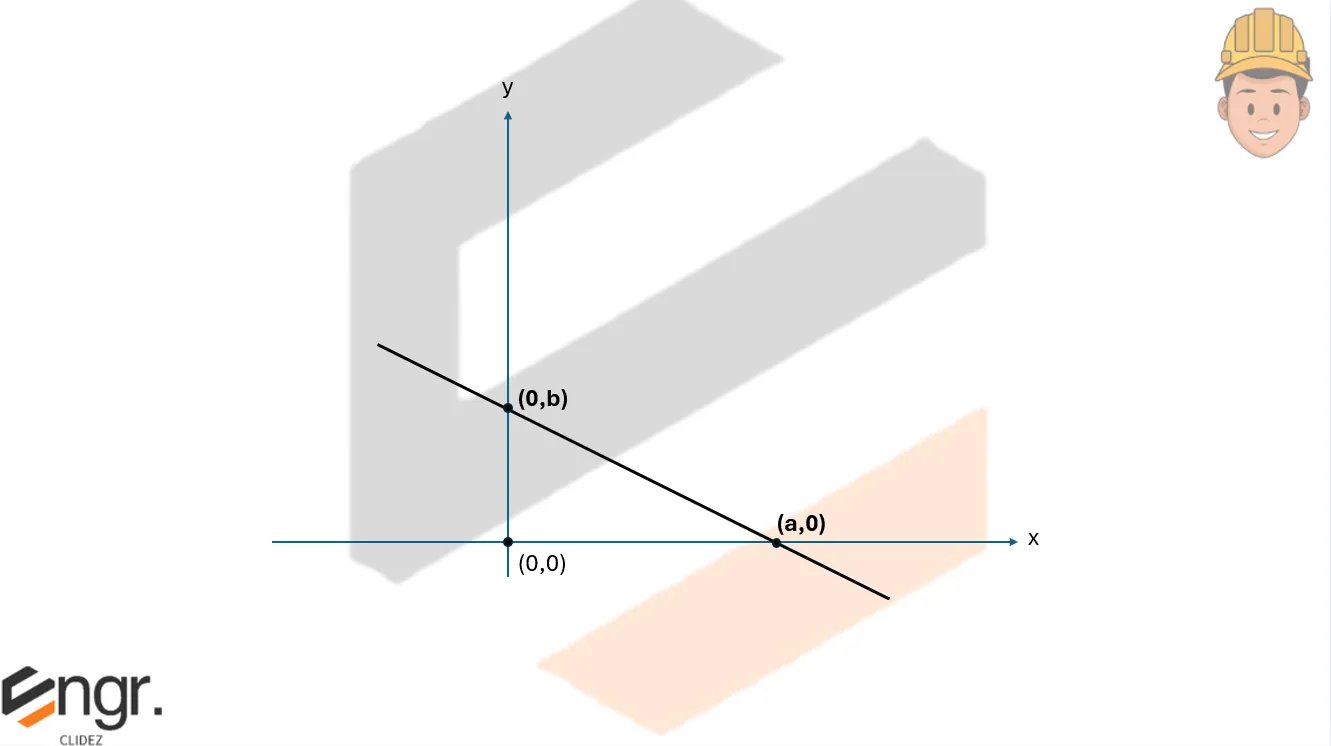
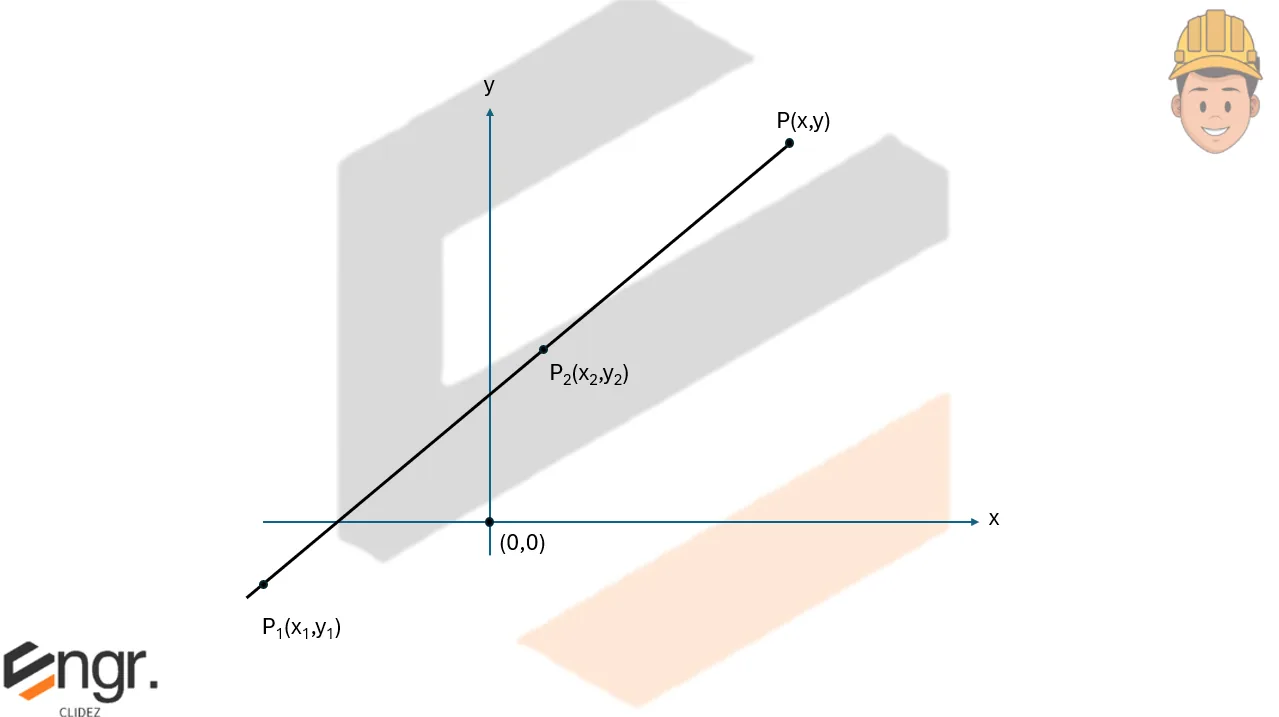
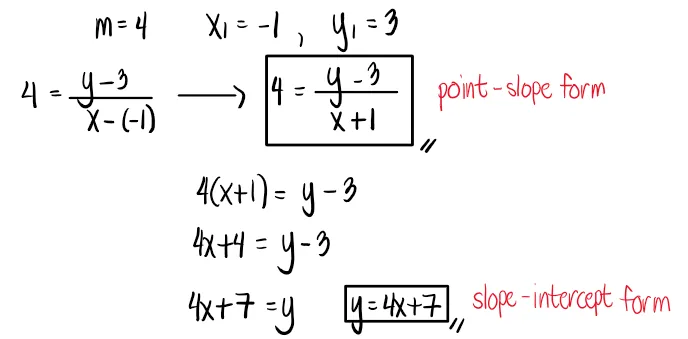
Write the point-slope form and the slope intercept form of the equation of the line with a slope of 4 that passes through the point (-1,3).
See images:
Problem:
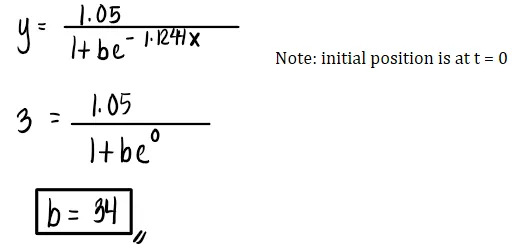
A logistic curve is the graph of an equation of the form where k, b, and c are positive constants. Such curves are useful for describing a population y that grows rapidly initially, but whose growth rate decreases after x reaches a certain value. In a famous study of the growth of protozoa by Gause, a population of Paramecium caudata was found to be described by the logitc equation with c=1.1244, k=105, and x time in days. Find b if the intial position was 3 protozoa.
Hint: $y=\frac{k}{1+be^{-cx}}$
See images:
Problem:
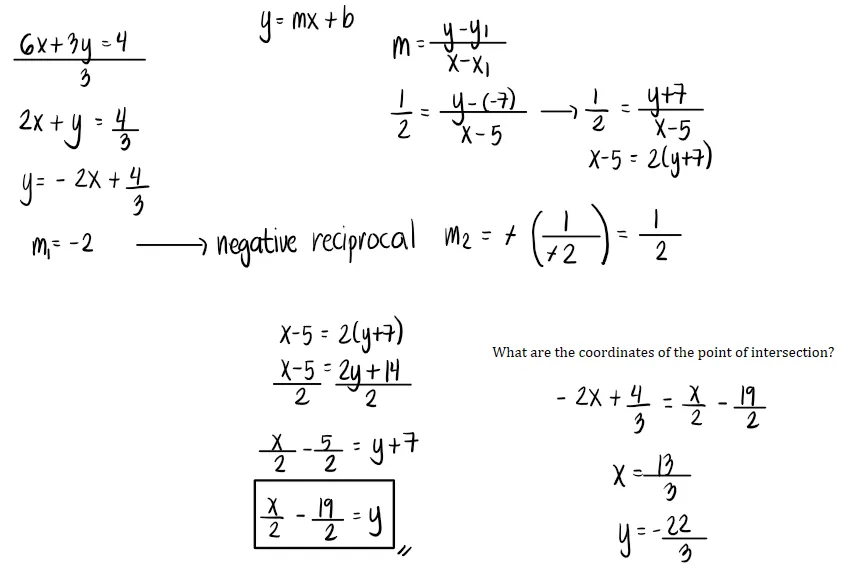
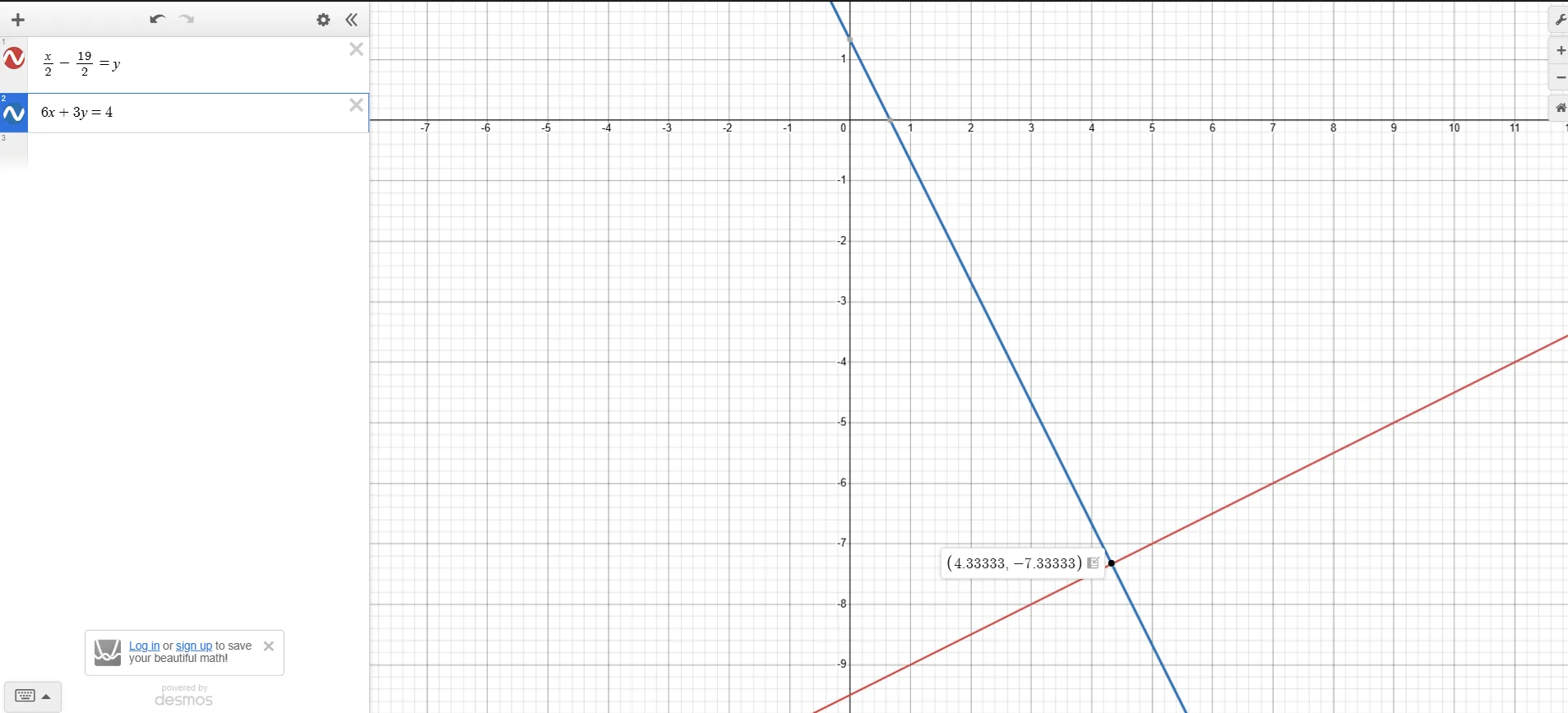
Find the slope-intercept form of the line that passes through (5,-7) that is perpendicular to the line 6x+3y=4. At what point do these lines intersect?
See images:
Problem:
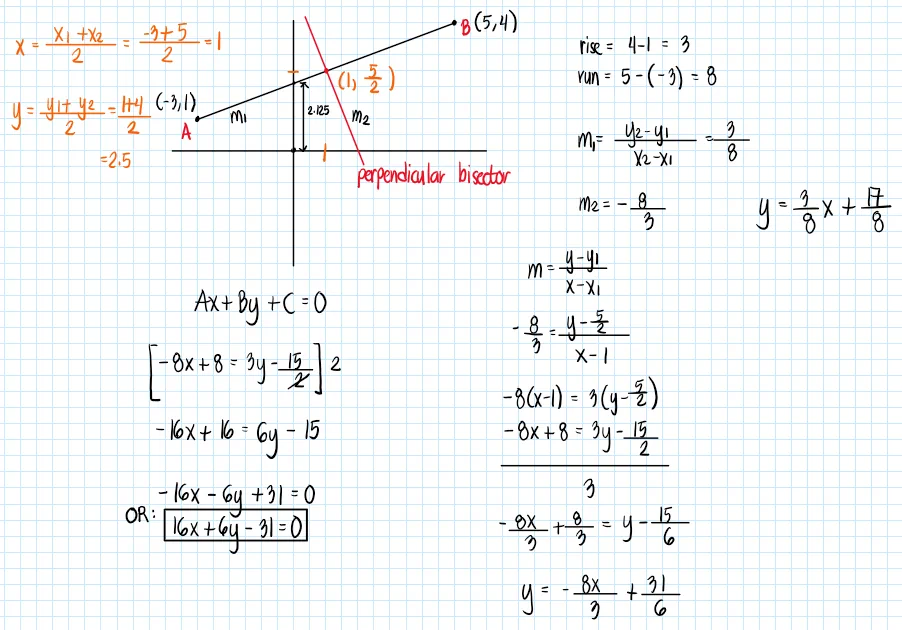
Given A(-3,1) and B(5,4), find the general form of the perpendicular bisector L of the line segment AB.
See images:
Problem:
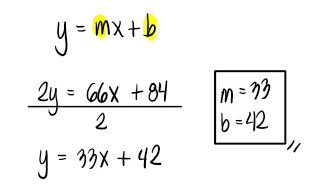
With wireless internet gaining popularity, the number of public wireless internet access points (in thousands) is projected to grow from 2003 to 2008 according to the equation -66x+2y=84, where is is the number of years after 2003. Find the slope and y-intercept of the line equation.
See images:
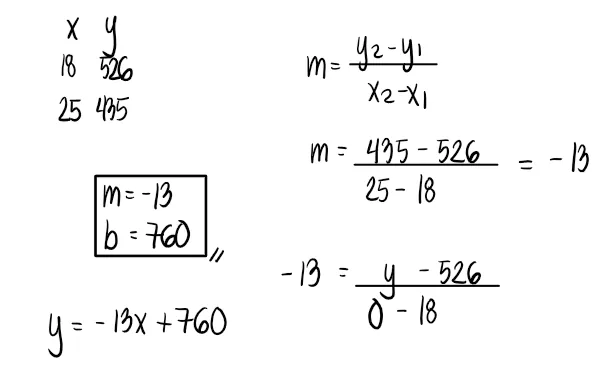
Problem:
The quantity of a product that consumers purchase depends on its price, with higher prices
leading to fewer sales. The table below shows the price of a video and the quantity of that
video sold on a weekly basis in a store.
x (Price of the video)
\$18
\$25
y (No. of videos sold weekly)
526
435
Assuming that as price increases, the number sold weekly decreases steadily, use the linear
function $y = mx + b$ to find the values of $m$ and $b$, thereby modeling video demand.
See images:
Problem:
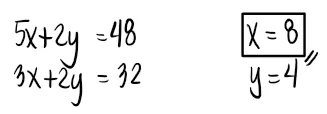
The equations $5x + 2y = 48$ and $3x + 2y = 32$ represent the money collected from
school concert ticket sales during the two class periods. If $x$ represents the cost
for each adult ticket and $y$ represents the cost for each student ticket, what is the
cost for each adult ticket?
See images:
Problem:
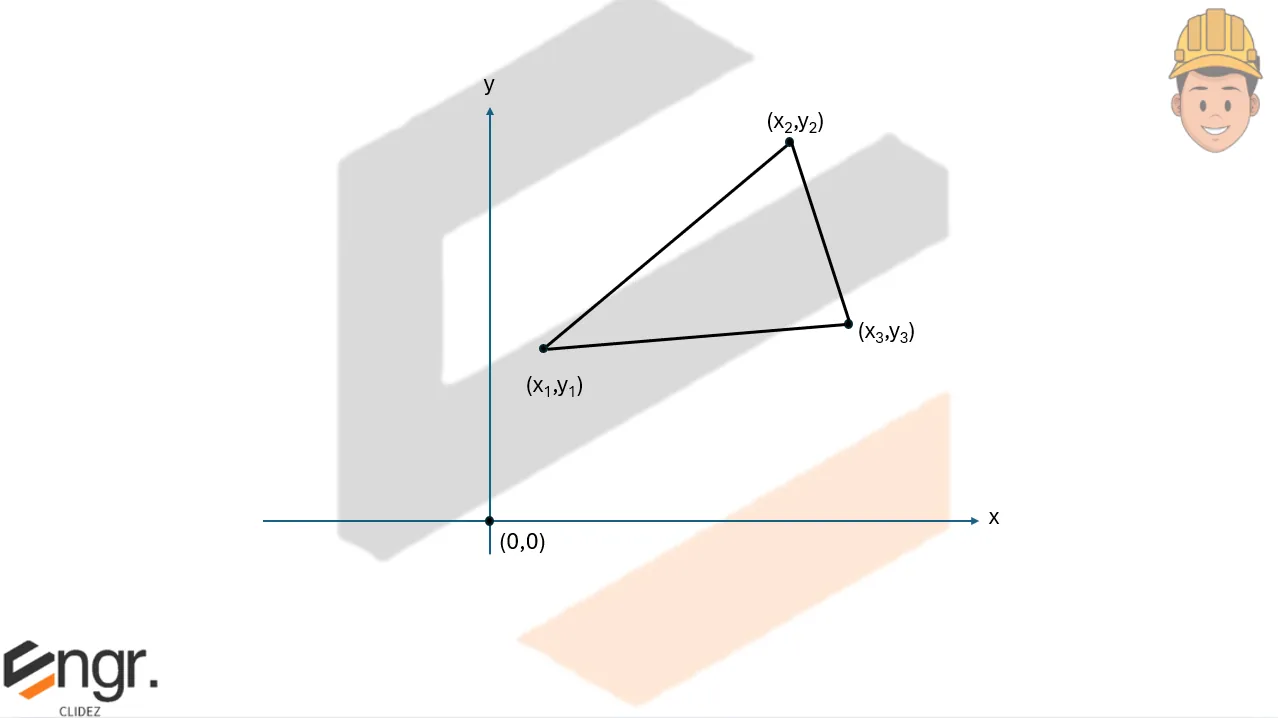
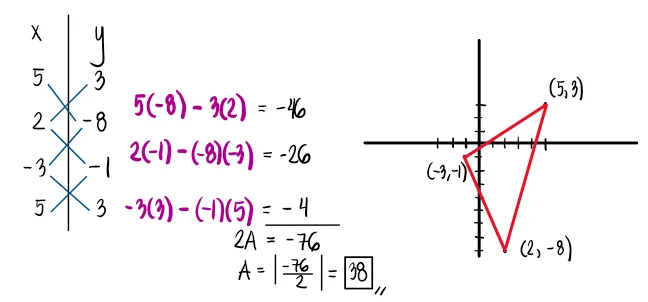
Find the area of a triangle whose vertices are A(-3,1), B(5,3), and (2,-8).
Write the coordinates in two columns, x and y. Follow a clockwise or counterclockwise direction when writing the coordinates. In the last row, copy the coordinates of the first row. Then, multiply from left to right and subtract the result when multiplying from right to left. Add all of the values and divide the result by 2. We use an absolute value sign as area cannot be negative.
Problem:
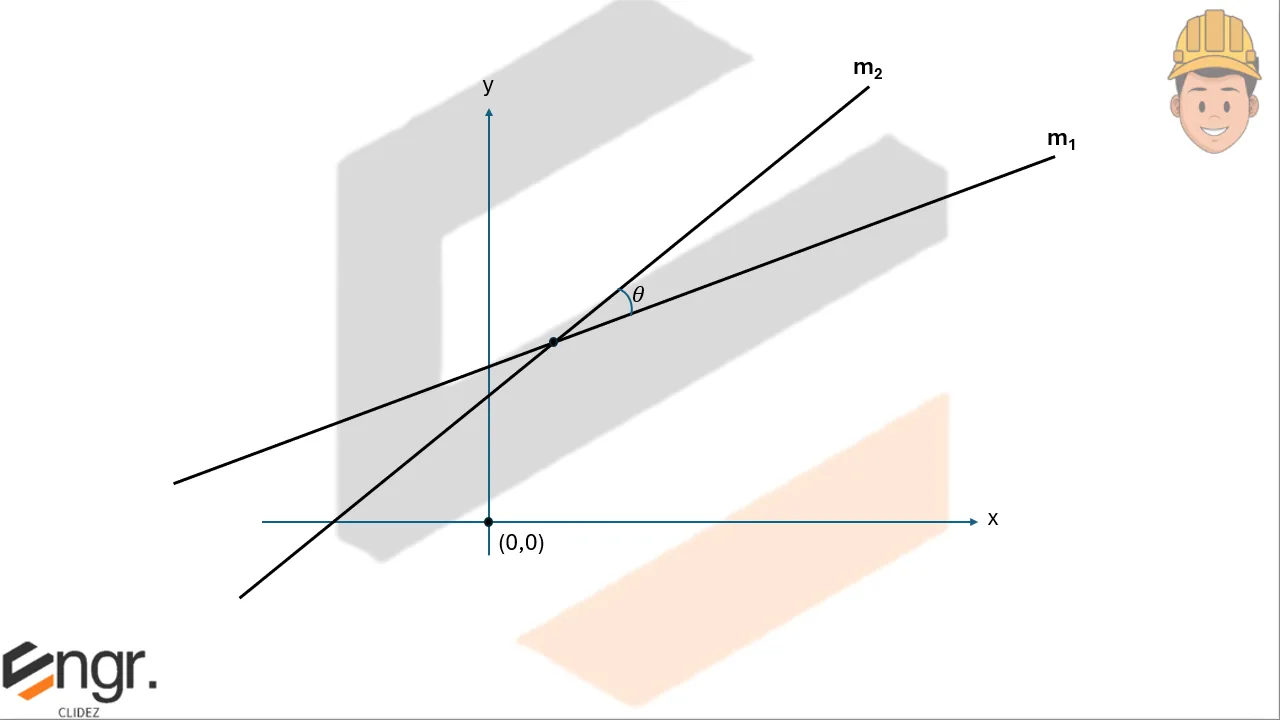
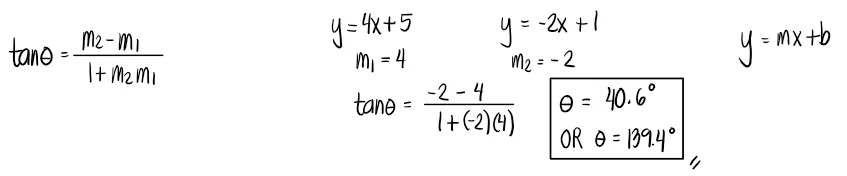
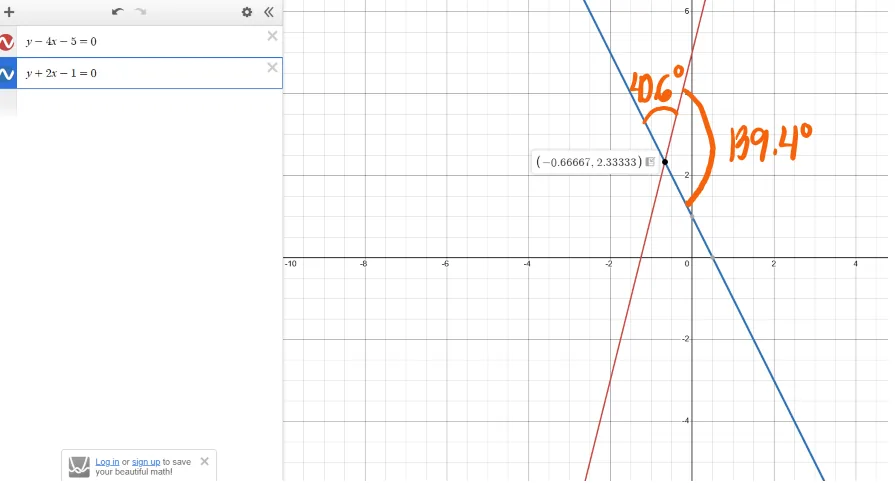
What is the angle between the lines y-4x-5=0 and y+2x-1=0?
Note that there are two possible answers because there is an acute and obtuse angle between the two lines.
Problem:
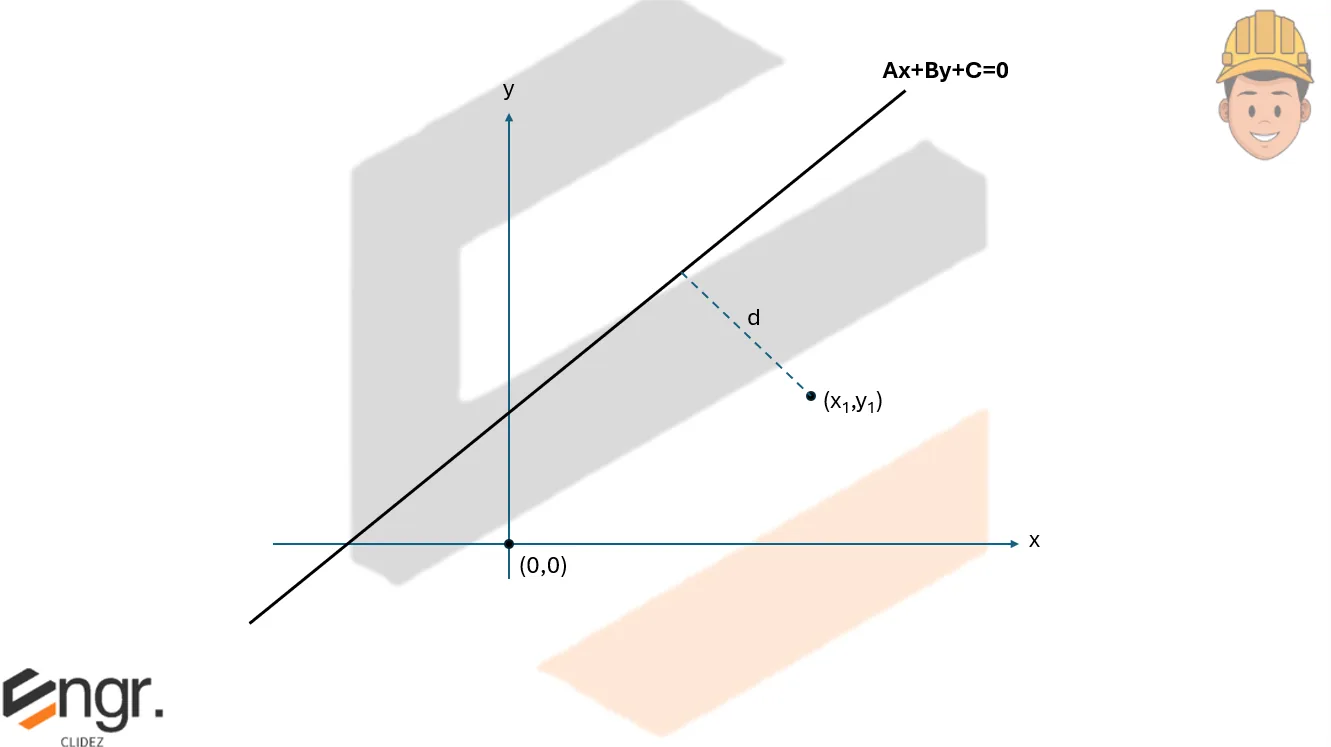
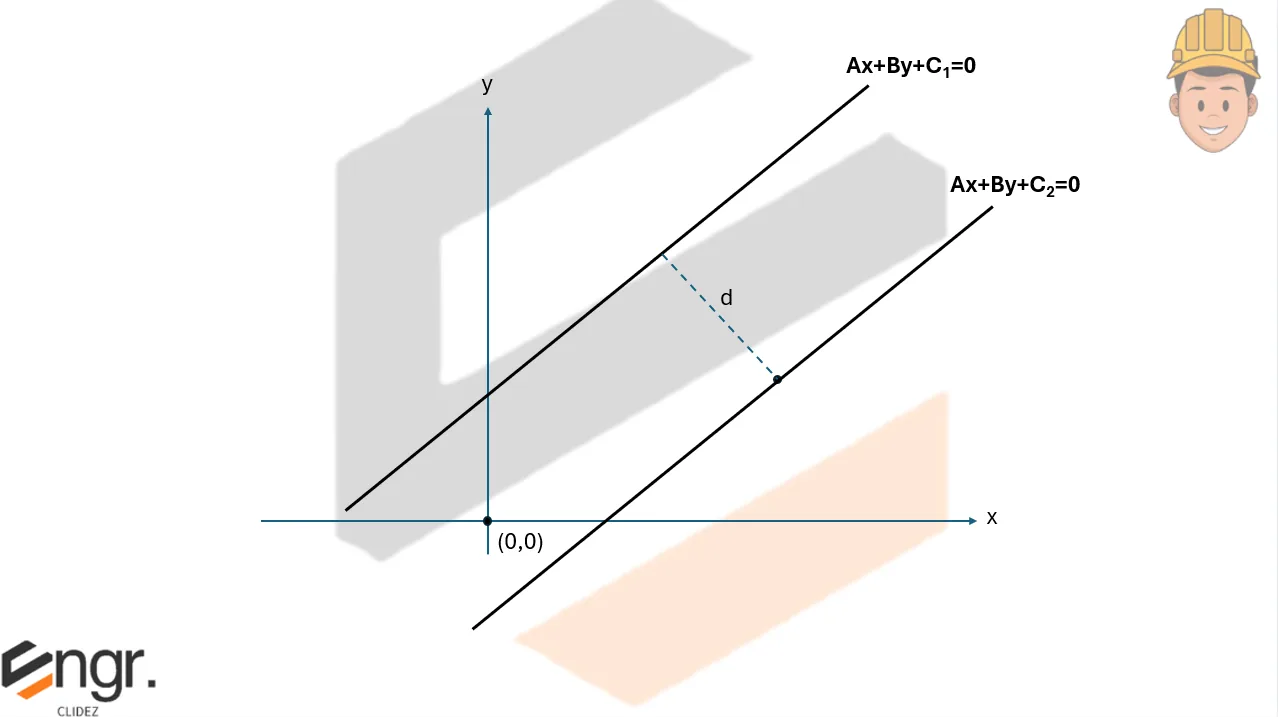
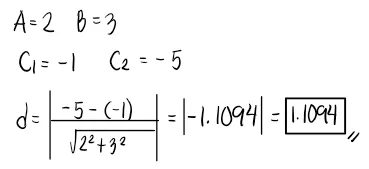
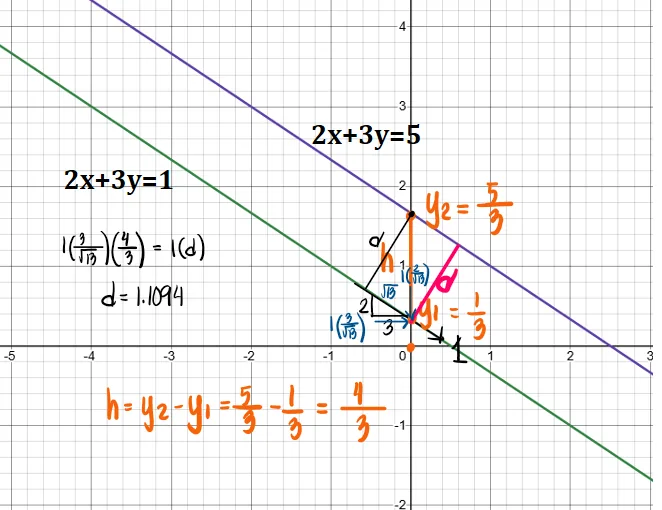
Find the distance between the lines 2x+3y=1 and 2x+3y=5.
We may also use the concept of moments in statics of rigid bodies. Treat one line as a unit force and take moments about the second line, vertically or horizontally, depending on preference. The vertical or horizontal distance can be obtained by y2-y1 or x2-x1. This moment shall equal the unit force multiplied by the perpendicular distance (which is the distance between the two lines).
Exam Generator Problems
Additional board-style practice items for this topic.
Compute the acute angle between the lines whose slopes are m1=1/3 and m2=2.
Answer:
45º
54.162º
60º
22.456º
The angle between two lines is: $\tan\theta=\left|\frac{m_2-m_1}{1+m_1m_2}\right|$ $\tan\theta=\left|\frac{2-1/3}{1+(1/3)(2)}\right|=1$ $\boxed{\theta=45^\circ}$
What is the acute angle formed between the lines 4x-y+3=0 and 2x-5y-1=0?
Answer:
54.162º
45º
60º
22.456º
The slopes are $m_1=4$ from $4x-y+3=0$ and $m_2=2/5$ from $2x-5y-1=0$. Use: $\tan\theta=\left|\frac{m_2-m_1}{1+m_1m_2}\right|$ $\tan\theta=\left|\frac{0.4-4}{1+4(0.4)}\right|=1.3846$ $\boxed{\theta=54.162^\circ}$
Find the distance between the points A (-2,3) and B(6,8).
Answer:
9.43
14.15
6.40
13.60
Use the distance formula: $d=\sqrt{(6-(-2))^2+(8-3)^2}$ $d=\sqrt{8^2+5^2}=\sqrt{89}$ $\boxed{9.43}$
Question Bank: q403
MSTE - Analytic Geometry / Area Computation with Given Coordinates / Engr. Janclyde Espinosa (Clidez)
Find the area of the triangle whose vertices are at points A(3,4), B(-2,1), and C (5,-6).
Answer:
28
56
13
26
Use the coordinate area formula: $A=\frac{1}{2}|x_1(y_2-y_3)+x_2(y_3-y_1)+x_3(y_1-y_2)|$ $A=\frac{1}{2}|3(1+6)+(-2)(-6-4)+5(4-1)|$ $A=\frac{1}{2}|21+20+15|$ $\boxed{28}$
Question Bank: q404
MSTE - Analytic Geometry / Area Computation with Given Coordinates / Engr. Janclyde Espinosa (Clidez)
Find the area of the triangle whose vertices are at points A(3,4), B(-2,1), and C (5,-6).
Answer:
28
56
13
26
Using the same determinant formula: $A=\frac{1}{2}|3(1+6)+(-2)(-6-4)+5(4-1)|$ $A=\frac{1}{2}(56)$ $\boxed{28}$
What is the distance between the lines: 5x-2y+3=0 and 5x-2y+7=0?
Answer:
0.743
1.346
0.190
5.385
For parallel lines $Ax+By+C_1=0$ and $Ax+By+C_2=0$, distance is: $d=\frac{|C_2-C_1|}{\sqrt{A^2+B^2}}$ $d=\frac{|7-3|}{\sqrt{5^2+(-2)^2}}=\frac{4}{\sqrt{29}}$ $\boxed{0.743}$
Find the distance from the point (5, -3) to the line 7x-4y-28=0.
Answer:
2.36
3.15
3.46
4.57
Distance from point $(x_0,y_0)$ to $Ax+By+C=0$ is: $d=\frac{|Ax_0+By_0+C|}{\sqrt{A^2+B^2}}$ $d=\frac{|7(5)-4(-3)-28|}{\sqrt{7^2+(-4)^2}}=\frac{19}{\sqrt{65}}$ $\boxed{2.36}$
Question Bank: q481
MSTE - Analytic Geometry / Area Computation with Given Coordinates / Engr. Janclyde Espinosa (Clidez)
Find the area of the polygon whose vertices are (2,3), (-4, -4), (-5, -1), and (1,-1).
Answer:
21
19
29
24
Use the shoelace formula for $(2,3)$, $(-4,-4)$, $(-5,-1)$, and $(1,-1)$: $A=\frac{1}{2}|(2(-4)+(-4)(-1)+(-5)(-1)+1(3))-(3(-4)+(-4)(-5)+(-1)(1)+(-1)(2))|$ $\boxed{21}$
Which of the following is perpendicular to the line x/3+y/4=1?
Answer:
3x-4y-5=0
x-4y-8=0
4x-3y-6=0
4x+3y-11=0
The line $x/3+y/4=1$ can be written $4x+3y=12$, with slope $-4/3$. A perpendicular line has slope $3/4$. For $3x-4y-5=0$: $y=\frac{3}{4}x-\frac{5}{4}$ $\boxed{3x-4y-5=0}$
The centroid of a triangle whose vertices are at A (5, 6), B (-8, 12) and C(x, y) is at (2, 4). What is the value of x?
6
-9
-6
9
The centroid's x-coordinate is the average of the vertices' x-values: $\bar{x} = \frac{5 + (-8) + x}{3} = 2$ $5 - 8 + x = 6$ $x - 3 = 6$ $\boxed{x = 9}$
ABCD is a parallelogram. If A = (-4, 1), B = (-6, -5), C = (1, -2), find the coordinate of D.
(3, 4)
(-1, -8)
(4, 3)
(2, 5)
In parallelogram $ABCD$ the diagonals bisect each other, so the midpoint of $AC$ equals the midpoint of $BD$. Midpoint of $AC = \left(\frac{-4+1}{2}, \frac{1-2}{2}\right) = (-1.5, -0.5)$ Set equal to midpoint of $BD$: $\frac{-6 + D_x}{2} = -1.5 \Rightarrow D_x = 3$ $\frac{-5 + D_y}{2} = -0.5 \Rightarrow D_y = 4$ $\boxed{D = (3,\ 4)}$
Put the line in slope-intercept form: $4y = 3x + 1 \Rightarrow y = \frac{3}{4}x + \frac{1}{4}$ The coefficient of $x$ is the slope: $\boxed{m = \frac{3}{4}}$
Two straight lines are drawn in a way that they will never meet even if extended indefinitely. If the equation of one of these lines is y = 5x - 3, which of the following must be the equation of the other line?
y = -3x + 5
y = 3x - 5
y = -5x - 3
y = 5x + 9
Lines that never meet are parallel, so they share the same slope ($m = 5$) but have a different y-intercept. Only $y = 5x + 9$ fits. $\boxed{y = 5x + 9}$
Determine the equation of a straight line that passes through the point (6, -3) if it is perpendicular to the line y = 2x - 3.
y = 2x - 15
y = -1/2 x - 6
y = -1/2 x
y = 1/2 x + 6
The given line $y = 2x - 3$ has slope $2$, so the perpendicular slope is $-\frac{1}{2}$. Point-slope through $(6, -3)$: $y + 3 = -\frac{1}{2}(x - 6) = -\frac{1}{2}x + 3$ $\boxed{y = -\frac{1}{2}x}$
What is the slope of the straight line whose nearest point to the origin is (-6, 8)?
4/3
-4/3
3/4
-3/4
The nearest point to the origin is the foot of the perpendicular from the origin, so the radius to $(-6, 8)$ is perpendicular to the line. Slope of the radius: $\frac{8}{-6} = -\frac{4}{3}$ The line's slope is the negative reciprocal: $\boxed{m = \frac{3}{4}}$
Line A has a slope of -4 and passes through (-25, -10). Line B has x-intercept of 10 and y-intercept of 25.
Determine the distance of line A to point (8, -3).
35.85
33.71
30.21
28.54
Determine the point of intersection of lines A and B.
(-90, 240)
(-90, 250)
(-80, 250)
(- 80, 240)
Determine the equation of a line perpendicular to line B and passing through (-20, 10).
2x - 5y - 90 = 0
2x + 5y + 90 = 0
2x + 5y - 90 = 0
2x - 5y + 90 = 0
Part 1.
Line A: slope $-4$ through $(-25,-10)$: $y + 10 = -4(x + 25) \Rightarrow 4x + y + 110 = 0$ Distance to point $(8, -3)$: $d = \frac{|4(8) + (-3) + 110|}{\sqrt{4^2 + 1^2}} = \frac{139}{\sqrt{17}}$ $\boxed{d = 33.71}$
Part 2.
Line A: $y = -4x - 110$. Line B (intercepts 10 and 25): $\frac{x}{10} + \frac{y}{25} = 1 \Rightarrow y = -\frac{5}{2}x + 25$. Set equal: $-4x - 110 = -\frac{5}{2}x + 25 \Rightarrow -\frac{3}{2}x = 135 \Rightarrow x = -90$ $y = -4(-90) - 110 = 250$ $\boxed{(-90,\ 250)}$
Part 3.
Line B has slope $-\frac{5}{2}$, so a perpendicular line has slope $\frac{2}{5}$. Through $(-20, 10)$: $y - 10 = \frac{2}{5}(x + 20) \Rightarrow 5y - 50 = 2x + 40$ $\boxed{2x - 5y + 90 = 0}$
A line on the xy- plane has an equation 5x + 12y = 60. A uv-plane of the same origin has its u-axis rotated at an angle of arctan (4/3) from the x-axis.
Find the uv-coordinates of the y- intercept of the given line.
(4, 3)
(5, 4)
(4, 5)
(3, 4)
Find the uv- coordinates of the x-intercept of the given line.
(36/5, - 48/5)
(27/5, -52/5)
(19/5, -37/5)
(41/5, -39/5)
Find the equation of the given line in the uv-plane.
68u + 21v = 335
68u + 21v = 288
63u + 16v = 300
16u + 63v = 300
Part 1.
The uv-axes are rotated by $\theta = \arctan\frac{4}{3}$, so $\cos\theta = \frac{3}{5}$, $\sin\theta = \frac{4}{5}$. Transform with $u = x\cos\theta + y\sin\theta$, $v = -x\sin\theta + y\cos\theta$. The y-intercept of $5x + 12y = 60$ is $(0, 5)$: $u = 0\left(\tfrac{3}{5}\right) + 5\left(\tfrac{4}{5}\right) = 4, \quad v = -0\left(\tfrac{4}{5}\right) + 5\left(\tfrac{3}{5}\right) = 3$ $\boxed{(4,\ 3)}$
Part 2.
The x-intercept of $5x + 12y = 60$ is $(12, 0)$. Apply the same rotation ($\cos\theta = \frac{3}{5}$, $\sin\theta = \frac{4}{5}$): $u = 12\left(\tfrac{3}{5}\right) + 0 = \frac{36}{5}, \quad v = -12\left(\tfrac{4}{5}\right) + 0 = -\frac{48}{5}$ $\boxed{\left(\tfrac{36}{5},\ -\tfrac{48}{5}\right)}$
Curve 1, $y = x^2 + 7x + 6$, is second-degree in $x$ only → a parabola. Curve 2, $x - 2y = 6$, is first-degree → a line. $\boxed{\text{parabola and line}}$
A tetrahedron is bounded by the coordinate planes and the plane 8x + 12y + 4z - 48 = 0. The base is on the x-y plane.
What is the base area of the tetrahedron?
24
12
36
48
What is the total surface area of the tetrahedron?
129.83
145.67
102.21
187.32
Find the volume of the tetrahedron.
56
36
48
132
Part 1.
The plane $8x + 12y + 4z = 48$ has intercepts $x = 6$, $y = 4$, $z = 12$. The base on the xy-plane is the right triangle with legs $6$ and $4$: $A = \frac{1}{2}(6)(4)$ $\boxed{A = 12}$
Part 3.
Volume of the tetrahedron from the intercepts $a = 6$, $b = 4$, $c = 12$: $V = \frac{1}{6}abc = \frac{1}{6}(6)(4)(12)$ $\boxed{V = 48}$
Given that $y = ax^4 + bx^2$ and $ab > 0$. Which of the following is true?
it always concaves upward
it always concaves downward
it has no point of inflection
it has no horizontal tangent
$y = ax^4 + bx^2 \Rightarrow y'' = 12ax^2 + 2b$. Since $ab > 0$, $a$ and $b$ have the same sign, so $12ax^2 + 2b$ never equals zero (its root would need $x^2 = -\frac{b}{6a} < 0$). With $y''$ never zero, the concavity never changes: $\boxed{\text{it has no point of inflection}}$
What is the image of a point (-4, -12) at a translated origin at (4, -3)?
(-8, 9)
(8, -9)
(-8, -9)
(8, 9)
Under a translation to a new origin $(h, k)$, the new coordinates are $x' = x - h$, $y' = y - k$. With $(h, k) = (4, -3)$ and the point $(-4, -12)$: $x' = -4 - 4 = -8$ $y' = -12 - (-3) = -9$ $\boxed{(-8,\ -9)}$
What is the area of the largest rectangle that can be cut from this ellipse?
25
18
20
16
What is the volume generated by revolving this ellipse about the line x = 8.
1894.34
1387.22
1263.31
1567.43
Part 1.
From $\frac{x^2}{16} + \frac{y^2}{4} = 1$: $a = 4$, $b = 2$. Area: $A = \pi a b = \pi(4)(2) = 8\pi$ $\boxed{A = 25.13}$
Part 2.
The largest rectangle inscribed in an ellipse has area $2ab$: $A = 2(4)(2)$ $\boxed{A = 16}$
Part 3.
By Pappus' theorem, the centroid $(0,0)$ is a distance $8$ from the line $x = 8$: $V = 2\pi d A = 2\pi(8)(8\pi) = 128\pi^2$ $\boxed{V = 1263.31}$
Question Bank: t2099
MSTE - Analytic Geometry / Equations of Lines / Besavilla CE Pre-Board Math & Surveying
$y = mx + c$ is the equation of a straight line of slope $m$ and y-axis intercept $c$. If a line passes through the point where $x = 2$ and $y = 2$ and also through the point where $x = 5$ and $y = \frac{1}{2}$, find the equation of the line.
$x = y + 6$
$x = 3y + 6$
$x = 2y + 6$
$x = y + 5$
$x = y^2 + 6$
Using the printed points $(2,2)$ and $(5,\frac{1}{2})$, the slope is $m=\frac{1/2-2}{5-2}=-\frac{1}{2}$ Then $y=-\frac{1}{2}x+c$. Substitute $(2,2)$: $2=-1+c \Rightarrow c=3$ So the line from the printed points is $y=-\frac{1}{2}x+3$, or $x+2y=6$. This does not match the keyed choice. The keyed answer shown in the file is $\boxed{x=2y+6}$.
Question Bank: t2113
MSTE - Analytic Geometry / Polar Equation / Besavilla CE Pre-Board Math & Surveying
Using polar coordinates, find the polar equation of the path of a point which is equidistant from the points whose polar coordinates are $(2a, 0)$ and $(a, \pi/2)$.
$r = \frac{3a}{2(2\cos\theta - \sin\theta)}$
$r = \frac{3a}{2(\cos\theta - \sin\theta)}$
$r = \frac{3a}{2(2\cos 2\theta - \sin 2\theta)}$
$r = \frac{3a}{(2\cos\theta - \sin\theta)}$
$r = \frac{3a}{2(2\cos\theta - 2\sin\theta)}$
Convert the fixed points to rectangular coordinates: $(2a,0)$ and $(0,a)$. A point with polar coordinates $(r,\theta)$ has rectangular coordinates $(r\cos\theta,r\sin\theta)$. Set the squared distances equal: $(r\cos\theta-2a)^2+(r\sin\theta)^2=(r\cos\theta)^2+(r\sin\theta-a)^2$ Cancel common terms: $-4ar\cos\theta+4a^2=-2ar\sin\theta+a^2$ $2r(2\cos\theta-\sin\theta)=3a$ $\boxed{r=\frac{3a}{2(2\cos\theta-\sin\theta)}}$
A football-field coordinate system uses meters as units. Pepe is at P(35, −20). The ball’s path from the corner kick is y = (4/3)x. Pepe wants to run to the ball along a line perpendicular to the ball’s path. Find the equation of the line on which Pepe should run.
y − 20 = (3/4)(x − 35)
y + 20 = −(3/4)(x − 35)
y + 20 = −(3/4)(x + 35)
y − 20 = −(3/4)(x + 35)
The ball’s line has slope $4/3$, so a perpendicular line has slope $-3/4$. Through $(35,-20)$: $y+20=-\frac34(x-35)$.