A geometric progression (GP) is a sequence where each term is obtained by multiplying the previous term by a fixed constant called the common ratio, denoted by $r$.
General Term of a GP:
$$
a_n = a_1 \cdot r^{n-1}
$$
Where:
$a_1$ = the first term
$r$ = common ratio
$n$ = number of terms
Sum of First n Terms of a GP:
$$
S_n = \frac{a_1(1 - r^n)}{1 - r}
$$
This formula is valid as long as $r \ne 1$.
Sum of an Infinite GP (when $|r| < 1$):
$$
S_\infty = \frac{a_1}{1 - r}
$$
This applies to converging geometric series, where the terms get smaller and smaller as $n$ increases.
Real-Life Examples:
Exponential growth and decay
Bank interest compounded regularly
Halving distances or population models
Problem 1:
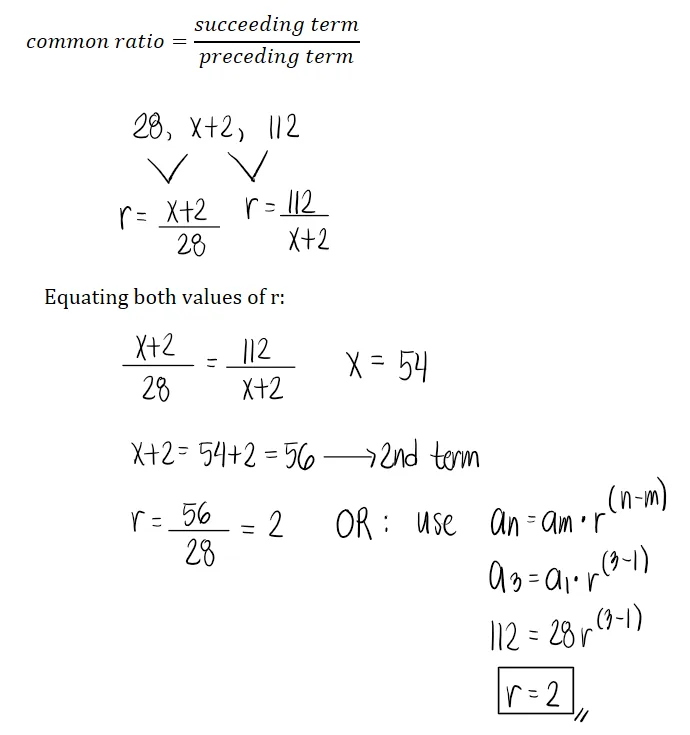
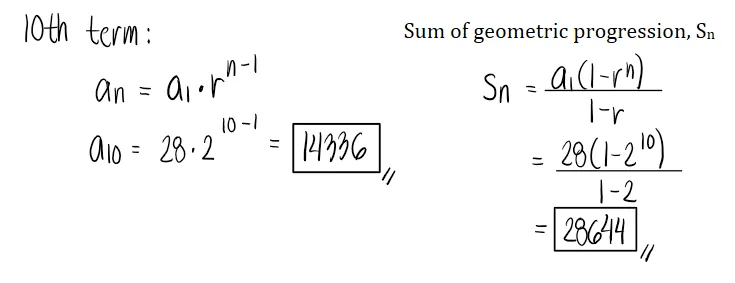
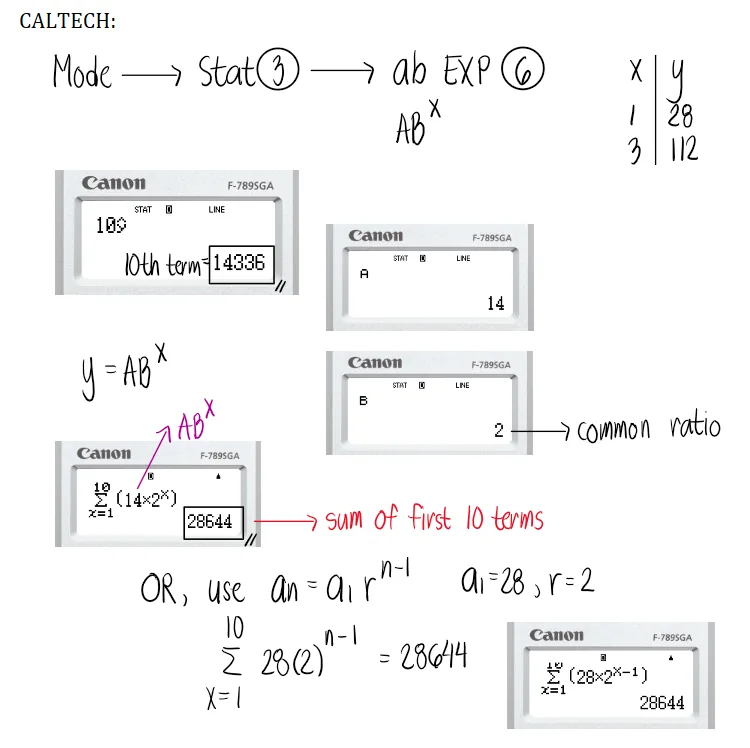
The number 28, x + 2, 112 form a geometric progression. What is the 10th term? What is the sum of the geometric progression?
See images:
Problem 2:
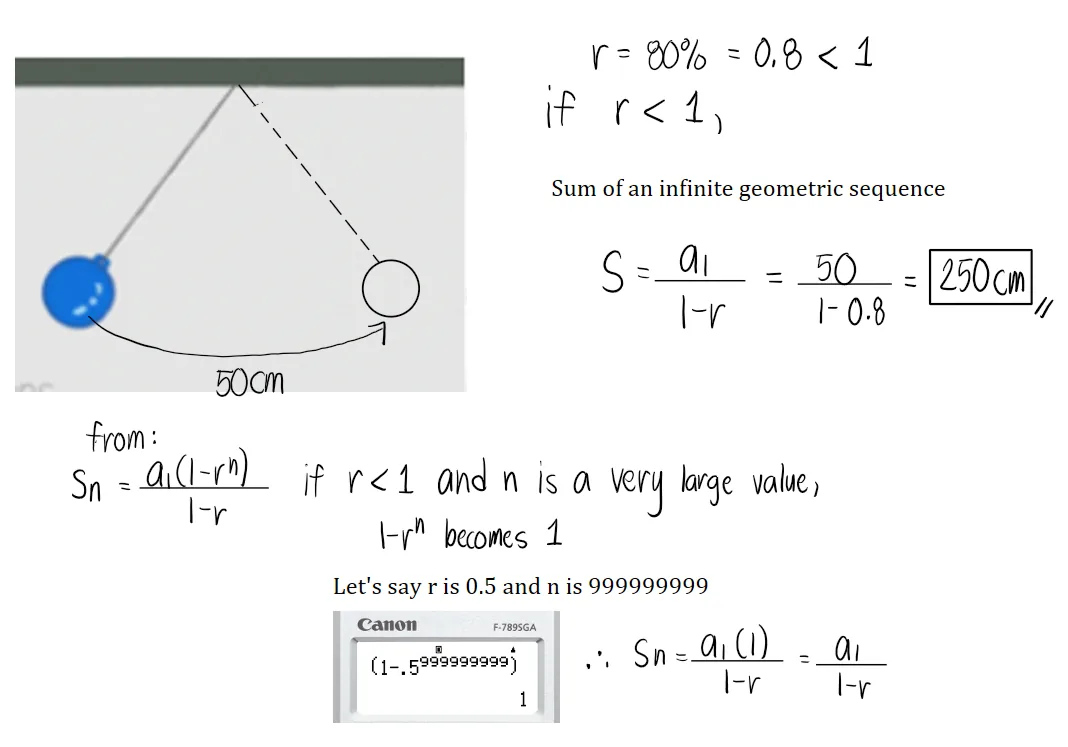
The first swing of the pendulum is 50 cm. If each swing is 80% of the preceding swing, how far does the pendulum travel before coming to rest?
See images:
Problem 3:
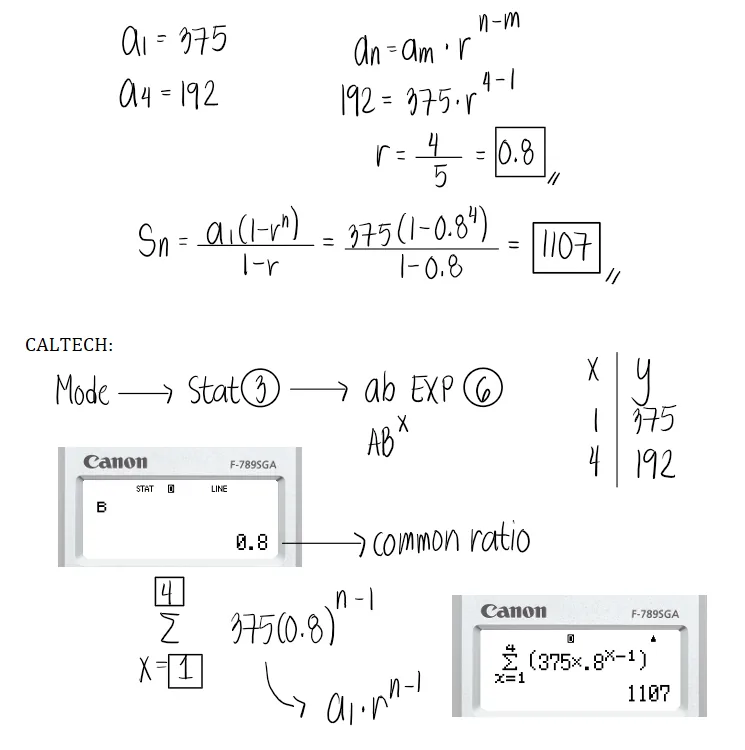
The first term of a geometric sequence is 375 and the fourth term is 192. Find the common ratio and the sum of the first four terms.
See images:
Problem 4:
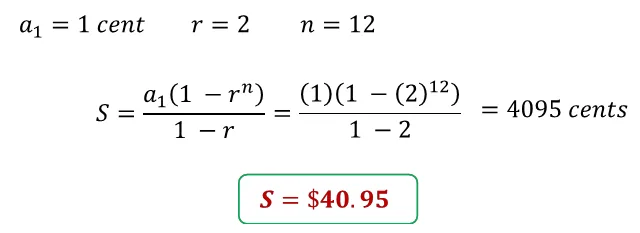
A boy agrees to work at the rate of one cent the first day, two cents the second day, four cents the third day, eight cents the fourth day, etc. How much would he receive at the end of 12 days?
See images:
Problem 5:
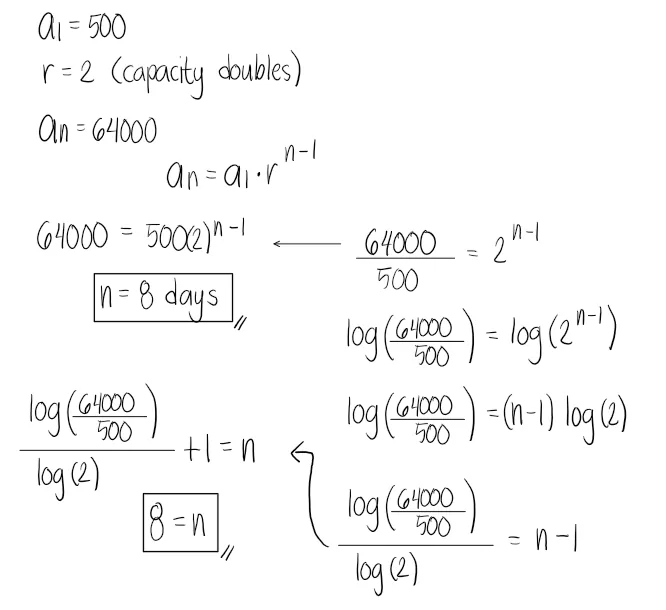
A tech startup launches a new data storage device with cutting-edge compression. On day 1, the device can store 500 MB. Each day, due to software upgrades, its capacity doubles. After how many days will the device be able to store exactly 64,000 MB?
See images:
Problem 6:
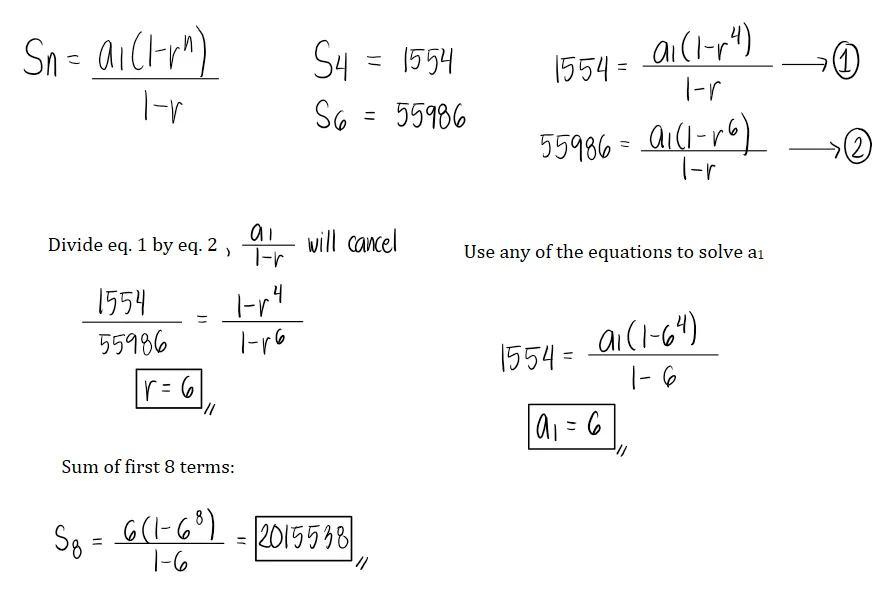
The sum of the first 4 terms of a geometric sequence is 1554. The sum of the first 6 terms is 55986. What is the sum of the first 8 terms?