The Remainder Theorem and Factor Theorem are essential tools in polynomial algebra. They allow us to evaluate polynomials quickly and determine whether a given binomial is a factor of the polynomial, without performing full division.
Remainder Theorem:
If a polynomial $f(x)$ is divided by a linear divisor of the form $(x - c)$, the remainder is simply:
$$
\text{Remainder} = f(c)
$$
This means you can find the remainder by directly substituting $x = c$ into the polynomial, avoiding long division.
Factor Theorem:
A special case of the Remainder Theorem: If $f(c) = 0$, then $(x - c)$ is a factor of $f(x)$.
$$
f(c) = 0 \quad \Rightarrow \quad (x - c) \text{ is a factor of } f(x)
$$
This theorem is commonly used to find roots or to start factoring higher-degree polynomials.
How They Work Together:
Use the Remainder Theorem to test potential roots quickly.
If the result is zero, you've also confirmed a factor via the Factor Theorem.
After identifying a factor, you can reduce the polynomial via division or synthetic division.
These theorems simplify root-finding and polynomial factoring, especially for higher-order polynomials in engineering equations or signal analysis.
Problem:
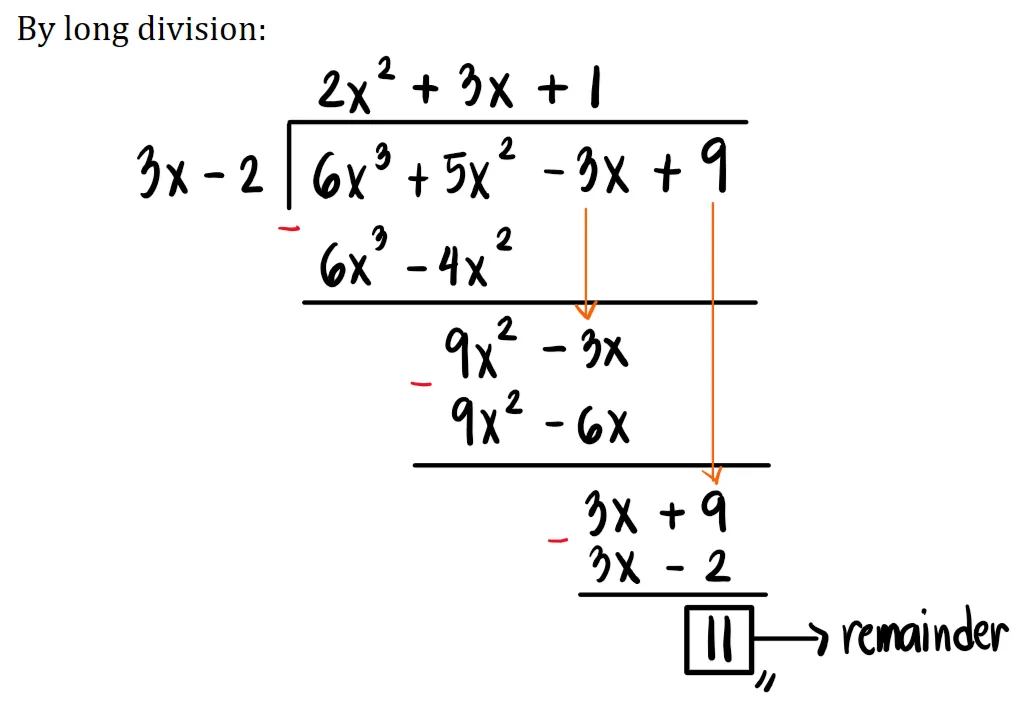
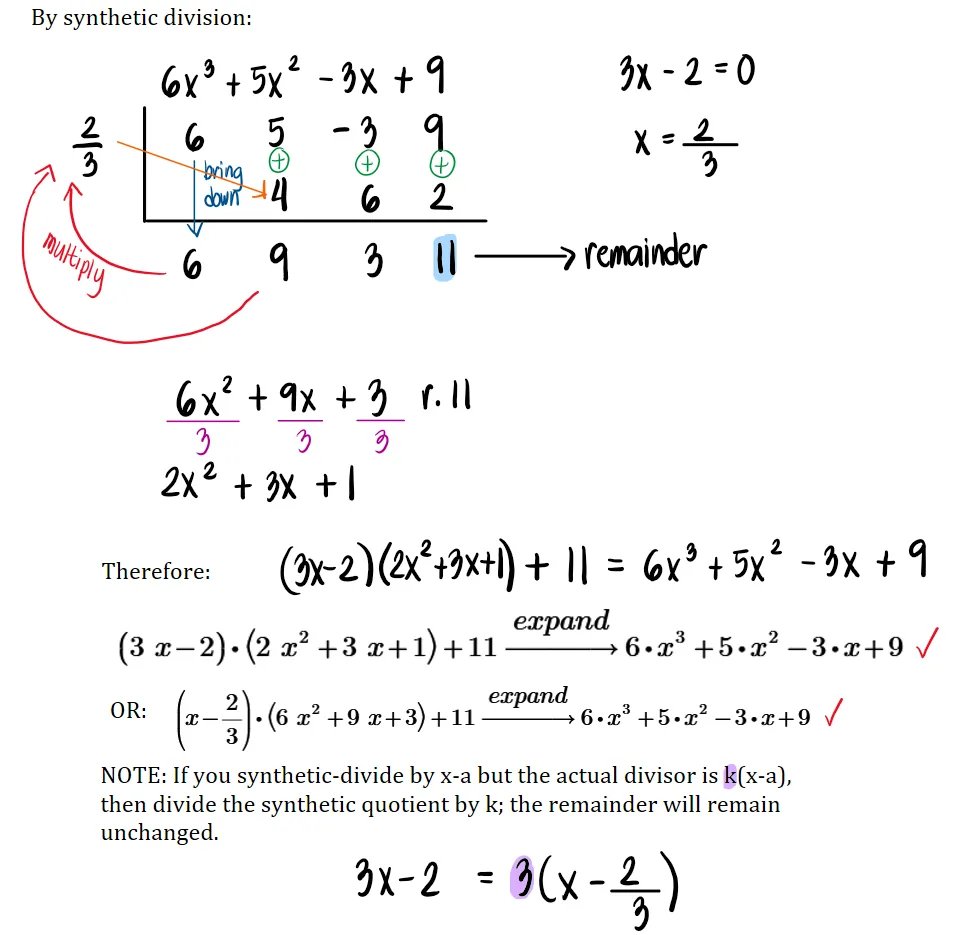
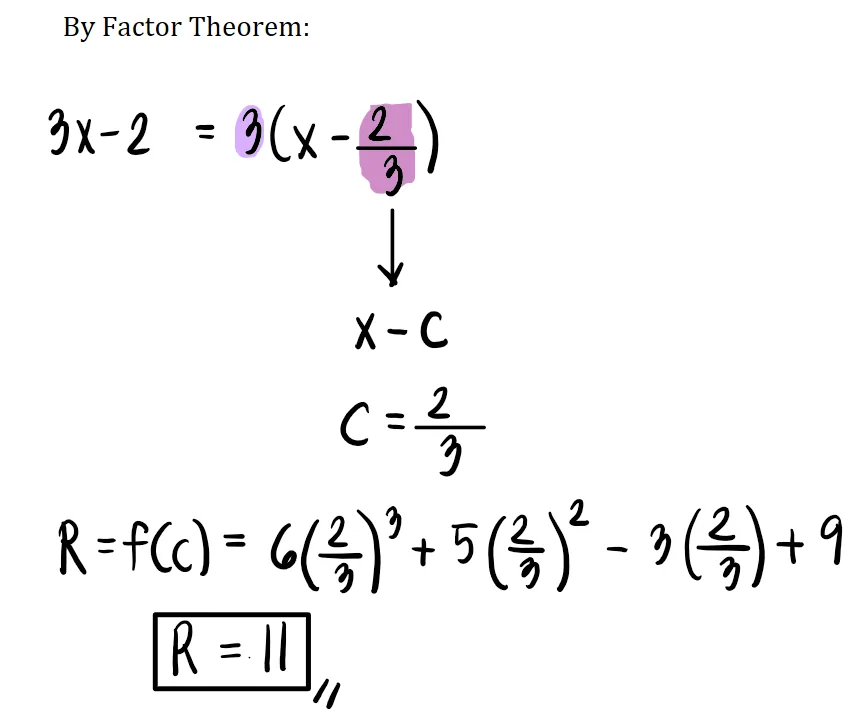
What is the remainder when $9-3x+5x^2+6x^3$ is divided by $3x-2$?
Using all methods: Long Division, Synthetic Division, and Remainder Theorem
Problem:
When the expression $x^4+ax^3+5x^2+bx+6$ is divided by $(x-2)$, the remainder is 16. When it is divided by $(x+1)$, the remainder is 10. Find the value of the constant b.
Given $f(x)=x^4+ax^3+5x^2+bx+6$. When divided by $(x-2)$ the remainder is $16$ $\Rightarrow$ $f(2)=16$. When divided by $(x+1)$ the remainder is $10$ $\Rightarrow$ $f(-1)=10$.
$f(2)=2^4+a(2)^3+5(2)^2+b(2)+6=16+8a+20+2b+6=42+8a+2b$. Set $42+8a+2b=16 \Rightarrow 8a+2b=-26 \Rightarrow 4a+b=-13$.
$f(-1)=(-1)^4+a(-1)^3+5(-1)^2+b(-1)+6=1-a+5-b+6=12-a-b$. Set $12-a-b=10 \Rightarrow a+b=2$.
Solve the system: $\begin{cases}4a+b=-13\\ a+b=2\end{cases}\Rightarrow 3a=-15\Rightarrow a=-5,\ b=7$.
If $x-k$ is a factor, then by the Factor Theorem we must have $f(k)=0$ for $f(x)=2x^2-kx-9$. Note that "the divisor is a factor" essentially means we do not have a remainder.
If f(x) = ax3+5x2-23x-6 and 4x+1 is a factor, determine the value of a.
Answer:
4
3
6
2
If $4x+1$ is a factor, then $x=-1/4$ is a root: $a(-1/4)^3+5(-1/4)^2-23(-1/4)-6=0$ $-\frac{a}{64}+\frac{5}{16}+\frac{23}{4}-6=0$ $-\frac{a}{64}+\frac{1}{16}=0$ $\boxed{a=4}$
The polynomial:
f(x)=ax3-10x2-3x+b has a factor of x+5. When f(x) is divided by x-2, the remainder is -77. Find the values of a and b.
a = −2, b = −15
a = 2, b = 15
a = −2, b = 1
a = 2, b = −15
Use the factor and remainder conditions. From $f(-5)=0$: $-125a-250+15+b=0$, so $b=125a+235$. From $f(2)=-77$: $8a-40-6+b=-77$, so $b=-31-8a$. Solving gives: $a=-2$, $b=-15$ $\boxed{a=-2,\ b=-15}$
A line is divided into 10 equal parts. If the measure of each part is a prime integer, what is the possible length of the line?
150
90
210
230
The line is divided into 10 equal parts, and each part must be a prime integer. Therefore the total length must be $10p$, where $p$ is prime. Check the choices by dividing by 10: $230 \div 10 = 23$, and 23 is prime. $\boxed{230}$
If $x/y$ gives a remainder of 0 and $z/y$ gives a remainder of 3, what is the remainder of $xz/y$?
0
3
2
1
If $x/y$ has remainder 0, then $x$ is divisible by $y$. Therefore $x = ky$ for some integer $k$. Then $xz = (ky)z = kzy$, which is also divisible by $y$. So the remainder is: $\boxed{0}$
When $f(x) = x^4 + ax^3 + 7x^2 + bx + 6$ is divided by $(x - 2)$ the remainder is 16 and when divided by $(x + 1)$ the remainder is 10. What is the value of $a$?
-7
11
-5
3
By the Remainder Theorem, $f(2)=16$ and $f(-1)=10$. $f(2)=16+8a+28+2b+6=16 \Rightarrow 4a+b=-17$ $f(-1)=1-a+7-b+6=10 \Rightarrow a+b=4$ Subtract: $(4a+b)-(a+b)=-17-4 \Rightarrow 3a=-21$ $\boxed{a=-7}$