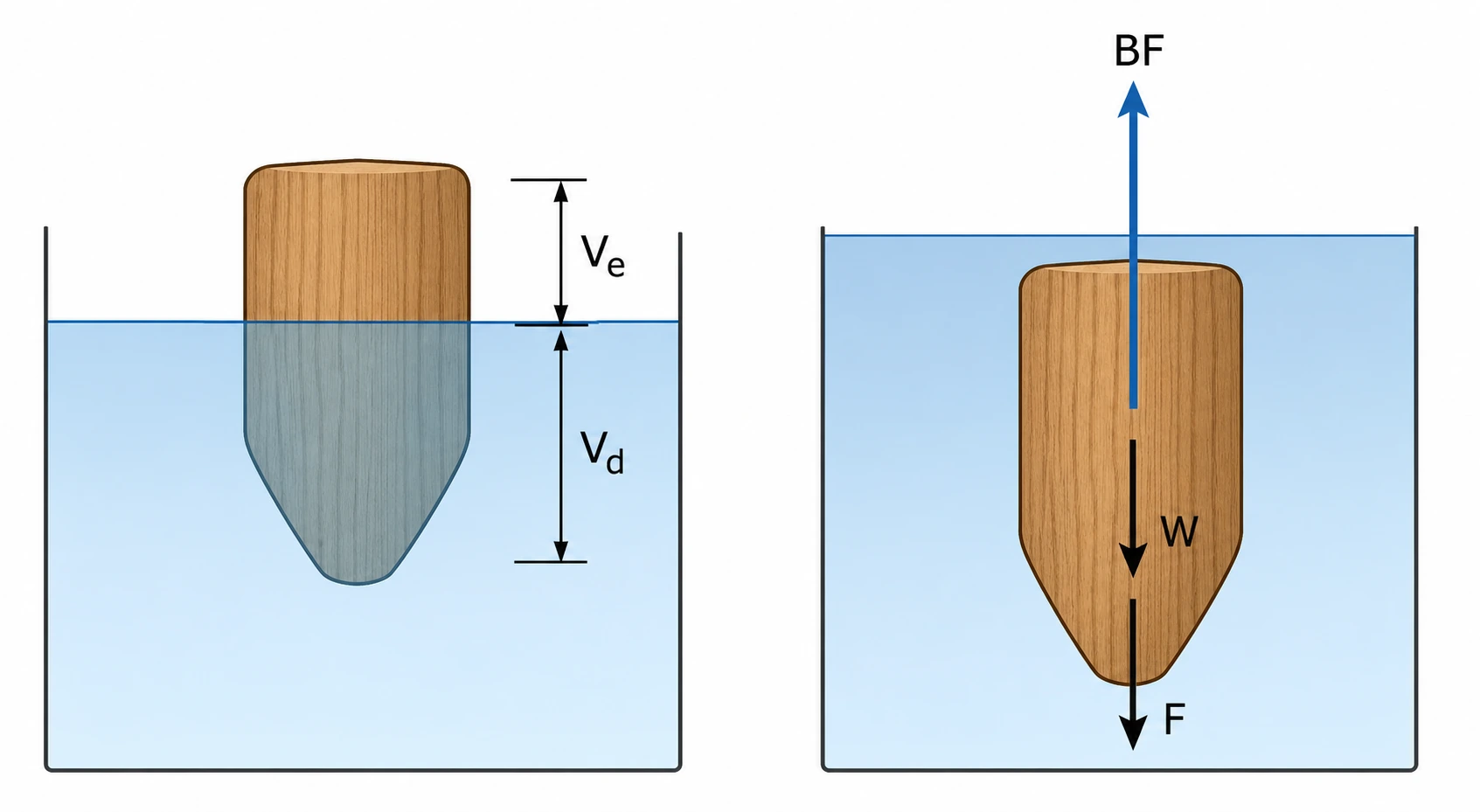
The buoyant force on a submerged or floating body is equal to the weight of the fluid displaced by the body.
$$BF = \gamma_f V_d$$
$$W = \gamma_b V_b$$
For floating equilibrium, the buoyant force equals the weight of the floating body.
$$BF = W$$
$$\gamma_f V_d = \gamma_b V_b$$
Floating, Sinking, and Draft
A body floats if buoyant force can balance its weight. It sinks if its weight is greater than the buoyant force available when fully submerged.
$$BF > W \Rightarrow \text{body tends to rise}$$
$$BF = W \Rightarrow \text{floating or neutral equilibrium}$$
$$BF < W \Rightarrow \text{body sinks}$$
For prismatic floating bodies, draft is found from the displaced volume.
$$V_d = A d$$
$$d = \frac{W}{\gamma_f A}$$
Apparent Weight and Submerged Force
When an object is submerged, its apparent weight is reduced by the buoyant force.
$$W_{app} = W - BF$$
$$BF = W - W_{app}$$
$$V = \frac{BF}{\gamma_f}$$
If a body must be held submerged, the required external force depends on whether the body tends to float up or sink down.
$$F + W = BF \quad \text{for downward holding force}$$
$$F + BF = W \quad \text{for upward lifting force}$$
Problem: Rectangular Scow Draft
A rectangular scow 5 m by 10 m with vertical sides weighs 40 tonnes. Determine its draft in fresh water and in sea water with $SG = 1.025$.
Answer: Draft is 0.80 m in fresh water and 0.78 m in sea water.
Problem: Iceberg Volume
An iceberg with $SG = 0.90$ floats in salt water with $SG = 1.03$. If the volume above the surface is $500 \text{ m}^3$, find the total volume of the iceberg.
Answer: The object volume is $0.00714 \text{ m}^3$.
Problem: Composite Floating Body — Wood with Steel Attachment
A wooden log has volume 0.50 m³ and specific gravity 0.60. A steel anchor piece (SG = 7.85) is attached to the bottom of the log so that the combined assembly just barely floats in fresh water (buoyant force exactly equals total weight). Determine the required volume of the steel anchor.
For just-floating equilibrium, buoyant force on the whole submerged system equals total weight. The assembly is fully submerged when just floating (barely):
Answer: A steel piece of 0.0292 m³ (volume) is required. Any larger steel piece would cause the assembly to sink.
Problem: Concrete Block Anchored to the Bottom by a Chain
A concrete block (SG = 2.40) with volume 0.25 m³ rests on the bottom of a freshwater lake. A steel chain holds it to a pile. The block tends to float because a hollow chamber inside it gives it a net SG of only 0.85. Determine the tension in the chain required to hold the block submerged.
Since BF > W, the block tends to rise. The chain must pull it down:
$$\sum F = 0: \quad T + W = BF$$
$$T = BF - W = 2.453 - 2.085 = 0.368 \text{ kN} = 368 \text{ N}$$
Answer: The chain tension is 368 N. The chain must be attached at the bottom to hold the buoyant block down.
Problem: Barge — Maximum Cargo Load Before Sinking
A steel barge is 8.0 m long, 3.0 m wide, and has vertical sides and bottom. The barge itself weighs 50 kN. The freeboard (distance from waterline to top of barge walls) is 0.40 m when empty in fresh water. Determine: (a) the draft when empty, and (b) the maximum additional cargo load the barge can carry without sinking.
$$BF = W: \quad \gamma_w(8.0)(3.0)d = 50$$
$$9.81(24.0)d = 50 \Rightarrow d = \frac{50}{235.44} = 0.212 \text{ m (draft when empty)}$$
$$H_{total} = d + freeboard = 0.212 + 0.40 = 0.612 \text{ m (total barge depth)}$$
Maximum load: when the barge sinks to the gunwale (freeboard = 0), draft = total depth = 0.612 m.
Answer: Empty draft is 0.212 m. Maximum additional cargo is 94.43 kN (≈9.63 tonnes) before the barge would take on water over the top of its sides.
Problem: Fraction of a Floating Log Submerged
A cylindrical log of length 4.0 m and diameter 0.30 m floats horizontally in a river (fresh water). The log has a specific gravity of 0.72. Determine: (a) the total weight of the log, (b) the fraction of the log volume that is submerged, and (c) whether the log would float in salt water (SG = 1.025) with more or less draft.
In salt water: $V_d = \frac{W}{\gamma_{sw}} = \frac{1.995}{9.81 \times 1.025} = 0.1984 \text{ m}^3$ (fraction = 0.70 — less submerged).
Answer: Log weighs 1.995 kN. 72% of its volume is submerged in fresh water (equal to its SG — this is always true for floating bodies). In salt water, only 70% is submerged — the log floats higher.
Exam Generator Problems
Additional board-style practice items for this topic.
A barge delivers 25mm reinforcing steel bars, 6m long. It travels from the Manila Bay (salt water) and unload its cargo at a point in Pasig River (fresh water). From salt to fresh water, the barge sinks 50mm, and it rises 250mm after unloading the cargo. The volume submerged in salt water is 346m3.
What is the draft in sea water in meters?
1.67
1.33
2.67
2.33
What is the weight of the barge in kN?
2993.74
3876.23
3496.09
2874.56
How many pieces of 25mm rebars are unloaded if the specfic gravity is 7.8?
2229
2260
2248
2237
Part 1.
For the same load, displacement in salt water equals displacement in fresh water after the barge sinks 0.05 m: $\gamma_sAT_s=\gamma_wA(T_s+0.05)$ Using seawater $s.g.=1.03$: $1.03T_s=T_s+0.05$ $0.03T_s=0.05$ $\boxed{T_s=1.67\text{ m}}$
A ship with vertical sides near the waterline weighs 40MN including its cargo and has a draft of 6.7 meters in seawater (s.g. = 1.026). Unloading 2 MN of its cargo, the draft decreases to 6.4m. With its cargo reduced, the ship enters a harbor of fresh water. Evaluate the draft of the ship in fresh water, in meters.
Answer:
6.56m
7.34m
4.63m
5.78m
After unloading, the ship draft in seawater is 6.4 m. For vertical sides, displaced volume is proportional to draft. For the same reduced load in fresh water: $\gamma_wAT_f=\gamma_sA(6.4)$ $T_f=1.026(6.4)=6.566$ m $\boxed{T_f\approx 6.56\text{ m}}$
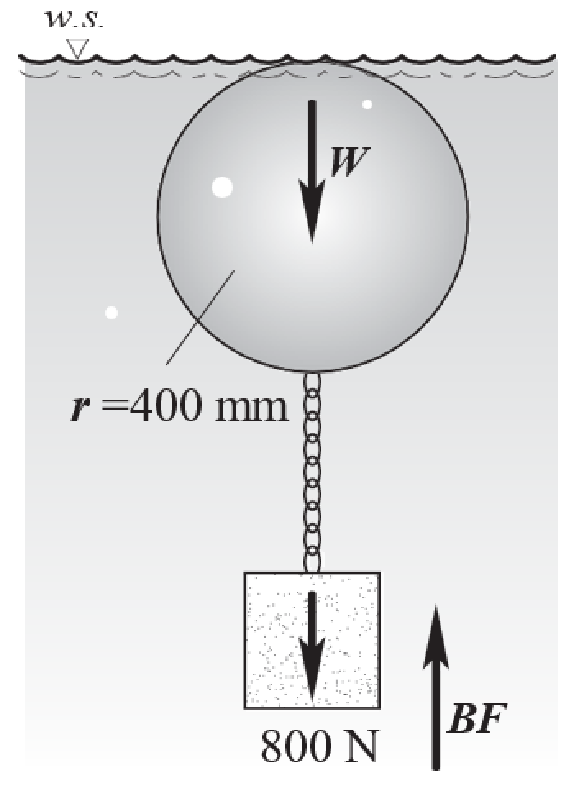
A sphere of radius 400mm is immersed in seawater (s.g. = 1.026) by anchoring it to the bottom of the seabed. The mooring line was observed to have a tension of 800N. Evaluate the specific weight of the sphere, in kN/m3.
Answer:
7.08
7.56
6.39
6.04
The anchored sphere is fully submerged. Buoyancy acts upward, while weight and cable tension act downward: $B=W+T$ so $W=B-T$ $V=\frac{4}{3}\pi(0.4)^3=0.2681$ m3 $B=1.026(9.81)(0.2681)(1000)=2698.27$ N $W=2698.27-800=1898.27$ N $\gamma_s=\frac{W}{V}=7080.9$ N/m3 $\boxed{\gamma_s=7.08\text{ kN/m}^3}$
A cylinder having a diameter of 1.20m and weighing 800N is held in position in sea water by a wire tied to an anchor block resting at the bottom of the sea such that 0.30m of the cylinder is below the surface of the water with its axis vertical. The anchor block has a volume of 0.50 cubic meter and weighs 24 kN per cubic meter in air. Assume sea water to have a specific gravity = 1.03. Neglecting the weight and volume of the cable,
Evaluate the buoyant force on the cylinder for the position described, in kN.
3.43
4.21
3.56
4.68
Evaluate the tensile force in the wire when the top of the cylinder is 0.60m above the water surface, in kN.
2.628
2.876
2.475
2.583
Evaluate the rise in the tide that will lift the anchor from the bottom of the sea, in meters.
0.378
0.426
0.353
0.417
Part 1.
The buoyant force on the cylinder equals the weight of displaced seawater: $B=\gamma_{sw}V_{sub}$ $V_{sub}=\frac{\pi(1.20)^2}{4}(0.30)=0.3393$ m3 $B=1.03(9.81)(0.3393)=3.428$ kN $\boxed{B\approx3.43\text{ kN}}$
Part 2.
With the top of the cylinder 0.60 m above the water and 0.30 m submerged, the wire holds the cylinder down. Equilibrium of the cylinder: $T+W=B$ $T=B-W=3.428-0.800$ $\boxed{T=2.628\text{ kN}}$
Part 3.
The anchor block is on the verge of lifting when the wire tension equals its effective (submerged) weight: $W_{a}=24(0.50)=12$ kN$\quad B_{a}=1.03(9.81)(0.50)=5.052$ kN $T_{lift}=W_{a}-B_{a}=12-5.052=6.948$ kN As the tide rises the cylinder submerges deeper. For the cylinder: $T=\gamma_{sw}\frac{\pi(1.20)^2}{4}h-W$ $6.948=1.03(9.81)(1.1310)h-0.800$ $h=\frac{7.748}{11.428}=0.678$ m Rise in tide $=0.678-0.30$ $\boxed{\Delta h\approx0.378\text{ m}}$
A container holds two layers of different liquids, one having specific gravity of 1.2 and the other having a specific gravity of 1.5. A solid spherical metal having a diameter of 200mm and specific gravity of 7.4 is submerged in such a manner that half of the sphere is on the top layer and the other half in the bottom layer of liquid.
Evaluate the buoyant force acting on the sphere, in kN.
0.055
0.249
0.667
0.286
Determine the tension in the cable attached to the sphere to normal position, in kN.
0.249
0.055
0.667
0.286
If both liquids are water, evaluate the buoyant force acting on the sphere, in kN.
0.0411
0.0511
0.0611
0.0311
Part 1.
Half of the sphere is in liquid with s.g. 1.2 and half is in liquid with s.g. 1.5. The buoyant force is the sum of the displaced liquid weights: $B=\gamma_wV\left(\frac{1.2+1.5}{2}\right)$ $V=\frac{4}{3}\pi(0.10)^3=0.004189$ m3 $B=9.81(0.004189)(1.35)=0.0555$ kN $\boxed{B\approx0.055\text{ kN}}$
Part 2.
The sphere weight is based on its specific gravity: $W=7.4\gamma_wV=7.4(9.81)\left[\frac{4}{3}\pi(0.10)^3\right]=0.3041$ kN From the two-liquid displacement, $B=0.0555$ kN. The cable tension is: $T=W-B=0.3041-0.0555=0.2486$ kN $\boxed{T\approx0.249\text{ kN}}$
Part 3.
If both liquids are water, the buoyant force is simply the weight of displaced water: $B=\gamma_wV$ $B=9.81\left[\frac{4}{3}\pi(0.10)^3\right]=0.0411$ kN $\boxed{B=0.0411\text{ kN}}$
A ship having a displacement of 20000 metric tones enters a harbor of fresh water. The ship captain recorded a draft of 8.4 m. while the ship was still in seawater (sp.gr. = 1.03). Obtain the draft in meters of the ship in fresh water if the horizontal section of the ship below the water line is 3000 m3 in both instances.
Answer:
8.594
8.206
8.608
8.624
When the ship moves from seawater to fresh water, the extra displacement volume needed is: $\Delta V=20{,}000-\frac{20{,}000}{1.03}=582.52$ m3 With waterplane area $A=3000$ m2: $\Delta T=\frac{582.52}{3000}=0.1942$ m $T_f=8.4+0.1942=8.594$ m $\boxed{T_f=8.594}$
An iceberg having a specific gravity of 0.90 floats in salt water having a specific gravity of 1.03. If the volume of the ice above the surface is 500 m3, what is the volume of the iceberg in m3?
Answer:
3962
3926
3629
3296
For floating equilibrium: $\gamma_iV=\gamma_sV_{sub}$ $V_{sub}=\frac{0.90}{1.03}V$ The volume above water is: $V_{above}=V-V_{sub}=V\left(1-\frac{0.90}{1.03}\right)=500$ $V=3961.54$ m3 $\boxed{V\approx3962}$
Question Bank: v18
HGE - Hydraulics / Buoyancy / HGE May 2019
Formula-mode item rendered with fixed values for lecture/PDF export.
A vertical cylinder of diameter 1.1 m, height 1 m, and weight 0.9 kN is held in sea water of specific gravity 1.03 by a cable. Use $\gamma_w=9.81$ kN/m$^3$.
If 0.45 m of the cylinder is submerged, evaluate the buoyant force on the cylinder, in kN.
4.88 kN
5.36 kN
3.20 kN
4.32 kN
Evaluate the cable tension when the top of the cylinder is 0.7 m above the water surface, in kN.
1.98 kN
3.07 kN
2.54 kN
1.70 kN
The cable anchors to a block of volume 0.5 m3 and unit weight in air 24 kN/m3 on the sea bed, with the cylinder initially 0.3 m submerged. Evaluate the rise in tide that will just lift the anchor, in meters.
0.567 m
0.517 m
0.617 m
0.667 m
The unit weight of sea water is $\gamma_{sw}=9.81\,SG$.
Part 1 — Buoyant force. It equals the weight of displaced sea water:
Part 3 — Tide to lift the anchor. The anchor lifts when the cable tension equals its submerged weight, $T_{max}=W_a-B_a$ with $W_a=\gamma_a V_a$ and $B_a=\gamma_{sw}V_a$. The cylinder must then supply buoyancy $B_c=T_{max}+W_c$, i.$e$. submergence
Formula-mode item rendered with fixed values for lecture/PDF export.
A cube 0.3 m on each side is held in equilibrium under water by attaching lightweight foam. The unit weights of the cube and foam are 20 kN/m3 and 1.1 kN/m3. Determine the minimum foam volume.
0.0262 m³
0.0316 m³
0.0553 m³
0.0193 m³
Minimum foam occurs when both bodies are fully submerged. Vertical equilibrium gives $$\gamma_fV_f+\gamma_cV_c=\gamma_w(V_f+V_c),$$ so $$V_f=\frac{(\gamma_c-\gamma_w)V_c}{\gamma_w-\gamma_f}=\frac{(20-9.81)(0.027)}{9.81-1.1}=0.0315878300804\text{ m}^3.$$ Computed answer: 0.0316 m³
Question Bank: v54
HGE - Hydraulics / Buoyancy / HGE November 2019
Formula-mode item rendered with fixed values for lecture/PDF export.
A square timber 0.6 m on each side and 1.9 m high floats vertically in water with 0.3 m outstanding. Evaluate its weight in kN.
7.23 kN
2.99 kN
5.65 kN
4.52 kN
A floating body weighs the same as the displaced water: $$W=\gamma_wV_D=\gamma_wb^2(H-h_f)=9.81(0.6)^2(1.9-0.3)=5.65056\text{ kN}.$$ Computed answer: 5.65 kN
Question Bank: v55
HGE - Hydraulics / Buoyancy / HGE November 2019
Formula-mode item rendered with fixed values for lecture/PDF export.
A wood block of specific gravity 0.84 and volume 0.16 m3 floats across an upper liquid of specific gravity 0.45 and water below. Determine the volume submerged in the upper liquid.
0.047 m³
0.065 m³
0.084 m³
0.028 m³
Let $V_u$ be in the upper liquid and $V-V_u$ in water. Buoyancy equals weight: $$(V-V_u)+SG_uV_u=SG_wV.$$ Hence $$V_u=V\frac{1-SG_w}{1-SG_u}=0.16\frac{1-0.84}{1-0.45}=0.0465454545455\text{ m}^3.$$ Computed answer: 0.047 m³
Question Bank: v56
HGE - Hydraulics / Buoyancy / HGE November 2019
Formula-mode item rendered with fixed values for lecture/PDF export.
A sunken boat has an effective submerged weight of 13 kN. Find the minimum volume of an attached balloon needed to raise it in seawater of specific gravity 1.03. Neglect balloon and air weight.
1.29 m³
0.63 m³
1.71 m³
2.84 m³
At impending lift, balloon buoyancy equals the effective boat weight: $$\gamma_wSG_{sw}V=W,$$ so $$V=\frac{13}{9.81(1.03)}=1.28658096058\text{ m}^3.$$ Computed answer: 1.29 m³
Question Bank: v57
HGE - Hydraulics / Buoyancy / HGE November 2019
Formula-mode item rendered with fixed values for lecture/PDF export.
A ship displacing 28000 metric tons has draft 12 m in seawater of specific gravity 1.04. Its waterline area is 2700 m2. Find its draft in fresh water.
12.27 m
12.56 m
12.40 m
11.84 m
The ship must displace more fresh water: $$\Delta V=W\left(\frac1{\rho_{fw}}-\frac1{\rho_{sw}}\right)=1076.92307692\text{ m}^3.$$ The draft increase is $\Delta d=\Delta V/A_w=0.39886039886$ m, hence $$d_{fw}=12+0.39886039886=12.3988603989\text{ m}.$$ Computed answer: 12.40 m
Question Bank: v94
HGE - Hydraulics / Buoyancy / HGE November 2021
Formula-mode item rendered with fixed values for lecture/PDF export.
A timber prism of length 3.5 m floats upright in water inside a cylindrical container of diameter 1.1 m and height 5.5 m. The water depth is 3.75 m, the timber cross section is 0.3 m by 0.225 m, and the portion above the water is 0.45 of its length. Evaluate the specific weight of the timber in kN/m^3.
6.47 kN/m^3
3.88 kN/m^3
2.97 kN/m^3
5.40 kN/m^3
For a freely floating prism, the submerged fraction equals the ratio of the timber and water specific weights. Since the exposed fraction is 0.45, $$\gamma_{timber}=\gamma_w(1-0.45)=5.3955 ext{ kN/m}^3.$$ Computed answer: 5.40 kN/m^3
Question Bank: v101
HGE - Hydraulics / Buoyancy / HGE November 2021
Formula-mode item rendered with fixed values for lecture/PDF export.
A wooden buoy has specific gravity 0.675 and floats in a liquid with specific gravity 0.85. The volume above the liquid is 0.055 m^3. Determine the percentage above the liquid, the buoy weight, and the downward force required to fully submerge it.
Evaluate the percentage of the volume above the liquid surface to the total volume of the buoy.
20.6 %
16.5 %
26.8 %
37.1 %
If the volume above the liquid is as given, estimate the weight of the buoy in kN.
1.38 kN
2.21 kN
2.51 kN
1.77 kN
What vertical force, in kN, must be applied to the buoy to fully submerge it?
0.33 kN
0.60 kN
0.46 kN
0.78 kN
For floating equilibrium, the submerged fraction is $V_d/V=SG_b/SG_l$, so the exposed fraction is $1-SG_b/SG_l=0.205882352941$. Therefore $$V=0.267142857143 ext{ m}^3,\quad W=\gamma_wSG_bV=1.76895321429 ext{ kN},$$ and the downward force for full submergence is $$F=\gamma_w(SG_l-SG_b)V=0.4586175 ext{ kN}.$$
Computed answers: 1. 20.6 % 2. 1.77 kN 3. 0.46 kN
Question Bank: v102
HGE - Hydraulics / Buoyancy / HGE November 2021
Formula-mode item rendered with fixed values for lecture/PDF export.
A stone weighs 35 kg in air and has an effective mass of 21 kg when submerged in fresh water. Determine the buoyant force, stone volume, and specific gravity of the stone.
What is the buoyant force acting on the stone, in N?
137 N
113 N
162 N
206 N
What is the volume of the stone, in cubic meters?
0.0140 m^3
0.0112 m^3
0.0175 m^3
0.0224 m^3
What is the specific gravity of the stone?
2.00
3.00
3.75
2.50
The buoyant mass is $m_b=m_{air}-m_{eff}$, so $$BF=(m_{air}-m_{eff})g=0.13734 ext{ kN}.$$ Fresh-water density gives $$V= rac{m_b}{1000}=0.014 ext{ m}^3,$$ and $$SG= rac{m_{air}}{1000V}=2.5.$$
Computed answers: 1. 137 N 2. 0.0140 m^3 3. 2.50
Question Bank: v119
HGE - Hydraulics / Buoyancy / HGE May 2022
Formula-mode item rendered with fixed values for lecture/PDF export.
A square wooden prism has side 50 mm, length 1.6 m, and specific gravity 0.575. A lead weight of specific gravity 11.5 is fastened to one end so the prism floats vertically with 0.2 m above the water surface. Determine the required mass of lead.
1.31 kg
1.03 kg
1.49 kg
1.66 kg
Let $V_L$ be the lead volume. Vertical equilibrium gives $$\gamma_wSG_wAL+\gamma_wSG_LV_L=\gamma_wA(L-h_e)+\gamma_wV_L.$$ Thus $$V_L=\frac{A[(L-h_e)-SG_wL]}{SG_L-1}=0.000114285714286\text{ m}^3,$$ and $$m_L=1000SG_LV_L=1.31428571429\text{ kg}.$$ Computed answer: 1.31 kg
Question Bank: v120
HGE - Hydraulics / Buoyancy / HGE May 2022
Formula-mode item rendered with fixed values for lecture/PDF export.
A rectangular barge weighs 500 kN when empty and is 7.5 m wide, 20 m long, and 6.5 m high. It carries 4250 bags of cement, each with mass 42.5 kg, in water of specific gravity 1.01. Evaluate the draft.
1.19 m
1.74 m
1.53 m
1.93 m
The loaded weight is $$W=500+\frac{(4250)(42.5)(9.81)}{1000}=2271.93125\text{ kN}.$$ From buoyancy, $W=\gamma_wSG\,LBd$, so $$d=\frac{W}{9.81(SG)LB}=1.52866930424\text{ m}.$$ Computed answer: 1.53 m
Question Bank: v125
HGE - Hydraulics / Buoyancy / HGE May 2022
Formula-mode item rendered with fixed values for lecture/PDF export.
A homogeneous wooden buoy of specific gravity 0.6 floats in a liquid whose specific gravity is 0.76. In the floating condition, its volume above the liquid is 0.04 m3.
Evaluate the percentage of the buoy volume below the liquid surface.
61.7 %
71.9 %
84.7 %
78.9 %
Estimate the weight of the buoy.
873 N
1272 N
1118 N
1410 N
What downward vertical force is required to fully submerge the buoy?
233 N
298 N
339 N
376 N
Floating equilibrium gives $$\frac{V_d}{V}=\frac{SG_b}{SG_l},$$ so the submerged percentage is $78.9473684211\%$. Since $V_e=V-V_d$, $$V=\frac{V_e}{1-SG_b/SG_l}=0.19\text{ m}^3.$$ Then $$W=9.81SG_bV(1000)=1118.34\text{ N}.$$ To hold the buoy fully submerged, $$F=9.81(SG_l-SG_b)V(1000)=298.224\text{ N downward}.$$
Computed answers: 1. 78.9 % 2. 1118 N 3. 298 N
Question Bank: v145
HGE - Hydraulics / Buoyancy / HGE Refresher Series
Formula-mode item rendered with fixed values for lecture/PDF export.
An irregular rock weighs 380 N in air and 180 N when fully submerged in fresh water.
Determine the rock volume.
0.02039 m^3
0.01592 m^3
0.02318 m^3
0.02571 m^3
The apparent loss of weight is the buoyant force, so V = (Wair - Wwater)/γw. Computed answers: 0.0203873598369.
Question Bank: v146
HGE - Hydraulics / Buoyancy / HGE Refresher Series
Formula-mode item rendered with fixed values for lecture/PDF export.
A solid sphere of radius 400 mm is held fully submerged in seawater of specific gravity 1.035 by a downward mooring-line tension of 300 N.
Calculate the sphere's specific gravity.
0.921
0.719
1.047
1.161
Vertical equilibrium gives buoyancy = weight + cable tension. Divide the resulting sphere unit weight by the unit weight of water. Computed answers: 0.920926789642.
Question Bank: v147
HGE - Hydraulics / Buoyancy / HGE Refresher Series
Formula-mode item rendered with fixed values for lecture/PDF export.
A ship displaces a total mass of 70000 metric tons. Its waterplane area is 12000 m2, and its draft in seawater of specific gravity 1.035 is 11.25 m. Assume the waterplane area remains constant.
Estimate the draft after the ship enters fresh water.
8.940 m
11.447 m
13.016 m
14.435 m
Fresh water requires a larger displaced volume. The draft increase equals the seawater displaced volume deficit divided by the waterplane area. Computed answers: 11.4472624799.
Question Bank: v156
HGE - Hydraulics / Buoyancy / HGE Refresher Series
Formula-mode item rendered with fixed values for lecture/PDF export.
A rectangular barge 50 m long by 15 m wide has an empty weight of 425 kN. It carries 4500 cement bags, each of mass 40 kg, in river water of specific gravity 1.
Find the resulting draft.
0.233 m
0.339 m
0.298 m
0.375 m
Set the total weight equal to the buoyant force γLBd. Computed answers: 0.297764186205.
Question Bank: v175
HGE - Hydraulics / Buoyancy / HGE Refresher Series
Formula-mode item rendered with fixed values for lecture/PDF export.
A prismatic timber member has dimensions 0.15 m by 0.22 m by 1.3 m and mass 35 kg. It floats vertically with length 0.3 m submerged in water.
How much additional mass can be placed on the member before it reaches the stated draft?
-19.6 kg
-25.1 kg
-28.5 kg
-31.7 kg
At equilibrium, total mass equals the mass of displaced water. Computed answers: -25.1.
Question Bank: v195
HGE - Hydraulics / Buoyancy / HGE Refresher Series
Formula-mode item rendered with fixed values for lecture/PDF export.
A solid cylinder of diameter 0.09 m, height 0.08 m, and weight 4 N floats upright in a liquid of unit weight 8100 N/m3. It is centered inside a cylindrical vessel of diameter 0.14 m.
Determine the fall in liquid level when the floating cylinder is removed.
0.043 m
0.055 m
0.062 m
0.069 m
The cylinder displaces W/γ. Divide that volume by the free annular area. Computed answers: 0.0546748060004.
Question Bank: v196
HGE - Hydraulics / Buoyancy / HGE Refresher Series
Formula-mode item rendered with fixed values for lecture/PDF export.
A rectangular prism 1.3 m by 0.8 m by 2.3 m weighs 29 kN while fully submerged in water.
Calculate the prism's specific gravity.
1.75
2.54
2.24
2.82
Add buoyancy to the apparent weight to recover true weight, then divide its unit weight by γw. Computed answers: 2.23585584296.
Question Bank: v202
HGE - Hydraulics / Buoyancy / HGE Refresher Series
Formula-mode item rendered with fixed values for lecture/PDF export.
A wooden buoy of specific gravity 0.74 floats in a liquid of specific gravity 0.92. The exposed volume is 0.13 m3.
Determine the buoy's total volume.
0.519 m^3
0.755 m^3
0.664 m^3
0.838 m^3
Determine its weight.
3.77 kN
5.48 kN
4.82 kN
6.08 kN
Find the downward force required to just submerge it.
0.92 kN
1.17 kN
1.33 kN
1.48 kN
Floating equilibrium gives the submerged fraction; full-submergence equilibrium then gives the additional downward force. Computed answers: 0.664444444444, 4.823468, 1.173276.
Question Bank: v211
HGE - Hydraulics / Buoyancy / HGE Refresher Series
Which principle states that buoyant force equals the weight of displaced fluid?
Archimedes' principle
Pascal's principle
Torricelli's theorem
Bernoulli's theorem
This is Archimedes' principle.
Question Bank: v215
HGE - Hydraulics / Buoyancy / HGE Refresher Series
Formula-mode item rendered with fixed values for lecture/PDF export.
A concrete cube of side 0.6 m and unit weight 24 kN/m3 is held submerged by a buoy of weight 0.6 kN. The buoy is partly submerged in water.
Determine the displaced volume of the buoy.
0.292 m^3
0.374 m^3
0.425 m^3
0.471 m^3
Balance the two weights against the buoyancy on the cube and buoy. Computed answers: 0.373602446483.
Question Bank: v218
HGE - Hydraulics / Buoyancy / HGE Refresher Series
Formula-mode item rendered with fixed values for lecture/PDF export.
Two fully submerged spheres, each diameter 1.3 m, have weights 10 and 25 kN and are connected vertically by a short rope.
Find the rope tension.
13.72 kN
10.71 kN
15.59 kN
17.29 kN
Find the percentage of the lighter sphere above water.
-86.0 %
-110.1 %
-125.2 %
-138.9 %
Find the heavier-sphere weight that would leave the lighter sphere half submerged.
12.22 kN
17.79 kN
15.64 kN
19.73 kN
Write vertical equilibrium for each sphere and use displaced volume for the buoyant forces. Computed answers: 13.715100737, -110.14898037, 15.6424496315.
Question Bank: v243
HGE - Hydraulics / Buoyancy / HGE Refresher Series
Formula-mode item rendered with fixed values for lecture/PDF export.
A vertical cylinder diameter 1.2 m weighs 0.6 kN and is tied to a bottom anchor block of volume 0.45 m3 and unit weight 25.5 kN/m3. Seawater SG=1.03; initial cylinder submergence is 0.25 m.
Find cylinder buoyancy.
2.23 kN
2.86 kN
3.25 kN
3.60 kN
Find cable tension.
2.26 kN
1.76 kN
2.57 kN
2.85 kN
Find tide rise needed to lift the anchor.
0.319 m
0.409 m
0.465 m
0.515 m
Write equilibrium first for the cylinder and then for the cylinder-anchor system. Computed answers: 2.85692351847, 2.25692351847, 0.408756259253.
Question Bank: v274
HGE - Hydraulics / Buoyancy / HGE Refresher Series
Formula-mode item rendered with fixed values for lecture/PDF export.
A prismatic body 0.16 m thick by 0.25 m wide by 0.35 m long weighs 59 N in air and 44 N when submerged.
Find its weight in air.
59.0 N
46.1 N
67.1 N
74.4 N
Find its specific gravity.
3.933
3.072
4.472
4.960
Find its specific weight.
38.59 kN/m^3
30.14 kN/m^3
43.87 kN/m^3
48.66 kN/m^3
Use the apparent loss of weight as buoyancy. Computed answers: 59, 3.93333333333, 38.586.
Question Bank: v281
HGE - Hydraulics / Buoyancy / HGE Refresher Series
Formula-mode item rendered with fixed values for lecture/PDF export.
A wooden sphere of specific gravity 0.35 and diameter 0.25 m floats in a pool. The water surface is 3.6 m above the pool bottom.
Estimate the ball's bottom clearance above the pool floor.
3.42 m
2.67 m
3.89 m
4.32 m
Use displaced-volume equilibrium, then subtract the submerged draft from the water depth. Computed answers: 3.4238175317.