Pressure measurement problems are solved by moving through fluid columns. Moving downward in a fluid increases pressure by $\gamma h$, while moving upward decreases pressure by $\gamma h$.
In manometer problems, begin at a known pressure and move point by point through the connected fluids. The sign depends on whether the path goes down or up through a fluid column.
A manometer is attached to a conduit. The specific gravity of the manometer liquid is $10$, with water column components $0.15 \text{ m}$ and $0.45 \text{ m}$, and heavy liquid height $0.45 \text{ m}$. Compute pressure at $A$ in kPa.
Problem: Differential Manometer Between Two Pipe Sections
Two horizontal pipes at the same elevation carry water and are connected by a mercury-filled U-tube differential manometer. Point A is 0.60 m above the left mercury meniscus and point B is 0.30 m above the right mercury meniscus. The mercury deflection between the two legs is 0.25 m (left leg lower). Mercury SG = 13.6. Determine the pressure difference $p_A - p_B$ in kPa.
Start at A, work through each column to B, adding when going down and subtracting when going up:
Answer: $p_A - p_B = 30.41 \text{ kPa}$. Point A is at higher pressure. This is the principle used in venturi and orifice meter readings.
Problem: Three-Fluid Manometer — Pipe to Atmosphere
A manometer connects a pressurized pipe carrying oil (SG = 0.90) to the open atmosphere. The oil in the left leg stands 1.20 m above the mercury surface in the left leg. A mercury column 0.55 m tall separates the left and right legs. Water occupies the right leg from the mercury surface to the open top, 0.40 m above the mercury. Determine the gage pressure at the oil pipe connection point A in kPa.
Traverse from A downward through oil, across mercury, then up through water to the open atmosphere (gage = 0):
Answer: The gage pressure at the pipe connection is 58.87 kPa. The heavy mercury reading amplifies small pressure differences, making it ideal for high-pressure pipe measurements.
Problem: Barometric Pressure at Altitude
A mercury barometer reads 760 mm at sea level. The unit weight of air is taken as 12 N/m³ (assumed constant) and of mercury as 133,420 N/m³. Estimate the expected barometric reading in mm of mercury at an elevation of 1800 m above sea level.
Answer: The mercury barometer reads approximately 598 mm at 1800 m. Atmospheric pressure decreases with altitude, which is why altimeters can be calibrated from barometric readings.
Problem: U-Tube Manometer on a Pressurized Pipe — Absolute Pressure
A pipe carries water under pressure. A simple U-tube mercury manometer is connected at point A, which is 1.50 m above a datum. The mercury in the left leg (connected to pipe) is 0.40 m below point A. The mercury column in the right (open) leg is 0.30 m higher than in the left leg. Atmospheric pressure is 101.3 kPa. Find the absolute pressure at point A.
Starting at A and traversing to the open mercury surface (right leg exposed to atmosphere):
Answer: Gage pressure at A is 36.10 kPa; absolute pressure is 137.4 kPa.
Problem: Hydraulic Press with Unequal Pistons
A hydraulic press has a small piston of diameter 30 mm and a large piston of diameter 200 mm. Both pistons are at the same horizontal level and connected by oil (SG = 0.90). A load of 15 kN is placed on the large piston. Find: (a) the oil pressure in kPa, (b) the force required on the small piston to maintain equilibrium, and (c) the mechanical advantage of the system.
Answer: Oil pressure is 477.5 kPa. A force of only 337.6 N on the small piston supports the 15 kN load, giving a mechanical advantage of 44.4.
Specific Gravity of Olive Oil in a Layered Tank
Given the figure, if the atmospheric pressure is 101.325 kPa and the absolute pressure at the bottom of the tank is 231.3 kPa, determine the specific gravity of the olive oil.
See images:
The tank is open to the atmosphere. Convert the specified bottom absolute pressure to gage pressure, then sum the pressure contributions of the four liquid layers.
Find the difference in pressure between the water pipe and the oil pipe shown below.
See images:
Start at the water-pipe pressure and traverse the connected columns to the oil pipe. Pressure increases while moving downward and decreases while moving upward.
A hydraulic jack was used to lift a car. It is filled with oil at SG = 0.85. Neglecting the weight of the two pistons, find the force applied at Area 1 to lift a car with 20.95 kN weight. The diameter of Area 1 is 30 mm and the diameter of Area 2 is 75 mm.
See images:
With piston weights neglected and the pressure transferred by Pascal's law, the force ratio equals the piston-area ratio. The oil SG does not affect the result because no elevation difference is specified.
Pressure in a Third Pipe of a Collinear Piston System
A 50 mm pipe is connected with the end of a cylinder having a diameter of 500 mm. There is a piston in the pipe and a piston in the cylinder, the space between being filled with water. The larger piston is connected by a rod with a 50 mm piston in a third pipe, the two pipes and cylinder having their axes horizontal and collinear. If a force of 90 N is applied to the small piston in the first pipe, what will be the necessary intensity of pressure in the third pipe to maintain equilibrium?
The water pressure produced by the small piston acts on the large piston, giving the force $F_2$ carried by the rod. That same rod force must be balanced by the pressure in the third pipe acting on the third 50 mm piston.
Answer: The required intensity of pressure in the third pipe is approximately 4.58 MPa. Because the third piston has the same diameter as the first, the pressure is amplified by the area ratio $(500/50)^2 = 100$.
Exam Generator Problems
Additional board-style practice items for this topic.
Question Bank: longquiz11
HGE - Hydraulics / Hydrostatic Pressure / Engr. Anne
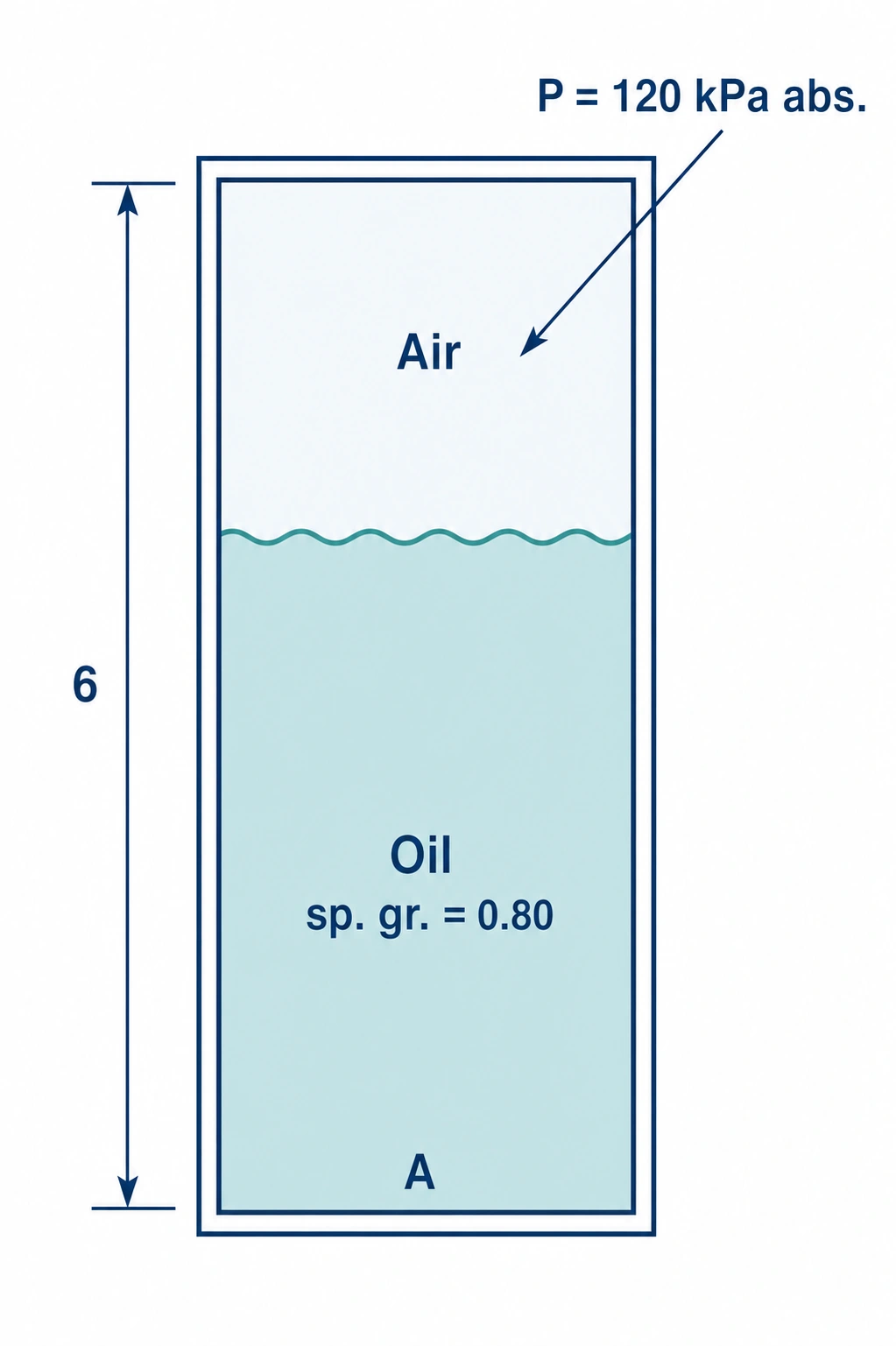
A closed cylindrical tank having a height of 6 m and a radius of 2 m is 2/3 full of oil having a sp. gr. of 0.80. The pressure in the air space above the oil surface is 120 kPa absolute. Atmospheric pressure is 101.3 kPa.
What is the gage pressure at the bottom of the tank?
50.09 kPa
31.39 kPa
151.70 kPa
18.70 kPa
Gage pressure of the air space: $P_{abs}=P_{atm}+P_{gage}$ $120=101.3+P_{gage}$ $P_{gage}=18.7\text{ kPa}$
Pressure at the bottom: The oil depth is $\frac{2}{3}(6)=4$ m, so $P_A=18.7+9.81(0.80)(4)$ $\boxed{P_A=50.09\text{ kPa}}$
Question Bank: longquiz12
HGE - Hydraulics / Hydrostatic Pressure / Engr. Anne
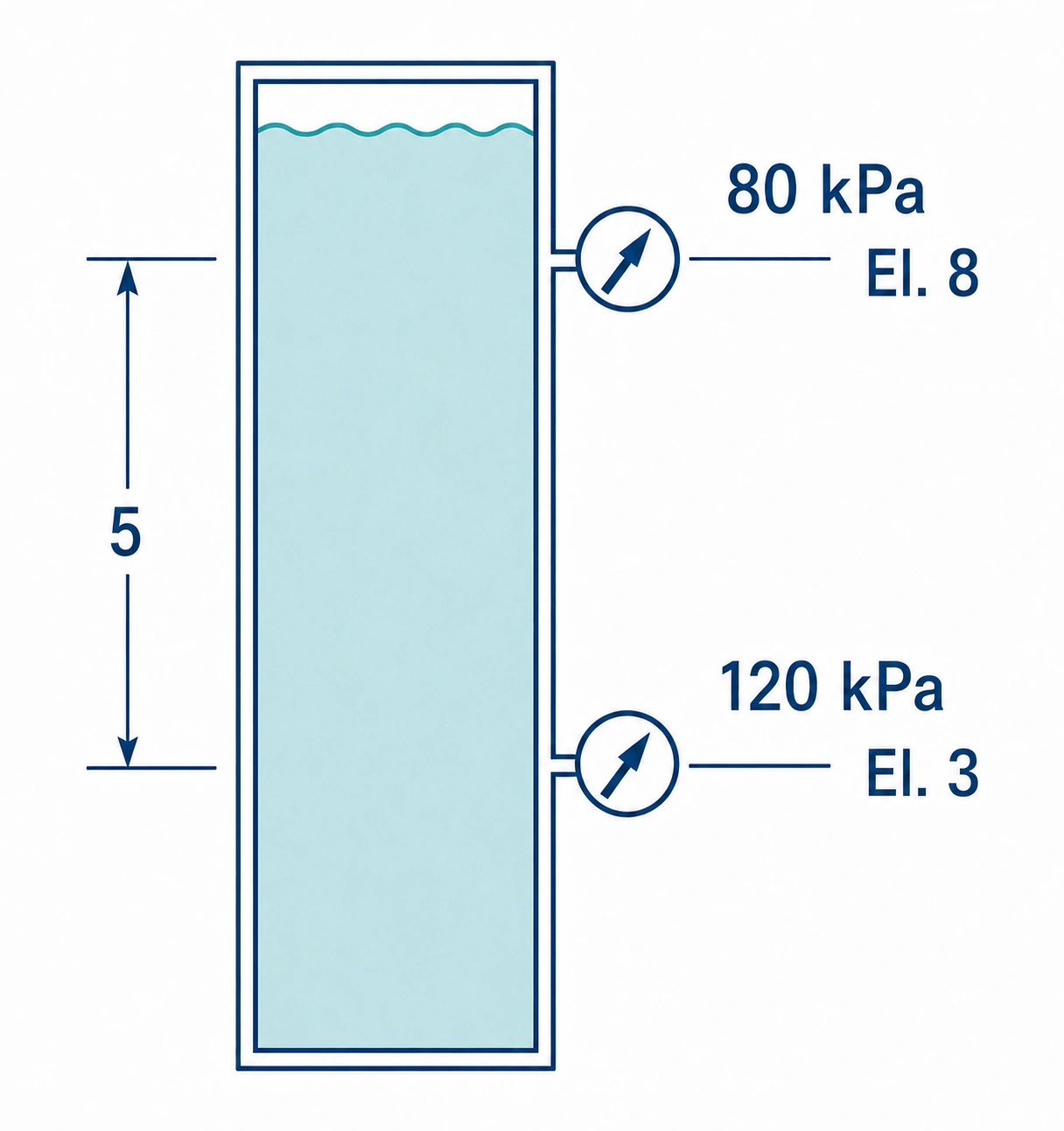
A pressure gauge at elevation 8 m at the side of a tank containing a liquid reads 80 kPa. Another gauge at elevation 3 m reads 120 kPa.
Compute the specific weight of the liquid.
8.00 kN/m3
9.81 kN/m3
6.40 kN/m3
10.00 kN/m3
Compute the density of the liquid.
815.49 kg/m3
1000.00 kg/m3
784.80 kg/m3
652.39 kg/m3
Compute the specific gravity of the liquid.
0.82
0.78
1.00
0.64
Specific weight: The two gauges are $8-3=5$ m apart vertically, so $120=80+5\gamma$ $\boxed{\gamma=8\text{ kN/m}^3}$
Specific gravity: $s=\dfrac{\rho}{\rho_w}=\dfrac{815.49}{1000}$ $\boxed{s=0.82}$
Question Bank: longquiz13
HGE - Hydraulics / Manometers / Engr. Anne
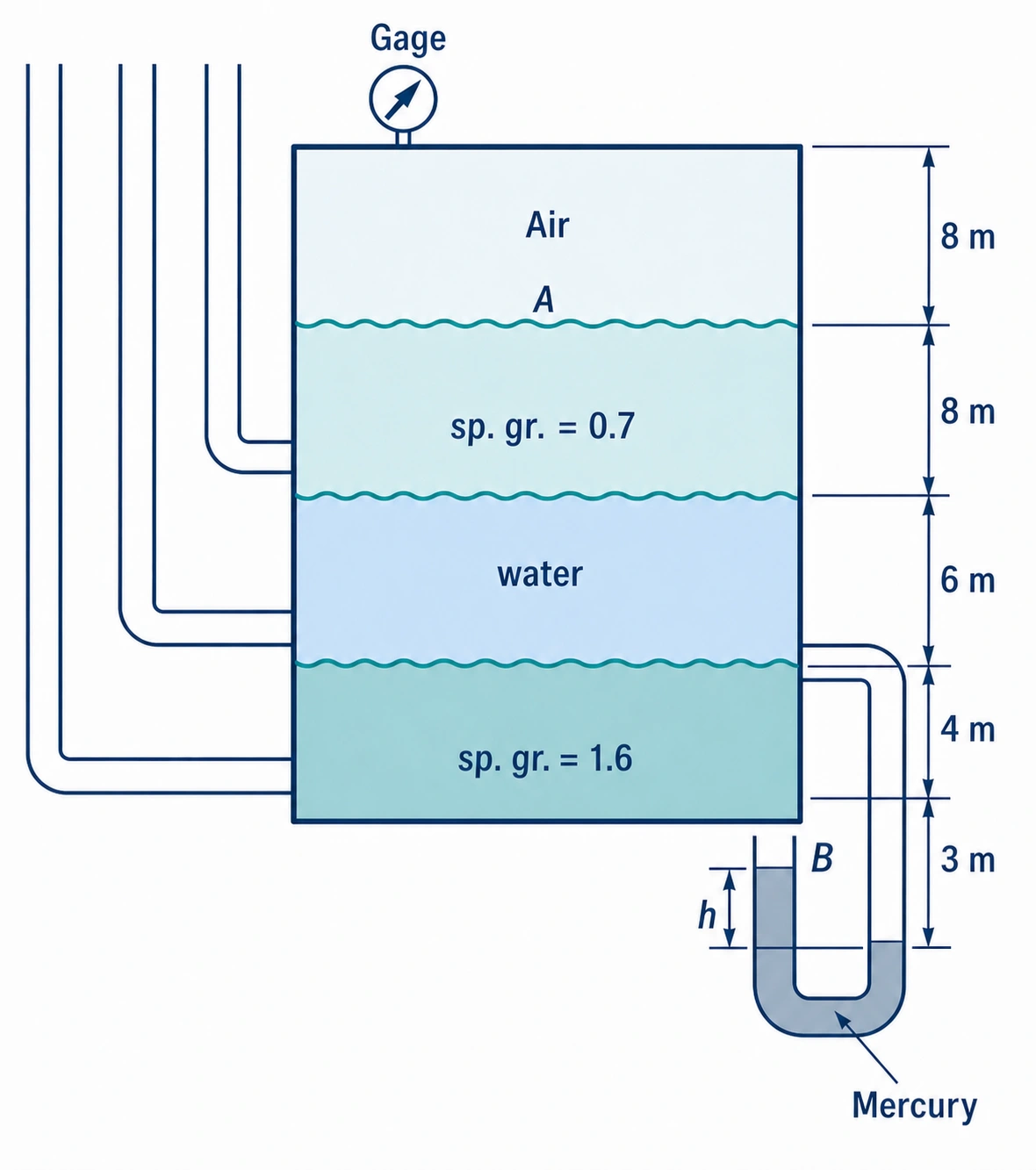
From the figure shown, the gage reading at the top of a closed tank is −18 kPa. Below the air space the tank contains, in order, a liquid of sp. gr. 0.7 (8 m deep), water (6 m deep), and a liquid of sp. gr. 1.6 (4 m deep). A U-tube mercury manometer is connected at point B, which is 3 m below the bottom of the sp. gr. 1.6 layer. Neglect the weight of air.
Determine the deflection h of the mercury in the U-tube manometer.
1.32 m
1.14 m
1.51 m
0.97 m
Sum the pressure heads from the gage down to the mercury surface and back up, taking $\gamma_w=9.81$ kN/m3 and $s_{Hg}=13.6$: $P_B=P_A+9.81(0.7)(8)+9.81(6)+9.81(1.6)(4)+(3-h)(9.81)-9.81(13.6)h$ $0=-18+54.94+58.86+62.78+29.43-9.81h-133.42h$ $143.23h=189.01$ $\boxed{h=1.32\text{ m}}$
Question Bank: longquiz16
HGE - Hydraulics / Manometers / Engr. Anne
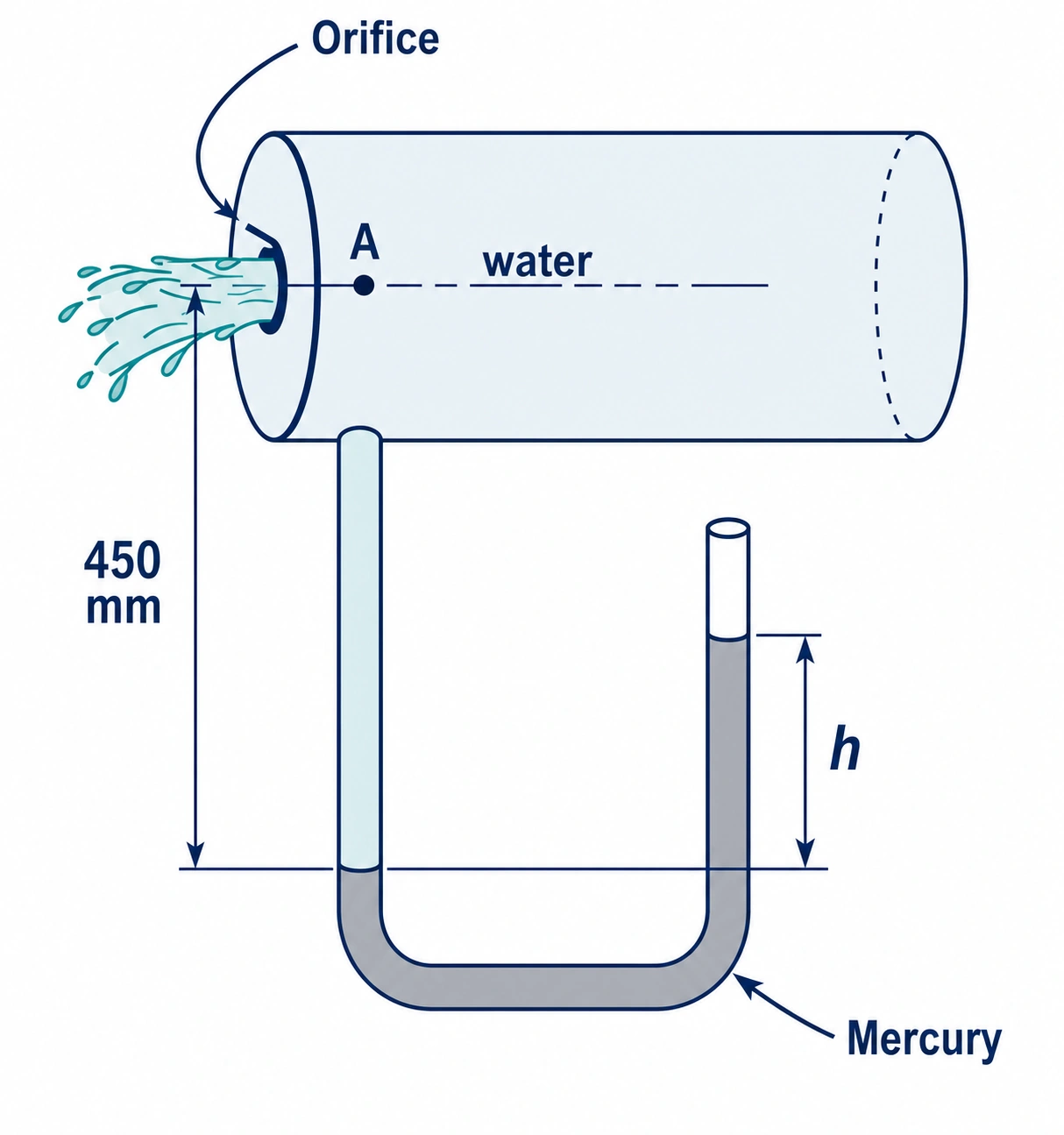
A manometer is attached to a pipe carrying water to measure pressure as shown. The mercury (sp. gr. 13.6) leg starts 450 mm below point A on the pipe.
Compute the deflection h of the mercury if the pressure at A is 16 kPa.
0.153 m
0.120 m
0.186 m
0.220 m
Sum pressure heads from A to the open end of the manometer, in metres of water: $\dfrac{P_A}{\gamma_w}+0.45-h(13.6)=0$ $\dfrac{16}{9.81}+0.45=13.6h$ $1.631+0.45=13.6h$ $\boxed{h=0.153\text{ m}}$
For lack of mercury, an improved barometer uses a liquid which was observed to weight 0.735 times that of mercury. At the base of the mountain, the barometer reads 850mm. Concurrently, another barometer of the same kind at the top of the mountain reads 600mm. Assuming the unit weight of air to be constant at 12N/m3, evaluate the height of the mountain in km.
Answer:
2.04km
3.02km
1.84km
2.46km
The pressure difference between the two barometer readings equals the pressure of the air column: $\Delta p=\gamma_l\Delta h=\gamma_{air}H$ The liquid weighs $0.735$ times mercury, so: $H=\frac{0.735(13{,}600)(9.81)(0.850-0.600)}{12}$ $H=2042.9$ m $\boxed{H\approx 2.04\text{ km}}$
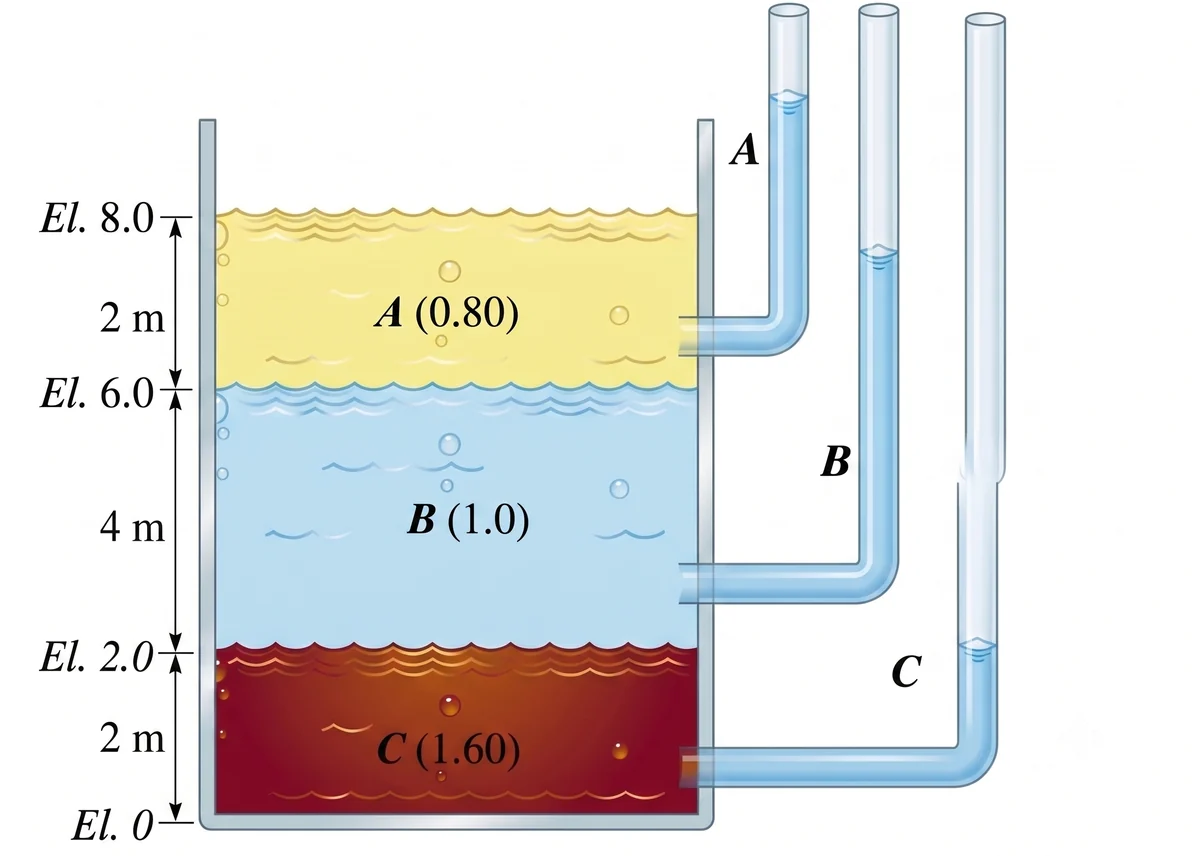
Liquids A, B, and C are inside the container shown.
What is the pressure in kPa at the bottom of the tank?
86.328kPa
85.734kPa
87.628kPa
88.234kPa
At what elevation will the liquid stand in the piezometer tube for liquid A?
8.0m
8.2m
8.4m
8.6m
At what elevation will the liquid stand in the piezometer tube for liquid B?
7.6m
5.6m
7.8m
8.0m
At what elevation will the liquid stand in the piezometer tube for liquid C?
5.5m
7.6m
6.7m
5.8m
### Multi-fluid pressure and piezometer levels
The pressure at the tank bottom is the sum of the pressure contributions of the three liquid layers:
$$p=\gamma_w[0.80(2)+1.00(4)+1.60(2)].$$
Thus
$$p=9.81(8.8)=\boxed{86.328\ \text{kPa}}.$$
A piezometer contains the same liquid as its connected layer, so its liquid level is the piezometric head for that liquid. From the layer interfaces and the corresponding specific gravities,
$$\boxed{h_A=8.0\ \text{m}},\qquad \boxed{h_B=7.6\ \text{m}},\qquad \boxed{h_C=5.5\ \text{m}}.$$
What is the absolute pressure in KPa 9 m below the open surface in a tank of oil (sp.gr. = 0.85) if the barometric pressure is 720 mm of mercury? Use Pa=101.356kPa
Answer:
171.07kPa
172.70kPa
168.54kPa
164.58kPa
Convert the barometric pressure, then add the oil pressure at 9 m depth: $p_{atm}=\frac{720}{760}(101.356)=96.08$ kPa $p_{oil}=0.85(9.81)(9)=75.04$ kPa $p_{abs}=96.08+75.04=171.07$ kPa $\boxed{p_{abs}=171.07\text{ kPa}}$
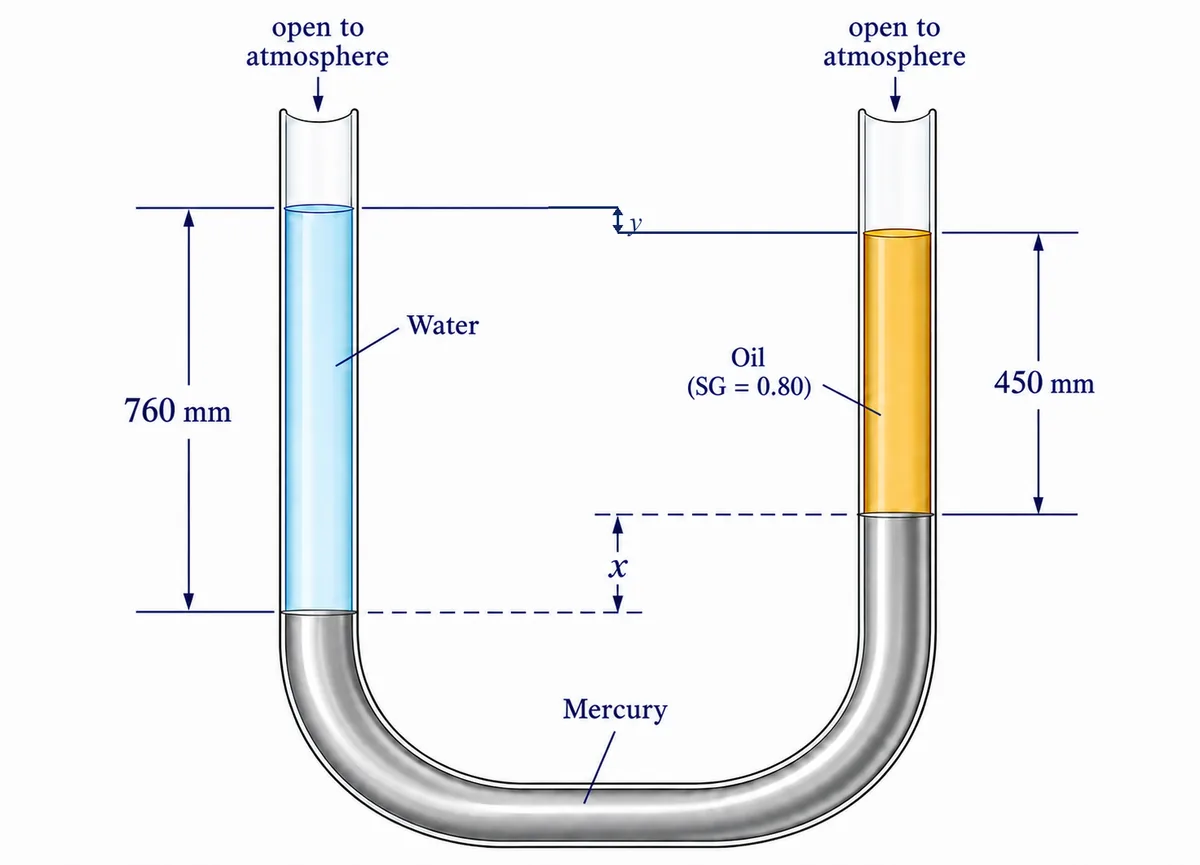
A U-tube with both ends open to the atmosphere contains contains mercury in the lower portion. In one leg, water stands 760 mm above the surface of the mercury. In the other leg, oil (sp.gr. = 0.80) stands 450 mm above the surface of the mercury. What is the difference in elevation between the surfaces of the oil and water columns?
Answer:
281mm
276mm
339mm
326mm
Pressure balance through the mercury gives the mercury-level difference: $\Delta h_{Hg}=\frac{0.760-0.80(0.450)}{13.6}=0.0294$ m The difference between the free surfaces is: $0.760-0.450-0.0294=0.2806$ m $\boxed{\Delta h\approx281\text{ mm}}$
Question Bank: q516
HGE - Hydraulics / Resultant of Parallel Force Systems / Engr. Deguma
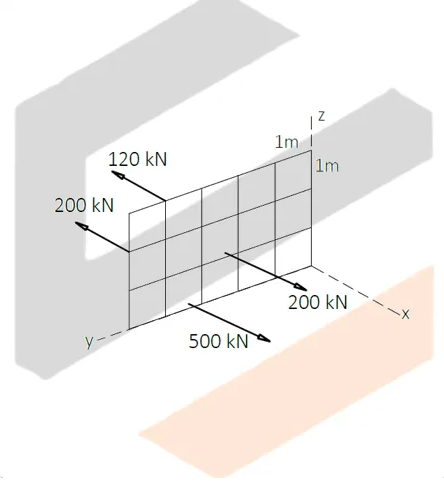
For the system shown:
Determine the resultant of the force system.
380
700
320
300
Determine the z-coordinate of the resultant force.
1.474m below the x-y plane
1.474m above the x-y plane
1.105m below the x-y plane
1.105m above the x-y plane
Determine the y-coordinate of the resultant force.
1.105m left of the x-z plane
1.105m right of the x-z plane
1.474m left of the x-z plane
1.474m right of the x-z plane
All shown forces are parallel to the $x$-axis. Add their signed magnitudes to obtain the resultant: $$R_x=380\text{ kN}$$ Take moments of every force about the coordinate planes. From the force locations in the figure: $$\sum M_y=-560.12\text{ kN}\cdot\text{m},\qquad \sum M_z=419.90\text{ kN}\cdot\text{m}$$ For a resultant $R_x$ acting at $(y_R,z_R)$: $$M_y=z_RR_x,\qquad M_z=-y_RR_x$$ Therefore: $$z_R=\frac{-560.12}{380}=-1.474\text{ m}$$ $$y_R=-\frac{419.90}{380}=-1.105\text{ m}$$ Thus the resultant is 380 kN, acting 1.474 m below the $x$-$y$ plane and 1.105 m left of the $x$-$z$ plane.
A closed cylindrical tank (h = 6 m, r = 2 m) is 2/3 full of oil (sp.gr. 0.80). If the air pressure above the oil is 120 kPa absolute, find the gage pressure at the bottom (Patm = 101.3 kPa).
A U-tube manometer contains mercury (sp.gr. 13.6). It is connected to a system with elevations at 8 m (sp.gr. 0.7), 6 m (sp.gr. 1.6), and 4 m. If the gage reads -18 kPa, find the mercury deflection h.
A submerged bottle (30 cm dia, 30 cm high cylinder; 5 cm dia, 30 cm long neck) is inverted in water. If the water depth in the bottle is 30 cm, find the submerged depth of the open end.
A manometer is attached to a pipe at A. The pipe center is 0.45 m above the mercury-water interface. If pressure at A is 16 kPa, find the mercury deflection h (sp.gr. 13.6).
HGE - Hydraulics / Hydrostatic Pressure / HGE November 2019
Formula-mode item rendered with fixed values for lecture/PDF export.
The weight-density of mud varies with depth according to $\gamma=14+0.4h$, where $\gamma$ is in kN/m3 and $h$ is in meters. Determine the pressure at a depth of 2.8 m in kPa.
44.03 kPa
38.73 kPa
40.77 kPa
42.81 kPa
Because the unit weight changes with depth, integrate $dp=\gamma\,dh$: $$p=\int_0^2.8(14+0.4h)\,dh=14(2.8)+\frac{0.4}{2}(2.8)^2.$$ Thus $p=40.768$ kPa. Computed answer: 40.77 kPa
Question Bank: v49
HGE - Hydraulics / Hydrostatic Pressure / HGE November 2019
Formula-mode item rendered with fixed values for lecture/PDF export.
A liquid column produces a pressure of 450 kPa. What is the equivalent height of water column in meters?
45.9 m
47.7 m
3.4 m
4.7 m
Pressure head is pressure divided by the unit weight of water: $$h_w=\frac{p}{\gamma_w}=\frac{450}{9.81}=45.871559633\text{ m}.$$ Computed answer: 45.9 m
Question Bank: v50
HGE - Hydraulics / Hydrostatic Pressure / HGE November 2019
Formula-mode item rendered with fixed values for lecture/PDF export.
Mercury barometers at the base and top of a mountain read 720 mm and 620 mm, respectively. Assume the unit weight of air is 9 N/m3. Approximate the mountain height.
1616 m
1868 m
1482 m
1171 m
The pressure difference indicated by mercury balances the air column: $$H=\Delta h_{Hg}\frac{\gamma_{Hg}}{\gamma_{air}}=\frac{(720-620)}{1000}\frac{9.81(13.6)}{9/1000}=1482.4\text{ m}.$$ Computed answer: 1482 m
Question Bank: v51
HGE - Hydraulics / Hydrostatic Pressure / HGE November 2019
Formula-mode item rendered with fixed values for lecture/PDF export.
If air had a uniform unit weight of 12 N/m3, determine the height of the atmosphere for an atmospheric pressure of 103 kPa.
8583 m
9785 m
7639 m
6523 m
For uniform air unit weight, $p=\gamma h$: $$H=\frac{p_{atm}}{\gamma_{air}}=\frac{103}{12/1000}=8583.33333333\text{ m}.$$ Computed answer: 8583 m
Question Bank: v52
HGE - Hydraulics / Measurements of Pressure / HGE November 2019
Formula-mode item rendered with fixed values for lecture/PDF export.
A hydraulic jack supports a load of 95 kN. If the pressure below the piston is 1.35 MPa, obtain the piston diameter in mm.
299 mm
263 mm
470 mm
332 mm
Use $pA=W$ and $A=\pi D^2/4$: $$D=1000\sqrt{\frac{4W}{\pi p}}=1000\sqrt{\frac{4(95)}{\pi(1.35)(1000)}}=299.329815309\text{ mm}.$$ Computed answer: 299 mm
Question Bank: v93
HGE - Hydraulics / Manometers / HGE November 2021
Formula-mode item rendered with fixed values for lecture/PDF export.
A manometer is attached to a conduit. Liquid B has specific gravity 10.5. The water level difference is h = 0.11 m and the liquid-B column difference is d = 0.35 m. Compute the pressure at A in kPa.
20.50 kPa
25.86 kPa
31.54 kPa
37.22 kPa
Summing pressure from the conduit point A to the atmospheric free surface gives $$p_A+\gamma_w(h+d)-\gamma_Bd=0.$$ Therefore $$p_A=\gamma_w[SG_Bd-(h+d)]=31.53915 ext{ kPa}.$$ Computed answer: 31.54 kPa
Question Bank: v99
HGE - Hydraulics / Measurements of Pressure / HGE November 2021
Formula-mode item rendered with fixed values for lecture/PDF export.
At an elevation above sea level, a mercury barometer reads 640 mm. Mercury has specific gravity 13.3, and air weighs 12 N/m^3. Determine the corresponding water-barometer reading, atmospheric pressure, and approximate elevation above sea level under normal atmospheric conditions.
What is the corresponding water-barometer reading in millimeters?
6895 mm
7661 mm
8512 mm
9533 mm
Evaluate the atmospheric pressure in kPa at that level.
76.8 kPa
90.2 kPa
83.5 kPa
61.8 kPa
What is the approximate elevation in meters above sea level?
5845 m
6959 m
8211 m
4662 m
Convert the mercury column to an equivalent water column: $$h_w=SG_{Hg}h_{Hg}=8512 ext{ mm}.$$ Atmospheric pressure is $$p_{atm}=\gamma_wSG_{Hg}h_{Hg}=83.50272 ext{ kPa},$$ and the approximate elevation is $$z=p_{atm}/\gamma_{air}=6958.56 ext{ m}.$$
Computed answers: 1. 8512 mm 2. 83.5 kPa 3. 6959 m
Question Bank: v117
HGE - Hydraulics / Hydrostatic Pressure / HGE May 2022
Formula-mode item rendered with fixed values for lecture/PDF export.
An airplane climbs from an altitude of 8 km to 13 km. Assuming the unit weight of air remains constant at 10 N/m3, determine the magnitude of the pressure change.
39.1 kPa
50.0 kPa
56.9 kPa
63.1 kPa
For a constant unit weight, the magnitude of the pressure change is $$\Delta p=\gamma_{air}\Delta h.$$ Since 1 km = 1000 m and 1 kPa = 1000 Pa, $$\Delta p=10(13-8)=50\text{ kPa}.$$ Computed answer: 50.0 kPa
Question Bank: v140
HGE - Hydraulics / Measurements of Pressure / HGE Refresher Series
Formula-mode item rendered with fixed values for lecture/PDF export.
Two mercury barometers are read simultaneously: 740 mm Hg at a low station and 500 mm Hg at a mountain station. Take the average unit weight of air as 0.012 kN/m3. Estimate the elevation difference.
Find the mountain height above the lower station.
2084 m
2668 m
3034 m
3365 m
Equate the pressure difference represented by the mercury columns to the pressure change through the air: γHgΔh = γairH. Computed answers: 2668.32.
Question Bank: v152
HGE - Hydraulics / Measurements of Pressure / HGE Refresher Series
What quantity is commonly obtained with a manometer connected to a pipe?
Atmospheric temperature
Only very low absolute pressure
Fluid pressure in the pipe
Mean channel velocity
A manometer converts a pressure difference into a measurable liquid-column difference.
Question Bank: v158
HGE - Hydraulics / Measurements of Pressure / HGE Refresher Series
Formula-mode item rendered with fixed values for lecture/PDF export.
An aircraft changes altitude by 4250 m. Use an average air unit weight of 0.011 kN/m3.
Estimate the magnitude of the atmospheric pressure change.
36.5 kPa
46.8 kPa
53.2 kPa
59.0 kPa
Use Δp = γairΔz. Computed answers: 46.75.
Question Bank: v179
HGE - Hydraulics / Measurements of Pressure / HGE Refresher Series
Formula-mode item rendered with fixed values for lecture/PDF export.
A column of liquid with specific gravity 3.2 and height 7 m produces the same pressure as a column of another liquid having specific gravity 0.75.
Determine the equivalent height of the second liquid.
23.33 m
33.96 m
29.87 m
37.66 m
Equate γ1h1 and γ2h2. Computed answers: 29.8666666667.
Question Bank: v182
HGE - Hydraulics / Measurements of Pressure / HGE Refresher Series
Formula-mode item rendered with fixed values for lecture/PDF export.
A sealed rectangular tank 3 m long, 2 m wide, and 3 m high is half filled with water. The air pressure over the water is 8 kPa gage.
Find the bottom gage pressure.
17.74 kPa
25.83 kPa
28.64 kPa
22.72 kPa
Compute the total force on an end wall.
54.73 kN
70.07 kN
79.67 kN
88.36 kN
Locate the resultant below the water surface using the signed reference shown in the solution.
0.315 m
0.246 m
0.358 m
0.397 m
Superpose the uniform air-pressure loading and the triangular water-pressure loading; locate their combined resultant by moments. Computed answers: 22.715, 70.0725, 0.31499518356.
Question Bank: v191
HGE - Hydraulics / Measurements of Pressure / HGE Refresher Series
How is gage pressure related to absolute and atmospheric pressure?
Absolute minus atmospheric
Absolute plus atmospheric
Atmospheric minus absolute
Independent of atmospheric pressure
pgage = pabsolute - patmospheric.
Question Bank: v194
HGE - Hydraulics / Measurements of Pressure / HGE Refresher Series
Formula-mode item rendered with fixed values for lecture/PDF export.
A vertical piezometer of inside diameter 1.1 mm is connected to a liquid line. Capillary rise is estimated by hc = 4σcosθ/(γd). The indicated column is 0.26 m.
Find the corrected gage pressure.
1.782 kPa
2.282 kPa
2.594 kPa
2.877 kPa
Subtract capillary rise from the observed liquid-column height before converting head to pressure. Computed answers: 2.28150909091.
Question Bank: v208
HGE - Hydraulics / Measurements of Pressure / HGE Refresher Series
Which scientist is associated with the principle that pressure applied to a confined fluid is transmitted undiminished?
Archimedes
Boyle
Torricelli
Pascal
This is Pascal's principle.
Question Bank: v213
HGE - Hydraulics / Measurements of Pressure / HGE Refresher Series
Formula-mode item rendered with fixed values for lecture/PDF export.
A liquid has depth-dependent unit weight γ = 14 + 0.6h kN/m3. Find the bottom pressure at depth 2.5 m.
Evaluate the bottom gage pressure.
28.80 kPa
41.93 kPa
36.88 kPa
46.50 kPa
Integrate p = ∫0Hγ(h)dh. Computed answers: 36.875.
Question Bank: v219
HGE - Hydraulics / Measurements of Pressure / HGE Refresher Series
Formula-mode item rendered with fixed values for lecture/PDF export.
A mercury barometer reads 725 mm at an elevated location. Use mercury specific gravity 13.5, air unit weight 0.011 kN/m3, and sea-level pressure 101.5 kPa.
Convert the barometer reading to millimeters of water.
7644 mm water
11128 mm water
12342 mm water
9788 mm water
Find the local atmospheric pressure.
74.99 kPa
109.17 kPa
121.08 kPa
96.02 kPa
Estimate the elevation above sea level.
389 m
499 m
567 m
629 m
Convert the mercury column to equivalent water head, then use the pressure deficit divided by air unit weight. Computed answers: 9787.5, 96.015375, 498.602272727.
Question Bank: v221
HGE - Hydraulics / Measurements of Pressure / HGE Refresher Series
Atmospheric pressure varies with which factors?
Altitude
Temperature
Weather conditions
All of these
All three affect local atmospheric pressure.
Question Bank: v229
HGE - Hydraulics / Measurements of Pressure / HGE Refresher Series
Hydrostatic pressure is the pressure at a point when which condition applies?
The fluid accelerates.
The fluid is incompressible.
The fluid is at rest.
Viscosity is high.
Hydrostatics concerns fluids at rest.
Question Bank: v240
HGE - Hydraulics / Measurements of Pressure / HGE Refresher Series
Formula-mode item rendered with fixed values for lecture/PDF export.
A liquid has unit weight γ=9.5+0.3h kN/m3. Evaluate pressure at depth 4.5 m.
Find gage pressure.
35.76 kPa
52.06 kPa
45.79 kPa
57.74 kPa
Integrate the variable unit weight over depth. Computed answers: 45.7875.
Question Bank: v244
HGE - Hydraulics / Measurements of Pressure / HGE Refresher Series
What is the line through piezometer water levels along a pipeline called?
Hydraulic grade line
Hydraulic head
Energy head
Energy gradient
The hydraulic grade line joins piezometric heads.
Question Bank: v245
HGE - Hydraulics / Measurements of Pressure / HGE Refresher Series
Which device measures static pressure head in a pipe with moving liquid?
Manometer only
Pitot tube
Venturi meter
Piezometer
A piezometer directly indicates pressure head for liquids.
Question Bank: v252
HGE - Hydraulics / Measurements of Pressure / HGE Refresher Series
Formula-mode item rendered with fixed values for lecture/PDF export.
A gas tank has absolute pressure 3.5 atmospheres. Take atmospheric pressure as 101.325 kPa.
Find gage pressure head in meters of water.
20.17 m
29.36 m
32.56 m
25.82 m
Subtract one atmosphere and divide by γw. Computed answers: 25.8218654434.
Question Bank: v267
HGE - Hydraulics / Measurements of Pressure / HGE Refresher Series
Formula-mode item rendered with fixed values for lecture/PDF export.
A tank contains 2.5 m of a liquid having unit weight 7 kN/m3 over a water layer.
Find the gage pressure at the liquid interface.
17.50 kPa
13.67 kPa
19.90 kPa
22.07 kPa
At the interface, the upper liquid contributes $p=\gamma h$. Computed answer: 17.5 kPa.
Question Bank: v272
HGE - Hydraulics / Measurements of Pressure / HGE Refresher Series
What is a space with pressure below atmospheric pressure commonly said to contain?
Absolute pressure
Vacuum
Gage pressure
Atmosphere
Pressure below atmospheric is described by its vacuum pressure.