Momentum Equation for Flow Force
Hydrodynamic force problems use the linear momentum equation. Resolve forces by components and assign signs before substituting.
$$\sum F_x=\rho Q(V_{2x}-V_{1x})$$$$\sum F_y=\rho Q(V_{2y}-V_{1y})$$

Hydrodynamic force problems use the linear momentum equation. Resolve forces by components and assign signs before substituting.
For elbows and nozzles, include pressure forces at inlet and outlet, weight if significant, and momentum change. The required anchor force is opposite the force of water on the pipe.
Water hammer is the pressure surge created when moving liquid is stopped or redirected suddenly.
For gradual valve closure, reduce the surge using the closure-time relation required by the problem statement.
Water velocity in a pipe drops from 2.0 m/s to zero. If wave celerity is 1000 m/s, find water hammer head.
Answer: The surge head is approximately 204 m of water.
Water flows at Q = 0.080 m³/s through a 150 mm diameter pipe that turns 90° in the horizontal plane (a right-angle elbow). The gauge pressure at the inlet of the elbow is 200 kPa. Neglect elevation changes and head loss through the elbow. Find the x- and y-components of the force that the water exerts on the elbow, and the magnitude and direction of the resultant force.
Pipe area: $A = \pi(0.15)^2/4 = 0.01767$ m². By continuity (same diameter), inlet and outlet velocities are equal: $V = Q/A = 0.080/0.01767 = 4.53$ m/s. For a 90° horizontal bend, inlet flow is in the +x direction and outlet is in the +y direction (or vice versa — assign inlet as +x, outlet as +y).
Momentum equation (forces on fluid from pipe = $R_x, R_y$; water exerts equal and opposite forces on the pipe):
Force of water on elbow is equal and opposite to $R_x, R_y$ (reaction from fluid on pipe):
Answer: Each component of the force on the elbow is 3.896 kN. The resultant is 5.51 kN at 45° from each pipe direction (diagonal outward). Pipe elbows must be anchored against this force — it is the combination of pressure thrust and momentum flux that tends to push the bend off its supports.
A 200 mm diameter pipe (inlet) reduces to a 100 mm diameter nozzle at the outlet. Water flows at Q = 0.060 m³/s and the inlet gauge pressure is 150 kPa. Find the force required to hold the nozzle in place (the axial force on the nozzle-pipe connection). Neglect losses and elevation change.
Apply Bernoulli (same elevation, no loss) to find $p_2$:
Momentum equation in flow direction (x), let F = bolt force (tension) holding nozzle:
Answer: The nozzle connection must resist 3.41 kN in tension (the pipe pulling back against the nozzle thrust). The dominant contribution is the pressure force at the inlet; momentum change adds only about 10% of the total load.
A steel water main has an inside diameter of 400 mm and a wall thickness of 10 mm. The pipe is assumed to be anchored at both ends. The bulk modulus of water is $K = 2.07 \times 10^9$ Pa and the Young's modulus of steel is $E = 200 \times 10^9$ Pa. Determine the wave celerity $c$ for water hammer. Then find the water hammer surge pressure if the initial velocity is 1.5 m/s and the valve closes instantaneously.
The wave celerity in an elastic pipe accounts for both water compressibility and pipe wall elasticity:
where $D$ = inside diameter, $t$ = wall thickness, $K$ = bulk modulus of water, $E$ = Young's modulus of pipe material.
Answer: Wave celerity c = 1210 m/s. Surge pressure = 1815 kPa (about 185 m water head). Pipe elasticity reduces celerity below the rigid-pipe value of 1439 m/s and correspondingly reduces the surge — this is why steel pipes are better than rigid cast-iron from a water hammer standpoint.
Water flows at 2.5 m/s in a 500 m long pipeline with a wave celerity of 1200 m/s. The maximum allowable surge pressure head is 80 m above the normal operating pressure. Determine: (a) whether instantaneous closure is safe, and (b) the minimum closure time needed for the valve to close "gradually" so that reflected waves can reduce the pressure rise. Use the criterion that closure is "gradual" if the closure time $T > 2L/c$.
305.8 m >> 80 m allowable — instantaneous closure is NOT safe.
The critical time for pressure wave return trip (pipe period):
For gradual closure ($T > T_c$), the surge head is approximately reduced by the ratio $T_c/T$:
Answer: (a) Instantaneous closure produces 305.8 m surge — far above the 80 m limit, so it is unsafe. (b) The valve must close in at least 3.18 seconds (more than 4 pipe periods) to keep surge below 80 m. In practice, valve closure times of 10–30 seconds or longer are used for large water mains to prevent catastrophic pipe failure.
A water jet 50 mm in diameter exits a nozzle at 12 m/s and strikes a flat stationary plate perpendicularly. Assuming the jet spreads radially after impact (velocity remains 12 m/s tangentially, zero normal component after), find: (a) the force on the plate, and (b) the force if the plate moves away from the jet at 4 m/s.
(a) Stationary plate:
(b) Moving plate (u = 4 m/s away from jet): Relative velocity of jet to plate = V − u = 12 − 4 = 8 m/s. The mass flow rate actually intercepted by the moving plate uses the relative velocity:
Answer: (a) Force on stationary plate = 282.7 N ≈ 283 N. (b) Force on moving plate = 125.6 N ≈ 126 N. The force drops to (8/12)² = 44% of the stationary-plate value because both the intercepted flow rate and the momentum change per unit mass decrease with plate velocity. Maximum power transfer to the plate occurs when u = V/3.
Additional board-style practice items for this topic.
A jet of water 25 mm in diameter and having a velocity of 7.5 m/s strikes against a plate at right angles.
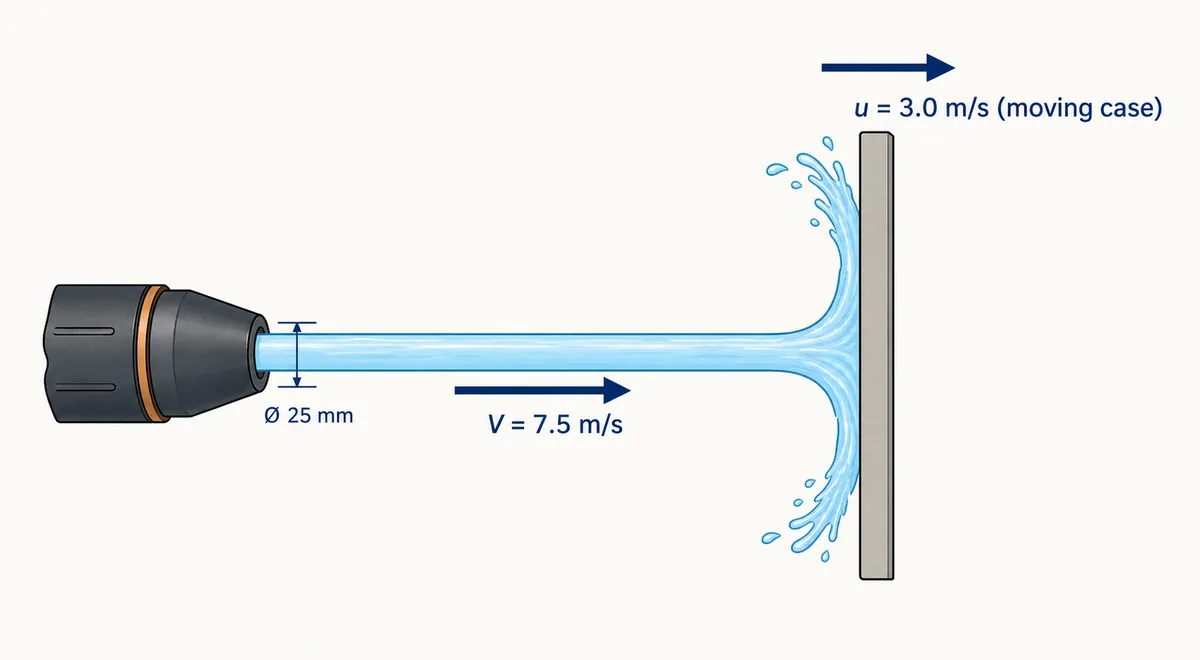
Determine the force on the plate if the plate is fixed.
Determine the force on the plate if the plate is moving in the same direction as the jet with a uniform velocity of 3 m/s.
Part 1.
For a fixed plate normal to the jet, the force is the rate of change of momentum:Part 2.
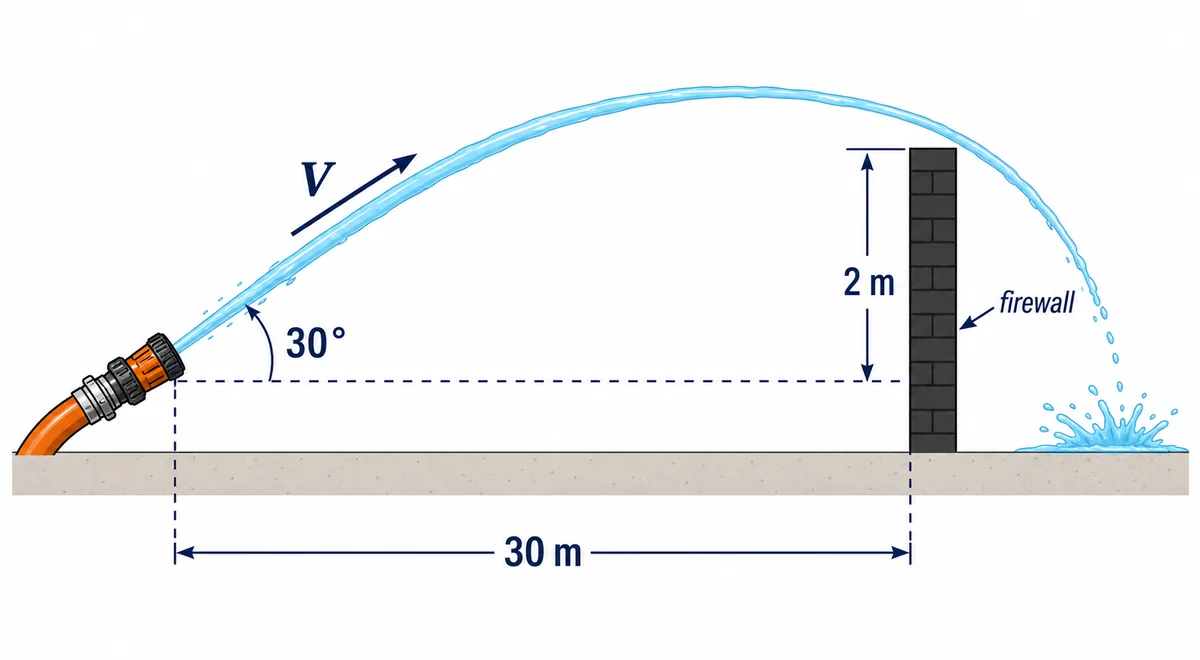
For a plate moving in the same direction as the jet, use the relative velocity:A fireman has to put out a fire but is blocked by a firewall. To reach over the wall, he directed the water jet from the nozzle at an angle of 30° to the horizontal. Evaluate the velocity of the water in meters per second, leaving the nozzle of his hose to reach over the wall if he stands 30 m. away from the wall and the wall is standing 2 m. higher than the nozzle of the hose. Neglect friction in the jet.
Answer:
What type of flow exists when, at any fixed point, the amount and properties of fluid passing a pipe section do not change with time?
Steady flow. By definition, in steady flow the quantity and properties of the fluid passing a fixed section do not change with time ($\partial/\partial t=0$). Uniform flow refers to no change along the path, while laminar describes orderly layered motion.
A water jet leaves a nozzle at 21 m/s and angle 45°. Find the maximum horizontal distance at which it can clear a wall 4 m above the nozzle. Neglect resistance.
A 30-mm water jet moving at 8 m/s strikes a flat plate moving at 5 m/s in the same direction. Determine the force on the plate.
Water falls freely from a height of 16 m. If 0.7 m3 falls in 2.5 s, compute the impact force when the downward jet is stopped.
A pressure surge or wave caused when a fluid in motion is forced to stop or change direction suddenly is referred to in hydraulics as what?
A line joining the points of highest elevation of water in a series of vertical open pipes rising from a pressurized pipeline is referred to as what?
A horizontal water jet with velocity 9.5 m/s issues from a 16 mm diameter nozzle and strikes a flat plate normal to the jet axis. Evaluate the force on the plate when it is stationary, when it moves away from the nozzle at 5 m/s, and when it moves toward the nozzle at 6.5 m/s.
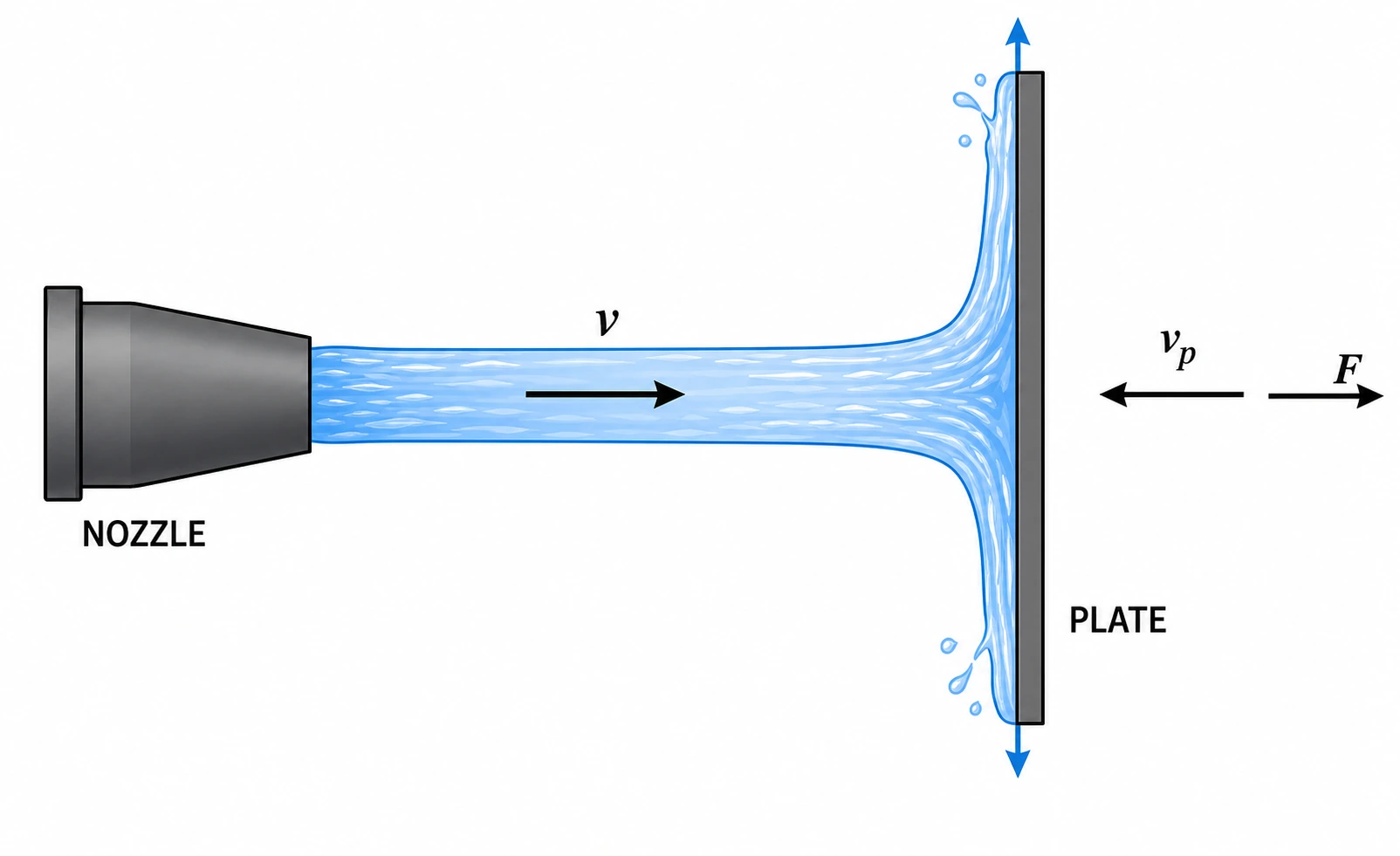
The plate is stationary.
The plate is moving away from the nozzle.
The plate is moving toward the nozzle.
A vertical water jet of diameter 35 mm issues upward under a head of 20 m with velocity coefficient 0.95 and discharge coefficient 0.94. A horizontal plate of weight 325 N is supported by the jet.
At what height above the nozzle can the plate remain in equilibrium?
A water jet leaves a nozzle at height 2 m with angle 35° above horizontal and lands -3.4876823301 m away at ground level.
Determine the nozzle speed.
Determine the maximum height of the jet above ground.
Determine the horizontal distance from the nozzle to the jet apex.
A rapidly closed valve in a long liquid pipeline may create a high-intensity pressure surge known as what?
With other conditions unchanged, which change reduces water-hammer pressure?
A horizontal jet leaves an orifice with Cv=0.94 and lands 2.4 m away after falling 2 m.
Find the orifice head.
Which bent tube is used to measure stagnation velocity in a flowing stream?
A water jet of diameter 25 mm and speed 9 m/s strikes a flat plate normally. Evaluate stationary and translating-plate cases.
Find the force on a stationary plate.
Find the force when the plate moves with the jet.
Find the force when the plate moves toward the jet.
Which device increases fluid velocity by discharging through a shaped end fitting?
A 25 mm water jet issues downward under head 34 m with Cv = 0.97 and Cd = 0.97 to support a plate of weight 210 N.
Find the nozzle speed.
Find the jet speed at the plate.
Find the vertical drop from nozzle to plate.