Constant Head Orifice
An orifice is an opening with a closed perimeter used to discharge or measure fluid. For constant head, discharge is based on Torricelli velocity corrected by coefficients.
$$V_t=\sqrt{2gH}$$$$Q=C_d A\sqrt{2gH}$$$$C_d=C_cC_v$$

An orifice is an opening with a closed perimeter used to discharge or measure fluid. For constant head, discharge is based on Torricelli velocity corrected by coefficients.
If a jet travels horizontal distance $x$ while falling vertical distance $y$, the actual jet velocity can be found from projectile motion.
For a tank of constant surface area $A_s$ emptying through an orifice area $A_o$, integrate because the head changes with time.
A 50 mm orifice under a constant head of 3 m has $C_d=0.62$. Find $Q$.
Answer: $Q=0.00933\text{ m}^3/\text{s}$.
A 40 mm diameter orifice discharges under a constant head of 2.5 m. If $C_c=0.62$ and $C_v=0.98$, determine the actual discharge.
Answer: $Q=0.00535\text{ m}^3/\text{s}$ or about 5.35 L/s.
A tank with constant plan area 3.0 m2 drains through a 30 mm orifice with $C_d=0.62$. Find the time for the head to fall from 2.0 m to 0.50 m.
Answer: The water level takes about 36.5 minutes to fall to 0.50 m head.
A horizontal jet from an orifice falls 0.45 m while traveling 1.80 m horizontally. The head over the orifice is 2.0 m. Determine $C_v$.
Answer: $C_v=0.949$.
An orifice 75 mm in diameter connects two tanks. The upstream water level is 3.5 m above the orifice centerline and the downstream water level is 1.2 m above the centerline (both measured from the same orifice elevation). Use $C_d = 0.62$. Find the discharge through the orifice and describe how submergence affects the effective head.
For a submerged orifice, the effective head is the difference between the upstream and downstream water levels:
Answer: Q = 0.01838 m³/s (18.38 L/s). Unlike a free-discharge orifice where the full upstream head drives flow, submergence reduces the effective head from 3.5 m to only 2.3 m — a 34% reduction in the head term and about 19% less discharge than if the downstream were free.
Two cylindrical tanks are connected at their bases by a 50 mm diameter orifice ($C_d = 0.62$). Tank 1 has a constant cross-sectional area of 4.0 m² and initial water depth of 3.0 m. Tank 2 has area 2.0 m² and initial depth of 0.50 m. Find the time in minutes for the two water levels to equalize.
Let $h$ = difference in water levels (Tank 1 higher). When levels equalize, $h = 0$. The combined effective storage area for a head change $dh$ is:
Answer: The two tanks equalize in approximately 13.05 minutes. The effective area formula accounts for the fact that water leaving Tank 1 partially fills Tank 2, so the net head change is slower than for a single emptying tank.
A tank with a horizontal cross-sectional area of 5.0 m² has a constant inflow rate of 0.025 m³/s. It also drains through a 60 mm diameter orifice at the base ($C_d = 0.65$). Initially the water depth is 1.5 m. Determine the equilibrium depth (when inflow equals outflow) and state whether the initial depth is above or below equilibrium.
At equilibrium, $Q_{in} = Q_{out}$:
Answer: The equilibrium water depth is 9.44 m. The initial depth of 1.5 m is far below equilibrium, meaning the tank level will rise over time as inflow exceeds outflow. The tank will fill until it reaches 9.44 m if it is tall enough.
Additional board-style practice items for this topic.
A water tank has a sloping inclined at 45° with the horizontal. The total depth of water in the tank is 6.7 m. A water jet issues from an orifice located on the inclined side of the tank under a hydrostatic head of 4 m. or that orifice is located 2.7 m. vertically above the bottom of the tank. Coefficient of velocity is 1.0. Negcting air resistance on the jet.
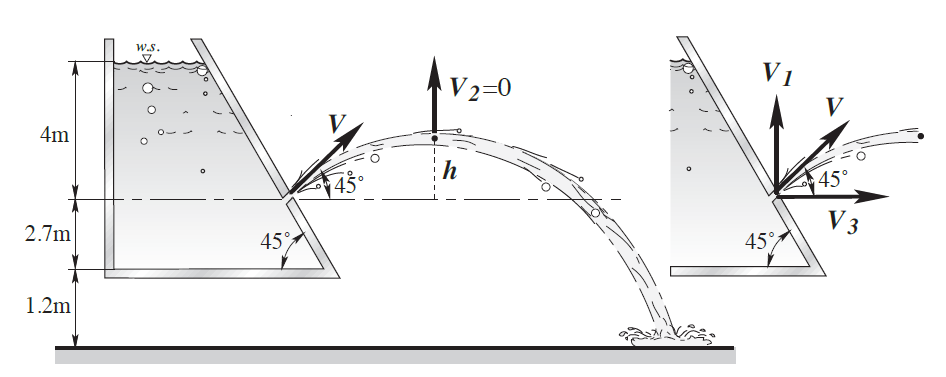
Determine the maximum height of the issuing jet arises above the level of the center of orifice in meters.
Determine the time it takes for this particle of the jet to sit the ground that is 1.20 m. below the bottom of the tank in seconds.
Determine the horizontal distance on the ground traveled by the jet from the center of the orifice in meters.
Part 1.
Jet velocity from the orifice is $V=\sqrt{2gh}$. The jet leaves normal to a side inclined 45°, so its vertical component gives the rise:Part 2.
The jet speed is $V=\sqrt{2gh}=\sqrt{2(9.81)(4)}=8.86$ m/s. Since it leaves at 45°:Part 3.
Using the time from vertical motion, $t=1.74$ s. The horizontal component is:A right cylindrical container 2.5 m in diameter is 3 meters tall. A 50-mm diameter hole is provided at the bottom of the container to drain the water when necessary. If it is 2/3 full of water how long, in minutes, does it take to empty the container from the instant that the hole is opened? Coefficient of velocity and coefficient of contraction are both equal to 1.0.
Answer:
A sharp-edged orifice, 75mm in diameter, lies in a horizontal plane, the jet being directed upward. If the jet rises to a height of 8 m and the coefficient of velocity is 0.98, determine the head under which the orifice is discharging, neglecting air friction.
Answer:
A vessel has an orifice located on the vertical side of a vessel under a constant head of h meters. The jet issuing from the orifice strikes the ground 12m below the center of the orifice at a point 20m distance, measured horizontally, from the vertical plane of the orifice. If the coefficient of velocity of orifice is 0.98 and neglecting air resistance on the jet.
Determine the time for the jet to strike the ground in seconds.
Determine the value of h.
Determine the exit velocity of the jet from the orifice, in meters per second.
Part 1.
The vertical motion of the jet controls the time to fall 12 m:Part 2.
From vertical motion, $t=1.56$ s. The horizontal velocity is:Part 3.
The jet is horizontal at the orifice, so the exit velocity is the horizontal velocity:A tank consists of a right circular cylinder of diameter 3.5 m and height 3.9 m sitting on top of a right circular cone of the same diameter and height 3.9 m with its apex pointing down. An orifice of area 0.08 m2 with discharge coefficient 0.58 is at the cone vertex.
Find the time to empty the cylindrical part, in seconds.
Find the time to empty the conical part, in seconds.
Find the total time to empty the tank, in seconds.
Part 1 — Cylinder (prismatic). With constant surface area $A_s=\dfrac{\pi D^{2}}{4}$, the head over the orifice falls from $h_1=2H$ to $h_2=H$:
$$t_{cyl}=\frac{2A_s}{C_dA_o\sqrt{2g}}\left(\sqrt{h_1}-\sqrt{h_2}\right).$$Part 2 — Cone. For the apex-down cone the surface area varies as $A(h)=\pi\!\left(\dfrac{R}{H}\right)^{2}h^{2}$, $R=\dfrac{D}{2}$. Integrating $\dfrac{A(h)}{C_dA_o\sqrt{2gh}}$ from $H$ to $0$,
$$t_{cone}=\frac{\pi (R/H)^{2}}{C_dA_o\sqrt{2g}}\cdot\frac{2}{5}H^{5/2}.$$Part 3 — Total time. $t_{total}=t_{cyl}+t_{cone}.$
A water jet issues from an orifice in the inclined side of a tank under a head of 3 m. The jet leaves at 55° above the horizontal. The tank bottom is 3.5 m below the orifice, and the landing ground is another 1 m lower. Assume a coefficient of velocity of 1.0 and neglect air resistance.
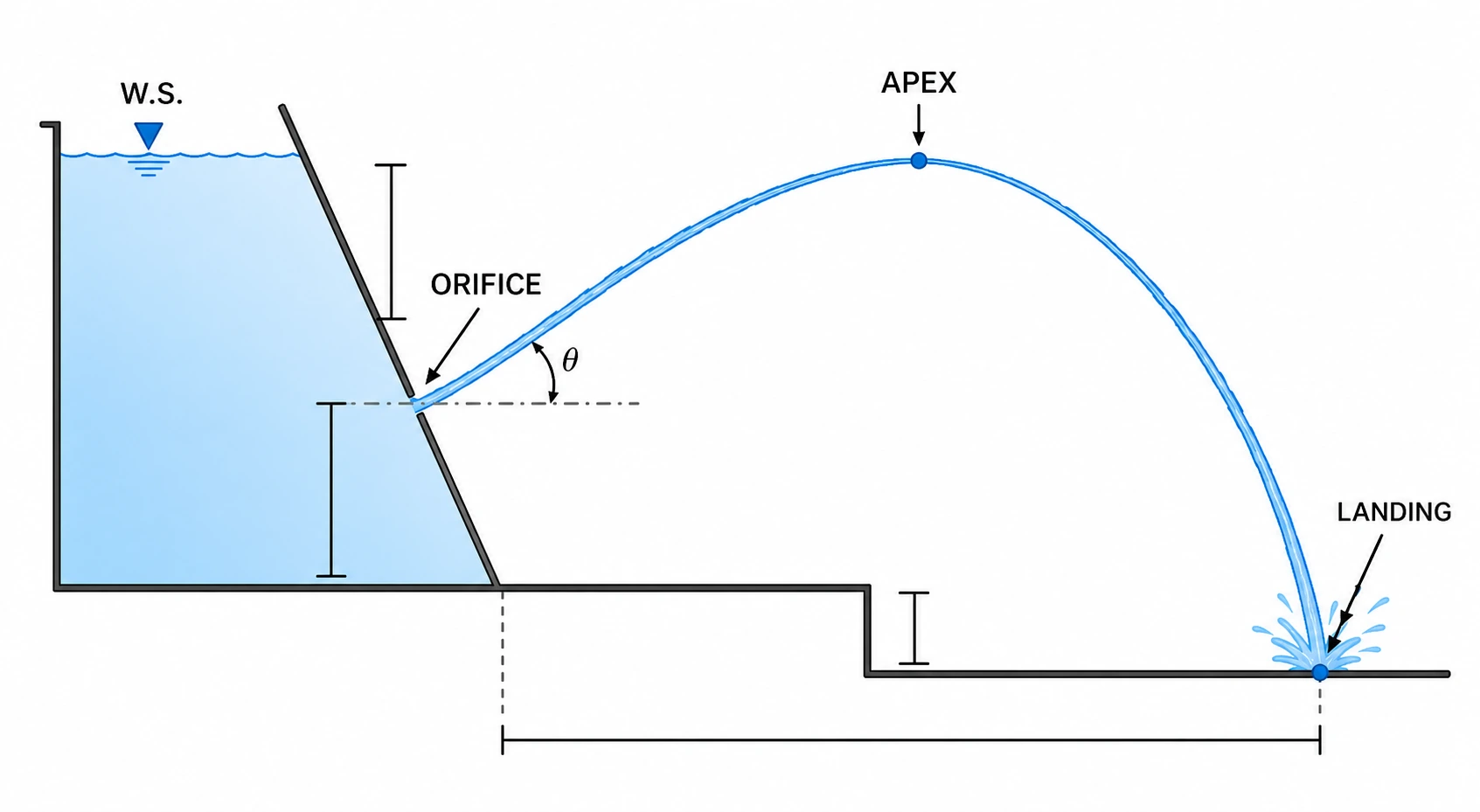
Obtain the maximum height the water jet rises above the orifice.
Compute the time required for the jet to hit the lower ground.
Obtain the horizontal distance traveled by the jet before it hits the ground.
Two pressurized compartments contain water. The upstream and downstream free surfaces are 4 m and 2.25 m above a 160 mm orifice, with air pressures 55 kPa and 30 kPa. The discharge coefficient is 0.82.
Calculate the discharge through the orifice.
Which theorem relates ideal jet speed from an opening to the head above it?
How is the coefficient of velocity for an orifice defined?
Approximately how far downstream from a sharp-edged circular orifice does the vena contracta occur, in opening diameters?
What is the contracted jet section just downstream of an orifice called?
A tank falls downward with acceleration 5 m/s2. Water depth above a 105 mm orifice is 8.5 m and discharge coefficient is 0.68.
Find the discharge.