Series Pipe Rules
For pipes in series, the same discharge passes through each pipe and the total head loss is the sum of the individual losses.
$$Q_1=Q_2=Q_3$$$$h_L=h_{L1}+h_{L2}+h_{L3}$$

For pipes in series, the same discharge passes through each pipe and the total head loss is the sum of the individual losses.
For parallel pipes between two common junctions, head loss is the same in each branch and total flow is the sum of branch flows.
Use Darcy-Weisbach when $f$ is given; use Hazen-Williams only when the coefficient $C$ is specified.
Two parallel pipes carry 0.10 m3/s total. If branch A carries 0.065 m3/s, find branch B and the head-loss condition.
Answer: Branch B carries 0.035 m3/s, and both branches must have equal head loss between the same junctions.
Water flows at 0.050 m3/s through two pipes in series. Pipe 1 is 200 m long and 200 mm in diameter. Pipe 2 is 150 m long and 150 mm in diameter. Take $f=0.020$ for both pipes and neglect minor losses. Find the total head loss.
Answer: The total head loss is 10.70 m.
Two parallel pipes have the same diameter and friction factor. Branch A is 100 m long and branch B is 400 m long. The total flow is 0.120 m3/s. Determine the flow in each branch.
Answer: Shorter branch A carries 0.080 m3/s; branch B carries 0.040 m3/s.
Three pipes are connected in series between two reservoirs with a total head difference of 25 m. Pipe 1: L = 500 m, D = 300 mm, f = 0.020. Pipe 2: L = 400 m, D = 250 mm, f = 0.022. Pipe 3: L = 300 m, D = 200 mm, f = 0.018. Neglect minor losses. Find the discharge through the system.
Express friction head loss for each pipe in terms of Q using $h_f = \frac{8fLQ^2}{\pi^2 g D^5}$:
Answer: Discharge is 0.100 m³/s (100 L/s). The smallest pipe (200 mm) contributes the most friction loss, controlling the system capacity.
Three parallel pipes connect junction J1 to junction J2 with a head loss of 8.0 m between them. All have f = 0.020. Branch 1: L = 600 m, D = 250 mm. Branch 2: L = 400 m, D = 200 mm. Branch 3: L = 300 m, D = 150 mm. Find the discharge in each branch and the total discharge.
For each branch: $h_f = K_i Q_i^2 = 8.0$ m, so $Q_i = \sqrt{8.0/K_i}$.
Answer: Q1 = 88.8 L/s, Q2 = 62.2 L/s, Q3 = 35.0 L/s. Total = 186 L/s. The 250 mm pipe carries the most flow even though it is the longest, because its large diameter (raised to the 5th power) dominates.
A water main must carry 0.085 m³/s over a length of 800 m with a maximum allowable head loss of 12 m. Using the Hazen-Williams formula $V = 0.8492 C R^{0.63} S^{0.54}$ with C = 120 and $R = D/4$ for a full circular pipe, determine the required pipe diameter in mm. Round up to the next standard size.
Solve by trial: try D = 0.25 m:
Too large. Try D = 0.20 m: Q ≈ 0.068 m³/s (too small). Interpolate: required D ≈ 0.225 m.
Answer: Required diameter is approximately 225 mm. Use the next standard size of 250 mm to ensure adequate capacity with margin.
Additional board-style practice items for this topic.
A 400 mmø pipeline discharges water and branches into 3 pipes at junction A. The first pipe has a diameter of 300 mm, and length of 3000 m, the 2nd pipe has a diameter of 200mm and length of 1300m, and the third pipe has a diameter of 250mm and length of 2600 m. These 3 pipes then merge together at junction B to form a single pipeline having a diameter of 400 mm. Headloss between junction A and B = 24 m. Assume C = 120.
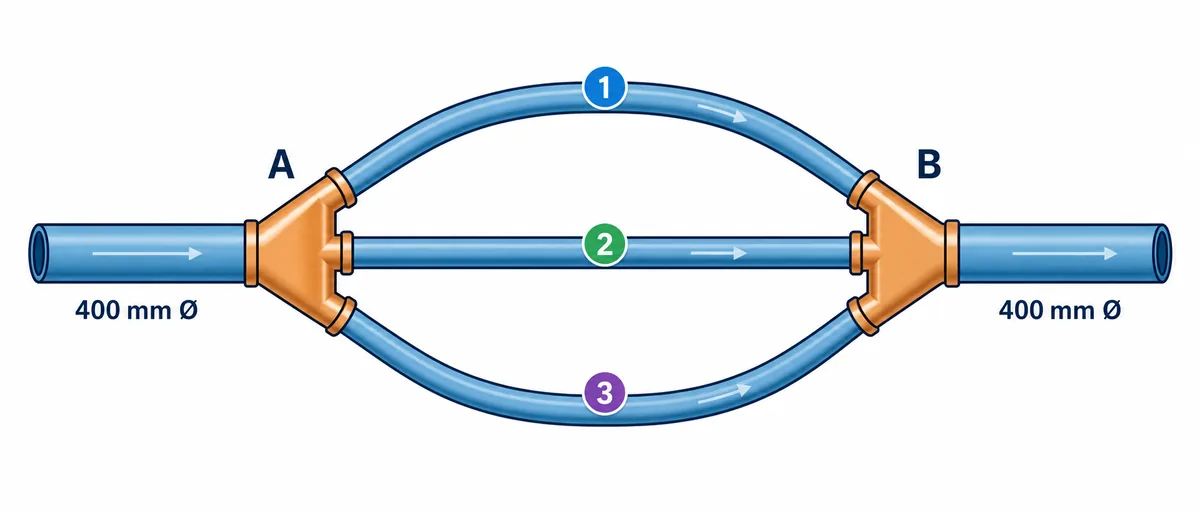
Determine the rate of flow of the first pipeline in m3/s.
Determine the rate of flow of the second pipeline in m3/s.
Determine the rate of flow of the third pipeline in m3/s.
Part 1.
For each parallel branch, the head loss is 24 m. Using Hazen-Williams in SI form:Part 2.
For branch 2, use Hazen-Williams with $h_f=24$ m, $D=0.200$ m, $L=1300$ m, and $C=120$:Part 3.
For branch 3, use Hazen-Williams with $h_f=24$ m, $D=0.250$ m, $L=2600$ m, and $C=120$:Three pipes A, B and C are connected in parallel. If the combined discharged of the 3 pipes is equal to 0.61 m3/s, and assuming they have equal values of friction factor "f", compute the following using the tabulated data shown:
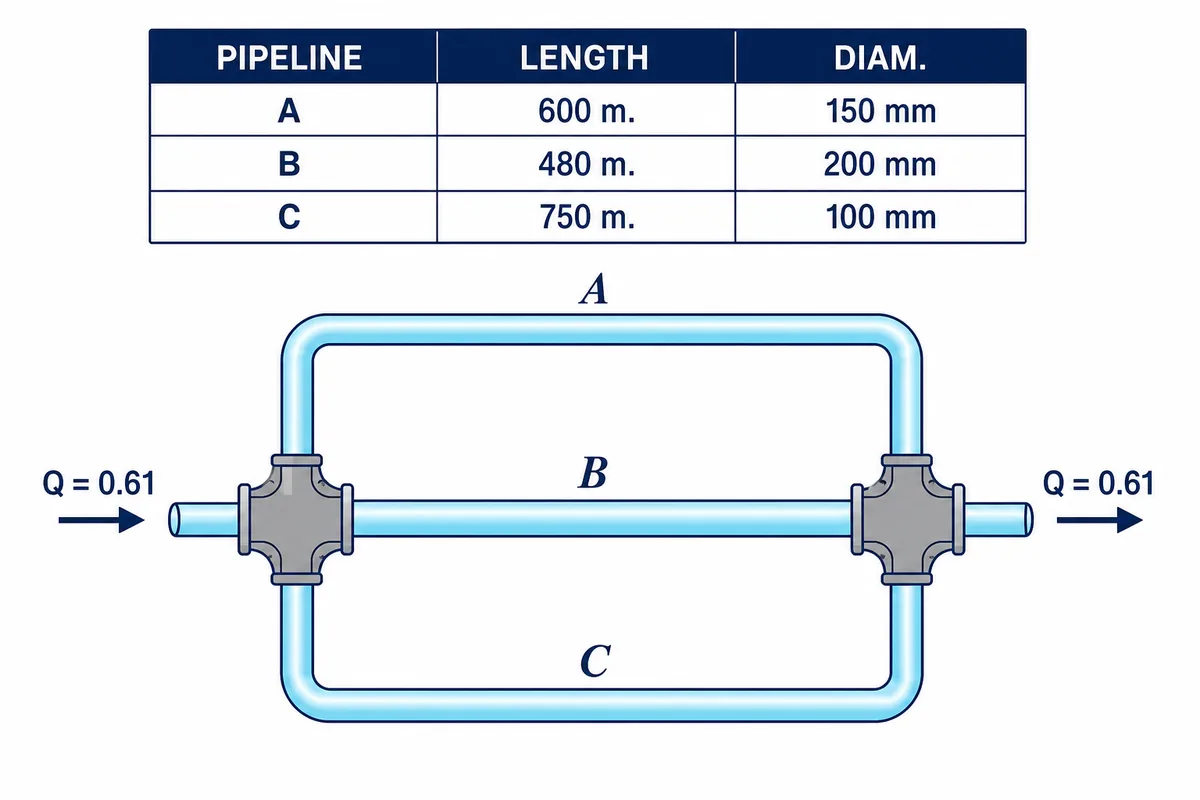
Compute the rate of flow of pipeline A in liters/sec.
Compute the rate of flow of pipeline B in liters/sec.
Compute the rate of flow of pipeline C in liters/sec.
Three pipes connect the same two points in parallel and carry a total discharge of 0.56 m3/s with equal friction factors. Line 1: $D_1$=0.15 m, $L_1$=650 m. Line 2: $D_2$=0.2 m, $L_2$=550 m. Line 3: $D_3$=0.1 m, $L_3$=720 m.
Compute the flow rate in line 1, in L/s.
Compute the flow rate in line 2, in L/s.
Compute the flow rate in line 3, in L/s.
Parallel pipes share the same head loss. With equal $f$, $h_f=\dfrac{8fLQ^{2}}{\pi^{2}gD^{5}}$ equal for all branches means $\dfrac{L_iQ_i^{2}}{D_i^{5}}$ is the same. Taking line 1 as reference,
$$Q_i=r_i\,Q_1,\qquad r_i=\sqrt{\frac{L_1/D_1^{5}}{L_i/D_i^{5}}}.$$Continuity gives $Q_1(1+r_2+r_3)=Q_{total}$, hence
$$Q_1=\frac{Q_{total}}{1+r_2+r_3},\quad Q_2=r_2Q_1,\quad Q_3=r_3Q_1\ \ (\times1000\ \text{for L/s}).$$Find the capacity in m3/min of a 0.9-m-diameter pipe with head loss 5 m per 900 m and Darcy friction factor 0.018.
Water flows at 0.18 m3/s through a horizontal pipe of diameter 180 mm. Mercury gages 140 m apart differ by 1.2 m. Evaluate the Darcy friction factor.
A water pipeline consists of a larger pipe of diameter 500 mm and length 3250 m joined in series to a smaller pipe of diameter 325 mm and length 6250 m. The elevation difference is 28 m. Neglect velocity head and minor losses and use friction factor f = 0.022 for both pipes. Determine the velocity in the larger pipe, velocity in the smaller pipe, and flow rate.
The velocity of water in the larger pipeline, in m/s.
The velocity of water in the smaller pipeline, in m/s.
The rate of flow in the pipes, in m^3/s.
A main carries total flow Q = 2.8 m^3/s and divides into two parallel pipes. Pipe 1 has diameter 1.3 m, length 300 m, and friction factor 0.025; pipe 2 has diameter 0.6 m, length 880 m, and friction factor 0.029. The branches have equal head loss. Determine the flow in the 0.6-m pipe, the flow in the 1.3-m pipe, and the velocity in pipe 2.
The flow in the 600-mm-diameter pipeline, in m^3/s.
The flow in the larger-diameter pipeline, in m^3/s.
The velocity of flow in the smaller pipeline, in m/s.
Three pipes are parallel between junctions J and K. Their diameters and lengths are D1 = 0.35 m, L1 = 2400 m; D2 = 0.2 m, L2 = 1000 m; and D3 = 0.25 m, L3 = 3200 m. The pressure-head difference is 33 m and Hazen-Williams C = 125 for all pipes. Determine the flow rate in each pipe.
The flow rate in pipeline 1, in m^3/s.
The flow rate in pipeline 2, in m^3/s.
The flow rate in pipeline 3, in m^3/s.
Minor losses through valves, bends, and fittings are conventionally expressed as a coefficient multiplied by which head?
Two parallel pipes connect the same reservoirs. Their lengths are 2500 m and 2600 m, diameters 0.22 m and 0.29 m, Darcy friction factors 0.021 and 0.019, and common head loss 35 m.
Find the discharge in the smaller pipe.
Find the discharge in the larger pipe.
Find the diameter of one 3000 m replacement pipe with f = 0.018 carrying the combined flow.
The continuity equation for fluid flow follows directly from which conservation law?
Oil of specific gravity 0.93 flows through a horizontal pipe of length 45 m and diameter 0.14 m at mean velocity 3.75 m/s with Darcy factor 0.025.
Find the pressure drop.
For a very long pipe, which local losses are commonly neglected compared with friction loss?
A pipeline length 900 m and diameter 0.33 m carries 0.19 m3/s with Darcy factor 0.024.
Find head loss.
Water and oil enter a mixing chamber through two pipes. Water flows at 0.17 m3/s, oil of specific gravity 0.77 at 0.05 m3/s, and the outlet diameter is 0.3 m.
Find the outlet mixture velocity.
Find the mixture density.
A 0.31 m pipeline has Darcy factor 0.022. Two pressure taps 500 m apart show a pressure difference 125 kPa; a leak between them causes unequal upstream and downstream flows.
Estimate the leak rate.