For siphons, apply the energy equation from the reservoir surface to the summit to check pressure, then from the surface to the outlet to get discharge. The pressure at the summit must not drop below vapor pressure.
Use absolute pressure only when vapor pressure or gas laws are involved. Gauge pressure may be used consistently when both points are in the same atmospheric reference.
Pipe Discharge from Pressure Head Drop
Water flows through a horizontal pipe that contracts from 150 mm diameter to 75 mm diameter. The pressure head at the larger section is 8 m of water and at the smaller section is 3 m of water. Neglect losses and find the discharge.
A pump delivers 0.080 m3/s of water from a lower reservoir to another reservoir 18 m higher. The pipe head loss is 6 m. Determine the pump head and hydraulic power delivered to the water.
Answer: Pump head is 24 m and hydraulic power is 18.8 kW.
Siphon Summit Gauge Pressure
A siphon carries water with velocity 3 m/s. The summit is 4 m above the upstream reservoir surface, and head loss from the reservoir to the summit is 0.80 m. Find the gauge pressure head at the summit.
$$0=\frac{p_s}{\gamma}+4+\frac{3^2}{2(9.81)}+0.80$$$$\frac{p_s}{\gamma}=-(4+0.459+0.80)=-5.26\text{ m of water}$$
Answer: The summit pressure is $-5.26\text{ m}$ of water gauge. Check vapor pressure for cavitation safety.
Problem: Pipe Reducer — Continuity and Bernoulli Combined
Water flows through a horizontal reducer pipe. The inlet is 250 mm in diameter with a pressure of 180 kPa gage. The outlet is 100 mm in diameter. The head loss through the reducer is 0.8 m. Find the velocity at the outlet and the outlet pressure in kPa.
Answer: For Q = 0.040 m³/s: outlet velocity = 5.09 m/s, outlet pressure = 159.5 kPa gage. The pressure drops at the constriction due to increased velocity (Bernoulli) and head loss.
Problem: Turbine Power from Reservoir to Tailrace
A turbine is installed in a penstock connecting two reservoirs. The upper reservoir surface is at elevation 120 m and the lower (tailrace) reservoir surface is at elevation 80 m. The penstock is 300 mm in diameter and carries 0.12 m³/s. Total head loss in the penstock from upper reservoir to turbine inlet is 4.5 m, and from the turbine outlet to the lower reservoir the head loss is 1.2 m. Find the turbine head and the shaft power output in kW.
Apply the extended energy equation from upper reservoir surface (1) to lower reservoir surface (2):
Answer: Turbine head is 34.3 m. Power extracted from the water is 40.37 kW. Mechanical and electrical efficiencies of the turbine would reduce the actual shaft output further.
Problem: Siphon — Maximum Allowable Height Without Cavitation
A siphon pipe of diameter 100 mm conveys water between two open reservoirs. The outlet is 3.0 m below the inlet reservoir surface. The total head loss from the inlet to the summit is 1.20 m and from the summit to the outlet is 0.80 m. Atmospheric pressure is 101.3 kPa and vapor pressure of water is 2.34 kPa absolute. Find the maximum allowable summit elevation above the inlet reservoir surface to prevent cavitation.
First find the siphon velocity using the full energy equation (inlet to outlet):
Answer: The summit must not exceed 7.89 m above the inlet reservoir surface. Exceeding this height causes absolute pressure to drop below vapor pressure, triggering cavitation and breaking the siphon.
Problem: Hydraulic Grade Line and Energy Grade Line
Water flows from a large reservoir through a 150 mm horizontal pipe into the open atmosphere. The reservoir surface is 12 m above the pipe centerline. The pipe is 200 m long with f = 0.020. Neglect minor losses. Find: (a) the velocity in the pipe, (b) the pressure at the pipe midpoint, and (c) sketch the HGL and EGL from reservoir to discharge.
Apply Bernoulli from reservoir surface (1) to pipe exit (2, gage = 0, z = 0):
Answer: V = 2.92 m/s. Midpoint pressure = 56.73 kPa gage. EGL drops linearly from 12 m to 0.43 m at exit; HGL is 0.43 m below EGL everywhere (the velocity head is constant throughout the constant-diameter pipe).
Exam Generator Problems
Additional board-style practice items for this topic.
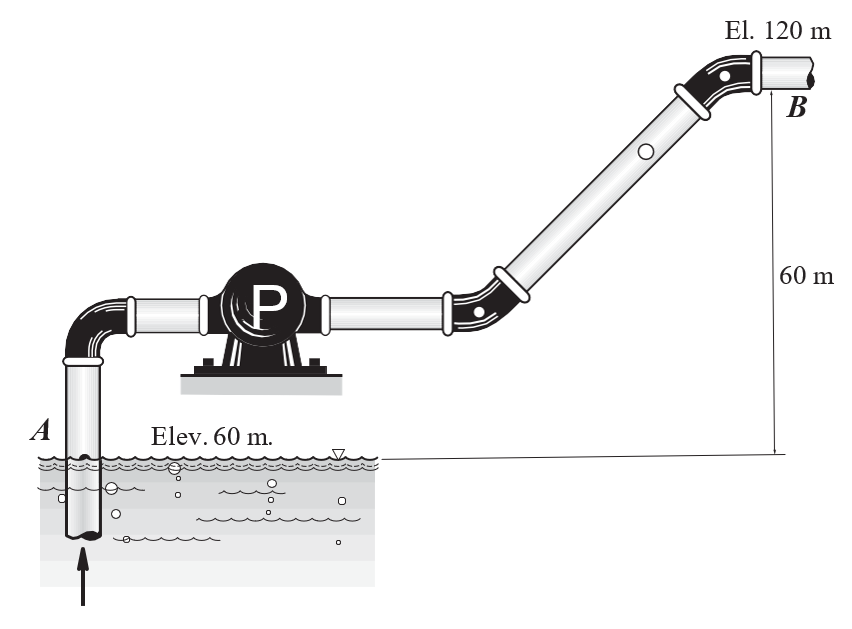
In order to provide irrigation, water has to be pumped to an elevation 120m from 60m through a common pipe where the pressure required at the higher elevation is 172kPa. The source of the water and the discharge point are at atmosphere pressure. Irrigation requirements dictate that water must be pumped at the rate of 1m3/s. The loss of head due to friction and other factors is estimated to be 2.45 m.
Determine the velocity of the water inside the pipe for the required discharge.
3.54m/s
3.26m/s
3.87m/s
3.49m/s
Determine the amount of energy, in meters, that the pump must furnish.
80.622
84.322
82.477
83.577
Determine the rating of the pump in horsepower if it is only 80% efficient.
1325.24
1386.06
1355.73
1373.81
Solution pending in psadquestions/q357.json.
Question Bank: v3
HGE - Hydraulics / Bernoulli Equation / HGE May 2019
Formula-mode item rendered with fixed values for lecture/PDF export.
The diameter of a pipe carrying water changes gradually from 170 mm at A to 480 mm at B. A is 3.5 m lower than B. What is pA - pB in kPa when 170 liter/sec is flowing and loss of energy is neglected?
18.73 kPa
-5.27 kPa
30.73 kPa
6.73 kPa
With $A=\dfrac{\pi D^{2}}{4}$ and $v=\dfrac{Q}{A}$, apply Bernoulli between A and B (A is $\Delta z$ lower than B, losses neglected):