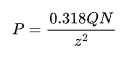
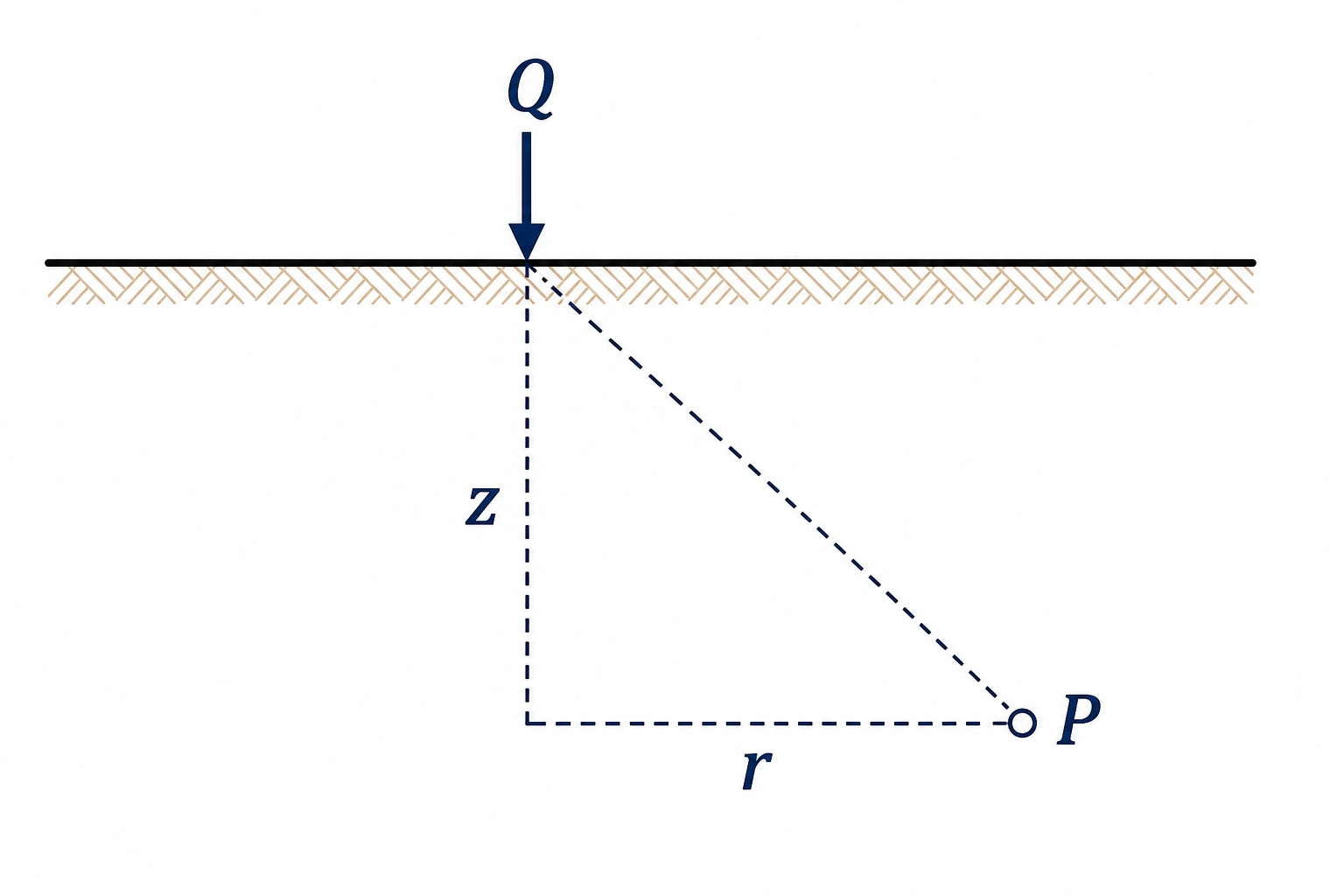
Boussinesq assumed a homogeneous, isotropic, elastic, semi-infinite soil mass. For a point load $Q$ at the ground surface, the vertical stress increment at depth $z$ and horizontal offset $r$ is:
Stress decreases as depth increases and as horizontal distance from the load increases. The expression does not require modulus of elasticity or Poisson's ratio when the ideal assumptions are accepted.
Westergaard Stress Distribution
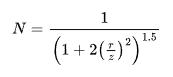
Westergaard's solution is often used for stratified deposits, such as alternating thin layers of sand and silt-clay. It assumes no lateral strain in the layered medium.
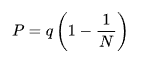
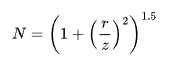
Here $q$ is uniform pressure, $r$ is radius of the circular loaded area, and $z$ is depth below the center.
Rectangular Loaded Area and 2:1 Method
For a flexible rectangular area, influence factors are often read from a chart/table using ratios $B/z$ and $L/z$. For stress below the center, divide the footing into four rectangles and multiply the corner influence result by 4.
$$\Delta\sigma_z = qI_z$$
$$\Delta\sigma_{center}=4qI_{corner}$$
The approximate 2 vertical to 1 horizontal method assumes the load spreads linearly with depth.
$$\Delta\sigma_z = \frac{P}{(B+z)(L+z)}$$
$$\Delta\sigma_z = q\frac{BL}{(B+z)(L+z)}$$
Problem: Square Footing by Boussinesq and 2:1 Method
A square footing 4 m on a side transmits a load of 1.6 MN. A clay layer is from 8 m to 12 m below the base. Determine the bearing pressure, estimate stress below the center at mid-height of clay using Boussinesq chart values, and evaluate stress using the 2:1 method.
A 4 m diameter circular footing transmits a concentrated load of 2000 kN. Evaluate the bearing pressure, vertical stress below the center at a depth equal to its diameter, and depth where pressure is reduced to one-tenth of base pressure.
Answer: $q=159.15$ kPa, stress at 4 m depth $=45.27$ kPa, and depth for one-tenth pressure is about 7.4 m.
Problem: Westergaard Point Load
Using Westergaard theory, evaluate vertical stress for $Q=1500$ kN if the point is 3 m directly below the load, 6 m directly below the load, and 6 m below but 3 m horizontally from the load.
Using Boussinesq theory, evaluate vertical stress for $Q=1500$ kN if the point is 2.5 m directly below the load, 5 m directly below the load, and 2.5 m below but 3 m horizontally from the load.
Concept: Engineering Use of Stress Distribution Theories
Boussinesq theory assumes the soil is elastic, homogeneous, and isotropic — conditions rarely met in real soil. Despite these simplifications, it gives reasonable estimates for stress increases in relatively uniform, soft to medium soils and is widely used for consolidation settlement calculations.
Westergaard theory better represents layered or varved deposits like alternating silt and clay, because it assumes no lateral strain occurs. It predicts lower stress increases than Boussinesq at the same depth and horizontal distance. The 2:1 method is the simplest approximation and is often used for preliminary estimates and for checking computer output. It overestimates stress below the corner of a footing but is reasonably accurate below the center for square and rectangular footings at depths comparable to the footing width.
Problem: Stress Below a Strip Load
A flexible strip footing 2 m wide carries a uniform pressure of 80 kPa. Using the 2:1 approximation adapted for strip loading, estimate the vertical stress increase at 2 m and 4 m directly below the center of the strip. For a strip footing, the 2:1 method gives $\Delta\sigma_z = qB/(B+z)$.
Answer: 40 kPa at 2 m depth and 26.7 kPa at 4 m depth below the strip footing center.
Problem: Rectangular Footing Using the 2:1 Method
A 3 m by 5 m rectangular footing carries a column load of 2000 kN. Using the 2:1 method, find the average stress increase in a 2 m thick clay layer that has its top at 4 m below the footing base and its bottom at 6 m below the footing base.
Answer: The average stress increase in the clay layer is approximately 26 kPa.
Problem: Boussinesq Stress at an Offset Point
A concentrated load $Q = 900$ kN is applied at the ground surface. Using Boussinesq theory, compute the vertical stress at a point 4 m below the surface and 3 m horizontally from the load.
Answer: The Boussinesq stress at that point is 8.80 kPa.
Problem: Superposition of Two Point Loads
Two column loads, each 600 kN, are placed at the ground surface 4 m apart. Using Boussinesq theory, find the total vertical stress increase at a point on the line connecting the two loads, 3 m below the surface and exactly midway between the columns. Use $r=2$ m for each load.
Both loads are equidistant from the midpoint, so by superposition:
Answer: The total vertical stress increase at the midpoint is 25.38 kPa.
Problem: Stress Below the Edge of a Circular Footing
A 3 m diameter circular footing applies a uniform pressure of 120 kPa. Using the Boussinesq formula for a uniformly loaded circular area, estimate the vertical stress below the center at a depth equal to the radius (1.5 m below the base).
Answer: The vertical stress below the center at a depth equal to the radius is 77.6 kPa.
Exam Generator Problems
Additional board-style practice items for this topic.
Question Bank: q731
HGE - Geotechnical Engineering / Stresses in Soil / Mastermatician
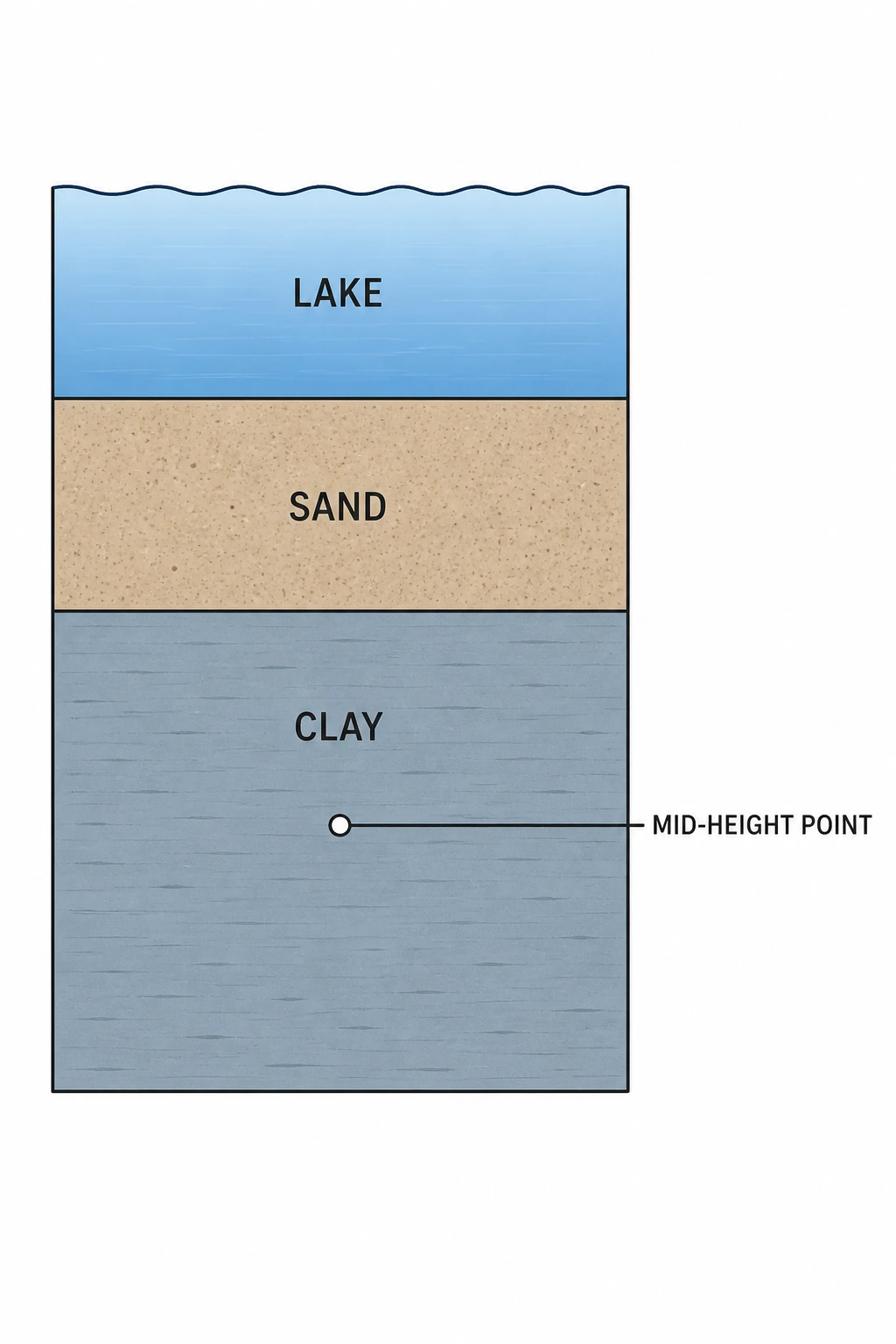
A 5m clay layer lies beneath an 8m sand layer. The sand is 3m below the water surface. Saturated unit weight of sand is 25kN/m3 and clay 20kN/m3. Calculate the following:
The total vertical pressure (in kPa) at the mid-height of the clay layer.
279.4
240.1
209.3
248.6
The pore water pressure (in kPa) at the mid-height of the clay layer
132.4
122.6
112.8
152.1
The effective vertical stress (in kPa) at the mid-height of the clay layer
147.0
99.4
96.5
117.5
Part 1.
Mid-height of the 5-m clay layer is 2.5 m below the top of clay, so the point is below 8 m of sand and 2.5 m of clay. Since the water surface is 3 m above the ground surface, include the 3 m water surcharge: $\sigma_v=3(9.81)+8(25)+2.5(20)$ $\boxed{\sigma_v=279.4\text{ kPa}}$
Part 2.
Pore water pressure is based on depth below the water surface. The point is $3+8+2.5=13.5$ m below the water surface: $u=\gamma_w h=9.81(13.5)$ $\boxed{u=132.4\text{ kPa}}$
Part 3.
Effective stress is total stress minus pore water pressure: $\sigma'_v=\sigma_v-u$ $\sigma'_v=279.4-132.4$ $\boxed{147.0\text{ kPa}}$
Question Bank: q732
HGE - Geotechnical Engineering / Stresses in Soil / Mastermatician
A normally consolidated clay is subjected to a consolidated drained triaxial test with a confining pressure of 48kPa and a total axial stress at failure of 90kPa. Compute the angle of failure for the sample.
28.9
17.7
53.9
59.5
For normally consolidated clay in a drained test, take $c'=0$. The Mohr-Coulomb relation is $$\sin\phi=\frac{\sigma_1-\sigma_3}{\sigma_1+\sigma_3}=\frac{90-48}{90+48}=0.30435$$ Thus $\phi=17.7^\circ$. The failure plane is inclined $$45^\circ+\frac\phi2=45^\circ+8.86^\circ=53.9^\circ$$ to the major principal plane. Therefore, the angle of failure is 53.9°.
Question Bank: q733
HGE - Geotechnical Engineering / Stresses in Soil / Mastermatician
An unconsolidated undrained test was conducted on a saturated clay sample. The cell pressure was 200kPa, and failure occurred under a deviatoric stress of 220kPa. The pore water pressure at failure is measured to be 80kPa. Determine the undrained shear strength in kPa.
110
60
70
100
For an unconsolidated undrained test on saturated clay, the undrained shear strength is one-half the deviator stress at failure: $s_u=\frac{\sigma_1-\sigma_3}{2}=\frac{220}{2}$ $\boxed{110\text{ kPa}}$
Question Bank: q734
HGE - Geotechnical Engineering / Stresses in Soil / Mastermatician
A footing 2mx3m in plan and 0.50m thick is designed to support a 0.60m square column. Due to architectural reasons, the column is located so that its external face is flush with the shorter edge of the footing. The column load, including the weight of the column itself, is 50kN. Assume concrete to weight 24kN/m3.
Evaluate the total downward load on the supporting ground.
122kN
132kN
142kN
112kN
Evaluate the maximum pressure induced on the ground.
40.3
43.0
30.4
34.0
Evaluate the minimum pressure induced on the ground.
0.33kPa
0.22kPa
0.44kPa
0.11kPa
Part 1.
Total downward load equals the column load plus the footing self-weight: $W_f=(2)(3)(0.50)(24)=72\text{ kN}$ $P=50+72$ $\boxed{122\text{ kN}}$
Part 2.
Footing area is $A=2(3)=6\text{ m}^2$, so average pressure is $P/A=122/6=20.33$ kPa. The column face is flush with the footing edge, so the column load acts 0.30 m from that edge. The footing centroid is 1.50 m from the same edge. Resultant eccentricity: $e=\frac{50(1.50-0.30)}{122}=0.492\text{ m}$ For eccentric pressure over length $L=3$ m: $q_{max}=\frac{P}{A}\left(1+\frac{6e}{L}\right)$ $q_{max}=20.33\left(1+\frac{6(0.492)}{3}\right)$ $\boxed{40.3\text{ kPa}}$
Part 3.
Minimum pressure is: $q_{min}=\frac{P}{A}\left(1-\frac{6e}{L}\right)$ $q_{min}=20.33\left(1-\frac{6(0.492)}{3}\right)$ $\boxed{0.33\text{ kPa}}$
Question Bank: q735
HGE - Geotechnical Engineering / Stresses in Soil / Mastermatician
An unconfined compression test was conducted on a sample of clay having a diameter of 50mm. The failure load was recorded at 240N.
The cohesion strength of the clay, in kPa, is nearest to a value of:
61.1
122.2
64.0
45.0
The unconfined compression strength, in kPa, is nearest to a value of:
122.2
61.1
64.0
45.0
The shear strength at the failure plane, in kPa, is nearest to a value of:
61.1
64.0
45.0
101.0
Part 1.
Area of the 50-mm diameter sample is: $A=\frac{\pi(0.05)^2}{4}=0.001963\text{ m}^2$ Unconfined compressive strength: $q_u=\frac{240}{0.001963}=122.2\text{ kPa}$ For clay, cohesion strength is $c=q_u/2$: $\boxed{c=61.1\text{ kPa}}$
Part 2.
The unconfined compression strength is the failure load divided by the area: $q_u=\frac{240}{\pi(0.05)^2/4}$ $\boxed{q_u=122.2\text{ kPa}}$
Part 3.
For an unconfined compression test on clay, shear strength at failure is: $s_u=q_u/2$ $s_u=122.2/2$ $\boxed{61.1\text{ kPa}}$
Question Bank: q736
HGE - Geotechnical Engineering / Stresses in Soil / Mastermatician
An unconfined compression test was conducted on a soil sample having a diameter of 50mm. The failure load was 66N. What is the value of the cohesion strength of the clay (in MPa)
16.8
33.6
37.2
18.6
Area of the 50-mm sample is: $A=\frac{\pi(0.05)^2}{4}=0.001963\text{ m}^2$ Unconfined compression strength: $q_u=\frac{66}{0.001963}=33.6\text{ kPa}$ Cohesion strength: $c=q_u/2=16.8\text{ kPa}$ $\boxed{16.8}$
Question Bank: q737
HGE - Geotechnical Engineering / Stresses in Soil / Mastermatician
According to the Westergaard Theory, the vertical stress at a point below the surface of a semi-infinite homogeneous, and isotropic soil mass due to a point load A applied at the ground surface is given by the equations below, where:
r=horizontal distance from the vertical line of application of the load
z=depth of the point below the ground surface
Evaluate the vertical stress, in kPa, at a point below the ground for Q=1500kN given the conditions below.
The point is 3m directly below the point of application of the load.
53kPa
47kPa
58kPa
42kPa
The point is 6m directly below the point of application of the load.
13.3kPa
14.5kPa
16.7kPa
10.2kPa
The point is 6m below the load but 3m horizontally from the application of the load.
7.2kPa
8.3kPa
9.4kPa
6.1kPa
Part 1.
Use Westergaard's expression from the figure: $P=\frac{0.318QN}{z^2},\quad N=\frac{1}{\left(1+2(r/z)^2\right)^{1.5}}$ Directly below the load, $r=0$, so $N=1$. With $Q=1500$ kN and $z=3$ m: $P=\frac{0.318(1500)(1)}{3^2}=53.0\text{ kPa}$ $\boxed{P=53\text{ kPa}}$
Part 2.
Again $r=0$, so $N=1$. With $Q=1500$ kN and $z=6$ m: $P=\frac{0.318(1500)(1)}{6^2}=13.25\text{ kPa}$ $\boxed{P=13.3\text{ kPa}}$
Part 3.
Here $z=6$ m and $r=3$ m: $N=\frac{1}{\left(1+2(3/6)^2\right)^{1.5}}=0.544$ $P=\frac{0.318(1500)(0.544)}{6^2}=7.21\text{ kPa}$ $\boxed{P=7.2\text{ kPa}}$
Question Bank: q738
HGE - Geotechnical Engineering / Stresses in Soil / Mastermatician
In accordance with the Boussinesq theory, the vertical stress at a point below the center of a flexible circular area in a semi-infinite, homogeneous, isotropic soil mass due to a uniform load is given by the expression below.
q = uniform load per unit area at the base of the footing
r = radius of point of the circular area
z = depth of point below the center of the circular area
Evaluate the bearing pressure, in kPa, exerted by the footing onto the supporting soil by a 4-m diameter circular footing that is transmitting a column load of 1500 kN.
119
77.9
110
99.5
Evaluate the vertical stress, in kPa, at a depth of 6 meters below the center of the footing.
17.5
25.5
22.6
19.6
How deep, in meters, below the footing would the pressure be reduced to 1/10 of the pressure at the base of the footing?
7.45
9.01
8.41
6.95
Part 1.
The bearing pressure is the load divided by the circular footing area. For diameter 4 m, $r=2$ m: $q=\frac{1500}{\pi(2)^2}=119.37\text{ kPa}$ $\boxed{q=119\text{ kPa}}$
Part 2.
Use the expression from the figure: $P=q\left(1-\frac{1}{N}\right),\quad N=\left(1+(r/z)^2\right)^{1.5}$ With $q=119.37$ kPa, $r=2$ m, and $z=6$ m: $N=\left(1+(2/6)^2\right)^{1.5}=1.171$ $P=119.37\left(1-\frac{1}{1.171}\right)=17.45\text{ kPa}$ $\boxed{P=17.5\text{ kPa}}$
Part 3.
For pressure reduced to one-tenth of the base pressure: $0.10q=q\left(1-\frac{1}{N}\right)$ $N=\frac{1}{0.90}=1.111$ $1.111=\left(1+(2/z)^2\right)^{1.5}$ $z\approx7.45\text{ m}$ $\boxed{z=7.45\text{ m}}$
Question Bank: q739
HGE - Geotechnical Engineering / Stresses in Soil / Mastermatician
The result of a consolidated drained triaxial shear test conducted on a consolidated clay are as follows:
Radial stress = 240 kPa; Deviator stress at failure = 450 kPa
Determine the angle of friction of the soil sample in degrees.
28.9
22.4
16.8
27.3
Determine the shear stress on the failure plane, in kPa
197
345
242
195
Determine the normal stress on the plane of maximum shear, in kPa
465
398
550
345
Part 1.
For a drained triaxial test with $c=0$, $\sigma_3=240$ kPa and $\sigma_1=240+450=690$ kPa. The friction angle is: $\sin\phi=\frac{\sigma_1-\sigma_3}{\sigma_1+\sigma_3}$ $\sin\phi=\frac{450}{930}$ $\boxed{\phi=28.9^\circ}$
Part 2.
Mohr circle radius is: $R=\frac{\sigma_1-\sigma_3}{2}=225\text{ kPa}$ Shear stress on the failure plane for a cohesionless soil is: $\tau_f=R\cos\phi$ $\tau_f=225\cos28.9^\circ$ $\boxed{197\text{ kPa}}$
Part 3.
The plane of maximum shear corresponds to the center of Mohr's circle for normal stress: $\sigma_n=\frac{\sigma_1+\sigma_3}{2}$ $\sigma_n=\frac{690+240}{2}$ $\boxed{465\text{ kPa}}$
Question Bank: q740
HGE - Geotechnical Engineering / Stresses in Soil / Dalgona
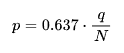
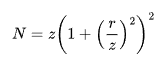
According to the elastic theory, the vertical stress induced by a flexible line load of infinite length that has an intensity of q units/length on the surface of a semi-infinite soil mass can be estimated by the expression shown below.
r=horizontal distance from the line of the load
z=depth of interest at which stress is induced
A concrete hollow block wall weighing 6kN per linear meter is carried by a wall footing 0.60m wide.
Evaluate the bearing pressure, in kPa, exerted by the footing onto the supporting soil.
10
14
12
16
Evaluate the stress in the soil caused by the load at a depth equal to twice its width.
3.19
7.25
6.47
5.31
Evaluate the stress at a depth of 2m and a horizontal distance of 3m from the line of the load.
0.181
0.531
0.668
0.302
Part 1.
The wall load is 6 kN per linear meter on a 0.60-m wide footing: $q_b=\frac{6}{0.60}=10\text{ kPa}$ $\boxed{q_b=10\text{ kPa}}$
Part 2.
Use the line-load expression from the figure: $p=0.637\frac{q}{N},\quad N=z\left(1+(r/z)^2\right)^2$ At depth equal to twice the footing width, $z=2(0.60)=1.20$ m and $r=0$. Thus $N=1.20$. $p=0.637\frac{6}{1.20}=3.185\text{ kPa}$ $\boxed{p=3.19\text{ kPa}}$
Part 3.
For $z=2$ m and $r=3$ m: $N=2\left(1+(3/2)^2\right)^2=21.125$ $p=0.637\frac{6}{21.125}=0.181\text{ kPa}$ $\boxed{p=0.181\text{ kPa}}$
Question Bank: q741
HGE - Geotechnical Engineering / Stresses in Soil / Dalgona
According to Section 304 of the National Structural Code of the Philippines, the presumptive load bearing capacity of gravelly soil, in the absence of exhaustive geotechnical site assessment and investigation, is 100 kPa for a minimum footing width of 300 mm and a minimum depth of embedment of 300 mm. This value can be increased by 20% for each additional 300 mm of width of footing and/or depth of foundation to a maximum of three (3) times the designated value.
Evaluate the allowable bearing capacity, in kPa, of the soil for a square footing 1.2 m wide founded at a depth of 300 mm below ground surface.
160
175
200
150
Evaluate the allowable bearing capacity of the soil for a footing 1.2 m wide when founded at a depth of 900 mm below ground surface.
224
225
182
200
Determine the safe downward load, in kN, that the footing of the preceding question can support.
323
252
302
288
Part 1.
Base presumptive capacity is 100 kPa. A 1.2-m footing is 0.9 m wider than the 0.3-m minimum, or three 300-mm increments. Increase: $3(20\%)=60\%$ $q_a=100(1.60)$ $\boxed{160\text{ kPa}}$
Part 2.
For 1.2-m width, the width-adjusted value is 160 kPa. A 900-mm embedment is two additional 300-mm increments beyond the 300-mm minimum, adding 40% to the width-adjusted value: $q_a=160(1.40)$ $\boxed{224\text{ kPa}}$
Part 3.
Safe downward load is allowable bearing capacity times footing area: $P=q_aA=224(1.2)(1.2)$ $P=322.56\text{ kN}$ $\boxed{323\text{ kN}}$
Question Bank: q742
HGE - Geotechnical Engineering / Stresses in Soil / Dalgona
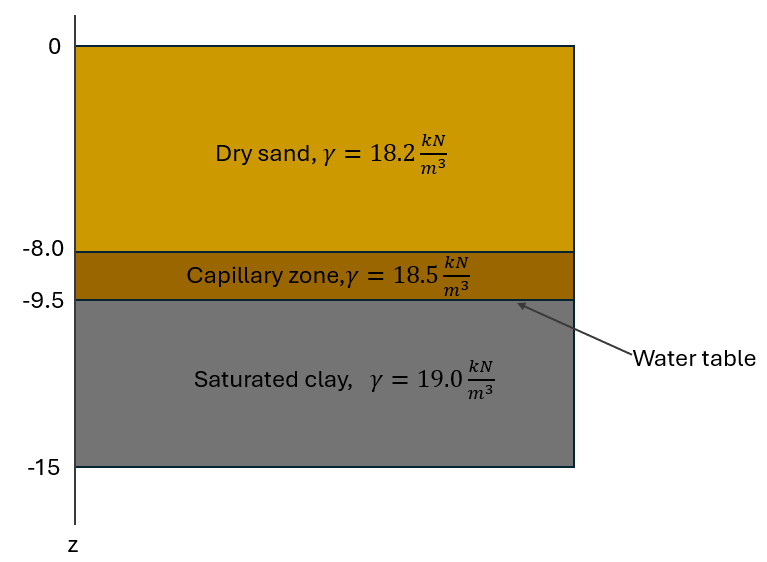
For the soil condition given in figure, consider the capillary rise. Assume that the average degree of saturation in the capillary zone is 50%.
Find the effective stress at a depth 9m.
154
164
169
167
Find the effective stress at a depth 8m.
146
160
153
138
Find the effective stress at a depth 9.5m.
158
166
173
124
Compute total vertical stress from the dry-sand, capillary-zone, and saturated-clay layers, then subtract pore-water pressure. In the capillary zone use the stated 50% average degree of saturation to obtain the effective unit weight. Applying $\sigma'_v=\sigma_v-u$ at the requested elevations gives: $$\sigma'_v(8\text{ m})=146\text{ kPa},\quad\sigma'_v(9\text{ m})=154\text{ kPa},\quad\sigma'_v(9.5\text{ m})=158\text{ kPa}$$ Therefore, the answers are 154 kPa, 146 kPa, and 158 kPa.
Question Bank: q744
HGE - Geotechnical Engineering / Stresses in Soil / Dalgona
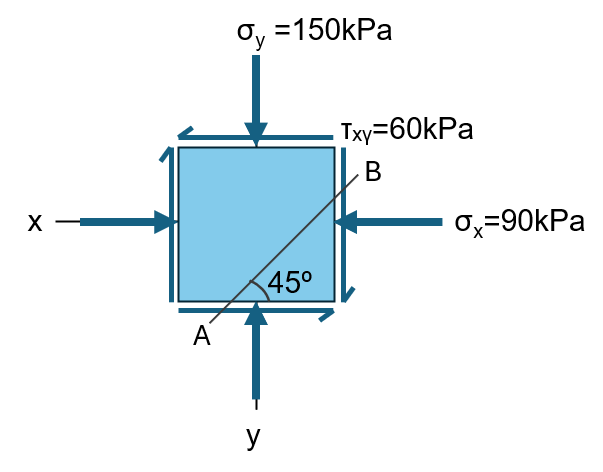
For the stressed soil element shown:
Determine the major principal stress, in kPa.
187.1
192.2
152.6
172.9
Determine the shear stress on plane AB, in kPa.
30
40
60
80
Determine the normal stress on plane AB, in kPa.
180
100
90
60
Determine the shear stress on plane AB.
67
60
58
54
Part 1.
Using compression magnitudes, $\sigma_x=90$ kPa, $\sigma_y=150$ kPa, and $\tau_{xy}=60$ kPa. The major principal stress is: $\sigma_1=\frac{\sigma_x+\sigma_y}{2}+\sqrt{\left(\frac{\sigma_x-\sigma_y}{2}\right)^2+\tau_{xy}^2}$ $\sigma_1=120+\sqrt{30^2+60^2}$ $\boxed{\sigma_1=187.1\text{ kPa}}$
Part 2.
For plane AB at 45°, use the stress-transformation equation with $2\theta=90^\circ$: $\tau_{AB}=-\frac{\sigma_x-\sigma_y}{2}\sin2\theta+\tau_{xy}\cos2\theta$ $\tau_{AB}=-\frac{90-150}{2}(1)+60(0)$ $\boxed{\tau_{AB}=30\text{ kPa}}$
Part 3.
The normal stress on plane AB is: $\sigma_{AB}=\frac{\sigma_x+\sigma_y}{2}+\frac{\sigma_x-\sigma_y}{2}\cos2\theta+\tau_{xy}\sin2\theta$ $\sigma_{AB}=120+(-30)(0)+60(1)$ $\boxed{\sigma_{AB}=180\text{ kPa}}$
Part 4.
The maximum shear stress is the radius of Mohr's circle: $\tau_{max}=\sqrt{\left(\frac{\sigma_x-\sigma_y}{2}\right)^2+\tau_{xy}^2}$ $\tau_{max}=\sqrt{30^2+60^2}=67.1\text{ kPa}$ $\boxed{\tau_{max}=67\text{ kPa}}$
Question Bank: q745
HGE - Geotechnical Engineering / Stresses in Soil / Dalgona
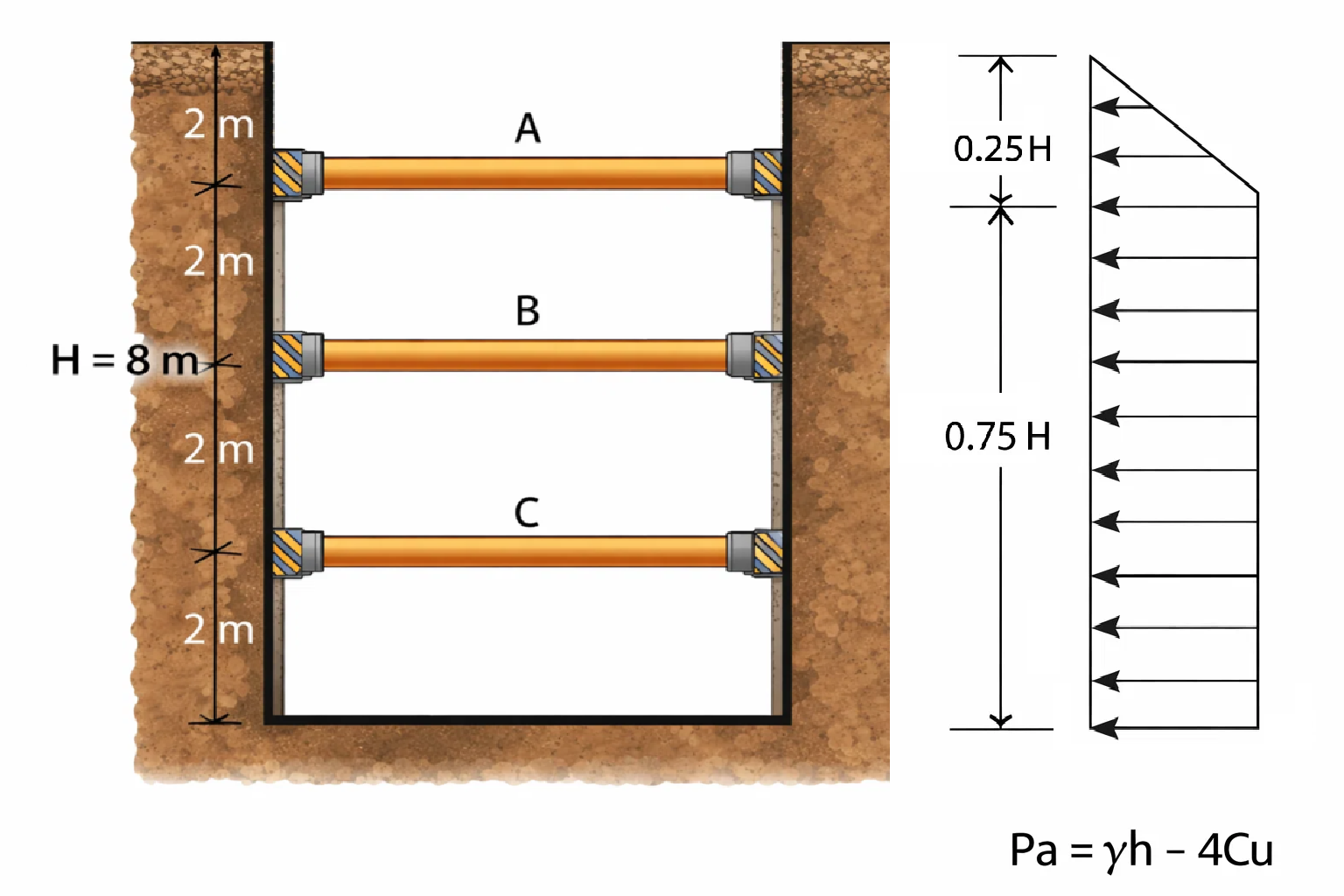
An 8-m deep braced cut in medium clay is shown. The unit weight γ=16.5kN/m3
and the undrained shear strength, Cu=27.8kPa. In the plan, the struts are placed at spacing 2.4 m center to center. Using Peck’s empirical pressure diagram,
Compute the actual load on strut A in kN
116.47
124.57
153.48
162.81
Determine the actual load on strut B, in kN
33.29
28.42
40.54
35.29
Calculate the actual load on strut C, in kN
199.68
131.95
127.92
210.38
For medium clay, Peck's apparent-pressure diagram has a triangular top $0.25H$ portion and a constant-pressure lower $0.75H$ portion. Use $$p_a=\gamma H-4C_u$$ and multiply each pressure-diagram tributary area by the 2.4-m strut spacing. The strut tributary areas shown give: $$P_A=116.47\text{ kN},\quad P_B=33.29\text{ kN},\quad P_C=199.68\text{ kN}$$ Therefore, the loads on struts A, B, and C are 116.47 kN, 33.29 kN, and 199.68 kN.
Question Bank: v89
HGE - Geotechnical Engineering / Stresses in Soil / HGE November 2019
Formula-mode item rendered with fixed values for lecture/PDF export.
A square footing 1.7 m wide supports 600 kN. Using a 1H:2V pressure spread, find vertical stress 2 m below the footing base.
43.8 kPa
39.4 kPa
50.4 kPa
238.9 kPa
At depth $z$, the 1H:2V method increases each square side by $z$. Thus $$\Delta\sigma_z=\frac{Q}{(B+z)^2}=\frac{600}{(1.7+2)^2}=43.8276113952\text{ kPa}.$$ Computed answer: 43.8 kPa
Question Bank: v90
HGE - Geotechnical Engineering / Stresses in Soil / HGE November 2019
Formula-mode item rendered with fixed values for lecture/PDF export.
A 4.5 m by 6 m footing supports 3300 kN at its center. Evaluate the uniform contact pressure beneath the footing.
142 kPa
73 kPa
98 kPa
122 kPa
Uniform soil pressure at the base is load divided by footing area: $$q=\frac{Q}{BL}=\frac{3300}{(4.5)(6)}=122.222222222\text{ kPa}.$$ Computed answer: 122 kPa
Question Bank: v91
HGE - Geotechnical Engineering / Stresses in Soil / HGE November 2019
Formula-mode item rendered with fixed values for lecture/PDF export.
A 3.5 m by 5 m footing supports 3200 kN. Compute the Boussinesq stress increase at depth 12 m directly below its center.
13.6 kPa
10.1 kPa
5.3 kPa
6.3 kPa
Divide the footing into four equal rectangles meeting at the center. For each corner, $m=(L/2)/z$ and $n=(B/2)/z$. The Boussinesq rectangular influence factor is evaluated from $m,n$, then the center stress is $$\Delta\sigma_z=4qI_z=4(182.857142857)(0.0137649579367)=10.0680835194\text{ kPa}.$$ Computed answer: 10.1 kPa
Question Bank: v92
HGE - Geotechnical Engineering / Stresses in Soil / HGE November 2019
Formula-mode item rendered with fixed values for lecture/PDF export.
A 4.5 m by 7 m footing carries 3000 kN. Using a 1H:2V distribution, compute the stress increase at depth 12 m.
7.7 kPa
6.9 kPa
13.4 kPa
9.6 kPa
For a 1H:2V spread, each plan dimension increases by $z$ at depth $z$. Therefore $$\Delta\sigma_z=\frac{Q}{(B+z)(L+z)}=\frac{3000}{(4.5+12)(7+12)}=9.56937799043\text{ kPa}.$$ Computed answer: 9.6 kPa
Question Bank: v107
HGE - Geotechnical Engineering / Stresses in Soil / HGE November 2021
If the groundwater table in a soil formation rises as a result of flooding, the bearing capacity of the soil generally what?
depends on the footing load
is unaffected
decreases
increases
A rising groundwater table increases pore-water pressure, reduces effective stress and shear strength, and generally decreases bearing capacity.
Question Bank: v108
HGE - Geotechnical Engineering / Stresses in Soil / HGE November 2021
Which foundation condition does not affect the bearing capacity of the supporting soil?
unit weight of the soil
load imposed onto the soil
position of groundwater table
depth of founding of footings
Bearing capacity depends on soil properties, footing size, groundwater position, and foundation depth; the imposed load is not itself a soil bearing-capacity parameter.
Question Bank: v110
HGE - Geotechnical Engineering / Stresses in Soil / HGE November 2021
Formula-mode item rendered with fixed values for lecture/PDF export.
An unconfined compression test on a clay sample of diameter 45 mm gives a failure load of 160 N. The cohesion strength of the clay is nearest to what value, in kPa?
68.4 kPa
100.6 kPa
50.3 kPa
38.2 kPa
The unconfined failure stress is $q_u=F/A$, where $A=\pi D^2/4$. For an unconfined compression test, $c_u=q_u/2$, so $$c_u= rac{F}{2(\pi D^2/4)}=50.3008215204 ext{ kPa}.$$
Computed answer: 50.3 kPa
Question Bank: v111
HGE - Geotechnical Engineering / Stresses in Soil / HGE November 2021
Formula-mode item rendered with fixed values for lecture/PDF export.
A point load Q = 10000 kN acts at the ground surface. A tunnel is at depth z = 13 m directly below the load. Using Boussinesq theory, determine the minimum horizontal distance r at which the vertical stress due to the load is no more than 0.06 of the stress directly below the load.
17.3 m
18.8 m
15.4 m
16.5 m
For a point load, $$p=0.477 rac{QN}{z^2},\qquad N= rac{1}{[1+(r/z)^2]^{2.5}}.$$ The stress directly below the load has $N=1$. Setting $p/p_0=0.06$ and solving gives $$r=z\sqrt{(1/0.06)^{1/2.5}-1}=18.7549010628 ext{ m}.$$
Computed answer: 18.8 m
Question Bank: v113
HGE - Geotechnical Engineering / Stresses in Soil / HGE November 2021
Formula-mode item rendered with fixed values for lecture/PDF export.
A three-layered soil has layer thicknesses h1 = 3 m, h2 = 3 m, h3 = 6 m and permeabilities k1 = 0.0001 cm/s, k2 = 0.03 cm/s, k3 = 0.000075 cm/s. For a vertical hydraulic gradient i = 0.55, determine the equivalent horizontal permeability, equivalent vertical permeability, and flow per square meter in the vertical direction.
The equivalent horizontal coefficient of permeability, in cm/s.
0.01059 cm/s
0.00756 cm/s
0.00567 cm/s
0.00454 cm/s
The equivalent vertical coefficient of permeability, in cm/s.
0.0001526 cm/s
0.0000708 cm/s
0.0001362 cm/s
0.0001090 cm/s
The estimated flow in the vertical direction per square meter, in L/hr.
1.726 L/hr
2.158 L/hr
2.698 L/hr
3.453 L/hr
For horizontal flow, $$k_x= rac{k_1h_1+k_2h_2+k_3h_3}{H}=0.0075625 ext{ cm/s}.$$ For vertical flow, $$k_z= rac{H}{h_1/k_1+h_2/k_2+h_3/k_3}=0.000108991825613 ext{ cm/s}.$$ Through one square meter, $$q=k_ziA=2.15803814714 ext{ L/hr},$$ using $A=10^4 ext{ cm}^2$ and converting seconds to hours.
HGE - Geotechnical Engineering / Stresses in Soil / HGE November 2021
Formula-mode item rendered with fixed values for lecture/PDF export.
A consolidated drained triaxial test on clay gives chamber confining pressure sigma3 = 350 kPa and deviator stress at failure sigmad = 540 kPa. Determine the angle of friction, shear stress at the failure plane, and normal stress at the plane of maximum shear.
The angle of friction, in degrees.
25.8°
21.9°
29.7°
18.1°
The shear stress at the plane of failure, in kPa.
243.1 kPa
218.7 kPa
267.4 kPa
182.3 kPa
The normal stress at the plane of maximum shear, in kPa.
651 kPa
570 kPa
496 kPa
620 kPa
The Mohr-circle radius is $R=\sigma_d/2=270$. Hence $$\phi=\sin^{-1}\left( rac{R}{\sigma_3+R}
ight)=25.816087334^\circ,$$ $$ au_f=R\cos\phi=243.053063925 ext{ kPa},$$ and the normal stress at maximum shear is $$\sigma_A=\sigma_3+R=620 ext{ kPa}.$$
HGE - Geotechnical Engineering / Stresses in Soil / HGE November 2021
Formula-mode item rendered with fixed values for lecture/PDF export.
A circular footing of diameter D = 4.75 m supports a centered column load Q = 1200 kN. Using Boussinesq theory for a uniformly loaded circular area, determine the bearing pressure at the base, the vertical stress at depth z = 8.5 m below the center, and the depth at which the stress is reduced to one-tenth of the base pressure.
Obtain the bearing pressure exerted by the footing onto the supporting soil, in kPa.
50.8 kPa
67.7 kPa
84.6 kPa
101.6 kPa
Evaluate the vertical stress at the given depth below the center of the footing, in kPa.
12.64 kPa
5.42 kPa
9.03 kPa
7.22 kPa
Obtain how deep below the footing the pressure is reduced to one-tenth of the pressure at the base.
10.57 m
7.04 m
8.80 m
12.33 m
The uniform bearing pressure is $$q= rac{Q}{\pi D^2/4}=67.7180034873 ext{ kPa}.$$ For a circular area, $$p=q\left[1- rac{1}{(1+(r/z)^2)^{1.5}}
ight]=7.22110089602 ext{ kPa},\qquad r=D/2.$$ Setting $p=q/10$ gives $$z_{10}= rac{r}{\sqrt{(1/0.9)^{2/3}-1}}=8.80439288089 ext{ m}.$$
HGE - Geotechnical Engineering / Stresses in Soil / HGE May 2022
According to Section 302.2.2 of the NSCP, the slope of cut surfaces shall be no steeper than is safe for the intended use and shall ordinarily be no steeper than which slope?
2V:3H
3V:1H
1V:2H
2V:1H
Section 302.2.2 limits an ordinary cut slope to 1 unit vertical in 2 units horizontal (50% slope), unless a geotechnical report supports a steeper stable cut.
Question Bank: v133
HGE - Geotechnical Engineering / Stresses in Soil / HGE May 2022
Formula-mode item rendered with fixed values for lecture/PDF export.
Evaluate the angle of friction of a soil when Rankine's passive pressure coefficient is 5.25.
42.8 degrees
33.5 degrees
48.7 degrees
54.0 degrees
Rankine's passive coefficient is $$K_p=\frac{1+\sin\phi}{1-\sin\phi}.$$ Rearranging, $$\sin\phi=\frac{K_p-1}{K_p+1},$$ so $$\phi=\sin^{-1}\left(\frac{5.25-1}{5.25+1}\right)=42.8436430436^\circ.$$ Computed answer: 42.8 degrees
Question Bank: v134
HGE - Geotechnical Engineering / Stresses in Soil / HGE May 2022
Formula-mode item rendered with fixed values for lecture/PDF export.
A 8 m thick layer of soft clay has an initial void ratio of 1.3. Compression reduces the void ratio by 20% of its original value. Obtain the settlement of the layer.
0.71 m
1.03 m
1.14 m
0.90 m
One-dimensional compression gives $$\Delta H=H\frac{e_0-e_f}{1+e_0}.$$ Here $e_f=e_0(1-20/100)=1.04$, so $$\Delta H=8\frac{1.3-1.04}{1+1.3}=0.904347826087\text{ m}.$$ Computed answer: 0.90 m
Question Bank: v135
HGE - Geotechnical Engineering / Stresses in Soil / HGE May 2022
Formula-mode item rendered with fixed values for lecture/PDF export.
A normally consolidated clay layer has thickness 9.5 m, natural void ratio 1.2, compression index 0.325, and average initial effective pressure 150 kPa. Obtain the primary consolidation settlement caused by a pressure increase of 130 kPa.
380.4 mm
297.1 mm
432.5 mm
479.7 mm
For normally consolidated clay, $$S=H\frac{C_c}{1+e_0}\log_{10}\left(\frac{p_0+\Delta p}{p_0}\right).$$ Substitution gives $$S=9.5(1000)\frac{0.325}{1+1.2}\log_{10}\left(\frac{150+130}{150}\right)=380.41757247\text{ mm}.$$ Computed answer: 380.4 mm
Question Bank: v137
HGE - Geotechnical Engineering / Stresses in Soil / HGE May 2022
Formula-mode item rendered with fixed values for lecture/PDF export.
A direct shear test uses a cylindrical specimen 70 mm in diameter and 24 mm high. Test 1 gives normal force 180 N and shear force 93.6 N; Test 2 gives normal force 270 N and shear force 133.7 N. Determine the Mohr-Coulomb parameters and the normal force corresponding to a shear force of 154 N.
Determine the cohesion of the soil.
3482 Pa
2719 Pa
3959 Pa
4391 Pa
Determine the angle of internal friction.
18.8 degrees
27.3 degrees
30.3 degrees
24.0 degrees
Determine the normal force for the stated target shear force.
315.6 N
246.5 N
358.8 N
397.9 N
The specimen area is $$A=\frac{\pi D^2}{4}=3848.45100065\text{ mm}^2.$$ Because dividing both forces by the same area does not change the slope, $$\tan\phi=\frac{V_2-V_1}{P_2-P_1}=0.445555555556,\qquad \phi=24.0156280788^\circ.$$ The force-line intercept is $b=V_1-P_1\tan\phi=13.4$ N, so $$c=\frac bA=3481.92038764\text{ Pa}.$$ For $V=154$ N, $$P=\frac{V-b}{\tan\phi}=315.561097257\text{ N}.$$
Computed answers: 1. 3482 Pa 2. 24.0 degrees 3. 315.6 N
Question Bank: v138
HGE - Geotechnical Engineering / Stresses in Soil / HGE May 2022
Formula-mode item rendered with fixed values for lecture/PDF export.
A saturated clay layer 12 m thick rests beneath 4 m of submerged sand. The top of the sand is 5 m below the surface of a lake. The saturated unit weights are 26 kN/m3 for sand and 19.5 kN/m3 for clay. Evaluate pressures at the mid-height of the clay layer.
Compute the effective pressure at the mid-height of the clay layer.
96.0 kPa
139.7 kPa
155.0 kPa
122.9 kPa
Compute the pore-water pressure at the mid-height of the clay layer.
114.9 kPa
167.3 kPa
147.2 kPa
185.6 kPa
Compute the total pressure at the mid-height of the clay layer.
210.9 kPa
307.0 kPa
270.1 kPa
340.5 kPa
At the clay mid-height, $$p_T=9.81h_w+\gamma_{sat,s}h_s+\gamma_{sat,c}\frac{h_c}{2}=270.05\text{ kPa}.$$ The pore-water pressure is $$u=9.81\left(h_w+h_s+\frac{h_c}{2}\right)=147.15\text{ kPa}.$$ Therefore, $$p'=p_T-u=122.9\text{ kPa}.$$
HGE - Geotechnical Engineering / Stresses in Soil / HGE May 2022
Formula-mode item rendered with fixed values for lecture/PDF export.
According to Westergaard theory, the vertical stress due to a point load is P = 0.318QN/z2, where N = 1/[1 + 2(r/z)2]1.5. A point load Q = 1500 kN acts at the ground surface. Evaluate the stress directly below the load at depth 3.25 m, at twice that depth, and at a point with depth 6 m and horizontal offset 2 m.
Compute the vertical pressure directly below the load at the stated first depth.
35.27 kPa
45.16 kPa
51.35 kPa
56.95 kPa
Compute the vertical pressure directly below the load at twice the first depth.
8.82 kPa
12.84 kPa
11.29 kPa
14.24 kPa
Compute the vertical pressure at the stated depth and horizontal offset.
9.81 kPa
7.66 kPa
11.15 kPa
12.37 kPa
Directly below the load, $r=0$ and $N=1$. Thus $$p_1=\frac{0.318Q}{z_1^2}=45.1597633136\text{ kPa}.$$ At twice the depth, $$p_2=\frac{0.318Q}{(2z_1)^2}=11.2899408284\text{ kPa}.$$ For the offset point, $$N=\frac{1}{[1+2(r/z)^2]^{1.5}}=0.740073300327,$$ so $$p_3=\frac{0.318QN}{z_3^2}=9.80597122934\text{ kPa}.$$