CE Board Exam Randomizer

⬅ Back to Subject Topics

Conjugate Beam Method

The Conjugate Beam Method is a powerful technique used to determine the slope and deflection in a real beam by analyzing a related, imaginary beam called the conjugate beam.

To understand this method, we compare two sets of relationships:

From the double integration method, we recall the following relationships:

\[ y'' = \frac{M}{EI} \]

Moment-curvature relation:

\[ y' = \theta = \int \frac{M}{EI} \, dx \]

Slope equation:

$$ y = \int \theta \, dx = \iint \frac{M}{EI} \, dx \, dx $$

Deflection equation:

These equations show that moment, slope, and deflection follow a pattern similar to load, shear, and moment in statics. Hence, we establish the following analogy:

\[ \text{Load }\, w \longleftrightarrow \frac{M}{EI}, \quad \text{Shear }\, V \longleftrightarrow \theta, \quad \text{Moment }\, M \longleftrightarrow y \]

Theorems of the Conjugate Beam Method:

The real beam is the actual structure under load. The conjugate beam is a hypothetical beam loaded with the moment diagram divided by $EI$, and its support conditions are chosen to reflect the slope and deflection behavior of the real beam.

Important: The resulting conjugate beam may be statically unstable from a structural perspective — for example, a real beam with fixed supports at both ends will lead to a conjugate beam with free ends. Despite appearing unstable, the conjugate beam must be solved as-is because it reflects the correct mathematical relationships between slope and deflection in the real beam.

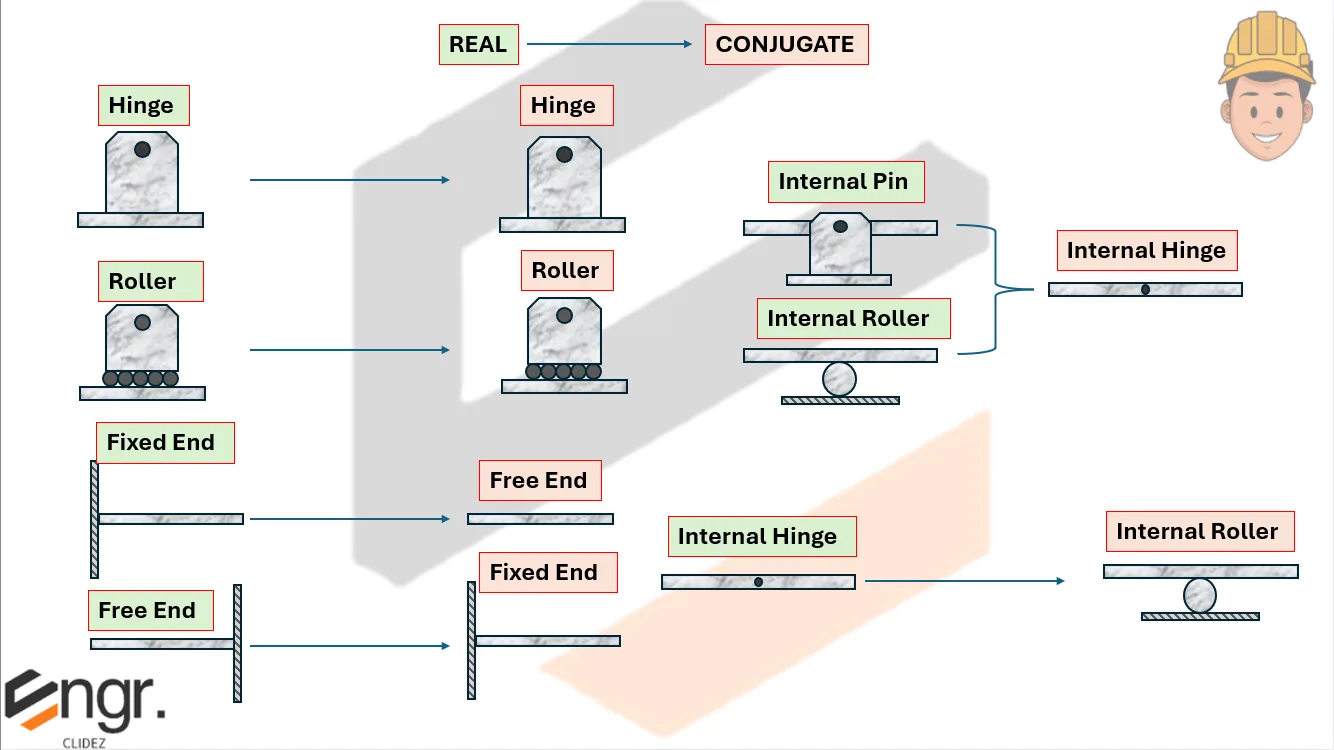
Key idea: The supports of the conjugate beam must be modified so that:

By designing the conjugate beam accordingly and applying the moment/$EI$ diagram as loading, we can compute the slope and deflection in the real beam by analyzing the shear and moment values in the conjugate beam.
Concept

Conjugate Beam Support Equivalents

Real Beam Support Slope $\theta$ Deflection $y$ Conjugate Beam Support Conjugate Shear $V$ Conjugate Moment $M$
Fixed End $\theta = 0$ $y = 0$ Free End $V = 0$ $M = 0$
Free End $\theta \ne 0$ $y \ne 0$ Fixed End $V \ne 0$ $M \ne 0$
Hinge $\theta \ne 0$ $y = 0$ Hinge $V \ne 0$ $M = 0$
Roller $\theta \ne 0$ $y = 0$ Roller $V \ne 0$ $M = 0$
Internal Pin $\theta \ne 0$ $y = 0$ Internal Hinge $V \ne 0$ $M = 0$
Internal Roller $\theta \ne 0$ $y = 0$ Internal Hinge $V \ne 0$ $M = 0$
Internal Hinge $\theta \ne 0$ $y \ne 0$ Internal Roller $V \ne 0$ $M \ne 0$

General rule: If a real support allows a slope, the conjugate support must develop a shear, and if the real support allows a displacement, the conjugate support must develop a moment.

Concept Concept Concept Concept Concept Concept Concept Concept

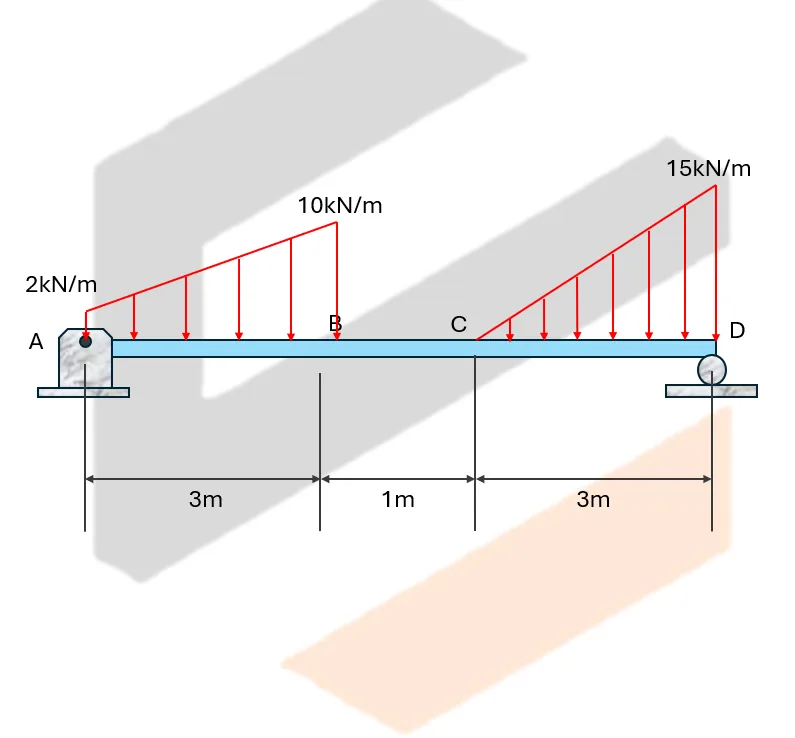
Problem: Discontinuous Trapezoidal Load and Triangular Load (Moment Diagram by Parts without Load Extension)

For the beam shown, using the Conjugate Beam Method:
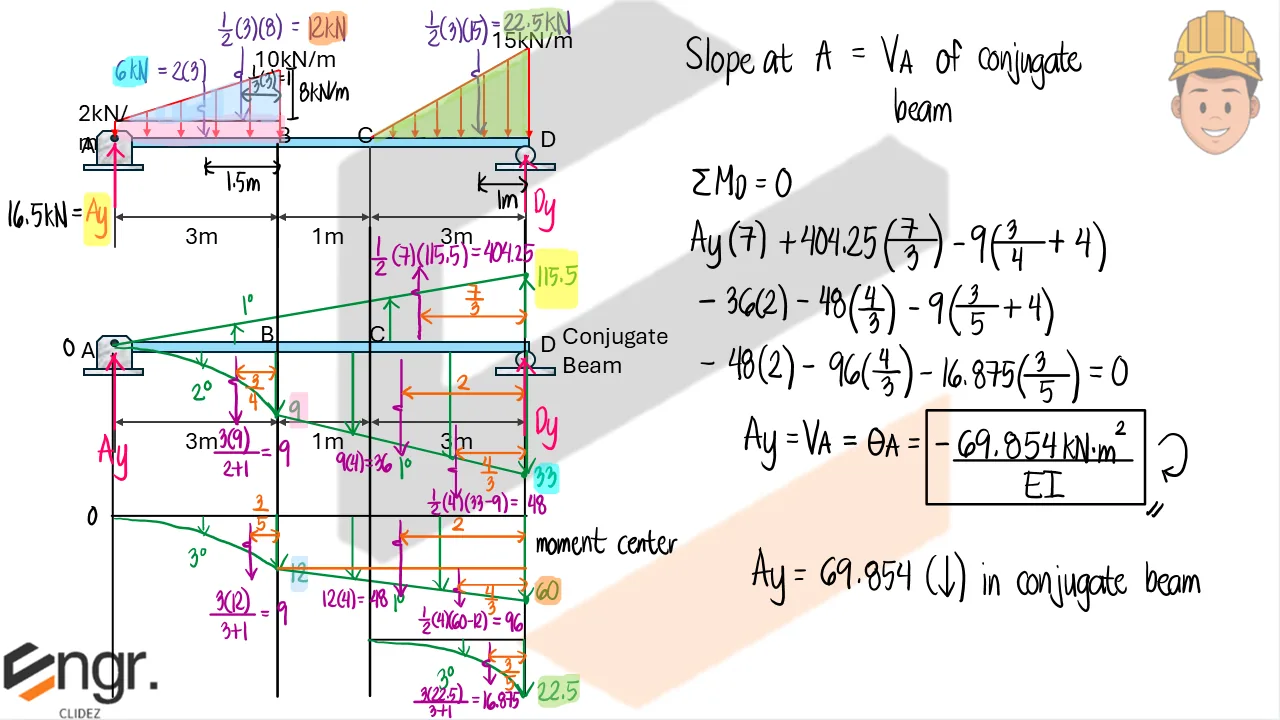
a. Determine the slope at A.
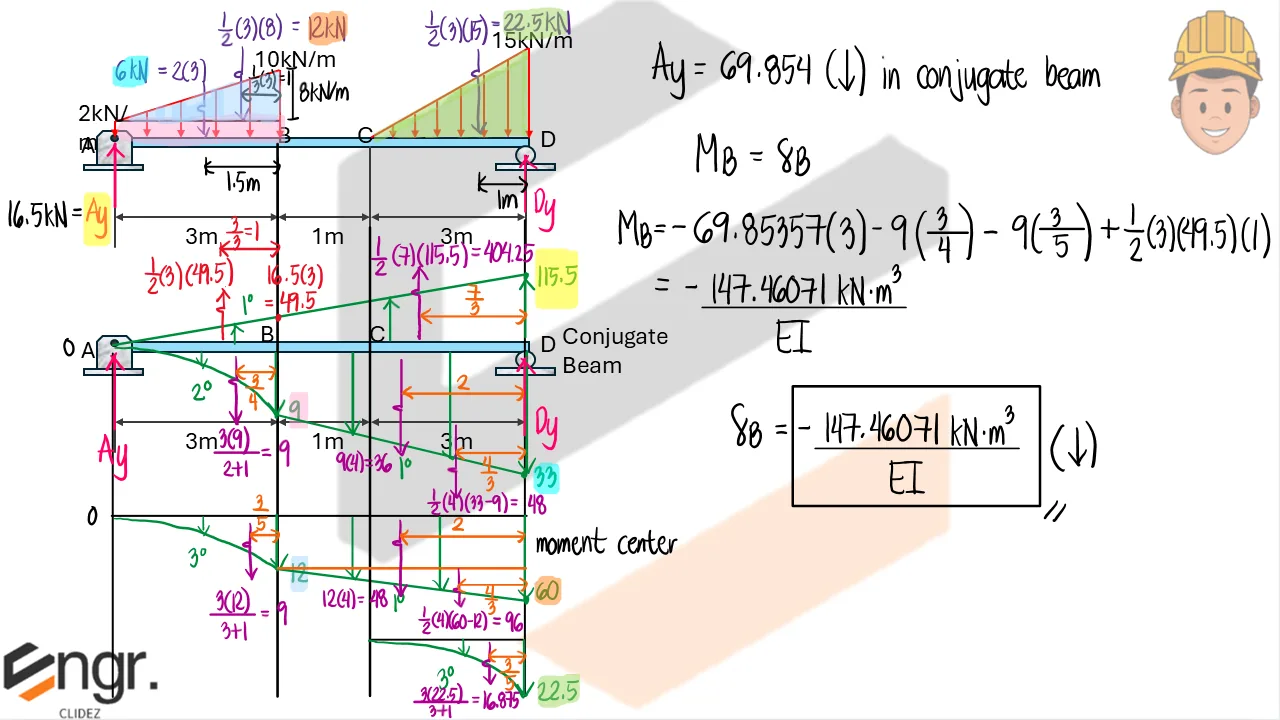
b. Determine the deflection at B.
c. Determine the location and value of the maximum deflection.

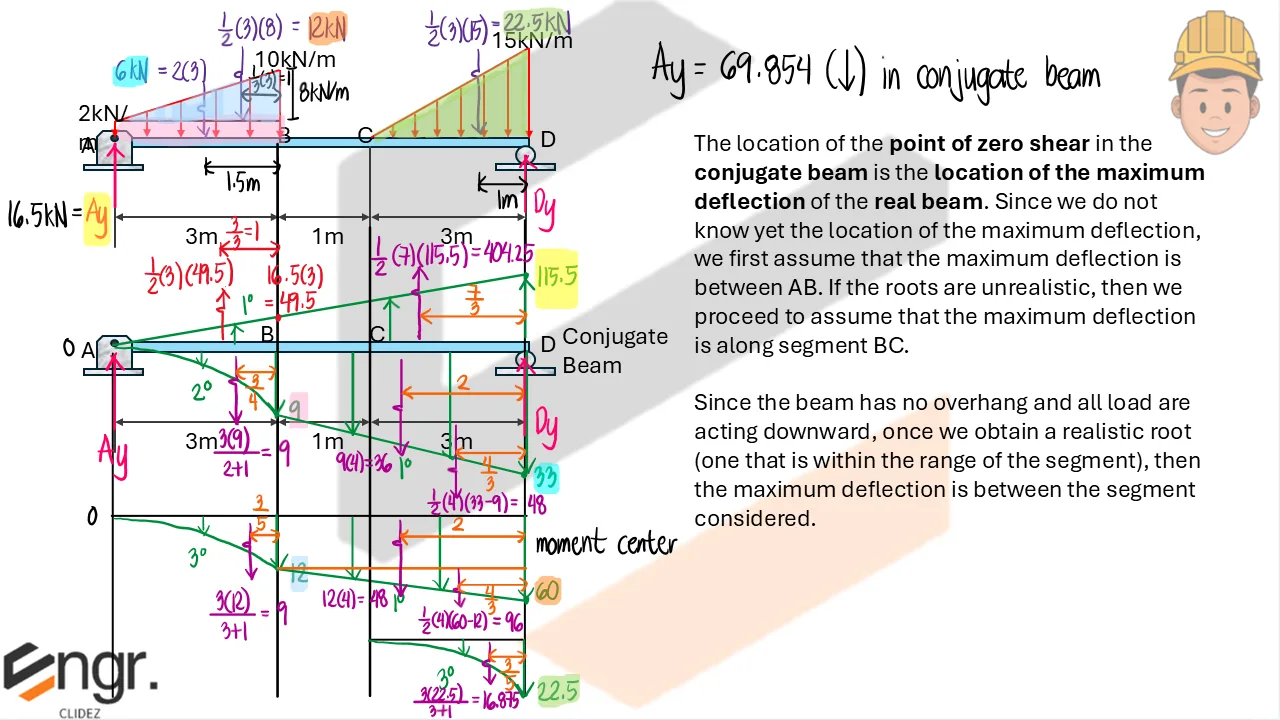
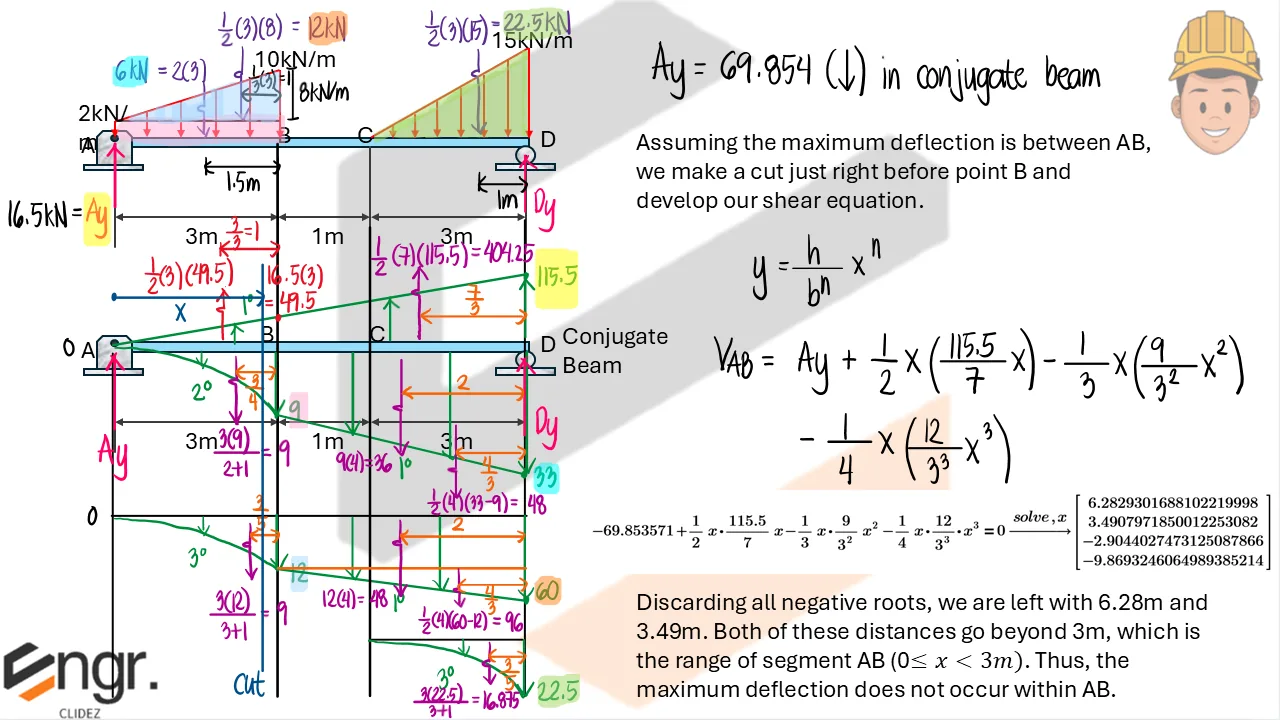
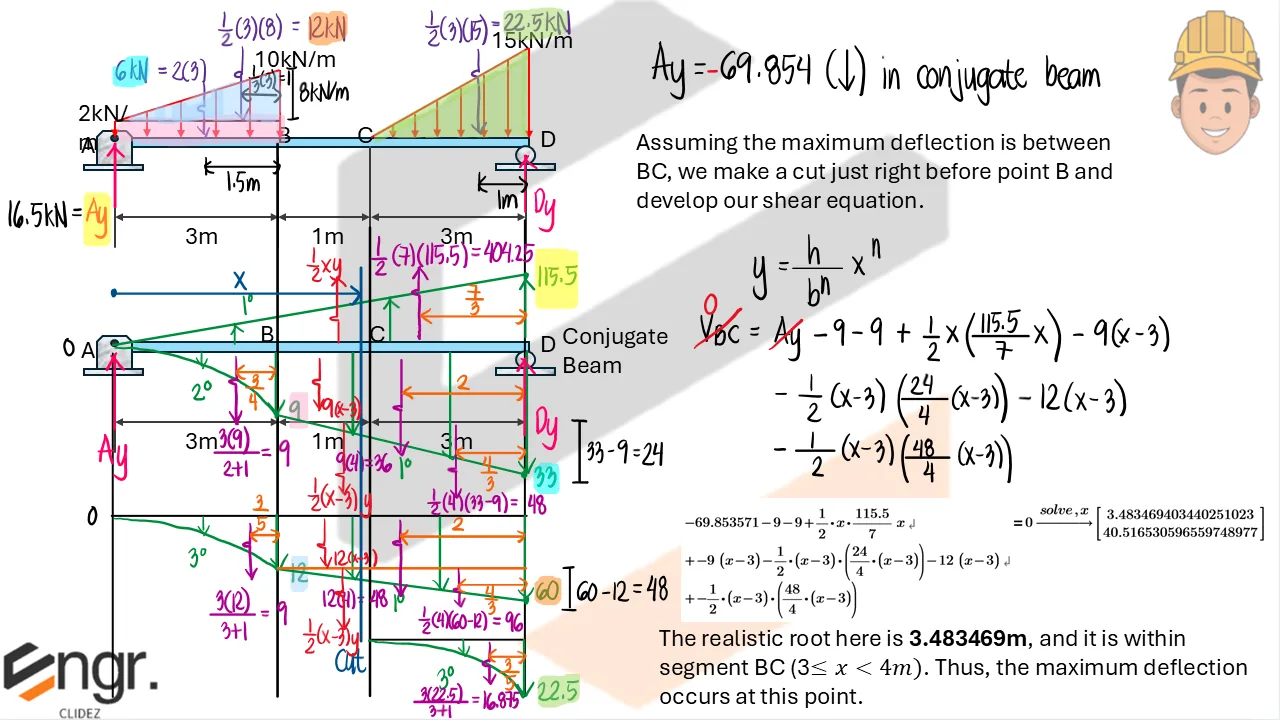
Conjugate Beam Method | Structural Theory – Problem 1: – Diagram Conjugate Beam Method | Structural Theory – Problem 1: – Diagram Conjugate Beam Method | Structural Theory – Problem 1: – Diagram

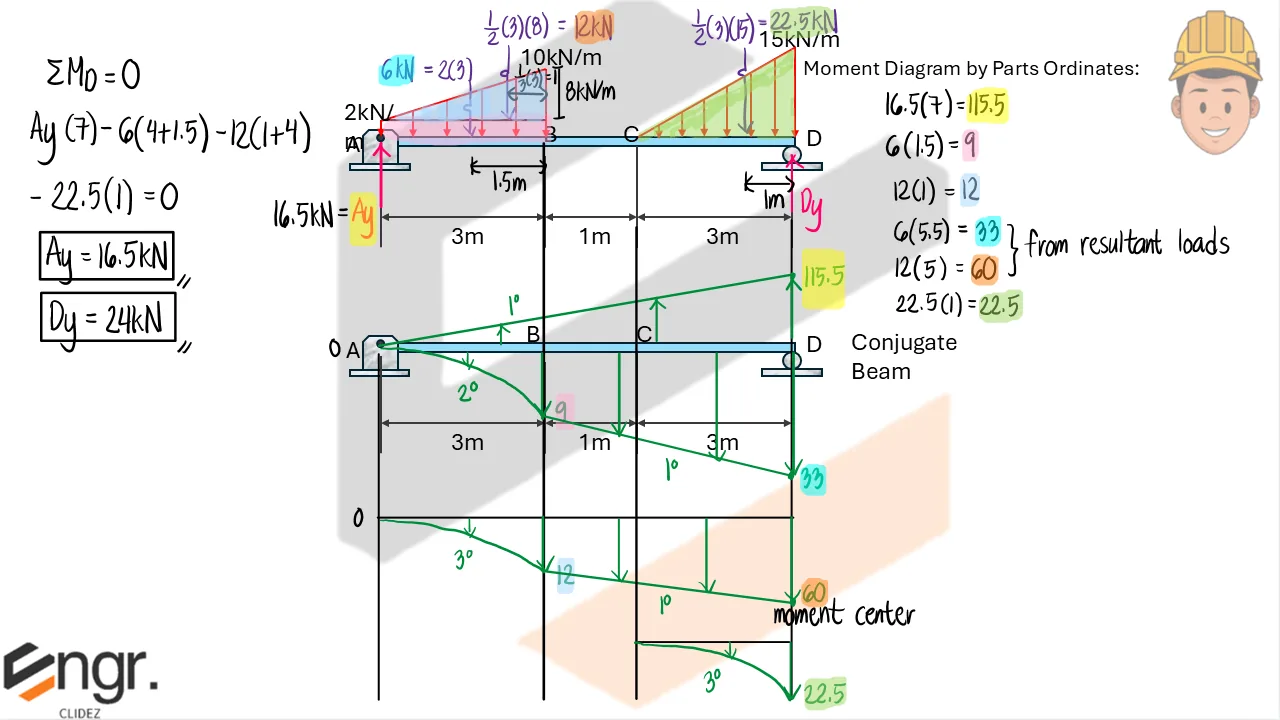
Moment Diagram by Parts

Conjugate Beam Method | Structural Theory – Problem 1: – Diagram Conjugate Beam Method | Structural Theory – Problem 1: – Diagram Conjugate Beam Method | Structural Theory – Problem 1: – Diagram Conjugate Beam Method | Structural Theory – Problem 1: – Diagram Conjugate Beam Method | Structural Theory – Problem 1: – Diagram Conjugate Beam Method | Structural Theory – Problem 1: – Diagram

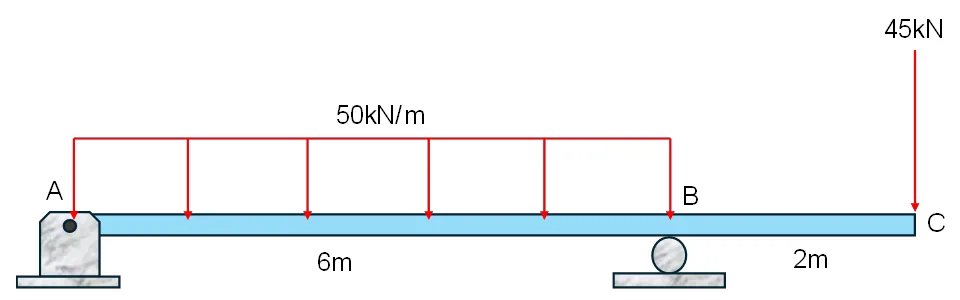
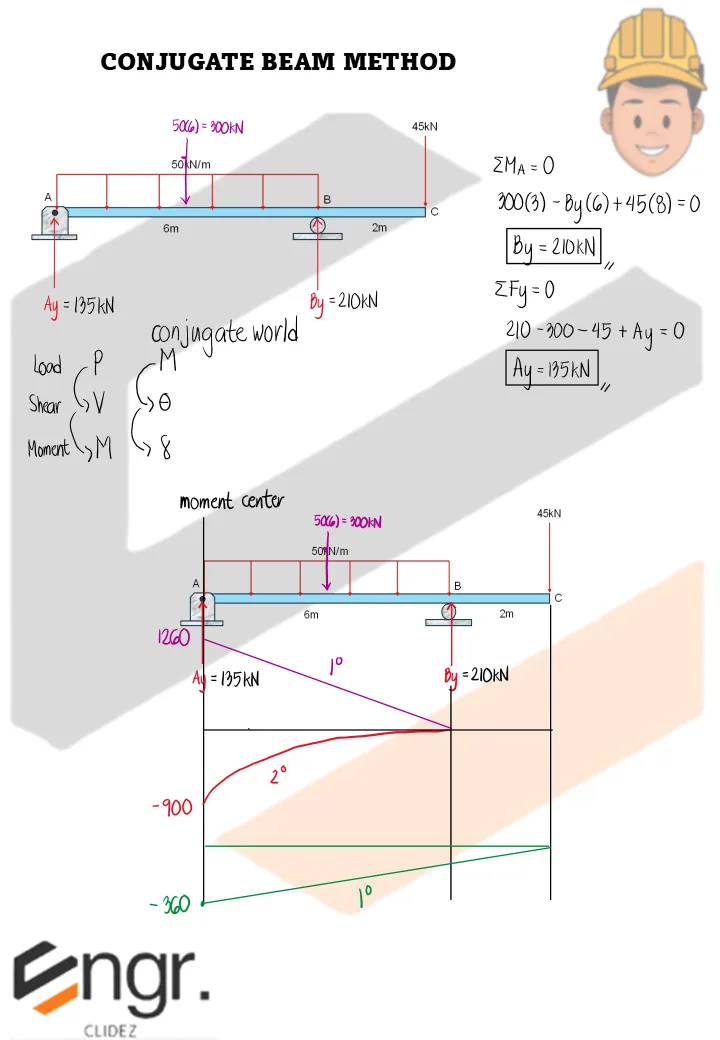
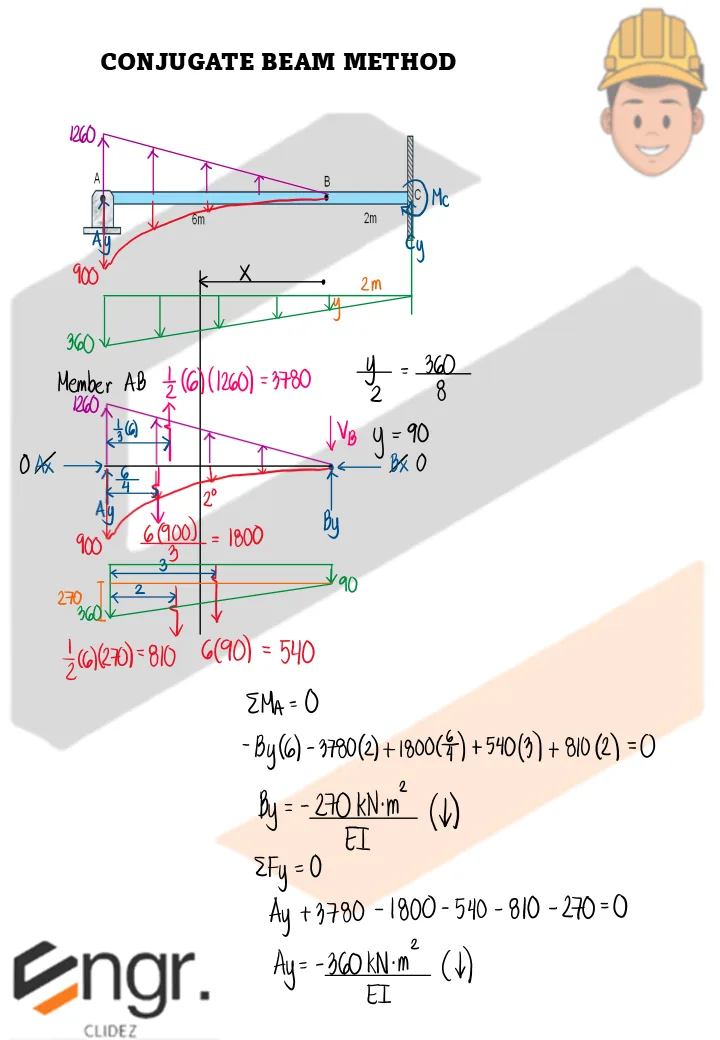
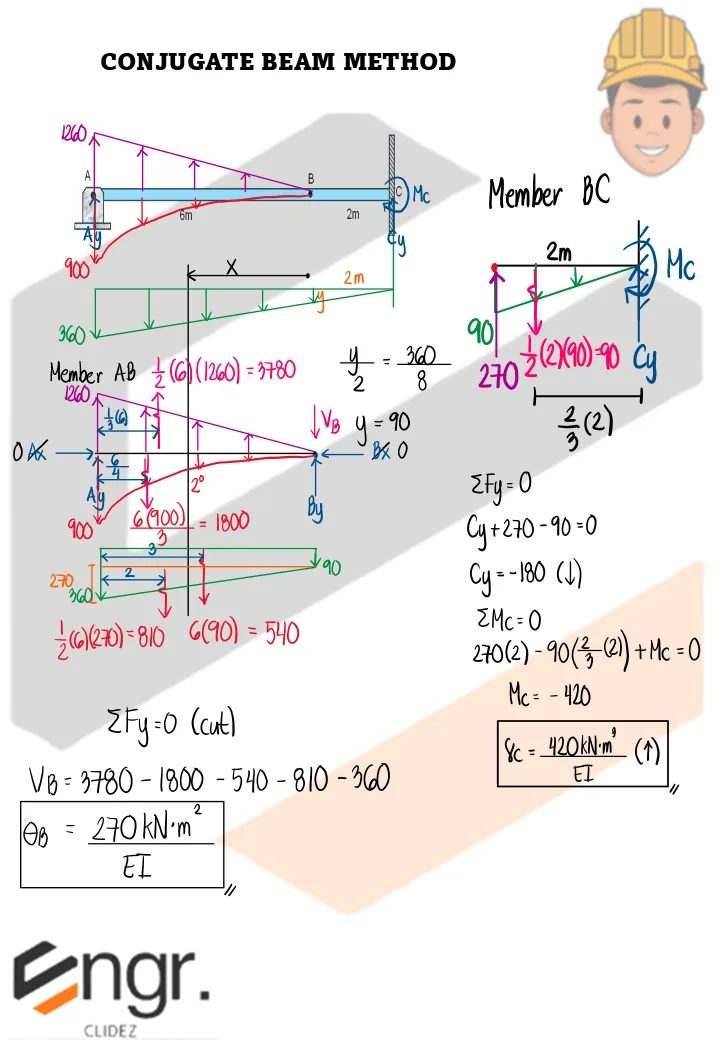
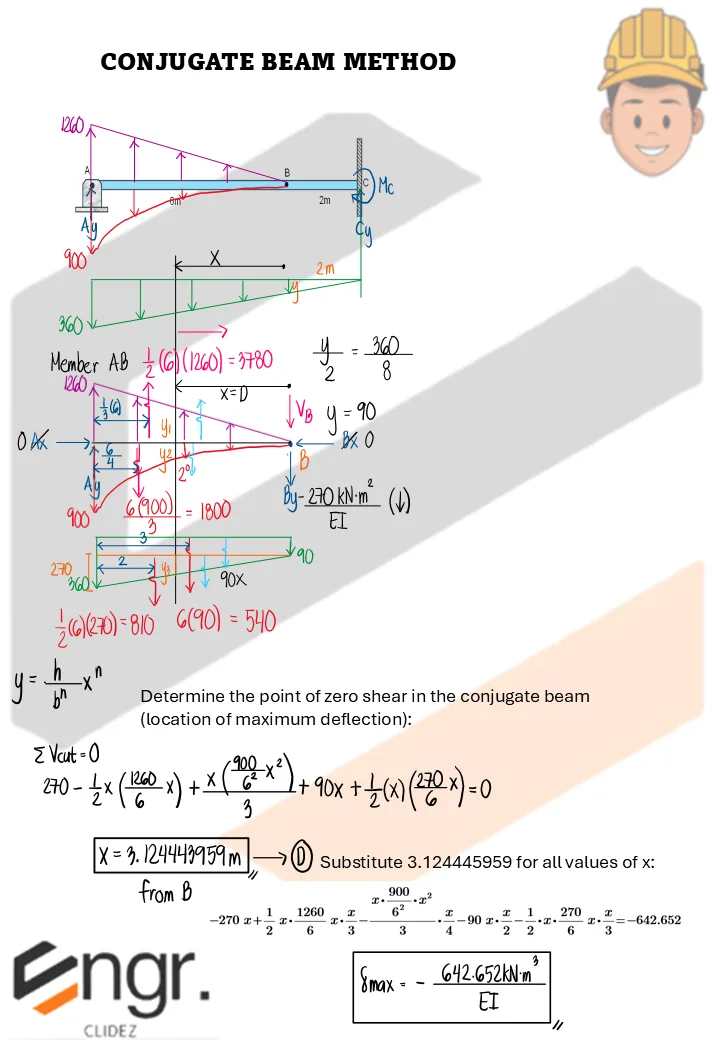
Problem: Overhanging Beam with Uniform Load at the Simple Span and Point Load at the Free End

For the beam shown, determine the following:
a. The deflection at the free end
b. The location of the maximum deflection
c. The maximum deflection
d. The slope at the roller support

Conjugate Beam Method | Structural Theory – Problem 2: – Diagram Conjugate Beam Method | Structural Theory – Problem 2: – Diagram Conjugate Beam Method | Structural Theory – Problem 2: – Diagram

See images:

Conjugate Beam Method | Structural Theory – Problem 2: – Diagram Conjugate Beam Method | Structural Theory – Problem 2: – Diagram Conjugate Beam Method | Structural Theory – Problem 2: – Diagram Conjugate Beam Method | Structural Theory – Problem 2: – Diagram

Problem: Simple Beam Loaded with Moments at the Ends

A 6-meter-simple-beam is loaded with clockwise moments M1 and M2 at the left and right supports, respectively. If M1=200kN-m and M2=100kN-m, compute the following:
a. The moment at the midspan in kN-m.
b. The location of the point of inflection from the left support.
c. The maximum deflection of the beam.

Conjugate Beam Method | Structural Theory – Problem 3: – Diagram Conjugate Beam Method | Structural Theory – Problem 3: – Diagram Conjugate Beam Method | Structural Theory – Problem 3: – Diagram

Note: The point of inflection is the point on the beam where the moment is zero. In the moment diagram shown, the point of zero moment is 4m from the left support. Conjugate Beam Method | Structural Theory – Problem 3: – Diagram

The shear and moment diagram constructed by our beam solver is shown below as reference for the moment diagram.

Conjugate Beam Method | Structural Theory – Problem 3: – Diagram Conjugate Beam Method | Structural Theory – Problem 3: – Diagram Conjugate Beam Method | Structural Theory – Problem 3: – Diagram

Problem:

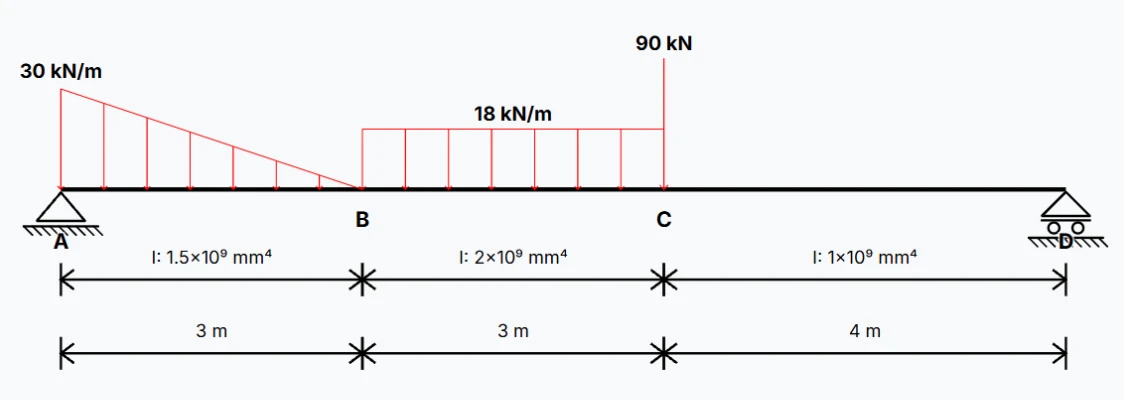
Refer to the image shown:

Conjugate Beam Method | Structural Theory – Problem 4: – Diagram Conjugate Beam Method | Structural Theory – Problem 4: – Diagram Conjugate Beam Method | Structural Theory – Problem 4: – Diagram

See images:

Conjugate Beam Method | Structural Theory – Problem 4: – Diagram Conjugate Beam Method | Structural Theory – Problem 4: – Diagram Conjugate Beam Method | Structural Theory – Problem 4: – Diagram Conjugate Beam Method | Structural Theory – Problem 4: – Diagram

Problem:

Refer to the image shown:

Conjugate Beam Method | Structural Theory – Problem 5: – Diagram Conjugate Beam Method | Structural Theory – Problem 5: – Diagram Conjugate Beam Method | Structural Theory – Problem 5: – Diagram

See images:

Conjugate Beam Method | Structural Theory – Problem 5: – Diagram Conjugate Beam Method | Structural Theory – Problem 5: – Diagram Conjugate Beam Method | Structural Theory – Problem 5: – Diagram Conjugate Beam Method | Structural Theory – Problem 5: – Diagram

Problem:

Refer to the image shown:

Conjugate Beam Method | Structural Theory – Problem 6: – Diagram Conjugate Beam Method | Structural Theory – Problem 6: – Diagram Conjugate Beam Method | Structural Theory – Problem 6: – Diagram

See images:

Conjugate Beam Method | Structural Theory – Problem 6: – Diagram Conjugate Beam Method | Structural Theory – Problem 6: – Diagram Conjugate Beam Method | Structural Theory – Problem 6: – Diagram Conjugate Beam Method | Structural Theory – Problem 6: – Diagram

Problem:

Refer to the image shown:

Conjugate Beam Method | Structural Theory – Problem 7: – Diagram Conjugate Beam Method | Structural Theory – Problem 7: – Diagram Conjugate Beam Method | Structural Theory – Problem 7: – Diagram

See images:

Conjugate Beam Method | Structural Theory – Problem 7: – Diagram Conjugate Beam Method | Structural Theory – Problem 7: – Diagram Conjugate Beam Method | Structural Theory – Problem 7: – Diagram Conjugate Beam Method | Structural Theory – Problem 7: – Diagram

Problem:

Refer to the image shown:

Conjugate Beam Method | Structural Theory – Problem 8: – Diagram Conjugate Beam Method | Structural Theory – Problem 8: – Diagram Conjugate Beam Method | Structural Theory – Problem 8: – Diagram

See images:

Conjugate Beam Method | Structural Theory – Problem 8: – Diagram Conjugate Beam Method | Structural Theory – Problem 8: – Diagram Conjugate Beam Method | Structural Theory – Problem 8: – Diagram Conjugate Beam Method | Structural Theory – Problem 8: – Diagram
-->
Scroll to zoom