Frames are structural systems composed of multiple members connected together, typically to support various types of loads. In this section, we will begin by analyzing pin-connected frames — similar in form to trusses but capable of carrying more complex loading scenarios.
Pin-connected frames may carry axial forces like trusses, but they can also transmit external loads applied between joints, making their analysis slightly more involved. We'll still rely on the basic principles of statics discussed in the Statics of Rigid Bodies section, including the following equations:
Later on, we will also tackle rigid frames — those with members connected by rigid joints, capable of resisting axial forces, shear forces, and bending moments. These types of frames require more advanced techniques for analysis, especially when they become statically indeterminate.
Problem: CE Past Board Exam
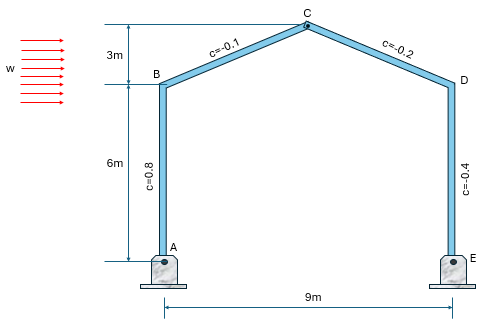
The representative frame shown below is subjected to a wind pressure of 1.5kPa. The frames are spaced 6m apart and the coefficients of wind pressure are given for each member as shown. Assume that A and E are hinged and that C is pin-connected. Solve the reactions and draw the shear, moment, and axial diagrams of each member.
The wind pressure is first converted into equivalent uniformly distributed loads on each member by multiplying it by the frame spacing. A positive wind pressure coefficient indicates that the load acts toward the member, whereas a negative coefficient represents a suction effect, causing the load to act away from the member (see the directions of the load on member CD and DE).
A useful technique in solving the reactions when there are distributed loads acting perpendicular to the inclined members of a frame is to split the load into two uniformly distributed loads acting over the horizontal and vertical components of the distances.
For example, the 2kN/m and 5kN/m uniform loads acting on BC and CD are broken into two separate loading acting over the 4-m horizontal distance and the 3-m vertical distance.
We only revert this once we draw the shear, moment, and axial diagrams since we generally want the external loads to act perpendicular to the member.
In our solution, we combine the forces with the same moment arms. For example, the 30kN resultant on AB and the 15kN resultant on DE each have a moment arm of 2.5m about point E, so we join the two as (30+15) multiplied by the common moment arm. Note that we still follow our sign convention here. Both the 30kN and 15kN loads cause a clockwise rotation about point E, so we use a positive sign for both. In the case where, for example, the 15kN load will cause a counterclockwise rotation, we use (30-15) multiplied by the moment arm.
For the purpose of uniformity, we draw our shear, moment, and axial diagrams from top to bottom or left to right and use rotated reference axes for inclined members (BC and CD). We must also obtain the components of the original external and internal reactions along the rotated axes.
-->
🧭 Jump to:
Scroll to zoom
Exam Generator Problems
Additional board-style practice items for this topic.
Question Bank: q307
PSAD - Structural Theory / Deflection of Frames / Engr. Janclyde Espinosa (Clidez)
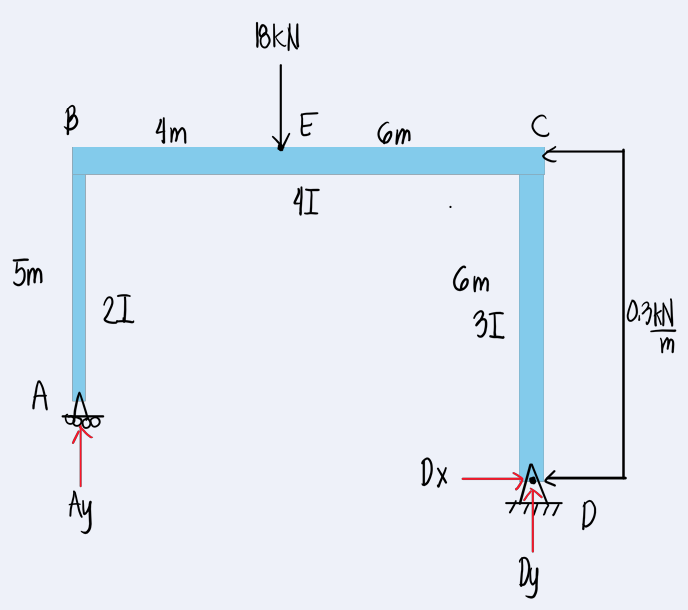
The rigid frame shown in TOS-006 is subjected to a
concentrated load of 18 kN and a uniform load of 300
N/m.
What is the vertical reaction at A?
11.34kN
10.56kN
13.36kN
6.66kN
What is the horizontal reaction at D?
1.80kN
2.00kN
1.30kN
2.30kN
What is the horizontal deflection at A?
359/EI
437/EI
320/EI
275/EI
### Frame reactions and horizontal deflection
Use member stiffnesses $2EI/5$, $4EI/10$, and $3EI/6$ for the three frame members. Resolve the $0.3 \text{kN/m}$ horizontal load on the right column, include the $18 \text{kN}$ load on the beam, and enforce frame-joint equilibrium by slope-deflection (or stiffness) equations.
The solved support reactions are
$$A_y=\boxed{11.34 \text{kN}},\qquad D_x=\boxed{1.80 \text{kN}}.$$
Using the unit-load method with a unit horizontal load at $A$,
$$\delta_{A,x}=sumint\frac{Mm}{EI},ds=\boxed{\frac{359}{EI}}.$$
The unit-load result is positive in the assumed horizontal direction.
Question Bank: q320
PSAD - Structural Theory / Analysis of Frames / Engr. Janclyde Espinosa (Clidez)
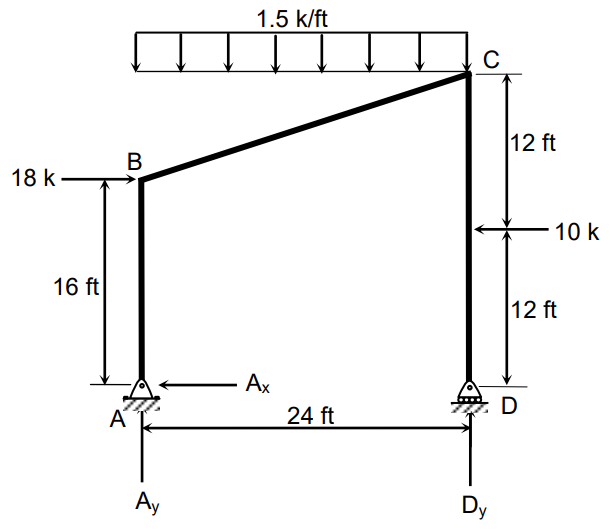
Determine the resultant reactions of the frame shown.
Resultant reaction at A in kips
13.60
16.30
15.80
18.50
Resultant reaction at D in kips
25
22
20
27
Internal Moment at B in k-ft
128
120
160
140
Internal Moment at C in k-ft
120
128
140
160
Equivalent w perpendicular to member BC
1.35k/ft
1.53k/ft
1.42k/ft
1.29k/ft
Equivalent w parallel to member BC
0.45k/ft
0.50k/ft
0.56k/ft
0.42k/ft
### Frame reactions and member actions
Resolve the distributed load on inclined member $BC$ into axes normal and parallel to the member. From the member geometry,
$$w_\perp=\boxed{1.35 \text{k/ft}},\qquad w_\parallel=\boxed{0.45 \text{k/ft}}.$$
Then use whole-frame equilibrium for the support reactions and cut the member at $B$ and $C$ for internal moments:
$$R_A=\boxed{13.60 \text{kips}},\qquad R_D=\boxed{25 \text{kips}},$$
$$M_B=\boxed{128 \text{k-ft}},\qquad M_C=\boxed{120 \text{k-ft}}.$$
Question Bank: q321
PSAD - Structural Theory / Analysis of Frames / Engr. Janclyde Espinosa (Clidez)
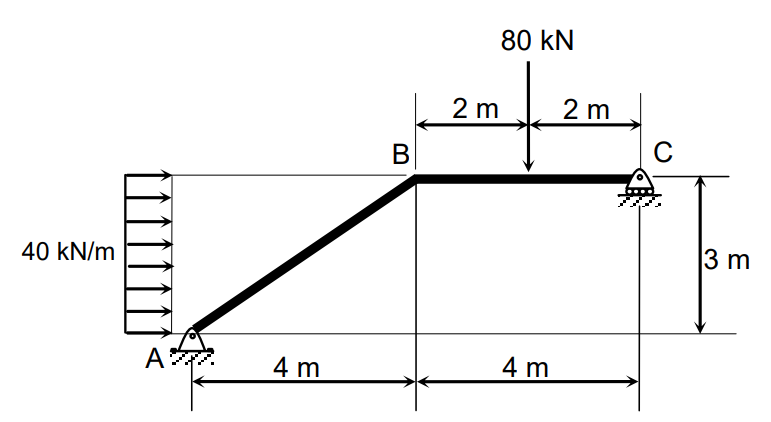
Draw the axial, shear, and moment diagrams of the frame shown.
Resultant reaction at A in kN
120.03
116.40
121.20
124.30
Resultant reaction at C in kN
82.5
84.6
83.8
81.7
Internal Moment at B in kN-m
170
180
190
200
Equivalent w perpendicular to member AB in kN/m
14.4
13.2
13.4
24.4
Equivalent w parallel to member AB in kN/m
19.2
20.3
18.7
15.6
Axial force at B in member AB in kN
1.5
97.5
37.5
2.75
Maximum moment at member AB in kN-m
170.1
160
165
175.2
Maximum shear at member BC in kN
82.5
2.5
70
75.6
### Frame diagrams
Resolve the $24 \text{kN/m}$ inclined load into local member axes:
$$w_{\perp,AB}=\boxed{14.4 \text{kN/m}},\qquad w_{\parallel,AB}=\boxed{19.2 \text{kN/m}}.$$
Whole-frame equilibrium gives
$$R_A=\boxed{120.03 \text{kN}},\qquad R_C=\boxed{82.5 \text{kN}}.$$
From local cuts,
$$M_B=\boxed{170 \text{kN}\!\cdot\!\text{m}},\quad N_{B,AB}=\boxed{1.5 \text{kN}},$$
$$M_{AB,\max}=\boxed{170.1 \text{kN}\!\cdot\!\text{m}},\quad V_{BC,\max}=\boxed{82.5 \text{kN}}.$$
Question Bank: q322
PSAD - Structural Theory / Analysis of Frames / Engr. Janclyde Espinosa (Clidez)
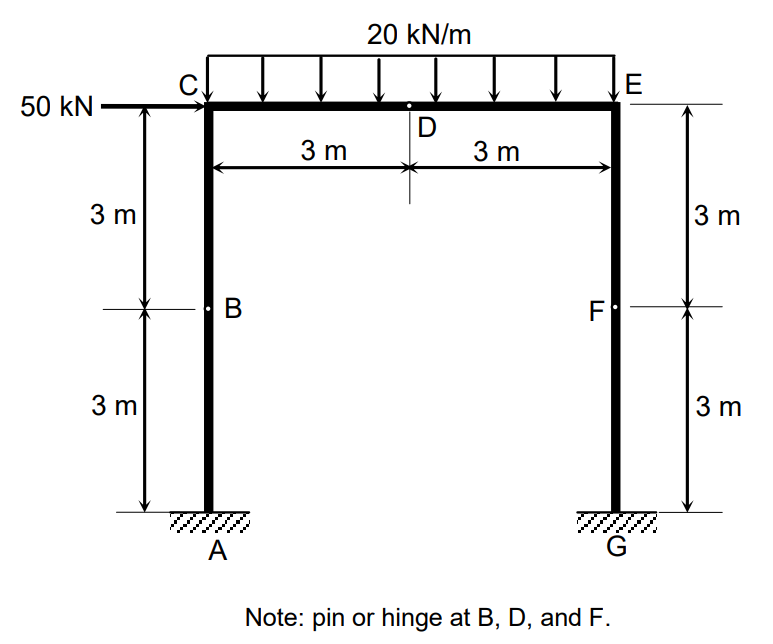
Solve the reactions of the frame shown.
Resultant reaction at A in kN
35.36
36.40
50.25
46.32
Resultant reaction at G in kN
101.24
91.92
98.62
103.48
Moment reaction at A in kN-m
15
165
20
140
Moment reaction at G in kN-m
165
15
140
20
### Frame reactions
Replace the horizontal distributed load by its resultant, $40(3)=120 \text{kN}$, acting at the column midpoint, and include the $80 \text{kN}$ point load. Apply $\sum F_x=0$, $\sum F_y=0$, and $\sum M=0$ to the frame. The resultants are
$$R_A=\boxed{35.36 \text{kN}},\qquad R_G=\boxed{101.24 \text{kN}},$$
with fixed-end moments
$$M_A=\boxed{15 \text{kN}\!\cdot\!\text{m}},\qquad M_G=\boxed{165 \text{kN}\!\cdot\!\text{m}}.$$
Question Bank: q515
PSAD - Structural Theory / Analysis of Frames / Engr. Janclyde Espinosa (Clidez)
The frame shown in the figure is acted on by a wind load pressure of p=1.44kPa. These frames are spaced 6m apart.
Determine the vertical component of the reaction at A in kN.
27.756
28.944
34.962
32.673
Determine the vertical component of the reaction at B in kN.
16.092
13.594
14.321
15.645
Determine the total horizontal force acting on the frame in kN.
64.8
65.3
62.7
61.6
Convert the pressure to the line loading for one frame by multiplying by the 6-m frame spacing. The wind analysis is performed on the shown portal frame using the listed member stiffness coefficients. The horizontal wind resultant is: $$H=64.8\text{ kN}$$ Apply the frame stiffness (slope-deflection) equations at the rigid knee and ridge joints, impose zero translations at the supports, and then obtain the support actions from joint equilibrium. The resulting vertical reactions are: $$A_y=27.756\text{ kN}$$ $$B_y=16.092\text{ kN}$$ The nonzero vertical reactions arise from the vertical components of the wind forces on the inclined roof members. Therefore, the answers are 27.756 kN at $A$, 16.092 kN at $B$, and a total horizontal wind force of 64.8 kN.