Trusses are structural systems composed of straight members connected at joints, typically assumed to be pinned. The goal of truss analysis is to determine the internal forces in each member under applied loads.
In this course, we analyze trusses using two classical methods:
Method of Joints
Method of Sections
These methods were thoroughly discussed in the Statics of Rigid Bodies section. You may refer back to that section for the discussion of concepts.
In Structural Theory, these same methods are still applicable, but they are often extended to handle more complex or indeterminate truss systems using advanced tools like virtual work, matrix methods, and compatibility equations.
For indeterminate trusses, internal forces are computed using energy methods, where virtual force tables and compatibility conditions (e.g., $ \Delta + y = 0 $) are applied to solve for redundant forces.
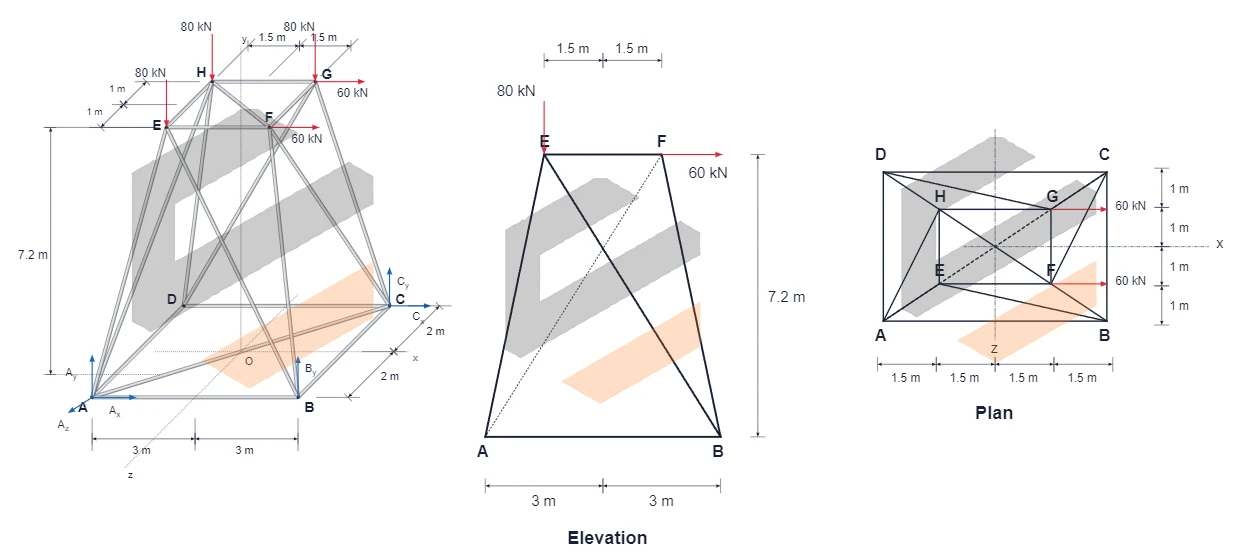
Space Truss | 3D Force System
Determine the forces in all of the members shown:
-->
🧭 Jump to:
Scroll to zoom
Exam Generator Problems
Additional board-style practice items for this topic.
CE Board: Transmission Tower with Lateral Loads
PSAD - Statics / Analysis of Trusses / Mastermatician
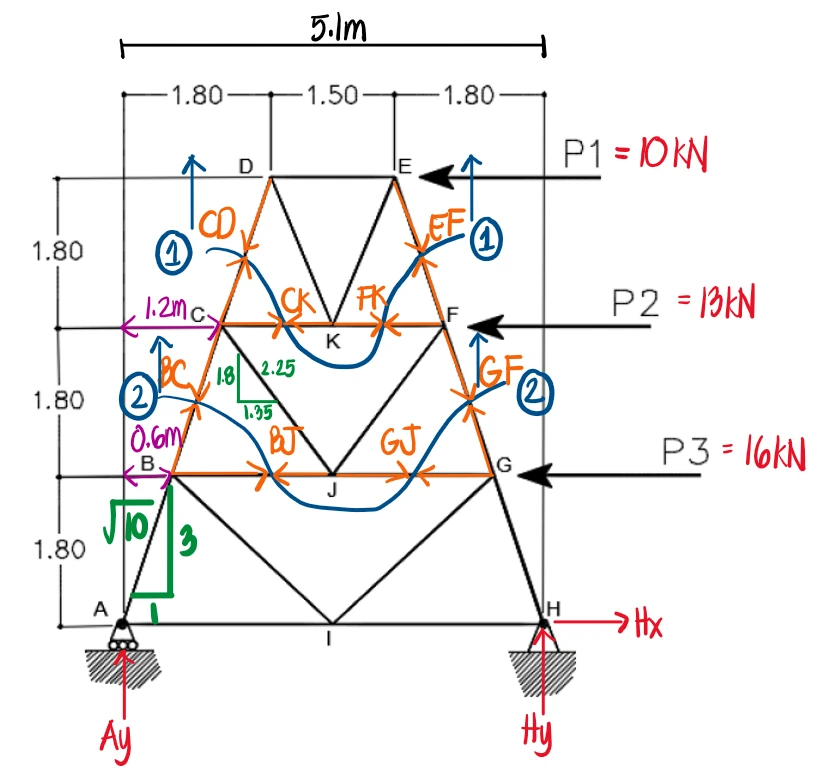
A transmission tower is loaded as shown.
P1=10kN
P2=13kN
P3=16kN
Determine the total reaction at H in kN.
46.55
25.41
39.00
52.11
Determine the force in member CJ, in kN.
10.7
9.7
6.1
16.1
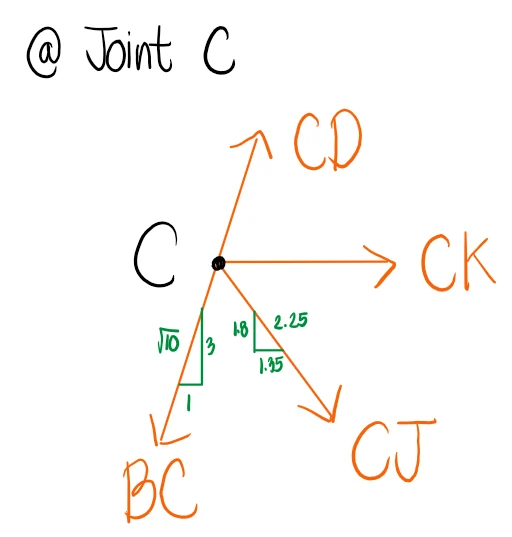
In this solution, we make the two cutting sections as shown to avoid solving the reaction at A. We first obtain the member forces of CD and BC; then, we analyze joint C to determine the force in CJ. In this example, therefore, it is crucial to combine the method of joints and sections. In both cuts, we consider the upper section and we apply the principle of transmissibility to reduce the terms in our equilibrium equations.
$$
\sum M_A = 0
$$
$$
-10(5.4)-13(3.6)-16(1.8)-H_y(5.1)=0
$$
$$
H_y=-25.41\,\text{kN}\;(\downarrow)
$$
$$
\sum F_x = 0
$$
$$
H_x=10+13+16
$$
$$
H_x=39\,\text{kN}
$$
$$
R_H=\sqrt{39^2+25.41^2}=46.55\,\text{kN}
$$
$$
\text{@ Section 1-1}
$$
$$
\sum M_F=0
$$
$$
-CD\left(\frac{3}{\sqrt{10}}\right)\left(5.1-2(1.2)\right)-10(1.8)=0
$$
$$
CD=-7.03\,\text{kN}\;(\text{C})
$$
$$
\text{@ Section 2-2}
$$
$$
\sum M_G=0
$$
$$
-BC\left(\frac{3}{\sqrt{10}}\right)\left(5.1-2(0.6)\right)-10(3.6)-13(1.8)=0
$$
$$
BC=-16.05\,\text{kN}\;(\text{C})
$$
$$
\sum F_y = 0
$$
$$
CD\left(\frac{3}{\sqrt{10}}\right)
-BC\left(\frac{3}{\sqrt{10}}\right)
-CJ\left(\frac{1.8}{2.25}\right)=0
$$
$$
-7.03\left(\frac{3}{\sqrt{10}}\right)
-(-16.05)\left(\frac{3}{\sqrt{10}}\right)
-CJ\left(\frac{1.8}{2.25}\right)=0
$$
$$
CJ=10.7\,\text{kN}\;(\text{T})
$$
Alternatively, we can make the cutting section 3-3.
$$
\text{@ Section 3-3}
$$
$$
\sum M_F = 0
$$
$$
\left[
-BC\left(\frac{3}{\sqrt{10}}\right)
-
CJ\left(\frac{1.8}{2.25}\right)
\right]
\left(5.1 - 2(1.2)\right)
-
10(1.8)
= 0
$$
$$
\left[
-(-16.05)\left(\frac{3}{\sqrt{10}}\right)
-
CJ\left(\frac{1.8}{2.25}\right)
\right]
\left(5.1 - 2(1.2)\right)
-
10(1.8)
= 0
$$
$$
CJ=10.7\,\text{kN}\;(\text{T})
$$




 In this solution, we make the two cutting sections as shown to avoid solving the reaction at A. We first obtain the member forces of CD and BC; then, we analyze joint C to determine the force in CJ. In this example, therefore, it is crucial to combine the method of joints and sections. In both cuts, we consider the upper section and we apply the principle of transmissibility to reduce the terms in our equilibrium equations.
$$
\sum M_A = 0
$$
$$
-10(5.4)-13(3.6)-16(1.8)-H_y(5.1)=0
$$
$$
H_y=-25.41\,\text{kN}\;(\downarrow)
$$
$$
\sum F_x = 0
$$
$$
H_x=10+13+16
$$
$$
H_x=39\,\text{kN}
$$
$$
R_H=\sqrt{39^2+25.41^2}=46.55\,\text{kN}
$$
$$
\text{@ Section 1-1}
$$
$$
\sum M_F=0
$$
$$
-CD\left(\frac{3}{\sqrt{10}}\right)\left(5.1-2(1.2)\right)-10(1.8)=0
$$
$$
CD=-7.03\,\text{kN}\;(\text{C})
$$
$$
\text{@ Section 2-2}
$$
$$
\sum M_G=0
$$
$$
-BC\left(\frac{3}{\sqrt{10}}\right)\left(5.1-2(0.6)\right)-10(3.6)-13(1.8)=0
$$
$$
BC=-16.05\,\text{kN}\;(\text{C})
$$
In this solution, we make the two cutting sections as shown to avoid solving the reaction at A. We first obtain the member forces of CD and BC; then, we analyze joint C to determine the force in CJ. In this example, therefore, it is crucial to combine the method of joints and sections. In both cuts, we consider the upper section and we apply the principle of transmissibility to reduce the terms in our equilibrium equations.
$$
\sum M_A = 0
$$
$$
-10(5.4)-13(3.6)-16(1.8)-H_y(5.1)=0
$$
$$
H_y=-25.41\,\text{kN}\;(\downarrow)
$$
$$
\sum F_x = 0
$$
$$
H_x=10+13+16
$$
$$
H_x=39\,\text{kN}
$$
$$
R_H=\sqrt{39^2+25.41^2}=46.55\,\text{kN}
$$
$$
\text{@ Section 1-1}
$$
$$
\sum M_F=0
$$
$$
-CD\left(\frac{3}{\sqrt{10}}\right)\left(5.1-2(1.2)\right)-10(1.8)=0
$$
$$
CD=-7.03\,\text{kN}\;(\text{C})
$$
$$
\text{@ Section 2-2}
$$
$$
\sum M_G=0
$$
$$
-BC\left(\frac{3}{\sqrt{10}}\right)\left(5.1-2(0.6)\right)-10(3.6)-13(1.8)=0
$$
$$
BC=-16.05\,\text{kN}\;(\text{C})
$$
 $$
\sum F_y = 0
$$
$$
CD\left(\frac{3}{\sqrt{10}}\right)
-BC\left(\frac{3}{\sqrt{10}}\right)
-CJ\left(\frac{1.8}{2.25}\right)=0
$$
$$
-7.03\left(\frac{3}{\sqrt{10}}\right)
-(-16.05)\left(\frac{3}{\sqrt{10}}\right)
-CJ\left(\frac{1.8}{2.25}\right)=0
$$
$$
CJ=10.7\,\text{kN}\;(\text{T})
$$
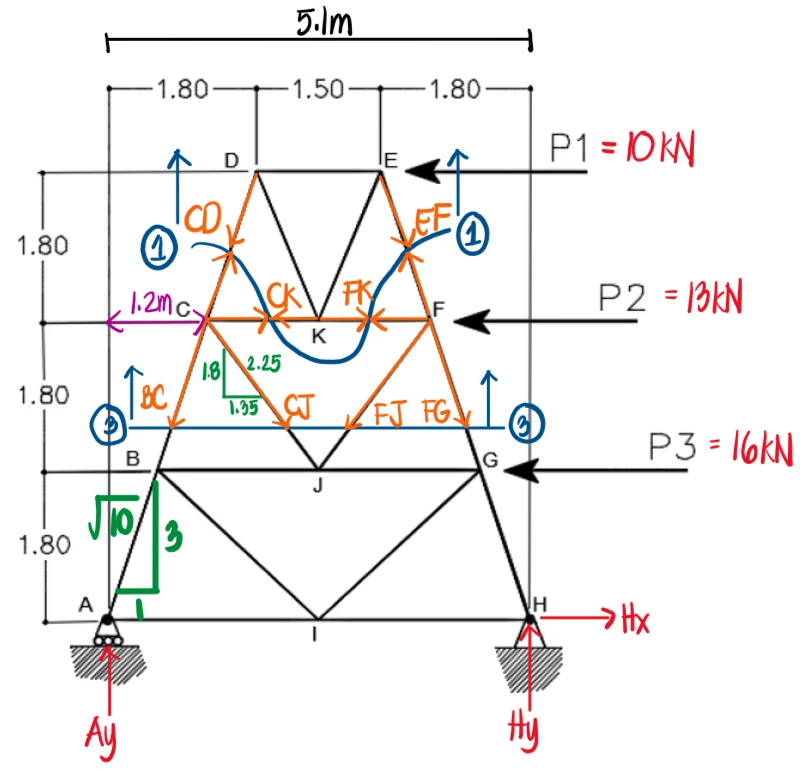
Alternatively, we can make the cutting section 3-3.
$$
\text{@ Section 3-3}
$$
$$
\sum F_y = 0
$$
$$
CD\left(\frac{3}{\sqrt{10}}\right)
-BC\left(\frac{3}{\sqrt{10}}\right)
-CJ\left(\frac{1.8}{2.25}\right)=0
$$
$$
-7.03\left(\frac{3}{\sqrt{10}}\right)
-(-16.05)\left(\frac{3}{\sqrt{10}}\right)
-CJ\left(\frac{1.8}{2.25}\right)=0
$$
$$
CJ=10.7\,\text{kN}\;(\text{T})
$$
Alternatively, we can make the cutting section 3-3.
$$
\text{@ Section 3-3}
$$
 $$
\sum M_F = 0
$$
$$
\left[
-BC\left(\frac{3}{\sqrt{10}}\right)
-
CJ\left(\frac{1.8}{2.25}\right)
\right]
\left(5.1 - 2(1.2)\right)
-
10(1.8)
= 0
$$
$$
\left[
-(-16.05)\left(\frac{3}{\sqrt{10}}\right)
-
CJ\left(\frac{1.8}{2.25}\right)
\right]
\left(5.1 - 2(1.2)\right)
-
10(1.8)
= 0
$$
$$
CJ=10.7\,\text{kN}\;(\text{T})
$$
$$
\sum M_F = 0
$$
$$
\left[
-BC\left(\frac{3}{\sqrt{10}}\right)
-
CJ\left(\frac{1.8}{2.25}\right)
\right]
\left(5.1 - 2(1.2)\right)
-
10(1.8)
= 0
$$
$$
\left[
-(-16.05)\left(\frac{3}{\sqrt{10}}\right)
-
CJ\left(\frac{1.8}{2.25}\right)
\right]
\left(5.1 - 2(1.2)\right)
-
10(1.8)
= 0
$$
$$
CJ=10.7\,\text{kN}\;(\text{T})
$$