CE Board Exam Randomizer

⬅ Back to Subject Topics

Types of Loads

Concept Concept Concept Concept Concept Concept Concept Concept Concept Concept

Types of Beams

Load Computations (One-Way and Two-Way Slabs)

Derivation of Live Load Conversions on Two-Way Slabs

Problem:

Refer to the image shown:

Load Computations: Tributary Area | Structural Theory – Problem 1: – Diagram Load Computations: Tributary Area | Structural Theory – Problem 1: – Diagram Load Computations: Tributary Area | Structural Theory – Problem 1: – Diagram

See images:

Load Computations: Tributary Area | Structural Theory – Problem 1: – Diagram Load Computations: Tributary Area | Structural Theory – Problem 1: – Diagram Load Computations: Tributary Area | Structural Theory – Problem 1: – Diagram Load Computations: Tributary Area | Structural Theory – Problem 1: – Diagram

Problem:

Refer to the image shown:

Load Computations: Tributary Area | Structural Theory – Problem 2: – Diagram Load Computations: Tributary Area | Structural Theory – Problem 2: – Diagram Load Computations: Tributary Area | Structural Theory – Problem 2: – Diagram

See images:

Load Computations: Tributary Area | Structural Theory – Problem 2: – Diagram Load Computations: Tributary Area | Structural Theory – Problem 2: – Diagram Load Computations: Tributary Area | Structural Theory – Problem 2: – Diagram Load Computations: Tributary Area | Structural Theory – Problem 2: – Diagram

Problem:

Refer to the image shown:

Load Computations: Tributary Area | Structural Theory – Problem 3: – Diagram Load Computations: Tributary Area | Structural Theory – Problem 3: – Diagram Load Computations: Tributary Area | Structural Theory – Problem 3: – Diagram

See images:

Load Computations: Tributary Area | Structural Theory – Problem 3: – Diagram Load Computations: Tributary Area | Structural Theory – Problem 3: – Diagram Load Computations: Tributary Area | Structural Theory – Problem 3: – Diagram Load Computations: Tributary Area | Structural Theory – Problem 3: – Diagram

Problem:

Refer to the image shown:

Load Computations: Tributary Area | Structural Theory – Problem 4: – Diagram Load Computations: Tributary Area | Structural Theory – Problem 4: – Diagram Load Computations: Tributary Area | Structural Theory – Problem 4: – Diagram

See images:

Load Computations: Tributary Area | Structural Theory – Problem 4: – Diagram Load Computations: Tributary Area | Structural Theory – Problem 4: – Diagram Load Computations: Tributary Area | Structural Theory – Problem 4: – Diagram Load Computations: Tributary Area | Structural Theory – Problem 4: – Diagram

Problem:

Refer to the image shown:

Load Computations: Tributary Area | Structural Theory – Problem 5: – Diagram Load Computations: Tributary Area | Structural Theory – Problem 5: – Diagram Load Computations: Tributary Area | Structural Theory – Problem 5: – Diagram

See images:

Load Computations: Tributary Area | Structural Theory – Problem 5: – Diagram Load Computations: Tributary Area | Structural Theory – Problem 5: – Diagram Load Computations: Tributary Area | Structural Theory – Problem 5: – Diagram Load Computations: Tributary Area | Structural Theory – Problem 5: – Diagram

Problem:

Refer to the image shown:

Load Computations: Tributary Area | Structural Theory – Problem 6: – Diagram Load Computations: Tributary Area | Structural Theory – Problem 6: – Diagram Load Computations: Tributary Area | Structural Theory – Problem 6: – Diagram

See images:

Load Computations: Tributary Area | Structural Theory – Problem 6: – Diagram Load Computations: Tributary Area | Structural Theory – Problem 6: – Diagram Load Computations: Tributary Area | Structural Theory – Problem 6: – Diagram Load Computations: Tributary Area | Structural Theory – Problem 6: – Diagram

Problem:

Refer to the image shown:

Load Computations: Tributary Area | Structural Theory – Problem 7: – Diagram Load Computations: Tributary Area | Structural Theory – Problem 7: – Diagram Load Computations: Tributary Area | Structural Theory – Problem 7: – Diagram

See images:

Load Computations: Tributary Area | Structural Theory – Problem 7: – Diagram Load Computations: Tributary Area | Structural Theory – Problem 7: – Diagram Load Computations: Tributary Area | Structural Theory – Problem 7: – Diagram Load Computations: Tributary Area | Structural Theory – Problem 7: – Diagram

Problem:

Refer to the image shown:

Load Computations: Tributary Area | Structural Theory – Problem 8: – Diagram Load Computations: Tributary Area | Structural Theory – Problem 8: – Diagram Load Computations: Tributary Area | Structural Theory – Problem 8: – Diagram

See images:

Load Computations: Tributary Area | Structural Theory – Problem 8: – Diagram Load Computations: Tributary Area | Structural Theory – Problem 8: – Diagram Load Computations: Tributary Area | Structural Theory – Problem 8: – Diagram Load Computations: Tributary Area | Structural Theory – Problem 8: – Diagram
-->
Scroll to zoom

Exam Generator Problems

Additional board-style practice items for this topic.

Question Bank: q313

PSAD - Structural Theory / Transmission of Loads / Engr. Janclyde Espinosa (Clidez)

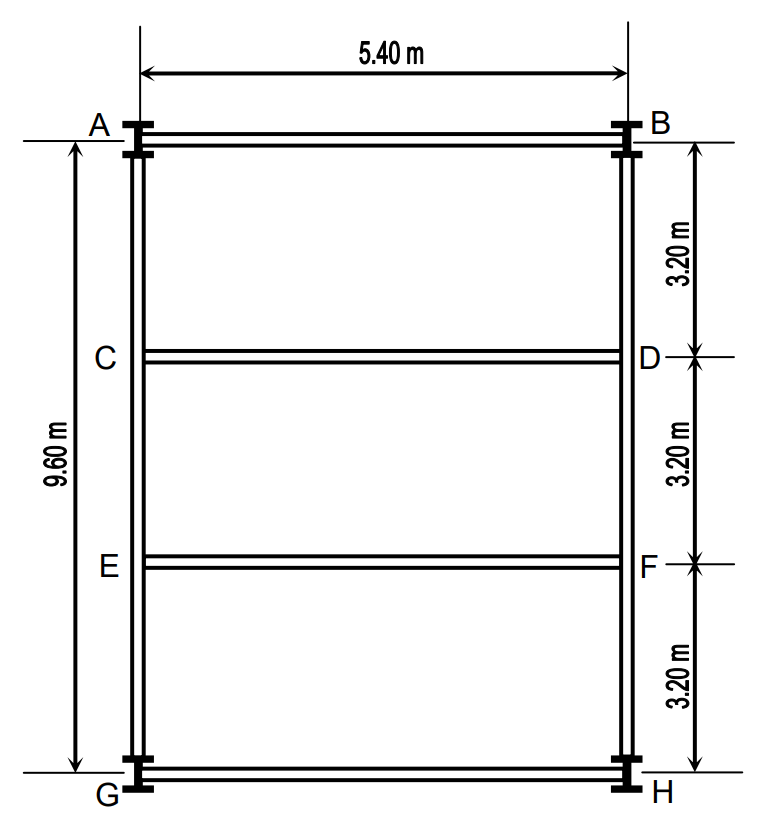
The floor of a building shown is subjected to the following loads:
Superimposed dead load = 2.4kPa
Superimposed live load = 5.2kPa

AB, CD, EF and GH: W 250 x 115 kg/m ( WEIGHT = 115 kg/m )
AG and GH: W 310 x 74 kg/m
Concrete Slab thickness = 110 mm
Unit weight of concrete = 23.54 kN/m3

q313

Compute the reaction at C and D, in kN, on beam CD.

  1. 66.11
  2. 33.74
  3. 59.64
  4. 46.12

Compute the reaction at A and B in kN, on beam AB.

  1. 33.12
  2. 17.43
  3. 32.13
  4. 18.96

Compute the total concentrated service load in kN on the column at A.

  1. 141.854
  2. 70.927
  3. 148.154
  4. 79.720
### Transmission of slab loads The slab dead load is $0.110(23.54)=2.589 \text{kPa}$. Add the $2.4 \text{kPa}$ superimposed dead load and the $5.2 \text{kPa}$ live load, then distribute the slab load by tributary area to the secondary and primary beams. Include the listed beam self-weights before taking simple-beam reactions. This gives the end reaction on beam $CD$, $$R_C=R_D=\boxed{66.11 \text{kN}},$$ and on beam $AB$, $$R_A=R_B=\boxed{33.12 \text{kN}}.$$ Summing all tributary beam reactions delivered to column $A$ gives $$\boxed{P_A=141.854 \text{kN}}.$$

Question Bank: q314

PSAD - Structural Theory / Transmission of Loads / Engr. Janclyde Espinosa (Clidez)

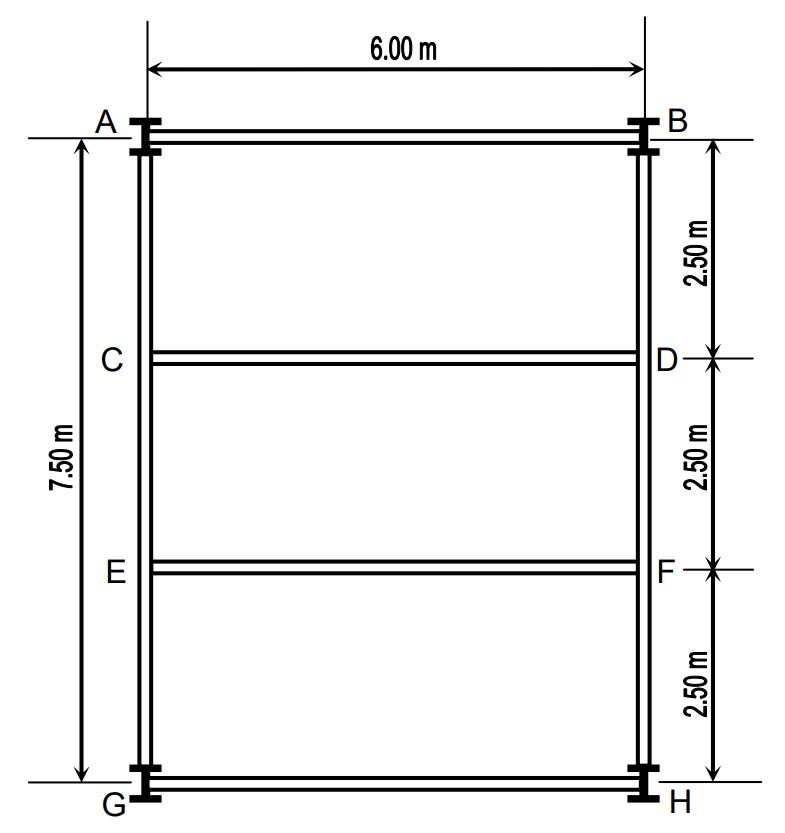
The floor of a building shown is subjected to the following loads:
Superimposed dead load = 2.8kPa
Superimposed live load = 6.0kPa

CD and EF: W 310 x 86 kg/m ( WEIGHT = 86 kg/m )
AB, GH, AG, and BH: W 310 x 97 kg/m
Concrete Slab thickness = 100 mm
Unit weight of concrete = 24 kN/m3

q314

Compute the total uniformly distributed service load in kN/m on beam CD.

  1. 28.84
  2. 21
  3. 21.84
  4. 22.84

Compute the total uniformly distributed service load in kN/m on beam AB.

  1. 14.95
  2. 11.95
  3. 14
  4. 11.45

Compute the total concentrated service load in kN on the column at A.

  1. 134.93
  2. 173.04
  3. 104.70
  4. 128.64
### Uniform loads and column load The slab service load is $$0.100(24)+2.8+6.0=11.2 \text{kPa}.$$ Using the tributary widths shown, then adding the stated beam weights, gives $$w_{CD}=\boxed{28.84 \text{kN/m}},\qquad w_{AB}=\boxed{14.95 \text{kN/m}}.$$ Transfer the simple-beam end reactions from the framing into column $A$ to obtain $$\boxed{P_A=134.93 \text{kN}}.$$