CE Board Exam Randomizer

⬅ Back to Subject Topics

Stability and Determinacy of Beams, Trusses, and Frames

To determine whether a structure is stable and statically determinate, we compare the number of unknowns with the number of available equilibrium equations. This helps identify whether:


1. Beams

For beams, we compare:

$$ r = 3n - e_c $$

Or rearranged for checking:

$$ r + e_c \quad \text{vs.} \quad 3n $$

Where:

If $r + e_c = 3n$, the beam is stable and determinate.
If $r + e_c > 3n$, the beam is indeterminate.
If $r + e_c < 3n$, the beam is unstable.

2. Trusses

For planar trusses, use the standard comparison:

$$ m + r \quad \text{vs.} \quad 2j $$

Where:

If $m + r = 2j$, the truss is stable and determinate.
If $m + r > 2j$, the truss is statically indeterminate.
If $m + r < 2j$, the truss is unstable.

3. Frames

For rigid frames, the check is:

$$ 3b + r \quad \text{vs.} \quad 3j + c $$

Where:

If $3b + r = 3j + c$, the frame is stable and determinate.
If $3b + r > 3j + c$, the frame is statically indeterminate.
If $3b + r < 3j + c$, the frame is unstable.

Geometric Instability

Even if a structure satisfies the basic equation for determinacy, it may still be unstable due to its geometry. This is referred to as geometric instability, and it typically arises from poor support layout or improper member arrangement.

A structure that appears statically determinate may still be unstable if it cannot resist motion due to geometric configuration alone.

Common Cases of Geometric Instability:

Always check whether the structure can resist:

Satisfying the equations of determinacy is necessary, but not sufficient. Geometry must also prevent rigid body motion.
Concept Concept Concept Concept Concept Concept Concept Concept Concept

Problem: L-frame

For the frame shown, determine the stability and determinacy.

Stability and Determinacy of Beams, Trusses, and Frames | Structural Theory – Problem 1: – Diagram Stability and Determinacy of Beams, Trusses, and Frames | Structural Theory – Problem 1: – Diagram Stability and Determinacy of Beams, Trusses, and Frames | Structural Theory – Problem 1: – Diagram

The reactions of the given frame all meet at the hinge. Therefore, the beam is unstable due to concurrent reactions.
$$3b+r=3j+c$$ b=2; r=3; j=3; c=0
$$3(2)+3=3(3)+0$$ Note: While using the formula for the determinacy of the frame returns $0=0$ making the structure determinate, it is still classified as unstable.

Stability and Determinacy of Beams, Trusses, and Frames | Structural Theory – Problem 1: – Diagram Stability and Determinacy of Beams, Trusses, and Frames | Structural Theory – Problem 1: – Diagram Stability and Determinacy of Beams, Trusses, and Frames | Structural Theory – Problem 1: – Diagram Stability and Determinacy of Beams, Trusses, and Frames | Structural Theory – Problem 1: – Diagram

Problem: Compound Structure (Beam & Frame)

Stability and Determinacy of Beams, Trusses, and Frames | Structural Theory – Problem 2: – Diagram Stability and Determinacy of Beams, Trusses, and Frames | Structural Theory – Problem 2: – Diagram Stability and Determinacy of Beams, Trusses, and Frames | Structural Theory – Problem 2: – Diagram

The bars are denoted by the purple lines; joints by the blue dots; and support reactions by the green symbols. We analyze only the encircled region since the bottom part of the structure becomes determinate if the internal reactions of the roller support are obtained. $$3b+r=3j+c$$ b=6; r=6; j=7; c=1 (one internal hinge)
$$3(6)+(6)=3(7)+1$$ $$I=\text{(left-hand side) - (right-hand side)}$$ $$I=3(6)+(6)-(3(7)+1)$$ $$I=24-22=\boxed{\text{indeterminate to the 2º & stable}}$$

Stability and Determinacy of Beams, Trusses, and Frames | Structural Theory – Problem 2: – Diagram Stability and Determinacy of Beams, Trusses, and Frames | Structural Theory – Problem 2: – Diagram Stability and Determinacy of Beams, Trusses, and Frames | Structural Theory – Problem 2: – Diagram Stability and Determinacy of Beams, Trusses, and Frames | Structural Theory – Problem 2: – Diagram

Problem: Truss with Cross-Bracing

Evaluate the Stability and Determinacy of the truss shown.

Stability and Determinacy of Beams, Trusses, and Frames | Structural Theory – Problem 3: – Diagram Stability and Determinacy of Beams, Trusses, and Frames | Structural Theory – Problem 3: – Diagram Stability and Determinacy of Beams, Trusses, and Frames | Structural Theory – Problem 3: – Diagram

The members are indicated by the purple lines; joints by the blue dots; and reactions by the green arrows. $$m+r=2j$$ m=6; r=5; j=4
$$6+5=2(4)$$ $$11>8$$ $$I=11-8=\boxed{\text{indeterminate to the 3º & stable}}$$

Stability and Determinacy of Beams, Trusses, and Frames | Structural Theory – Problem 3: – Diagram Stability and Determinacy of Beams, Trusses, and Frames | Structural Theory – Problem 3: – Diagram Stability and Determinacy of Beams, Trusses, and Frames | Structural Theory – Problem 3: – Diagram Stability and Determinacy of Beams, Trusses, and Frames | Structural Theory – Problem 3: – Diagram

Problem:

Refer to the image shown:

Stability and Determinacy of Beams, Trusses, and Frames | Structural Theory – Problem 4: – Diagram Stability and Determinacy of Beams, Trusses, and Frames | Structural Theory – Problem 4: – Diagram Stability and Determinacy of Beams, Trusses, and Frames | Structural Theory – Problem 4: – Diagram

See images:

Stability and Determinacy of Beams, Trusses, and Frames | Structural Theory – Problem 4: – Diagram Stability and Determinacy of Beams, Trusses, and Frames | Structural Theory – Problem 4: – Diagram Stability and Determinacy of Beams, Trusses, and Frames | Structural Theory – Problem 4: – Diagram Stability and Determinacy of Beams, Trusses, and Frames | Structural Theory – Problem 4: – Diagram

Problem:

Refer to the image shown:

Stability and Determinacy of Beams, Trusses, and Frames | Structural Theory – Problem 5: – Diagram Stability and Determinacy of Beams, Trusses, and Frames | Structural Theory – Problem 5: – Diagram Stability and Determinacy of Beams, Trusses, and Frames | Structural Theory – Problem 5: – Diagram

See images:

Stability and Determinacy of Beams, Trusses, and Frames | Structural Theory – Problem 5: – Diagram Stability and Determinacy of Beams, Trusses, and Frames | Structural Theory – Problem 5: – Diagram Stability and Determinacy of Beams, Trusses, and Frames | Structural Theory – Problem 5: – Diagram Stability and Determinacy of Beams, Trusses, and Frames | Structural Theory – Problem 5: – Diagram

Problem:

Refer to the image shown:

Stability and Determinacy of Beams, Trusses, and Frames | Structural Theory – Problem 6: – Diagram Stability and Determinacy of Beams, Trusses, and Frames | Structural Theory – Problem 6: – Diagram Stability and Determinacy of Beams, Trusses, and Frames | Structural Theory – Problem 6: – Diagram

See images:

Stability and Determinacy of Beams, Trusses, and Frames | Structural Theory – Problem 6: – Diagram Stability and Determinacy of Beams, Trusses, and Frames | Structural Theory – Problem 6: – Diagram Stability and Determinacy of Beams, Trusses, and Frames | Structural Theory – Problem 6: – Diagram Stability and Determinacy of Beams, Trusses, and Frames | Structural Theory – Problem 6: – Diagram

Problem:

Refer to the image shown:

Stability and Determinacy of Beams, Trusses, and Frames | Structural Theory – Problem 7: – Diagram Stability and Determinacy of Beams, Trusses, and Frames | Structural Theory – Problem 7: – Diagram Stability and Determinacy of Beams, Trusses, and Frames | Structural Theory – Problem 7: – Diagram

See images:

Stability and Determinacy of Beams, Trusses, and Frames | Structural Theory – Problem 7: – Diagram Stability and Determinacy of Beams, Trusses, and Frames | Structural Theory – Problem 7: – Diagram Stability and Determinacy of Beams, Trusses, and Frames | Structural Theory – Problem 7: – Diagram Stability and Determinacy of Beams, Trusses, and Frames | Structural Theory – Problem 7: – Diagram

Problem:

Refer to the image shown:

Stability and Determinacy of Beams, Trusses, and Frames | Structural Theory – Problem 8: – Diagram Stability and Determinacy of Beams, Trusses, and Frames | Structural Theory – Problem 8: – Diagram Stability and Determinacy of Beams, Trusses, and Frames | Structural Theory – Problem 8: – Diagram

See images:

Stability and Determinacy of Beams, Trusses, and Frames | Structural Theory – Problem 8: – Diagram Stability and Determinacy of Beams, Trusses, and Frames | Structural Theory – Problem 8: – Diagram Stability and Determinacy of Beams, Trusses, and Frames | Structural Theory – Problem 8: – Diagram Stability and Determinacy of Beams, Trusses, and Frames | Structural Theory – Problem 8: – Diagram
-->
Scroll to zoom

Exam Generator Problems

Additional board-style practice items for this topic.

Question Bank: q137

PSAD - Structural Theory / Stability and Determinacy / Engr. Janclyde Espinosa (Clidez)

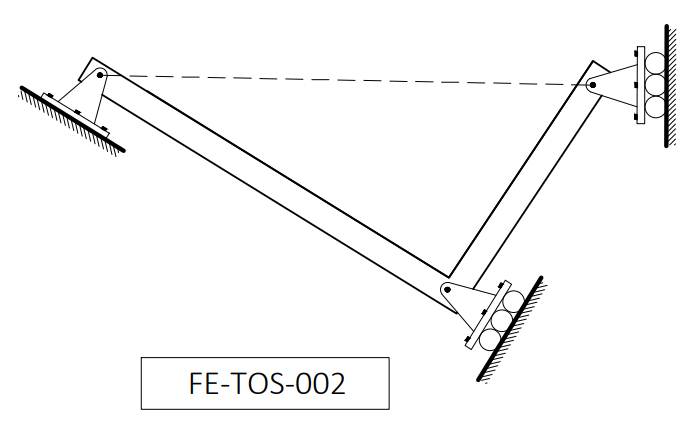
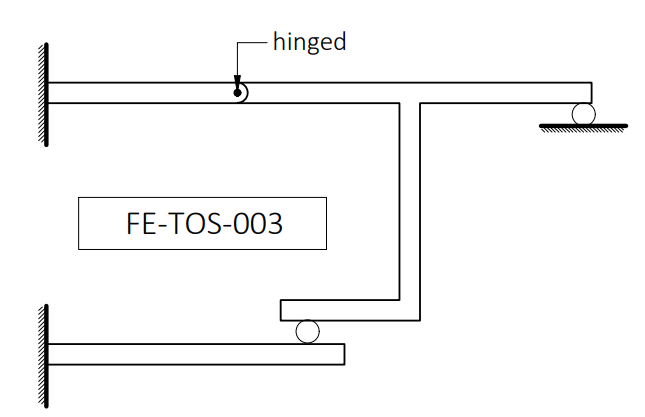
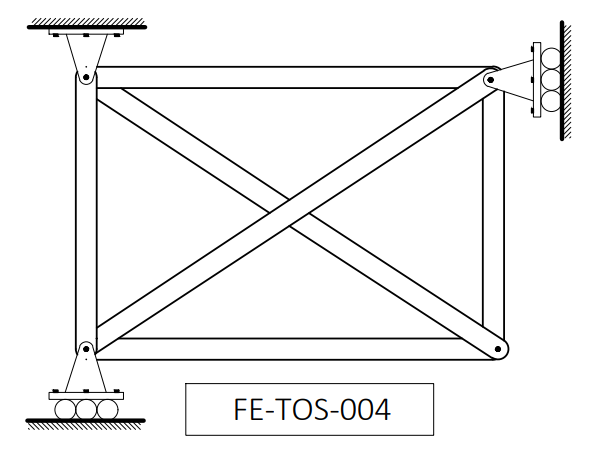
Classify each of the structures based on their determinacy and stability.

q137 q137 q137

Refer to FE-TOS-002

  1. externally unstable
  2. statically determinate
  3. indeterminate to 1º
  4. indeterminate to 2º

Refer to FE-TOS-003

  1. indeterminate to 1º
  2. statically determinate
  3. externally unstable
  4. internally unstable

Refer to FE-TOS-004

  1. externally unstable
  2. statically determinate
  3. indeterminate to 1º
  4. internally unstable
### Stability and determinacy A structure is externally stable only if its support reactions prevent translation in two independent directions and rotation. It is statically determinate when all reaction and internal forces follow from equilibrium alone; otherwise, the number of extra force unknowns is its degree of indeterminacy. 1. In FE-TOS-002, the support reaction directions do not provide three independent restraints for the assembly. A rigid-body motion is possible, so it is $\boxed{\text{externally unstable}}$. 2. In FE-TOS-003, separating the structure at the internal hinge and counting the independent equilibrium equations leaves one redundant reaction. It is $\boxed{\text{indeterminate to }1^\circ}$. 3. In FE-TOS-004, the support reaction arrangement permits a rigid-body motion of the frame. Thus it is $\boxed{\text{externally unstable}}$.

Question Bank: q318

PSAD - Structural Theory / Determinacy and Stability of Structures / Engr. Janclyde Espinosa (Clidez)

Evaluate if the given frame is determinate, indeterminate, or unstable. For indeterminate frames, compute the degree of indeterminacy.

q318

Frame 1:

  1. unstable
  2. determinate
  3. indeterminate to the 1st degree
  4. geometrically unstable

Frame 2:

  1. determinate
  2. unstable
  3. unstable equilibrium
  4. indeterminate to the 2nd degree

Frame 3:

  1. determinate
  2. unstable
  3. indeterminate to the 1st degree
  4. geometrically unstable

Frame 4:

  1. indeterminate to the 6th degree
  2. indeterminate to the 3rd degree
  3. indeterminate to the 2nd degree
  4. indeterminate to the 4th degree
### Determinacy and stability Count independent reaction unknowns, member rigid-body restraints, and any internal hinge releases. - Frame 1 has a mechanism despite its reactions: $\boxed{\text{unstable}}$. - Frame 2 has just enough independent restraints: $\boxed{\text{determinate}}$. - Frame 3 is a cantilever frame with three fixed-support reactions: $\boxed{\text{determinate}}$. - Frame 4 has six excess force unknowns after joint equilibrium is considered: $\boxed{\text{indeterminate to the 6th degree}}$.

Question Bank: q556

PSAD - Structural Theory / Determinacy and Stability of Structures / Engr. Deguma

Classify each of the structures based on their determinacy and stability.

q556 q556 q556

TOS-004

  1. indeterminate to the 2º
  2. indeterminate to the 3º
  3. indeterminate to the 4º
  4. determinate

TOS-005

  1. statically determinate
  2. indeterminate to 1º
  3. externally unstable
  4. internally unstable

TOS-006

  1. indeterminate to 1º
  2. indeterminate to the 3º
  3. indeterminate to the 4º
  4. statically determinate
For a plane structure, compare the number of independent reaction/member unknowns with the available equilibrium equations and also check that the restraints prevent rigid-body motion.

TOS-004: the support and internal constraints supply two redundants, so it is indeterminate to the 2nd degree.

TOS-005: the three roller reactions are independent and sufficient for equilibrium of the rigid frame, so it is statically determinate.

TOS-006: the braced truss has one redundant member/reaction beyond the determinacy condition, so it is indeterminate to the 1st degree.