CE Board Exam Randomizer

⬅ Back to Subject Topics

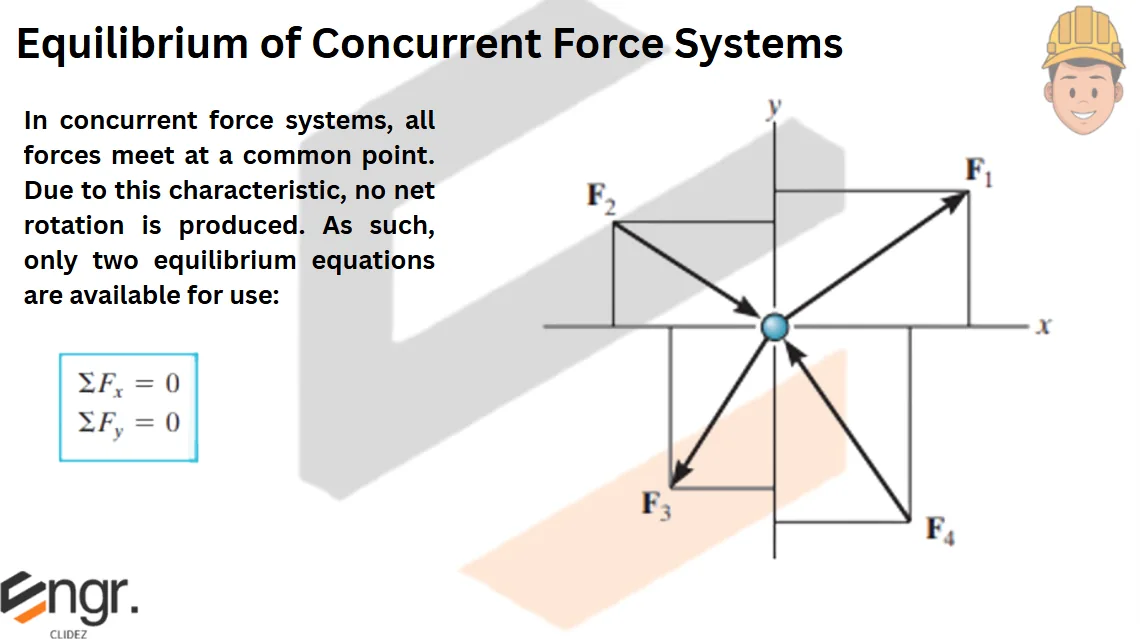
Equilibrium of Concurrent Force Systems
Concept Concept Concept Concept Concept Concept Concept Concept Concept

Problem (Tension in Cables):

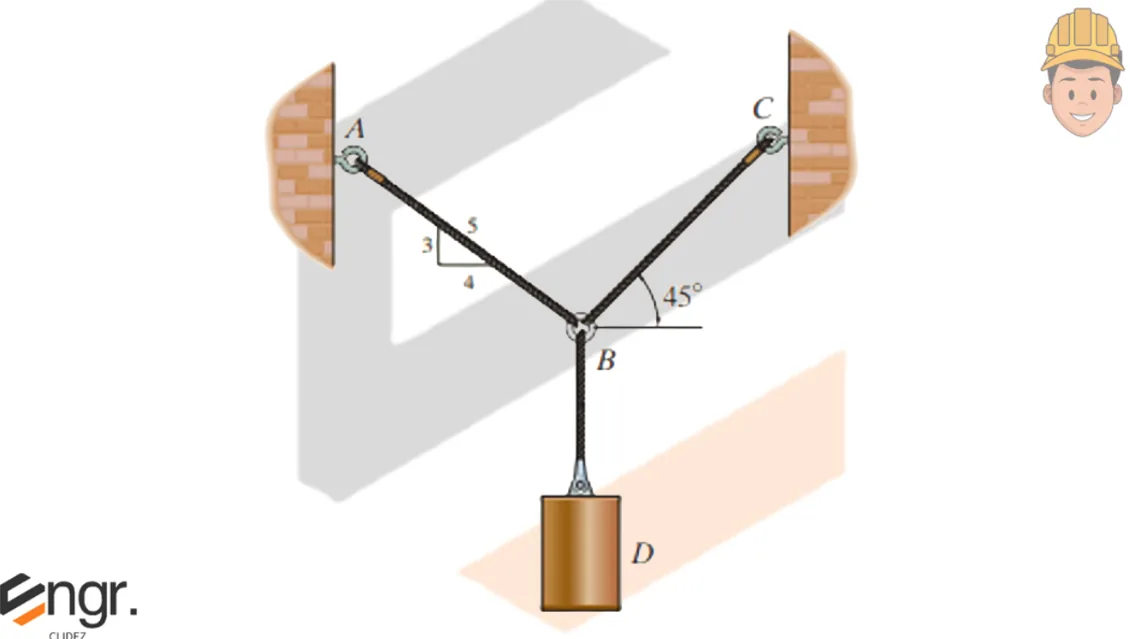
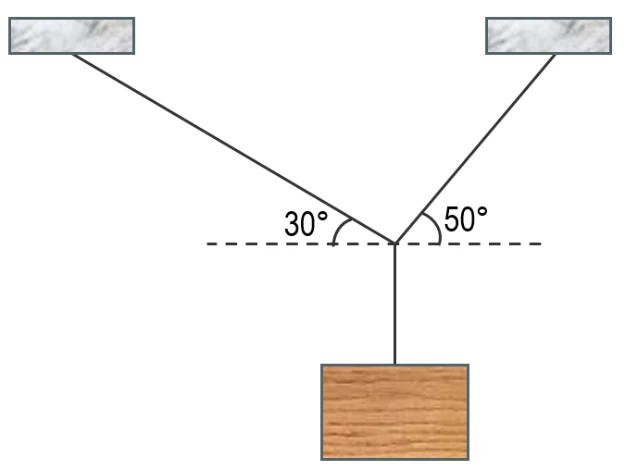
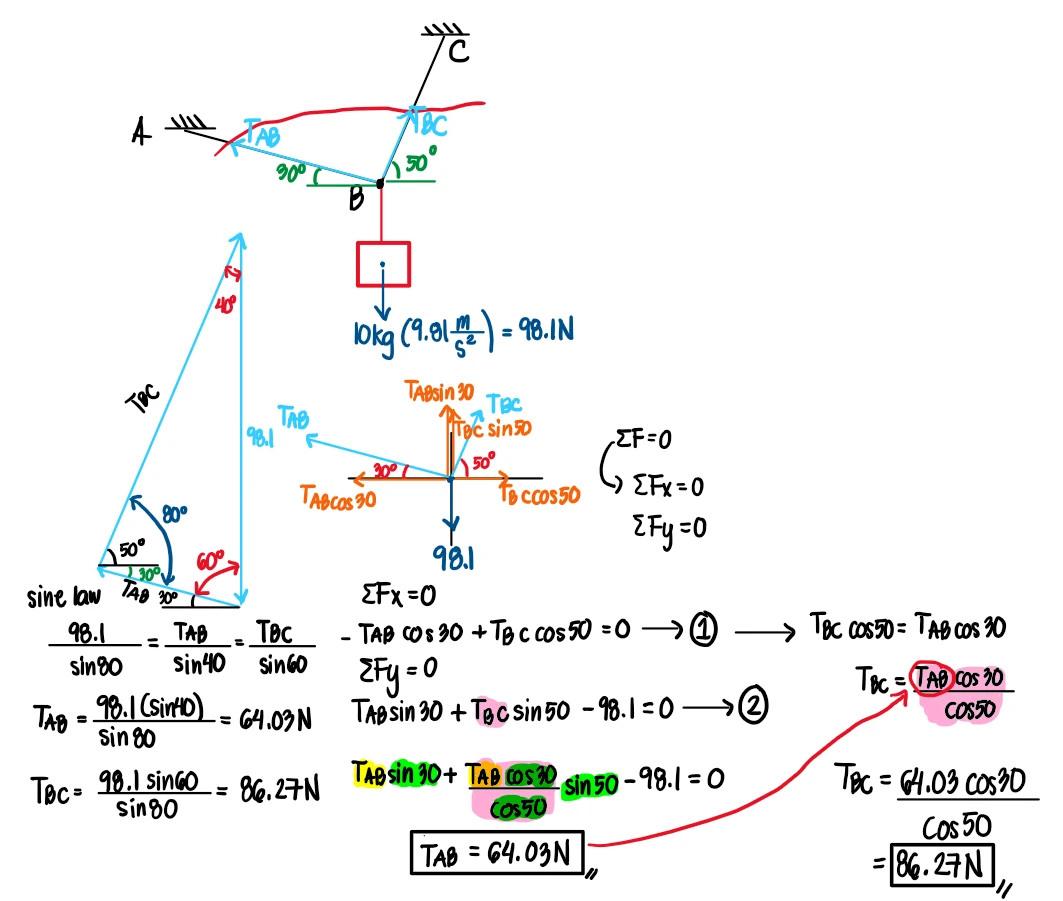
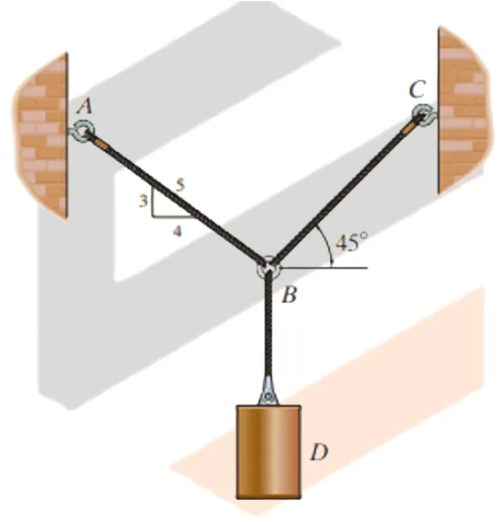
Determine the tension in cables AB and BC necessary to support the 60-kg cylinder.

Equilibrium of Concurrent Force Systems | Statics of Rigid Bodies – Problem 1 (Tension in Cables): – Diagram Equilibrium of Concurrent Force Systems | Statics of Rigid Bodies – Problem 1 (Tension in Cables): – Diagram Equilibrium of Concurrent Force Systems | Statics of Rigid Bodies – Problem 1 (Tension in Cables): – Diagram
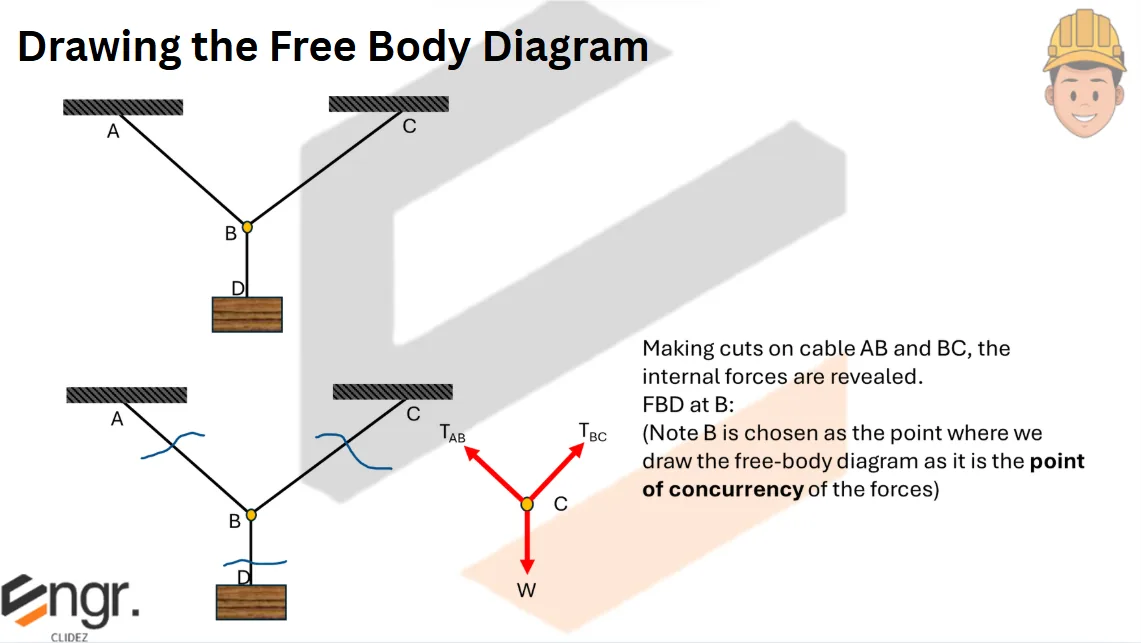
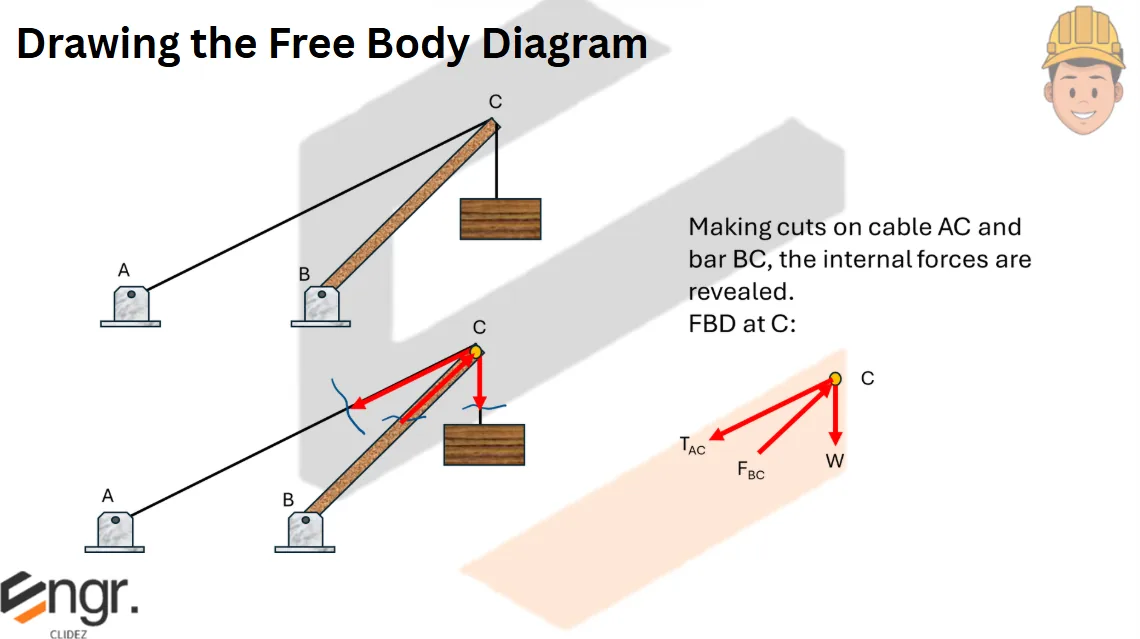
See images:

Equilibrium of Concurrent Force Systems | Statics of Rigid Bodies – Problem 1 (Tension in Cables): – Diagram Equilibrium of Concurrent Force Systems | Statics of Rigid Bodies – Problem 1 (Tension in Cables): – Diagram Equilibrium of Concurrent Force Systems | Statics of Rigid Bodies – Problem 1 (Tension in Cables): – Diagram Equilibrium of Concurrent Force Systems | Statics of Rigid Bodies – Problem 1 (Tension in Cables): – Diagram

Problem (Tension in Cables):

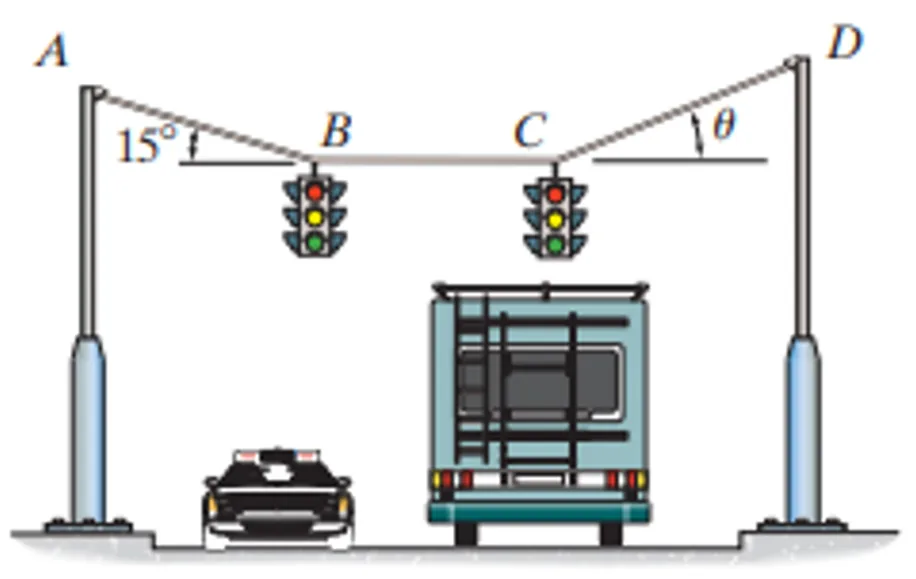
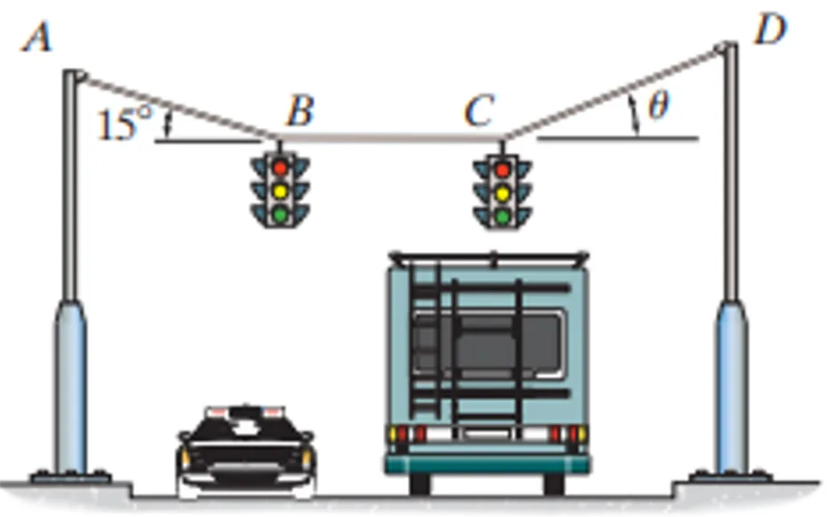
Determine the tension in cables AB, BC, and CD necessary to support the 10-kg and 15-kg traffic lights at B and C, respectively. Also, find the angle θ.

Equilibrium of Concurrent Force Systems | Statics of Rigid Bodies – Problem 2 (Tension in Cables): – Diagram Equilibrium of Concurrent Force Systems | Statics of Rigid Bodies – Problem 2 (Tension in Cables): – Diagram Equilibrium of Concurrent Force Systems | Statics of Rigid Bodies – Problem 2 (Tension in Cables): – Diagram

See images:

Equilibrium of Concurrent Force Systems | Statics of Rigid Bodies – Problem 2 (Tension in Cables): – Diagram Equilibrium of Concurrent Force Systems | Statics of Rigid Bodies – Problem 2 (Tension in Cables): – Diagram Equilibrium of Concurrent Force Systems | Statics of Rigid Bodies – Problem 2 (Tension in Cables): – Diagram Equilibrium of Concurrent Force Systems | Statics of Rigid Bodies – Problem 2 (Tension in Cables): – Diagram

Problem (Tension in Springs):

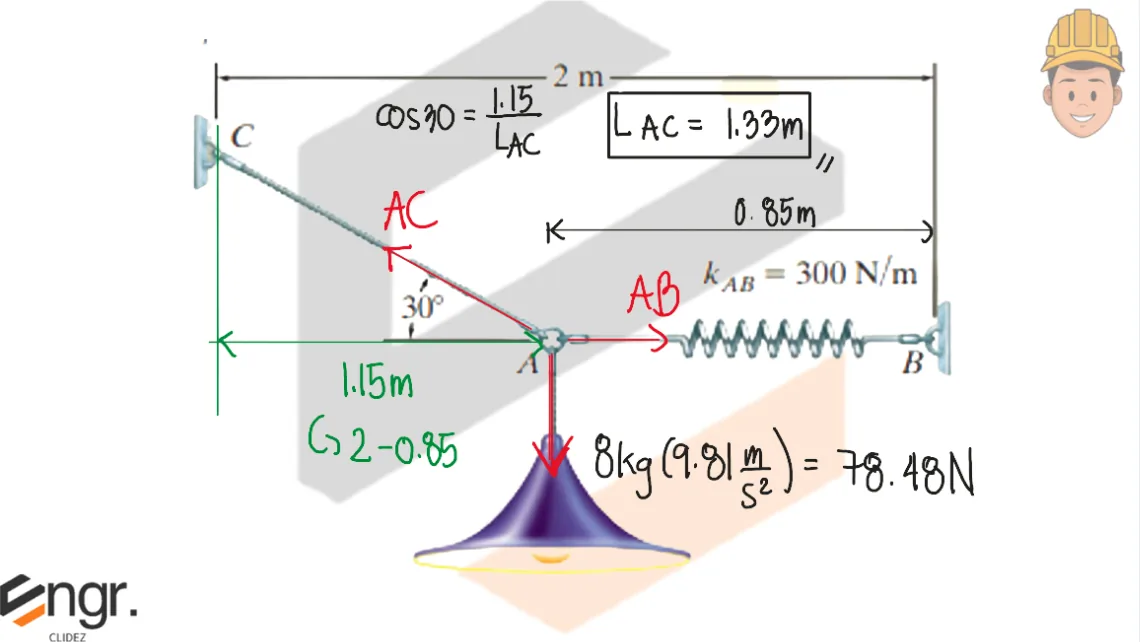
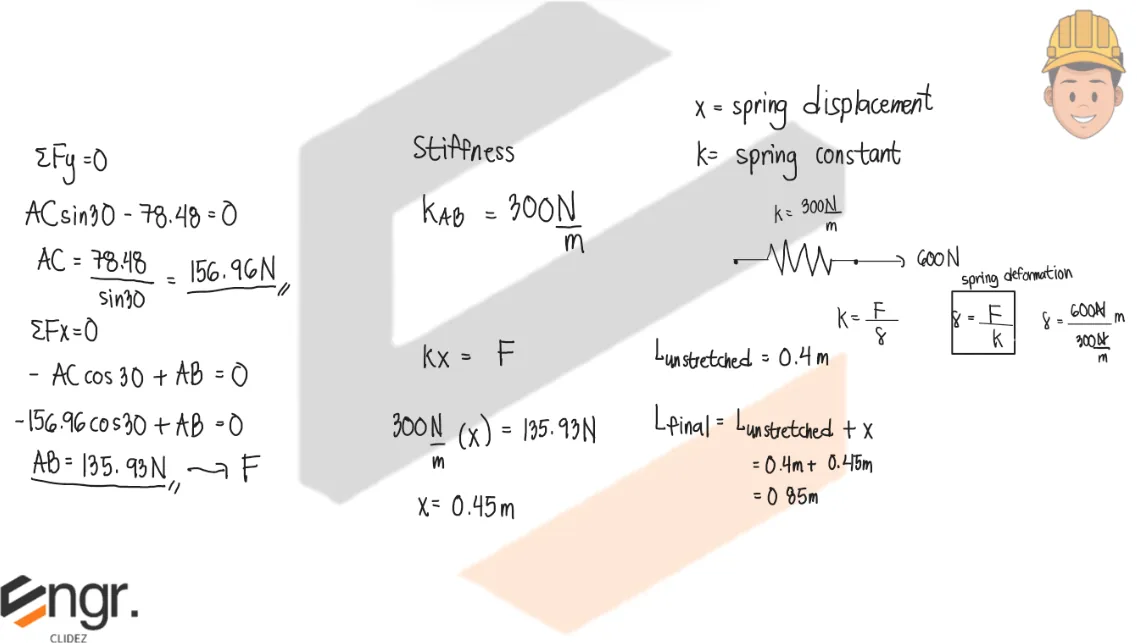
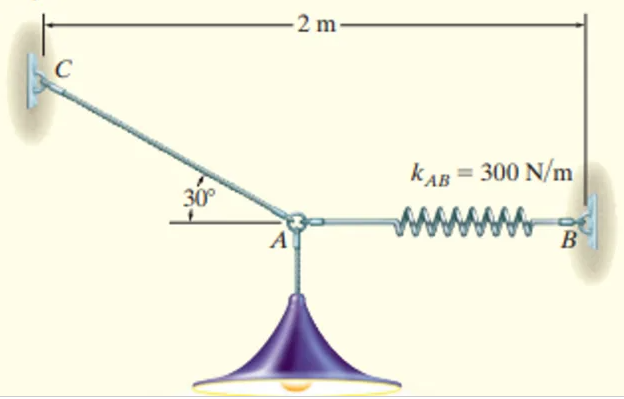
Determine the required length of cord AC so that the 8-kg lamp can be suspended in the position shown. The unstretched length of spring AB is 0.4m, and the spring has a stiffness of kAB=300N/m
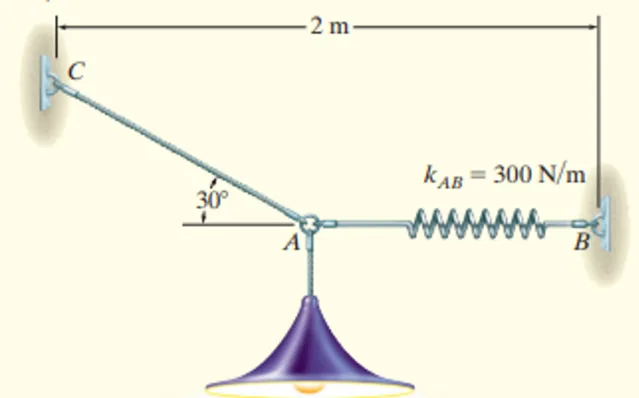
Equilibrium of Concurrent Force Systems | Statics of Rigid Bodies – Problem 3 (Tension in Springs): – Diagram Equilibrium of Concurrent Force Systems | Statics of Rigid Bodies – Problem 3 (Tension in Springs): – Diagram Equilibrium of Concurrent Force Systems | Statics of Rigid Bodies – Problem 3 (Tension in Springs): – Diagram

See images:

Equilibrium of Concurrent Force Systems | Statics of Rigid Bodies – Problem 3 (Tension in Springs): – Diagram Equilibrium of Concurrent Force Systems | Statics of Rigid Bodies – Problem 3 (Tension in Springs): – Diagram Equilibrium of Concurrent Force Systems | Statics of Rigid Bodies – Problem 3 (Tension in Springs): – Diagram Equilibrium of Concurrent Force Systems | Statics of Rigid Bodies – Problem 3 (Tension in Springs): – Diagram

Problem:

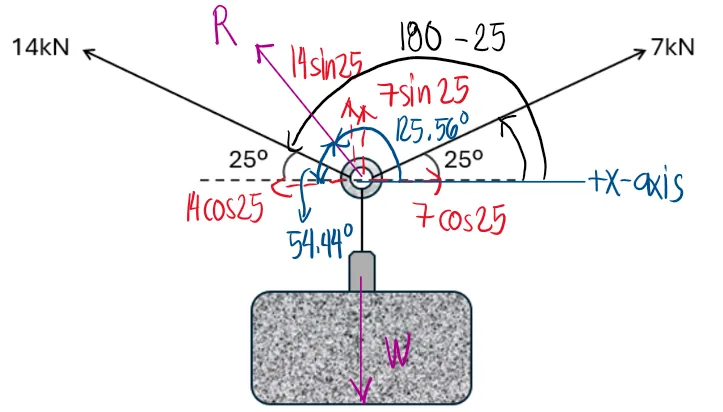
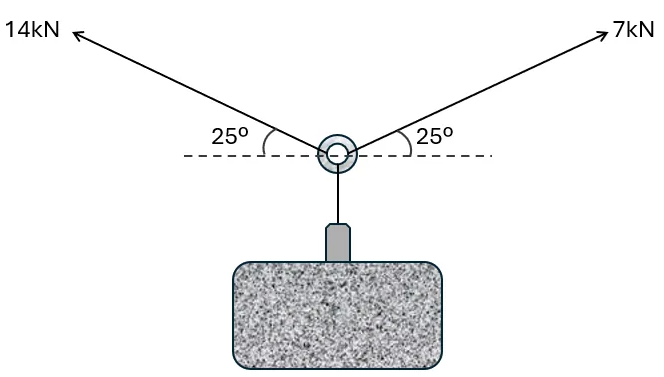
A concrete block of weight W holds a ring anchor bolt fastened to two guy wires as shown.
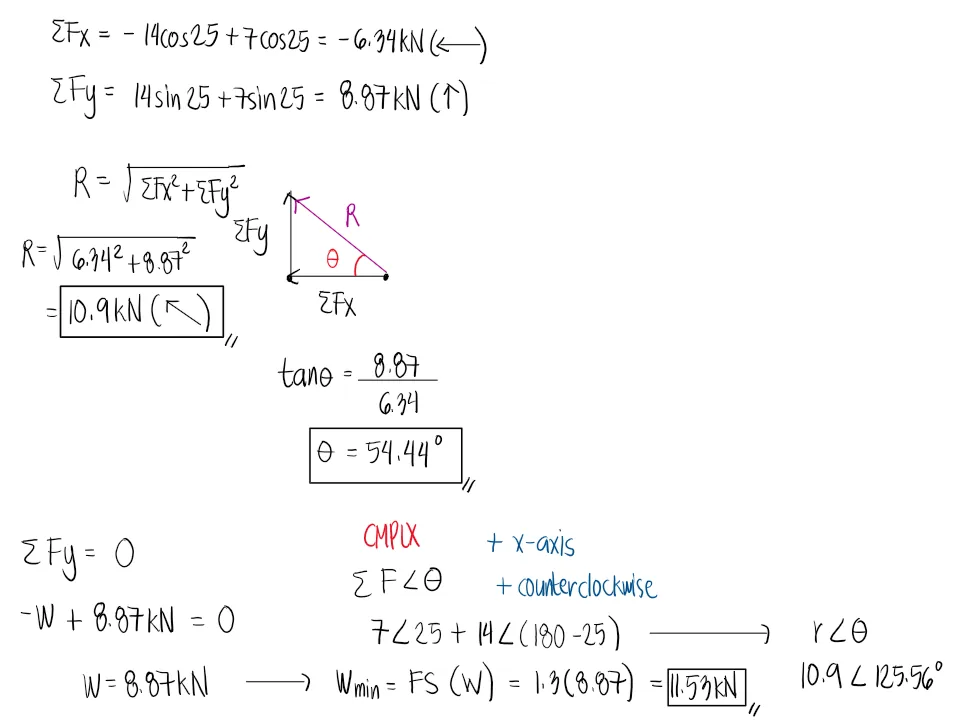
1. Calculate the resultant force acting on the bolt.
2. Determine the angle which the resultant pull makes with the horizontal.
3. To prevent uplift, what is the minimum weight of the concrete block W if the required factor of safety is 1.3?
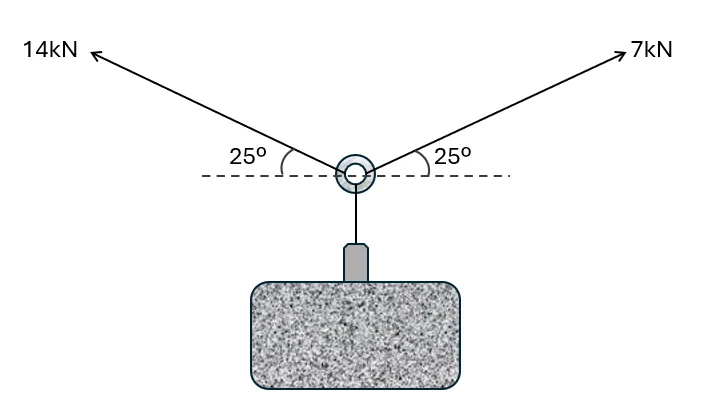
Equilibrium of Concurrent Force Systems | Statics of Rigid Bodies – Problem 4: – Diagram Equilibrium of Concurrent Force Systems | Statics of Rigid Bodies – Problem 4: – Diagram Equilibrium of Concurrent Force Systems | Statics of Rigid Bodies – Problem 4: – Diagram

See images:

Equilibrium of Concurrent Force Systems | Statics of Rigid Bodies – Problem 4: – Diagram Equilibrium of Concurrent Force Systems | Statics of Rigid Bodies – Problem 4: – Diagram Equilibrium of Concurrent Force Systems | Statics of Rigid Bodies – Problem 4: – Diagram Equilibrium of Concurrent Force Systems | Statics of Rigid Bodies – Problem 4: – Diagram

Problem:

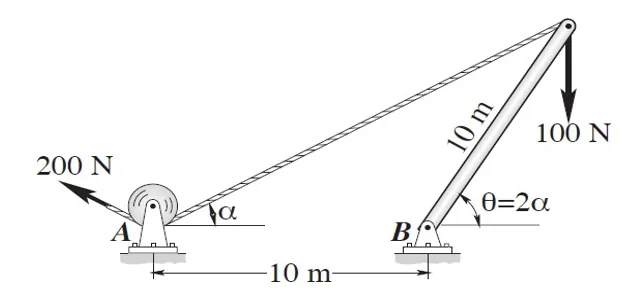
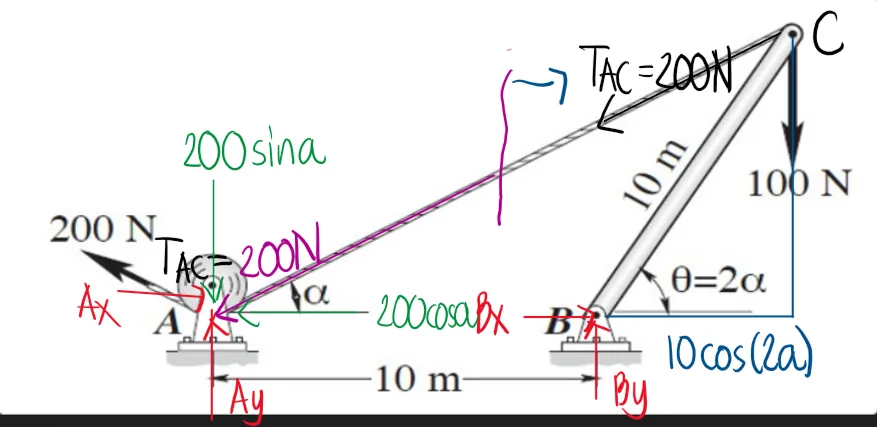
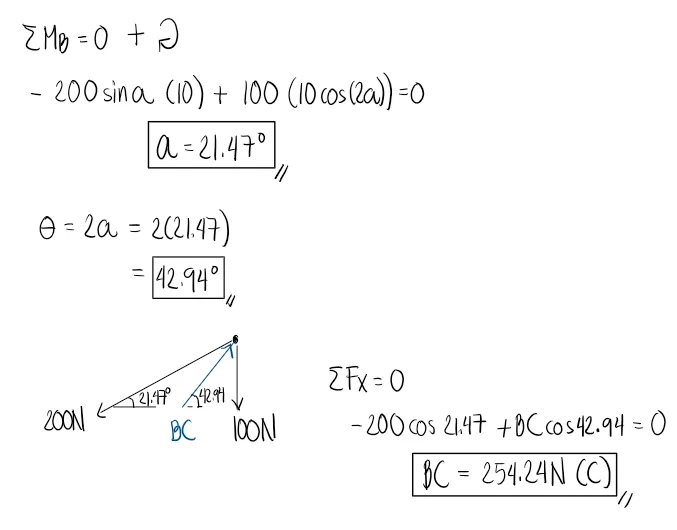
A boom supports a 100N load as shown below. If the tension in the cable is 200N,
1. Find the angle α.
2. Find the angle θ.
3. Find the force in the boom.

Equilibrium of Concurrent Force Systems | Statics of Rigid Bodies – Problem 5: – Diagram Equilibrium of Concurrent Force Systems | Statics of Rigid Bodies – Problem 5: – Diagram Equilibrium of Concurrent Force Systems | Statics of Rigid Bodies – Problem 5: – Diagram

See images:

Equilibrium of Concurrent Force Systems | Statics of Rigid Bodies – Problem 5: – Diagram Equilibrium of Concurrent Force Systems | Statics of Rigid Bodies – Problem 5: – Diagram Equilibrium of Concurrent Force Systems | Statics of Rigid Bodies – Problem 5: – Diagram Equilibrium of Concurrent Force Systems | Statics of Rigid Bodies – Problem 5: – Diagram

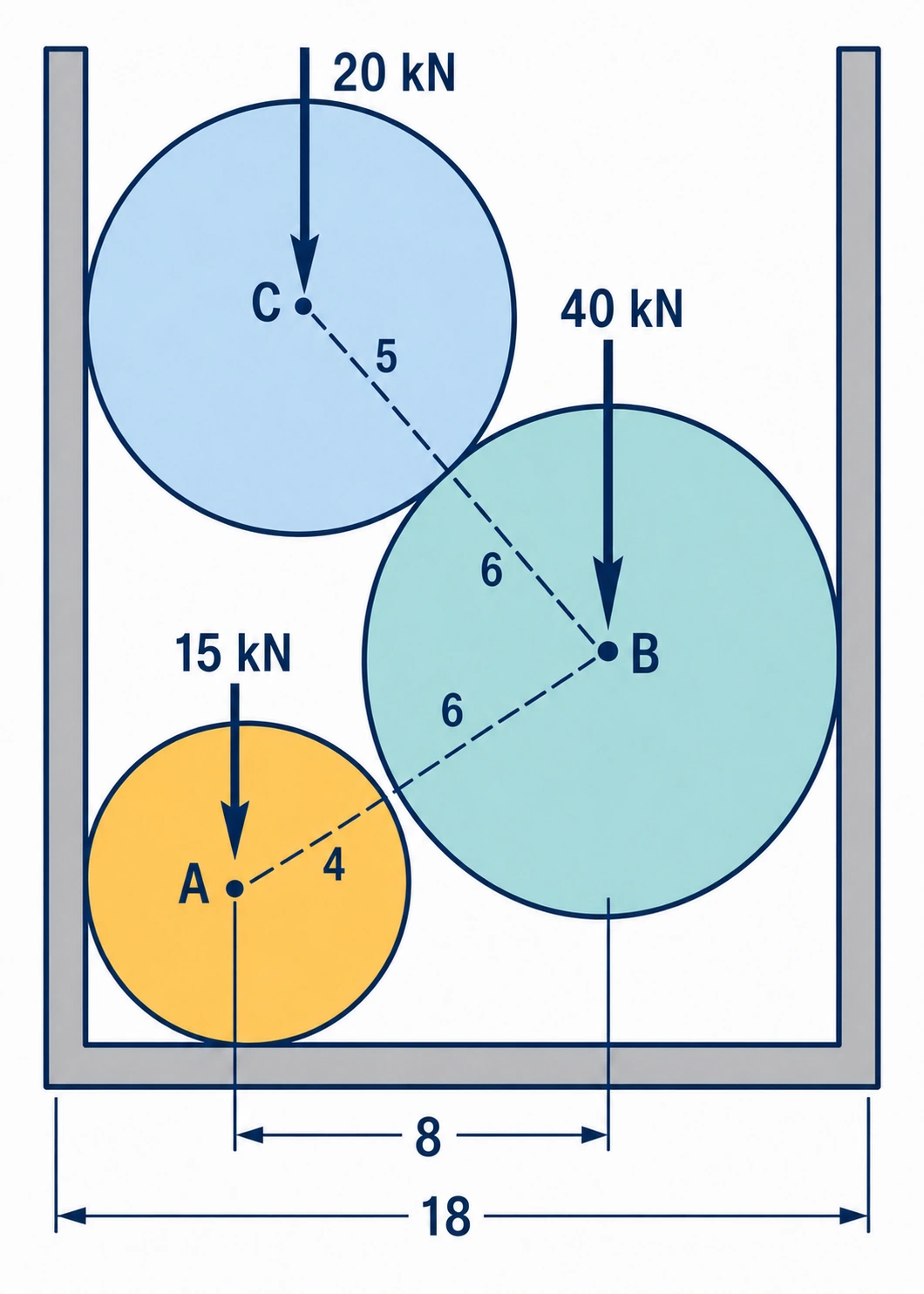
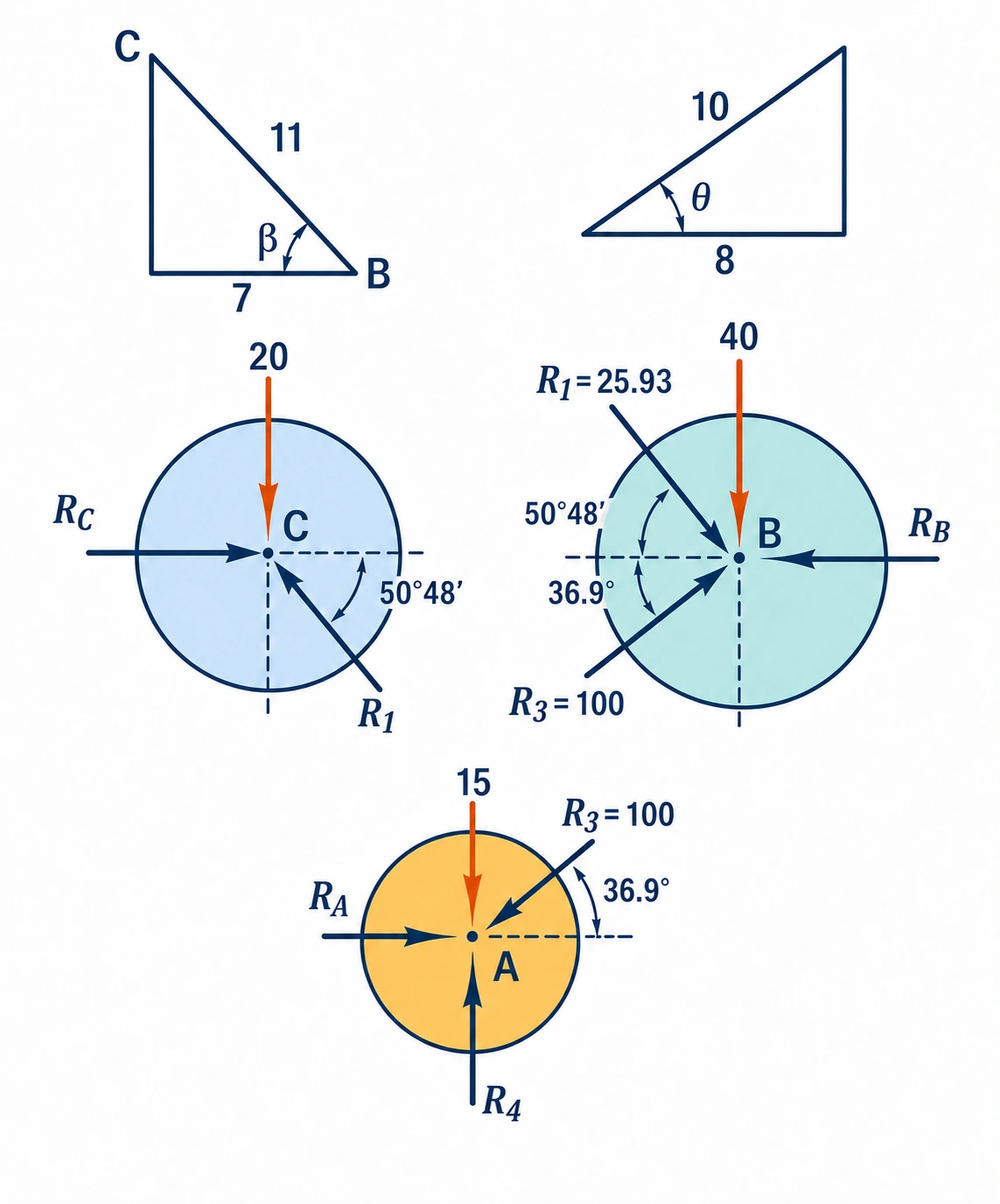
Problem:

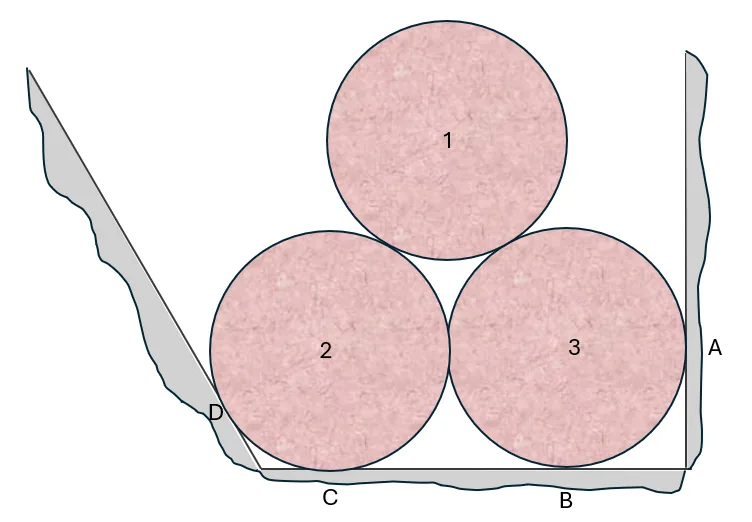
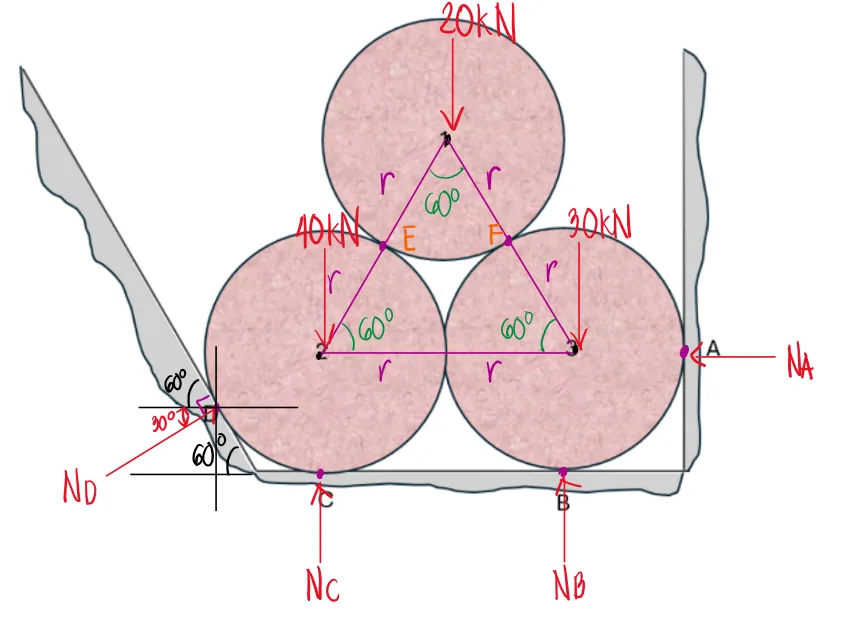
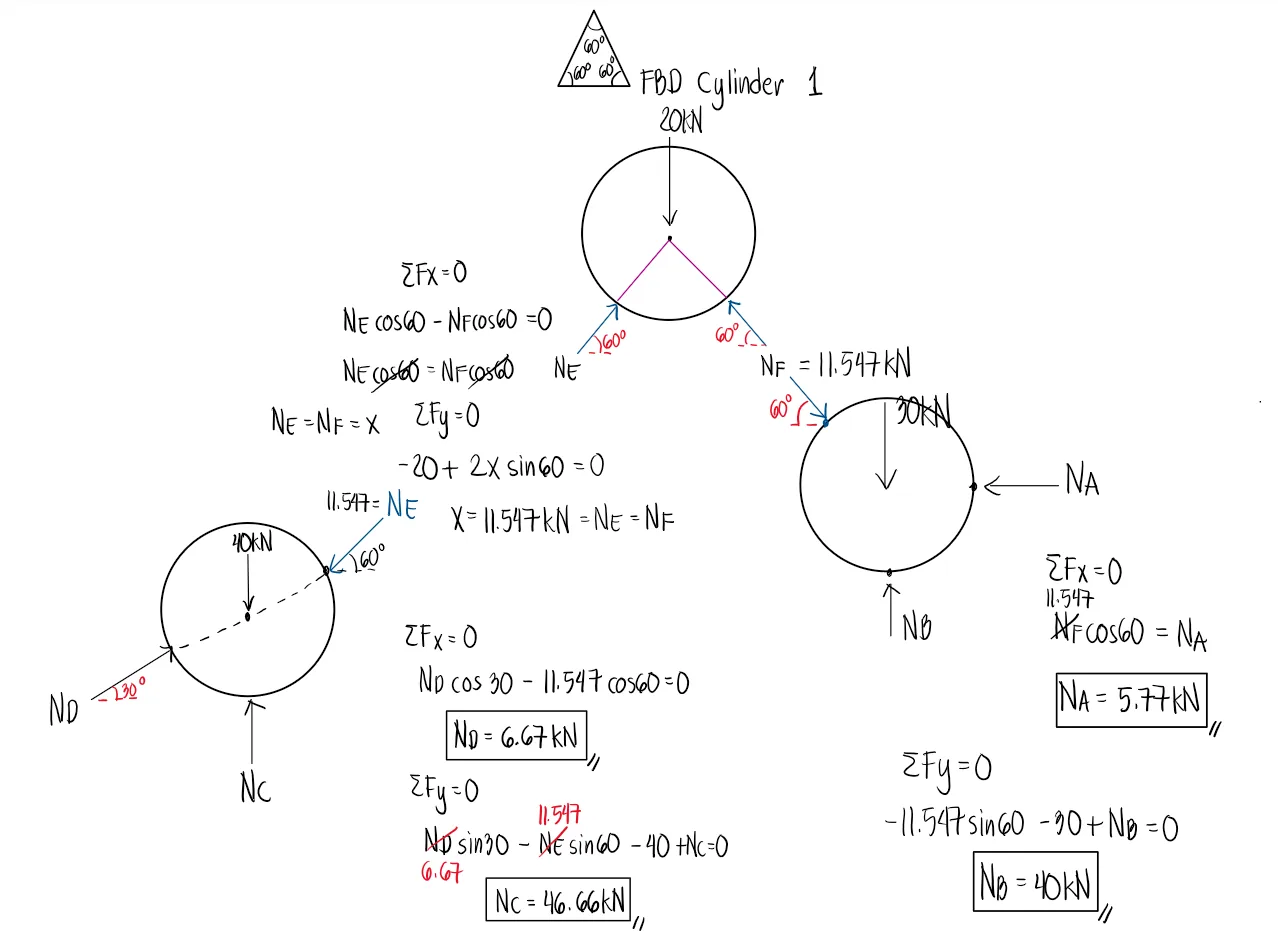
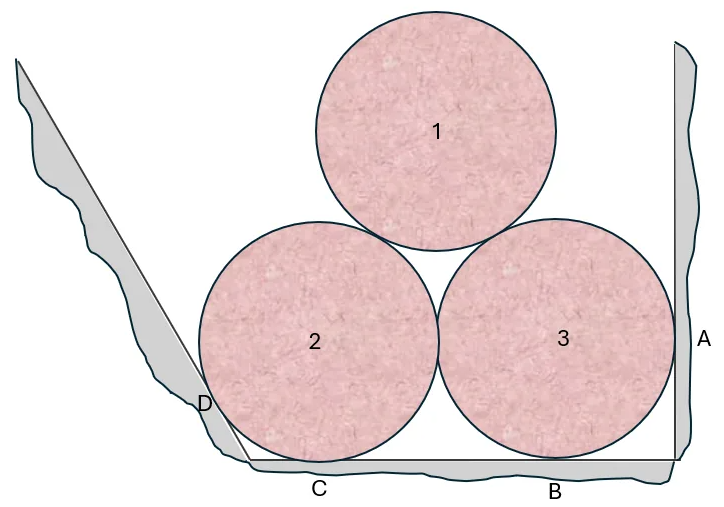
Refer to the image shown. Cylinder 1 weighs 20kN, cylinder 2 weighs 40kN, and cylinder 3 weighs 30kN. The surface along point D is inclined 60º with the horizontal.
1. Determine the reaction at A.
2. Determine the reaction at D.
3. Determine the reaction at C.

Equilibrium of Concurrent Force Systems | Statics of Rigid Bodies – Problem 6: – Diagram Equilibrium of Concurrent Force Systems | Statics of Rigid Bodies – Problem 6: – Diagram Equilibrium of Concurrent Force Systems | Statics of Rigid Bodies – Problem 6: – Diagram

See images:

Equilibrium of Concurrent Force Systems | Statics of Rigid Bodies – Problem 6: – Diagram Equilibrium of Concurrent Force Systems | Statics of Rigid Bodies – Problem 6: – Diagram Equilibrium of Concurrent Force Systems | Statics of Rigid Bodies – Problem 6: – Diagram Equilibrium of Concurrent Force Systems | Statics of Rigid Bodies – Problem 6: – Diagram

Problem:

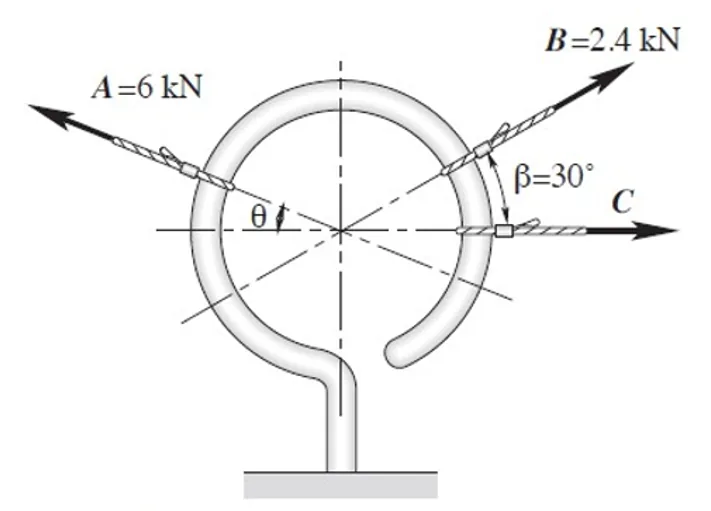
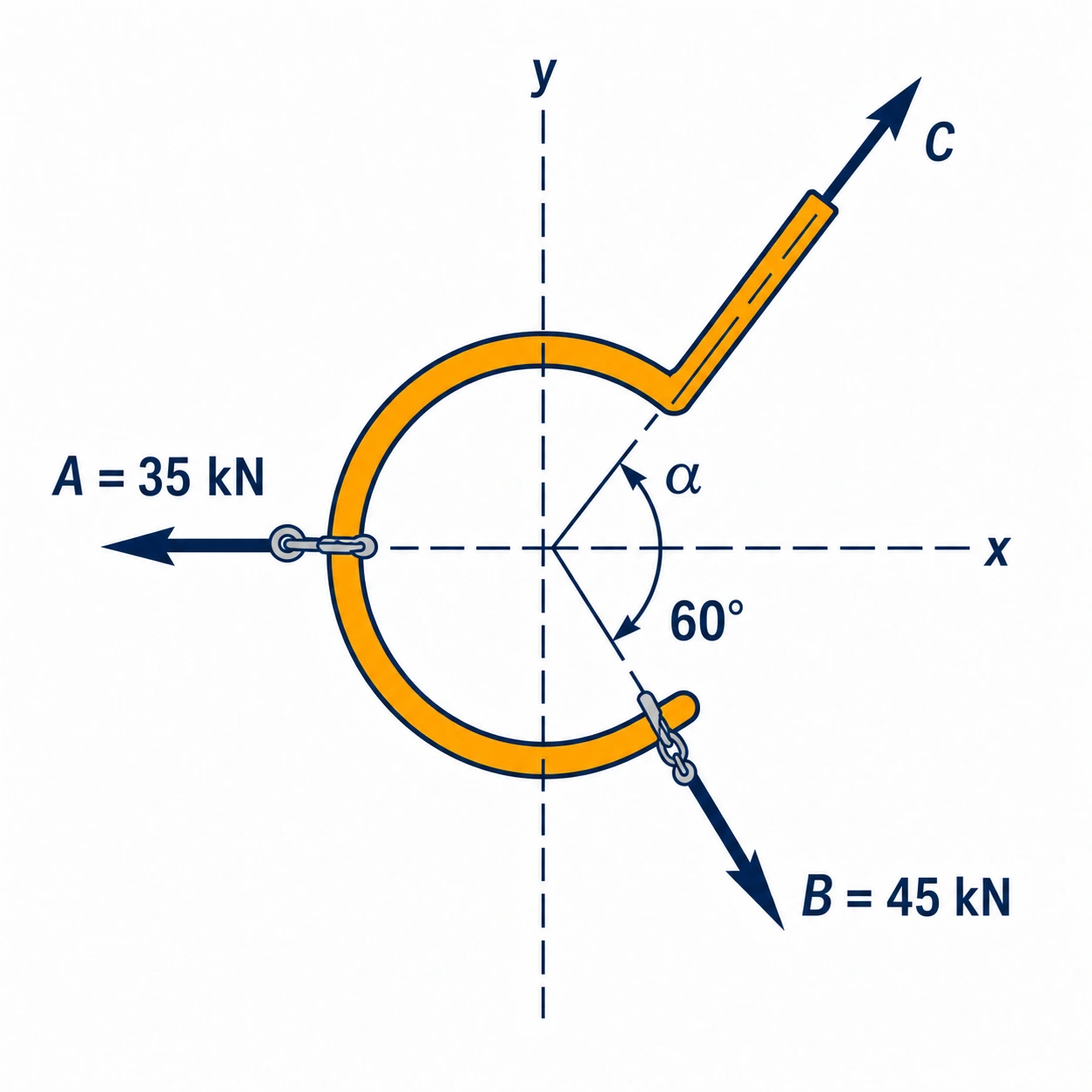
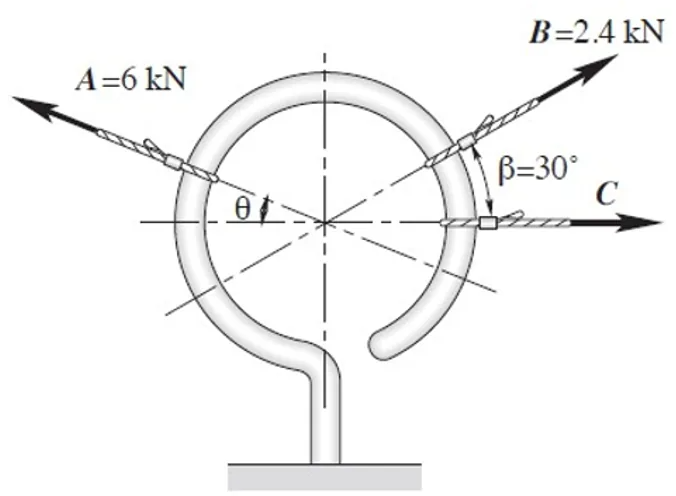
Force A = 6kN
Force B = 2.4kN
Angle β = 30°
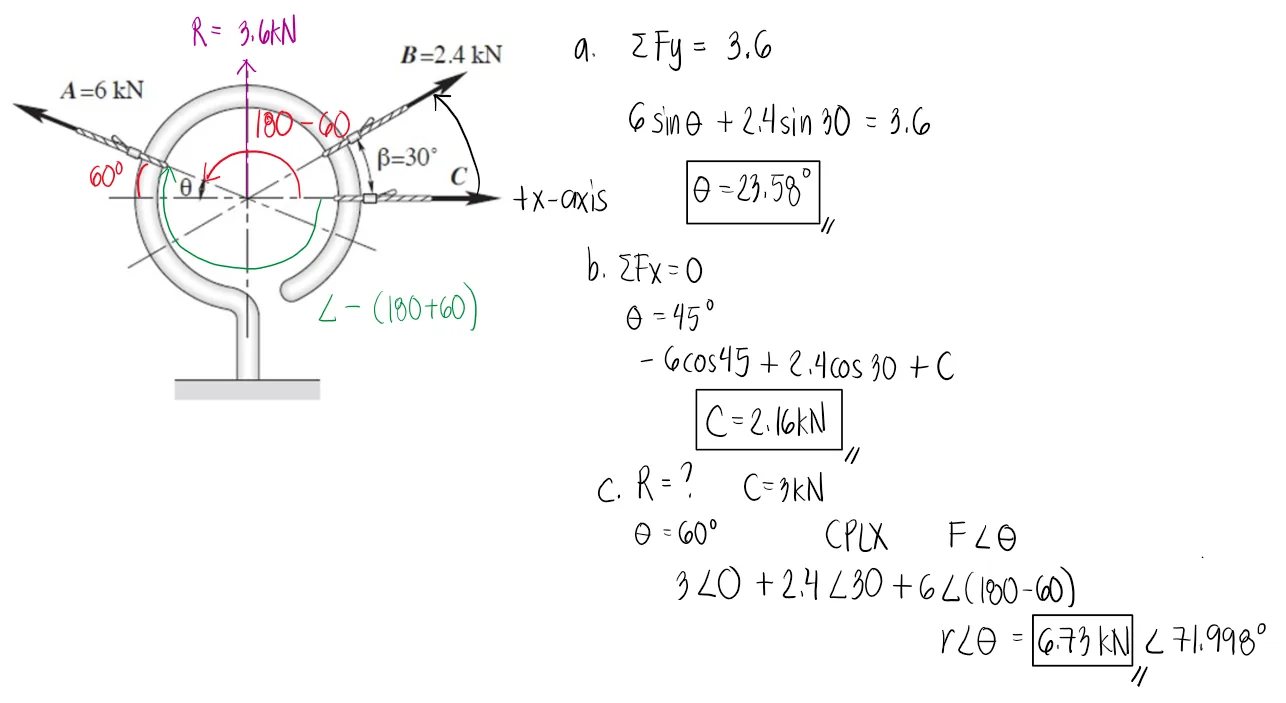
1. The resultant of the three forces, A, B, and C is 3.6kN and it acts along the y-axis. What is the angle θ?
2. If the resultant of the three forces A, B, and C is 5.4kN and it acts along the y-axis, what is the value of C if θ=45°?
3. If the angle θ=60° and the force C = 3kN, how much is the resultant pulling force on the eyebolt?

Equilibrium of Concurrent Force Systems | Statics of Rigid Bodies – Problem 7: – Diagram Equilibrium of Concurrent Force Systems | Statics of Rigid Bodies – Problem 7: – Diagram Equilibrium of Concurrent Force Systems | Statics of Rigid Bodies – Problem 7: – Diagram

See images:

Equilibrium of Concurrent Force Systems | Statics of Rigid Bodies – Problem 7: – Diagram Equilibrium of Concurrent Force Systems | Statics of Rigid Bodies – Problem 7: – Diagram Equilibrium of Concurrent Force Systems | Statics of Rigid Bodies – Problem 7: – Diagram Equilibrium of Concurrent Force Systems | Statics of Rigid Bodies – Problem 7: – Diagram

Problem:

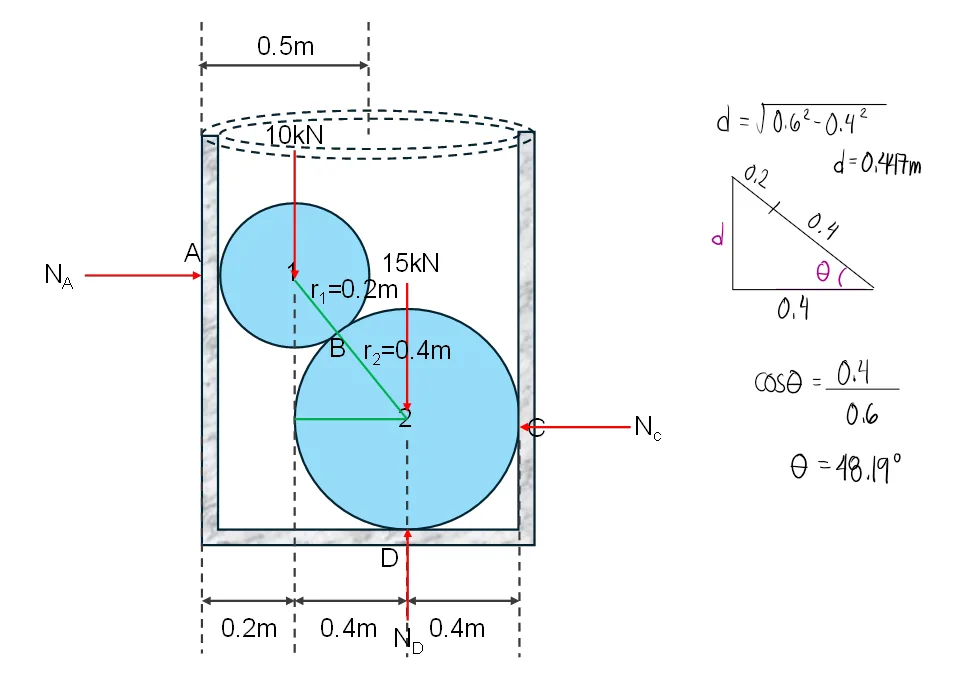
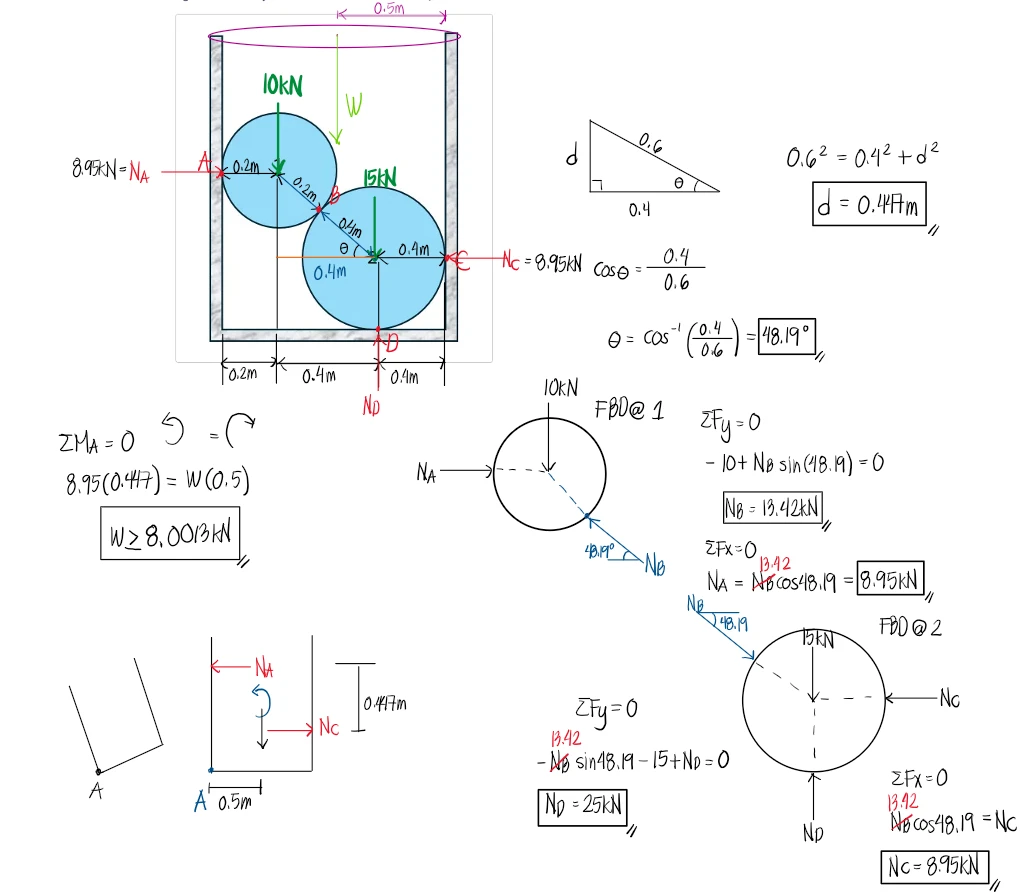
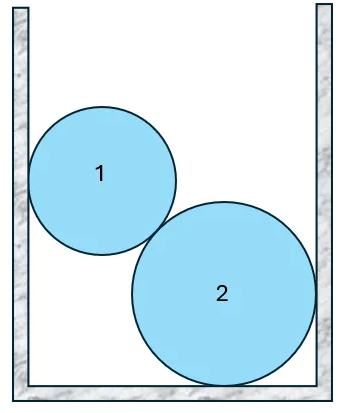
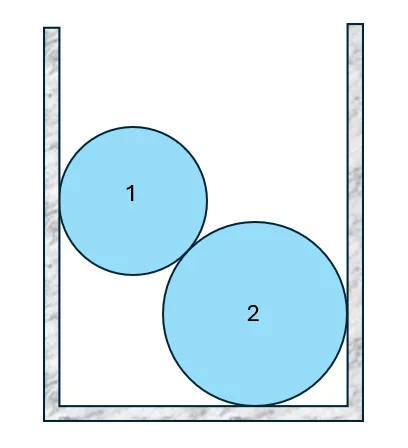
A hollow right circular cylinder of radius 0.5m is open at both ends and rests on a smooth horizontal plane. Inside the cylinder are two spheres having weights w1=10kN and w2=15kN and radius r1=0.20m and r2=0.40m, respectively, as shown. Neglect friction.
a. Determine the horizontal reaction of w1 on the side of the cylinder.
b. Determine the vertical reaction of w2 at the horizontal plane.
c. Determine the minimum weight Q of the cylinder in order for it not to tip over.

Equilibrium of Concurrent Force Systems | Statics of Rigid Bodies – Problem 8: – Diagram Equilibrium of Concurrent Force Systems | Statics of Rigid Bodies – Problem 8: – Diagram Equilibrium of Concurrent Force Systems | Statics of Rigid Bodies – Problem 8: – Diagram

See images:

Equilibrium of Concurrent Force Systems | Statics of Rigid Bodies – Problem 8: – Diagram Equilibrium of Concurrent Force Systems | Statics of Rigid Bodies – Problem 8: – Diagram Equilibrium of Concurrent Force Systems | Statics of Rigid Bodies – Problem 8: – Diagram Equilibrium of Concurrent Force Systems | Statics of Rigid Bodies – Problem 8: – Diagram

Problem:

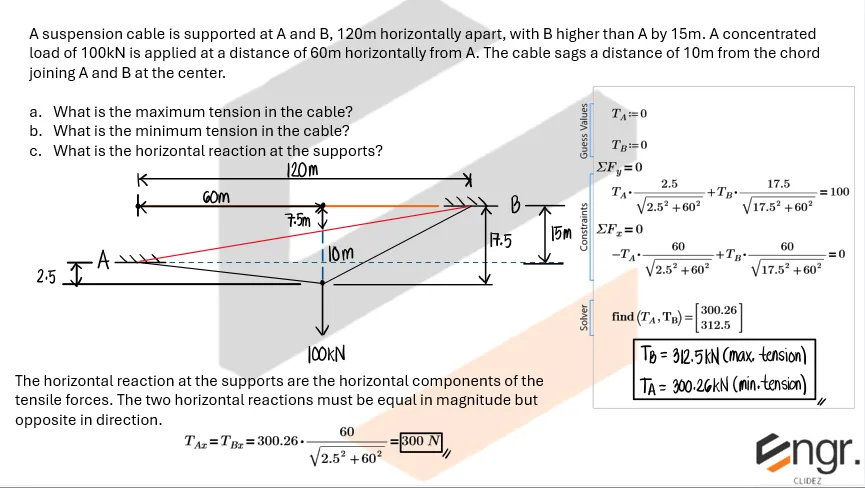
A suspension cable is supported at A and B, 120m horizontally apart, with B higher than A by 15m. A concentrated load of 100kN is applied at a distance of 60m horizontally from A. The cable sags a distance of 10m from the chord joining A and B at the center.

a. What is the maximum tension in the cable?
b. What is the minimum tension in the cable?
c. What is the horizontal reaction at the supports?

See images:

Equilibrium of Concurrent Force Systems | Statics of Rigid Bodies – Problem 9: – Diagram

Problem:

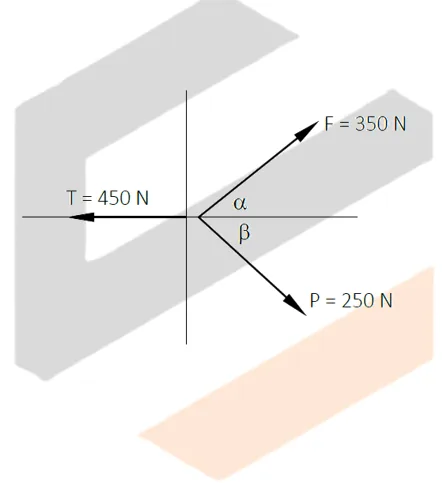
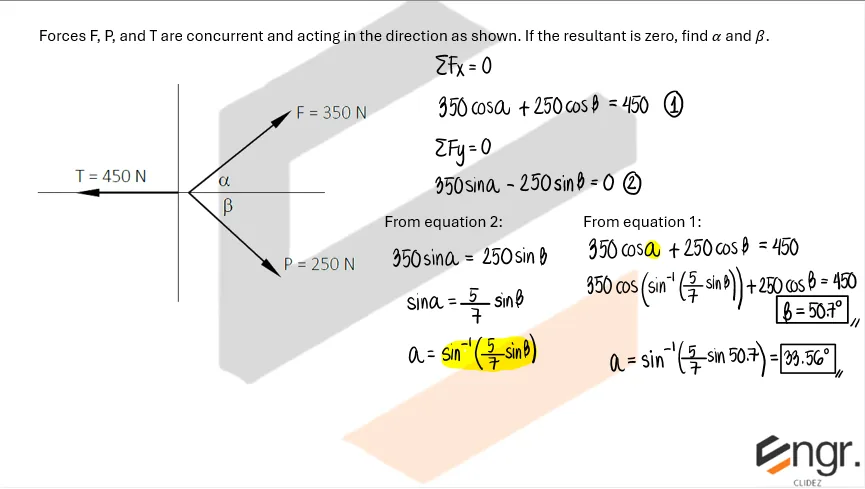
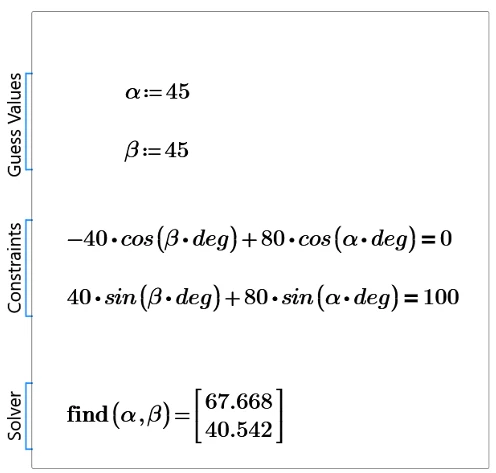
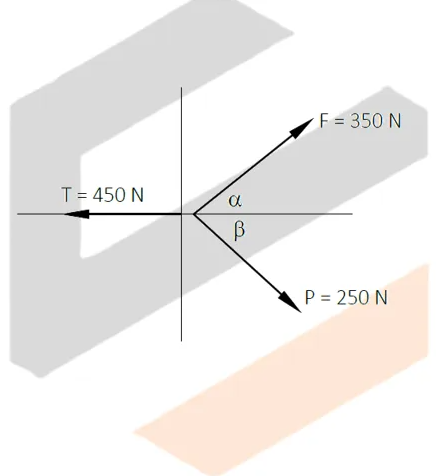
Forces F, P, and T are concurrent and acting in the direction as shown. If the resultant is zero, find α and β.

Equilibrium of Concurrent Force Systems | Statics of Rigid Bodies – Problem 10: – Diagram

See images:

Equilibrium of Concurrent Force Systems | Statics of Rigid Bodies – Problem 10: – Diagram

Problem:

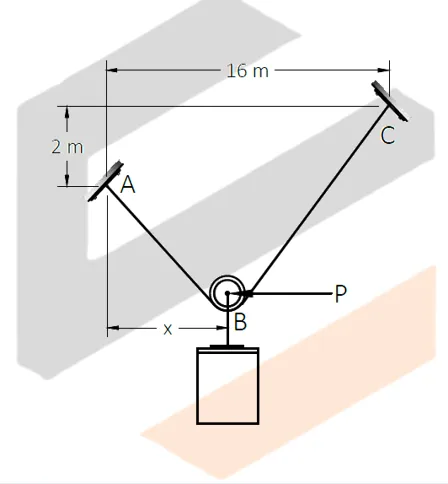
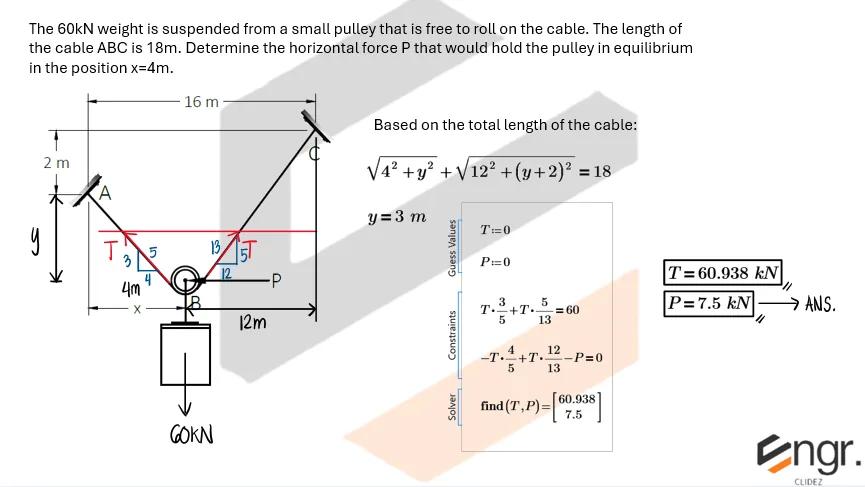
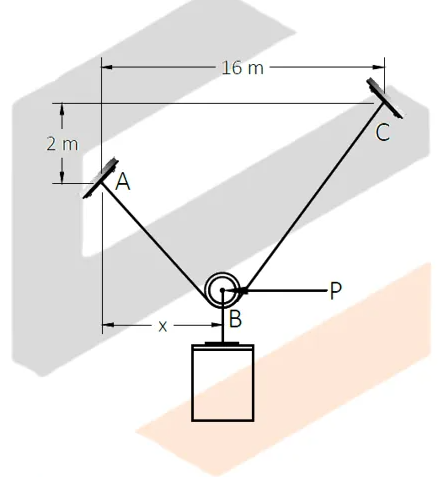
The 60kN weight is suspended from a small pulley that is free to roll on the cable. The length of the cable ABC is 18m. Determine the horizontal force P that would hold the pulley in equilibrium in the position x=4m.

Equilibrium of Concurrent Force Systems | Statics of Rigid Bodies – Problem 11: – Diagram

Problem: Force to Raise a Cylindrical Tank Against a Block

The cylindrical tank shown weighs 100kN. What horizontal force should be applied horizontally at C to raise the tank?

Problem (Two-cable ring equilibrium):

A 1.20kN load is suspended from a ring supported by two cables. Cable AB is inclined 30° above the horizontal to the left, while cable AC is inclined 60° above the horizontal to the right. Find the cable tensions.

At the ring, apply horizontal and vertical equilibrium.

\[ \begin{aligned} \sum F_x=0:\quad T_{AC}\cos60^\circ &= T_{AB}\cos30^\circ \\ T_{AC} &= 1.732T_{AB} \\ \sum F_y=0:\quad T_{AB}\sin30^\circ+T_{AC}\sin60^\circ &= 1.20 \\ T_{AB} &= 0.600\ \text{kN},\quad T_{AC}=1.04\ \text{kN} \end{aligned} \] $\boxed{T_{AB}=0.600\ \text{kN}},\qquad \boxed{T_{AC}=1.04\ \text{kN}}$

Problem (Horizontal reaction with an inclined cable):

A 900N lamp is held by an inclined cable at 40° above the horizontal and a horizontal strut. Determine the cable tension and the horizontal force in the strut.

The inclined cable supplies the vertical component needed to balance the weight.

\[ \begin{aligned} T\sin40^\circ &= 900 \\ T &= 1400\ \text{N} \\ H &= T\cos40^\circ=1073\ \text{N} \end{aligned} \] $\boxed{T=1400\ \text{N}},\qquad \boxed{H=1073\ \text{N}}$

Problem (Three-force concurrent equilibrium):

A ring is pulled by a 600N downward load. Force P acts 25° above the horizontal to the left, and force Q acts 55° above the horizontal to the right. Determine P and Q for equilibrium.

Resolve all forces at the ring.

\[ \begin{aligned} \sum F_x=0:\quad Q\cos55^\circ &= P\cos25^\circ \\ Q &= 1.58P \\ \sum F_y=0:\quad P\sin25^\circ+Q\sin55^\circ &= 600 \\ P &= 349\ \text{N},\quad Q=552\ \text{N} \end{aligned} \] $\boxed{P=349\ \text{N}},\qquad \boxed{Q=552\ \text{N}}$
Scroll to zoom

Exam Generator Problems

Additional board-style practice items for this topic.

Question Bank: q517

PSAD - Statics / Equilibrium of Concurrent Force Systems / Engr. Janclyde Espinosa (Clidez)

The cables AB and BC carry a 60-kg cylinder as shown.

q517

Determine the tension in cable AB in Newtons.

  1. 420.43
  2. 475.83
  3. 588.60
  4. 294.30

Determine the tension in cable BC in Newtons.

  1. 475.83
  2. 420.43
  3. 294.30
  4. 588.60

Part 1.

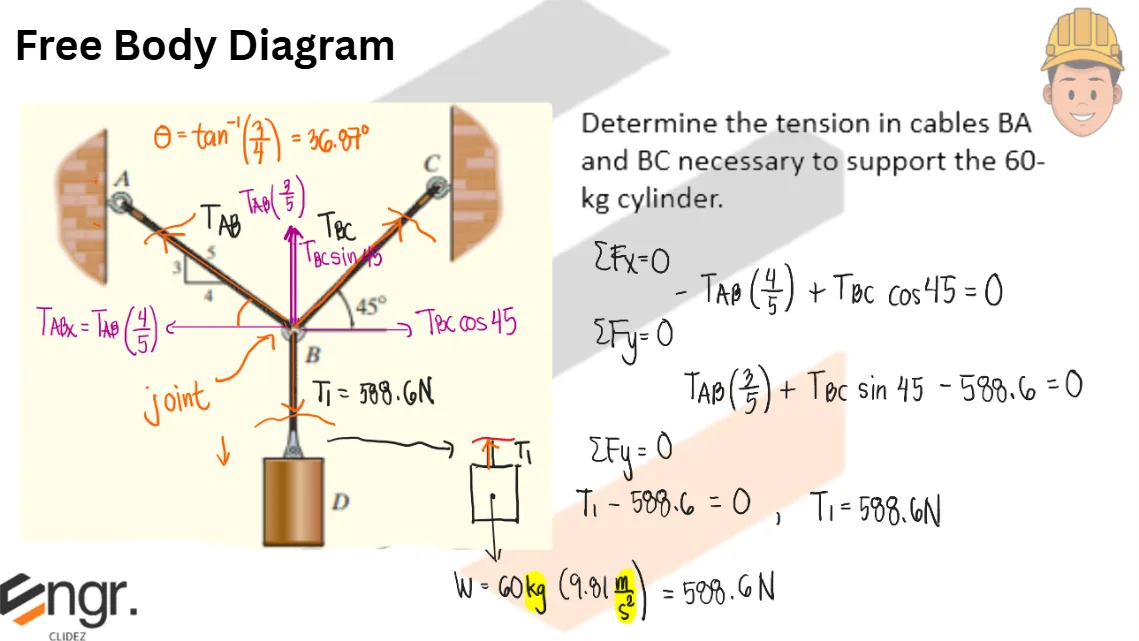
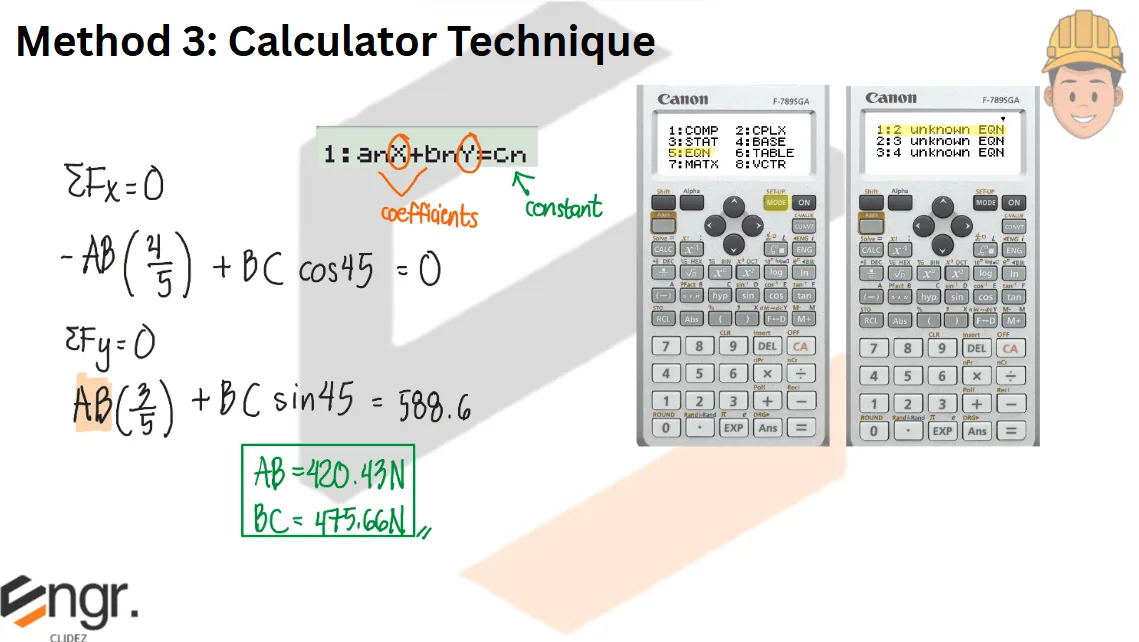
At joint B, the cylinder weight is $W = 60(9.81) = 588.6$ N. Cable AB has a 3-4-5 direction, so its components are $\frac{4}{5}T_{AB}$ left and $\frac{3}{5}T_{AB}$ up.
$\Sigma F_x=0:\ -\frac{4}{5}T_{AB}+T_{BC}\cos45^\circ=0$
$\Sigma F_y=0:\ \frac{3}{5}T_{AB}+T_{BC}\sin45^\circ-588.6=0$
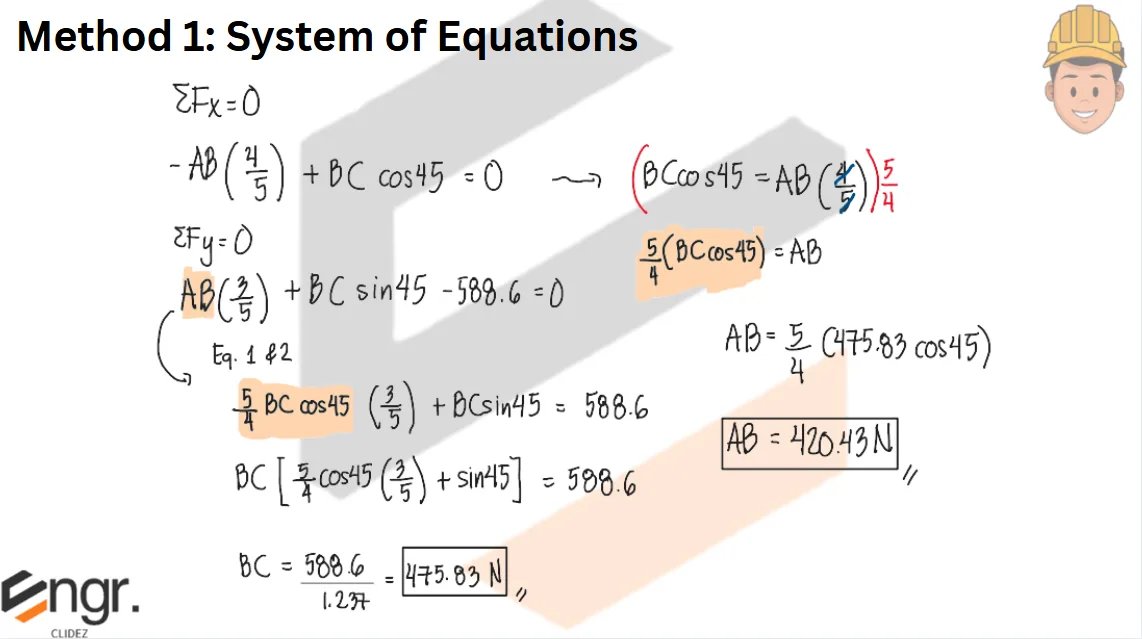
Using the first equation, $T_{BC}=\frac{(4/5)T_{AB}}{\cos45^\circ}$. Substitute in the vertical equation:
$\frac{3}{5}T_{AB}+\frac{4}{5}T_{AB}-588.6=0$
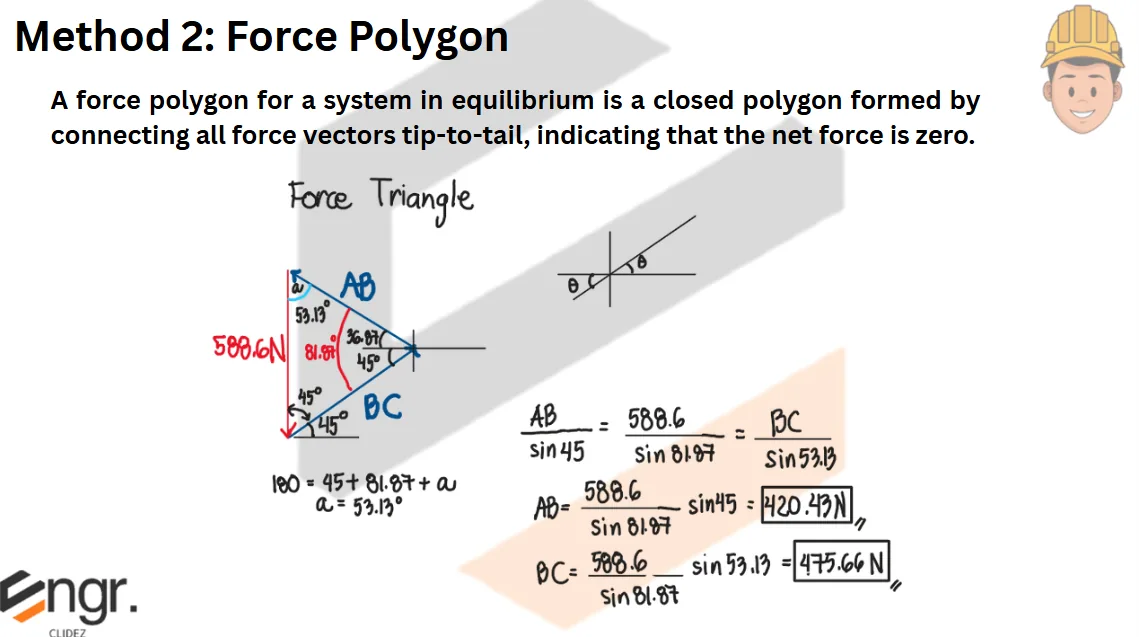
$\boxed{T_{AB}=420.43\text{ N}}$

Part 2.

From horizontal equilibrium at joint B:
$T_{BC}=\frac{(4/5)T_{AB}}{\cos45^\circ}$
$T_{BC}=\frac{(4/5)(420.43)}{0.7071}$
$\boxed{T_{BC}=475.83\text{ N}}$

Question Bank: q518

PSAD - Statics / Equilibrium of Concurrent Force Systems / Engr. Janclyde Espinosa (Clidez)

Three segmented cables support the two traffic lights weighing 10kg and 15kg at B and C, respectively.

q518

Determine the tension in cable AB in Newtons.

  1. 379.03
  2. 366.11
  3. 394.58
  4. 245.25

Determine the tension in cable BC in Newtons.

  1. 366.11
  2. 394.58
  3. 379.03
  4. 245.25

Determine the tension in cable CD in Newtons.

  1. 394.58
  2. 366.11
  3. 245.25
  4. 147.15

Determine the value of the angle θ.

  1. 21.9º
  2. 23.7º
  3. 22.6º
  4. 24.5º

Part 1.

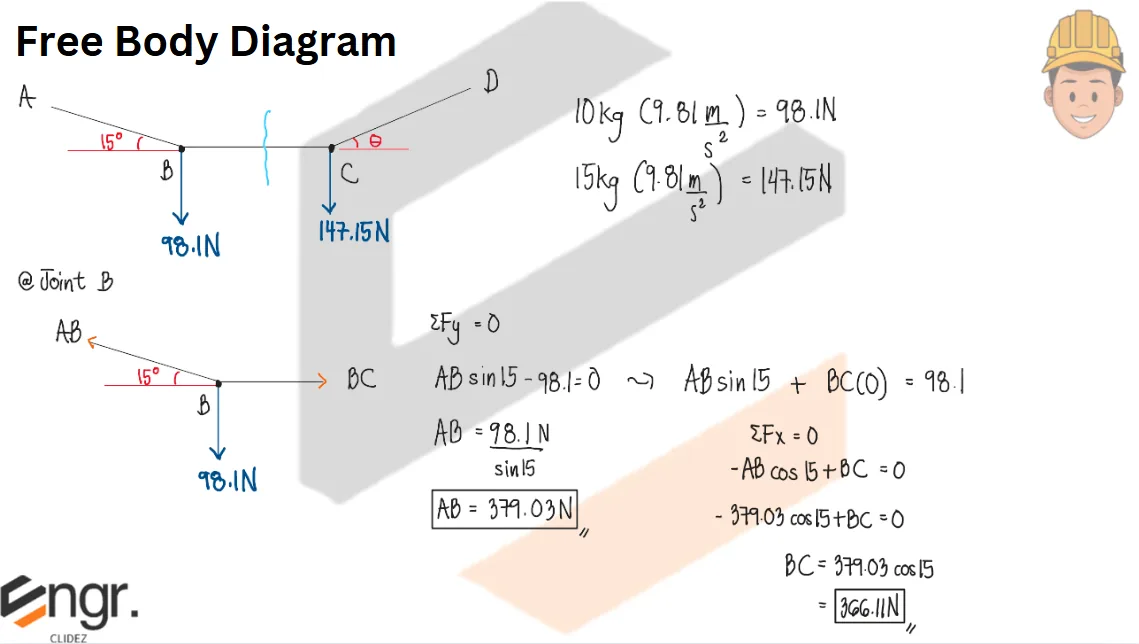
At joint B, the 10-kg light has weight $W_B=10(9.81)=98.1$ N. Cable BC is horizontal, so cable AB supplies the vertical component.
$\Sigma F_y=0:\ T_{AB}\sin15^\circ-98.1=0$
$T_{AB}=\frac{98.1}{\sin15^\circ}$
$\boxed{T_{AB}=379.03\text{ N}}$

Part 2.

Use horizontal equilibrium at joint B:
$\Sigma F_x=0:\ T_{BC}-T_{AB}\cos15^\circ=0$
$T_{BC}=379.03\cos15^\circ$
$\boxed{T_{BC}=366.11\text{ N}}$

Part 3.

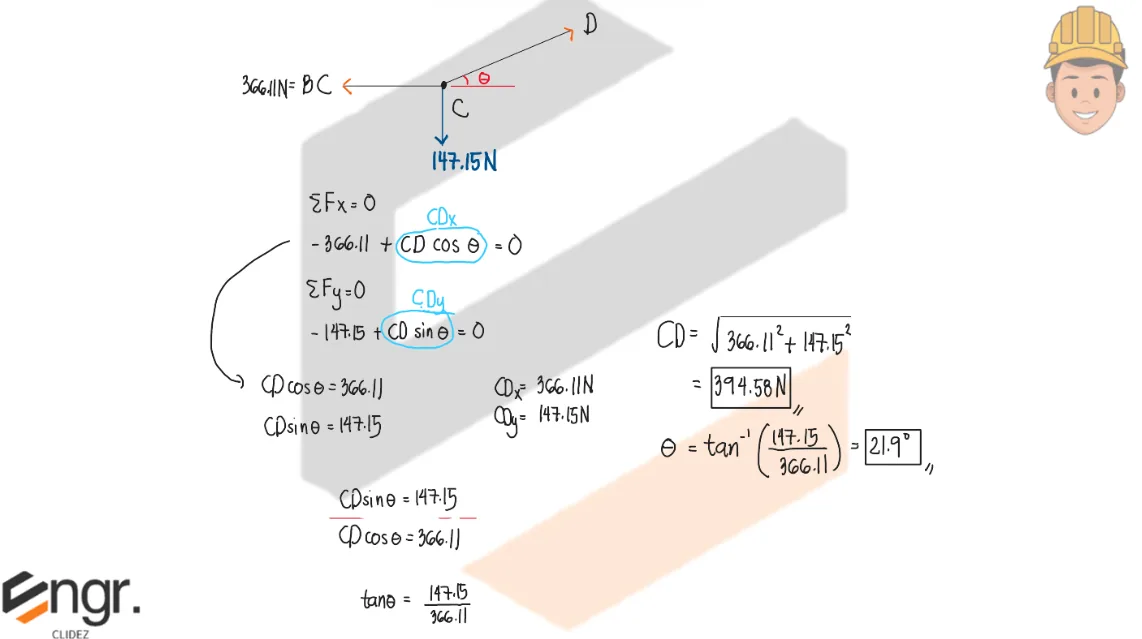
At joint C, the 15-kg light has weight $W_C=15(9.81)=147.15$ N. Cable BC is horizontal, so cable CD must balance $T_{BC}$ horizontally and $W_C$ vertically.
$T_{CD,x}=366.11\text{ N},\quad T_{CD,y}=147.15\text{ N}$
$T_{CD}=\sqrt{366.11^2+147.15^2}$
$\boxed{T_{CD}=394.58\text{ N}}$

Part 4.

At joint C, the cable angle satisfies:
$\tan\theta=\frac{T_{CD,y}}{T_{CD,x}}=\frac{147.15}{366.11}$
$\theta=21.9^\circ$
$\boxed{\theta=21.9^\circ}$

Question Bank: q519

PSAD - Statics / Equilibrium of Concurrent Force Systems / Engr. Janclyde Espinosa (Clidez)

A concrete block of weight W holds a ring anchor bolt fastened to two guy wires as shown.

q519

Calculate the resultant force acting on the bolt in kN.

  1. 10.90
  2. 6.34
  3. 8.87
  4. 12.61

Determine the angle which the resultant pull makes with the horizontal.

  1. 54.44º
  2. 52.33º
  3. 51.66º
  4. 56.77º

To prevent uplift, what is the minimum weight of the concrete block W (in kN) if the required factor of safety is 1.3?

  1. 11.53
  2. 8.87
  3. 6.82
  4. 14.99

Part 1.

Resolve the two wire pulls into components. Taking rightward and upward as positive:
$\Sigma F_x=(14-7)\cos25^\circ=6.34\text{ kN}$
$\Sigma F_y=(14+7)\sin25^\circ=8.87\text{ kN}$
$R=\sqrt{(6.34)^2+(8.87)^2}$
$\boxed{R=10.90\text{ kN}}$

Part 2.

The direction of the resultant is measured from the horizontal:
$\tan\theta=\frac{\Sigma F_y}{\Sigma F_x}=\frac{8.87}{6.34}$
$\boxed{\theta=54.44^\circ}$

Part 3.

The block must resist the vertical uplift component with the required factor of safety:
$W_{min}=1.3(\Sigma F_y)$
$W_{min}=1.3(8.87)$
$\boxed{W_{min}=11.53\text{ kN}}$

Question Bank: q520

PSAD - Statics / Equilibrium of Concurrent Force Systems / Engr. Janclyde Espinosa (Clidez)

Refer to the image shown. Cylinder 1 weighs 20kN, cylinder 2 weighs 40kN, and cylinder 3 weighs 30kN. The surface along point D is inclined 60º with the horizontal.

q520

Determine the reaction at A.

  1. 5.77
  2. 6.67
  3. 3.33
  4. 4.67

Determine the reaction at D.

  1. 6.67
  2. 5.77
  3. 3.33
  4. 4.67

Determine the reaction at C.

  1. 46.66
  2. 40.00
  3. 43.33
  4. 50.00

Solution pending in psadquestions/q520.json.

Question Bank: q521

PSAD - Statics / Equilibrium of Concurrent Force Systems / Engr. Janclyde Espinosa (Clidez)

Force A = 6kN
Force B = 2.4kN
Angle β = 30°

q521

The resultant of the three forces, A, B, and C is 3.6kN and it acts along the y-axis. What is the angle θ?

  1. 23.58º
  2. 24.67º
  3. 28.24º
  4. 20.44º

If the resultant of the three forces A, B, and C is 5.4kN and it acts along the y-axis, what is the value of C (in kN) if θ=45°?

  1. 2.16
  2. 3.42
  3. 5.14
  4. 1.68

If the angle θ=60° and the force C = 3kN, how much is the resultant pulling force (in kN) on the eyebolt?

  1. 6.73
  2. 2.08
  3. 6.40
  4. 7.04

Part 1.

For the resultant to act along the y-axis, its x-component must be zero; for this item, use the given resultant magnitude in the y-direction.
$R_y=A\sin\theta+B\sin\beta$
$3.6=6\sin\theta+2.4\sin30^\circ$
$3.6=6\sin\theta+1.2$
$\sin\theta=0.40$
$\boxed{\theta=23.58^\circ}$

Part 2.

Since the resultant acts along the y-axis, $\Sigma F_x=0$. With $\theta=45^\circ$ and $\beta=30^\circ$:
$-A\cos\theta+B\cos\beta+C=0$
$C=6\cos45^\circ-2.4\cos30^\circ$
$C=4.243-2.078$
$\boxed{C=2.16\text{ kN}}$

Part 3.

Resolve all three forces for $\theta=60^\circ$, $\beta=30^\circ$, and $C=3$ kN:
$\Sigma F_x=-6\cos60^\circ+2.4\cos30^\circ+3=2.078\text{ kN}$
$\Sigma F_y=6\sin60^\circ+2.4\sin30^\circ=6.396\text{ kN}$
$R=\sqrt{(2.078)^2+(6.396)^2}$
$\boxed{R=6.73\text{ kN}}$

Question Bank: q522

PSAD - Statics / Equilibrium of Concurrent Force Systems / Engr. Janclyde Espinosa (Clidez)

The 9-kg lamp is suspended in the position shown. The unstretched length of spring AB is 0.4m, and the spring has a stiffness of kAB=300N/m.

q522

Determine the tension in cable AC in Newtons.

  1. 156.96
  2. 135.93
  3. 143.78
  4. 136.89

Determine the final length of spring AB in meters.

  1. 0.85
  2. 0.45
  3. 0.64
  4. 0.58

Determine the required length of cord AC.

  1. 1.33m
  2. 1.28m
  3. 1.15m
  4. 1.48m

Solution pending in psadquestions/q522.json.

Question Bank: q523

PSAD - Statics / Equilibrium of Concurrent Force Systems / Engr. Janclyde Espinosa (Clidez)

A hollow right circular cylinder of radius 0.5m is open at both ends and rests on a smooth horizontal plane. Inside the cylinder are two spheres having weights w1=10kN and w2=15kN and radius r1=0.20m and r2=0.40m, respectively, as shown. Neglect friction.

q523

Determine the horizontal reaction of w1 on the side of the cylinder.

  1. 8.95kN
  2. 13.42kN
  3. 8.00kN
  4. 25.00kN

Determine the vertical reaction of w2 on the horizontal plane.

  1. 25.00kN
  2. 8.00kN
  3. 8.95kN
  4. 13.42kN

Determine the minimum weight Q of the cylinder in order for it not to tip over.
  1. 8.00kN
  2. 8.95kN
  3. 13.42kN
  4. 25.00kN

Solution pending in psadquestions/q523.json.

Question Bank: q524

PSAD - Statics / Equilibrium of Concurrent Force Systems / Engr. Janclyde Espinosa (Clidez)

A suspension cable is supported at A and B, 120m horizontally apart, with B higher than A by 15m. A concentrated load of 100kN is applied at a distance of 60m horizontally from A. The cable sags a distance of 10m from the chord joining A and B at the center.

What is the maximum tension in the cable?

  1. 312.5kN
  2. 300.26kN
  3. 345.21kN
  4. 357.82kN

What is the minimum tension in the cable?

  1. 300.26kN
  2. 312.5kN
  3. 345.21kN
  4. 357.82kN

What is the horizontal reaction at the supports?

  1. 300.00kN
  2. 312.5kN
  3. 345.21kN
  4. 357.82kN
Let A be at elevation 0. Since B is 15 m higher over a 120 m horizontal span, the chord elevation at the middle is:
$y_{chord}=\dfrac{15}{120}(60)=7.5\text{ m}$
The load point is 10 m below the chord, so:
$y_C=7.5-10=-2.5\text{ m}$

Left cable segment AC:
$\tan\alpha=\dfrac{2.5}{60}=0.041667$
Right cable segment CB:
$\tan\beta=\dfrac{15-(-2.5)}{60}=\dfrac{17.5}{60}=0.291667$

At the load point C, the horizontal component is the same in both cable segments. Let it be H.
$\sum F_y=0:$
$H\tan\alpha+H\tan\beta=100$
$H(0.041667+0.291667)=100$
$H=300.00\text{ kN}$

The cable tensions are:
$T_{AC}=H\sec\alpha=\sqrt{H^2+(H\tan\alpha)^2}$
Since $H\tan\alpha=300(0.041667)=12.5\text{ kN}$:
$T_{AC}=\sqrt{300^2+12.5^2}=300.26\text{ kN}$

$T_{CB}=H\sec\beta=\sqrt{H^2+(H\tan\beta)^2}$
Since $H\tan\beta=300(0.291667)=87.5\text{ kN}$:
$T_{CB}=\sqrt{300^2+87.5^2}=312.5\text{ kN}$

Thus:
$\boxed{T_{max}=312.5\text{ kN}}$
$\boxed{T_{min}=300.26\text{ kN}}$
$\boxed{H=300.00\text{ kN}}$

Question Bank: q525

PSAD - Statics / Equilibrium of Concurrent Force Systems / Engr. Deguma

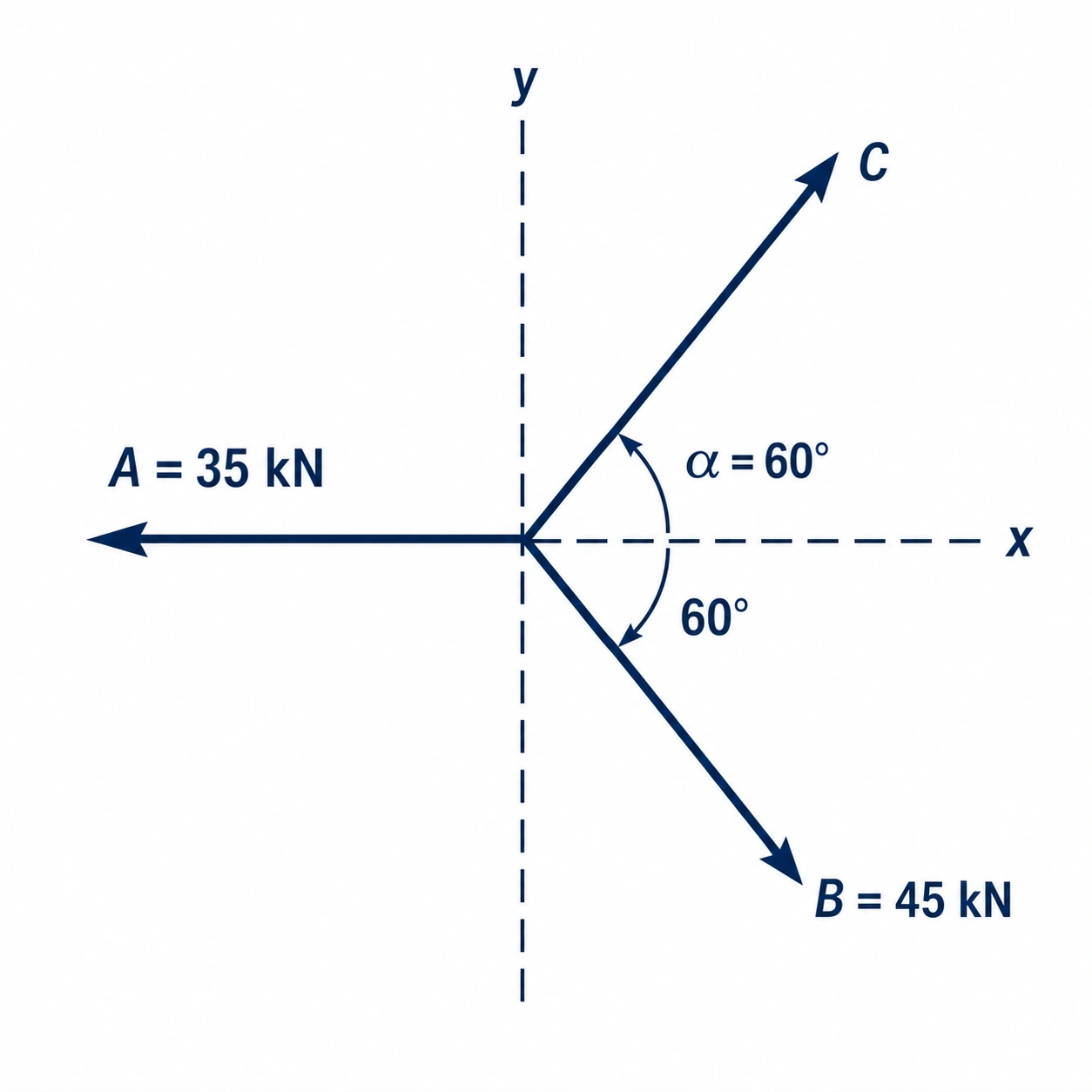
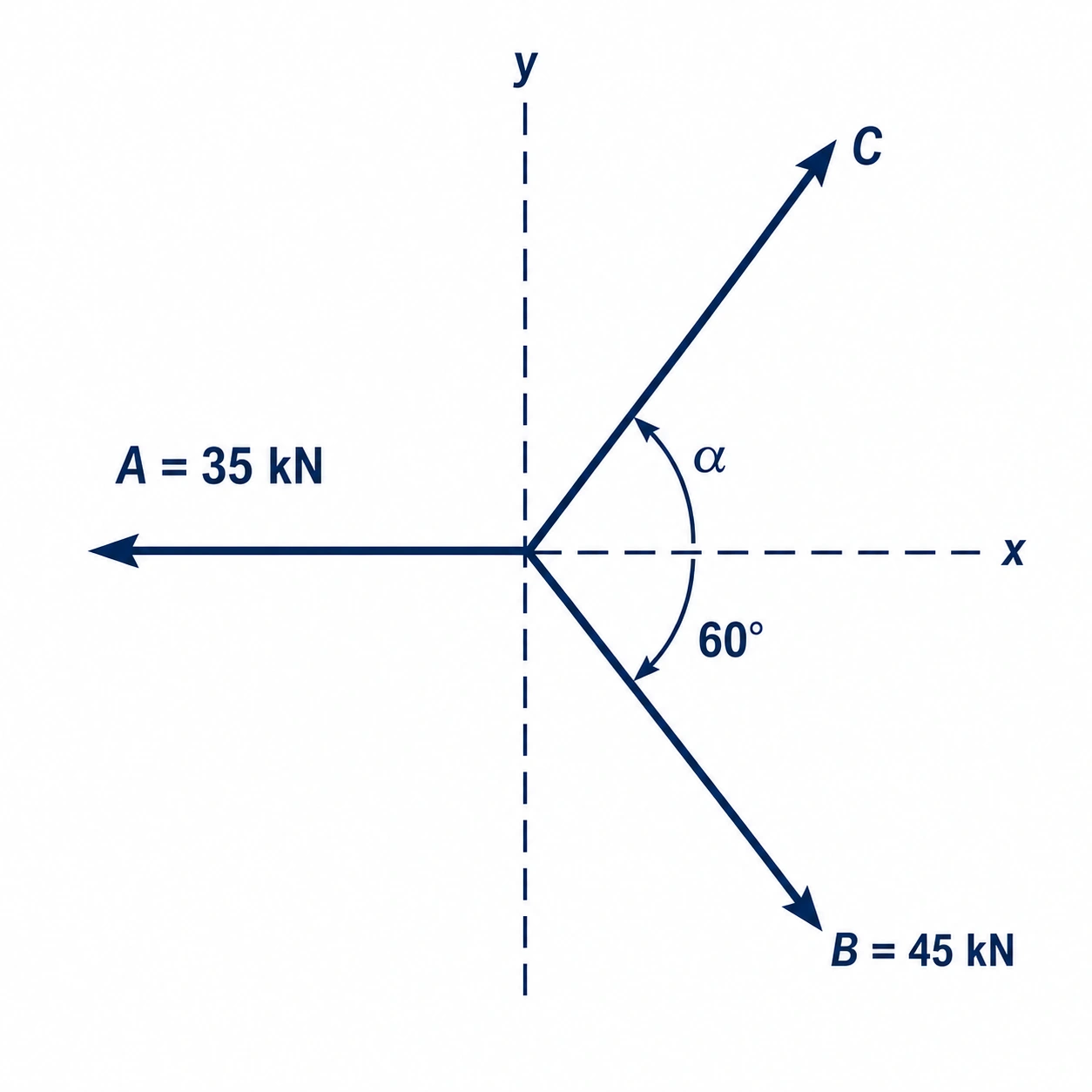
Forces F, P, and T are concurrent and acting in the direction as shown. If the resultant is zero:
q525

Determine the value of α.

  1. 33.56º
  2. 50.70º
  3. 34.87º
  4. 53.13º

Determine the value of β.

  1. 50.70º
  2. 34.87º
  3. 53.13º
  4. 33.56º

Part 1.

For equilibrium, the horizontal and vertical components must balance:
$\Sigma F_x=0:\ 350\cos\alpha+250\cos\beta=450$
$\Sigma F_y=0:\ 350\sin\alpha-250\sin\beta=0$
Solving the two simultaneous component equations gives:
$\boxed{\alpha=33.56^\circ}$

Part 2.

Using the same equilibrium equations:
$350\cos\alpha+250\cos\beta=450$
$350\sin\alpha=250\sin\beta$
With $\alpha=33.56^\circ$, the vertical equation gives:
$\sin\beta=\frac{350\sin33.56^\circ}{250}$
$\boxed{\beta=50.70^\circ}$

Question Bank: q526

PSAD - Statics / Equilibrium of Concurrent Force Systems / Engr. Deguma

The 60kN weight is suspended from a small pulley that is free to roll on the cable. The length of the cable ABC is 18m. If x=4m,
q526

Determine the horizontal force P that would hold the pulley in equilibrium in the position shown.

  1. 7.50kN
  2. 6.40kN
  3. 8.50kN
  4. 5.40kN

Determine the tension in cable ABC.

  1. 60.938kN
  2. 70.389kN
  3. 50.274kN
  4. 80.274kN

Solution pending in psadquestions/q526.json.

Question Bank: q549

PSAD - Statics / Equilibrium of Concurrent Force Systems / Engr. Deguma

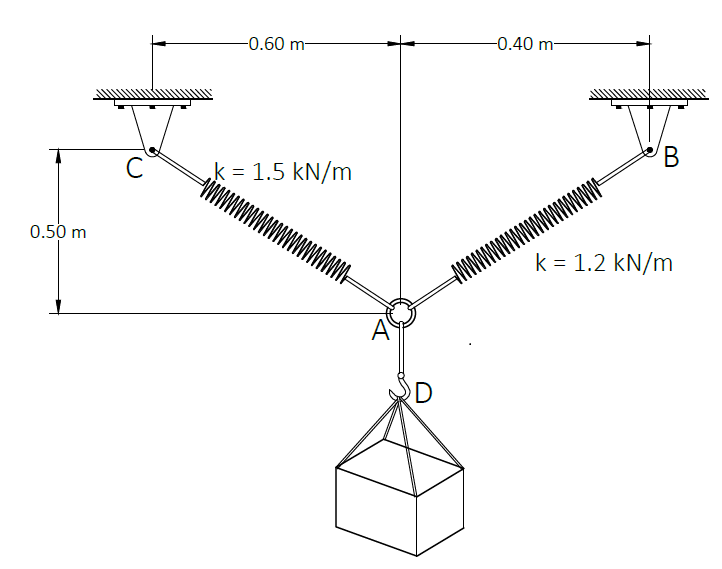
In the figure shown, if the weight of the block at D is 30kgs, compute the following:
q549

Tensile force in AB in Newtons.

  1. 226
  2. 255
  3. 184
  4. 165

The unstretched length of spring AB in meters.

  1. 0.45
  2. 0.23
  3. 0.18
  4. 0.72

The unstretched length of spring AC in meters.

  1. 0.66
  2. 0.54
  3. 0.97
  4. 0.78

Part 1.

At ring A, the current spring directions are found from the figure. For AB: $L_{AB}=\sqrt{0.40^2+0.50^2}=0.640$ m, so its unit components are $(0.625,0.781)$. For AC: $L_{AC}=\sqrt{0.60^2+0.50^2}=0.781$ m, so its unit components are $(-0.768,0.640)$. The load is $W=30(9.81)=294.3$ N.
$\Sigma F_x=0:\ 0.625T_{AB}-0.768T_{AC}=0$
$\Sigma F_y=0:\ 0.781T_{AB}+0.640T_{AC}=294.3$
Solving gives:
$\boxed{T_{AB}=226\text{ N}}$

Part 2.

The current length of spring AB is:
$L_{AB}=\sqrt{0.40^2+0.50^2}=0.640\text{ m}$
Using Hooke's law, $T=k\Delta$:
$\Delta_{AB}=\frac{226}{1200}=0.188\text{ m}$
$L_{0,AB}=0.640-0.188=0.452\text{ m}$
$\boxed{L_{0,AB}=0.45\text{ m}}$

Part 3.

From the equilibrium solution, $T_{AC}=183.9$ N. The current length of spring AC is:
$L_{AC}=\sqrt{0.60^2+0.50^2}=0.781\text{ m}$
$\Delta_{AC}=\frac{183.9}{1500}=0.123\text{ m}$
$L_{0,AC}=0.781-0.123=0.658\text{ m}$
$\boxed{L_{0,AC}=0.66\text{ m}}$

Question Bank: q551

PSAD - Statics / Equilibrium of Concurrent Force Systems / Engr. Deguma

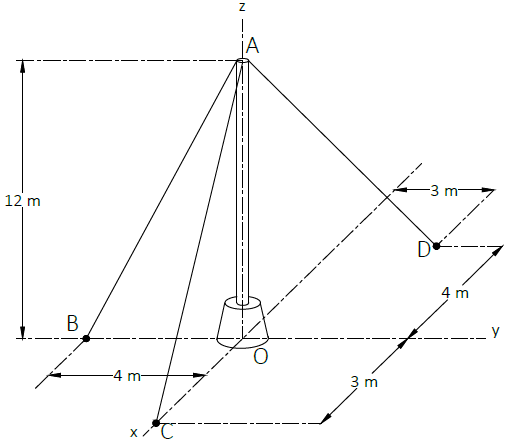
An antenna tower on top of a building is subjected to an uplift force of 400 kN acting along the z-axis. The tower is braced by three cables AB, AC, and AD.
q551

Determine the tension in cable AC in kN.

  1. 178.30
  2. 156.02
  3. 133.73
  4. 164.93

Determine the tension in cable AD in kN.

  1. 140.54
  2. 130.01
  3. 122.97
  4. 105.41

Determine the tension in cable AB in kN.

  1. 102.40
  2. 76.81
  3. 94.73
  4. 89.61

Solution pending in psadquestions/q551.json.

Question Bank: q562

PSAD - Statics / Equilibrium of Concurrent Force Systems / Engr. Deguma

A canal boat is towed by a rope making an angle of 35° with the horizontal, the tension of the line being 115 kg. How much of this is utilized in propelling the boat?

Answer:

  1. 94kg
  2. 66kg
  3. 96kg
  4. 64kg

Solution pending in psadquestions/q562.json.

Question Bank: q593

PSAD - Statics / Equilibrium of Concurrent Force Systems / Mastermatician

A car is being towed uphill, inclined at 20º with the horizontal. What force (in kilonewtons) parallel to the inclined plane is needed to pull the car with an acceleration of 1.5 m/s². Weight of the car is 25 kN.

  1. 12.37
  2. 14.39
  3. 6.74
  4. 4.73

Solution pending in psadquestions/q593.json.