CE Board Exam Randomizer

⬅ Back to Subject Topics

Resultant of Concurrent Force Systems
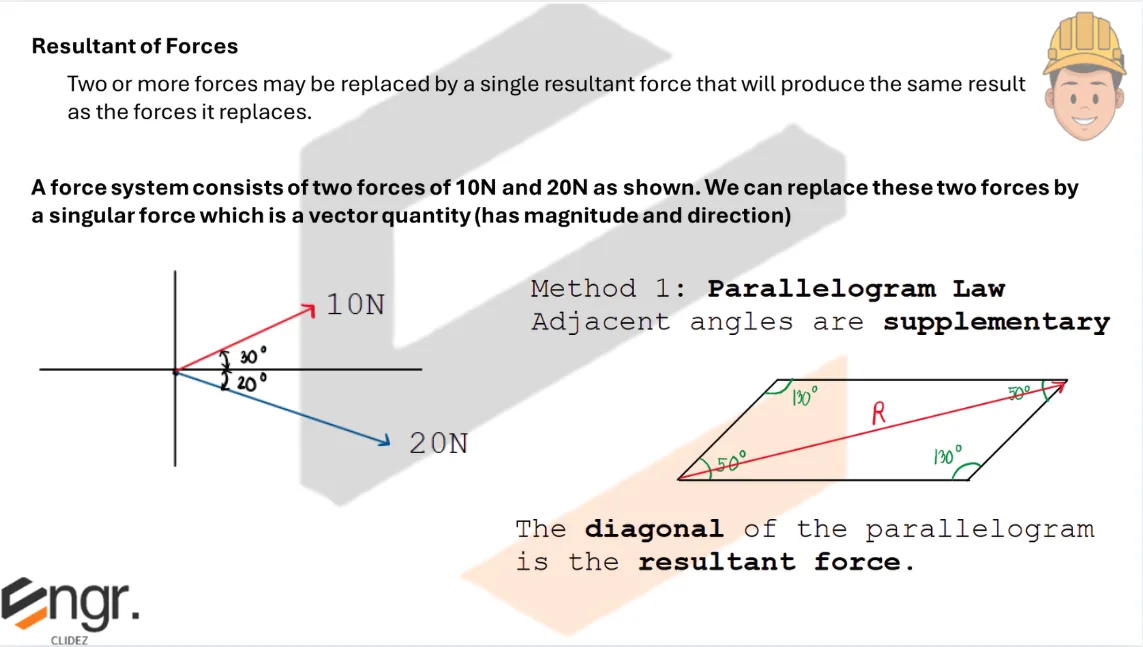
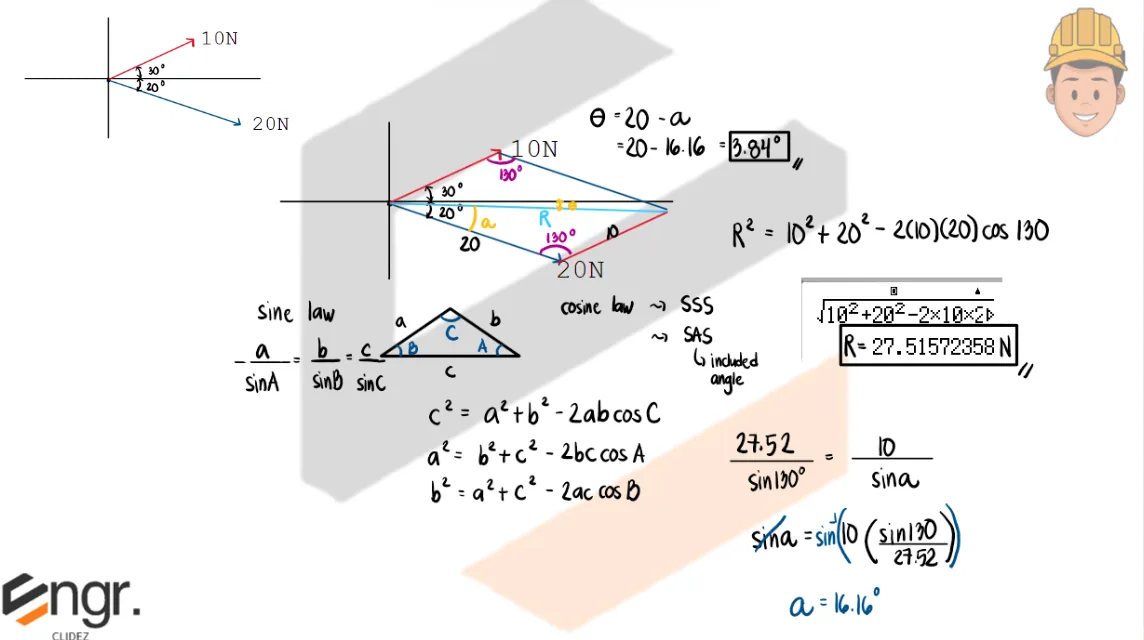
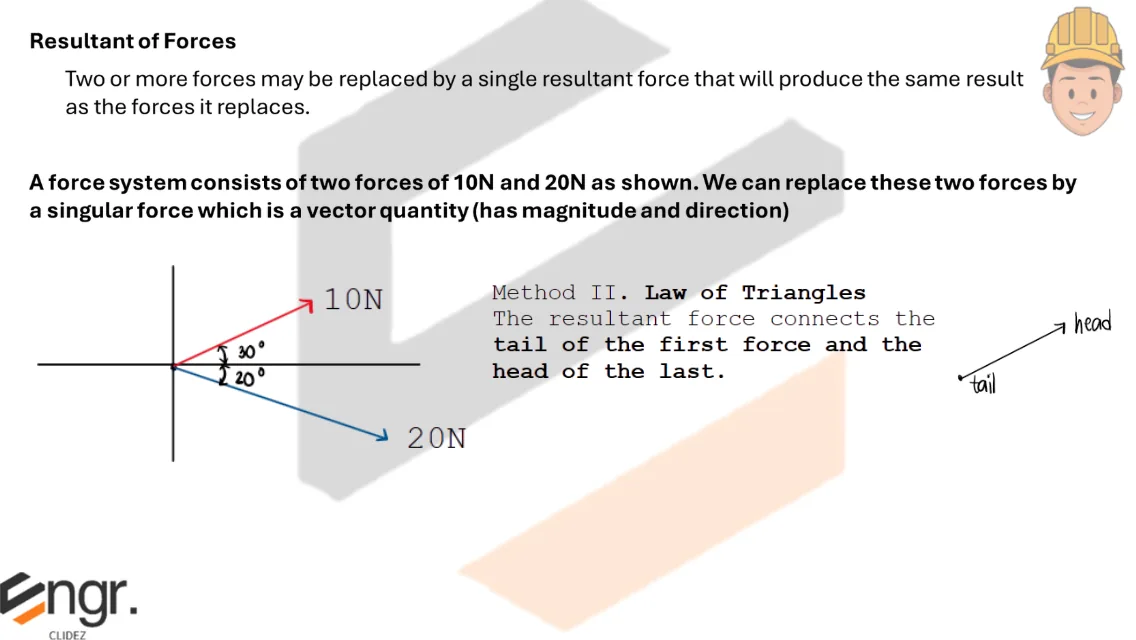
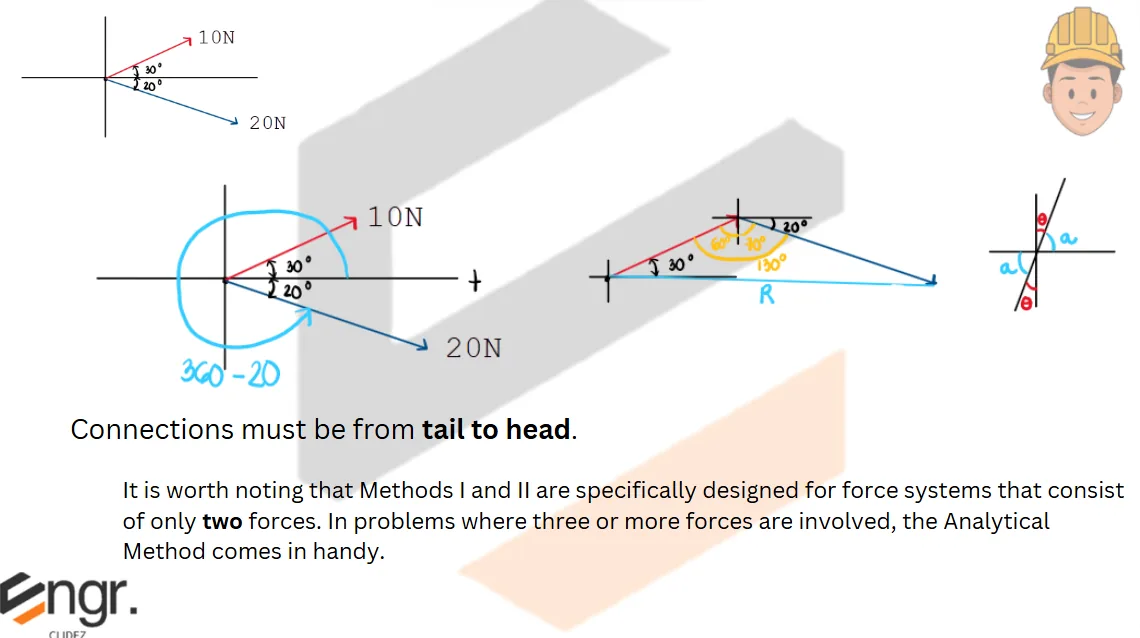
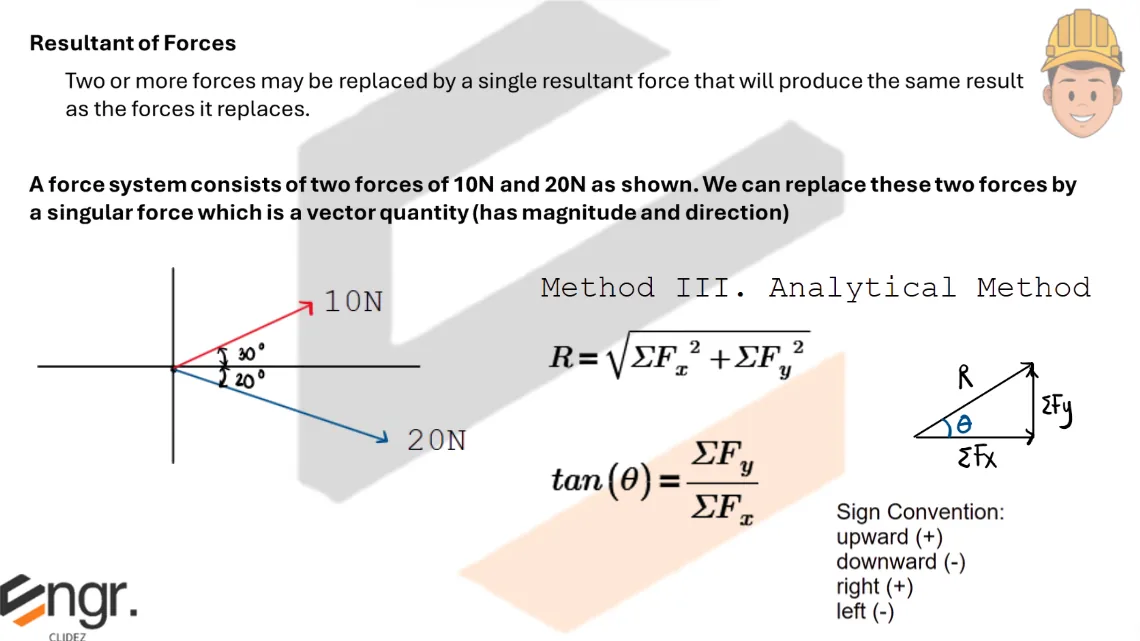
Concept Diagram 1 Concept Diagram 2 Concept Diagram 3 Concept Diagram 4 Concept Diagram 5 Concept Diagram 6 Concept Diagram 7

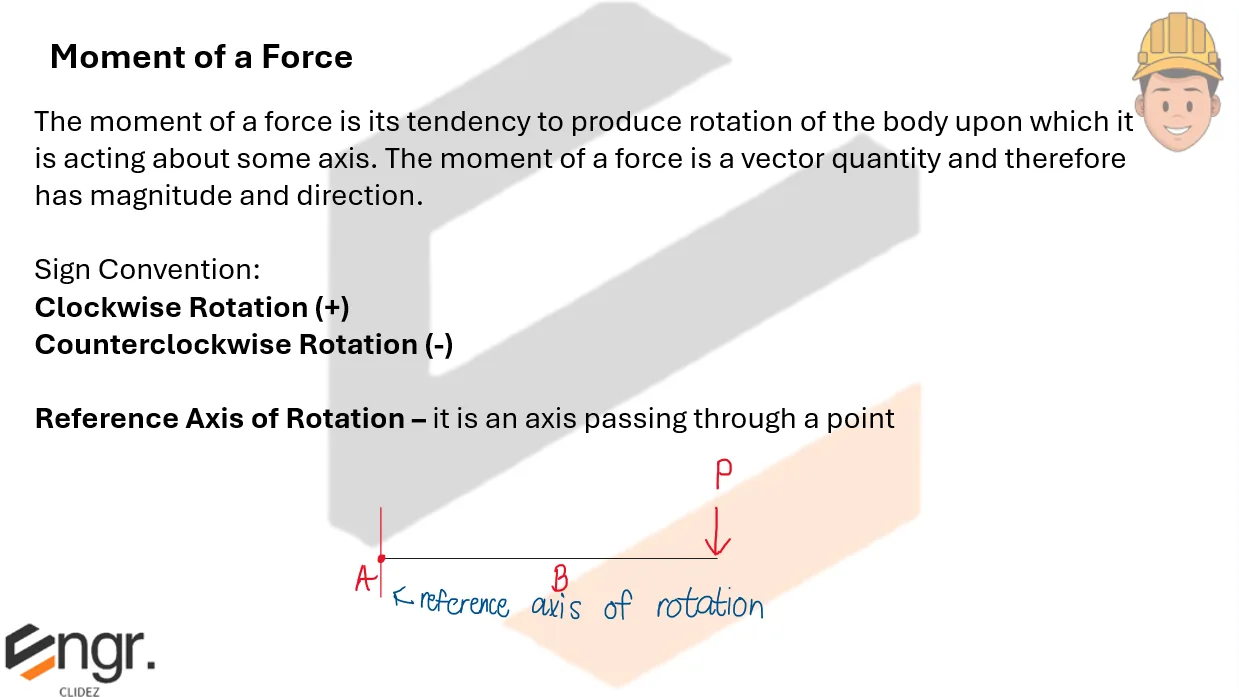
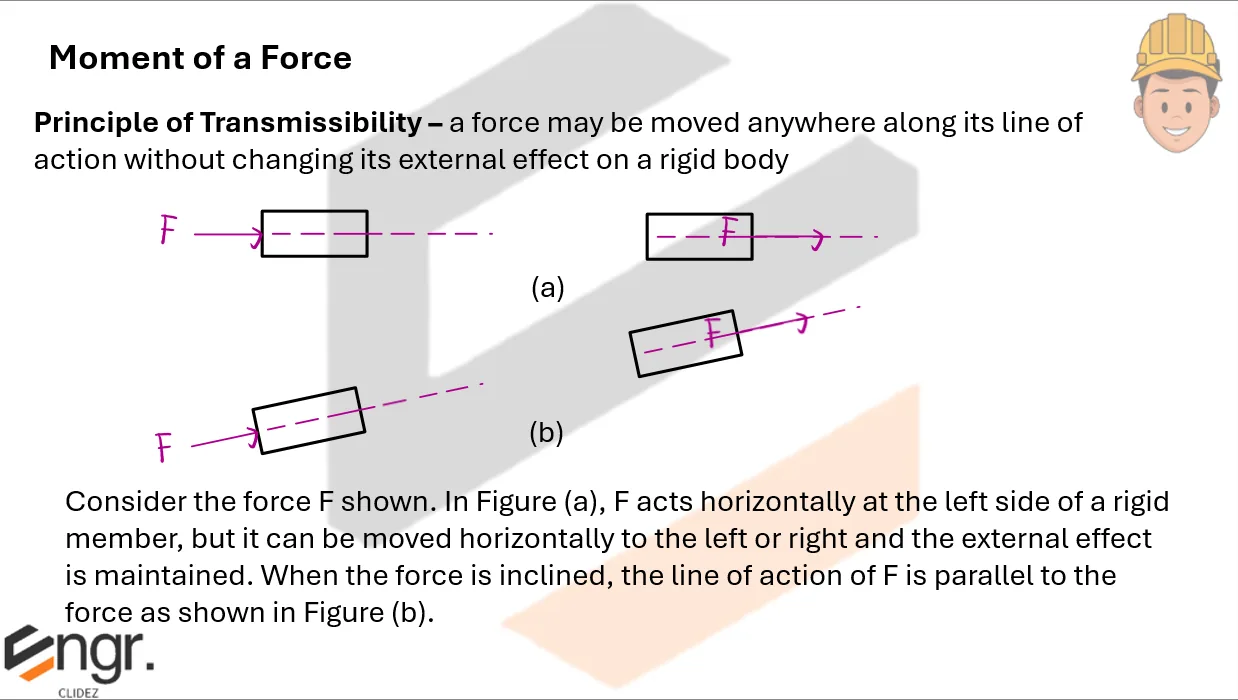
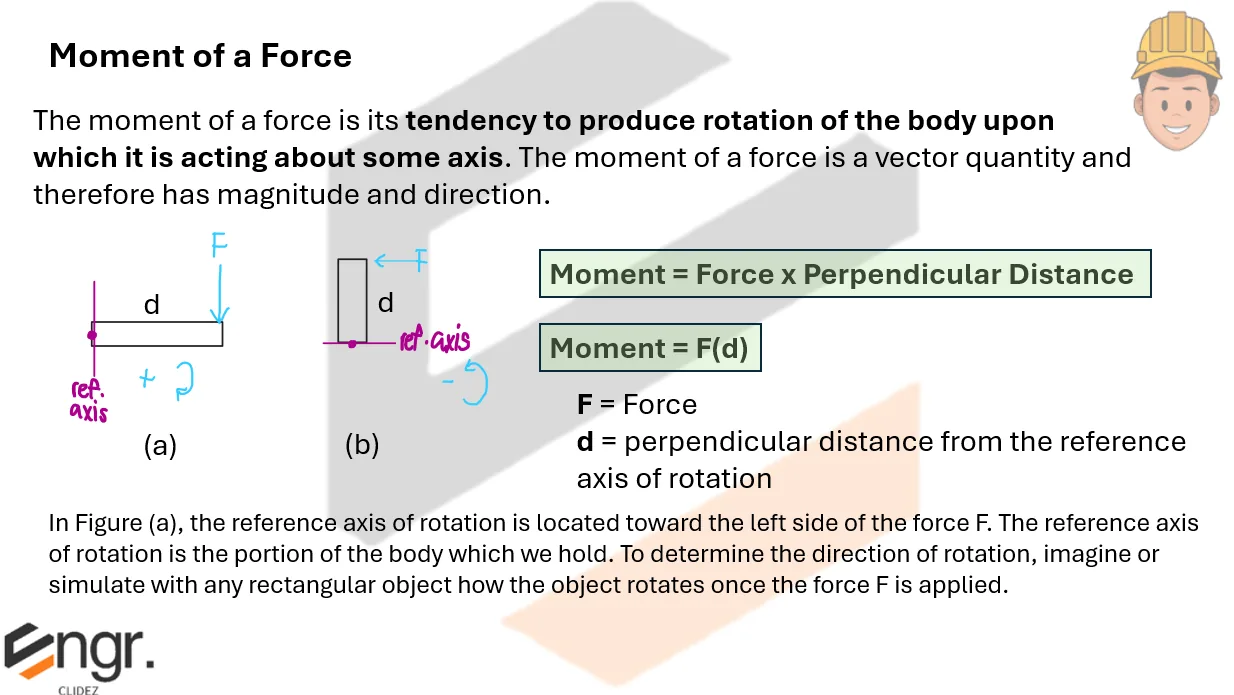
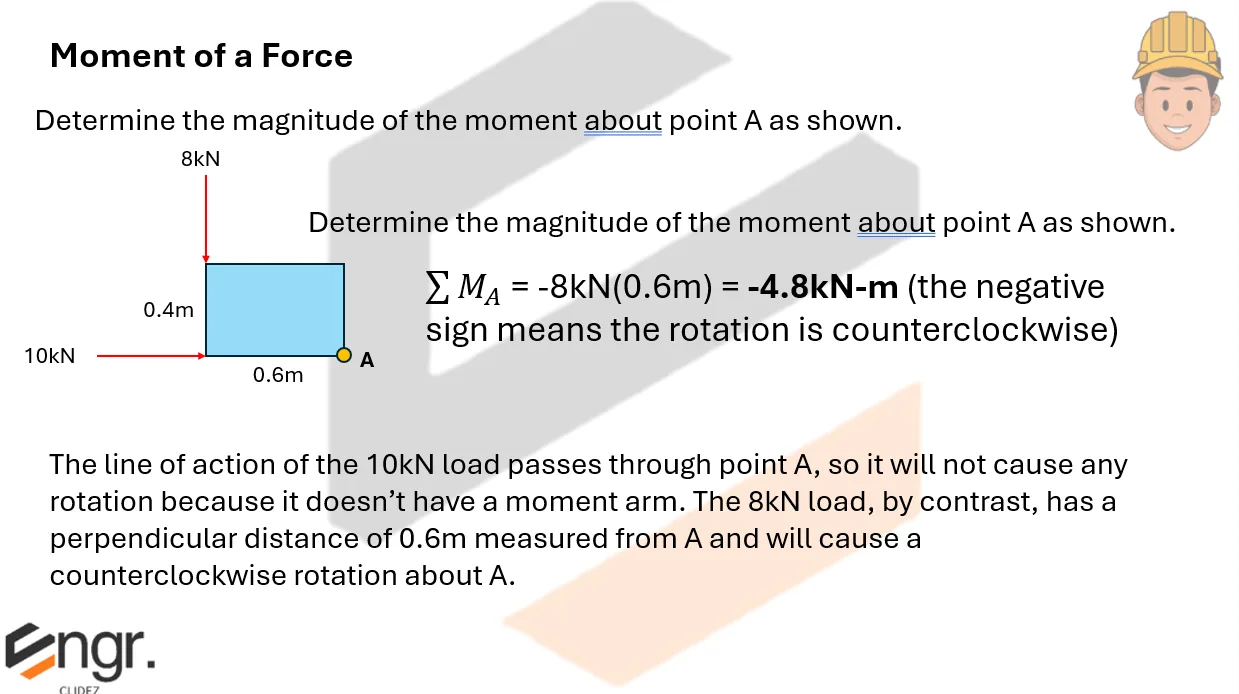
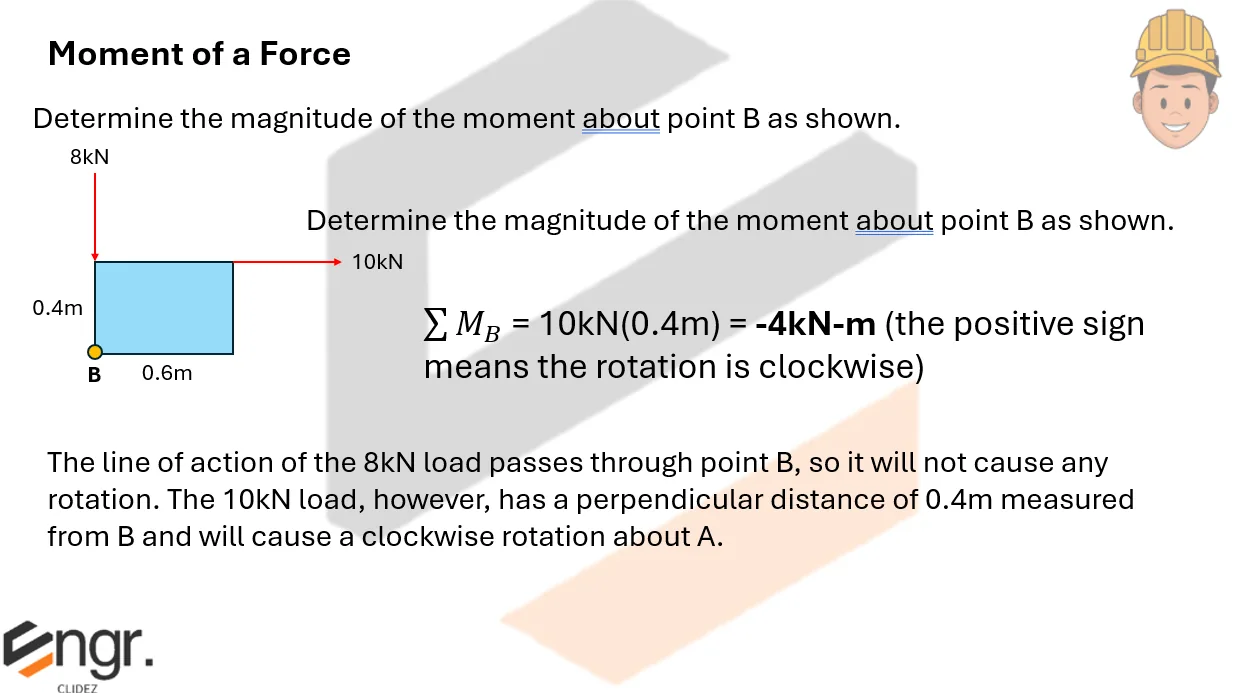
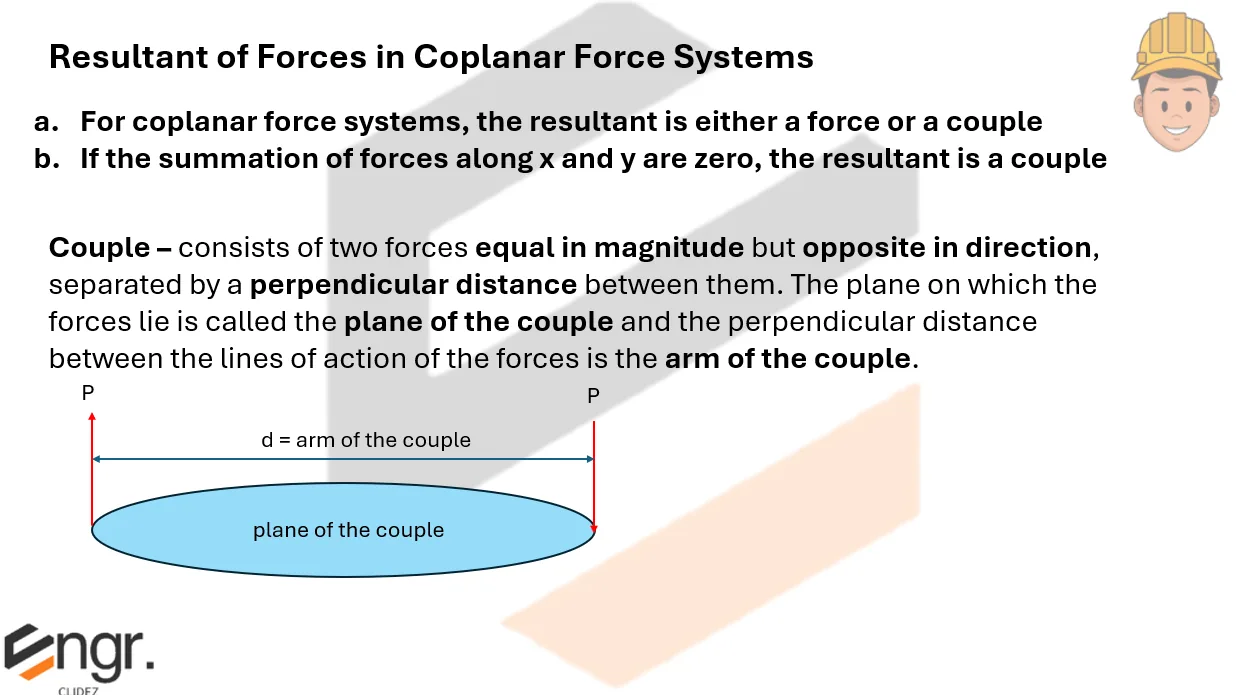
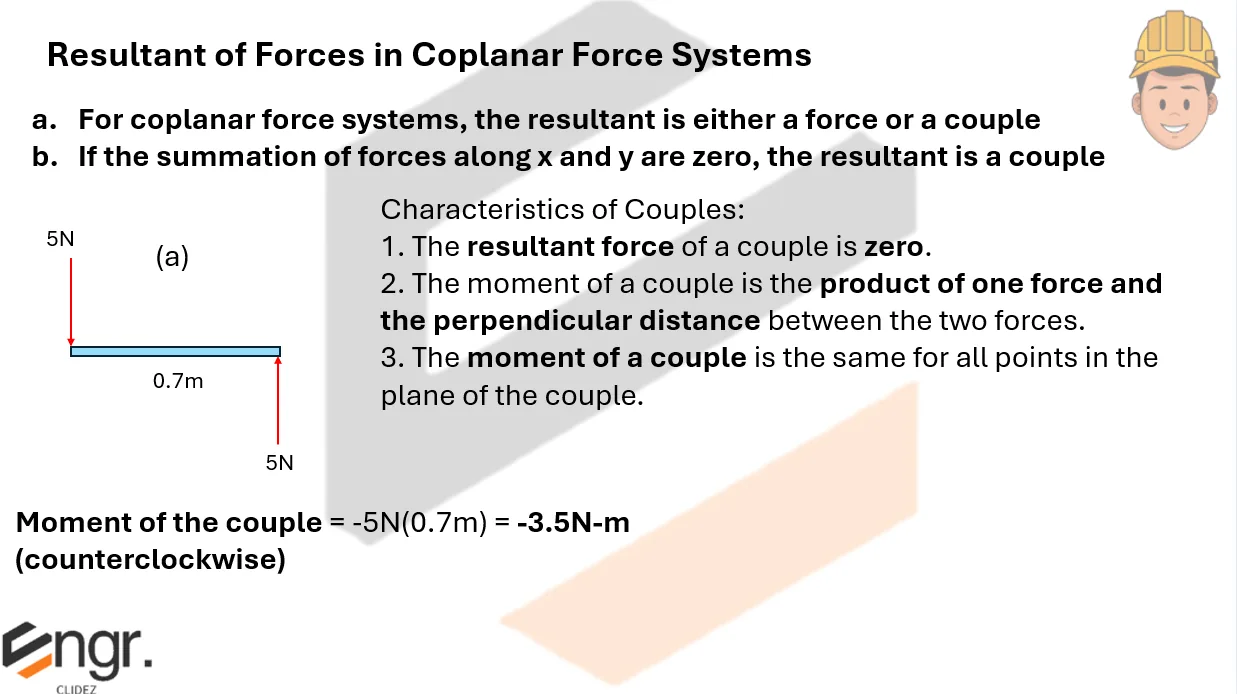
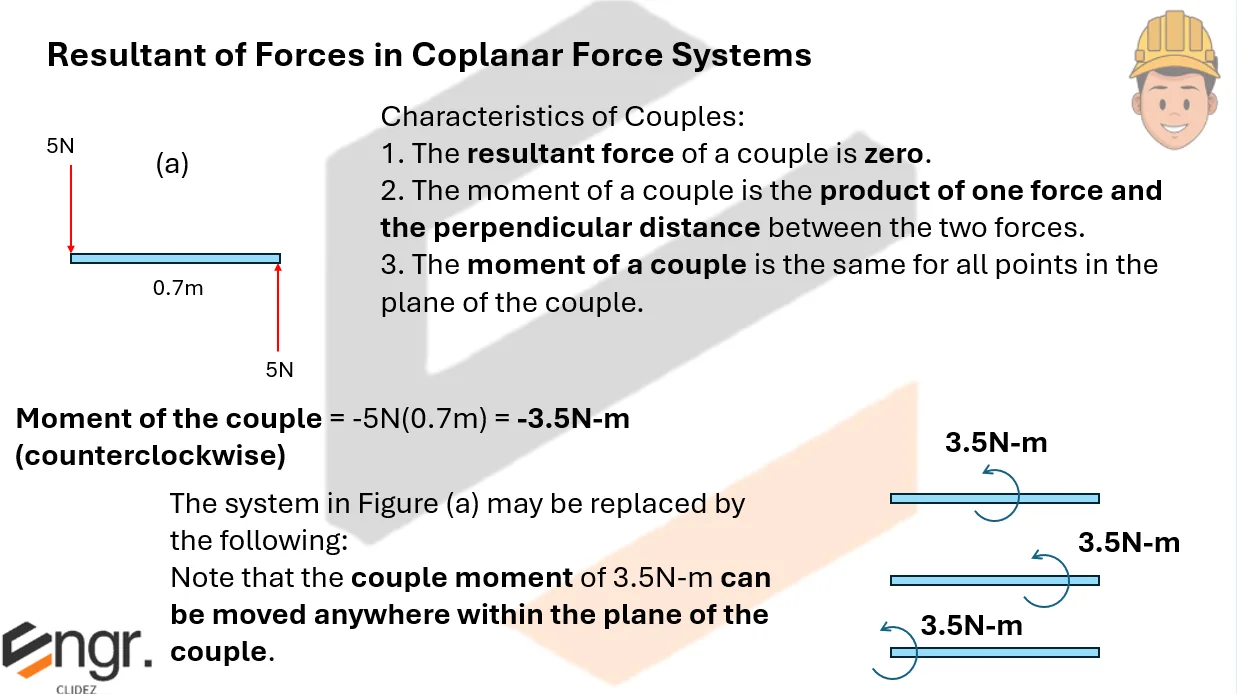
Moment of a Force & Couples

Concept Diagram 1 Concept Diagram 2 Concept Diagram 3 Concept Diagram 4 Concept Diagram 5 Concept Diagram 6 Concept Diagram 7 Concept Diagram 8 Concept Diagram 9 Concept Diagram 9

Problem: Moment of a Force about a Point

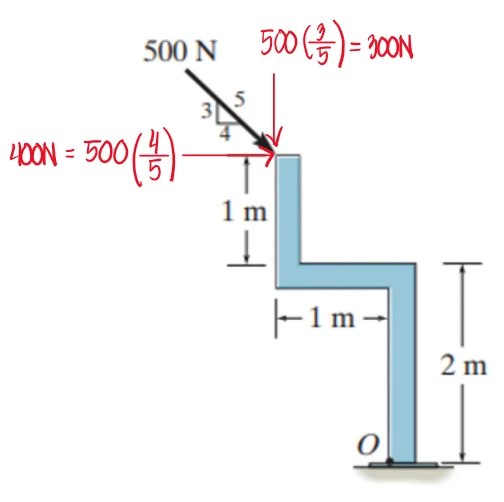
Determine the moment about point O.

Resultant of Concurrent Force Systems | Statics of Rigid Bodies – Problem 2: – Diagram Resultant of Concurrent Force Systems | Statics of Rigid Bodies – Problem 2: – Diagram Resultant of Concurrent Force Systems | Statics of Rigid Bodies – Problem 2: – Diagram
$M_o=400N(3m)-300N(1m)=900N-m$ (clockwise)

Resultant of Concurrent Force Systems | Statics of Rigid Bodies – Problem 2: – Diagram Resultant of Concurrent Force Systems | Statics of Rigid Bodies – Problem 2: – Diagram Resultant of Concurrent Force Systems | Statics of Rigid Bodies – Problem 2: – Diagram Resultant of Concurrent Force Systems | Statics of Rigid Bodies – Problem 2: – Diagram Solution Diagram 1
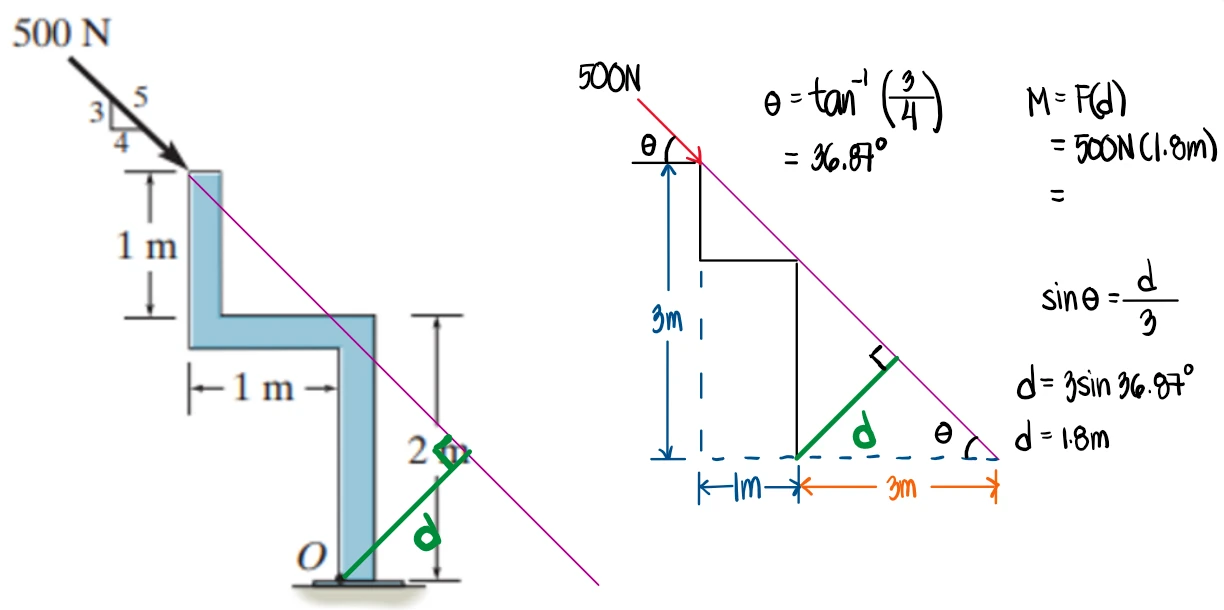
Second solution: Using the perpendicular distance from the line of action of the 500N load to point O: Solution Diagram 2

Problem: Moment of a Force about a Point

Determine the moment about point O.

Resultant of Concurrent Force Systems | Statics of Rigid Bodies – Problem 2: – Diagram Resultant of Concurrent Force Systems | Statics of Rigid Bodies – Problem 2: – Diagram Resultant of Concurrent Force Systems | Statics of Rigid Bodies – Problem 2: – Diagram

$300(0.3+0.125)+400(0.25)+600cos(60)(0.25)+600sin(60)(0.425)=268.34N \cdot m$

Resultant of Concurrent Force Systems | Statics of Rigid Bodies – Problem 2: – Diagram Resultant of Concurrent Force Systems | Statics of Rigid Bodies – Problem 2: – Diagram Resultant of Concurrent Force Systems | Statics of Rigid Bodies – Problem 2: – Diagram Resultant of Concurrent Force Systems | Statics of Rigid Bodies – Problem 2: – Diagram Solution Diagram 1

Problem: Moment of a Force about a Point

Determine the resultant moment about:
a. Point A
b. Point B
c. Point C
d. Point D

Resultant of Concurrent Force Systems | Statics of Rigid Bodies – Problem 2: – Diagram Resultant of Concurrent Force Systems | Statics of Rigid Bodies – Problem 2: – Diagram Resultant of Concurrent Force Systems | Statics of Rigid Bodies – Problem 2: – Diagram

Note: The two 50 N forces, acting upward and downward, form a couple. Consequently, their moment about any point in the figure is equal to the magnitude of one of the forces multiplied by the perpendicular distance (the couple arm) between their lines of action. Observing the direction of the forces as if turning a steering wheel, the couple produces a clockwise rotation. Hence, under the adopted sign convention, the moment contributed by this couple is taken as positive. $$ \text{Solution (Moments): Clockwise is assumed positive } (+) \text{ and counterclockwise is negative } (-). $$ $$ M_A = 50(110) + 60\left(\frac{1}{\sqrt{2}}\right)(110-20) - 60\left(\frac{1}{\sqrt{2}}\right)(115-20-25) - 30(115-20) = 3498.52814 $$ $$ M_B = 50(110) + 60\left(\frac{1}{\sqrt{2}}\right)(25) - 60\left(\frac{1}{\sqrt{2}}\right)(20) = 5712.13203 $$ $$ M_C = 50(110) + 60\left(\frac{1}{\sqrt{2}}\right)(60-20) - 30(25) = 6447.05627 $$ $$ M_D = 50(110) - 30(25) = 4750 $$

Resultant of Concurrent Force Systems | Statics of Rigid Bodies – Problem 2: – Diagram Resultant of Concurrent Force Systems | Statics of Rigid Bodies – Problem 2: – Diagram Resultant of Concurrent Force Systems | Statics of Rigid Bodies – Problem 2: – Diagram Resultant of Concurrent Force Systems | Statics of Rigid Bodies – Problem 2: – Diagram Solution Diagram 1

Problem: Replacing the Loading on a Grid System by a Resultant Force

Compute the resultant of the three forces shown. Locate its intersection with the x and y-axes. Each square is 1ft on a side.

Resultant of Concurrent Force Systems | Statics of Rigid Bodies – Problem 2: – Diagram Resultant of Concurrent Force Systems | Statics of Rigid Bodies – Problem 2: – Diagram Resultant of Concurrent Force Systems | Statics of Rigid Bodies – Problem 2: – Diagram

Sign Convention: Positive along the +x-axis and +y-axis.

$$ \sum F_x=-300\cos60^\circ+360+600.74=810.74\text{ lb} $$ $$ \sum F_y=-300\sin60^\circ+150-400.49=-510.30\text{ lb} $$ $$ R=\sqrt{(810.74)^2+(510.30)^2}=957.97\text{ lb} $$ $$ \theta=\tan^{-1}\left(\frac{510.30}{810.74}\right)=32.19^\circ $$

Assume clockwise moments are positive and counterclockwise moments are negative.

$$ M_A=-150(5)-600.74(3)+400.49(4)=-950.26\text{ lb}\cdot\text{ft} $$ $$ M_B=-300\cos60^\circ(9)+400.49(4)-150(5)+360(3)=1481.96\text{ lb}\cdot\text{ft} $$

Using Varignon's Theorem,

$$ R(d)=\sum F_nd_n $$

The moment of the resultant must equal the moment of the original force system.

$$ (\sum F_x)y=M $$ $$ (\sum F_y)x=M $$

Using moments about Point A,

$$ -810.74\,y_A=-950.26 $$ $$ y_A=1.17\text{ ft} $$ $$ -510.30\,x_A=-950.26 $$ $$ x_A=1.86\text{ ft} $$

Using moments about Point B,

$$ 810.74\,y_B=1481.96 $$ $$ y_B=1.83\text{ ft} $$ $$ 510.30\,x_B=1481.96 $$ $$ x_B=2.90\text{ ft} $$

From the triangle drawn:

Checking:

$$ \tan^{-1}\left(\frac{3}{4.76}\right)=32.22^\circ $$

Furthermore, if we add ya and yb, the sum would be 3m, which is geometrically consistent with the figure shown.

Resultant of Concurrent Force Systems | Statics of Rigid Bodies – Problem 2: – Diagram Resultant of Concurrent Force Systems | Statics of Rigid Bodies – Problem 2: – Diagram Resultant of Concurrent Force Systems | Statics of Rigid Bodies – Problem 2: – Diagram Resultant of Concurrent Force Systems | Statics of Rigid Bodies – Problem 2: – Diagram Solution Diagram 1 Solution Diagram 2

Problem: Replacing the Loading by a Singular Force

Replace the loading by an equivalent resultant force and specify where the resultant’s line of action intersects the horizontal segment of the member measured from A.

Resultant of Concurrent Force Systems | Statics of Rigid Bodies – Problem 2: – Diagram Resultant of Concurrent Force Systems | Statics of Rigid Bodies – Problem 2: – Diagram Resultant of Concurrent Force Systems | Statics of Rigid Bodies – Problem 2: – Diagram

See images:

Resultant of Concurrent Force Systems | Statics of Rigid Bodies – Problem 2: – Diagram Resultant of Concurrent Force Systems | Statics of Rigid Bodies – Problem 2: – Diagram Resultant of Concurrent Force Systems | Statics of Rigid Bodies – Problem 2: – Diagram Resultant of Concurrent Force Systems | Statics of Rigid Bodies – Problem 2: – Diagram

Problem: Grid System with Applied Couples

Determine the resultant moment about point A. Each square is 1ft on a side.

Resultant of Concurrent Force Systems | Statics of Rigid Bodies – Problem 2: – Diagram Resultant of Concurrent Force Systems | Statics of Rigid Bodies – Problem 2: – Diagram Resultant of Concurrent Force Systems | Statics of Rigid Bodies – Problem 2: – Diagram

See images:

Resultant of Concurrent Force Systems | Statics of Rigid Bodies – Problem 2: – Diagram Resultant of Concurrent Force Systems | Statics of Rigid Bodies – Problem 2: – Diagram Resultant of Concurrent Force Systems | Statics of Rigid Bodies – Problem 2: – Diagram Resultant of Concurrent Force Systems | Statics of Rigid Bodies – Problem 2: – Diagram Solution Diagram 1

Problem: Determining the Magnitude of a Couple to Achieve the Required Rotation

Determine the magnitude of the force F so that the resultant couple is 400N-m clockwise.

Resultant of Concurrent Force Systems | Statics of Rigid Bodies – Problem 2: – Diagram Resultant of Concurrent Force Systems | Statics of Rigid Bodies – Problem 2: – Diagram Resultant of Concurrent Force Systems | Statics of Rigid Bodies – Problem 2: – Diagram

Using the Law of Sines,

$$ \frac{d}{\sin 40^\circ}=\frac{1}{\sin 100^\circ} $$ $$ d=\frac{\sin 40^\circ}{\sin 100^\circ}(1)=0.6527\text{ m} $$

Substitute the value of \(d\) into the moment equation.

$$ 250(1)-600(0.6527)+F(0.6527)=400 $$ $$ 250-391.62+0.6527F=400 $$ $$ 0.6527F=541.62 $$ $$ F=\frac{541.62}{0.6527} $$ $$ F=829.82\text{ N} $$ $$ \boxed{F\approx 830\text{ N}} $$

Resultant of Concurrent Force Systems | Statics of Rigid Bodies – Problem 2: – Diagram Resultant of Concurrent Force Systems | Statics of Rigid Bodies – Problem 2: – Diagram Resultant of Concurrent Force Systems | Statics of Rigid Bodies – Problem 2: – Diagram Resultant of Concurrent Force Systems | Statics of Rigid Bodies – Problem 2: – Diagram Solution Diagram 1

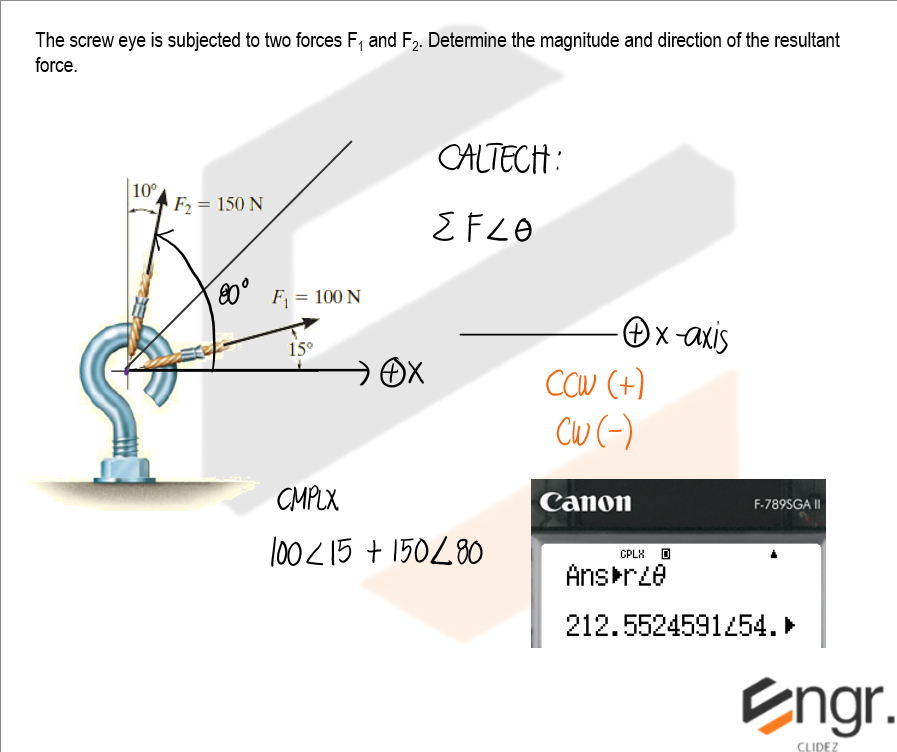
Problem: Screw Eye Resultant Force

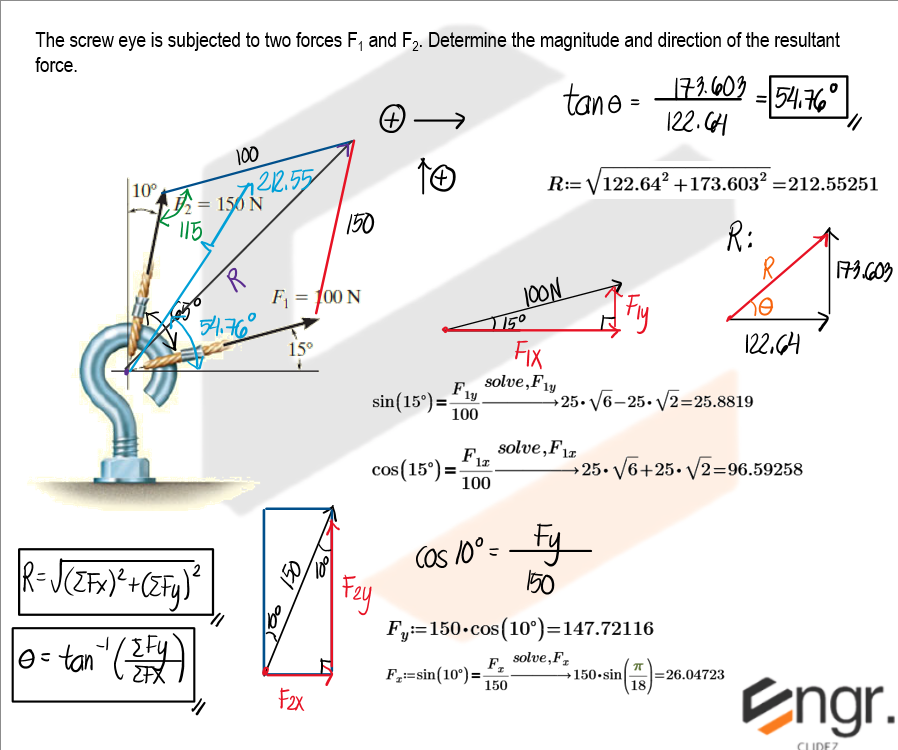
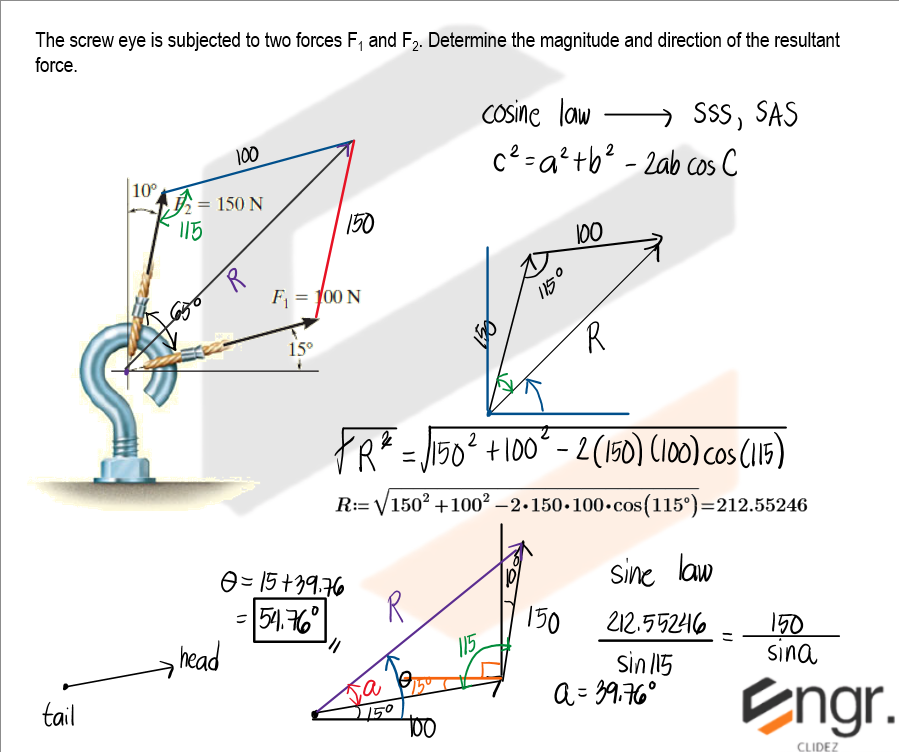
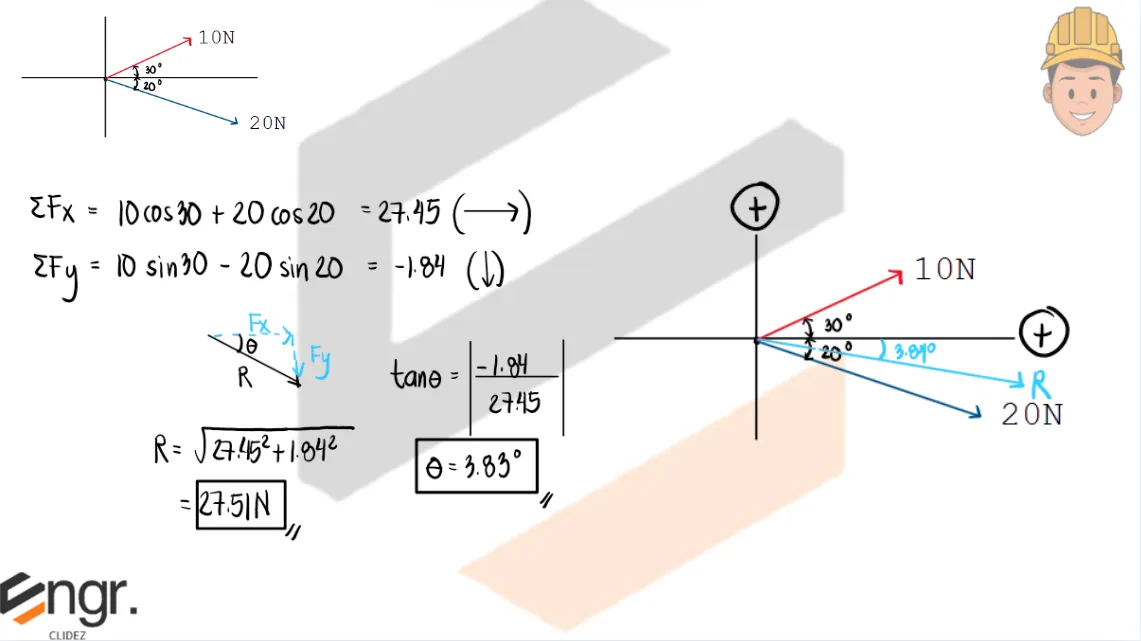
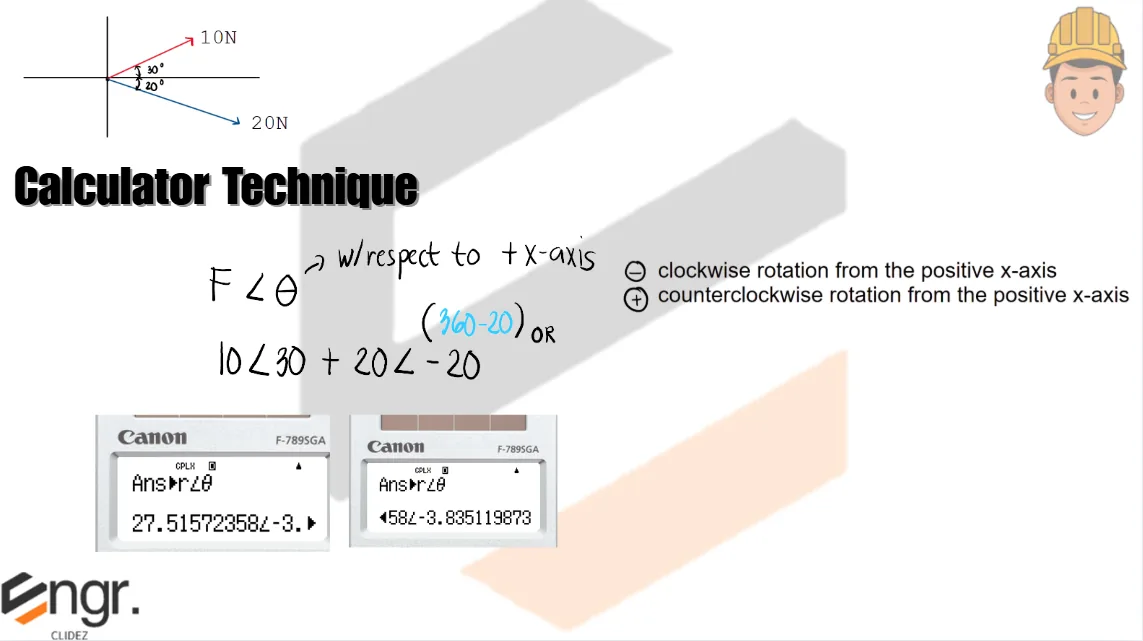
The screw eye is subjected to two forces F1 and F2. Determine the magnitude and direction of the resultant force.
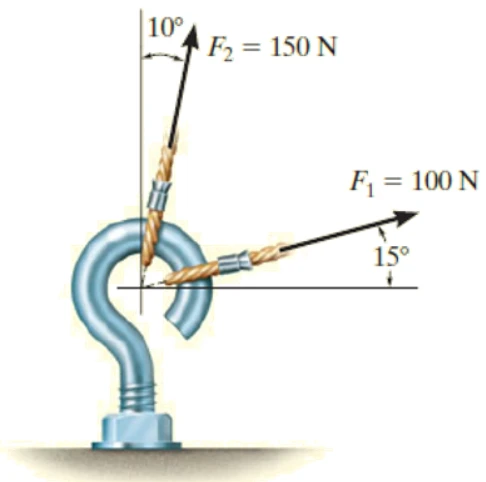
Problem Figure 1

See images:

Solution Diagram 9A Solution Diagram 9B Solution Diagram 9C

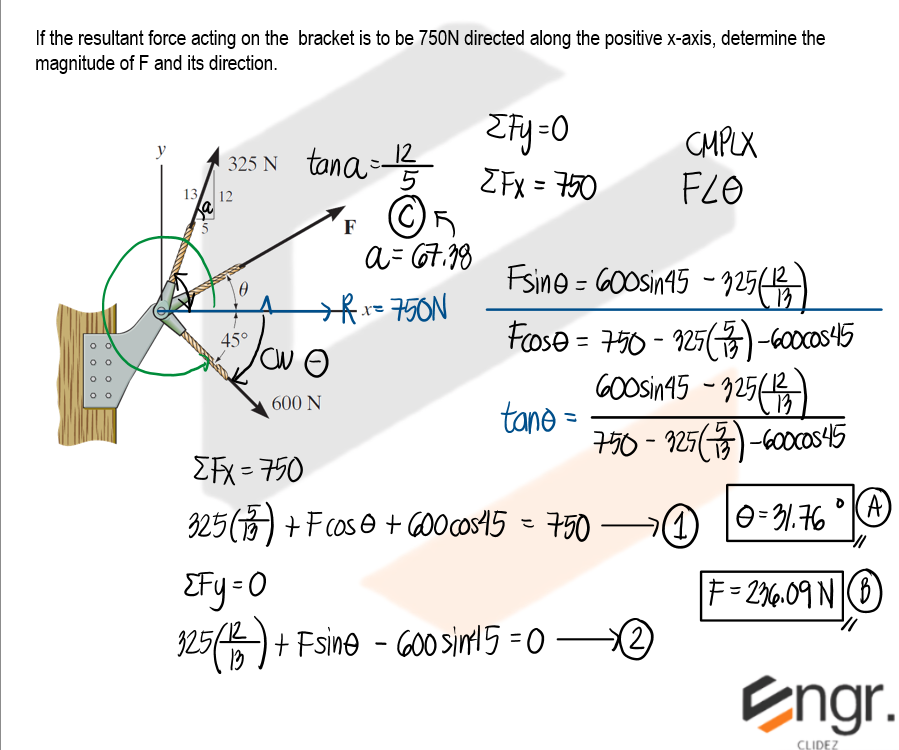
Problem: Resultant Force Along the Positive x-axis

If the resultant force acting on the bracket is to be 750 N directed along the positive x-axis, determine the magnitude of F and its direction.
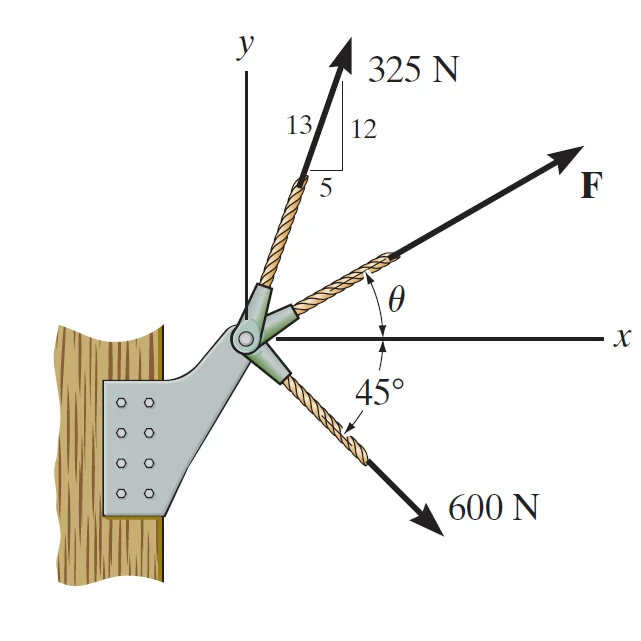
Problem Figure 1

See images:

Solution Diagram 13

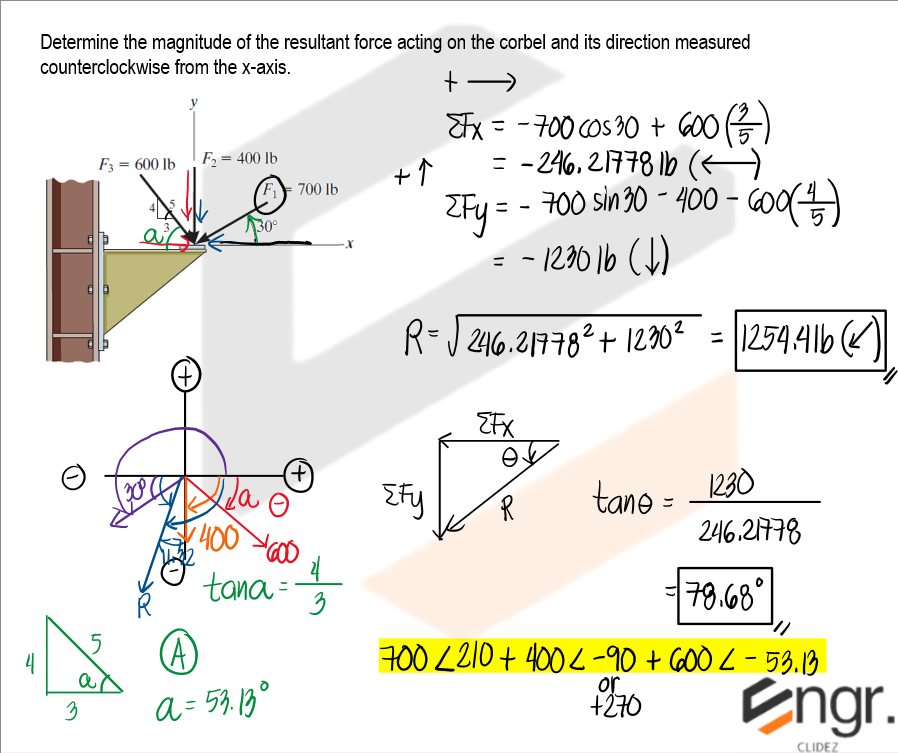
Problem: Corbel Resultant Force

Determine the magnitude of the resultant force acting on the corbel and its direction measured counterclockwise from the x-axis.
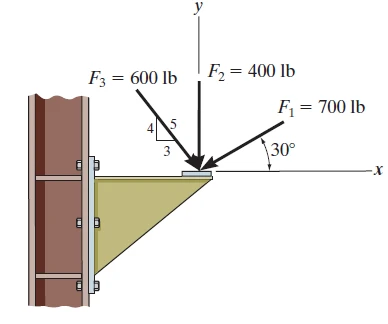
Problem Figure 1

See images:

Solution Diagram 14

Problem (Resultant of two concurrent forces):

Two forces act at a pin: 8kN to the right and 6kN acting 60° above the positive x-axis. Determine the magnitude and direction of the resultant.

Resolve each force into rectangular components, then combine the components.

\[ \begin{aligned} R_x &= 8+6\cos60^\circ=11.00\ \text{kN} \\ R_y &= 6\sin60^\circ=5.20\ \text{kN} \\ R &= \sqrt{11.00^2+5.20^2}=12.16\ \text{kN} \\ \theta &= \tan^{-1}\left({5.20\over 11.00}\right)=25.3^\circ \end{aligned} \] $\boxed{R=12.16\ \text{kN}},\qquad \boxed{\theta=25.3^\circ}$

Problem (Resultant of three concurrent forces):

Forces of 5kN east, 7kN at 120° from the positive x-axis, and 4kN downward act at the same point. Find the resultant force.

Add x-components and y-components with signs.

\[ \begin{aligned} R_x &= 5+7\cos120^\circ=1.50\ \text{kN} \\ R_y &= 7\sin120^\circ-4=2.06\ \text{kN} \\ R &= \sqrt{1.50^2+2.06^2}=2.55\ \text{kN} \\ \theta &= \tan^{-1}\left({2.06\over1.50}\right)=54.0^\circ \end{aligned} \] $\boxed{R=2.55\ \text{kN}},\qquad \boxed{\theta=54.0^\circ}$

Problem (Force required for a vertical resultant):

A 10kN force acts 20° above the positive x-axis. A second force P acts 150° from the positive x-axis. Determine P so that the resultant is vertical, then compute the resultant magnitude.

For the resultant to be vertical, the horizontal components must cancel.

\[ \begin{aligned} \sum F_x=0:\quad 10\cos20^\circ+P\cos150^\circ &= 0 \\ P &= 10.85\ \text{kN} \\ R &= 10\sin20^\circ+10.85\sin150^\circ \\ R &= 8.85\ \text{kN} \end{aligned} \] $\boxed{P=10.85\ \text{kN}},\qquad \boxed{R=8.85\ \text{kN upward}}$
Scroll to zoom

Exam Generator Problems

Additional board-style practice items for this topic.

Question Bank: q25

PSAD - Statics / Resultant of Forces / Engr. Janclyde Espinosa (Clidez)

If the system shown is in equilibrium,
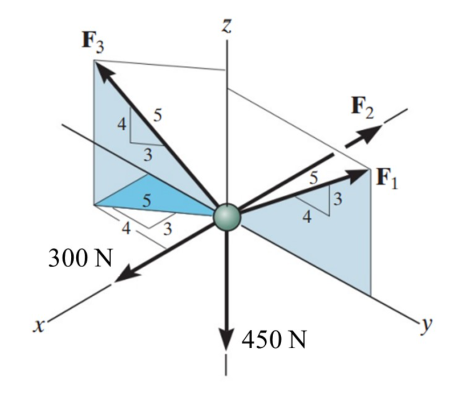
q25

What is the value of F1?

  1. 232.76
  2. 387.93
  3. 439.65
  4. 312.67

What is the value of F2?

  1. 439.65
  2. 312.67
  3. 387.93
  4. 232.76

What is the value of F3?

  1. 387.93
  2. 439.65
  3. 232.76
  4. 312.67

Solution pending in psadquestions/q25.json.

Question Bank: q52

PSAD - Statics / Resultant of Forces / Engr. Janclyde Espinosa (Clidez)

CE Board 2011
An eyebolt is subjected to three forces, A, B, and C, where A=6kN, B=2.4kN, and ϴ=30º.
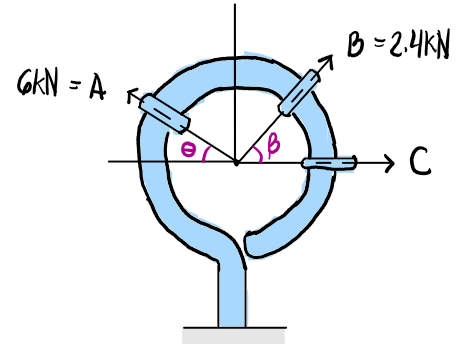
q52

Determine the angle β if the resultant of the three forces acts along the y-axis if C=4.6kN.

  1. 75.62º
  2. 14.38º
  3. 31.48º
  4. 72.65º

What is the resultant of the forces if C=4.6kN and β=45º?

  1. 4.82
  2. 5.67
  3. 8.34
  4. 6.28

Determine the force, C, if the resultant is 7kN acting along the x-axis and β=45º.

  1. 10.5
  2. 0.11
  3. 4.5
  4. 6.7

Solution pending in psadquestions/q52.json.

Question Bank: q552

PSAD - Statics / Resultant of Forces / Engr. Deguma

A force F= 50 N is acting horizontally, and another force P = 60 N is acting upward and to the right. If the resultant of these two forces is 90 N, compute the horizontal component of the resultant in Newtons.

Answer:

  1. 70
  2. 72
  3. 64
  4. 82

Solution pending in psadquestions/q552.json.

Question Bank: q561

PSAD - Statics / Resultant of Forces / Engr. Deguma

A 30N force is acting upward and a 40N force is acting to the right. Compute the magnitude of the third force required for translation equilibrium.

Answer:

  1. 50N
  2. 10N
  3. 70N
  4. 0N

Solution pending in psadquestions/q561.json.

Question Bank: t29

PSAD - Statics / Resultant Forces / Civil Engineering Refresher

Two guy wires are attached to an anchor ring: T1 = 7 kN at 15° and T2 = 3.5 kN at 30°.

Calculate the magnitude of the resultant force.

  1. 5.156 kN
  2. 10.50 kN
  3. 3.73 kN
  4. 7.33 kN

Determine the angle of the resultant force from Question 31 with respect to the horizontal axis.

  1. 43.7°
  2. 22.5°
  3. 15.0°
  4. 60.0°

For the anchor ring in Question 31, determine the concrete block weight W required to prevent uplift using a factor of safety of 1.25.

  1. 4.45 kN
  2. 3.56 kN
  3. 5.57 kN
  4. 4.00 kN

Part 1.

Resolve the two tensions into perpendicular components. Taking the horizontal components opposite in sense:
$R_x = 7\cos 15^\circ - 3.5\cos 30^\circ = 3.728$ kN
$R_y = 7\sin 15^\circ + 3.5\sin 30^\circ = 3.562$ kN
$R = \sqrt{R_x^2 + R_y^2} = \sqrt{3.728^2 + 3.562^2}$
$\boxed{R = 5.156\text{ kN}}$

Part 2.

Use the resultant components from the previous item:
$R_x = 3.728$ kN, $R_y = 3.562$ kN
$\theta = \tan^{-1}\left(\frac{R_y}{R_x}\right) = \tan^{-1}\left(\frac{3.562}{3.728}\right)$
$\boxed{\theta = 43.7^\circ}$

Part 3.

The uplift to be resisted is the vertical component of the resultant:
$R_y = 3.562$ kN
With factor of safety $FS = 1.25$:
$W = FS(R_y) = 1.25(3.562)$
$\boxed{W = 4.45\text{ kN}}$

Question Bank: t31

PSAD - Statics / Resultant Forces / Civil Engineering Refresher

A hook is subjected to forces A = 35 kN and B = 45 kN.

If the resultant is 80 kN acting along the positive x-axis, find the angle α.

  1. 22.85°
  2. 30.00°
  3. 15.75°
  4. 25.50°

If α = 60° for the hook in Question 37, find the value of force C such that the total resultant acts strictly along the x-axis.

  1. 45 kN
  2. 35 kN
  3. 40 kN
  4. 50 kN

For the hook forces A, B, and C to be in a state of static equilibrium, what is the required magnitude of force C?

  1. 40.9 kN
  2. 80.0 kN
  3. 38.97 kN
  4. 12.5 kN

Solution pending in psadquestions/t31.json.