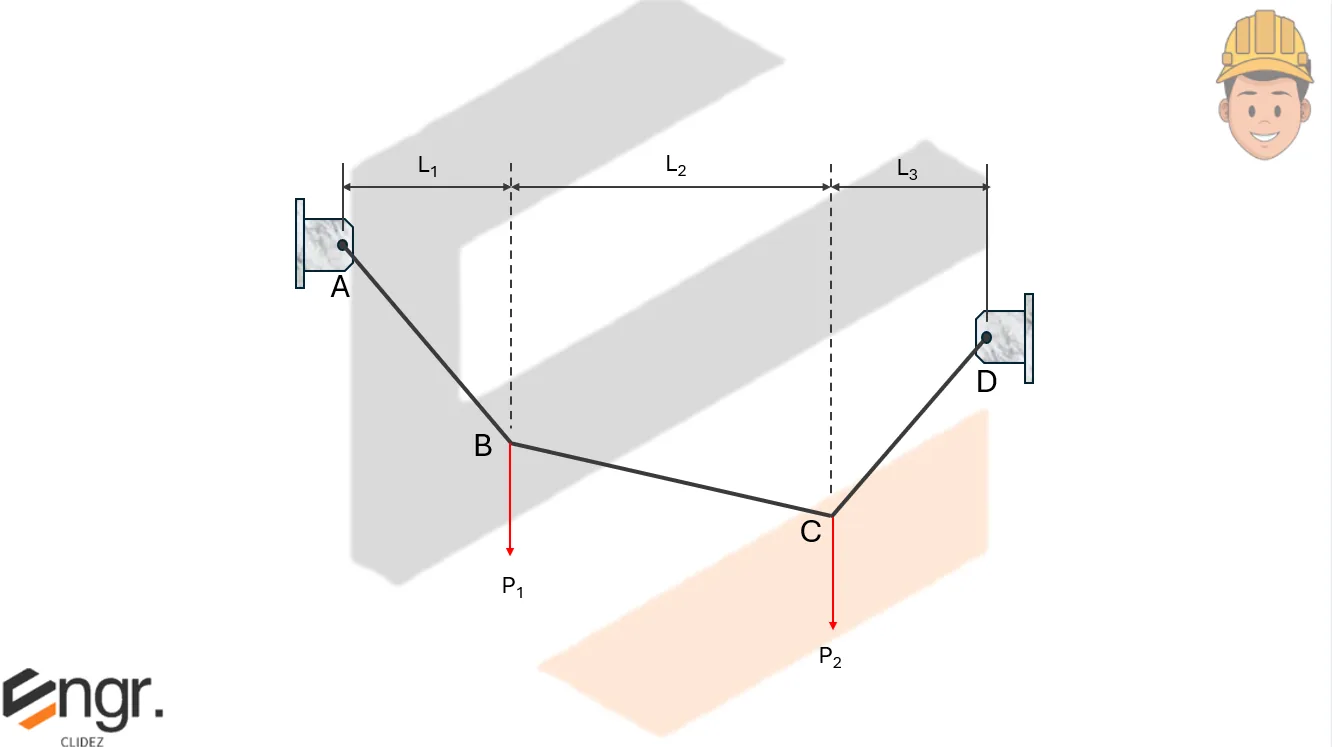
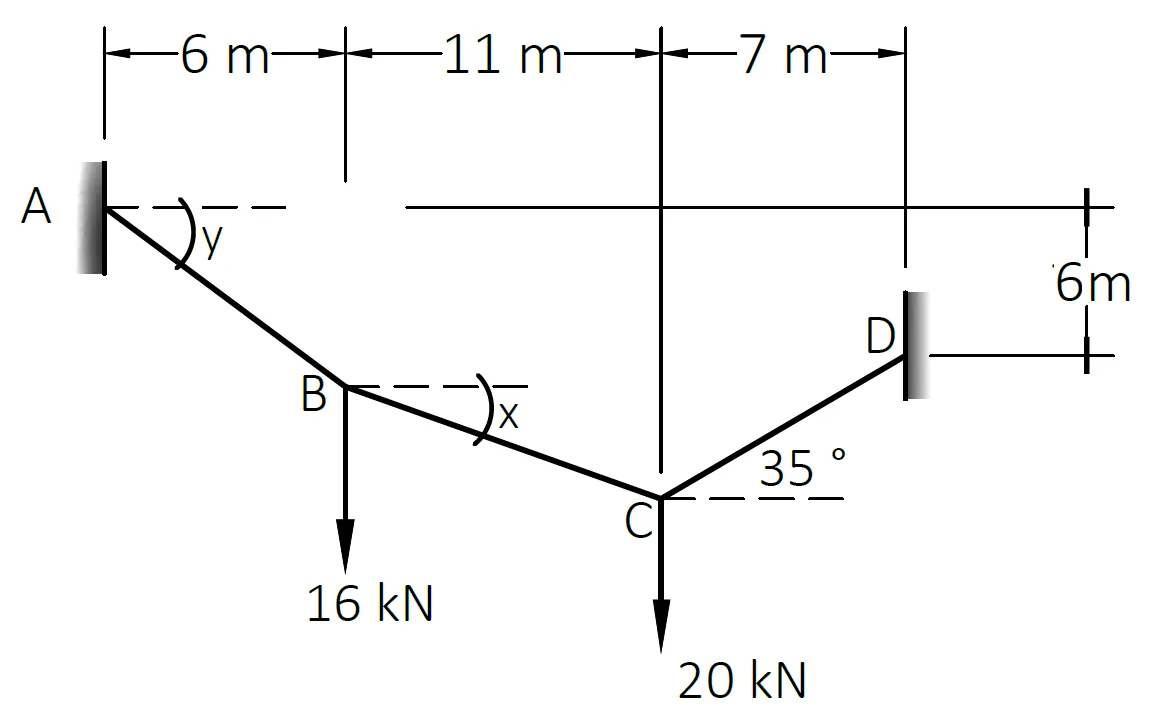
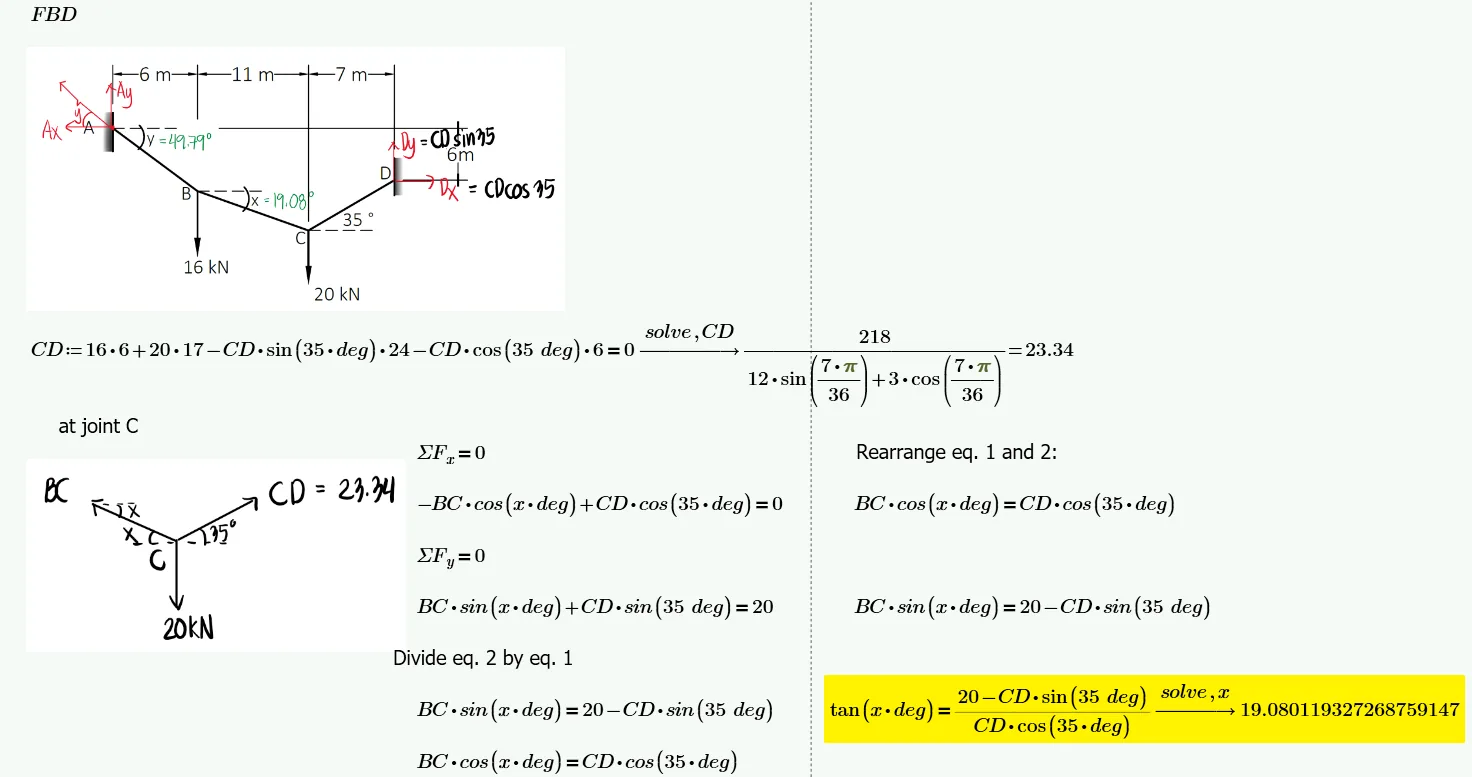
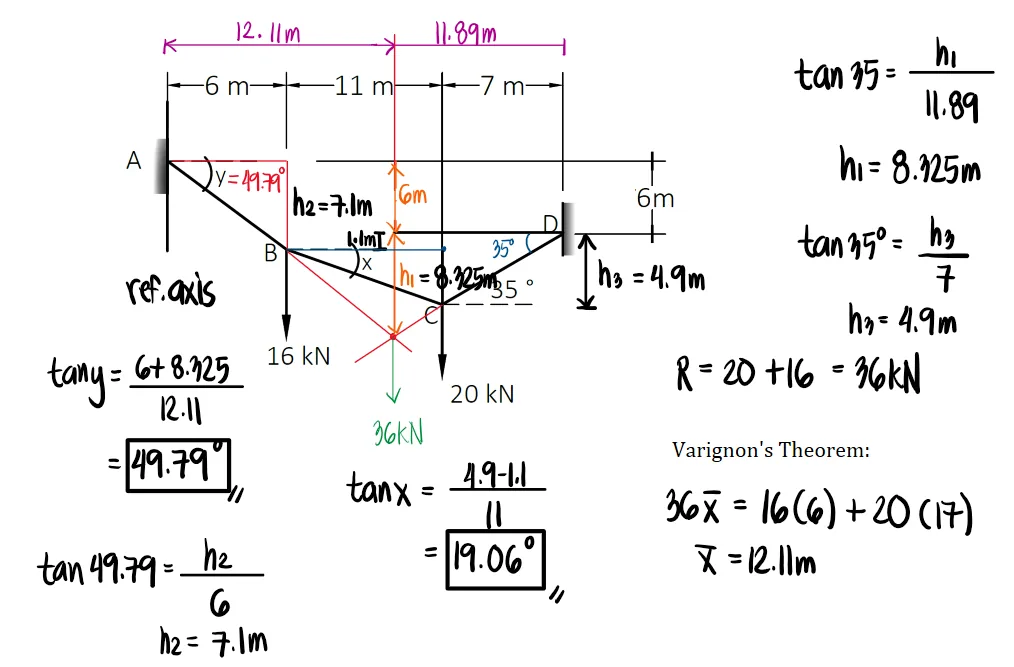
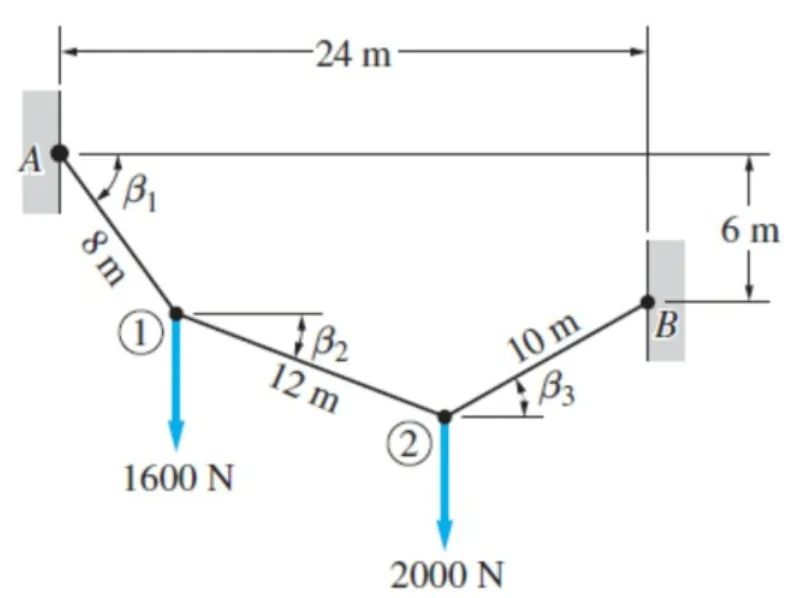
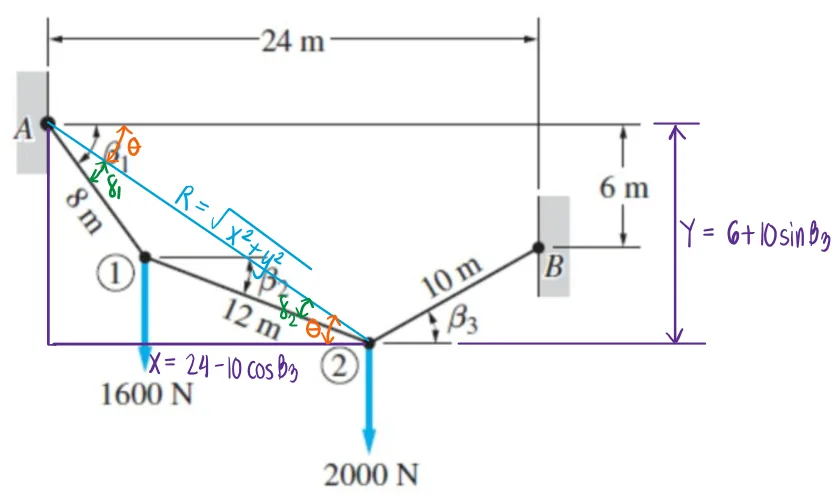
A cable is composed of three straight segments having lengths of 8 m, 12 m, and 10 m.
The cable is supported at points A and B, where B is 6 m lower than A. The horizontal
distance from A to B is 24 m. A vertical load of 1600 N acts at the first joint, and
a vertical load of 2000 N acts at the second joint.
Determine the angles $\beta_1$, $\beta_2$, and $\beta_3$, the common horizontal component
of tension $H$, and the tensions in the three cable segments.
Step 1: Use $\beta_3$ as the only unknown angle.
We will reduce the problem to one unknown by assuming that $\beta_3$ is the only unknown.
The other two angles, $\beta_1$ and $\beta_2$, will be written in terms of $\beta_3$ using geometry.
Step 2: Express the position of the second joint in terms of $\beta_3$.
The third cable segment has a length of 10 m and makes an angle $\beta_3$ with the horizontal.
Therefore, its horizontal projection is $10\cos\beta_3$, and its vertical projection is
$10\sin\beta_3$.
Since the total horizontal distance from A to B is 24 m, the horizontal distance from A to
the second joint is:
$$
X = 24 - 10\cos\beta_3
$$
Since B is 6 m lower than A, and the second joint is below B by $10\sin\beta_3$, the vertical
drop from A to the second joint is:
$$
Y = 6 + 10\sin\beta_3
$$
Step 3: Find the imaginary straight distance from A to the second joint.
The first two cable segments, 8 m and 12 m, form a triangle with an imaginary straight line
from A to the second joint. Call this imaginary distance $R$.
$$
R = \sqrt{X^2 + Y^2}
$$
$$
R =
\sqrt{
(24 - 10\cos\beta_3)^2
+
(6 + 10\sin\beta_3)^2
}
$$
This distance $R$ is not an actual cable segment. It is only a helper line used to form the
triangle involving the first two cable segments.
Step 4: Find the angle of the imaginary line $R$.
The angle of $R$ from the horizontal is:
$$
\theta = \tan^{-1}\left(\frac{Y}{X}\right)
$$
$$
\theta =
\tan^{-1}
\left(
\frac{6 + 10\sin\beta_3}
{24 - 10\cos\beta_3}
\right)
$$
Step 5: Use the triangle formed by sides 8, 12, and $R$.
The first two cable segments and the imaginary line $R$ form a triangle with sides:
$$
8,\quad 12,\quad R
$$
Let $\delta_1$ be the angle between the 8-m segment and $R$. Using the cosine law:
$$
\cos\delta_1 =
\frac{8^2 + R^2 - 12^2}{2(8)(R)}
$$
$$
\cos\delta_1 =
\frac{64 + R^2 - 144}{16R}
$$
$$
\cos\delta_1 =
\frac{R^2 - 80}{16R}
$$
Therefore:
$$
\delta_1 =
\cos^{-1}
\left(
\frac{R^2 - 80}{16R}
\right)
$$
Substitute the expression for $R$:
$$
\delta_1 =
\cos^{-1}
\left(
\frac{
(24 - 10\cos\beta_3)^2
+
(6 + 10\sin\beta_3)^2
-
80
}{
16
\sqrt{
(24 - 10\cos\beta_3)^2
+
(6 + 10\sin\beta_3)^2
}
}
\right)
$$
Step 6: Solve for $\delta_2$ using the same triangle.
Let $\delta_2$ be the angle between the 12-m segment and $R$. Again, using the cosine law:
$$
\cos\delta_2 =
\frac{12^2 + R^2 - 8^2}{2(12)(R)}
$$
$$
\cos\delta_2 =
\frac{144 + R^2 - 64}{24R}
$$
$$
\cos\delta_2 =
\frac{R^2 + 80}{24R}
$$
Therefore:
$$
\delta_2 =
\cos^{-1}
\left(
\frac{R^2 + 80}{24R}
\right)
$$
Substitute the expression for $R$:
$$
\delta_2 =
\cos^{-1}
\left(
\frac{
(24 - 10\cos\beta_3)^2
+
(6 + 10\sin\beta_3)^2
+
80
}{
24
\sqrt{
(24 - 10\cos\beta_3)^2
+
(6 + 10\sin\beta_3)^2
}
}
\right)
$$
Step 7: Express $\beta_1$ in terms of $\beta_3$.
From the geometry of the triangle:
$$
\beta_1 = \theta + \delta_1
$$
Substitute the full expressions for $\theta$ and $\delta_1$:
$$
\beta_1 =
\tan^{-1}
\left(
\frac{6 + 10\sin\beta_3}
{24 - 10\cos\beta_3}
\right)
+
\cos^{-1}
\left(
\frac{
(24 - 10\cos\beta_3)^2
+
(6 + 10\sin\beta_3)^2
-
80
}{
16
\sqrt{
(24 - 10\cos\beta_3)^2
+
(6 + 10\sin\beta_3)^2
}
}
\right)
$$
Step 8: Express $\beta_2$ in terms of $\beta_3$.
From the same geometry:
$$
\beta_2 = \theta - \delta_2
$$
Substitute the full expressions for $\theta$ and $\delta_2$:
$$
\beta_2 =
\tan^{-1}
\left(
\frac{6 + 10\sin\beta_3}
{24 - 10\cos\beta_3}
\right)
-
\cos^{-1}
\left(
\frac{
(24 - 10\cos\beta_3)^2
+
(6 + 10\sin\beta_3)^2
+
80
}{
24
\sqrt{
(24 - 10\cos\beta_3)^2
+
(6 + 10\sin\beta_3)^2
}
}
\right)
$$
Step 9: Derive the force equation.
At the joints, the loads are vertical only. Therefore, the horizontal component of tension is
the same in all cable segments. Let this common horizontal component be $H$.
From vertical equilibrium at the first joint:
$$
H(\tan\beta_1 - \tan\beta_2) = 1600
$$
From vertical equilibrium at the second joint:
$$
H(\tan\beta_2 + \tan\beta_3) = 2000
$$
Divide the first equation by the second equation:
$$
\frac{H(\tan\beta_1 - \tan\beta_2)}
{H(\tan\beta_2 + \tan\beta_3)}
=
\frac{1600}{2000}
$$
$$
\frac{\tan\beta_1 - \tan\beta_2}
{\tan\beta_2 + \tan\beta_3}
=
0.8
$$
Cross multiply and simplify:
$$
\tan\beta_1 - \tan\beta_2
=
0.8(\tan\beta_2 + \tan\beta_3)
$$
$$
\tan\beta_1 - \tan\beta_2
=
0.8\tan\beta_2 + 0.8\tan\beta_3
$$
$$
\tan\beta_1 - 1.8\tan\beta_2 - 0.8\tan\beta_3 = 0
$$
Step 10: Substitute $\beta_1$ and $\beta_2$ to get one equation with one unknown.
Substitute the expressions for $\beta_1$ and $\beta_2$ into:
$$
\tan\beta_1 - 1.8\tan\beta_2 - 0.8\tan\beta_3 = 0
$$
The resulting equation contains only one unknown, $\beta_3$:
$$
\tan
\left[
\tan^{-1}
\left(
\frac{6 + 10\sin\beta_3}
{24 - 10\cos\beta_3}
\right)
+
\cos^{-1}
\left(
\frac{
(24 - 10\cos\beta_3)^2
+
(6 + 10\sin\beta_3)^2
-
80
}{
16
\sqrt{
(24 - 10\cos\beta_3)^2
+
(6 + 10\sin\beta_3)^2
}
}
\right)
\right]
$$
$$
-
1.8
\tan
\left[
\tan^{-1}
\left(
\frac{6 + 10\sin\beta_3}
{24 - 10\cos\beta_3}
\right)
-
\cos^{-1}
\left(
\frac{
(24 - 10\cos\beta_3)^2
+
(6 + 10\sin\beta_3)^2
+
80
}{
24
\sqrt{
(24 - 10\cos\beta_3)^2
+
(6 + 10\sin\beta_3)^2
}
}
\right)
\right]
-
0.8\tan\beta_3
=
0
$$
This is now a one-unknown equation. Students can solve this directly using a calculator in
degree mode.
Step 11: Solve for $\beta_3$.
Using calculator trial, table mode, or numerical solve:
$$
\beta_3 \approx 33.23^\circ
$$
Step 12: Back-substitute to solve for $\beta_1$ and $\beta_2$.
Use the expression for $\beta_1$:
$$
\beta_1 =
\tan^{-1}
\left(
\frac{6 + 10\sin\beta_3}
{24 - 10\cos\beta_3}
\right)
+
\cos^{-1}
\left(
\frac{
(24 - 10\cos\beta_3)^2
+
(6 + 10\sin\beta_3)^2
-
80
}{
16
\sqrt{
(24 - 10\cos\beta_3)^2
+
(6 + 10\sin\beta_3)^2
}
}
\right)
$$
$$
\beta_1 \approx 53.62^\circ
$$
Use the expression for $\beta_2$:
$$
\beta_2 =
\tan^{-1}
\left(
\frac{6 + 10\sin\beta_3}
{24 - 10\cos\beta_3}
\right)
-
\cos^{-1}
\left(
\frac{
(24 - 10\cos\beta_3)^2
+
(6 + 10\sin\beta_3)^2
+
80
}{
24
\sqrt{
(24 - 10\cos\beta_3)^2
+
(6 + 10\sin\beta_3)^2
}
}
\right)
$$
$$
\beta_2 \approx 24.83^\circ
$$
Step 13: Solve for the common horizontal component $H$.
Use the second joint equation:
$$
H(\tan\beta_2 + \tan\beta_3) = 2000
$$
$$
H =
\frac{2000}{\tan\beta_2 + \tan\beta_3}
$$
$$
H =
\frac{2000}{\tan 24.83^\circ + \tan 33.23^\circ}
$$
$$
H \approx 1788.8 \text{ N}
$$
Step 14: Solve for the cable tensions.
Since $H$ is the horizontal component of tension:
$$
H = T\cos\beta
$$
$$
T = \frac{H}{\cos\beta}
$$
For the first cable segment:
$$
T_1 = \frac{1788.8}{\cos 53.62^\circ}
$$
$$
T_1 \approx 3016 \text{ N}
$$
For the second cable segment:
$$
T_2 = \frac{1788.8}{\cos 24.83^\circ}
$$
$$
T_2 \approx 1971 \text{ N}
$$
For the third cable segment:
$$
T_3 = \frac{1788.8}{\cos 33.23^\circ}
$$
$$
T_3 \approx 2139 \text{ N}
$$
Final Answers:
$$
\boxed{\beta_1 \approx 53.62^\circ}
$$
$$
\boxed{\beta_2 \approx 24.83^\circ}
$$
$$
\boxed{\beta_3 \approx 33.23^\circ}
$$
$$
\boxed{H \approx 1788.8 \text{ N}}
$$
$$
\boxed{T_1 \approx 3016 \text{ N}}
$$
$$
\boxed{T_2 \approx 1971 \text{ N}}
$$
$$
\boxed{T_3 \approx 2139 \text{ N}}
$$
Alternative Solution: Using Trigonometric Identities
The previous method substitutes the full expressions of $\beta_1$ and $\beta_2$ directly into the
force equation. Another way is to use trigonometric identities so that the final expression is more
calculator-friendly.
Alternative Step 1: Start with the same geometric quantities.
From the third cable segment:
$$
X = 24 - 10\cos\beta_3
$$
$$
Y = 6 + 10\sin\beta_3
$$
$$
R =
\sqrt{
(24 - 10\cos\beta_3)^2
+
(6 + 10\sin\beta_3)^2
}
$$
The angle of the imaginary line $R$ is $\theta$, so:
$$
\tan\theta = \frac{Y}{X}
$$
$$
\tan\theta =
\frac{6 + 10\sin\beta_3}
{24 - 10\cos\beta_3}
$$
Alternative Step 2: Express $\tan\delta_1$ using the cosine law.
From the triangle with sides 8, 12, and $R$:
$$
\cos\delta_1 =
\frac{R^2 - 80}{16R}
$$
Since:
$$
\tan\delta_1 =
\frac{\sin\delta_1}{\cos\delta_1}
$$
$$
\sin\delta_1 =
\sqrt{1-\cos^2\delta_1}
$$
then:
$$
\tan\delta_1 =
\frac{
\sqrt{
1 -
\left(
\frac{R^2 - 80}{16R}
\right)^2
}
}{
\frac{R^2 - 80}{16R}
}
$$
Substitute the full expression of $R$:
$$
\tan\delta_1 =
\frac{
\sqrt{
1 -
\left(
\frac{
(24 - 10\cos\beta_3)^2
+
(6 + 10\sin\beta_3)^2
-
80
}{
16
\sqrt{
(24 - 10\cos\beta_3)^2
+
(6 + 10\sin\beta_3)^2
}
}
\right)^2
}
}{
\frac{
(24 - 10\cos\beta_3)^2
+
(6 + 10\sin\beta_3)^2
-
80
}{
16
\sqrt{
(24 - 10\cos\beta_3)^2
+
(6 + 10\sin\beta_3)^2
}
}
}
$$
Alternative Step 3: Express $\tan\delta_2$ using the cosine law.
From the same triangle:
$$
\cos\delta_2 =
\frac{R^2 + 80}{24R}
$$
Therefore:
$$
\tan\delta_2 =
\frac{
\sqrt{
1 -
\left(
\frac{R^2 + 80}{24R}
\right)^2
}
}{
\frac{R^2 + 80}{24R}
}
$$
Substitute the full expression of $R$:
$$
\tan\delta_2 =
\frac{
\sqrt{
1 -
\left(
\frac{
(24 - 10\cos\beta_3)^2
+
(6 + 10\sin\beta_3)^2
+
80
}{
24
\sqrt{
(24 - 10\cos\beta_3)^2
+
(6 + 10\sin\beta_3)^2
}
}
\right)^2
}
}{
\frac{
(24 - 10\cos\beta_3)^2
+
(6 + 10\sin\beta_3)^2
+
80
}{
24
\sqrt{
(24 - 10\cos\beta_3)^2
+
(6 + 10\sin\beta_3)^2
}
}
}
$$
Alternative Step 4: Use the tangent sum identity for $\beta_1$.
From geometry:
$$
\beta_1 = \theta + \delta_1
$$
Using the identity:
$$
\tan(A+B)=\frac{\tan A+\tan B}{1-\tan A\tan B}
$$
Therefore:
$$
\tan\beta_1 =
\frac{
\tan\theta + \tan\delta_1
}{
1 - \tan\theta\tan\delta_1
}
$$
Alternative Step 5: Use the tangent difference identity for $\beta_2$.
From geometry:
$$
\beta_2 = \theta - \delta_2
$$
Using the identity:
$$
\tan(A-B)=\frac{\tan A-\tan B}{1+\tan A\tan B}
$$
Therefore:
$$
\tan\beta_2 =
\frac{
\tan\theta - \tan\delta_2
}{
1 + \tan\theta\tan\delta_2
}
$$
Alternative Step 6: Substitute into the force equation.
From equilibrium, the one-unknown force equation is still:
$$
\tan\beta_1 - 1.8\tan\beta_2 - 0.8\tan\beta_3 = 0
$$
Substitute the identity forms of $\tan\beta_1$ and $\tan\beta_2$:
$$
\frac{
\tan\theta + \tan\delta_1
}{
1 - \tan\theta\tan\delta_1
}
-
1.8
\left(
\frac{
\tan\theta - \tan\delta_2
}{
1 + \tan\theta\tan\delta_2
}
\right)
-
0.8\tan\beta_3
=
0
$$
where:
$$
\tan\theta =
\frac{6 + 10\sin\beta_3}
{24 - 10\cos\beta_3}
$$
$$
\tan\delta_1 =
\frac{
\sqrt{
1 -
\left(
\frac{R^2 - 80}{16R}
\right)^2
}
}{
\frac{R^2 - 80}{16R}
}
$$
$$
\tan\delta_2 =
\frac{
\sqrt{
1 -
\left(
\frac{R^2 + 80}{24R}
\right)^2
}
}{
\frac{R^2 + 80}{24R}
}
$$
$$
R =
\sqrt{
(24 - 10\cos\beta_3)^2
+
(6 + 10\sin\beta_3)^2
}
$$
This is also a one-unknown equation because every term is written in terms of $\beta_3$ only.
Alternative Step 7: Solve the identity-based equation.
Using calculator solve, table mode, or trial and error in degree mode:
$$
\beta_3 \approx 33.23^\circ
$$
Then the remaining values are obtained the same way:
$$
\beta_1 \approx 53.62^\circ
$$
$$
\beta_2 \approx 24.83^\circ
$$
$$
H \approx 1788.8 \text{ N}
$$
$$
T_1 \approx 3016 \text{ N}
$$
$$
T_2 \approx 1971 \text{ N}
$$
$$
T_3 \approx 2139 \text{ N}
$$
This alternative method avoids writing $\tan[\tan^{-1}(\cdots)+\cos^{-1}(\cdots)]$ directly.
Instead, it computes the tangent of each angle using trigonometric identities.