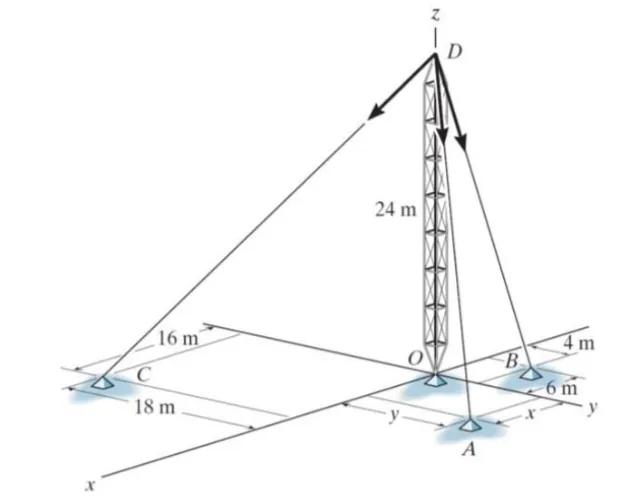
A tower is held in place by a ball and socket support at its base and three cables attached at various points along its height. At the mid-height of the tower, a 70-kN lateral force acts along the negative x-axis. Note: The indicated x-axis in the figure is the positive x-axis.
Given:
x=18m
y=22m
The 70-kN horizontal load is applied at the mid-height of the 24-m tower. For the free-body setup used here, translate it into equivalent joint forces shared by the top joint $D$ and the ball-and-socket support at $O$, so the horizontal force used at the top joint is $70/2=35$ kN.
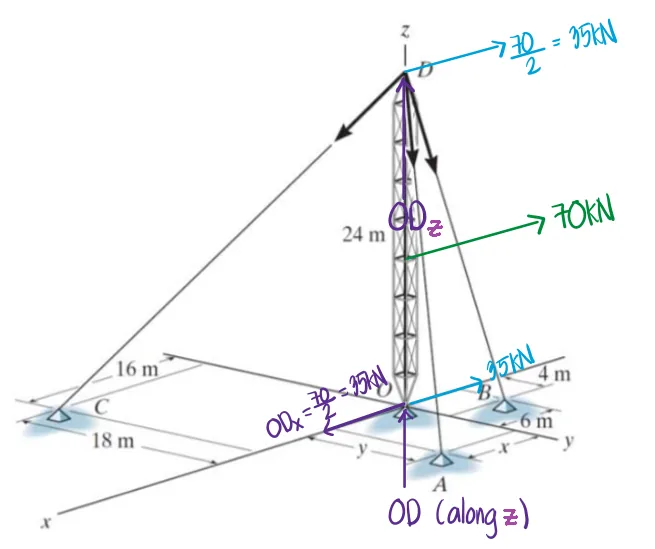
Use cable direction cosines from the top of the tower at $D$ to the ground anchors $C$, $A$, and $B$:
$$
\begin{aligned}
L_{CD} &= \sqrt{16^2+18^2+24^2}=34 \text{ m} \\
L_{AD} &= \sqrt{18^2+22^2+24^2}=37.20215 \text{ m} \\
L_{BD} &= \sqrt{6^2+4^2+24^2}=25.05993 \text{ m}
\end{aligned}
$$
Let $CD$, $AD$, and $BD$ be the cable tensions, and let $OD$ be the vertical reaction at the support. Substituting the actual dimensions into the equilibrium equations:
$$
\begin{array}{l}
\sum F_x=0 \\
35-CD\left(\frac{16}{34}\right)-AD\left(\frac{18}{37.20215}\right)+BD\left(\frac{6}{25.05993}\right)=0 \\[8pt]
\sum F_z=0 \\
-CD\left(\frac{24}{34}\right)-AD\left(\frac{24}{37.20215}\right)+BD\left(\frac{24}{25.05993}\right)+OD=0 \\[8pt]
\sum F_y=0 \\
-CD\left(\frac{18}{34}\right)+AD\left(\frac{22}{37.20215}\right)+BD\left(\frac{4}{25.05993}\right)=0
\end{array}
$$
Due to the direction of the lateral load, cable $BD$ would tend to shorten and go into compression in the trial equilibrium setup. Since a cable can carry tension only and cannot resist compression, set:
$$BD=0$$
Solving with $BD=0$, the equilibrium equations reduce to:
$$
\begin{array}{l}
\sum F_x=0 \\
35-CD\left(\frac{16}{34}\right)-AD\left(\frac{18}{37.20215}\right)=0 \\[8pt]
\sum F_z=0 \\
-CD\left(\frac{24}{34}\right)-AD\left(\frac{24}{37.20215}\right)+OD=0 \\[8pt]
\sum F_y=0 \\
-CD\left(\frac{18}{34}\right)+AD\left(\frac{22}{37.20215}\right)=0
\end{array}
$$
From these equations:
$$
\begin{bmatrix}
CD\\
AD\\
BD\\
OD
\end{bmatrix}
=
\begin{bmatrix}
38.72781\\
34.67064\\
0\\
49.70414
\end{bmatrix}
\text{ kN}
$$
The ball-and-socket support has a vertical component $OD=49.70414$ kN and a horizontal component equal to the translated joint load, $35$ kN. Thus the resultant support reaction is:
$$
R_{OD}=\sqrt{49.70414^2+35^2}=60.79064 \text{ kN}
$$
$$
\boxed{CD=38.73\text{ kN}},\quad
\boxed{AD=34.67\text{ kN}},\quad
\boxed{BD=0},\quad
\boxed{R_{OD}=60.79\text{ kN}}
$$