CE Board Exam Randomizer

⬅ Back to Subject Topics

Belt Friction

Concept

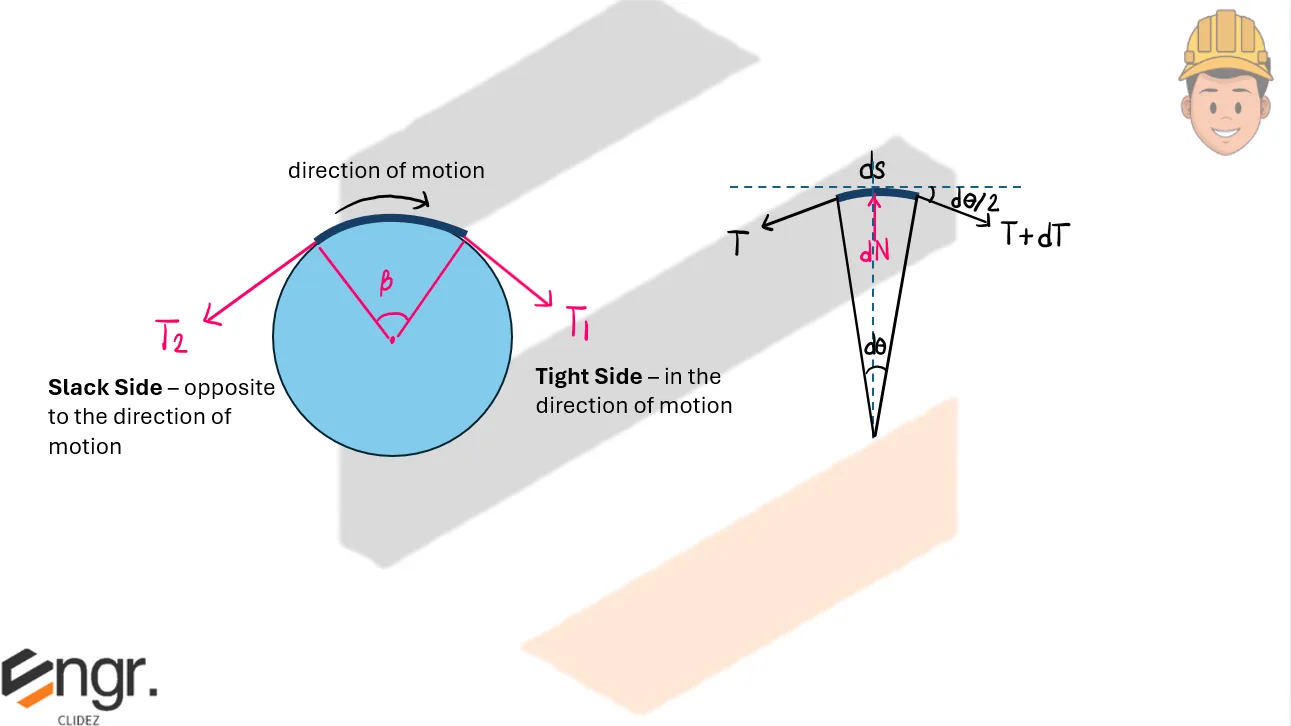
To derive the belt friction equation, consider an infinitesimal element of the belt that subtends a small angle \( d\theta \) on the surface of a pulley. Tension forces on either side of this segment are:

These forces are separated by an angle \( d\theta \), so they each deviate from the central direction by \( \frac{d\theta}{2} \). A normal force \( dN \) acts radially inward, and the frictional force \( dF \) opposes the relative slipping motion.

In equilibrium (neglecting second-order small terms), summing forces in the tangential direction yields:

$$ dT = \mu \, dN $$

In the normal direction:

$$ dN = T \, d\theta $$

Substituting into the tangential equation:

$$ dT = \mu T \, d\theta $$

Separating variables:

$$ \frac{dT}{T} = \mu \, d\theta $$

Integrating from \( T_2 \) to \( T_1 \), and from \( 0 \) to \( \beta \):

$$ \int_{T_2}^{T_1} \frac{dT}{T} = \mu \int_0^\beta d\theta $$
$$ \ln\left( \frac{T_1}{T_2} \right) = \mu \beta $$
$${T_1 = T_2 e^{\mu \beta}} $$

This final equation relates the tensions on the tight and slack sides of a belt in contact with a surface over an angle \( \beta \) (in radians), where \( \mu \) is the coefficient of static friction.

Concept Concept Concept Concept Concept Concept Concept Concept

Problem:

Refer to the image shown:

Belt Friction | Statics of Rigid Bodies – Problem 1: – Diagram Belt Friction | Statics of Rigid Bodies – Problem 1: – Diagram Belt Friction | Statics of Rigid Bodies – Problem 1: – Diagram

See images:

Belt Friction | Statics of Rigid Bodies – Problem 1: – Diagram Belt Friction | Statics of Rigid Bodies – Problem 1: – Diagram Belt Friction | Statics of Rigid Bodies – Problem 1: – Diagram Belt Friction | Statics of Rigid Bodies – Problem 1: – Diagram

Problem:

Refer to the image shown:

Belt Friction | Statics of Rigid Bodies – Problem 2: – Diagram Belt Friction | Statics of Rigid Bodies – Problem 2: – Diagram Belt Friction | Statics of Rigid Bodies – Problem 2: – Diagram

See images:

Belt Friction | Statics of Rigid Bodies – Problem 2: – Diagram Belt Friction | Statics of Rigid Bodies – Problem 2: – Diagram Belt Friction | Statics of Rigid Bodies – Problem 2: – Diagram Belt Friction | Statics of Rigid Bodies – Problem 2: – Diagram

Problem:

Refer to the image shown:

Belt Friction | Statics of Rigid Bodies – Problem 3: – Diagram Belt Friction | Statics of Rigid Bodies – Problem 3: – Diagram Belt Friction | Statics of Rigid Bodies – Problem 3: – Diagram

See images:

Belt Friction | Statics of Rigid Bodies – Problem 3: – Diagram Belt Friction | Statics of Rigid Bodies – Problem 3: – Diagram Belt Friction | Statics of Rigid Bodies – Problem 3: – Diagram Belt Friction | Statics of Rigid Bodies – Problem 3: – Diagram

Problem:

Refer to the image shown:

Belt Friction | Statics of Rigid Bodies – Problem 4: – Diagram Belt Friction | Statics of Rigid Bodies – Problem 4: – Diagram Belt Friction | Statics of Rigid Bodies – Problem 4: – Diagram

See images:

Belt Friction | Statics of Rigid Bodies – Problem 4: – Diagram Belt Friction | Statics of Rigid Bodies – Problem 4: – Diagram Belt Friction | Statics of Rigid Bodies – Problem 4: – Diagram Belt Friction | Statics of Rigid Bodies – Problem 4: – Diagram

Problem:

Refer to the image shown:

Belt Friction | Statics of Rigid Bodies – Problem 5: – Diagram Belt Friction | Statics of Rigid Bodies – Problem 5: – Diagram Belt Friction | Statics of Rigid Bodies – Problem 5: – Diagram

See images:

Belt Friction | Statics of Rigid Bodies – Problem 5: – Diagram Belt Friction | Statics of Rigid Bodies – Problem 5: – Diagram Belt Friction | Statics of Rigid Bodies – Problem 5: – Diagram Belt Friction | Statics of Rigid Bodies – Problem 5: – Diagram

Problem:

Refer to the image shown:

Belt Friction | Statics of Rigid Bodies – Problem 6: – Diagram Belt Friction | Statics of Rigid Bodies – Problem 6: – Diagram Belt Friction | Statics of Rigid Bodies – Problem 6: – Diagram

See images:

Belt Friction | Statics of Rigid Bodies – Problem 6: – Diagram Belt Friction | Statics of Rigid Bodies – Problem 6: – Diagram Belt Friction | Statics of Rigid Bodies – Problem 6: – Diagram Belt Friction | Statics of Rigid Bodies – Problem 6: – Diagram

Problem:

Refer to the image shown:

Belt Friction | Statics of Rigid Bodies – Problem 7: – Diagram Belt Friction | Statics of Rigid Bodies – Problem 7: – Diagram Belt Friction | Statics of Rigid Bodies – Problem 7: – Diagram

See images:

Belt Friction | Statics of Rigid Bodies – Problem 7: – Diagram Belt Friction | Statics of Rigid Bodies – Problem 7: – Diagram Belt Friction | Statics of Rigid Bodies – Problem 7: – Diagram Belt Friction | Statics of Rigid Bodies – Problem 7: – Diagram

Problem:

Refer to the image shown:

Belt Friction | Statics of Rigid Bodies – Problem 8: – Diagram Belt Friction | Statics of Rigid Bodies – Problem 8: – Diagram Belt Friction | Statics of Rigid Bodies – Problem 8: – Diagram

See images:

Belt Friction | Statics of Rigid Bodies – Problem 8: – Diagram Belt Friction | Statics of Rigid Bodies – Problem 8: – Diagram Belt Friction | Statics of Rigid Bodies – Problem 8: – Diagram Belt Friction | Statics of Rigid Bodies – Problem 8: – Diagram
-->

Problem (Basic belt tension ratio):

A belt wraps around a drum through 180°. If μ = 0.30 and the smaller belt tension is 200N, find the larger belt tension.

Use the belt friction equation with the wrap angle in radians.

\[ \begin{aligned} \beta&=\pi\ \text{rad} \\ {T_2\over T_1}&=e^{\mu\beta}=e^{0.30\pi}=2.566 \\ T_2&=200(2.566)=513\ \text{N} \end{aligned} \] $\boxed{T_2=513\ \text{N}}$

Problem (Coefficient from belt tensions):

A belt has tensions of 900N and 300N and wraps around a pulley through 210°. Determine the coefficient of friction.

Solve the belt friction equation for μ.

\[ \begin{aligned} \beta&=210^\circ\left({\pi\over180^\circ}\right)=3.665\ \text{rad} \\ {900\over300}&=e^{\mu(3.665)} \\ \mu&={\ln3\over3.665}=0.300 \end{aligned} \] $\boxed{\mu=0.300}$

Problem (Belt brake torque):

A belt brake has tight-side tension 1200N, slack-side tension 450N, and drum radius 0.25m. Determine the braking torque.

The torque equals the tension difference times the drum radius.

\[ \begin{aligned} M&=(T_2-T_1)r \\ M&=(1200-450)(0.25)=187.5\ \text{N-m} \end{aligned} \] $\boxed{M=187.5\ \text{N-m}}$
Scroll to zoom

Exam Generator Problems

Additional board-style practice items for this topic.

Question Bank: q29

PSAD - Statics / Belt Friction / Engr. Janclyde Espinosa (Clidez)

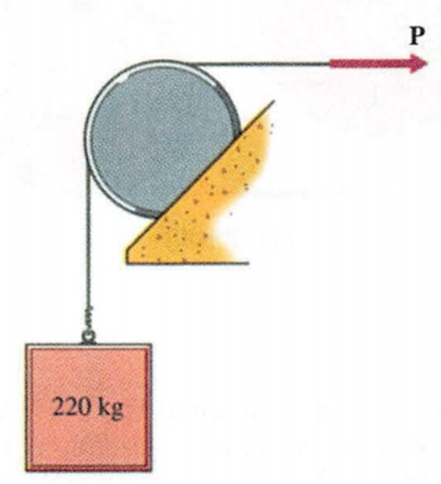
Refer to the assembly below. If the weight of the block is 500kg and the coefficient of friction between the rope and the drum is 0.3,

q29

Which of the following most nearly gives the minimum force P (in Newtons) that must be applied to raise the block?

  1. 7860
  2. 7340
  3. 7420
  4. 7660

Which of the following most nearly gives the minimum force P (in Newtons) that must be applied to prevent the drum from falling?

  1. 3060
  2. 3480
  3. 2890
  4. 3220

Solution pending in psadquestions/q29.json.