In the study of statics of rigid bodies, understanding the nature of friction
is essential when analyzing surfaces in contact. Friction is the resistive force that opposes relative motion,
and it occurs in several forms:
Dry friction (Coulomb friction) → between solid surfaces without lubrication
Fluid friction → occurs when objects move through fluids (liquids or gases)
Internal friction → resistance within materials to deformation
In this course, we will focus exclusively on dry friction, or Coulomb friction,
as it directly applies to rigid body problems involving surfaces in contact—such as blocks on inclined planes,
wedges, screws, and belt systems.
Dry friction has several key characteristics: it acts tangentially to the contact surface,
opposes the direction of impending or actual motion, and is independent of the contact area.
The maximum force of static friction is proportional to the normal force and is given by:
$$ f_s \leq \mu_s N $$
where $ \mu_s $ is the coefficient of static friction. Once motion begins, kinetic friction
takes over and is slightly less than the maximum static friction:
$$ f_k = \mu_k N $$
Understanding these principles is crucial for solving equilibrium problems where friction plays a limiting or stabilizing role.
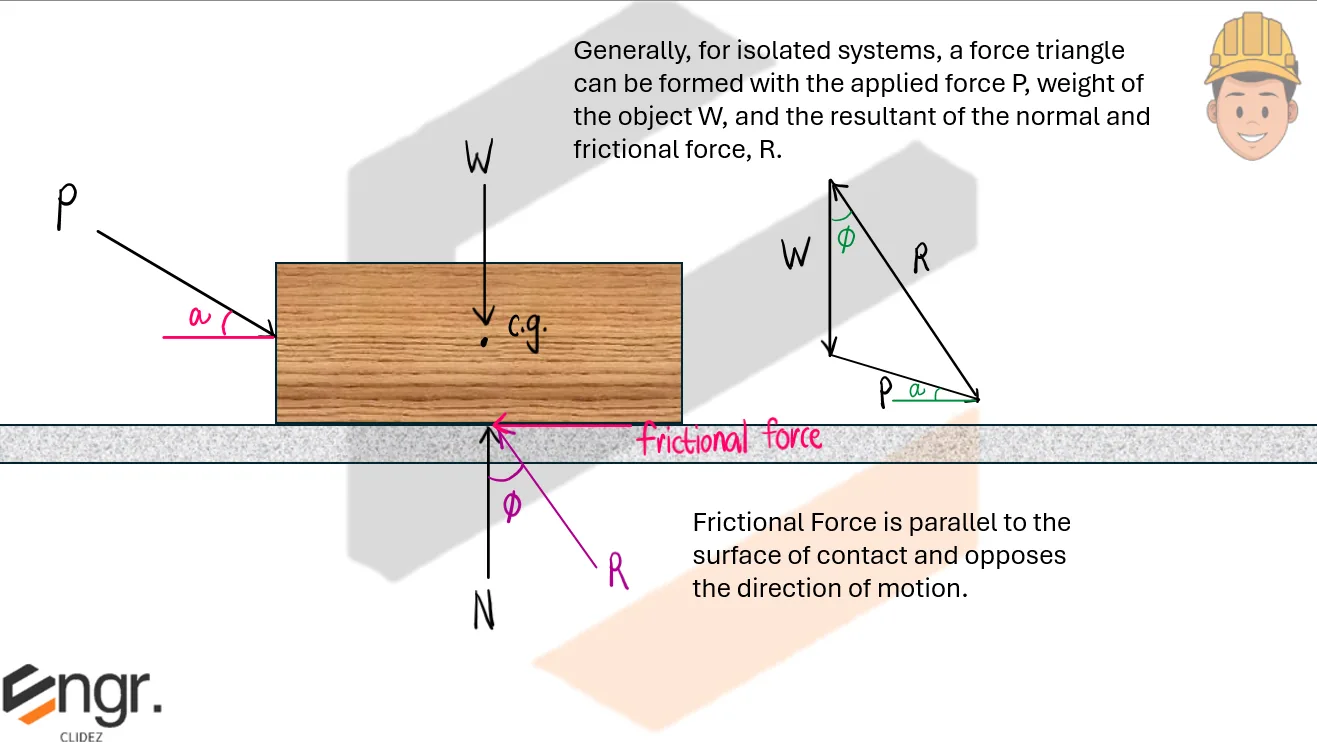
For isolated systems in static friction, a force triangle can be constructed using:
The applied force $ P $,
The weight of the object $ W $,
And the resultant force $ R $, which is the vector sum of the normal force $ N $ and the frictional force $ f$
When the applied force $ \alpha = 0^\circ $, meaning the force $ P $ is purely horizontal, the triangle formed by $ W $, $ P $, and $ R $ becomes a right triangle. This triangle illustrates the angle of friction $ \phi $, which is the angle between the normal force $ N $ and the resultant force $ R $.
Frictional Force is always parallel to the surface of contact and opposes the direction of motion. The applied force $ P $ may act at an angle $ \alpha $, and depending on its direction, the system may be in equilibrium, pending motion, or moving.
The vector diagram (force triangle) helps visualize how the forces relate and how the angle of friction $ \phi $ plays a role in determining the system's stability or motion.
Problem:
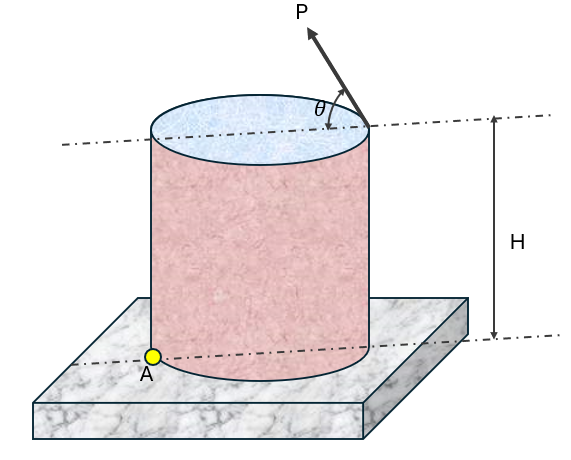
The cylindrical tank shown has a diameter D=1.4m and height H=3m. The tank weighs 2200N and ∅=60º. Unit weight of water, γw=9.81kN/m3
a. If the tank is full of water, compute the value of P so that the tank is on the verge of tipping over about point A.
b. If the tank is full of water, compute the smallest coefficient of static friction that would allow tipping-over about point A.
c. If P=8.50kN, calculate the depth of water in the tank if the tank is on the verge of tipping over about point A.
See images:
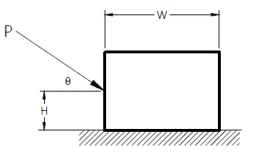
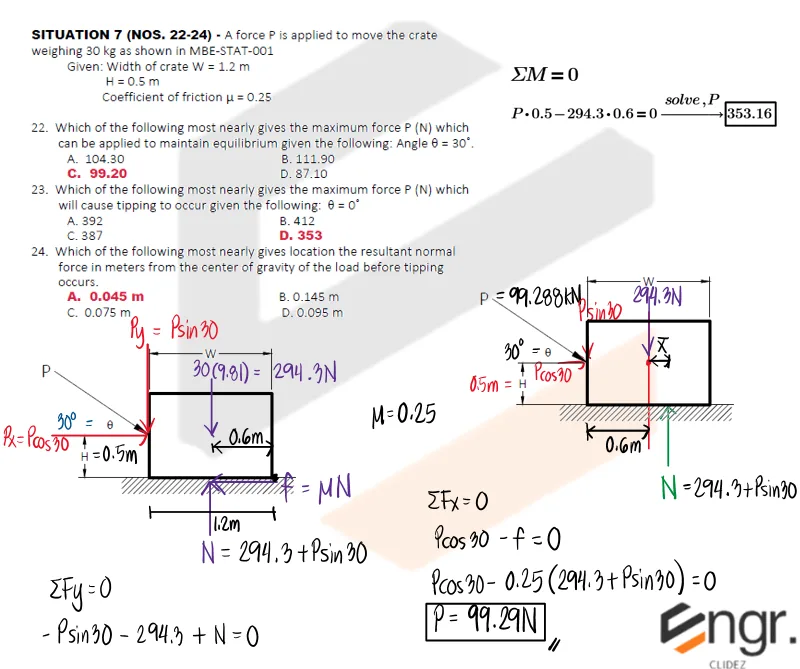
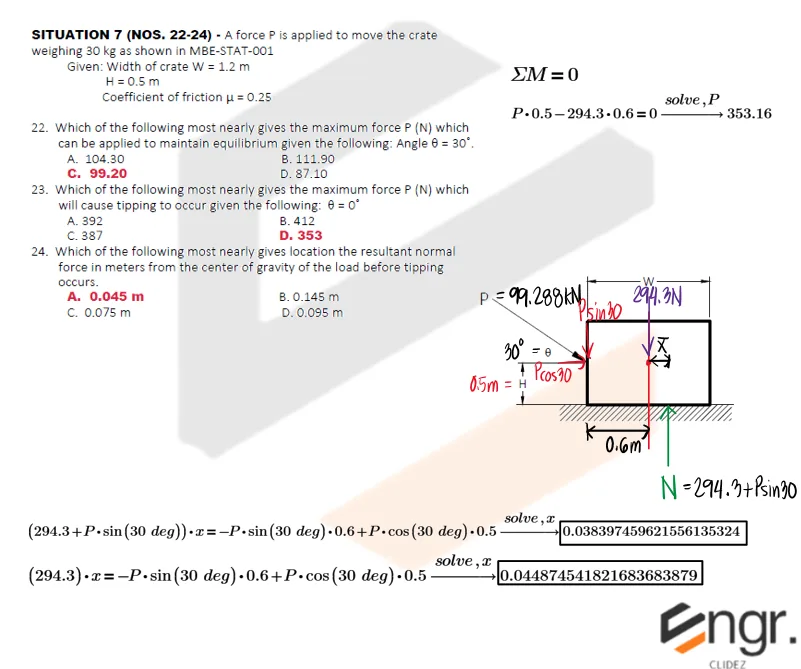
Problem: Crate Pulling and Tipping with Friction
A force P is applied to move a crate weighing 30 kg, as shown below. The crate has width W = 1.2 m, height H = 0.5 m, and coefficient of friction μ = 0.25.
a. Which of the following most nearly gives the maximum force P in newtons that can be applied to maintain equilibrium in the figure shown, given the following: angle θ = 30°?
A. 104.30
B. 111.90
C. 99.20
D. 87.10
b. Which of the following most nearly gives the maximum force P in newtons which will cause tipping to occur in the following: θ = 0°?
A. 392
B. 412
C. 387
D. 353
c. Which of the following most nearly gives the location of the resultant normal force in meters from the center of gravity of the load before tipping occurs?
A. 0.045 m
B. 0.145 m
C. 0.075 m
D. 0.095 m
See images:
-->
Problem (Horizontal block friction):
A 500N block rests on a horizontal rough surface. If the coefficient of static friction is 0.35, determine the minimum horizontal force required to start motion.
At impending motion, friction reaches its limiting value.
A 2kN rectangular crate is 1.0m wide and 1.5m high. A horizontal force P is applied at the top. If μs = 0.50, determine whether sliding or tipping occurs first.
Compare the force required for sliding with the force required to tip about the bottom edge.
\[
\begin{aligned}
P_{slide}&=\mu_s W=0.50(2)=1.00\ \text{kN} \\
P_{tip}(1.5)&=2(0.5) \\
P_{tip}&=0.667\ \text{kN}
\end{aligned}
\]
$\boxed{\text{Tipping occurs first because }0.667\ \text{kN}<1.00\ \text{kN}}$
🧭 Jump to:
Scroll to zoom
Exam Generator Problems
Additional board-style practice items for this topic.
Question Bank: q589
PSAD - Statics / Dry Friction / Mastermatician
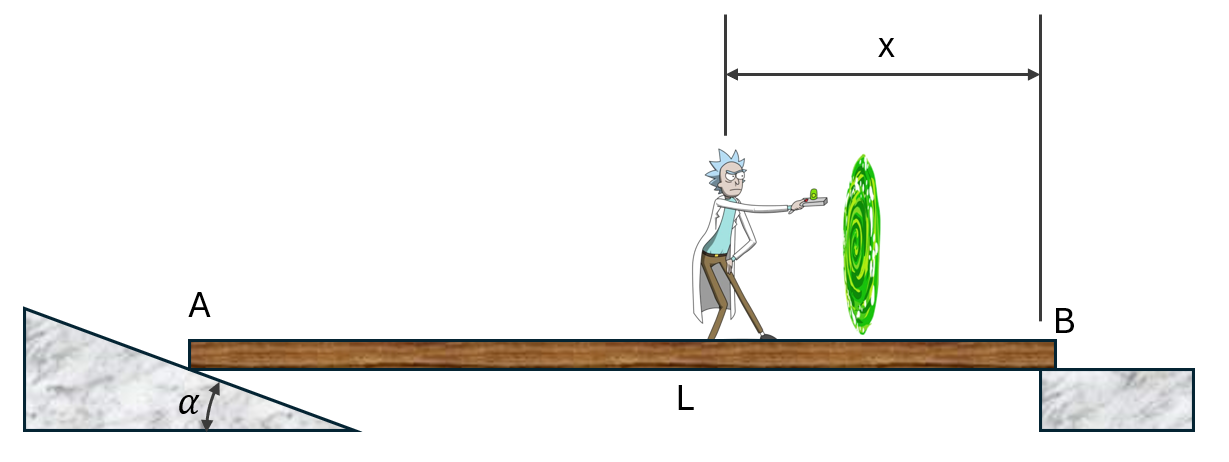
Rick has a mass of 120kg and walks on a plank resting on rough surfaces A and B.
L=4m
α=30º
Coefficient of friction at A, μA=0.4
Coeffcient of friction at B, μB=0.2
At what distance x should Rick shoot his portal gun so he does not fall as the plank starts to slide?
2.33m
1.69m
1.62m
2.29m
What is the friciton force at A, in N?
256.7
135.6
98.6
186.7
Determine the vertical force at B in N.
493
684
235
348
At impending slip, $F_A=\mu_AN_A$ and $F_B=\mu_BN_B$. The 120-kg person weighs $W=120(9.81)=1177.2$ N. Resolve the limiting reaction at the $30^\circ$ inclined contact $A$ and use force equilibrium. This gives: $$F_A=256.7\text{ N},\qquad N_B=493\text{ N}$$ Taking moments about $A$ with the person at distance $4-x$ from $A$: $$N_B(4)=W(4-x)$$ $$493(4)=1177.2(4-x)\quad\Rightarrow\quad x=2.33\text{ m}$$
Therefore, Rick must be 2.33 m from $B$; the friction at $A$ is 256.7 N and the vertical force at $B$ is 493 N.
Question Bank: q590
PSAD - Statics / Dry Friction / Mastermatician
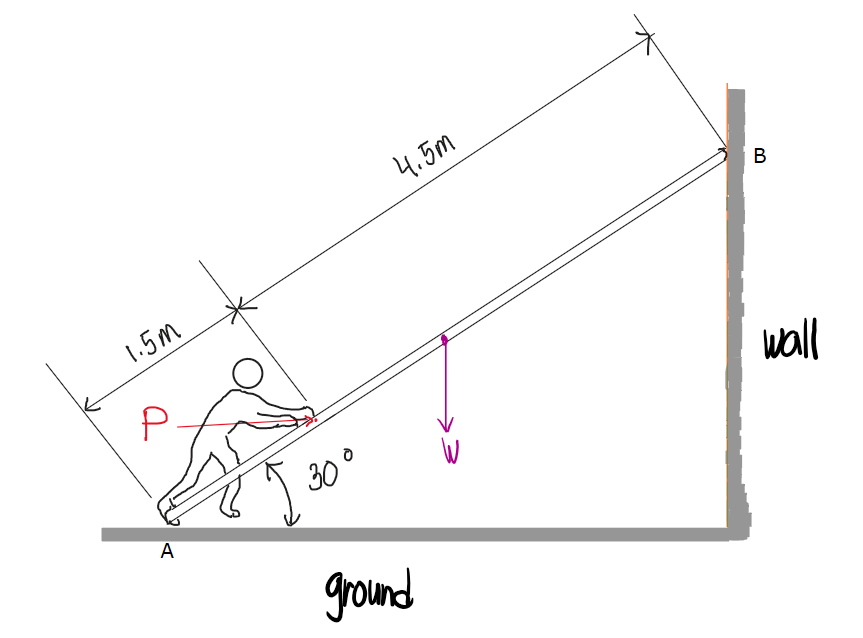
To prevent the ladder from sliding down, a person exerts a horizontal force P.
Determine the horizontal force P that the person should exert if the weight of the ladder is 500N. Assume that all surfaces are frictionless.
577N
500N
250N
1000N
If the weight of the ladder is 500 N, what is the reaction at A? Assume that all surfaces are frictionless.
500N
250N
1000N
577N
Find the maximum weight of the ladder that can be held from sliding if the person exerts a force of 200N. The coefficient of friction between the ground and the ladder is 0.30 and the coefficient of friction between the wall and the ladder is 0.20.
421N
359N
308N
366N
Part 1.
For frictionless contacts, the floor reaction at A is vertical and the wall reaction at B is horizontal. The 6-m ladder is at 30°, so $y_B=6\sin30^\circ=3$ m, $x_W=3\cos30^\circ=2.598$ m, and the person applies $P$ at $y_P=1.5\sin30^\circ=0.75$ m. Since $\Sigma F_x=0$, $R_B=P$. Taking moments about A: $R_B(3)-P(0.75)-500(2.598)=0$ $P(3-0.75)=1299$ $\boxed{P=577\text{ N}}$
Part 2.
For frictionless contacts, the only vertical external forces are the floor reaction at A and the ladder weight. $\Sigma F_y=0:\ R_A-W=0$ $R_A=500\text{ N}$ $\boxed{R_A=500\text{ N}}$
Part 3.
At impending sliding, use $\mu_A=0.30$ at the floor and $\mu_B=0.20$ at the wall. Let $N_A$ be the floor normal and $N_B$ the wall normal. With $P=200$ N: $\Sigma F_x=0:\ N_B=P+0.30N_A$ $\Sigma F_y=0:\ W=N_A+0.20N_B$ Moments about A: $N_B(3)+0.20N_B(6\cos30^\circ)-200(0.75)-W(3\cos30^\circ)=0$ Solving these equations gives: $\boxed{W\approx421\text{ N}}$
Question Bank: q591
PSAD - Statics / Dry Friction / Mastermatician
For the figure shown, the weight of the cylindrical tank is negligible in comparison to the weight of water it contains. γwater=9.81kN/m3. The coefficient of static friction between the tank and the horizontal surface is μs. The height of the tank is 3.2m and its diameter is 1.5m. The inclination of the force P is α=60º
Assuming a full tank, find the smallest force P required to tip
the tank.
14.35kN
6.50 kN
17.70 kN
13.82 kN
Find the smallest coefficient of static friction μs that would allow tipping to take place.
0.17
0.15
0.13
0.11
If the force P = 6.5 kN initiates tipping, determine the depth of
water in the tank.
1.45 m
1.09 m
1.54 m
0.95 m
Part 1.
For a full tank, the water weight is: $W=\gamma V=9.81\left[\pi(0.75)^2(3.2)\right]=55.47\text{ kN}$ At impending tipping about point A, take moments about A. The moment arm of the water weight is the radius, 0.75 m. The force $P$ is applied at the top edge, with components $P\cos60^\circ$ and $P\sin60^\circ$: $W(0.75)=P\cos60^\circ(3.2)+P\sin60^\circ(1.5)$ $\boxed{P=14.35\text{ kN}}$
Part 2.
At tipping, the required friction is the horizontal component of $P$ and the normal reaction is reduced by the upward component of $P$: $F=P\cos60^\circ=14.35(0.5)=7.175\text{ kN}$ $N=W-P\sin60^\circ=55.47-14.35(0.866)=43.04\text{ kN}$ $\mu_s=\frac{F}{N}=\frac{7.175}{43.04}$ $\boxed{\mu_s=0.17}$
Part 3.
Let $h$ be the water depth. Then $W=9.81\pi(0.75)^2h=17.34h$ kN. The force is still applied at the top edge of the 3.2-m tank. Taking moments about A for tipping: $(17.34h)(0.75)=6.5\cos60^\circ(3.2)+6.5\sin60^\circ(1.5)$ $13.005h=18.84$ $\boxed{h=1.45\text{ m}}$