CE Board Exam Randomizer

⬅ Back to Subject Topics

Plastic Analysis (Collapse Mechanism)

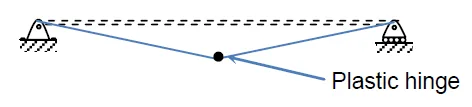
When all elements of the beam's cross-section have yielded, any further increase in load will cause collapse. At this stage, the beam has reached the yield plateau of the stress→strain curve, and unrestricted plastic flow will occur. A plastic hinge forms, and together with the actual hinges at the beam ends, they constitute an unstable mechanism.
Concept

Structural analysis based on collapse mechanism is called plastic analysis. This method applies the principle of virtual work, where an assumed mechanism is subjected to virtual displacements consistent with the mechanism's motion, and the external work is equated to the internal work.

Before solving plastic analysis problems, recall some principles of the virtual work method:

External Work:

  1. Work done by a force $P$ that varies linearly with displacement $y$ from zero to its final value:
    $$ W = \tfrac{1}{2} P y \quad (1) $$
  2. Work done by a constant force $P$ while its point of application undergoes displacement $y$:
    $$ W = P y \quad (2) $$

Internal Work:

$$ W_{\text{internal}} = \sum (M_p \cdot \text{rotation}) \quad \text{at plastic hinges} $$

Virtual work equation at collapse:

$$ \sum P_i \Delta_i = \sum M_p \theta_j $$

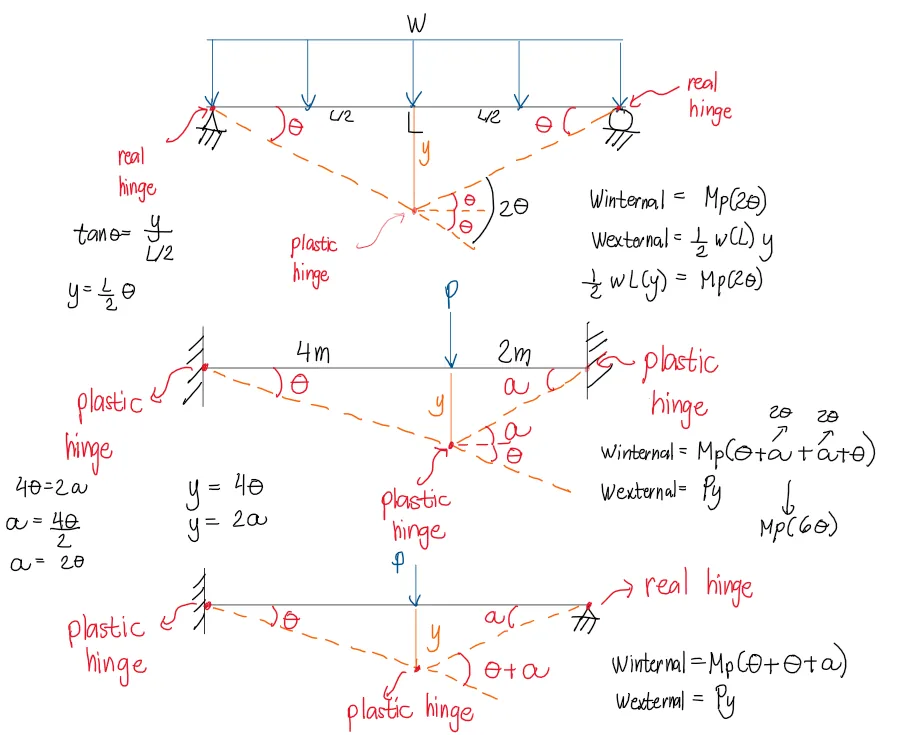
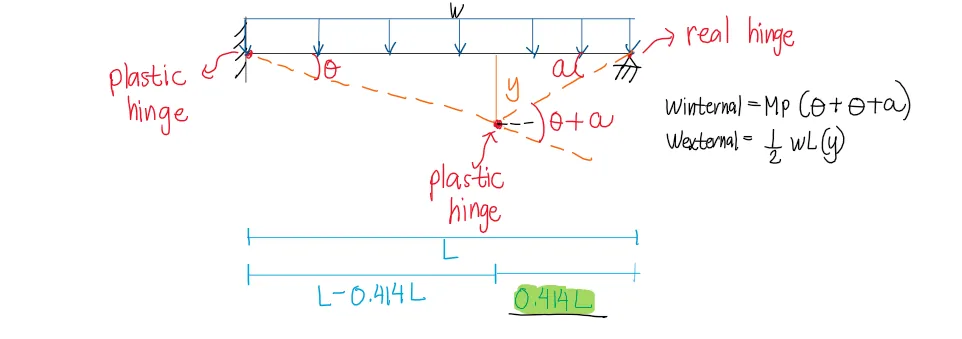
Real hinges and plastic hinges in virtual work:

Why the lesser collapse load is chosen:

For the same structure, several possible collapse mechanisms may be drawn. Each mechanism gives a trial collapse load from the virtual-work equation. The governing load is the least of these values because the structure will collapse as soon as any valid mechanism can form. A larger computed load belongs to a mechanism that would require the structure to remain stable past an earlier collapse mechanism, so it is not the controlling collapse load.

Plastic moment reminders:

$$ M_p=F_yZ, \qquad M_y=F_yS $$ $$ \text{Shape factor}=\frac{M_p}{M_y}=\frac{Z}{S} $$

Major Cases in Plastic Analysis

Concept Concept

Recall:
When all the elements of the cross-section of the beam has yielded, any further increase in the load will cause collapse, since all elements of the cross-section reached the yield plateau of the stress-strain curve and unrestricted plastic flow will occur.
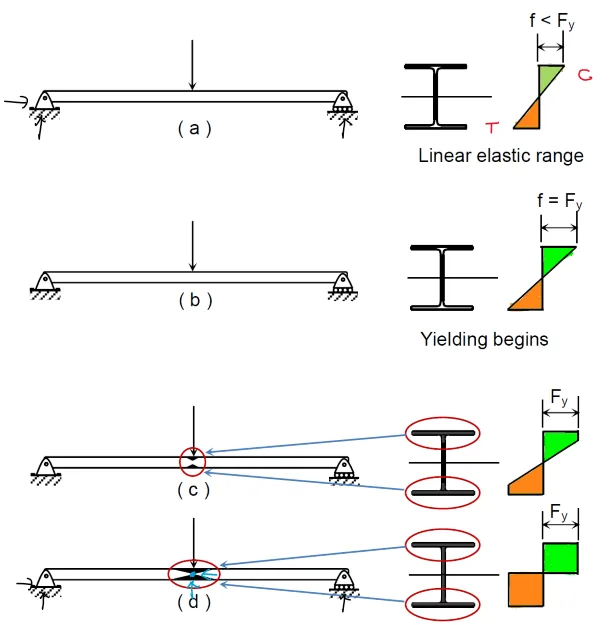
Concept Concept Concept Concept Concept Concept

Problem:

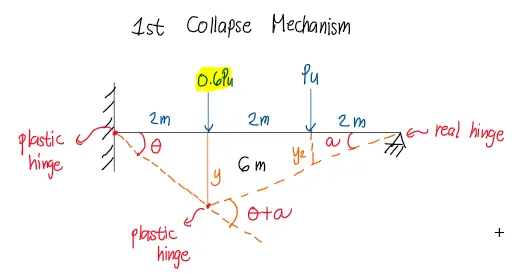
A propped beam having a span of 6m carries two concentrated loads of 0.6Pu and Pu at its middle thirds. The beam has a plastic section modulus of 1852x103mm3. Fy=248MPa. Determine the value of Pu so that the beam is about to collapse.
A. 324kN
B. 353kN
C. 422kN
D. 521kN

Plastic Analysis | Principles of Steel Design – Problem 1: – Diagram Plastic Analysis | Principles of Steel Design – Problem 1: – Diagram Plastic Analysis | Principles of Steel Design – Problem 1: – Diagram
Plastic Analysis | Principles of Steel Design – Problem 1: – Diagram $$ \frac{y}{4} = \frac{y_2}{2} $$ $$ y_2 = \frac{2}{4}y $$ $$ y_2 = 0.5y $$ $$ 2\theta = 4\alpha $$ $$ \alpha = \frac{2}{4}\theta $$ $$ \alpha = 0.5\theta $$ $$ \tan\theta = \frac{y}{2} $$ $$ 2\theta = y $$ $W_{ext} = W_{int}$
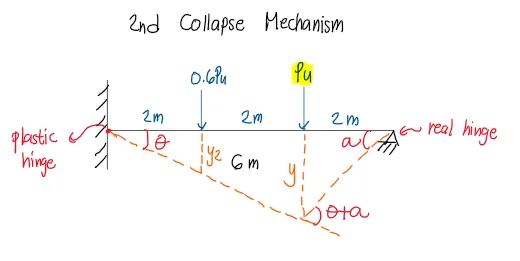
$ 0.6P_u(y) + P_u(0.5y) = M_p(\theta + \theta + \theta_a) $
$ 0.6P_u(2\theta) + P_u(0.5(2\theta)) = M_p(\theta + \theta + 0.5\theta) $
$ 1.2P_u\theta + P_u\theta = M_p(2.5\theta) $
$ M_p = F_y Z_x = 248(1852 \times 10^3) $
$ 2.2P_u = 248(1852 \times 10^3)(2.5) $
$ P_u = 521.9 \;\text{kN} $ Plastic Analysis | Principles of Steel Design – Problem 1: – Diagram $$\frac {y}{4}=\frac {y_2}{2}$$ $$y_2=0.5y$$ $$2\alpha=4\theta$$ $$\alpha=2\theta$$ Therefore, $$y=4\theta$$ $W_{ext} = W_{int}$
$0.6P_u(y_2) + P_u(y) = M_p(2\theta + \alpha)$
$0.6P_u(0.5y) + P_u(y) = 248(1852 \times 10^3)(2\theta + \alpha)$
$0.6P_u(0.5(4\theta)) + P_u(2\theta) = 248(1852 \times 10^3)(2\theta + 2\theta)$
$P_u=353.3kN$ Plastic Analysis | Principles of Steel Design – Problem 1: – Diagram Plastic Analysis | Principles of Steel Design – Problem 1: – Diagram

Why choose the lesser load? The two trial mechanisms are possible collapse patterns for the same beam. The beam will collapse as soon as the first valid mechanism can form, so the smaller computed load controls. The larger value would require the beam to remain stable after the lower-load mechanism has already formed, so it is not governing.

Real hinge versus plastic hinge: A real hinge is an actual support or connection that is already free to rotate and has no moment resistance. It helps define the shape of the mechanism, but it is not counted as internal work. A plastic hinge is a yielded section of the beam where the bending moment has reached Mp; it rotates while still resisting moment, so each plastic hinge contributes internal work equal to Mpθ.

External work and internal work for this problem: The applied loads 0.6Pu and Pu are included in external work because they move through vertical displacements during the mechanism. The plastic hinges formed in the beam are included in internal work because they rotate while resisting Mp. The actual hinge support is not added to internal work because its resisting moment is zero.

$$ P_u = \min(353.3, \; 521.9) = 353.3 \;\text{kN} $$
Scroll to zoom

Exam Generator Problems

Additional board-style practice items for this topic.

Question Bank: q153

PSAD - Steel Design / Plastic Analysis / Engr. Janclyde Espinosa (Clidez)

A 10-meter propped beam is loaded with 2P at 6 meters from the propped end. If the beam is made of a 200-mm circular steel section with Fy = 250MPa, compute the value of P in kN. Use plastic analysis.

Answer:

  1. 104kN-m
  2. 112kN-m
  3. 128kN-m
  4. 94kN-m

Solution pending in psadquestions/q153.json.

Question Bank: q571

PSAD - Steel Design / Plastic Analysis / Engr. Deguma

A propped beam having a span of 6m carries two concentrated loads of 0.6Pu and Pu at its middle thirds. The beam has a plastic section modulus of 1852x103mm3. Fy=248 MPa. Determine the value of Pu so that the beam is about to collapse.

Answer:

  1. 522
  2. 324
  3. 353
  4. 422

Solution pending in psadquestions/q571.json.

Question Bank: q572

PSAD - Steel Design / Plastic Analysis / Engr. Deguma

Compute the design plastic moment (kN-m) for a 6-meter-propped beam (fixed at left) loaded with 90kN and 80 kN applied 4m and 1m from the propped end, respectively.

Answer:

  1. 83
  2. 94
  3. 88
  4. 76

Solution pending in psadquestions/q572.json.

Question Bank: q573

PSAD - Steel Design / Plastic Analysis / Engr. Deguma

An I-beam has the cross-section: 250mmx20mm top and bottom flanges and 15mmx200mm web. The beam is bent about the x-axis. Fy=250MPa

Determine the elastic section modulus in mm3

  1. 1094444.44
  2. 131333333.3
  3. 1490487.67
  4. 1208444.44

Determine the plastic section modulus in mm3

  1. 131333333.3
  2. 1094444.44
  3. 1490487.67
  4. 1208444.44

Determine the shape factor of the section.

  1. 1.142
  2. 2.114
  3. 1.214
  4. 2.421

Solution pending in psadquestions/q573.json.