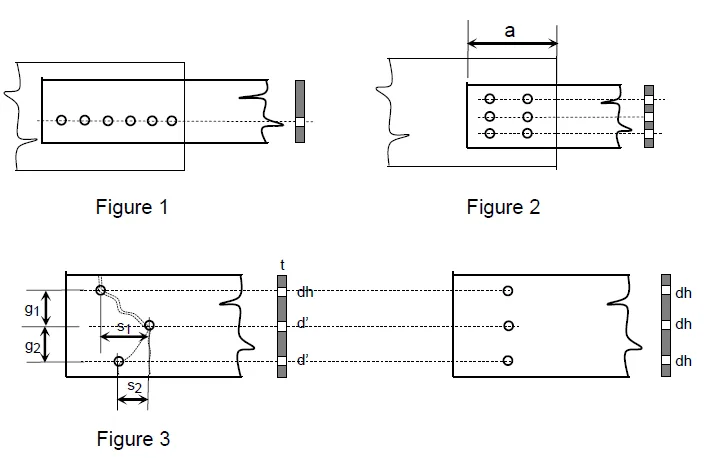
In tension member connections with bolts, the net area is largest when fasteners are placed in a single line. However, space constraints often require multiple rows of bolts. To reduce the loss of cross-sectional area, bolts can be arranged in a staggered pattern, where holes do not line up directly. This arrangement ensures that any potential failure plane passes through fewer bolt holes, helping maintain strength and efficiency compared to non-staggered layouts.
Staggered Connection Figures
Cochrane's Formula for Staggered Connections with Uniform Thickness
Cochrane (1922) proposed that when deducting the area corresponding to a staggered hole,
a reduced diameter d′ should be used, given by:
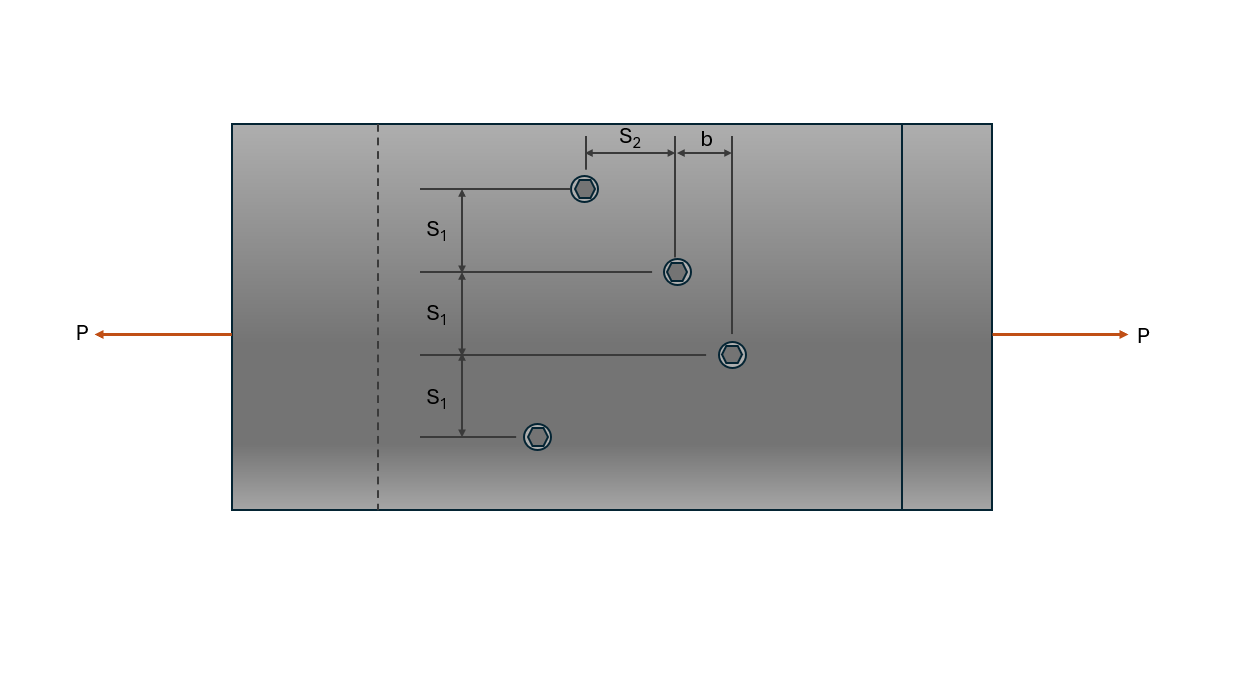
A plate having a width of 400mm and thickness of 12mm is to be connected with another plate by 34-mm⌀ bolts as shown. Given the following: s1=100mm s2=60mm s3=150mm Fy=248MPa Fu=400MPa Bolt hole diameter = 36mm Strength reduction factor: For gross area yielding, ϕ=0.9 For net area rupture, ϕ=0.75
Determine the value of b, in mm, so that the net width along bolts 1-2-3-4 is equal to the net width along bolts 1-2-4.
19.71
18.43
20.52
21.64
Determine the ultimate load P, in kN, based on the rupture of the net area.
1160
1260
1680
1547
Determine the ultimate load P, in kN, that can be safely applied to the plate.
1071.36
1190.4
1428.48
1285.63
For each staggered path, use $b_n=b-\sum d_h+\sum(s^2/4g)$. Set the net width for path 1-2-3-4 equal to that for path 1-2-4.
Part 1. Solving the net-width equality gives $b=\boxed{19.71\text{ mm}}$.
Part 2. The controlling net area gives $\phi P_n=0.75F_uA_n=\boxed{1160\text{ kN}}$ for rupture.
Part 3. Gross yielding gives $\phi P_n=0.9F_yA_g=0.9(248)(400)(12)/1000=\boxed{1071.36\text{ kN}}$. This is lower than the rupture strength and therefore governs.

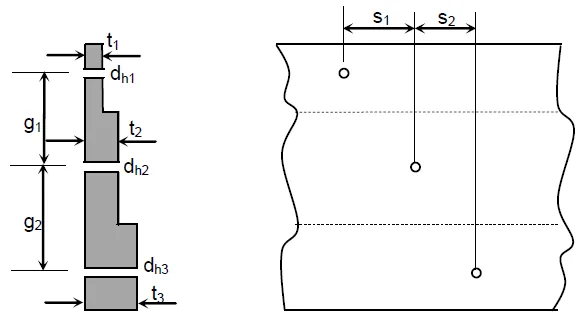 The equation of the net area becomes: