Welded connections are widely used in steel structures to transfer loads between members.
They provide rigidity, continuity, and strength by joining structural components through welds.
The strength of a welded connection depends on the electrode type, the configuration of the welds,
and the stresses produced by direct loads and moments. The polar moment of inertia of the weld group
is an important parameter in determining the distribution of stresses within the welds.
Where:
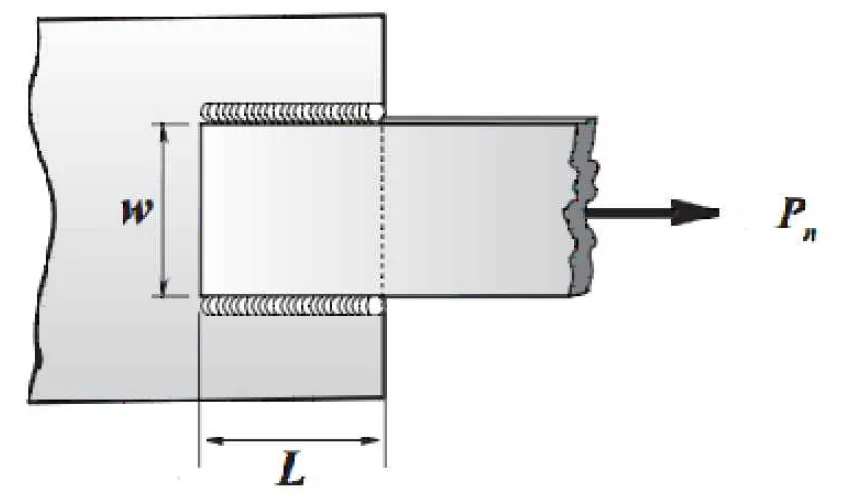
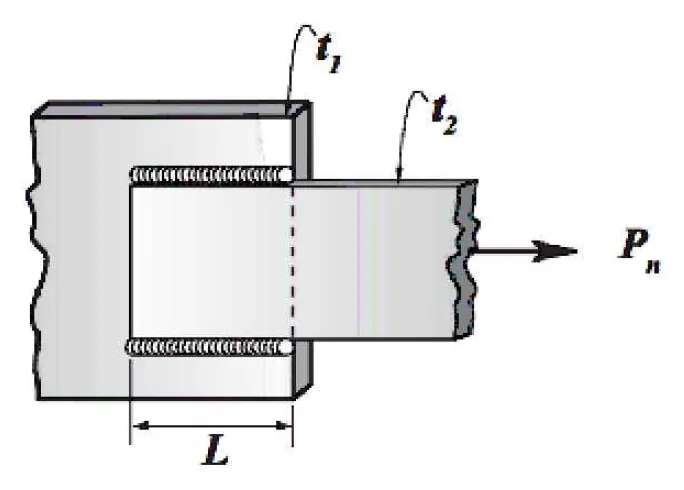
Pnwl = total nominal strength of the longitudinal fillet welds
Pnwt = total nominal strength of the transversely loaded fillet welds
Pnwl = Fnw (Awe)
Note: Use the larger value between Pn1 and Pn2 as the design Pn.
Problem: Welded Bracket Under Inclined Eccentric Load
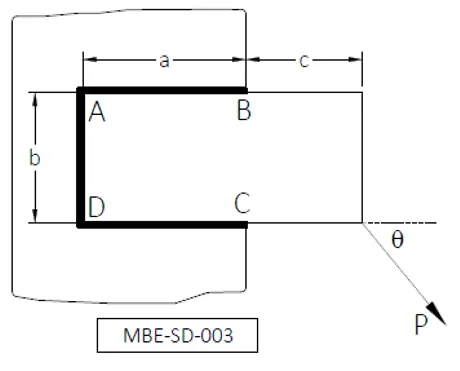
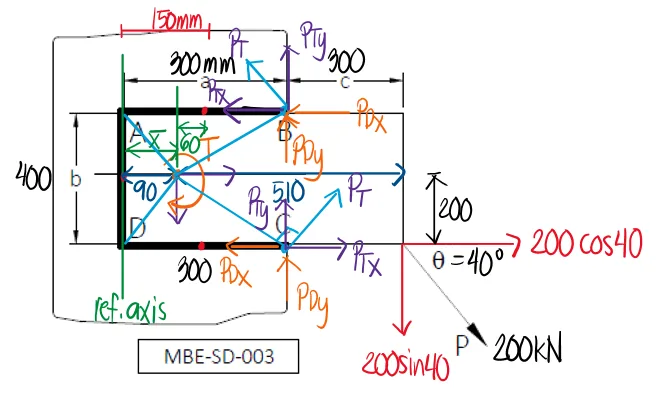
Given the following data for the welded bracket shown below: a = 300 mm, b = 400 mm, c = 300 mm, and allowable shear stress of weld metal is 145 MPa. If P = 200 kN and θ = 40°, answer the following:
What is the unit polar moment of inertia of the weld group in mm3?
49.30 × 10⁶
24.90 × 10⁶
39.20 × 10⁶
56.60 × 10⁶
Which of the following most nearly gives the reaction at C in N/mm?
336.40
316.50
487.60
457.50
Which of the following most nearly gives the reaction at B in N/mm?
336.40
316.50
487.60
457.50
Find the centroid of the weld group from the left vertical weld.
For the torsional weld reactions, check the extreme weld points because they are farthest from the weld-group centroid and therefore usually develop the largest torsional components. The torsional force at a point on the weld group acts perpendicular to the radial line drawn from the centroid to that point, with direction chosen to resist the rotation caused by the eccentric load. For a point with vertical offset y and horizontal offset x from the centroid, PTx is associated with the y-distance, while PTy is associated with the x-distance.
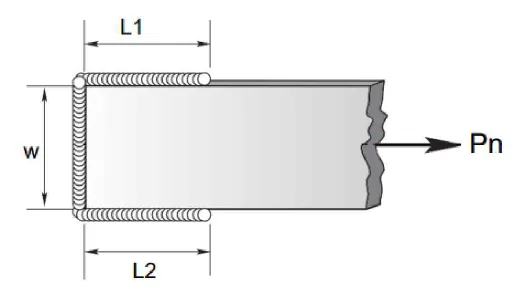
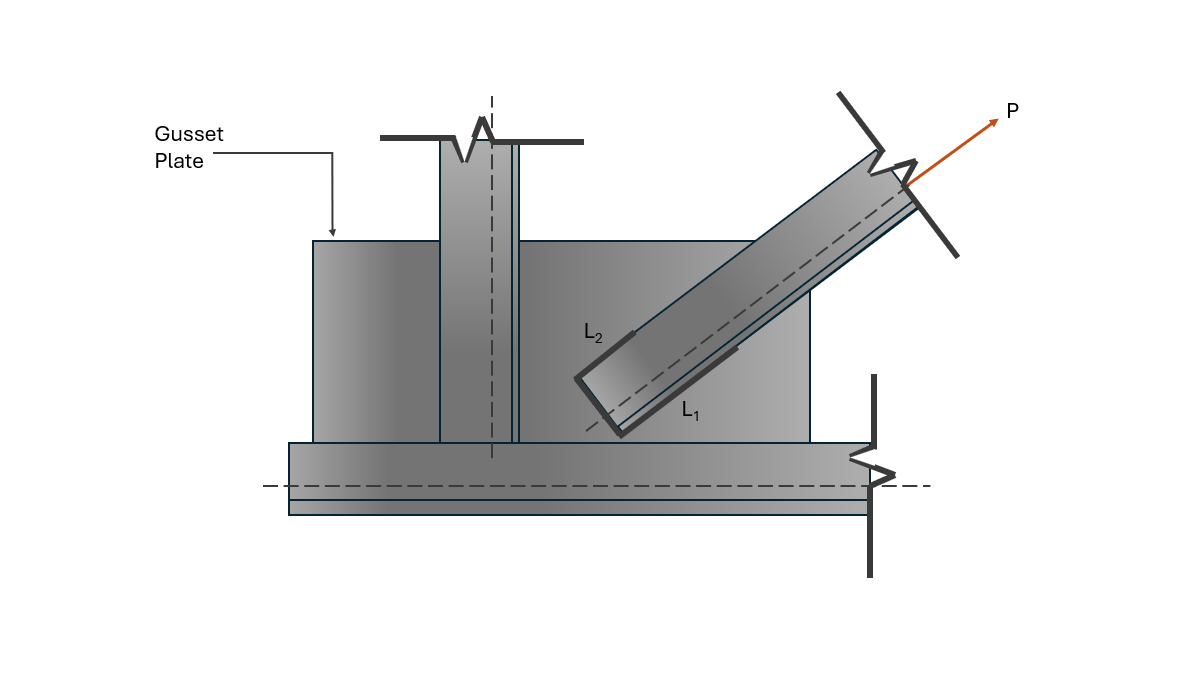
The diagonal member, a single angle 76mmx76mmx6mm with an area of 929mm2 is welded to an 8-mm thick gusset plate. The weld electrode used is E60. Assume load P is acting on the centroid of the weld group. Given weld lengths: L1=125mm L2=65mm Steel strength and stress are as follows: Fy=248MPa Fu=400MPa Gross area yielding, Ft=0.6Fy Net area rupture, Ft=0.5Fu On effective area of weld in shear, Fv=0.3Fuw
Based on the effective net area of the diagonal, calculate the allowable tensile load in kN. Use strength reduction coefficient of 85%.
157.93
185.8
138.24
162.64
Based on the strength of the fillet welds, calculate the allowable tensile load in kN. Take the weld thickness as 5mm.
116.79
185.8
304
296.83
Given the following properties of L76x76x6: DIstance from the outermost part of the angle leg to the centroid of the angle bar, x=22mm Shear lag factor, U=1-x/ℓ
0.768
0.884
0.93
0.86
Part 1.
The effective-net-area factor is $U=0.85$, so
$P=0.5F_uUA_g=0.5(400)(0.85)(929)/1000=\boxed{157.93\text{ kN}}$.
Part 2.
For the fillet welds, use effective throat $0.707w$ and sum the effective weld lengths. Applying the allowable weld shear stress to $A_w=0.707(5)\sum L$ gives $P=\boxed{116.79\text{ kN}}$.
Part 3.
The shear-lag factor is $U=1-\bar x/\ell=1-22/95=\boxed{0.768}$.
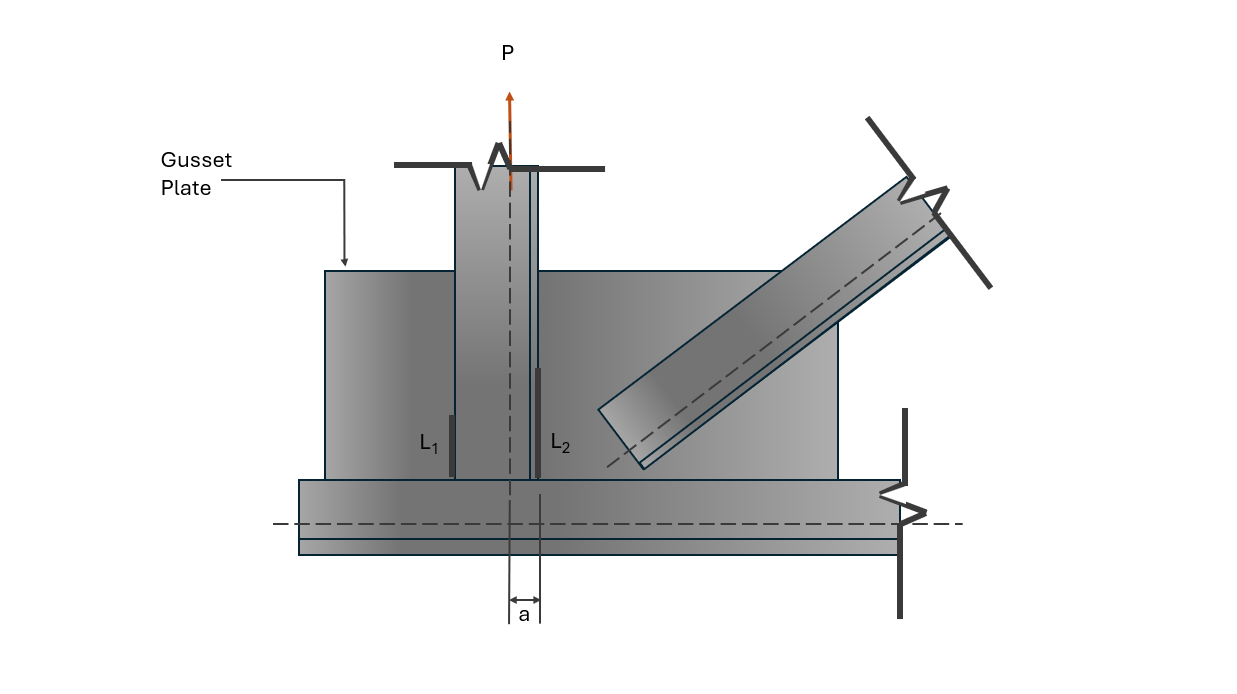
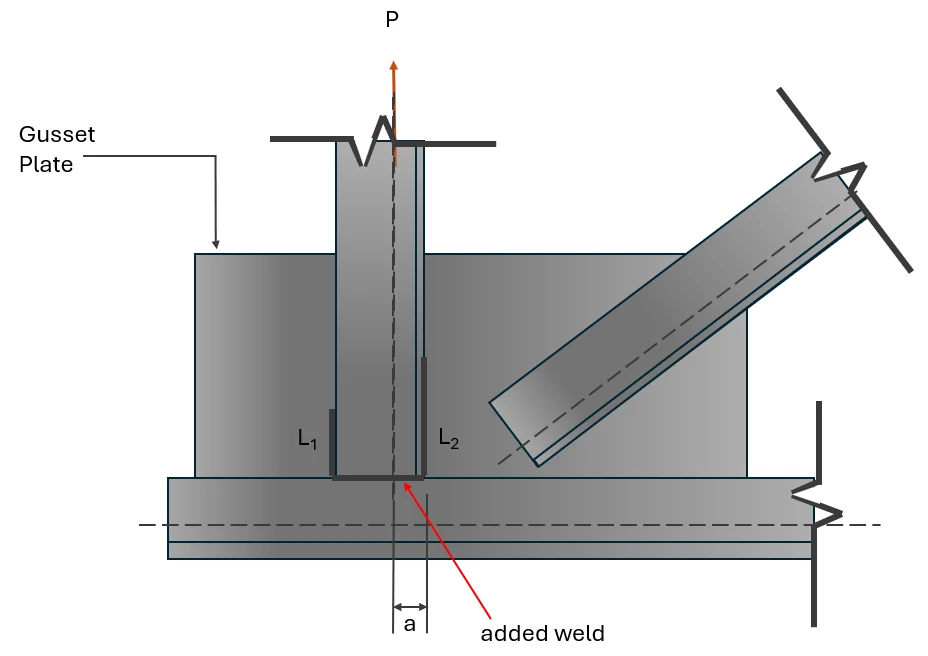
The vertical member consisting of two unequal leg angle with long legs back-to-back are welded to the 8-mm thick gusset plate. Given the following: a=25mm Weld thickness=5mm Angle size=75mmx50mmx6mm thick Steel yield stress, Fy=248MPa Area of two angles=1535mm2 Allowable weld shear stress, Fv=124MPa
What is the tensile capacity, P (kN), of the vertical member?
228.411
218.423
240.624
238.142
Due to a force P=60.5kN, what is the length of weld L2 so that each fillet weld is equally stressed in shear? Neglect end returns.
46
52
50
48
Part 1.
The gross yielding capacity of the two angles is
$P=0.6F_yA_g=0.6(248)(1535)/1000=\boxed{228.411\text{ kN}}$.
Part 2.
For equally stressed fillet welds, locate the centroid of the weld group so its line of action coincides with P. Use the throat area $0.707(5)L$ for each weld and equate the weld-group moments about its centroid. The required second weld length is $\boxed{46\text{ mm}}$.
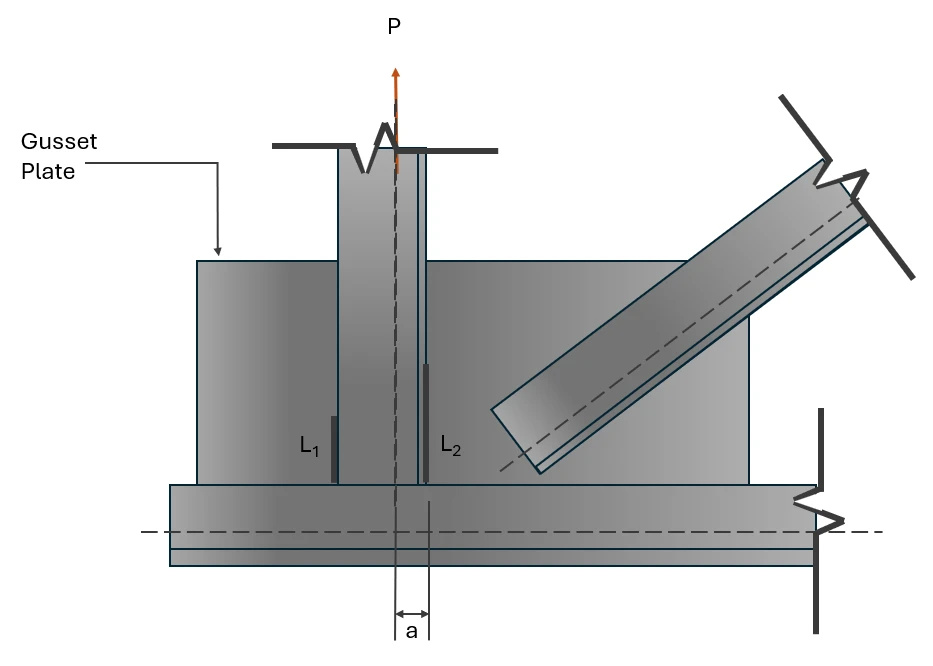
The line of action of the force P coincides with the axis of the angle, which is at a distance a = 33 mm from the back of the connected leg.
Properties of L120 mm × 120 mm × 10 mm
Area, A = 2320 mm2
Yield strength, Fy = 250 MPa
Allowable tension on the gross area of the angle = 150 MPa
Allowable weld shear stress, Fvw = 145 MPa
Weld thickness, tw = 8 mm
Determine the maximum tensile capacity (kN) of the angle.
290
336
348
580
If P=260kN, determine the minimum length, L2 in mm.
159
230
317
87
If P = 260kN, determine the minimum length L2 in mm when a weld size of 6mm is added at the end of the angle.
230
185
140
170
Maximum tensile capacity of the angle
The allowable tensile capacity based on the gross area is
Minimum length of weld L2 when a 6 mm end weld is added
The allowable strength per unit length of the 8 mm fillet weld is
$$q_8=F_{vw}(0.707t_w)$$
$$q_8=145(0.707)(8)$$
$$q_8=820.12\text{ N/mm}$$
The allowable strength per unit length of the 6 mm end weld is
$$q_6=F_{vw}(0.707t_w)$$
$$q_6=145(0.707)(6)$$
$$q_6=615.09\text{ N/mm}$$
The 6 mm transverse weld extends across the 120 mm width of the angle. Its total resisting force is
$$R_6=q_6(120)$$
Since the weld resistance is uniformly distributed along its length, its resultant acts at the centroid of the weld.
$$\bar{x}=\frac{120}{2}=60\text{ mm}$$
Taking moments about weld line L1,